On this Easter Sunday, I filled up our modern sedan at one of the local Sunocos. Across from me: an Alfa Romeo GTV-6. So, here you go.
“… an extremely exciting machine”
For 1985, Alfa Romeo’s GTV-6 stood mostly pat. The shift linkage was modified to address some complaints of stiffness and some standard equipment was removed to reach a more approachable price.
The engine continued to be the star: a 154 bhp 2.5 liter/152 ci V6 with aluminum block and heads and Bosch L-Jetronic fuel injection paired with a five-speed manual. Performance was respectable—Road & Track recorded an 8.5 second 0-60 time in the 2,955-pound car. Fuel mileage was 19 city/26 highway by the standards of the day—17/24 by today’s standards.
Standard equipment in the $16,500 car (about $39,000 in today’s dollars or almost exactly what a 2018 Alfa Romeo Giulia goes for) included an independent front suspension, a deDion rear suspension, four-wheel disc brakes, and 195/60HR15 tires (a size still easily available) on 15-inch wheels. Inside, there was an adjustable steering column and cloth seats. Power windows were standard, but with a back-up mechanical crank.
Optional equipment included rear spoiler ($395), sunroof ($500), leather seats ($750), and an AM/FM stereo with a cassette player ($395). A very uncommon option was the Callaway Twin Turbo package ($2,095), which include a 230 bhp engine, along with upgraded BBS 16 x 7 wheels and Goodyear Eagle 205/55VR-16 tires.
Potential collectors of a GTV-6 are warned that they are highly susceptible to rust—even in states where that isn’t usually a problem. These cars have a following, and make appearances in the Hemming’s Motor News classifieds and eBay. Values are sliding up: according to Hagerty’s valuation tools, all the money for a 1985 GTV-6 in #1/Concours condition is $24,700, with a far more typical #3/Good car going for $12,900.
For many years, I made a retro CD for the holidays that goes to friends and family. Whatever expertise in popular music that I have is from the eighties, so that I would go forward one year in that decade—that means that in 2017, I was doing 1988. There’s a story behind every year’s CD, and this one involved a 1985 Trans Am. So, I decided to draw a 1985 Trans Am dashboard and thus this blog post.
1985 Pontiac Firebird Trans Am dashboard
“The most serious piece of machinery we put on the road.”
Updates for the 1985 Pontiac Firebird Trans Am included a restyled nose with integrated fog lamps, new taillights, fake hood louvers replacing the traditional power bulge, and full rocker and quarter panel extensions. A new WS6 suspension package was made available for the Trans Am, which included gas-pressurized shocks, four-wheel disc brakes, and 16-inch wheels with P245/50VR16 Goodyear “Gatorback” tires for a $664 price tag. Inside, all gages now had graph-patterned backgrounds, and a new UT4 “Touch-Control” optional stereo was available.
For 1985, the standard Trans Am powertrain was the LG4 165 bhp 5.0 liter/305 ci V8 with a four-barrel carburetor paired with a five-speed manual transmission. The top-of-the-line engine was the $695 LB9 fuel-injected 5.0 liter/305 ci V8, with 205 bhp—but that was only available with a $425 four-speed automatic transmission, yielding a zero to sixty time of about 7.5 seconds. If you wanted the five-speed manual transmission, the best engine choice available on the Trans Am was the 190 bhp L69H.O. 5.0 liter/305 ci V8 with a four-barrel carburetor.
Mileage with the standard powertrain was 15 city/24 highway by the day’s standards (14/22 by 2025 measures). With a 15.9-gallon gas tank, a Trans Am owner could expect a range of between 255 and 280 miles with a 10% fuel reserve.
Trans Am pages from the 1985 Pontiac brochure
Standard exterior and mechanical equipment on the $11,569 Trans Am (about $35,700 in today’s dollars) included power brakes (front disc/rear drum), hidden electronically-controlled halogen headlamps, dual sport mirrors, an all-glass rear hatch, a rear deck lid spoiler, and P215/65R15 steel-belted radial tires (still a readily available size) on “deep-dish” 15 x 7 wheels. Inside, reclining front bucket seats, a Formula steering wheel, full gages, and side window defoggers were included.
Options & Production Numbers
Options included T-tops ($875), a louvered rear sunshield ($210), four wheel disc brakes ($179), electric rear window defogger ($145), air conditioning ($750), Luxury Trim Group ($359), tilt steering wheel ($115), cruise control ($175), and a series of five stereos. In something you rarely see in the current day, Pontiac offered two completely different optional front seats—Lear Siegler Custom adjustable bucket seats and Recaro bucket seats (which were not available with the six-way power driver’s seat).
The 1985 Trans Am sold reasonably well, with 44,028 sold—about 46% of total Firebird sales. In Pontiac showrooms, only the Sunbird and the 6000 outsold the Firebird in the 1985 model year.
The View From 2025
Third-generation Firebirds have a strong following, and 1985 Trans Ams make regular appearances in the Hemmings Motor News classifieds, on eBay Motors, and at online auctions such as Bring a Trailer that cater to the eighties car market. According to Hagerty’s valuation tools, a loaded 1985 Trans Am with the LB9 in #1/Concours condition is $47,400, while a far more typical #3/Good car goes for $14,900. As I update this post in November 2025, there’s a Canary Yellow 1985 Trans Am with the LB9 engine, an automatic, and 12,000 miles for sale on Hemmings, asking $23,500.
For unclear reasons, one, but only one, of the supermarkets in my area often has interesting eighties cars parked outside. In mid-December 2017, despite some snow on the ground, there was a 1989 Cadillac Sedan de Ville on “display” with classic car tags—good enough reason for this blog entry.
“… the definitive full-size luxury car”
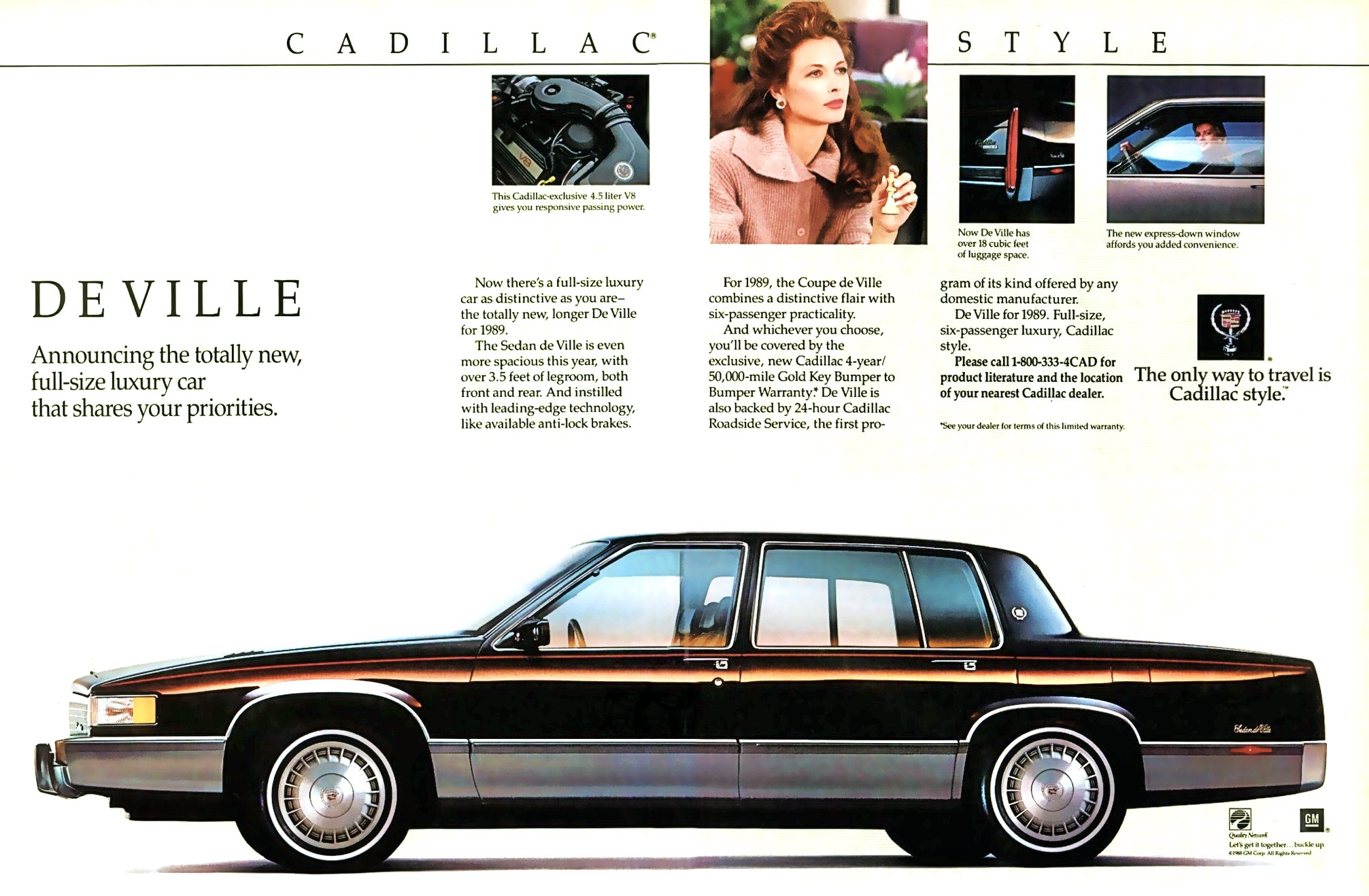
Cadillac’s Sedan de Ville was substantially revised for 1989, marking the first time that it had been “up-sized” for almost two decades. Overall length increased by nearly nine inches, while the wheelbase increased by three inches. The styling of this C-body was more in the traditional Cadillac vein than the 1985-1988 cars, with vertical blades in the rear that somewhat resembled the fins of previous decades. Changes extended to the interior, with more comfortable seats, more room in the rear compartment, and a larger trunk. New options included a heated windshield defogger ($250) and a Delco-Bose GoldSeries music system with an AM stereo/FM stereo radio, a compact disc player, and extended-range rear speakers ($872).
Standard power for the front-wheel-drive Sedan de Ville continued to be the transverse-mounted HT 155 bhp 4.5 liter/273 ci V8 with throttle-body fuel injection paired with a Turbo Hydramatic 4T60 four-speed automatic transmission. 0-60 mph took about 10 seconds in the 3,470-pound car. Mileage was 17 city/25 highway by the day’s standards (15/23 by today’s measures)—with an 18-gallon gas tank, a de Ville owner could expect a range of about 310 to 340 miles with a 10% fuel reserve.
1989 Cadillac Sedan de Ville print advertisement
Standard exterior and mechanical equipment on the $25,760 Sedan de Ville (about $69,500 in today’s dollars or about what a loaded 2026 Cadillac CT5 sedan goes for) included tungsten-halogen headlamps, Soft-Ray tinted glass, power rack-and-pinion steering, power brakes, four-wheel independent suspension, and P205/70R15 Michelin steel-belted all seasons whitewall tires (a size still readily available) on 15-inch wheels. Inside, the Sedan de Ville was well equipped: electronic climate control, a six-way power driver’s seat, a tilt-and-telescope steering wheel, cruise control, power side mirrors, power windows (including an express-down driver’s side window), power door locks, and an AM/FM stereo with cassette player were all standard.
Options, Period Reviews, & Production Numbers
Exterior and mechanical options for the 1989 Sedan de Ville included Firemist paint ($240), an Astroroof ($1,355), an anti-lock braking system ($925), and aluminum alloy wheels ($480). Inside, leather seating areas ($560 and including leather-trimmed headrests), a leather-trimmed steering wheel ($115), a theft deterrent system ($225), a digital information cluster ($250), and a rear window defogger ($195) were available.
Reviews of the revised Sedan de Ville were generally positive—Motor Trend referred to the 1989 models as “upgunned”—and it sold well. Cadillac shipped 122,693, making it by far Cadillac’s most successful model for the year—the rear-wheel-drive D-body Brougham was a distant second place with 28,926.
The View From 2025
According to Hagerty’s valuation tools, a 1989 Sedan de Ville in #1/Concours condition is $17,300, with a far more typical #3/Good car going for $7,100 (only the top-of-the-line Allantés do really well among late eighties Cadillacs). This generation of de Villes does maintain a presence in the Hemmings Motor News classifieds, on eBay Motors, and on Bring a Trailer. When I last updated this blog entry in December 2025, there was a Medium Garnet Red Metallic 1989 with 36,000 miles for sale on Hemmings, asking $16,000.
Make mine that same Medium Garnet Red Metallic, please.
To me, the 1980 Ford Thunderbird was one of those “why?” cars, though the competitive drivers were obvious. The third Ford based on the “Fox” platform (the Fairmont and the Mustang had come first), the eighth-generation ‘bird was one of the most radically downsized automobiles in the North American auto industry. In comparison to its 1979 predecessor, the base 1980 Thunderbird was 17 inches shorter and 900 pounds lighter.
Standard power for 1980 was a Windsor 118 bhp 4.2 liter/255 ci V8 with a Motorcraft two-barrel carburetor paired with a SelectShift three-speed automatic transmission. Powertrain upgrades were available: buyers could specify a $150 131 bhp 4.9 liter/302 ci V8 with a two-barrel carburetor and could then add a $133 automatic overdrive transmission (with that engine only).
With the standard powertrain, 0-60 mph took about 15 seconds in the 3,100-pound car—the best powertrain combination dropped that time to a far more respectable 11.1 seconds. Mileage was 18 city/26 highway by the day’s standards—with a 17.5-gallon gas tank, a Thunderbird owner could expect a range of 285 to 310 miles with a 10% fuel reserve.
Standard exterior and mechanical equipment on the $6,816 base Thunderbird (about $29,400 in today’s dollars) included variable ratio power rack-and-pinion steering, power front disc/rear drum brakes, a Thunderbird hood ornament with color-coordinated insert, full wheel covers, and P185/75R14 black sidewall tires on 14-inch wheels. Inside, a tweed cloth-and-vinyl Flight Bench seat, a day/night inside mirror, an electric clock, and an AM radio were all standard.
Packages, Options, & Production Numbers
Moving up to the $10,424 Town Landau (approximately $44,900 now) added a lot of equipment, including dual remote control mirrors, interval windshield wipers, and TR-type wide oval low-profile white sidewall radial tires on cast aluminum wheels. Inside, a velour cloth split front bench seat, six-way power driver’s seat, SelectAire air conditioning, power windows, power lock group, tilt steering wheel, and an electronic AM/FM stereo radio were included.
Silver Anniversary edition pages from the 1980 Ford Thunderbird brochure
The top-of-the-line Silver Anniversary edition ($12,172 then, $52,400 now) added the 4.9 liter engine, the automatic overdrive transmission, Keyless Entry System, and a power antenna. Inside, Silver Anniversary buyers got a patterned luxury cloth split front bench seat, a leather-wrapped steering wheel, Fingertip Speed Control, and—of course—all kinds of Silver Anniversary badging.
Options included a power-operated moonroof ($219), an electronic information cluster ($275-$313), and leather upholstery ($349).
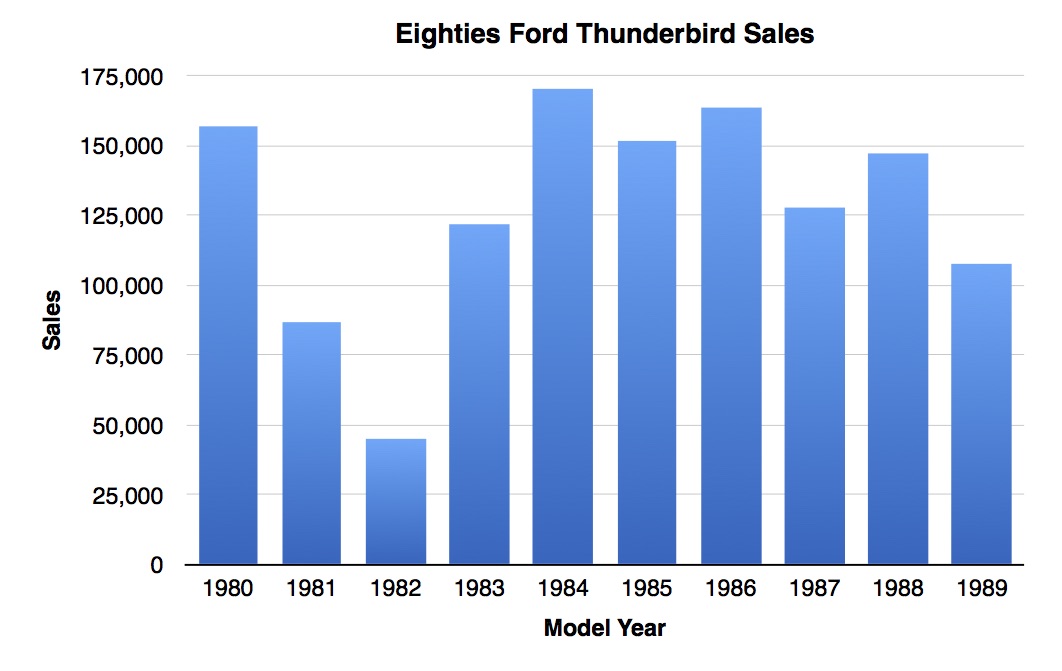
To say the market was not ready for the 1980 Thunderbird is a distinct understatement. Despite a much better level of standard equipment, the Thunderbird was only five inches longer than the plebian Fairmont. Sales of Ford’s halo model collapsed: dropping from 284,141 in 1979 to 156,803 in 1980, and losing almost a full percentage point of sales during a year when none of the main General Motors competitors in the personal luxury coupe market had more than a facelift.
It would get worse in the following two years: 86,693 in 1981 and 45,142 in 1982. By 1982, the Thunderbird was being handily outsold by all four of the mid-size GM coupes: Buick Regal, Chevrolet Monte Carlo, Oldsmobile Cutlass, and Pontiac Grand Prix. It would take the next Thunderbird design in 1983 to redress this balance.
The View From 2025
According to Hagerty’s valuation tools, a 1980 Thunderbird Silver Anniversary in #1/Concours condition is $25,500, with a far more typical #3/Good “normal” Thunderbird going for $8,800. This generation of Thunderbirds maintains some presence in the Hemming’s Motor News classifieds, on eBay Motors, and on Bring a Trailer. As I write this blog entry in October 2025, there’s a Silver Metallic 1980 with gray cloth seats and the 255 ci V8 on Hemmings, showing 73,000 miles and asking $11,500.
Make mine Midnight Blue Metallic, please—that’s one of the six Silver Anniversary edition colors.
A recent query about whether I had done a write-up on a Thunderbird Turbo Coupe compelled me to update this post written a few years ago, changing it enough to consider it a new entry.
“Ford presents a dramatic new balance of form and function.”
The aerodynamic styling of Ford’s 1983 Thunderbird was a breath of fresh air and a substantial change from the boxy and unloved eighth-generation 1980-1982 models, though the underlying components remained the Fox platform. For 1983, the Thunderbird came in base, Heritage, and Turbo Coupe models.
The Turbo Coupe featured Ford’s Lima 142 bhp 2.3 liter/140 ci inline four with Bosch L-Jetronic fuel injection and a Garrett turbocharger and came with a standard five-speed manual transmission. Road & Track recorded a 0-60 time of 9.7 seconds in a Turbo Coupe that weighed 3,420 pounds as tested. Ford’s new coupe didn’t just look aerodynamic—the drag coefficient was a very competitive 0.35. Fuel economy ratings for the Turbo Coupe were 21 city/33 highway by the standards of the day (17/24 by today’s standards). With an 18.0-gallon fuel tank, a Turbo Coupe owner could expect a range of between 330 and 435 miles with a 10% reserve—decent for a mid-size performance coupe in the early to mid-1980s.
Turbo Coupe page from the 1983 Ford Thunderbird brochure
The Turbo Coupe started at $11,790—approximately $30,300 in today’s dollars and nearly what a 2019 Mustang EcoBoost Premium Fastback (also with a turbocharged 2.3 liter inline four) costs. Standard exterior and mechanical features on the Turbo Coupe included variable ratio power rack-and-pinion steering, power brakes, power mirrors, a Traction-Lok limited-slip differential, Marchal foglamps, and Goodyear Eagle HR 205/70R-14 tires (a size still readily available) on 14-inch x 5.5-inch cast aluminum wheels. Inside, all Turbo Coupe buyers got a leather-wrapped steering wheel, articulated front seats, and an AM/FM stereo radio. Options included front cornering lamps ($68), tilt steering ($105), power door locks ($172), and a premium sound system ($179).
Reviews were quite good—Road & Track‘s tagline was “An enthusiast’s Bird comes soaring back”—and the newly aerodynamic Thunderbird sold well. After dropping down below 50,000 sales for the 1982 model year with the last of the eighth-generation ‘birds, the ninth generation would not see sales of less than 120,000 per year.
According to Hagerty’s valuation tools, all the money for a 1983 Thunderbird Turbo Coupe in #1/Concours condition is $17,000, with a far more typical #3/Good car going for $6,700. Thunderbird Turbo Coupes only occasionally show up in the Hemming’s Motor News classifieds. You do see them more often on eBay Motors; as I update this blog entry in December 2018, there’s a 1985 Silver Clearcoat Metallic/Medium Charcoal Clearcoat Metallic two-tone Turbo Coupe with Oxford Gray cloth seats and 52,000 miles listed for $8,500. Make mine Silver, please.
As I walked to the train in October 2017, I saw an eighties Mercury Grand Marquis sedan idling on Chestnut Street in Philadelphia. It stood out because of its size—at 214 inches, these cars are longer than a 2025 Lincoln Navigator—and its new for 1979 squareness. That was reason enough to write a relatively rare Mercury blog entry.
“A Lesson In Luxury”
For the 1983 model year, Mercury renamed all versions of the full-size Marquis to Grand Marquis and moved the Marquis name to the mid-size Fox platform. Other than the name change, changes for the Grand Marquis were relatively modest: there were new full-width wraparound tail lamps and a modified grille. New options included a remote locking fuel filler door ($24), locking wire wheel covers ($168), and a Tripminder trip computer ($261), which showed month/day/time, elapsed time, average speed, average MPG, instantaneous MPG, and gallons of fuel used. In their annual “Charting the Changes” roundup, Car and Driver once again made the ritual complaint that there was still no de Sad package.
The standard engine in 1983 was Ford’s 130 bhp 4.9 liter/302 ci V8 with fuel injection paired to a four-speed automatic. Somewhat strangely to our modern eyes, the optional power upgrade was a carburetted version of the same motor with 145 bhp. These were not fast cars—with an almost 3,800-pound curb weight, 0-60 came in about 12 seconds. Mileage with the standard powertrain was 17 city/27 highway by the day’s standards (14/20 by today’s standards). With the 18-gallon fuel tank, Grand Marquis drivers could expect a range of 275 to 355 miles with a 10% fuel reserve.
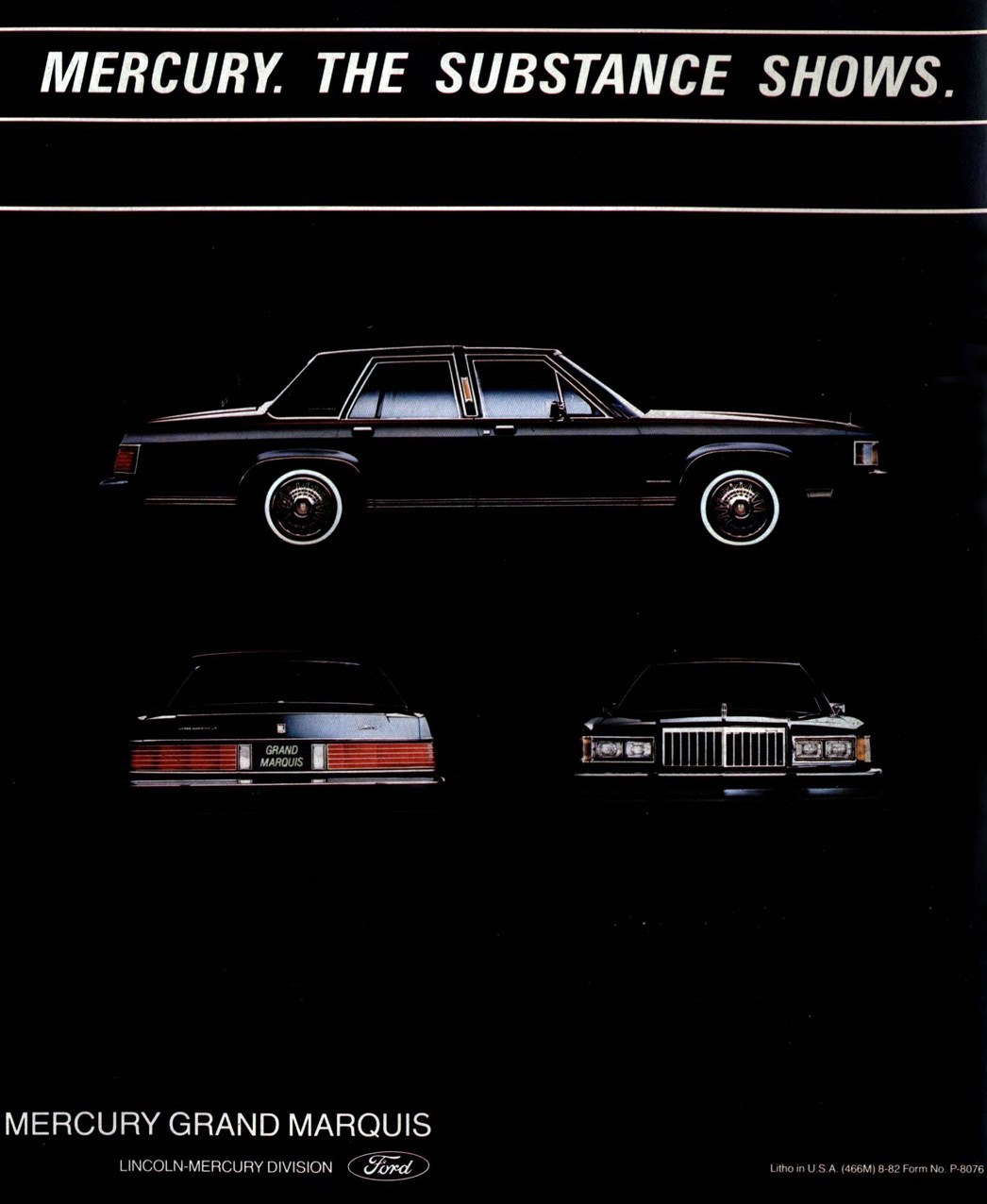
Rear cover of the 1983 Mercury Grand Marquis brochure
Standard exterior and mechanical equipment on the $10,718 Grand Marquis (about $34,700 in today’s dollars) included a coach vinyl roof, coach lamps, halogen headlamps, power brakes (front disc and rear drum), power steering, and P215/75R14 steel-belted white sidewall radial tires on 14-inch wheels with deluxe wheel covers. Inside, cloth/vinyl Twin Comfort Lounge seats with dual front seat recliners, a four-spoke Luxury (the Grand Marquis brochure mentioned luxury a lot) steering wheel, an analog quartz clock, and an AM/FM stereo radio with four speakers were included. Standard items that Mercury proudly listed that do not impress in 2025 included a front stabilizer bar, seat belt warning chimes, and carpeted lower door trim panels.
Packages, Options, & Production Numbers
Upgrading to the $11,273 LS added tinted glass, luxury cloth Twin Comfort Lounge seats, cloth-trimmed headrests, right-hand visor vanity mirror, map pockets in front seatback, luxury door trim with armrest woodtone inserts and courtesy lights, dual beam dome/map light, dual fold-down front center armrests, rear-seat folding center armrest, and the all-important LS badge on the rear decklid.
Exterior and mechanical options included the Traction-Lok differential ($95) and cast aluminum turbine spoke wheels ($361), which required P205/75R15 tires ($17). Interior options included manual air conditioning ($724), automatic air conditioning ($802), 6-way power driver’s seat ($210) or driver’s and passenger’s seats ($420), power door locks ($123), fingertip speed control ($170), and tilt steering wheel ($105). Audio options included a host of optional radios with 8-track or cassette player, a power antenna ($60), and the Premium Sound System with two additional speakers in the front doors, upgraded rear speakers, and an extra power amplifier ($175 base/$145 LS). Leather seating surfaces ($418) were only available on the LS. All these options meant that a loaded Grand Marquis LS could quickly get close to the Lincoln Town Car’s pricing territory—I quickly priced one to $14,584 (about $47,200 in 2025 dollars).
The Grand Marquis sold well for Mercury in 1983—72,207 sedans, 11,117 coupes, and 12,394 Colony Park wagons made it one of the division’s best sellers—23% of sales in a year when Mercury also offered the Capri, Cougar, LN7 (remember the LN7?), Lynx, Marquis, and Zephyr.
The Mercedes-Benz 380SL is a common vehicle at the auctions I follow—since starting this blog in late 2013, I’ve seen almost 40 of these convertibles go across the block, mostly at the Barrett-Jackson and Mecum events. I chose to go with 1985 as the model year to write about because it and 1982 have been the two most common years I have seen.
“What do you get when you blend a Mercedes-Benz with a sports car? The incomparable 380SL.”
1985 was the final year for the 380SL—from 1986 on, the heavier and more powerful 560SL would be the only option in North America. There wasn’t much change for 1985; all cars got anti-lock brakes, and later production SLs got a drivers-side airbag. About 11,100 buyers took home this last of the line example, which benefited from having very little real competition.
Motive power was provided by a 155 bhp 3.8 liter/234 ci V8 with Bosch Jetronic fuel injection, connected to a four-speed automatic transmission. As with all R107 models, mileage for the 3,600-pound car wasn’t very good—the ratings of the day were 16 city/18 highway (14/17 by today’s standards). With the 22.5-gallon fuel tank, a 380SL driver could expect a range of between 310 and 350 miles with a 10% fuel reserve. 0-60 came in about 10.5 seconds; despite the claims of Mercedes-Benz, the 380SL was closer to a grand touring car than to a sports car.
The 380SL’s base price for 1985 was $43,820 (about $102,200 in today’s dollars—neatly spaced between what an SL 450 and an SL 550 cost in 2017). For the money, exterior and mechanical standard features included the aforementioned ABS controlling power disk brakes, power steering, a steel hardtop, and 205/70VR14 tires (now a rare size) on 14-inch forged light-alloy wheels. Inside, power windows, power door locks via a vacuum locking system, cruise control, and an AM/FM stereo with cassette player were standard. Air conditioning was also included in the electronic automatic climate control system, though most say it wasn’t that effective. Heated leather seats were optional.
According to Hagerty’s valuation tools, all the money for a 1985 380SL in #1/Concours condition is $28,200, with a more typical #3/Good car going for $13,600. There is decent club support for the 380SL, as there is for almost all Mercedes-Benz’s. 380SLs maintain a substantial presence in the Hemming’s Motor News classifieds and on eBay Motors. As I write this in September 2017, there are 66 advertised on Hemmings, including 14 of the 1985 models.
Make mine Astral Silver Metallic, please. Dealer advertising image courtesy of Alden Jewell.
It was a beautiful weekend in the Philadelphia area in August 2017. Lots of people had their old cars out—one that caught my eye was an eighties Monte Carlo. However, it wasn’t the relatively glamorous SS of the mid-eighties; just a “normal” coupe.
“A matter of personal pride.”
For the 1981 model, the Monte Carlo that had been downsized in 1978 was significantly restyled, both to improve aerodynamics and modernize its looks. Much of the sculpting on the sides (which the middle-school-aged me found appealing) was flattened, the hood was lowered, and the trunk slightly raised. All of this change reduced the drag coefficient by about 10%.
The standard engine continued to be an LC3 110 bhp 3.8 liter/229 ci V6 with a Rochester 2ME two-barrel carburetor. Optional power included a $750 (!) Buick-built LC8 170 bhp 3.8 liter/231 ci V6 with a turbocharger and a Rochester E4ME four-barrel carburetor and a $50 L39 115 bhp 4.4 liter/267 ci V8 with a Rochester 2ME two-barrel carburetor. California got an LG4 150 bhp 5.0 liter/305 ci V8 with a Rochester 4ME four-barrel carburetor as an option replacing the 4.4 liter V8. All engines were paired with a Turbo Hydra-Matic three-speed automatic transmission.
Mileage for the standard engine was 19 city/26 highway by the day’s standards. With an 18.1-gallon gas tank, a Monte Carlo driver could reasonably expect 300 to 325 miles of range with a 10% fuel reserve. Performance wasn’t exactly sparkling: 0-60 mph came in about 14.5 seconds with the standard V6 and 14 seconds for the 4.4 liter V8. The rare (about 2% of 1981 sales) turbo V6 was much faster—about 9 seconds for the 0-60 mph dash.
Rear cover of 1981 Chevrolet Monte Carlo brochure
The Monte Carlo Sport Coupe‘s base price was $7,299—approximately $28,000 in today’s dollars or about what a base 2026 Chevrolet Equinox SUV costs. Standard exterior and mechanical equipment included Computer Command Control,Delco Freedom II battery, power steering, power front disc/rear drum brakes, and P195/75R14 steel-belted radial tires (a size still available thanks to Hancook and Kumho) on 14-inch wheels. Inside, a split cloth front bench seat, cut pile carpeting, and an electric clock were standard.
Exterior and mechanical options for the Sport Coupe (there was also a higher-content Landau Coupe) included halogen high beam headlamps ($27), removable glass roof panels ($695), F41 Sport Suspension ($43), limited-slip differential ($67), Rally wheels ($49), and attractive new aluminum wheels ($319). Inside, there were many options: air conditioning ($585), automatic speed control ($132), Comfortilt steering wheel ($81), power windows ($140), power door locks ($93), bucket seats ($118), gauge package ($55), and an AM/FM stereo radio with cassette tape ($264) were all available.
Options & Production Numbers
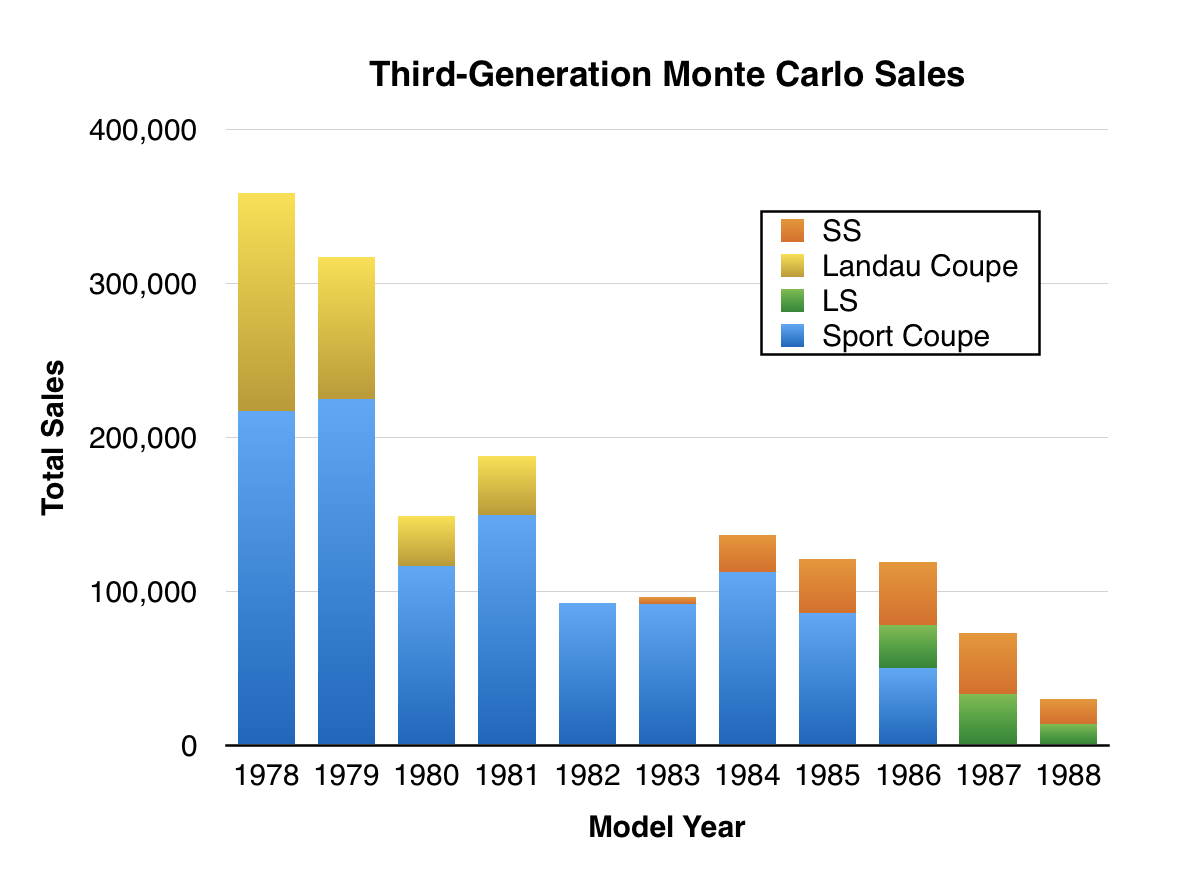
1981 Monte Carlo sales were astounding by modern standards for auto sales—Chevrolet sold 149,659 Sport Coupes along with another 38,191 Landau Coupes. For context, the combined Monte Carlo numbers would be enough to make it the 18th most popular vehicle in 2024, and Chevrolet had four model lines that sold better in 1981 (Chevette, Citation, Malibu, and Impala/Caprice). Chevrolet was probably happy with the increased sales over 1980, but this would not last—1981 turned out to be the eighties high-water mark for Chevrolet’s mid-size personal luxury coupe.
The View From 2025
Third-generation Monte Carlos have a following, though most of the interest is in the aforementioned SS, which is the only eighties Monte rated in Hagerty’s valuation tools. A 1986 maroon Chevrolet Monte Carlo coupe with a maroon interior and cloth bucket seats, an LG4 150 bhp 5.0 liter/305 cubic inch V8 with a four-barrel carburetor, an automatic, and 60,000 miles sold for $9,000 at Barrett-Jackson’s 2016 Las Vegas auction.
These Monte Carlos do show up for sale in the Hemmings Motor News classifieds, on eBay Motors, and on Bring a Trailer. When I updated this post in October 2025, Hemmings was listing a Light Maroon 1984 Monte Carlo with maroon cloth seats, a 3.8 liter V6, and 13,000 miles, asking $24,000.
Make mine Green Light Jade Metallic, please. A rare choice when new, those GM light greens from the early eighties have aged very well.
The October 2017 issue of Hemmings Classic Car included an article on an “Unbelievable Restoration of a 1979 Plymouth Horizon,” which certainly falls into my “Who Saves These Cars?” category. In honor of this, I updated a blog entry on the 1980 Horizon.
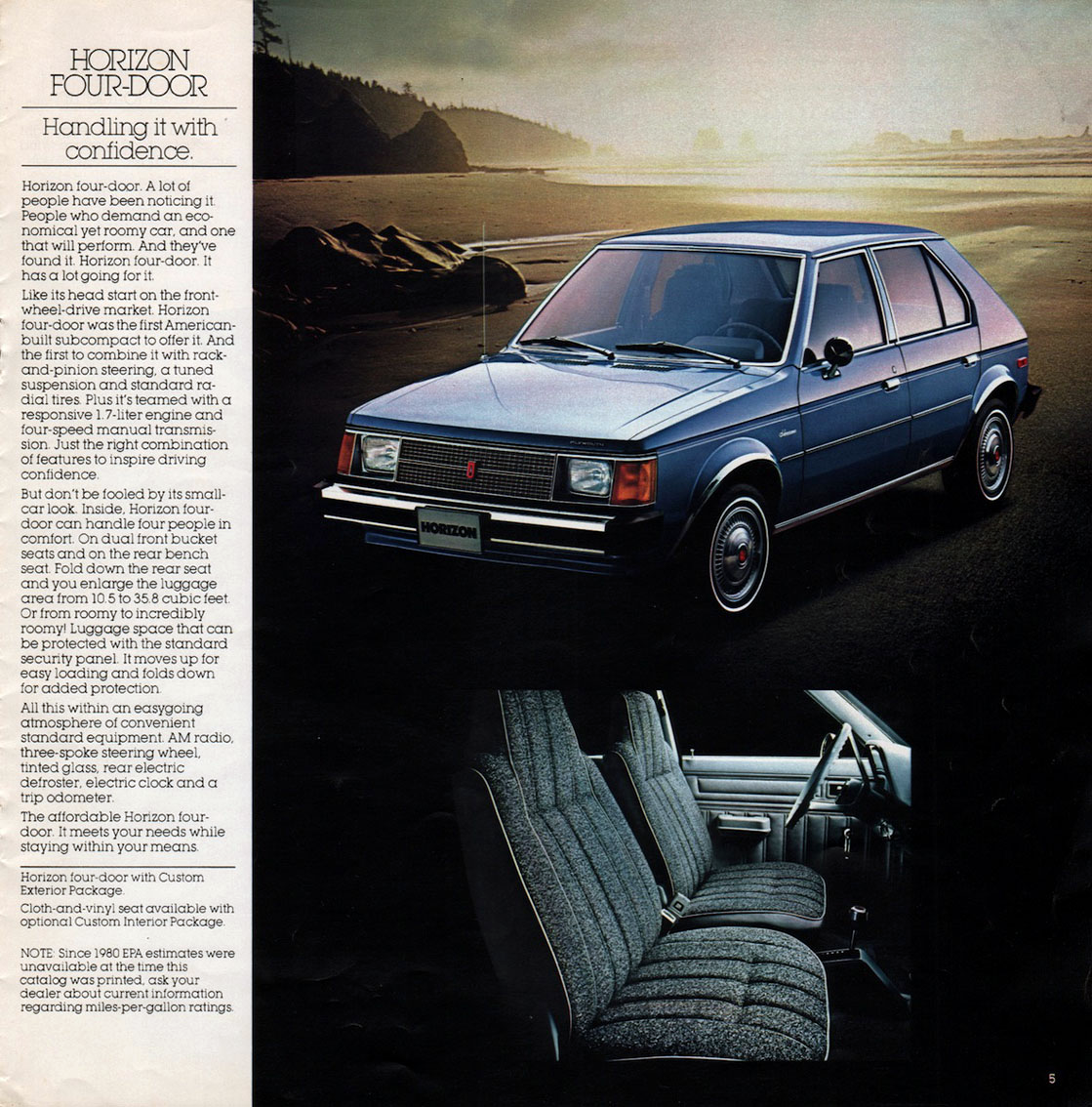
“Handling it with confidence.”
1980 was the third model year for Chrysler’s “Omnirizon” front-wheel drive subcompact. Once again, the only available engine was a Volkswagen-sourced 1.7 liter/105 ci four-cylinder with a Holley two-barrel carburetor and all of 65 bhp. With the standard four-speed manual transmission, 0-60 came in about 14.5 seconds in the 2,135-pound car. Fuel economy was rated at 24 city/31 highway by the day’s standards, so the 13-gallon gas tank gave a range of 265 to 285 miles with a 10% fuel reserve.
Four-door page from the 1980 Plymouth Horizon brochure
Standard exterior and mechanical equipment on the $5,526 car (about $23,900 in today’s dollars) included rack and pinion steering, front disc/rear drum brakes, a rear electric defroster, tinted glass, and P155/80R13 glass-belted radial tires (a size still available from Kumho) on 13-inch wheels. Standard interior equipment included a heater, an AM radio, and an electric clock.
A variety of exterior and interior packages were available to dress up the rather spare base Horizon. The Custom exterior package ($101) added some bright moldings to the outside of the car. Moving up to the Premium exterior ($207) added some more bright moldings and deluxe wheel covers. The Premium Woodgrain exterior added (natch!) woodgrain appliques on the body sides and lower liftgate pane. The Custom ($112) interior added a glove box lock, a cigarette lighter, custom door panels, and custom vinyl seats. The top-of-the-line Premium ($355) interior added a color-keyed console, a “luxury” three-spoke steering wheel, premium door panels, and a reclining passenger-side seatback.
Options & Production Numbers
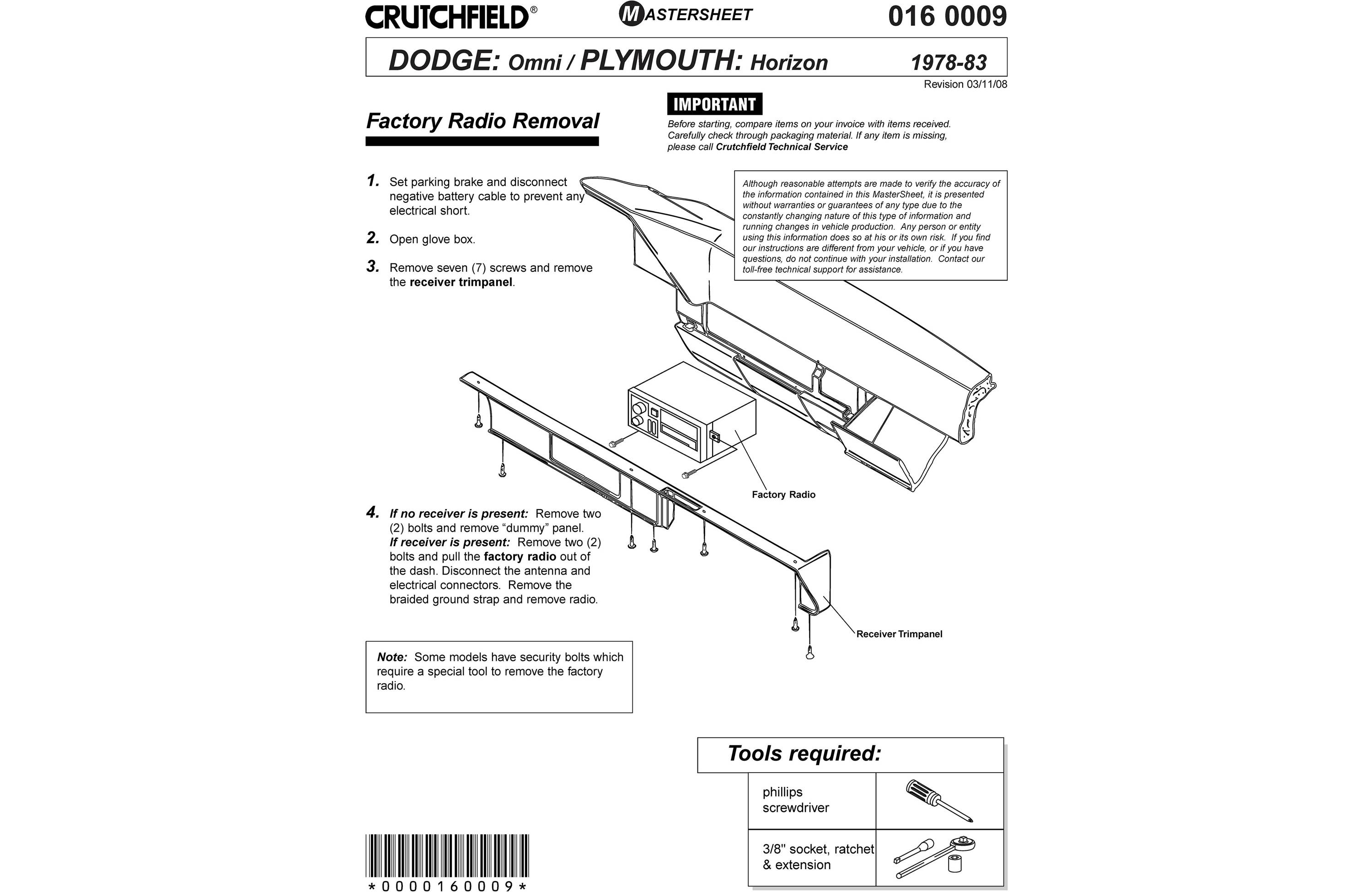
Exterior and mechanical options included a removable flip-up glass sun roof ($182), power steering ($161), power front brakes ($77), and a three-speed TorqueFlite automatic transmission ($340) which further slowed the Horizon’s acceleration. Inside, air conditioning ($541), a sport steering wheel ($40), and an AM/FM stereo radio ($93) were available—there were no eight-tracks or cassettes available as factory stereos (it was left to Crutchfield and others to provide those upgrades—and they still do).
The Horizon continued to sell reasonably well in the 1980 model year, with almost 86,000 units sold. The slightly sportier two-door TC3 hatchback added another 60,000 or so units. Combined, the two models accounted for 58% of Plymouth’s dire 1980 automobile sales totals in the United States (Plymouth’s other offerings for that year included the Arrow, Champ, Gran Fury, Sapparo, and Volaré).
The View From 2025
A few folks are trying to save “Omnirizons”—including that fellow featured in Hemmings Classic Car (journalist Robert Suhr)—but you rarely see these cars for sale in the Hemming’s Motor News classifieds, on eBay Motors, or on Bring a Trailer. The exception, of course, is the later and much faster Dodge Omni GLH.
There’s a strong feeling of fulfillment behind the wheel of this striking coupe.
The Dodge 600 was an extended (E-platform) version of the original K-platform cars, with three more inches of wheelbase added to the sedans (coupes and wagons kept the same wheelbase as the first K cars). It debuted in the 1983 model year, two years after the original K cars reached the market. Other E-platform cars were the Chrysler New Yorker, Chrysler E-Class, and (later) the Plymouth Caravelle.
There were three engines available for the Dodge 600. The base engine was Chrysler’s K 99 bhp 2.2 liter/135 ci inline four with fuel injection. The high-performance option was the Turbo I 146 bhp version of the same engine with a Garrett T3 turbocharger and fuel injection. The other option was Mitsubishi’s Astron series 4G54 101 bhp 2.6 liter/153 ci inline four with a two-barrel carburetor.
Fuel economy for the Turbo I and three-speed automatic transmission combination (the five-speed manual was no longer available) was 19 city/24 highway by the day’s standards (it would be 17/22 today). With a 14-gallon gas tank, the new owner of a club coupe could expect a range of between 245 and 270 miles with a 10% fuel reserve.
Club Coupe page from the 1985 Dodge 600 brochure
Standard exterior and mechanical equipment on the $9,060 Club Coupe (about $27,900 in today’s dollars) included halogen headlamps, a Landau padded vinyl roof, power front disc/rear drum brakes, power rack-and-pinion steering, and P185/70R14 steel-belted radial white sidewall tires (a size still readily available) on 14-inch wheels with Luxury wheel covers. Inside, cloth high-back front bucket seats with integral headrests, a full-length console, a Luxury color-keyed two-spoke steering wheel, and an electronically-tuned AM radio were standard. Features listed in the brochure that wouldn’t be considered worth mentioning now included a tethered fuel filler cap and an inside hood release.
Exterior and mechanical options included tinted glass ($115), a sport/handling suspension ($79), and cast aluminum wheels. Inside, air conditioning ($757), automatic speed control ($179), a leather-wrapped steering wheel ($50), and a tilt steering wheel ($110) were available. Three optional radios were available.
The View From 2025
The original K cars and their many variants were once so common on the roads, but have essentially vanished. I haven’t seen a 600 of any type in years, even though Dodge produced over 300,000 of them between 1983 and 1988. You’ll sometimes see the original Dodge Aries/Plymouth Reliant cars at AACA shows along with the top of the line Chrysler LeBaron convertibles. You do occasionally see Dodge 600s for sale in the Hemming’s Motor News classifieds, on eBay Motors, and on Bring a Trailer, but there are no coupes out there as I update this blog post in October 2025.









 Eighties Cars