“Igniting the exhilaration of true sports coupe performance.”
For 1986, the second-generation Scirocco gained a substantial amount of power, elevating it from a VW loyalist’s car to one considered by a wider range of sports coupe buyers. The engine was a notably upgraded version of the 90 bhp 8-valve 1.8 liter/109 ci inline four that shipped on the base Scirocco. The new 16-valve version made 123 bhp, changing the character of Volkswagen’s sportiest coupe.
With a curb weight of 2,380 pounds, Car and Driver recorded a 0-60 time of 8.0 seconds and a top speed of 124 mph for the 16V. Fuel economy was rated at 23 city/28 highway by the day’s standards (21/26 by modern measures). A 13.8-gallon gas tank meant that a Scirocco 16V‘s owner could expect a range of 295 to 315 miles with a 10% fuel reserve.
Classified as sub-compact by the EPA, the Scirocco was not a large car—its 165.7-inch length is three inches shorter than the current Golf GTI hatchback sedan. All Sciroccos continued to be assembled by Karmann in Osnabrück, Germany.
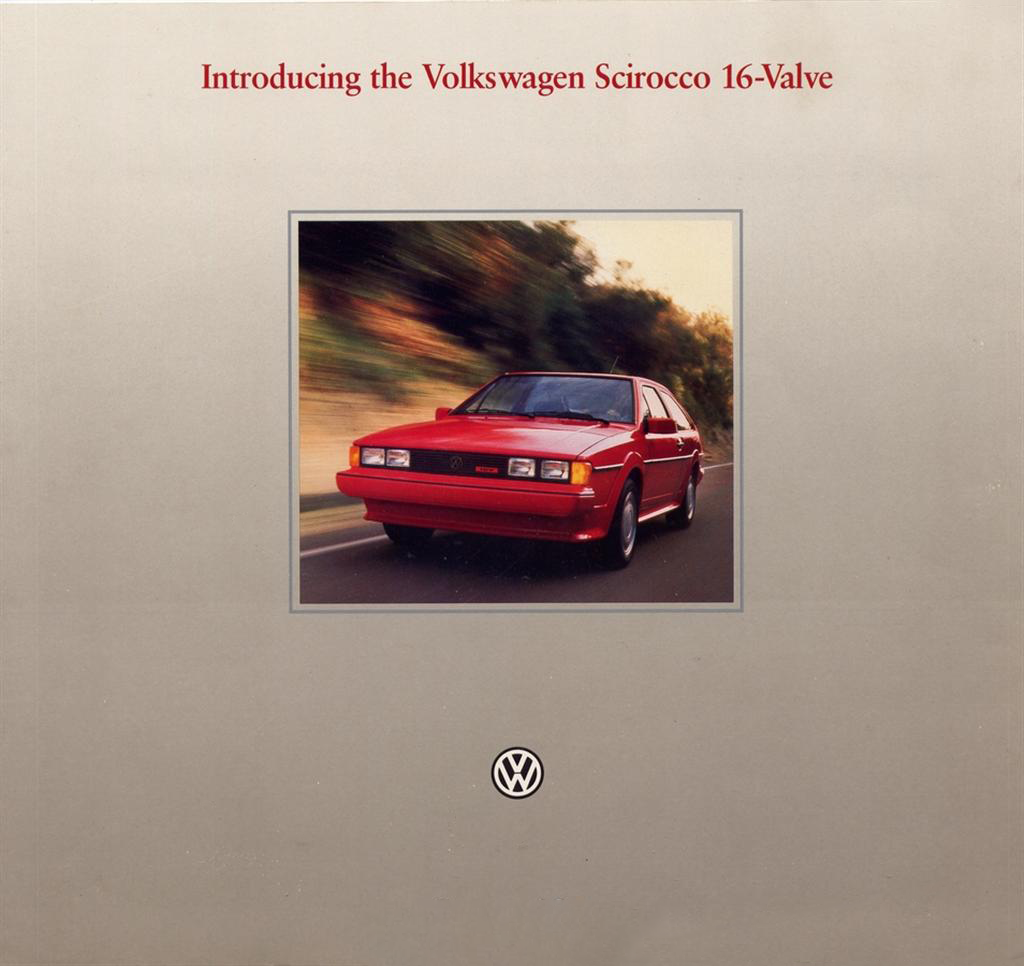
Cover of the 1986 Volkswagen Scirocco 16V brochure
The 1986 Scirocco 16V‘s base price was $11,980—about $36,000 in today’s dollars, or almost exactly what a 2026 Golf GTI hatchback sedan goes for. Standard exterior features included halogen headlamps, tinted glass, body colored rocker panels, wheelhouse flares, and a 16V-specific rear spoiler. Mechanical features of the 16V included front wheel drive (still on the window sticker in 1986), quick-ratio power rack and pinion steering,four wheel power disc brakes, and 185/60HR-14 steel belted radial tires (a size still readily available) on 14-inch Sport alloy wheels.Inside,reclining front Sport seats with height adjustment, a foldable rear seat, a leather-wrapped Sport steering wheel, a digital clock, and a stereo prep package were standard.
Options & Period Reviews
Options for the reasonably well-equipped Scirocco 16V were relatively few—a manual tilt and slide sunroof ($450), metallic paint, leather seats, air conditioning ($750), a power door locks and windows package ($445), cruise control, and an AM/FM stereo cassette radio with a cassette storage tray ($390).
Period reviews of the Scirocco 16V were good, though the exterior styling took some lumps for its lack of distinctiveness. Car and Driver stated that the new motor made for an “amazing transformation.” MotorWeek was a little iffy about the 16V‘s price in a very competitive market. Both Car and Driver and MotorWeek noted that the 16V was the fastest Volkswagen yet sold in the United States.
1986 was the final model year for the Jeep CJ-7, which had debuted in 1976. Because of this, there were only minor trim and detail changes.
The CJ-7’s standard powertrain was an AMC 86 bhp 2.5 liter/150 ci inline four with electronic fuel injection paired with a four-speed manual transmission and part-time four wheel drive. An AMC 102 bhp 4.2 liter/258 ci inline six with a two-barrel carburetor was a $361 option. Both engines could be had with a five-speed manual ($250), but only the inline six could be paired with a Torque-flite automatic ($495).
Jeep CJs were neither economical nor fast—but most Jeep fanciers would have and do argue that isn’t the point. The spriteliest powertrain combination (inline six/five-speed) came in with fuel economy ratings of 17 city/21 highway by the day’s standards (15/20 by modern measures). With the standard 15.1-gallon gas tank, a CJ-7’s presumably happy owner could expect a range of 240 to 255 miles with a 10% fuel reserve. It’s no wonder many went for the $57 20-gallon extra capacity fuel tank, which promised ranges of over 300 miles.
Front cover of the 1986 Jeep CJ brochure
The 1986 CJ-7’s base price was $7,500—about $22,400 in today’s dollars. Standard exterior and mechanical equipment included a roll bar, a moveable tailgate, a swing away spare tire carrier, a front stabilizer bar, manual front disc brakes, and free-wheeling hubs. Inside, linen-grain vinyl high back bucket seats, a padded instrument panel, a day/night mirror, an electric washer and 2-speed wipers, a cigarette lighter, and a heater and defroster were included.
Packages, Options, & Production Numbers
Jeep offered two packages for the 1986 CJ-7:
The $1,253 Renegade package included special Renegade exterior graphics, rocker panel protection moldings, and 15 x 7 white styled steel wheels. Inside, a denim-look vinyl rear seat, a soft feel 3-spoke Sport steering wheel, and intermittent wipers were included.
The $3,304 Laredo package included a chrome grille panel with pinstripe, a hard top, a Laredo hood decal, and 15 x 7 chrome styled steel wheels. Inside, a leather-wrapped 3-spoke steering wheel, a console, a rear seat, courtesy lights, a tachometer and clock, and intermittent wipers were included. A Laredo with no other options came to $10,804—about $32,300 in 2025 dollars, or about 10% less than a 2026 Jeep Wrangler Sport 2-door goes for.
Individual options included heavy duty engine cooling ($57), power steering ($274), power disc brakes ($125), a rear Trac-lok differential ($255), a conventional spare tire ($94), and a tilt steering wheel ($118). Many CJ-7s exited dealer showrooms with stickers that were about twice the base price.
Jeep produced 25,929 CJ-7s in the 1986 model year. They marked the final version of the original Civilian Jeep from 1945, whose total production measured over 1.5 million units.
The View From 2025
CJ-7s have a devoted fanbase, and their values reflect that. According to Hagerty’s valuation tools, a 1986 CJ-7 Renegade with the inline six in #1/Concours condition is $48,800, while a more typical #3/Good condition example goes for $24,500. CJ-7s frequently show up for sale in the Hemmings Motor News classifieds, on eBay Motors, and on Bring a Trailer.
The 1986 Mercedes-Benz 560SL marked the last significant revision to the R107 generation that had begun way back in 1972 with the 450SL. In addition to a larger and more powerful V8, Mercedes added a new rear suspension, anti-lock brakes (ABS), a limited-slip differential, a driver’s side airbag, and standard leather upholstery. The 560SL also got the federally-required high-mounted third brake light, mounted awkwardly on the trunk.
Motive power was provided by a Bosch fuel-injected 227 bhp 5.5 liter/338 ci V8 connected to a four-speed automatic transmission. Motor Trend recorded a 0-60 time of 6.8 seconds, while Road & Track recorded 7.5 seconds—no matter what, the 560SL was over three seconds faster than the 380SL. Mileage wasn’t exactly a priority in a car with 3,781-pound curb weight—the ratings of the day were 14 city mpg/17 highway (adding a $1,300 gas guzzler tax to every vehicle), by today’s standards that would be 12 city/16 highway. With the 22.5-gallon gas tank, 560SL owners could expect a range of between 280 and 315 miles with a 10% fuel reserve.
The 560SL’s base price at the beginning of the 1986 model year was $48,200—about $143,700 in today’s dollars, which is slightly under what a 2026 AMG SL 55 convertible goes for. By the end of the 1986 model year, the 560SL’s base price had risen to $53,730.
560SL pages from the 1986 Mercedes-Benz brochure
For their money, SL buyers got a plethora of standard equipment. Standard exterior and mechanical features included halogen head and fog lamps, tinted glass, power assisted steering, power assisted four wheel disc brakes, and 205/65R15 steel belted radial-ply tires (a size still readily available) on 15-inch light alloy wheels. Inside, adjustable front bucket seats and head restraints, a leather covered steering wheel and gear selector, cruise control, a central locking system, electric window lifts, fully automatic climate control, an electronic AM and FM stereo radio with a cassette player, and a first aid kit were included.
Options & Production Numbers
The 560SL offered only three factory options: heated seats, electronically adjustable headrests, and California emissions ($30).
About 13,788 well-healed buyers took home the first-year 560SL, up about 69% from the final year 380SL.
The View From 2025
There is solid club and forum support for the 560SL, as there is for almost all Mercedes-Benzes. According to Hagerty’s valuation tools, all the money for a 1986 560SL in #1/Concours condition is an astounding$150,000, while a more normal #3/Good condition car goes for $22,300. 560SLs maintain a substantial presence in the Hemming’s Motor News classifieds, on eBay Motors, and on Bring a Trailer. As I wrote this blog post in September 2025, there were 74 available on Hemmings, including 15 of the 1986 models.
I have a personal connection with the Yugo. My father’s younger brother worked for Malcolm Bricklin for many years, including with Yugo America. Years later, my uncle made it to the front page of the Wall Street Journal in an article entitled A Drag Racer Turns Handicap Of His Yugo to His Advantage.
“Introducing the same old idea.”
Famously advertised with a base price of $3,990, the 1986 Yugo GV was a response to escalating prices—the average transaction price of a car in the United States had just passed $10,000. Built by Zastava in Yugoslavia, the Yugo was a shortened variant of the Fiat 128—a design dating from 1969. Serial entrepreneur Malcolm Bricklin saw potential in the Yugo and created Yugo America to import the car into the United States. The GV stood for Great Value.
The Yugo was a tiny car by mid-1980s standards, with a 139-inch length and an 84-inch wheelbase. The slightly more expensive 1986 Chevrolet Chevette hatchback coupe was 18% longer and had a 13% greater wheelbase, while the same year’s class-leading Honda Civic hatchback was 8% longer and had a 12% greater wheelbase. The also newly available Hyundai Excel hatchback coupe was notably larger.
Power, if you could call it that, was provided by a 55 bhp 1.1 liter/68 ci inline four with a two-barrel carburetor. A four-speed manual was standard, and Car and Driver recorded a 0-60 time of 14.0 seconds. Fuel mileage was rated at 25 city/31 highway by the day’s standards (22/29 by modern measures). With a small 8.4-gallon gas tank, a Yugo owner could expect a short range of 195 to 210 miles with a 10% fuel reserve.
1986 Yugo GV print advertisement
Standard exterior and mechanical equipment on the Yugo GV included opening front vent windows, a rear-window wiper, front-wheel-drive, rack and pinion steering, front disc/rear drum brakes, and 145R13 74H tires (now barely available) on 13-inch wheels. Inside, cloth/vinyl reclining front bucket seats, a fold-down rear seat, a rear-window defroster, and a small tool kit were included. A full-sized spare tire was stored under the hood.
The Yugo offered few options—neither air conditioning nor an automatic transmission were available for the 1986 model year. Yugo buyers could choose a variety of dealer-installed radios.
Many Jokes & One Survey
Yugo jokes were many. Just a few of them:
What do you call a Yugo with twin tailpipes? A wheelbarrow.
What do you call a Yugo with a flat tire? Totaled.
How do you make a Yugo go from 0 to 60 in five seconds? Push it off a cliff.
Why do Yugos have rear-window defrosters? To keep your hands warm.
How do you double the value of a Yugo? Fill the gas tank.
What’s on the first page of the Yugo owner’s manual? The bus schedule.
Popular Mechanics‘ owners survey for the Yugo GV found that Yugo buyers wanted a new car instead of a comparably-priced used one, and that, as one said, “you have to keep the car in perspective.”
The View From 2025
Oh, these are vanished. Bring a Trailer has sold a grand total of eight over nine years, and they’re long gone from Hemmings and eBay Motors.
After a soft rollout in the Midwest in early 1985, 1986 was the first full model year for the fifth-generation Chevrolet Nova sedan, which was built in the New United Motor Manufacturing Incorporated (NUMMI) plant in Fremont, California—a collaboration between General Motors and Toyota. Of course, these front-wheel-drive Novas had nothing to do with the previous four rear-wheel-drive generations, the last of which had been seen in the 1979 model year.
The new Nova was a rebadged and mildly restyled version of the Japanese market Toyota Sprinter, itself a model sold in Japan as a badge-engineered version of the Toyota Corolla. The pre-existing design was chosen over a clean-sheet approach because it could be brought to market more quickly.
The Nova’s standard powertrain was the 4-AC 70 bhp 1.6 liter/97 ci inline four with a two-barrel carburetor paired with a five-speed manual. A three-speed automatic was optional. Car and Driver recorded a 0-60 time of 12.4 seconds with the manual in a car with a 2,260-pound curb weight—edging toward slow by 1986. Mileage ratings with the manual were 30 city/37 highway by the day’s standards (26/33 by today’s measures). As was normal in the eighties, the automatic gave up some mileage—off two mpg in the city and five mpg on the highway. With a 13.2-gallon gas tank, the owner of a manual Nova could expect a range of 355 to 395 miles with a 10% fuel reserve.
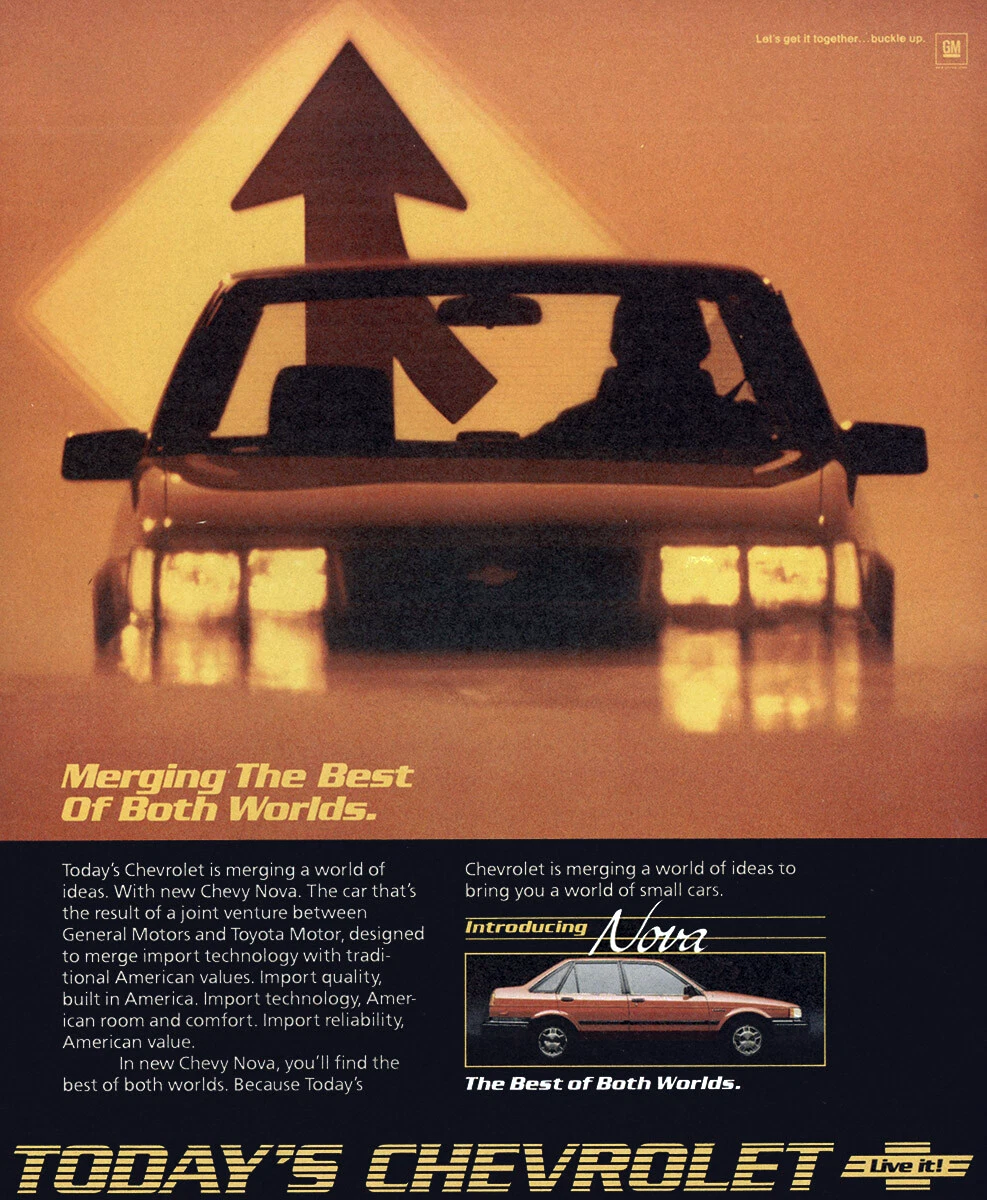
1986 Chevrolet Nova print advertisement
The Nova sedan’s price was $7,435—about $22,700 in 2025 dollars or slightly over what a 2025 Chevrolet Trax LS compact crossover SUV goes for. Standard exterior and mechanical equipment included tinted glass, narrow black body side moldings, front wheel drive, rack-and-pinion steering, power front disk/rear drum brakes, and P155/80R13 all-season steel-belted radial tires (a size still available courtesy of Kumho) on 13-inch wheels with a wheel center cap. Inside, reclining front seats with adjustable head restraints, cloth and vinyl seat trim, cut-pile carpeting, a full length console, side window defoggers, and an AM radio were included.
The Nova CL sedan added a wide body side molding and half-cap wheel covers. Inside, all CLs had a Custom Cloth interior, a driver’s seat with lumbar support and vertical adjustment, a console with a storage box and an armrest, a right-side visor vanity mirror, and an adjustable steering wheel.
Option Packages, Period Reviews, & Production Numbers
The 1986 Nova’s configurability was described mainly by eight separate packages, half of them manual and half automatic:
Base Package 1 was the base sedan
Base Package 2 ($610) added the three-speed automatic, left-hand remote and right-hand manual outside mirrors, and power steering
Base Package 3 ($1,180) added halogen high and low beam headlamps, left-hand remote and right-hand manual outside mirrors, power steering, air conditioning, an electric rear window defogger, and an electronically-tuned AM/FM stereo radio with seek/scan and a digital clock to the base sedan
Base Package 4 ($1,575) added halogen high and low beam headlamps, air conditioning, an electric rear window defogger, and an electronically-tuned AM/FM stereo radio with seek/scan and a digital clock to Base Package 2
CL Package 5 ($1,730) added halogen high and low beam headlamps, left-hand remote and right-hand manual outside mirrors, power steering, air conditioning, an electric rear window defogger, and an electronically-tuned AM/FM stereo radio with seek/scan and a digital clock to the CL sedan
CL Package 6 ($2,125) added the three-speed automatic, halogen high and low beam headlamps, left-hand remote and right-hand manual outside mirrors, power steering, air conditioning, an electric rear window defogger, and an electronically-tuned AM/FM stereo radio with seek/scan and a digital clock to the CL sedan
CL Package 7 ($2,515) was the sportiest of the Novas and added P175/70R-13 all-season steel belted radial ply blackwall tires, aluminum wheels, electronic speed control with resume speed, an intermittent windshield washer system, and an electronically-tuned AM/FM stereo radio with seek/scan, stereo cassette tape, and a digital clock to CL Package 5
CL Package 8 ($2,620) was the most luxurious Nova and added a power door lock system, electronic speed control with resume speed, an intermittent windshield washer system, and an electronically-tuned AM/FM stereo radio with seek/scan, stereo cassette tape, and a digital clock to CL Package 6
The Nova’s only individual option was Two-Tone paint ($176), which was only available with the CL. The absolute fanciest CL sedan retailed for $10,231—about $30,500 in today’s dollars, which is about what a well-equipped 2025 Chevrolet Trailblazer LT compact crossover SUV goes for.
Period reviews freely acknowledged that the Nova was basically a rebadged Corolla. Road & Track‘s tagline was “we have met the enemy, and they is us”—another repackaging of Walt Kelly. Motor Trend stated that the Nova was the “latest installment in the ongoing serial of “If you can’t beat ’em, join ’em.”” Popular Mechanics got more personal and asked, “Can a Japanese car built in California find happiness in America?”
Chevrolet sold 124,961 Nova sedans in the 1986 model year, in addition to the 27,943 that had been sold in the 1985 soft rollout. Predictably, the quality of the Nova was considerably higher than that of any other Chevrolet compact car.
The View From 2025
Some call them “Toyolets,” but I’m going to declare this version of the Nova as vanished. I haven’t seen a fifth-generation Nova in the wild for decades, and they have little presence in the Hemmings Motor News classifieds or on eBay Motors. Bring a Trailer has sold a grand total of one—a 1987 sedan.
The seventh-generation Riviera debuted on November 14th, 1985. For a third and final time, Buick downsized the Riviera—this time to a 108-inch wheelbase and a 187.2-inch overall length. The size reduction (more than 19 inches shorter) made this generation the smallest and lightest of all Rivieras. Among the planning assumptions for the seventh generation model and its Eldorado and Toronado platform-mates was that gasoline would cost approximately $3.00 a gallon upon debut. Instead, fuel was going for around $1.19 when the three prestige coupes entered the market in late 1985.
In part because of the assumptions mentioned previously, there were no more V8s for the Riviera—from 1986 forward, the Riviera that had been V8 only until 1979 would now be V6 only. Also gone forever was the diesel V8, almost certainly less missed by buyers than the gasoline versions. Production moved to a brand new plant in Hamtramck, MI. Finally, the Riviera was also back to being coupe-only—the four-year experiment with the glamorous, attention-getting, and pricey convertibles was no more.
After many years that had some (sometimes many) choices, the only available powertrain for 1986 was the LG2 “3800” 140 bhp 3.8 liter/231 ci V6 with sequential fuel injection paired with a Turbo Hydramatic 440-T4 automatic transmission with overdrive. The LG2 was a version of the previous generation Riviera’s LD5 modified for transverse front-wheel-drive usage and was first seen as an option in the 1984 versions of the Buick Century and the Oldsmobile Cutlass Ciera. Though it was “just” a V6, the LG2 had the same power rating as the 1985’s base V8, making the substantially lighter “civilian” 1986 Riviera quicker than its 1985 equivalent. The 0-60 time was about 10 seconds, making the Riviera quite competitive in class.
Fuel mileage for the new Riviera was 19 city/30 highway by the day’s standards. With an 18.0-gallon fuel tank, the driver of a 1986 Riviera could reasonably expect a range of 370 to 415 miles with a 10% fuel reserve. This impressive range put paid to the reputation of Rivieras of years past, who were often said to “pass anything but a gas station”—and sometimes had about 200 miles between fill-ups. The 1986 ended up with among the longest ranges of any Riviera, despite having a smaller fuel tank than most.
Along with its downsizing, powertrain, and configuration revisions, a change also came to the Riviera’s styling brief. Buick described the seventh-generation exterior as a “gentle wedge form” and paid far more attention to aerodynamics than with any previous generation (more advanced technology made these objectives more easily attainable). Led by William Porter, the division settled on its new Riviera look quickly—the final design for the new generation was recognizable even in renderings done many years earlier, in late 1980.
As might be expected with the far lighter weight (the Riv shed more than 500 pounds) and smaller engine, fuel economy was better than any Riviera before—or after. Perhaps more surprisingly, the available interior room was quite close to that of the sixth-generation cars, a sign of careful and skilled packaging design.
For the first time in its history, the presumed differentiator for a new generation of Rivieras was inside the car—not its exterior design. The Graphic Control Center included seven to ten microprocessors (depending on the particular options ordered) and a 3 x 4 inch touch-sensitive cathode-ray tube screen. This component was bleeding edge for publicly available technology in the mid-1980s and certainly not inexpensive to produce—dealer cost for a replacement unit was said to be over $2,000. The Graphic Control Center was also easily a quarter of a century ahead of its time—probably not the right choice for the average Riviera customer.
Designed by Delco Electronics over several years with assistance from Buick engineers, the Graphic Control Center was prototyped in one hundred 1984 and 1985 Rivieras. In production form, it included diagnostic displays, a trip monitor, retained accessory power, and controls for the electronic air conditioning and sound system. Touching gauges brought up additional information, including a tachometer along with battery and coolant gauges.
The Graphic Control Center was heavily promoted in both the press and Buick’s sales materials—the 24-page 1986 Riviera brochure devoted its first four inside pages to it. At the time, Buick’s chief engineer, Dave Sharpe, told Popular Mechanics that the new Riviera targeted America’s young “technotypes.” From over a third of a century away, it’s quite unclear who he was talking about.
The 1986 Riviera had many new standard features: four-wheel power disc brakes were finally included on every example after having been an option for almost a decade. Another item newly standard on the seventh-generation Riviera was tungsten-halogen headlamps—first seen on a Riviera in the 1972Silver Arrow III concept car and optional on production Rivieras since 1981. So was a high-mounted stop lamp—federally mandated for all 1986 automobiles and a faint echo of the fourth-generation Rivieras.
Every one of the 15 exterior colors was also new—even the Riviera’s black and white color formulations (both of which had been constant for at least a decade) did not carry over from 1985. The Riviera’s four Firemist colors were shared with Cadillac and Oldsmobile—but not with other Buicks as had been true in the fifth-generation cars.
Flies In The Ointment
From a marketing perspective, the 1986 Riviera was more than a foot shorter than that year’s Buick Regal coupe—whose base price of $10,654 was $9,177 less than the $19,831 that the supposedly senior coupe went for. A persistent rumor stated that Buick dealers were told not to place the Riviera too close to the similar-looking but even less expensive Somerset Regal coupe, which had been on their showroom floors since the beginning of the 1985 model year. As early as September 1985, Popular Mechanics pointedly queried, “why make an expensive car look like a cheaper model?”
As if that wasn’t enough, the Riviera’s size was also quite close to that of the LeSabre—traditionally the largest coupe in the Buick family, and now also front wheel drive. It also probably did not help that 1986 Riviera prices were up almost 16% over the 1985 version, even when accounting for inflation.
Due to these and other contributing factors, Riviera sales collapsed, declining 66% to 22,138—a painful state of affairs for General Motors, which the Riviera shared with its Eldorado (off 72%) and Toronado (down 62%) stablemates. Six years later, GM had now managed to duplicate the carnage that Ford had experienced with its 1980 downsizing. Notably, Ford Thunderbird, Lincoln Mark VII (the Continental name departed that year), and Mercury Cougar sales were all up for 1986, along with those of some of GM’s “junior” personal luxury coupes. The December 1987 issue of Special Interest Autos simply called it “the E-body disaster” and speculated that it was costing GM half a billion dollars a year in lost profits.
It seems clear that General Motors had utterly misjudged what the appeal of its new prestige coupe platform was to folks who might actually consider buying it. One can only wonder how many hundreds of thousands of future vehicle sales were lost as the revised E-body offerings for 1986 got buyers permanently out of the habit of buying big personal luxury coupes—what only one year prior had been over 181,000 high-profit sales. To add to the pain, a short but memorable star turn by a Riviera in the 1986 Arnold Schwarzenegger vehicle Raw Deal featured a sixth-generation convertible—not a seventh-generation coupe.
Pages from the 1986 Buick Riviera brochure
The relatively few folks who did purchase a 1986 Riviera got a well-equipped car by mid-eighties standards. Standard exterior equipment included Soft-Ray tinted glass, cornering lamps, and an automatic power antenna. Mechanical equipment included power steering, a DynaRide four-wheel independent suspension with automatic level control, and 205/70R14 all-season whitewall tires on 14-inch wheels with Deluxe wheel covers. Inside, standard features included Electric Speed Control cruise control, a tilt steering column, a Limited steering wheel with cruise-control switches, electric door locks, and a Delco ETR AM-FM stereo with seek and scan, a clock, and four extended-range speakers. Interior trim and upholstery featured a full-length console with a floor shift, manual reclining cloth front bucket seats, and a six-way power driver’s seat.
One Package & Individual Options
The sporty T Type package (at $21,577, an additional $1,746 over the base Riviera) carried over its designation from the previous generation but lost its differentiating turbocharged V6—making it no quicker than any other Riviera. It did at least handle better than the average Riviera—the T Type’s 1986 guise included a Gran Touring suspension and P215/60R15 Goodyear Eagle GT blackwall tires on 15-inch aluminum wheels. T Type’s were only available with Flame Red, White, Silver Metallic, or Black exterior paint, and all featured gray lower accent paint. Inside, every T Type included a leather-wrapped steering wheel with cruise control switches and the heavily-hyped Power Comfort six-way power bucket seats for driver and front passenger—with reversible cloth and leather center sections that attached with velcro. The Power Comfort seats included inflatable lumbar supports, electrically adjustable headrests, and double pivoting systems for the lower seatback. A little over 9% of Riviera buyers took home a T Type in 1986.
In addition to all that was newly standard, new options for 1986 included a keyless entry system (available mid-year), a heated outside drivers mirror, and the availability of lumbar support with the optional seats. The radio delete option no longer existed—every Riviera buyer was driving home for the dealership with some kind of factory radio. The number of options in 1986 was reduced to less than one-third of what it had been in 1985, as Buick worked aggressively to reduce build complexity—but removed much of the path to a truly personal Riviera.
The View From 2025
With the excellent support of the Riviera Owners Association, a few folks are collecting these early seventh-generation Rivieras. According to Hagerty’s valuation tools, a base 1986 Buick Riviera in #1/Concours condition is $15,500, with a more normal #3/Good condition car going for $7,600. Rivieras of this generation sometimes show up in the Hemming’s Motor News classifieds, on eBay Motors, and on Bring a Trailer.
Make mine Black Cherry Metallic, please. I know that means that the 1986 Riviera I want won’t be a T Type.
After a six-year pause, Porsche brought the 911 Turbo back to the United States market in 1986. The difference compared to other 911s was, of course, the engine, a Bosch fuel-injected 282 bhp 3.3 liter/201 ci flat six with a turbocharger.
With the standard four-speed manual transmission (the Porsche five-speed could not reliably handle the Turbo‘s power), you could expect to hit 60 mph in 6.1 seconds, with a top speed of 157 mph in the 3,000-pound Turbo (the 2025 911 Turbo coupe is about 3,700 pounds). Fuel mileage was an unimpressive 16 city/22 highway by the day’s standards (15/20 by today’s measures) with premium gas, which meant you were paying a $500 gas guzzler tax. A 22.5-gallon gas tank meant a range of 355 to 380 miles with a 10% fuel reserve.
1986 Porsche 930 Turbo print advertisement
The 911 Turbo‘s base price was $53,475—about $157,000 in 2025 dollars. Standard exterior and mechanical equipment included tinted glass all around, a front and rear spoiler, heatable and electrically adjustable outside mirrors, heatable windshield washer nozzles, integrated fog lights, four-wheel vented disc brakes (but no ABS), and an engine oil cooler. Tires were 225/50VR-16 in the front and 245/45VR-16 for the rear, both mounted to 16-inch forged alloy wheels (both tire sizes are still readily available). Inside, a leather interior, a 4-spoke leather-covered steering wheel, an air conditioner, a central locking system, power windows, and Blaupunkt’s Monterey AM/FM stereo cassette with four speakers were all standard.
Production & Period Reviews
Porsche sold 1,424 Turbos in the United States during the 1986 model year, with many of the eager buyers happy to avoid the vicissitudes of gray market imports.
Like many turbocharged Porsches in the 1980s, the 911 Turbo was somewhat of a poster child for turbo lag. The immortal quote from Car and Driver:
“A cheerleader in a clapped-out Mustang II will have no trouble beating you across an intersection while checking her makeup. As a matter of fact, one did exactly that to us.”
All the buff books agreed that the wider rear wheels and tires substantially improved the handling over 1970s Turbos. However, there was a feeling that the mid-eighties Turbo was not as differentiating as the seventies version had been, perhaps because many other performance cars (including others from Porsche) had closed the gap by 1986.
The View From 2025
After all that has been written about them, I don’t feel I have anything startlingly new to say about the 911 Turbo—perhaps the reason it has taken me so long to generate a blog post about it.
Porsche 911 Turbos have (of course) excellentclub support from many sources and are often available in the Hemmings Motor News classifieds, on eBay Motors, and on Bring a Trailer. 911 Turbos from the 1980s have held their values very well. According to Hagerty’s valuation tools, all the money for a 1986 Porsche 911 Turbo coupe in #1/Concours condition is $275,000, with a more normal #3/Good condition car going for $175,000. As I write this blog entry in April 2025, there’s a Black 1986 911 Turbo with black leather seats and 16,000 miles for sale on Hemmings, asking $182,500.
A black 1987 Lincoln Continental with 86,000 miles hammered sold for $8,500 at the 2025 Mecum Kissimmee auction.
“The first thing you’ll notice is that everyone else does.”
In the final year of its seventh generation, the “Fox” Lincoln Continental was little changed. The real wood trim in the interior was retired in favor of imitation wood, and 1986’s weird-looking “geometric cast aluminum” wheels were gone. Otherwise, only color and trim changes were visible.
The V6 and the BMW diesel were long gone, so the 1987 Continental’s only available powertrain was a Windsor 150 bhp 4.9 liter/302 ci V8 with sequential multi-port fuel injection mated with a four-speed automatic with overdrive. 0-60 came in about 11 seconds in a car with a 3,800-pound curb weight. Fuel economy was respectable: 17 city/27 highway by the standards of the day (16/24 by 2025 measures). With a 20.3-gallon gas tank, a Continental owner could expect a range of 365 to 400 miles with a 10% fuel reserve.
The Continental’s base price was $26,402 for 1987—approximately $75,500 in today’s dollars. That’s about $20,000more than the 2025 Lincoln Corsair Grand Touring SUV goes for—with about the same interior dimensions, including somewhat tight rear legroom.
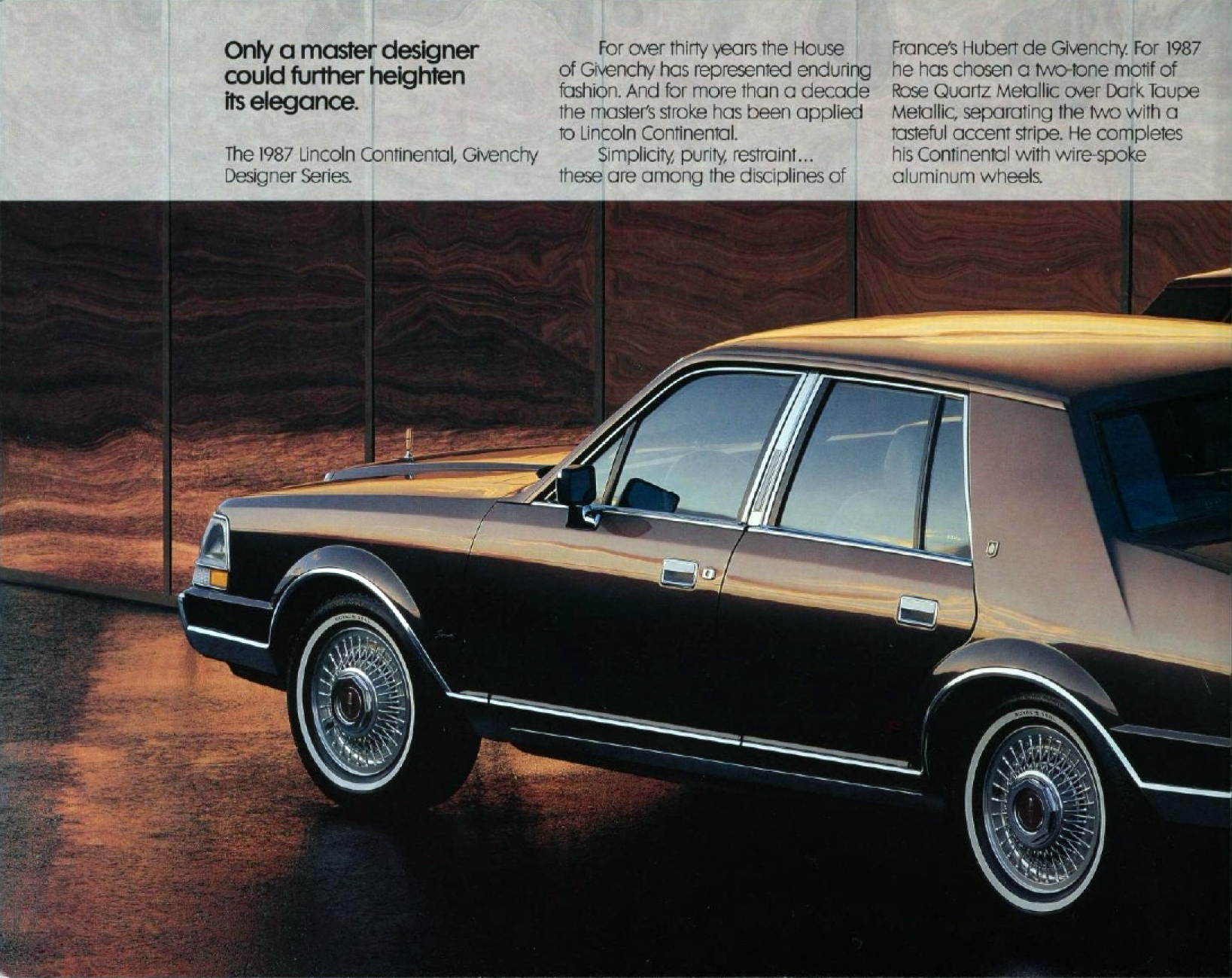
Page from the 1987 Lincoln Continental brochure
Over its six-year lifespan, Lincoln notably increased the Continental’s base equipment level. By 1987, base exterior and mechanical equipment included quad halogen headlamps, an illuminated/keyless entry system, a power antenna, power-assisted rack-and-pinion steering, an Electronic Air Suspension with automatic level control, four-wheel anti-lock disc brakes, and P215/75R15 white sidewall tires (a size still readily available) on 15-inch forged aluminum wheels. Inside, every Continental for that year included fingertip speed control, interval windshield wipers, Automatic Climate Control, power windows, power door locks, six-way power-adjusted Twin Comfort Lounge cloth seats, and an AM/FM stereo cassette radio with a six-speaker Premium Sound System.
Options & Production Numbers
The now well-equipped Continental offered relatively few options for 1987. Exterior and mechanical options included Glamour paint ($268), dual-shade paint ($320), a power glass moonroof ($1,319), a Traction-Lok differential ($101), puncture sealant white sidewall tires ($200), and wire-spoke aluminum wheels ($693). Interior options included an automatic-dim day/night mirror ($89), an Anti-Theft Alarm System ($200), leather seat surfaces ($569), and the Ford JBL high fidelity 12-speaker audio system ($506).
For $4,300 over the base Continental, the Givenchy Designer Series made the wire-spoke aluminum wheels and leather seat surfaces standard. Special Givenchy two-tone paint and specific trim were also added.
1987 was a decent year for Lincoln’s mid-size sedan. Despite being at the end of its life cycle, 17,597 were sold. This Continental was also the last of the bustlebacks, as Cadillac’s second-generation Seville sedan (1985) and Chrysler’s Imperial coupe (1983) had already departed.
The View From 2025
Continentals of this era do attract some collector interest—though not as much as the Mark VIIs and Town Cars—and there is club support. Being based on the Fox platform means that some mechanical issues are more straightforward and less expensive to solve than they might otherwise be (and that some mild performance upgrades are easier).
According to Hagerty’s valuation tools, all the money for a 1987 Continentals in #1/Concours condition is a somewhat astounding $21,100, with a far more normal #3/Good condition version going for $6,800. These Continentals are sometimes available in the Hemmings Motor News classifieds, on eBay Motors, or on Bring a Trailer, and, as previously discussed, they occasionally show up at auction.
In February 2022, a 1986 Honda Prelude Si sold on Bring a Trailer for $7,500. This appearance made me wonder why I hadn’t yet written about any Prelude.
“We are lots of fun.”
1986 brought few changes to Honda’s Prelude sports coupe, which continued in both base and Si versions. A visual distinction from 1985 was the high-mounted brake lamp, along with a few more exterior color choices.
The Si‘s salient feature was its engine—the B20A 110 bhp 2.0 liter/120 ci inline four with three valves per cylinder and fuel injection. Making ten more horsepower than the base Prelude meant that it was about half a second faster to get from 0-60 mph—spritely but not fast at a little over 9 seconds.
A five-speed manual transmission was standard, with a four-speed automatic optional. Fuel economy was respectable at 25 city/30 highway by the day’s standards with the manual transmission (22/28 by modern measures). As might be expected, the automatic dropped ratings by 8% in the city and 3% on the highway. With a 15.8-gallon fuel tank, a Prelude Si‘s proud new owner could expect a range of 335 to 390 miles with a 10% fuel reserve.
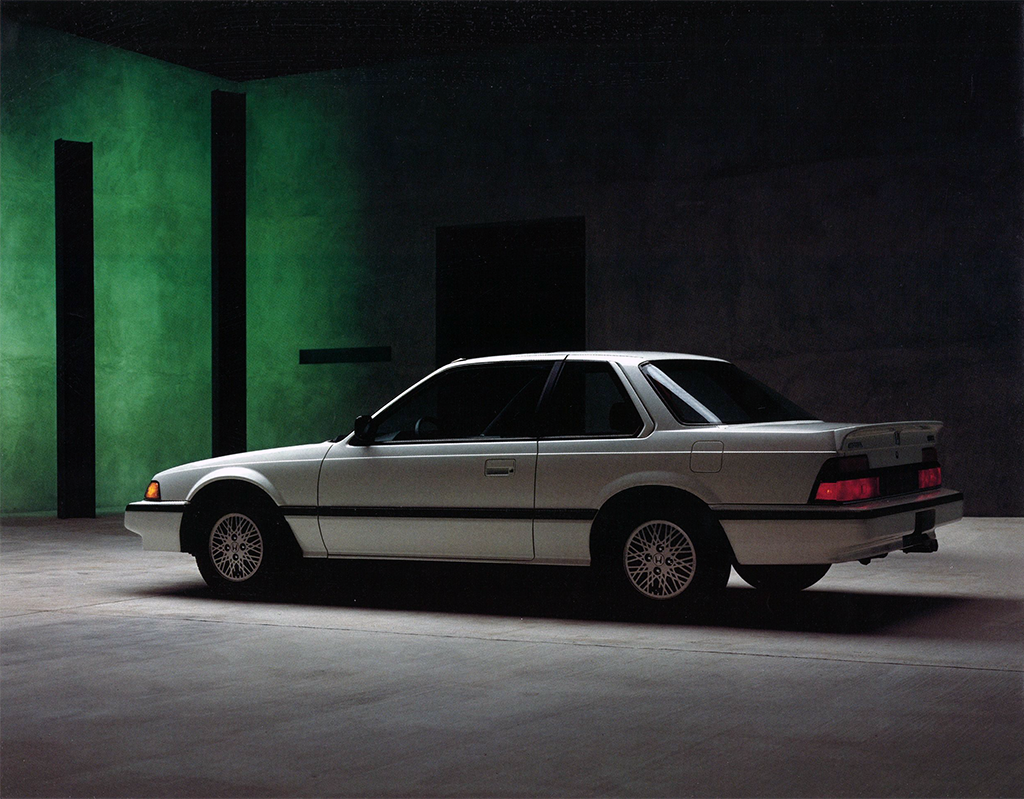
Prelude Si photo from the 1986 Honda full-line brochure
By 1986 standards, the $12,955 Prelude Si—about $38,700 in today’s dollars or about what a 2026 Prelude is expected to go for—came well-equipped. Standard exterior and mechanical equipment included a power moonroof (a Prelude trademark), power windows, power mirrors, power disc brakes, and Michelin 185/75R13 steel-belted radial tires (a size still somewhat available) on Custom 13-inch alloy wheels. Inside, air conditioning, cruise control, a leather-wrapped steering wheel, and cloth front bucket seats were included. The stereo featured electronic quartz tuning, an autoreverse cassette player, a seven-band graphic equalizer, and four speakers.
These second-generation Preludes were a revelation when introduced for the 1983 model year, replacing the somewhat ungainly first-generation coupes that had been introduced in the late 1970s. They come from a period when Honda styling seemingly could do no wrong—Road & Track called the second-generation Preludes “handsome, satisfying, exciting.”
“The good-looking car at the great-looking price.”
Hyundai was new to the United States in 1986, and the first product they sold was the Excel, available in hatchback coupe, hatchback sedan, and sedan versions.
The Excel L‘s standard powertrain was a 4G15 68 bhp 1.5 liter/90 ci inline four with a carburetor paired with a four-speed manual. The GL and GLS upmarket trims included a five-speed manual and had a three-speed automatic available as an option. Whichever transmission was chosen, the Excel was not exactly fast: Car and Driver reported a 0-60 time of just over 16 seconds.
Fuel economy by 1986 standards was 28 city/31 highway with the four-speed manual—24/28 by current measures. Predictably, the five-speed manual was better on the highway than the three-speed automatic. With a 10.6-gallon fuel tank on all but the GLS/automatic combination, Excel owners could expect a range of between 235 to 300 miles with a 10% fuel reserve.
Designed by Giorgetto Giugiaro, the Excel’s styling was pleasing, if somewhat anonymous. At the time, some Hyundai executives were concerned that it looked a little too much like the concurrent Izuzu I-Mark/Chevrolet Spectrum—also designed by Giugiaro.
1986 Hyundai Excel advertisement
With a base price of $4,995 (about $14,700 in today’s dollars), the Excel L was the second cheapest car for sale in the United States—the Yugo GV was, of course, the most affordable. One of Hyundai’s strategies was to differentiate with standard equipment compared to the economy car competition. Thus, standard exterior and mechanical equipment included halogen headlamps, an electric rear window defroster, front-wheel drive, rack-and-pinion steering, power front disc/rear drum brakes, and name-brand Goodyear Corsa P155/80R13 all-season tires (a size still available) on 13-inch styled steel wheels. Inside, a lockable glove box, a color-keyed dash, vinyl reclining front bucket seats, and split fold-down rear seats were included.
Moving up to the $5,895 GL added tinted glass, styled steel wheels with hub covers and wheel trim rings, a remote hatch release, dual remote control rearview mirrors, an analog quartz clock, a full center console, cloth/vinyl front bucket seats, and Luxury door trim with cloth inserts.
The top-of-the-line $6,395 GLS included full wheel covers, thicker carpeting, a color-keyed Luxury steering wheel, cloth front bucket seats with driver’s side height and lumbar adjustment, and a Panasonic ETR AM/FM stereo cassette deck with auto-reverse and two speakers.
Options & Production Numbers
Individual options were few—a power sliding sunroof, Goodyear Corsa P175/70R13 all-season tires on aluminum alloy wheels, air conditioning, and a Panasonic ETR AM/FM stereo cassette deck with auto-reverse, Dolby noise reduction, and four speakers. Initial reviews of the Excel were decent and initial sales were quite strong, with 168,882 sold in the 1986 model year.
The View From 2025
The view of the Excel from today is not so kind. The Excel turned out to be notably less reliable than the Yugo and also had significant rust problems—even compared to other mid-1980s economy cars. Hyundai now barely acknowledges the Excel, though it occasionally gets mentioned in press releases. I haven’t seen a first-generation Excel in many years.
Make mine Medium Red Metallic, please.
This post is my first Hyundai article, but one of many on vanished vehicles.






 Eighties Cars