1985 Volkswagen Jetta GLI sedan

“… a true German road car …”

Volkswagen’s Jetta sedan was all-new for the North American market for the 1985 model year. The top-of-the-line version (and the one that attracted the most attention from the “buff books”) was the GLI. The Jetta was a small car by modern standards—the 171.7-inch length makes it more than a foot shorter than the 2025 Jetta.

Under the hood was a 100 bhp 1.8 liter/109 ci inline four with Bosch KE-Jetronic fuel injection. A five-speed manual transmission completed the rest of the powertrain—an automatic transmission was optional. Car and Driver recorded a 10.9-second 0-60 time and a 108 mph top speed in a vehicle with a 2,460-pound curb weight. Fuel economy was rated at 26 city/32 highway (23/29 by today’s measures); a 14.5-gallon gas tank gave a 340 to 375-mile range with a 10% fuel reserve.

Front cover of the 1985 Volkswagen Jetta GLI brochure

The Jetta GLI’s base price was $10,315—about $31,600 in 2025 dollars and just a little less than the 2025 Jetta GLI goes for. Standard exterior and mechanical equipment included a front spoiler, aerodynamic halogen headlights, tinted glass, quick ratio power assisted rack and pinion steering, power-assisted four wheel disc brakes with the front brakes ventilated, and 185/60HR14 performance series steel belted radial tires (a size still readily available) on 14-inch styled alloy wheels. Inside, fully reclining front sport bucket seats with adjustable headrests, a 4-spoke leather-wrapped Sport steering wheel, a leather shift knob, a center console, and an electric rear window defroster were included.

Options & Period Reviews

Individual options were relatively few and included a manual sunroof ($335), metallic paint ($150), air conditioning ($725), cruise control, and an AM/FM stereo cassette with four speakers ($575). The $595 power-assist group included power windows, power door locks, and power mirrors.

The 1985 Jetta GLI got good reviews—Car and Driver‘s tagline was “one of the most capable sport sedans.”

The View From 2025

Second-generation Jettas have a following, and GLIs are occasionally featured in the Hemming’s Motor News classifieds, eBay Motors, and Bring a Trailer.

Make mine Black, please.

I have also written about the 1981 Dasher station wagon, the 1981 Sirocco S hatchback coupe, the 1983 Rabbit GTI hatchback coupe, and the 1985 Cabriolet.

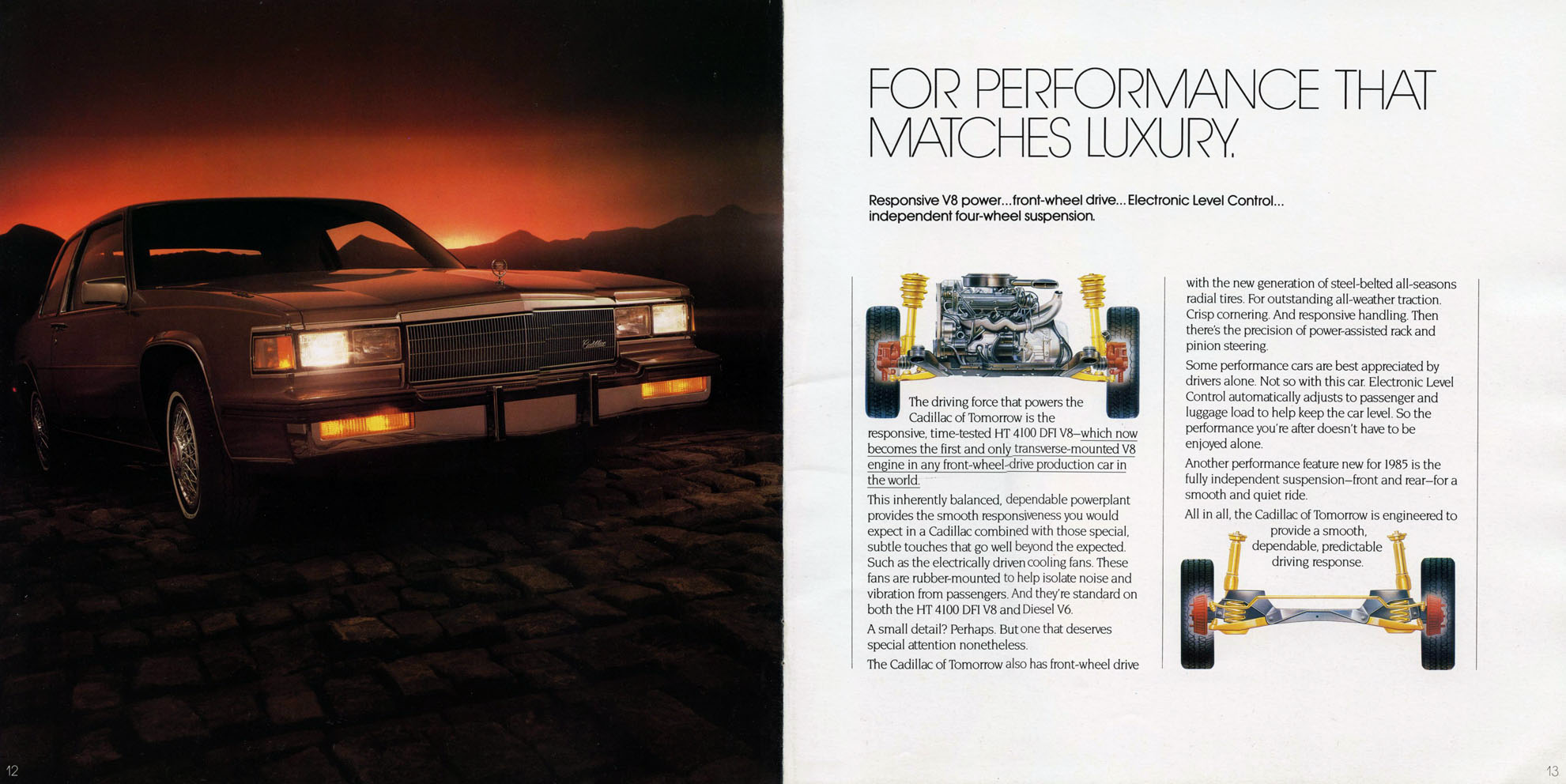
1985 Buick Electra sedan

“Engineered well into the future.”

The 1985 Buick Electra sedan was substantially downsized from the previous year and switched to front wheel drive. The big sedan’s overall length decreased by over two feet from 221.3 inches to 197 inches, while shipping weight dropped by about 14%. Design details of the all-new Electra included a front-hinged hood, a flush-mounted windshield, and a flush-mounted back window.

Standard power came from the LK9 110 bhp 3.0 liter/181 ci V6 with a two-barrel carburetor. Optional engines were the 125 bhp LG3 3.8 liter/231 ci multi-port fuel-injected V6 ($260) and the 85 bhp LS2 4.3 liter/261 ci V6 diesel ($390). All engines were teamed with a four-speed automatic transmission with overdrive. For 1985 only, Buick named base model Electras by their engine size—Electra 300, Electra 380, and Electra 430. The 3.0 liter V6 was discontinued in the middle of the 1985 model year, and the diesel V6 would be gone by the time the 1986 model year rolled around.

MotorWeek clocked a 0-60 time of 12 seconds flat in a 1985 Electra with the 3.8 liter V6. Mileage for the short-lived standard engine was 18 city/25 highway by the 1985 measures (16/23 by today’s standards). Hilariously, the upmarket 3.8 liter engine was rated at 19 city/26 highway, the precision of the multi-port fuel injection more than making up for the increased displacement. Buyers of the diesel could expect 22 city/32 highway. With an 18-gallon gas tank, an Electra 380 owner could expect a range of 335 to 360 miles with a 10% fuel reserve.

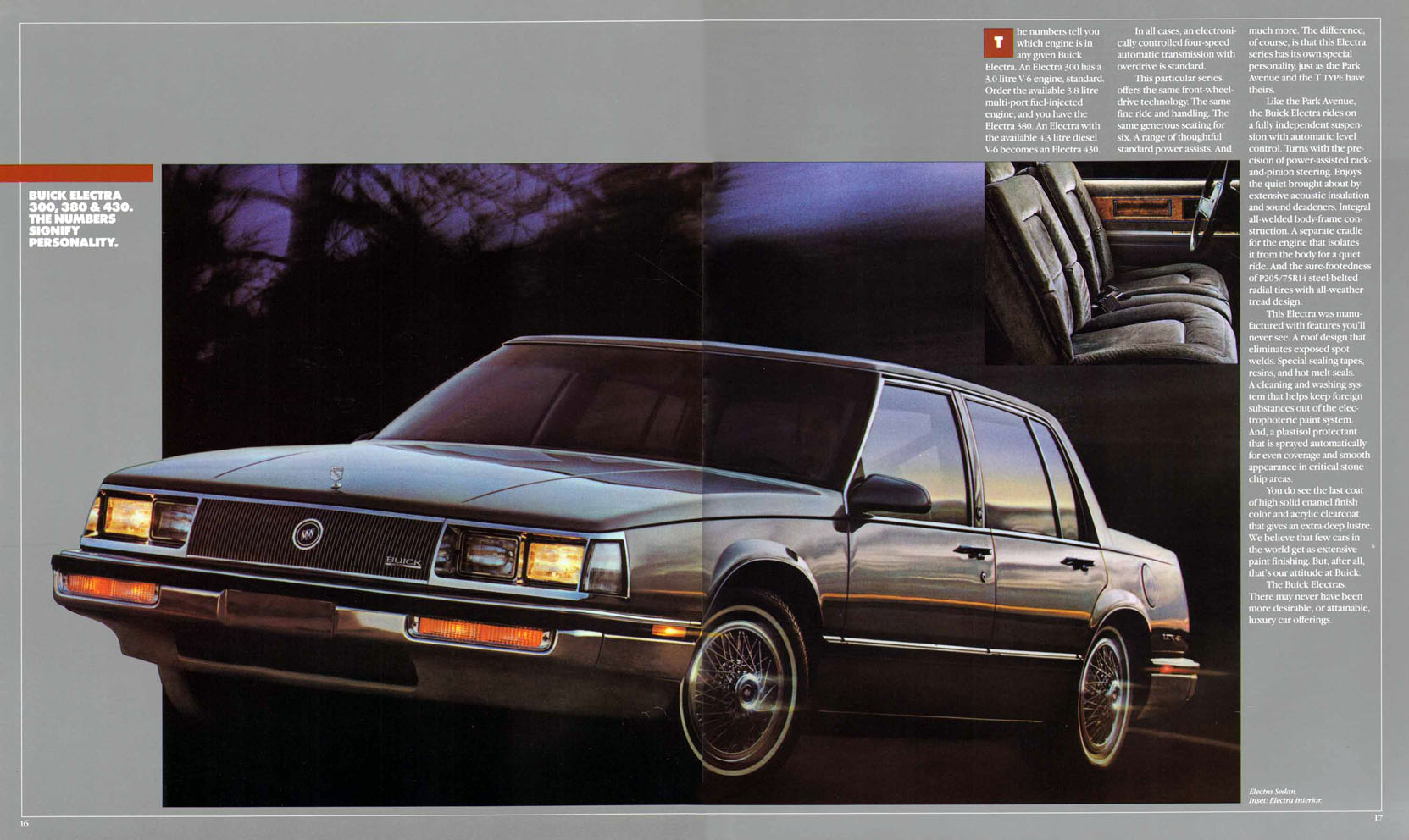
Pages from the 1985 Buick Electra brochure

The Electra 300‘s base price was $14,331—approximately $43,800 in 2025 dollars and about what a 2025 Buick Enclave full-size crossover goes for. Standard exterior and mechanical equipment included Soft-Ray tinted glass, rack-and-pinion steering with power assist, an independent four-wheel suspension, automatic level control, low drag power front disc/rear drum brakes, and P205/75R14 steel-belted radial-ply blackwall tires (a size still available thanks to Hankook and Kumho) on 14-inch wheels. Inside, cloth 45/55 notchback front seats, a six-way power driver’s seat, manual seatback recliners, air conditioning, power windows, and an electronically-tuned AM/FM stereo radio with clock were standard.

An Electra purchaser could go in two directions if the base model wasn’t enough—more luxury or a sporting touch. Most buyers opted for luxury, which continued to be represented by the Park Avenue. The $16,240 Park Avenue added whitewall tires, a tilt steering column, Electronic Cruise Control, electric door locks, an electric trunk release, and an electronically-tuned AM/FM stereo radio with seek and scan and clock. The Park Avenue included the 3.8 liter V6, but allowed buyers to choose the diesel.

Choosing the $15,568 T TYPE added black accents, a Gran Touring suspension (higher-rate springs, larger shock absorbers, and bigger front and rear stabilizer bars), styled aluminum alloy wheels, cloth 45/55 front sport seats with a storage console, and a leather wrapped Sport steering wheel. The T TYPE included and required the 3.8 liter V6.

Options & Production Numbers

Individual options included an electric sliding glass Astroroof ($1,195), a six-way power passenger’s seat ($215), Electronic Touch Climate Control air conditioning ($165), Twilight Sentinel headlamp control ($60), an electric rear window defogger ($140), and the all-conquering Delco GM/Bose Music System ($895).

55/45 leather front seats ($425) were only available with the Park Avenue. Options only available for the T TYPE included 45/45 leather front Sport seats ($175) and Goodyear Eagle GT P215/65R15 performance tires paired with 15 x 6 inch aluminum wheels.

These C-bodies (there were also Cadillac and Oldsmobile versions) had a stately appearance. Big and (I think) handsome, they had a lot of interior room despite the downsizing—at 111 cubic feet, they had only one cubic foot less than the 1984.

Sales of the 1985 Electra sedan and its variants were good—at 131,011 sedans, more than double the 52,551 that had been sold in 1984. It’s unclear what percentage of buyers went with the Park Avenue or the T TYPE, but I’m betting that the Park Avenue was quite popular.

The View From 2025

C-body Electra sedans sometimes come up for sale in the Hemming’s Motor News classifieds and on eBay Motors. Bring a Trailer has sold four from this generation, including two 1985s.

Make mine the extra-cost ($200) Blue Firemist, please.

I have written about the top-of-the-line 1989 Electra Park Avenue Ultra sedan—likely Buick’s finest sedan of the eighties. The only other 1985 Buick I have written about is the Somerset Regal coupe.

1985 BMW 535i sedan

As I dropped my parents off at church on a Sunday morning a few years ago, I saw a BMW 535i parked on a side street.

“Civilization without isolation”

The 535i version of BMW’s 5-series was introduced in 1985. The 35 in the designation indicated that the sedan newly included BMW’s 182 bhp M30B34 3.4 liter/209 ci inline six with Bosch Motronic fuel injection. A Getrag 265 five-speed manual was standard, and a four-speed automatic was available. 0-60 came in a little under eight seconds in a car with a 3,200-pound curb weight. Fuel economy was rated at a chastening 16 city/22 highway by the day’s standards (14/20 by today’s measures). With a 17.2-gallon gas tank, a 535i owner could expect a range of 265 to 290 miles with a 10% fuel reserve.

1985 BMW 535i print advertisement

The 1985 535i’s base price was $30,760—about $93,900 in today’s dollars and well more than any non M-branded 5 series goes for in 2025. Standard exterior and mechanical equipment on the 535i included a two-position electric sunroof, a fully-independent suspension, power steering, anti-lock power disc brakes, and 200/60-390 tires (a size still readily available thanks to Michelin) on 390 cm wheels. Inside, leather seats, electronic climate control, and an Onboard Computer were included.

Options included a limited slip differential ($390) and electrically adjustable front seats ($415).

The View From 2025

Like most BMWs from the eighties, the 535i attracts collector interest, and there is support from BMW car clubs. According to Hagerty’s valuation tools, all the money for a 1985 BMW 535i in #1/Concours condition is $32,200, with a more normal #3/Good condition car going for $8,400. 535i’s frequently appear for sale in the Hemming’s Motor News classifieds, on eBay Motors, and on Bring A Trailer.

Make mine New Polaris Metallic, please. I know silver is a BMW and other German car cliché, but sometimes a cliché is correct.

Other BMWs I have written about include the 1982 733i sedan, the 1983 633CSi coupe, the 1984 325e coupe, the 1987 L6 coupe, the 1987 M6 coupe, the 1988 M3 coupe, and the 1988 750iL sedan.

1985 Oldsmobile Cutlass Ciera sedan

One of my regular readers and commenters mentioned that he once owned a 1985 Oldsmobile Cutlass Ciera sedan. Longtime followers of this blog know that’s a great way to inspire an article—especially with the knowledge that I had already written about the Buick, Chevrolet, and Pontiac versions of the A-car.

“You always win with a mid-size leader in high style.”

For 1985, Oldsmobile’s Cutlass Ciera received its first facelift, with updates to the front fascia that included a new grille and sleeker headlights. The taillamps were revised, and a high-center mount stop lamp was optional one year before it would be required.

The Ciera’s standard powertrain remained the Iron Duke 92 bhp 2.5-liter/151 ci inline four with fuel injection paired with a three-speed automatic transmission. The LK9 110 bhp 3.0 liter/181 ci V6 with a two-barrel carburetor added $260, while the LG3 125 bhp 3.8 liter/231 V6 with multi-port fuel injection cost $520. The LT7 85 bhp 4.3 liter/263 ci diesel V6 was $260. A four-speed automatic was $175.

The best case 0-60 time was about 11 seconds with the 3.8 liter V6 and the four-speed automatic. Fuel economy ratings for the same combination were 18 city/25 highway by the day’s standards (16/23 by today’s measures). With a 15.6-gallon gas tank, the owner of the quickest Ciera could expect a range of 275 to 300 miles.

The owner of a Ciera with the base Iron Duke/three-speed automatic powertrain might as well have been driving a different car. Their 0-60 time was more like 16 seconds. Fuel economy ratings were an impressive 23 city/32 highway by 1985 standards (21/29 by 2025 measures). With the same 15.6-gallon gas tank, the owner of that Ciera could expect a range of 355 to 385 miles.

Ciera LS page from the 1985 Oldsmobile Cutlass brochure

The 1985 Cutlass Ciera LS sedan was $9,497—about $28,900 in today’s dollars. Standard exterior and mechanical equipment included a front-end panel stand-up ornament, power rack and pinion steering, low drag power front disc brakes, P185/75R14 steel-belted radial-ply all season blackwall tires, and Deluxe wheel discs. Inside, a Custom bench seat with a center armrest in either cloth or vinyl and an AM push-button radio with dual front speakers and a fixed mast fender antenna were included.

Moving up to the $9,998 Brougham added bright rocker panel and wheel opening moldings, a Convenience Group (lamps, visor vanity mirror, and chime tones), knit velour trims, and a divided front seat with individual controls and a center armrest.

One Package, Options, & Production Numbers

Oldsmobile continued to offer a sporty ES package for the Ciera. Built on the LS sedan and adding $895, the ES included a firm ride and handling package, P195/75R14 steel-belted radial-ply blackwall tires on 14-inch wheels with styled wheel discs, reclining bucket seats, and a console with shifter.

Individual options included Soft-Ray tinted glass, a glass panel sunroof ($310), styled aluminum wheels, a four-season air conditioner, and cruise control ($175). Custom leather trim was only available with the Brougham. Three optional radios were offered, with the top-of-the-line being an ETR AM/FM stereo cassette with auto reverse, seek and scan, noise reduction, extended range speakers, and a clock.

August 1983 Fortune magazine cover

Oldsmobile sold 118,575 LS sedans and 112,441 Brougham sedans, making Ciera sedans 21% of total Oldsmobile production. Cieras overall were two out of every seven sales at an average Oldsmobile dealer. Cieras were also relatively reliable and had few, if any, recalls—a significant improvement over the X-cars.

Of course, the Ciera was one of the four poster children for Fortune magazine’s brutal but accurate August 22nd, 1983 cover. Many believe that cover alone changed the future direction of GM styling, but perhaps that course-correction came too late.

The View From 2025

I see these A-body cars as basic and honest, and believe they deserved their sales numbers. Cutlass Cieras sometimes show up for sale in the Hemmings Motor News classifieds or on eBay Motors, though this is increasingly unusual. Bring a Trailer has sold four Cieras.

Make mine Light Chestnut Metallic, please.

Other A-bodies I have written about include the 1983 Pontiac 6000 STE sedan, the 1985 Chevrolet Celebrity Eurosport coupe, the 1986 Buick Century sedan, and the 1989 Chevrolet Celebrity sedan. Blog entries on Oldsmobiles with the Cutlass name include the 1980 Cutlass coupe, the 1981 Cutlass Supreme coupe, and the 1985 Cutlass Supreme coupe.

1985 Chevrolet Celebrity Eurosport coupe

“Celebrity precision.”

1985 was the second year for the Eurosport version of Chevrolet’s Celebrity. Designated as RPO ZV8, the Eurosport followed one year after the introduction of Pontiac’s STE version of the 6000. Among the notable changes for 1985 was the addition of multi-port fuel injection for the H.O. V6, along with hydraulic motor mounts for all engines.

Powertrains, Performance, & Standard Equipment

Despite its sporting pretensions, the Eurosport came standard with the same LR8 Iron Duke 92 bhp 2.5 liter/151 ci inline four with throttle-body fuel injection and four-speed manual that was the base powertrain on “civilian” Celebrities. Many Eurosport buyers upgraded to the LB6 H.O. 130 bhp 2.8 liter/173 cu V6 ($435), which was paired with a choice of a three-speed automatic ($425) or a four-speed automatic ($600).

With the H.O. engine and the four-speed automatic, 0-60 times were a little over 10 seconds in the 2,700 pound Eurosport. Fuel economy was decent with the same powertrain—19 city/28 highway by the day’s standards (17/26 by 2025 standards). With a 16.4-gallon gas tank, a Eurosport owner could expect a range of 320 to 345 miles with a 10% reserve.

Eurosport coupe pages from the 1985 Chevrolet Celebrity brochure

Standard exterior and mechanical equipment on the $8,301 Eurosport coupe (about $25,000 in today’s dollars) included blackout exterior trim, a red accent stripe, fast-ratio power steering, a “special” version of the F41 sport suspension with gas-charged struts and shocks, and P195/75R-14 blackwall all-season steel-belted radial tires on 14 x 5.5 inch Rally wheels. Inside, blackout instrument panel trim and a Sport steering wheel were included—otherwise, a low-optioned Eurosport looked plain inside.

Standard equipment on all Celebrity coupes included “front-drive” (still worth noting in 1985 advertisements), rack and pinion steering, and power front disc/rear drum brakes. Inside, coupe buyers got a two-passenger cloth front bench seat with a center armrest, side window defoggers, and an AM push-button radio with dual front speakers.

Options & Production Numbers

With standard equipment relatively spare, many options were available for the 1985 Celebrity Eurosport coupe. Exterior and mechanical options included Custom Two-Tone paint ($148), tinted glass ($110), dual remote sport mirrors ($91), P195/70R-14 Goodyear Eagle GT blackwall tires ($60), and aluminum wheels ($306).

Inside, cloth reclining front bucket seats ($147), a console ($105), a Gage Package with trip odometer ($64), electronic speed control ($175), power door locks ($125), power windows ($185), air conditioning ($730), and a Comfortilt steering wheel ($110) were all available. Five different optional radios were available, with the top-of-the-line being the UX1 ETR AM stereo/FM stereo radio with seek and scan, cassette player with search and repeat, clock, graphic equalizer, and extended range sound system ($504).

A loaded Eurosport coupe could frequently near $12,000—real money in those days and about $36,400 now.

Production numbers for the 1985 Eurosport coupe are hard to come by, but we do know that Chevrolet sold a total of 29,010 Celebrity coupes in that year. The sedan (239,763 sold) and the wagon (86,149) did far better.

The View From 2025

Eurosports of any type rarely appear in the Hemming’s Motor News classifieds or on eBay Motors, and one has yet to be seen on Bring a Trailer.

Make mine Dark Blue Metallic, please.

Other A-bodies I’ve written about in this blog include the 1983 Pontiac 6000 STE sedan, the 1986 Buick Century sedan, and the 1989 Chevrolet Celebrity sedan—I guess I owe the Oldsmobile Cutlass Ciera some attention.

1985 Volvo 740 Turbo station wagon

“… an unmistakable outlaw edge.”

The 700 series Volvos had been available in the United States for a few years before Volvo brought the station wagon to our shores to offer Volvo loyalists a step up from the aging 240. The most interesting version of the 700 series wagon to enthusiasts was the 740 Turbo, which was formally introduced in the middle of the 1985 model year.

The 740 Turbo‘s standard engine was a B230FT 160 bhp 2.3 liter/141 ci inline four with fuel injection, a Garrett T3 turbocharger, and an intercooler. A four-speed manual was standard, while a four-speed automatic with overdrive was optional. Car and Driver recorded a 0-60 time of 7.9 seconds in a 740 Turbo sedan with the manual. With the manual, mileage in the 3,042-pound car was rated at 19 city/25 highway by the day’s standards (17/23 by today’s standards). With a 15.8-gallon fuel tank, 740 Turbo drivers could expect 285 to 310 miles of range with a 10% reserve.

1985 Volvo 740 Turbo station wagon advertisement

The 1985 740 Turbo station wagon’s base price was $21,340—about $64,400 in today’s dollars or about what a 2025 V90 Cross Country Ultra station wagon goes for. Standard exterior and mechanical equipment included tinted windows, a front spoiler, halogen high and low beam headlights, a manual sunroof, power-assisted rack-and-pinion steering, power-assisted disc brakes, and 195/60R15 Michelin MXV tires (a size still readily available) on 15-inch wheels. Inside, a rear window wiper/washer, power door locks, cargo tie-down rings, and air conditioning were included. Trim and upholstery features included adjustable front bucket seats with integrated head rests and lumbar support, a heated driver’s seat, a 60/40 split rear seat, and full carpeting including the trunk.

Options & Reviews

Like all Volvo models in the 1980s, the 740 Turbo had few individual factory options—you chose the exterior and interior colors, and that was about it. Cruise control and an AM/FM-stereo radio/cassette with four speakers ($800) were available.

The automobile press of the day liked the 740 Turbo wagon, and it’s interesting to watch MotorWeek‘s review. Common complaints were the lack of an oil pressure gauge—considered essential for turbocharged engines at that time—along with the “archaic” driver’s seat height adjustment. Everyone also felt the need to comment on the Volvo’s very square design.

The View from 2025

All vintage Volvos have strong club support, and there is definite collector interest in the 740 Turbo. 740 Turbo station wagons are often available in the Hemmings Motor News classifieds, on eBay Motors, and at online auctions such as Bring a Trailer that cater to the eighties car market.

Make mine Silver, please.

Other Volvos that have been covered in Eighties Cars are the 1985 240 station wagon and the 1987 780 coupe. I should write about a Volvo sedan or two at some point.

1985 Oldsmobile Cutlass Supreme coupe

It was Thanksgiving Day in the United States a few years ago. I dropped off my parents in the late morning and temporarily headed home. On the way, I spotted a mid-1980s Cutlass Supreme coupe driving in the other direction. It looked unmodified in its original Light Chestnut Metallic.

“When a champion performs, it has a style all its own.”

For 1985, Oldsmobile’s Cutlass Supreme coupe gained a new grille. Little else changed, though the sporty 4-4-2 package replaced the Hurst/Olds package that had been available in the 1983 and 1984 model years.

The Cutlass Supreme’s standard engine remained the LD5 110 bhp 3.8 liter/231 ci V6 with a Rochester M2ME two-barrel carburetor. The optional engines were the LV2 140 bhp 5.0 liter/307 ci V8 with a Rochester M4ME four-barrel carburetor ($490) and the LF9 105 bhp 5.7 liter/350 ci diesel V8 ($490). A three-speed automatic transmission was standard, while a four-speed automatic was available with the gasoline V8. Mid-eighties Cutlass Supremes were stylish but relatively slow—the best-case V8 and the four-speed automatic yielded a 0-60 time of about 13 seconds. Mileage with the V8 was 17 city/24 highway by the day’s standards (15/22 by today’s standards); with an 18.1-gallon fuel tank, a Cutlass Supreme owner could expect a range of about 300 to 330 miles with a 10% fuel reserve.

Cover of 1985 Oldsmobile Cutlass Supreme brochure

The base Cutlass Supreme coupe was $9,797—about $29,700 in 2025 dollars. Standard equipment included power steering, power front disc brakes, and P195/70R14 blackwall tires (a size still readily available) on 14-inch wheels with Deluxe bright wheel discs. Interior equipment included a Custom front bench seat in either cloth or vinyl, Deluxe seat belts, a Deluxe steering wheel, and an AM pushbutton radio with dual front speakers and a fixed mast antenna.

At $10,486, the Cutlass Supreme Brougham added a velour divided front bench seat with individual controls, Convenience Group, and (of course) specific Brougham ornamentation.

Options & Production Numbers

Options included a power Astroroof with sliding glass roof panel ($925), a full padded vinyl roof ($245), Four-Season air conditioning ($750), power windows ($195), and cruise control ($175).

The Cutlass Supreme coupe remained one of Oldsmobile’s sales stars, though numbers did not match the halcyon days back in the seventies and early eighties. Lansing sold 75,045 of the base coupes, along with another 58,868 of the Brougham coupes.

The View From 2025

A few folks are collecting these cars, but they aren’t common at shows. You do see eighties Cutlass Supremes for sale in the Hemming’s Motor News classifieds, on eBay Motors, and at online auctions such as Bring a Trailer that cater to the eighties car market, though non-Hurst/Olds or 4-4-2 versions are relatively rare. As I was updating this blog entry in March 2025, there was a Light Teal Blue Metallic 1985 Cutlass Supreme Brougham coupe with blue cloth seats, a 5.0 liter/307 ci V8 with a four-barrel carburetor, and 75,000 miles listed on Hemming‘s for $19,500.

Make mine Dark Teal Blue Metallic, please.

As of early 2025, the most viewed post overall on Eighties Cars is one on the 1981 Oldsmobile Cutlass Supreme coupe that I wrote back in 2015. Other rear-wheel-drive G-platform (designated A-platform before 1982) cars I have written about include the 1984 Buick Regal Grand National coupe, the 1983 Chevrolet Malibu sedan, the 1981 Chevrolet Monte Carlo Sport Coupe, the 1983 Chevrolet Monte Carlo SS Sport Coupe, the 1980 Pontiac Grand Am coupe, and the 1987 Pontiac Grand Prix coupe. I’m shocked I haven’t yet written about Oldsmobile’s Hurst/Olds or 4-4-2 variants.

Last updated March 2025.

1985 Dodge Shelby Charger hatchback coupe

At Mecum Kissimmee 2022, a Dodge Shelby Charger sold for $12,000.

“32% nastier.”

For 1985, the Dodge Shelby Charger gained an upgraded engine. Gone was the 107 bhp naturally aspirated inline four, replaced with a Turbo I 146 bhp 2.2 liter/135 ci inline four with fuel injection and (natch) a turbocharger. Dodge added a power bulge to the hood to clear the turbocharger, and, of course, there were new Turbo badges. Inside, the high back front bucket seats were notably improved. This combination of changes yielded a substantially improved Shelby Charger over what was initially released in the middle of the 1983 model year.

Shelby Charger pages from the 1985 Dodge Performance brochure

With the aid of a 2,456-pound curb weight, 0-60 mph came in a little under 8 seconds—sprightly for a reasonably priced sport coupe in 1985. Fuel economy ratings were 19 city/29 highway by the day’s standards (17/26 by today’s measures). With a 13-gallon gas tank, the owner of a Shelby Charger could expect a range of 250 to 280 miles with a 10% fuel reserve.

Standard exterior and mechanical equipment on the $9,553 Shelby Charger included tinted glass, halogen headlamps, a rear spoiler, rack and pinion steering, power front disc/rear drum brakes, and P205/50VR15 Goodyear Eagle tires (a size still readily available) with 15-inch cast aluminum wheels. Inside, a Rallye cluster with a tachometer and trip odometer, a front console, a power liftgate release, a Sport steering wheel, and the aforementioned high back front bucket seats were included.

Options & Production Numbers

Options included a removable glass sunroof ($315), a rear window defroster ($132), a rear cargo area tonneau cover ($69), air conditioning ($643), and two upmarket stereos. A $779 Sun/Sound/Shade Discount Package included the sunroof, an AM/FM Premium stereo with cassette, and black rear deck window louvers.

Dodge produced 7,709 Shelby Chargers for the 1985 model year, making that year the second-highest production of the five years the model was available. After 1987, the front-wheel-drive Charger would be gone, replaced by the Shadow.

The View From 2025

Shelby Chargers have their followers as a part of Dodge’s storied high-performance history. They are sometimes available in the Hemmings Motor News classifieds, on eBay Motors, and at online auctions such as Bring a Trailer that cater to the eighties car market. As I update this blog post in April 2025, there’s a Burgundy/Silver 1987 Shelby Charger with a gray interior and 51,000 miles for sale on Hemmings, asking $12,400.

Make mine Santa Fe Blue Metallic, please. That also gets me the silver stripe.

I have also written about the 1985 Omni GLH hatchback sedan.

Last updated April 2025.

1985 Volvo 240 station wagon

When I was growing up in the Philadelphia suburbs in the mid-eighties, Volvo 240 station wagons were everywhere. They were respected, but not appreciated. Now, they’re becoming collector cars, and I see them infrequently.

“… a car whose quality you can both see and feel.”

For 1985, Volvo’s 240 sedan and station wagon gained a revised “low friction” engine with slightly increased horsepower. Otherwise, there were few changes to a design that had been in production since the 1975 model year.

The 240’s standard powertrain was a B230F 114 bhp 2.3 liter/141 ci inline four with fuel injection paired to a four-speed manual. A four-speed automatic with overdrive was optional. 0-60 mph likely took a little over 12 seconds with either transmission. With the manual transmission, mileage in the 3,042-pound car was rated at 23 city/28 highway by the day’s standards (20/26 by today’s standards). With a 15.9-gallon gas tank, 240 drivers could expect 330 to 365 miles of range with a 10% fuel reserve.

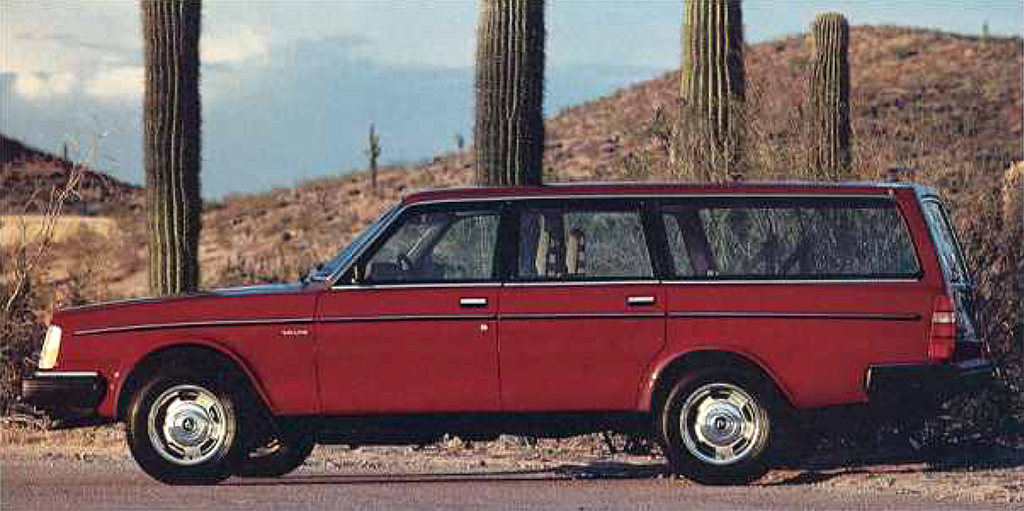
Volvo 240 DL station wagon photo from the 1985 Volvo brochure

By 1985, the 240 was no longer as spare as it had been a few years before. Standard exterior and mechanical equipment for the $14,690 240 DL station wagon (about $45,300 in today’s dollars) included tinted windows, a front spoiler, power-assisted rack-and-pinion steering, power-assisted disc brakes, and 195/75R14 tires on 14-inch wheels. Inside, a rear window wiper/washer, power door locks, cargo tie-down rings, and air conditioning were included. Trim and upholstery features included adjustable front bucket seats with integrated head rests and lumbar support and full interior carpeting.

Moving up to GL added an engine compartment light, power windows, an intermittent setting for the rear window wiper/washer, a small diameter steering wheel (I’m not sure why this was notable or a positive), and a heated driver’s seat.

Volvo 240s had few individual factory options—you chose the trim level and the color, and that was about it. They continued to sell in decent numbers—the 1985 240 station wagon moved about 68,000 units worldwide.

The View from 2025

All vintage Volvos have strong club support, and there is definite collector interest in what 240 owners call “bricks”—enough for Hagerty to offer a buyer’s guide. According to Hagerty’s valuation tools, all the money for a 1985 Volvo 240 GL station wagon in #1/Concours condition is $52,300, with a far more normal #3/Good condition version going for $13,800. 240 station wagons are often available in the Hemmings Motor News classifieds, on eBay Motors, and at online auctions such as Bring a Trailer that cater to the eighties car market.

Make mine Dark Red, please.

Other Volvos that have been covered in Eighties Cars include the 1985 740 Turbo station wagon and the 1987 780 coupe.

Last updated November 2025.

My Eighties Car Departs

In the spring of 2021, I had a major medical issue that involved lower back surgery. Close followers of this blog might have noticed the paucity of posts between late January and late May.

When I returned home from not one but two hospitals, one of the first things that came to mind was what to do with my 1985 Chevrolet Corvette coupe. With its hard-riding Z51 sport suspension and challenging entry/exit, this car is not for someone who has had back surgery—and I don’t believe in keeping cars around that we don’t drive.

After thinking about it for a while, I decided to auction my Corvette on Bring a Trailer at no reserve—there was nothing that would want me to keep the car. I chose Bring a Trailer in part because I wanted to reach a wide audience: I figured that my 1985’s Light Blue Metallic color was a love it or hate it deal, and I wanted potential bidders to be able to self-sort.

I filled out the vehicle submission form, and the next step was to get the car photographed. Bring a Trailer‘s assigned professional came out in mid-July on what must have been the hottest day of the summer. He took many both accurate and complimentary photos of the car.

In late August, the auction began. Like most Bring a Trailer auctions, it ran for slightly over a week. I was eager not to misrepresent the car but equally interested in putting its best face forward. This desire meant that I spent a lot of time in the comments section.

The 1985 leaves

Three days after the auction ended, the winning buyer sent one of his employees out to pick up the car. He loaded the car onto an open trailer (very on-brand for the purchase venue) in the light rain. A few minutes later, he drove away, and my life with a 1985 Corvette ended.

I was sad to see the Corvette go, but not unhappy. My view is that the car owed us nothing—we enjoyed it for seventeen years and it was our ticket to many interesting experiences. I hope the new owner has as much fun with this C4 as we did.