Midway through the 1982 model year, the Lamborghini Countach received a larger version of its V12. With that, the model designation changed from LP400 S to 5000S. Just because (why not?), this version was also sometimes called the LP500 S.
The engine requires some more detail. The 4.8 liter/291 ci V12 came with six Weber carburetors and made 325 bhp in North American form. With the standard five-speed manual, the 0-60 time was 5.7 seconds. As might be expected, fuel economy by the day’s standards was not impressive—12 city/18 highway (10/13 by 2025 measures). At least the two 15.4-gallon gas tanks allowed a range of 320 to 370 miles before a 5000S driver had to search for more premium fuel.
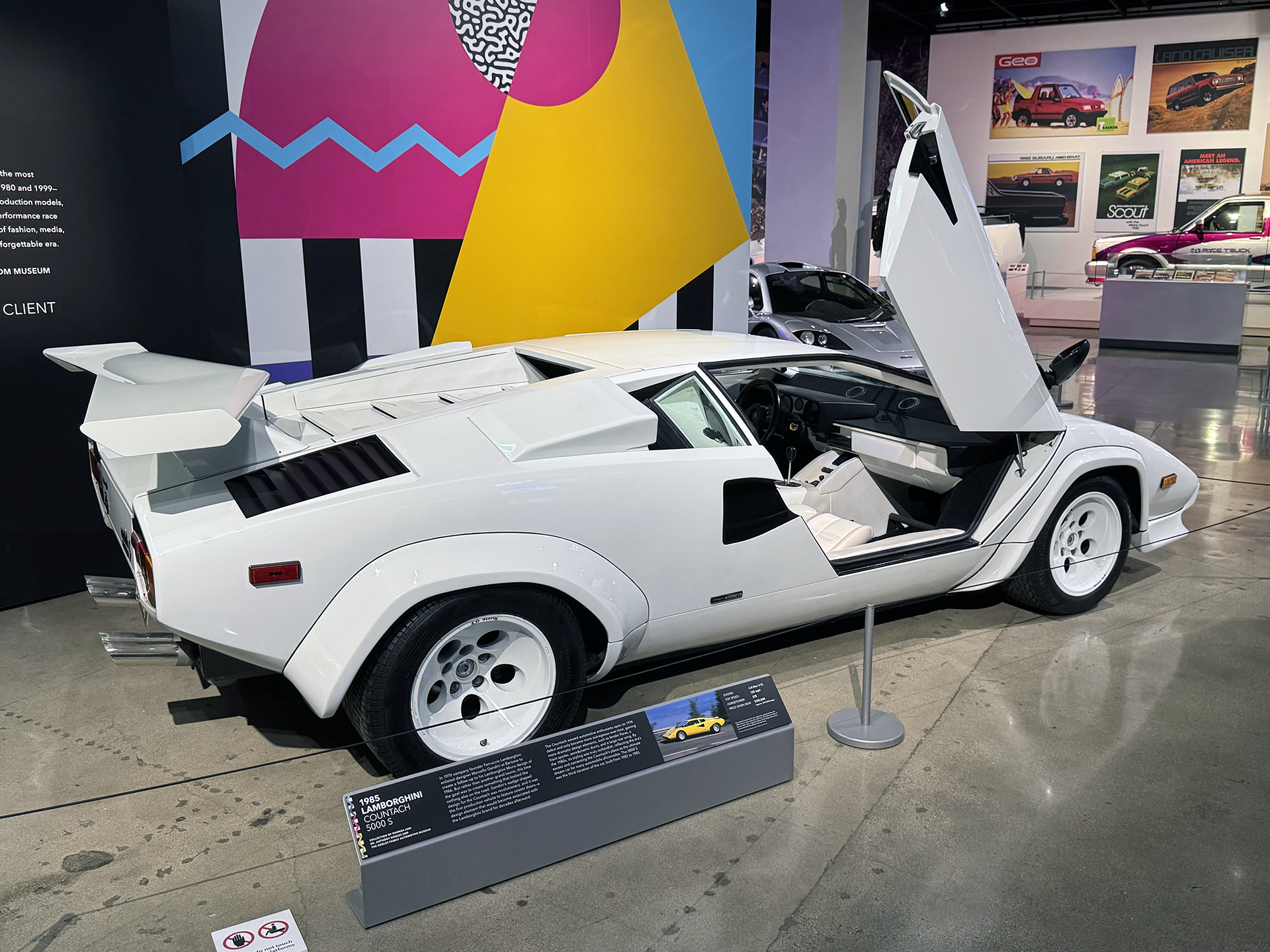
1985 Lamborghini Countach 5000S coupe at the Peterson Museum
I saw Countachs of various types at the wonderful Petersen Automotive Museum in Los Angeles in late 2025, and it was a great reminder of how vertically short these cars are—the spec for the 5000S was 42.1 inches. When Lamborghini released the Countach LPI 800-4 homage for the 2022 model year, it was actually 2.7 inches taller.
The 1982 Countach 5000S‘s base price was an eye-watering $99,500—about $342,000 in today’s dollars, or about 14% less than what a 2026 Lamborghini Temerario coupe goes for (Lamborghinis have gotten no cheaper in the last forty years) . Standard exterior and mechanical equipment included rack-and-pinion steering, ventilated disc brakes, and 205/50ZR15 front tires and 345/35ZR15 rear tires (both Pirelli P7s) on 15-inch wheels. Inside, leather bucket seats, a tilt-and-telescoping steering wheel, and air conditioning were included.
Options & Production Numbers
Options included a rear wing ($5,500), a sports exhaust, gold wheels, and a series of stereos (including a $3,000 one from Alpine).
Lamborghini built 321 5000S Countachs from March 1982 through March 1985. At that point, the Countach Quattrovalvole took over.
The View From 2025
The view from 2025 is just fine, thank you—according to Hagerty’s valuation tools, all the money for a 1982 Countach 5000S in #1/Concours condition is an astounding$676,000. A more “normal” #3/Good condition example is valued at $407,000. 5000Ss frequently appear for sale in the Hemmings Motor News classifieds, on Bring a Trailer, and at in-person auctions.
Make mine Black, please.
The 5000S is the first Lamborghini I have written about in Eighties Cars. Another 1985 exotic I have written about is the Ferrari Testarossa coupe.
For some reason, I’m always interested in the last year of a “failed” model. Usually, not much gets changed, as the manufacturer’s hopes have already been dashed. For Labor Day 2025, we’ll cover the fruits of Ford’s labors for the 1982 model year.
“Three distinctive series, each built to be driven with pride.”
For 1982, Ford’s Thunderbird personal luxury coupe added a 3.8 liter V6 option, and removed the 4.9 liter V8 option. A Tripminder trip computer was a new option, and the gas tank size increased to 21 gallons. Otherwise, Ford changed little besides colors and trims.
Ford engine availability and power ratings were still in decline in 1982—except if you were purchasing a Mustang. The Thunderbird’s standard powertrain was the Thriftpower Six 87 bhp 3.3 liter/200 ci inline six with a one-barrel carburetor paired with a SelectShift three-speed automatic transmission. Powertrain upgrades were available: buyers could specify the aforementioned Essex 112 bhp 3.8 liter/232 ci V6 with a two-barrel carburetor or the Windsor 120 bhp 4.2 liter/255 ci V8 with a Motorcraft two-barrel carburetor. Both of the optional engines cost $241.
The Thunderbird was a notably different car depending on the engine choice. Looking at the table, it’s hard not to believe that the new Essex engine was the winner—almost as quick as the Windsor V8, and with notably better fuel mileage than either the inline six or the V8.
Thriftpower Six (3.3 liter inline six)
Essex (3.8 liter V6)
Windsor (4.2 liter V8)
0-60 mph (approximate)
17.3 seconds
13.2 seconds
12.6 seconds
Fuel mileage (1982 standards)
17 city/24 highway
19 city/30 highway
17 city/26 highway
Range (10% fuel reserve)
315 to 345 miles
375 to 415 miles
330 to 365 miles
Pages from the 1982 Ford Thunderbird brochure
Standard exterior and mechanical equipment on the $8,492 base Thunderbird (about $29,400 in today’s dollars) included concealed rectangular halogen headlamps, variable ratio power rack and pinion steering, power front disc/rear drum brakes, full wheel covers, and P-metric white sidewall steel-belted radial ply tires. Inside, a Flight bench seat in fine-ribbed cloth and vinyl trim, a day/night inside mirror, a trip odometer, a quartz electric clock, and an AM radio were included.
Packages, Options, & Production Numbers
Ford continued to decontent the $9,703 Town Landau (approximately $33,600 now), so its price was closer to the base Thunderbird compared to 1980. Moving up still added Luxury wheel covers, dual remote control mirrors, diagnostic warning lights, interval windshield wipers, a tilt steering wheel, and an AM/FM stereo radio. The Luxury vinyl roof—a padded rear half vinyl roof with a color-coordinated wrapover band and coach lamps—was also standard on the Town Landau. Finally, the included Interior Decor Group added cloth covered head restraints (vinyl if vinyl trim was purchased), Decor door trim panels with assist straps, and a choice of either split bench seats with dual recliners in higher level knit cloth fabric or bucket seats with console.
For the second year, the Heritage edition was the top-of-the-line Thunderbird ($12,472 then, $43,100 now). Exterior and mechanical features the Heritage edition added over the Town Landau included front cornering lamps, complete tinted glass, rocker panel moldings, the 3.8 liter V6 engine, an Automatic Overdrive transmission, and wire wheel covers. Inside, the Heritage edition included a 6-way power driver’s seat, an electronic instrument cluster, air conditioning with manual controls, the power lock group, and an AM/FM stereo search radio.
Every Heritage edition buyer also got a padded rear half vinyl roof with a brushed aluminum wrapover band, coach lamps, and a frenched backlight. They also received the Interior Luxury Group, which included split bench seats with dual recliners in crushed velour cloth, cloth covered head restraints, a Luxury steering wheel, an automated parking brake release, a right hand visor illuminated vanity mirror, 18-oz floor carpeting, burled rosewood woodtone instrument and door panel appliques, the Light Group (dual beam map light, instrument panel courtesy lights, and engine compartment light), power side windows, interval windshield wipers, diagnostic warning lights, an electronic digital clock, and Luxury luggage compartment trim.
Individual options included a flip-up open-air roof ($276), metallic glow paint ($80), a Tu-Tone paint/tape treatment ($128-206), the Keyless Entry System ($319), Recaro bucket seats with a console ($523/$405/$222 depending on series), the SelectAire conditioner with automatic temperature control ($754 for all but the Heritage, which charged $78), and the Tripminder trip computer ($215-261). Nine different audio selections were available, ranging up to an electronic AM/FM stereo search radio with a cassette tape player and the Dolby noise reduction system ($318/$233/$87), which could be paired with the Premium Sound System ($133-187).
Ford sold 45,142 Thunderbirds in the 1982 model year, which was the lowest number since 1975. It was handily outsold by all four of the mid-size GM coupes: Buick Regal, Chevrolet Monte Carlo, Oldsmobile Cutlass, and Pontiac Grand Prix. It would take the next Thunderbird design in 1983 to redress this balance.
The View From 2025
According to Hagerty’s valuation tools, a 1982 Thunderbird with the V8 in #1/Concours condition is $17,400, with a far more typical #3/Good “normal” Thunderbird with the six going for $6,500. This generation of Thunderbirds maintains a presence in the Hemmings Motor News classifieds, on eBay Motors, and on Bring a Trailer, but you see very few 1982 examples. As I update this blog entry in October 2025, there’s a Silver Metallic 1980 with gray cloth seats and the 255 ci V8 on Hemmings, showing 73,000 miles and asking $11,500.
Make mine the extra-cost Medium Blue Glow, please.
1982 was the final year for the first generation of Honda’s Prelude Sport Coupe. Honda changed little from the 1981 model year—the major variation was more dealer accessories. Two of the three available exterior colors also changed.
The Prelude’s engine was the EK CVCC 75 bhp 1.8 liter inline four with a three-barrel carburetor. The standard transmission was a five-speed manual, and a three-speed automatic was available. 0-60 mph came in about 11.5 seconds in a car with a curb weight of 2,138 pounds. EPA fuel economy ratings with the manual were 29 city/40 highway by the day’s standards. With a 13.2-gallon gas tank, the owner of a 1982 Prelude with the five-speed could expect a range of 335 to 365 miles with a 10% fuel reserve.
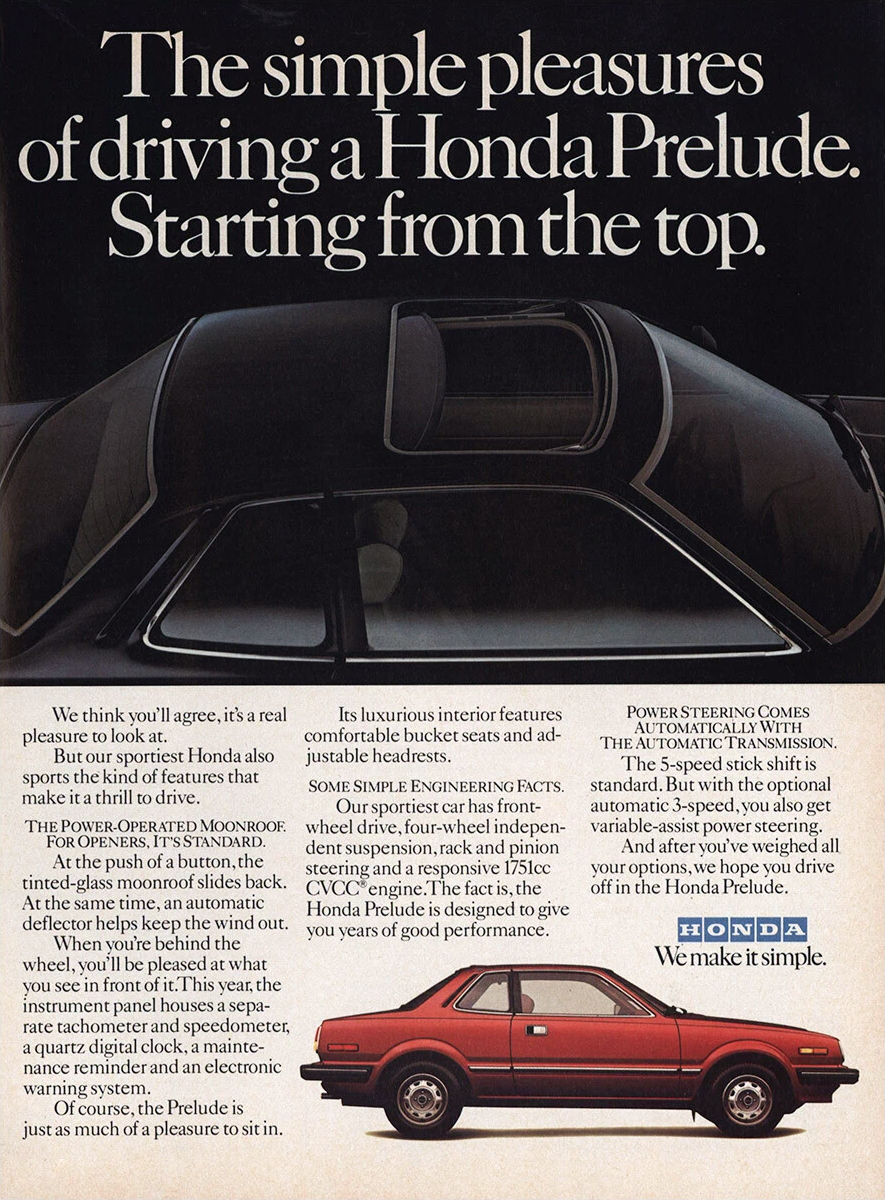
1982 Honda Prelude print advertisement
The 1982 Prelude Sport Coupe’s base price was $7,995—about $27,700 in today’s dollars or almost exactly what a 2025 Honda Civic hatchback sedan goes for. Standard exterior and mechanical equipment included tinted glass, a power-operated moonroof, rack and pinion steering, power-assisted front disc/rear drum brakes, and 175/70SR13 steel-belted radial ply tires (a size still available) on 13-inch wheels with bright metal wheel trim wings. Inside, reclining front bucket seats with 4-way adjustable headrests, a four-spoke Sport steering wheel, two-speed plus intermittent wipers, a quartz digital clock, front side window defrosters, a remote trunk release, and a rear window defroster were included.
Accessories & Production Numbers
There were no factory options for the Prelude other than transmission and paint color. Dealer accessories included aluminum alloy wheels and air conditioning. Dealers also offered twelve (!) audio choices, ranging up to an AM/FM stereo radio with electronic tuning, a digital display, and an autoreverse cassette with Dolby—but I would probably have just given Crutchfield a call.
Honda sold 37,872 Preludes in the United States in the 1982 model year—a solid finish for the first generation.
The View From 2025
There’s Prelude news right now—Honda promises that the Prelude will be coming back for the 2026 model year. Closer to our topic, first-generation Preludes were once commonly seen on American roads, but have virtually disappeared by now. You occasionally see these Preludes for sale in the Hemmings Motor News classifieds, on eBay Motors, and on Bring a Trailer.
Make mine Windsor Blue Metallic, please. Honda offered a grand total of three color choices for the 1982 Prelude. More color choices for the Prelude wouldn’t come until the 1985 model year arrived.
On my birthday, here’s a big, comfortable eighties convertible.
“A classic in its own time.”
After being considered by Buick since the early 1960s, the 1982 model year’s most significant news for the Riviera was the advent of the first production convertibles—though the division didn’t deliver the first examples until July 1982. Every Riviera convertible began life as a “normal” Riviera coupe built at GM’s Linden, NJ assembly plant. Cars destined to become convertibles were assembled with neither a rear seat nor a headliner and were finished in either White or Red Firemist paint with maple leather interiors.
Buick then shipped these coupes about 675 miles to American Sunroof Corporation (ASC) in Lansing, MI, where the involved process of changing them to convertibles began. This procedure required cutting the top off, strengthening the body, adding a different rear seat (narrower than the one fitted to the coupe), and installing the white diamond-grain vinyl convertible top and the associated electronics for the power top’s operation. This process took more than 300 parts and required a quoted 10 hours of labor per car—both notable additions. Once completed, new Riviera convertibles underwent two separate leak tests to ensure the top’s integrity before being shipped to Buick dealers. Buick general manager Lloyd Reuss was quoted as saying, “it’s not a hacksaw job,” perhaps comparing it to contemporary efforts from Chrysler and Ford.
Advertisement for the 1982 Buick Riviera convertible
Additional standard equipment packaged with the Riviera convertible included contrasting body-side stripes, four-wheel disc brakes, Custom locking wire wheel covers, deluxe trunk trim, 45/45 leather seats, and the aforementioned Firemist paint (if one went with red). Convertible-specific components included a power-operated convertible top, a cloth headliner, power-operated rear quarter windows, and a “special” radio speaker system. It was a good thing that Riviera convertibles came well-equipped because they were really expensive—with a base price of $24,064, 1982’s droptop Riv was about 66% more expensive than its coupe relation’s barrier to entry. In constant dollars, the sixth-generation convertibles are easily the most costly production Rivieras ever built.
Options & Production Numbers
Exterior and mechanical options for the convertible included door edge guards ($15), an 85-amp Delcotron generator ($35), tungsten-halogen high beam headlamps ($10), and Twilight Sentinel headlamp control ($97). Inside, electric seat back recliners for the driver and front passenger ($139 each), Electronic Touch Climate Control air conditioning ($150), and a tilt and telescoping steering column ($150) were available. Buick offered five optional radios for the Riviera, ranging up to a Delco ETR AM-FM stereo radio with a cassette tape player, CB, and Triband power antenna.
For all its expense—a Riviera convertible started at about $80,200 in today’s dollars—the convertible made and continues to make a distinct impression. A friend of mine who has owned his Riviera convertible since new remembers viewing one at a Buick dealership and thinking it was one of the most beautiful cars he had ever seen.
Buick sold 1,248 Riviera convertibles in the 1982 model year, making the droptop 2.8% of overall production. Approximately sixty were part of Buick’s Select 60 program for top dealers.
The View From 2025
There’s robust discussion and support for the sixth-generation Riviera on the AACA’s Buick Riviera page. According to Hagerty’s valuation tools, a 1982 Riviera convertible in #1/Concours condition is $40,600, with a far more normal #3/Good condition going for $12,900. Riviera convertibles often come up for sale in the Hemmings Motor News classifieds, on eBay Motors, on Bring a Trailer, and at in-person auctions.
Make mine Red Firemist, please.
Other sixth-generation Rivieras I have written about include the 1980 S TYPE and the 1984 T TYPE. I should write about a “civilian” coupe at some point.
Most material in this blog entry was sourced from the unfinished Riviera Project.
November 1, 1982 was an incredibly important date for Honda. That day, a Charcoal Gray Metallic 1983 Honda Accord sedan rolled off the production line at Honda’s Marysville, Ohio plant. That car is currently on exhibition at the marvelous Henry Ford Museum of American Innovation.
The only engine available for any 1983 Accord was the EK1 75 bhp 1.8 liter/107 ci inline four with a three-barrel carburetor. A five-speed manual was standard, while a four-speed automatic transmission was newly available. Consumer Guide clocked a 13.0-second 0-60 time with the manual, which they charitably described as “brisk.” Fuel economy ratings were 32 city/45 highway by the day’s standards (25/32 by today’s measures). With a 15.9-gallon gas tank, an Accord driver could expect a range of between 410 and 495 miles.
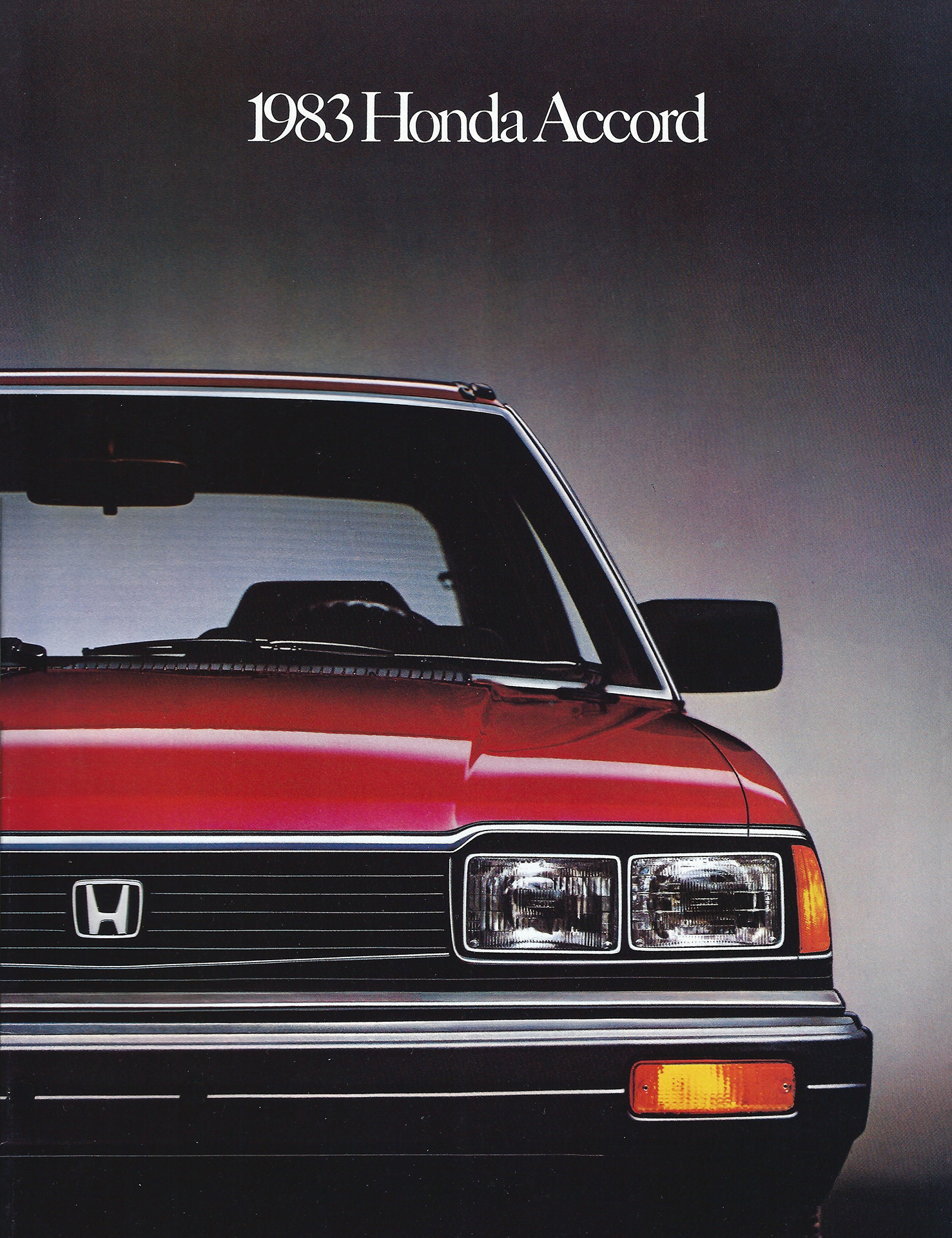
Cover of 1983 Honda Accord brochure
The 1983 Honda Accord sedan’s base price was $8,345—about $27,500 in today’s dollars, which is almost exactly what a 2025 Honda Accord LX sedan goes for. Standard exterior and mechanical equipment included dual halogen headlights, tinted glass, variable-assist power rack and pinion steering, power disc/rear drum brakes, and P185/70R13 steel-belted radial ply tires on 13-inch wheels. Inside, cloth reclining front bucket seats with adjustable headrests, cruise control, two speed plus intermittent wipers, a rear window defroster, a remote-control outside rearview mirror, a remote trunk lid release, a tachometer, and a quartz clock with a sweep hand were standard.
One Package, Dealer Options, & Production Numbers
In the middle of the model year, Honda released the Accord Special Edition. The SE added a power sunroof, aluminum alloy wheels, Michelin steel-belted radial tires, leather seats, air conditioning, dual remote-controlled outside mirrors, power windows, power locks, and an AM/FM digital electronic stereo with a stereo cassette player with Dolby noise reduction, a seven-band graphic equalizer, and a power antenna.
There were no factory options—you chose the transmission and the color, and that was it. All options were dealer-installed, including air conditioning for non SE‘s ($500) and eight different radios.
Honda produced 221,137 Accords for the 1983 model year. Comments on the Accord’s build quality from the automotive press continued to range from admiring to stunned—Consumer Guide commented on their test Accord’s “lustrous” paint and “formidable” quality control.
The View From 2025
Second-generation Accords were once prevalent on American roads, but have virtually disappeared by now. You occasionally see these Accords for sale in the Hemmings Motor News classifieds, on eBay Motors, and on Bring a Trailer, but there were no sedans out there as I write this in May 2025.
Writing about the 1981 Mercedes-Benz 380 SEL sedan recently got me looking at what writers of the day thought were its competitors. I posted about the Jaguar XJ6 a couple of years ago—perhaps it’s time to finally finish this post about the 733i.
“Engineered for drivers, not onlookers.”
For 1982, BMW’s top-of-the-line 733i sedan received a slight horsepower bump. Otherwise, things changed little from 1981, when the significant upgrade had been the introduction of a five-speed overdrive manual. The general look and marketing of the 7-series remained about the same as it had been when BMW launched it in 1977.
The 733i’s standard powertrain was the M30B32 181 bhp 3.3 liter inline six coupled to the aforementioned five-speed manual. More than forty years later, the manuals are popular with collectors, but the smart money is that most 733i’s were ordered new with the three-speed automatic ($775). With the manual, 0-60 came in about eight seconds—crazy fast for a sedan in 1982, let alone one with a curb weight of almost 3,600 pounds. Fuel economy was rated at 19 city/29 highway mpg—with a 22.5-gallon gas tank, a 733i driver could expect a range of 395 to 435 miles with a 10% fuel reserve.
1982 BMW 733i advertisement
The $33,315 733i (about $114,700 in today’s dollars or almost what a 2025 760i xDrive sedan goes for) came well-equipped. Standard exterior and mechanical equipment included tinted glass, halogen high beam lights, an electric dual position sunroof, power assisted steering, power assisted four wheel disc brakes, and P205/70R14 steel-belted radial tires (a size still readily available) on 14-inch light alloy wheels. Inside, leather upholstery, fully adjustable front bucket seats, an adjustable telescopic steering column, electric windows, an electric central locking system, air conditioning, and an AM/FM stereo cassette radio with an electric antenna were included. The famous deluxe toolkit was integrated into the trunk.
The View From 2025
Like many BMWs, the 733i does attract collector interest, and there is support from BMW car clubs. According to Hagerty’s valuation tools, all the money for a 1982 BMW 733i in #1/Concours condition is $32,200, with a more normal #3/Good condition car going for $8,400. 733i’s frequently appear for sale in the Hemming’s Motor News classifieds, on eBay Motors, and on Bring A Trailer.
Make mine New Polaris Metallic, please. I know silver is a BMW and other German car cliché, but sometimes a cliché is correct.
Ford’s EXP two-seat coupe was new for the 1982 model year and introduced early in April 1981. Ford’s first two-seat car since the 1957 Thunderbird, the EXP was designed for a far different purpose. Built on the same platform as the Ford Escort/Mercury Lynx twins and closely related to the Mercury LN7, the EXP was marketed as a car for buyers who wanted an efficient and decently equipped vehicle somewhat sportier than the Escort.
The design language of the EXP resembled that of the contemporary Fox-body Mustang. However, front-wheel-drive and a different platform made the proportions different, which some observers saw as ungainly (or worse). I remember thinking that it was different-looking, but not unattractive.
Ford’s new two-seater was a small car—a length of 170.3 inches makes the EXP more than half a foot shorter than the 2020 Honda Civic coupe. However, the EXP’s length was almost seven inches longer than an Escort hatchback coupe, while its height was over 2.5 inches shorter. Because Ford made the EXP reasonably well-equipped, its weight was about 125 pounds greater than the spare base Escort.
The EXP’s standard powertrain was a CVH 70 bhp 1.6 liter/98 ci inline four with a Motorcraft 740 two-barrel carburetor paired with a four-speed manual. An automatic transmission was optional for $411. EPA fuel economy ratings with the manual were 29 city/46 highway by the day’s standards. With an 11.3-gallon gas tank, an EXP owner could expect a range of 345 to 380 miles with a 10% fuel reserve.
What the EXP wasn’t was anything approaching quick. Figures are hard to find, but the EXP’s 0-60 time was likely about 14.5 seconds. Late in the extended 1982 model year, an HO version of the same engine became available, with 80 bhp. It likely dropped the EXP’s 0-60 time by more than a second, but in this case, HO did not mean fast.
1982 Ford EXP brochure cover
Standard exterior and mechanical equipment on the $7,387 EXP (about $25,200 in today’s dollars) included halogen headlamps, front-wheel-drive, a four-wheel independent suspension, rack and pinion steering, power front disc/rear drum brakes, and P165/80R13 tires (a size now hard to find) on 13-inch Sport styled steel wheels with trim rings. Inside, a Sport steering wheel, reclining high-back front bucket seats, a console, a tachometer, an electronic digital clock, and an AM radio with dual front speakers were included.
Packages, Options, & Production Numbers
The optional TR Performance Suspension Package included special handling tuned suspension components (a thicker stabilizer bar, stiffer shocks, and stiffer springs) and P165/70R 365 Michelin TRX tires (still available!) on a choice of either TR Sport aluminum wheels ($405) or Sport steel wheels ($204).
Exterior and mechanical options included tinted glass (initially $82 but standard later in the model year), a flip-up open air roof ($276), power steering ($190), and cast aluminum wheels ($232). Inside, options included an air conditioner ($611), fingertip speed control ($151), leather/vinyl reclining low back bucket seats ($138), and a few different stereo choices.
First-year sales of the EXP were decent: 98,258 in a model year that extended from April 1981 through September 1982. Following 1982, sales dropped precipitously—only 19,697 for 1983, 23,016 for 1984, 26,462 for 1985, 30,978 for 1986, and 25,888 for the EXP’s final year in 1987.
The View From 2025
I have not seen an EXP on the road in over fifteen years. EXPs rarely show up for sale in the Hemmings Motor News classifieds and on eBay Motors—in fact, they seem to have virtually vanished. Because Bring a Trailer is … Bring a Trailer, they have sold one EXP.
A friend of mine mentioned recently that he once owned an early Renault Fuego Turbo. As good a reason as any to finally complete this blog post—one I’ve had “in the hopper” for years.
After some sales success in Europe, Renault’s Fuego hatchback coupe became available for sale in the United States in 1982. Based on the Renault 18 sedan and using its floorpan and drivetrain, the Fuego was a different approach to a sporty coupe from what most manufacturers offered in the early eighties. Designed by Michel Jardin, the Fuego’s exterior looked like nothing else on the market, though some saw faint echos of the Porsche 924 and 928.
Two versions of the Fuego were available on its debut in the USA: the base Fuego coupe and the line-leading Fuego Turbo. The coupe came with an 81 bhp 1.6 liter/101 ci inline four with Bosch L-Jetronic fuel injection mated with a five-speed manual transmission. The Turbo featured an A5L 107 bhp 1.6 liter/96 ci inline four with Bosch L-Jetronic fuel injection and a Garrett T3 turbocharger paired with the same five-speed transmission.
As one might expect, performance was notably different for the two models. With a 2,372-pound curb weight, owners of a new Fuego Turbo could expect a 0-60 time of little over 10 seconds. A base Fuego was about 3.5 seconds slower, putting it in the same category as other slow sporty coupes for 1982, such as Lima-powered Mustangs and Capris and Iron Duke-powered Camaros and Firebirds. Mileage ratings were impressive for either version—the Turbo registered 26 city/39 highway mileage rating by the standards of the day. With a 14.8-gallon fuel, a Fuego Turbo owner could expect a range of 390 to 435 miles with a 10% fuel reserve.
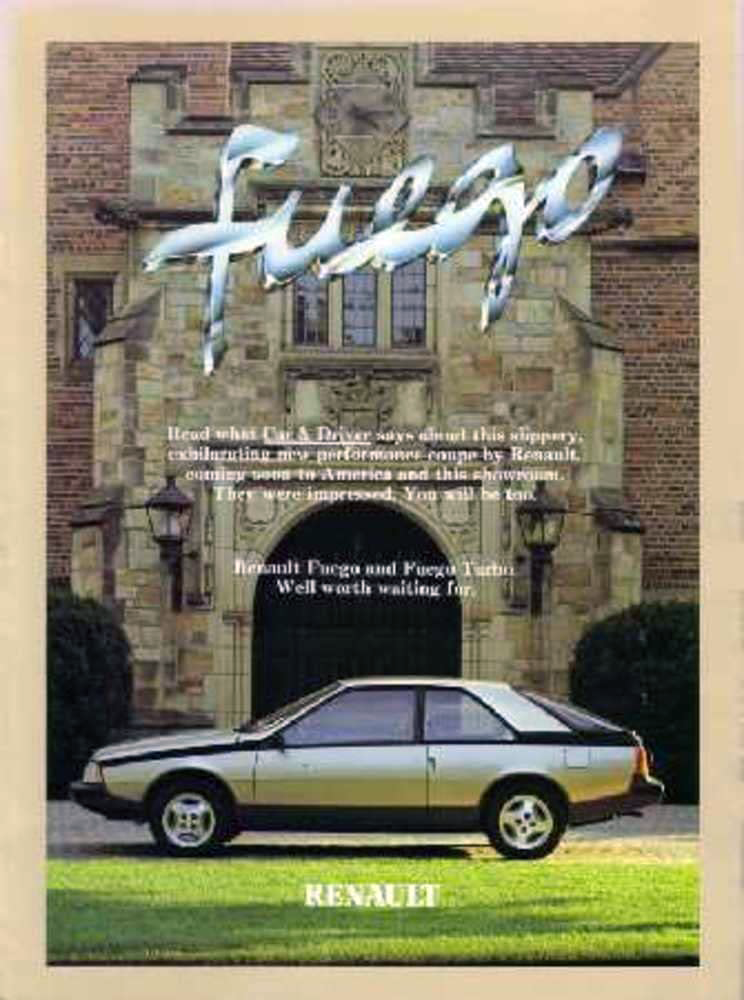
1982 Renault Fuego advertisement
Standard equipment for the $8,654 base Fuego included front-wheel-drive, rack-and-pinion steering, front disc/rear drum brakes, and P185/70R13 tires on 13-inch wheels.
Standard equipment on the $10,704 Fuego Turbo included power rack-and-pinion steering, 190/65 HR 365 (metric) Michelin TRX radial tires on 14.4-inch cast alloy wheels, air conditioning, and an AM/FM stereo. An electric sunroof was a $400 option.
Despite their success in Europe, Fuegos did not sell well in North America, which was Renault’s evident lot in life. Peak sales of 33,229 in 1982 declined every year going forward—by 1986, the Fuego’s last year in the US, they were a mere 4,152.
Those who did buy a Fuego reported that they were generally happy with their choice. A January 1983 Popular Mechanics Owner’s Report found that owners liked the handling and styling, but wanted more power.
According to Hagerty’s valuation tools, all the money for a 1982 Renault Fuego in #1/Concours condition is $5,400, with a more typical #3/Good condition example going for $1,700. For unclear reasons, Hagerty only has values for the base version and not the Turbo. Fuegos rarely show up for sale in the Hemmings Motor News classifieds and on eBay Motors—in fact, they seem to have basically vanished. There was an interesting write-up on the Fuego in OldMotors last year.
Make mine Silver Poly, please.
This post is another first—my first Renault. I should probably cover the Alliance I spent a portion of the early nineties in sometime soon …
One of the many Hallmark vehicle ornaments my ex-wife purchased for me over the years is a 1982 Jeep Scrambler—with a Christmas tree in the bed, of course. It’s part of their All-American Trucks collection.
“… America’s first small 4×4 pickup …”
1982 was the second year for Jeep’s CJ-8 Scrambler pickup truck. For 1982, the Scrambler gained a substantially wider front and rear tread but otherwise was little changed from its debut year.
Based on the Jeep CJ-7 SUV, the Scrambler filled a requirement for a reasonably compact truck in the AMC’s Jeep line, as it was more than 16 inches shorter and almost a thousand pounds lighter than the smallest of Jeep’s J10 Pickup offerings. Its wheelbase was 9.5 inches longer than the CJ-7s, which brought a smoother ride. Of course, the Scrambler had that slightly over five-foot-long truck bed, which some found deficient compared to the more common six-foot bed.
The Scrambler’s standard powertrain continued to be an 86 bhp Iron Duke 2.5 liter/151 ci inline four with a two-barrel carburetor paired with a four-speed manual. The Iron Duke was, of course, sourced from General Motors. One optional engine was available—a $145 110 bhp 4.2 liter/258 ci inline six with a two-barrel carburetor. Either engine could be paired with a five-speed manual, which added $199 to the price and was newly available for 1982, while the inline six could also be mated with a $409 Torque-flite automatic. All Scramblers came with Quadra-Trac part-time four-wheel drive.
The performance of Jeep’s small truck wasn’t exactly sparkling—Car and Driver measured a 0-60 time of 17 seconds with the inline four and the four-speed manual. The inline six gave better—though not great—performance, with 0-60 times in the 12 to 14 second range depending on transmission. Fuel economy ratings for the standard powertrain were 23 city/28 highway by the day’s standards. With a 15-gallon gas tank, a Scrambler owner could reasonably expect a range of 245 to 265 miles with a 10% fuel reserve.
The Scrambler’s base price was $7,588—about $26,300 in today’s dollars, which is well under what a base 2025 Jeep Gladiator pickup truck costs. Standard exterior and mechanical equipment included dual outside rearview mirrors, a drop down tailgate, skid plates for the fuel tank and transfer case, front disc/rear drum brakes, and H78 x 15 Suburbanite XG tires on 15-inch wheels. Inside, linen grain vinyl bucket seats and a color-keyed vinyl mat were included.
Sport packages page from the 1982 Jeep Scrambler brochure
Two Sport packages were available. The first, Sport SR ($799), included Scrambler hood lettering available in three different colors, a spare wheel lock, and high back forward pivoting bucket seats trimmed in denim-look vinyl. Goodyear Tracker P/G OWL L78 x 15 tires sat on 15 x 6 inch white styled steel wheels. Convenience Group was part of SR, featuring an 8-inch day/night mirror, an under hood light, and courtesy lights. Finally, the SR include Decor Group, which included rocker panel protection molding, sports steering wheel, front frame panel, and instrument panel overlay.
The second package, Sport SL ($1,999), included everything in the Sport SR package, with various replacements or additions, the most visible of which was a half-cab hardtop or soft-top. Outside, the SL added two-color Scrambler hood lettering, beltline and door inset pin stripes, and additional chrome trim. Mechanical changes in the SL included hood insulation and heavy duty shocks, while P235/75R15 Wrangler OWL tires were mated with 15 x 7 inch chrome plated styled steel wheels. Inside, the SL included Special high back forward pivoting vinyl bucket seats, Special console and trim panels, a black leather-wrapped steering wheel, a clock, and a tachometer.
Individual Options & Production Numbers
Exterior and mechanical options included a polycarbonate top ($695), a soft vinyl top ($280), halogen fog lamps ($90), power brakes ($95), variable-ratio power steering ($229), a Heavy-Duty cooling system ($103), and a 20-gallon fuel tank. Inside, air conditioning ($650), a tilt steering wheel ($90), and an AM/FM stereo radio ($224) were available.
Scrambler sales for 1982 were … okay, with 7,759 produced, making it 12% of overall Jeep production in a down year for the marque where only Cherokee sales increased. The Scrambler did outsell the larger Jeep J10/J20 Pickup for the second straight model year—but that wouldn’t last.
The View From 2025
Scramblers have a devoted fanbase, and their values reflect that. According to Hagerty’s valuation tools, all the money for a 1982 CJ-8 ScramblerSport SL in #1/Concours condition is $53,800, with a more typical #3/Good condition example going for $32,700. Scramblers frequently show up for sale in the Hemmings Motor News classifieds, on eBay Motors, and on Bring a Trailer.
Make mine Deep Maroon Metallic, please.
This post is the first on Eighties Cars to be informed in some way by my recent acquisition of Flory’s American Light Trucks & Utility Vehicles, 1967–1989. Allpar and Hemmings also were valuable sources as I completed this blog entry. Astoundingly, this was the first Jeep I have covered in a specific post, though Jeeps frequently show up in auction coverage and I wrote about the 1980 Eagle early on. A Wagoneer post wasn’t far behind.
“… one of the fastest production two-liter cars in the world.”
1982 was the final model year for both the Porsche 924 Turbo and the base 924. The 924 S would return in 1987 and 1988, but the 944 would take over as the entry-level Porsche from 1983 to 1986, with the 944 Turbo coming in 1986.
The 924 Turbo‘s engine was a 154 bhp 2.0 liter/121 ci inline four with a single turbocharger and Bosch K-Jetronic fuel injection. 154 bhp isn’t that impressive over forty years later, but in the early 1980s, it marked a significant upgrade from the base 924’s 110 bhp—enough to drop 0-60 times by about two seconds (Road & Track clocked a 9.3 second 0-60). Fuel economy ratings were 20 city/33 highway by the day’s standards. With a 17.4-gallon gas tank, a 924 Turbo driver could expect a range of 375 to 415 miles with a 10% fuel reserve.
1982 Porsche 924/924 Turbo advertisement
The $21,500 924 Turbo was about $73,500 in today’s dollars or just about exactly what a 2025 718 Cayman costs. Standard exterior and mechanical equipment included tinted glass all around, a rear spoiler, a four-wheel independent suspension, rack and pinion steering, 4-wheel ventilated disc brakes, and 185/70VR15 tires (a size still available thanks to Pirelli and Vredestein) on 15-inch light alloy wheels. Inside, air conditioning, power windows, and an electric rear window defroster were included. Upholstery features included reclining bucket seats, full carpeting, and a leather-covered steering wheel.
Options & Production Numbers
Options for the 924 Turbo included headlamp washers, a limited slip differential, an electric rear window wiper, an alarm system, leather sport seats, a digital cassette radio, and a power antenna.
Porsche sold 876 examples of the 924 Turbo in the United States in 1982. In 1983, the 944 would sell 75% more than the 1982 sales of the 924 and the 924 Turbo combined.
The View From 2025
There is good club support for the Porsche 924, as there is for all Porsches. According to Hagerty’s valuation tools, all the money for a 1982 Porsche 924 Turbo in #1/Concours condition is an astounding $39,000, with a more normal #3/Good condition car going for $12,500. Porsche 924s frequently show up for sale in the Hemmings Motor News classifieds, on eBay Motors, and on Bring a Trailer. As I update this blog post in April 2025, there’s a Black Metallic 1982 924 Turbo with tan leather seats and 46,000 miles for sale on Hemmings, asking $15,000.
Make mine Diamond Silver Metallic, please. The 924 always looked good in silver.







 Eighties Cars