1980 Pontiac Grand Prix SJ coupe

Bring a Trailer offered an almost unique 1979 Grand Prix for auction in early 2022. It had a four-speed manual transmission—quite rare in 1979 and no longer available in 1980. With only 858 miles on the odometer, this Grand Prix sold for $35,000.

… carries Grand Prix sportiness to the max

1980 was the final year for the SJ designation on Pontiac’s Grand Prix. Of course, the SJ designation had been around for a long time—and not just for Pontiac. Duesenberg had used SJ in the early 1930s to describe the supercharged versions of their spectacular cars. By 1969, Pontiac had started (shamelessly—no surprise) using SJ for the top-of-the-line version of second generation of their Grand Prix coupe. By 1980, SJ indicated something like “moderately sporty.”

The 1980 Grand Prix returned to a vertical bar grille and featured new taillight lenses with “GP” logos. A three-speed automatic transmission became standard equipment on all Grand Prix models, and the two-barrel 4.9 liter/301 ci Pontiac V8 was replaced by a new 4.3 liter/265 ci V8 rated at 125 hp.

The SJ‘s powertrain choices were slightly loftier. The standard non-California powertrain was a W72 170 bhp 4.9 liter/301 ci V8 with a four-barrel carburetor mated with a three-speed automatic transmission. California cars swapped in the LG4 150 bhp 5.0 liter/305 ci V8 with a four-barrel carburetor. 0-60 came in a little under 10 seconds in a car with a 3,291-pound curb weight—spritely for a personal luxury coupe in 1980. EPA fuel economy ratings for the non-California cars were 17 city/25 highway by the day’s standards. With an 18.1-gallon gas tank, an SJ‘s owner could expect a range of 310 to 340 miles with a 10% fuel reserve.

With a base price of $6,219, standard exterior and mechanical equipment on all Grand Prix’s included dual rectangular headlamps, power steering, power front disc/rear drum brakes, and P195/75R14 tires (a size still readily available) on 14-inch wheels with hubcaps. Interior features included door pull straps, an inside hood release, and an electric quartz clock.

Grand Prix SJ page from the 1980 Pontiac brochure

For $7,295 (about $31,400 in 2025 dollars), the SJ added Custom finned wheel covers, body-color Sport mirrors, wide rocker panel moldings with extensions, accent stripes, and, of course, SJ identification to the exterior. Inside, SJ buyers got rally gages with clock and trip odometer, Lamp Group, and added acoustical insulation. SJ trim and upholstery included a Custom Sport steering wheel, a simulated brushed aluminum instrument panel, a Custom stitched-appearance instrument panel pad, Custom pedal trim plates, and SJ-specific front vinyl bucket seats.

Options & Production Numbers

Options were many—exterior options included two-tone paint in two different styles, cornering lamps, Soft Ray glass, a removable hatch roof, and a power sunroof (either glass or metal). Air conditioning (Custom or climate control), power door locks, and power windows were among the available interior options. Trim and upholstery options included Viscount leather front bucket seats with vinyl bolsters, a power driver’s seat, a tilt steering wheel, and a litter container.

Audio options included dual rear extended range speakers, two power antenna options, and six different stereo radios, including two 8-track tape choices, one cassette tape choice, one CB radio choice, and an ETR radio choice. A buyer looking to make their SJ as sporting as possible would have ordered 205/75R14 tires (which included the Rally Handling Package), Rally II wheels, and rally gages with an instrument panel tachometer (which required either the digital clock or the ETR radio).

Though the Grand Prix sold pretty well overall, the SJ did not—only 7,087 left dealer lots in the 1980 model year. This total meant that the SJ was a mere 6% of Grand Prix sales and hints strongly at why it was gone for the 1981 model year, with the new Grand Prix submodel being the Brougham. Pontiac would use the SJ designation on the sportiest versions of the compact Phoenix until the end of the 1984 model year.

The View From 2025

Grand Prix’s of this generation are not generally considered collector cars—Hagerty does not track any Grand Prix newer than 1977. These cars are sometimes available in the Hemmings Motor News classifieds and on eBay Motors. As we have seen, these Grand Prix’s also show up at auction.

Make mine Bordeaux Red, please.

Other Grand Prix models I have written about include the 1987 coupe and the 1988 coupe. I seem to like Pontiacs—I have covered eighteen other models over the last twelve years.

Last updated December 2025.

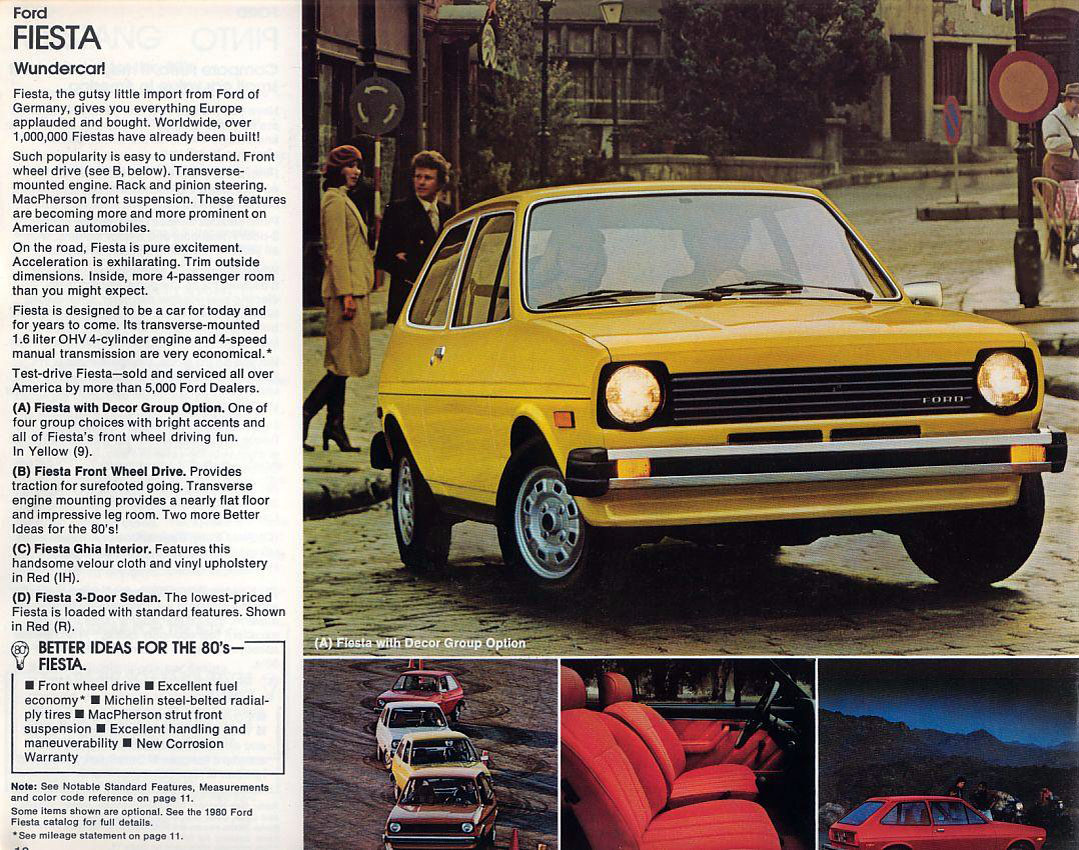
1980 Ford Fiesta hatchback coupe

In late 2021, Bring a Trailer featured a 1980 Ford Fiesta with unknown mileage selling at no reserve—it went for $7,200.

Ford’s first-generation Fiesta was in its final year of availability in the United States, soon to be replaced by the Escort. Because of this, the 1980 Fiesta had only minor trim and detail changes.

The Fiesta’s standard powertrain was a transverse-mounted 66 bhp 1.6 liter/98 ci inline four with a two-barrel carburetor paired with a four-speed manual. Ford’s full-line brochure stated that Fiesta acceleration was “exhilarating.” In reality, 0-60 mph took between 11 and 12 seconds in a car with a shipping weight of 1,726 pounds. The EPA rated fuel economy at an impressive 26 city/38 highway by the day’s standards. With a 10-gallon gas tank, a Fiesta owner could expect a range of 260 to 290 miles with a 10% fuel reserve.

Classified by the EPA as a subcompact, the Fiesta was a small car even in 1980, and is tiny by modern standards. With a 90-inch wheelbase and a 147.1-inch length, it gives up 8 inches of wheelbase and over 5 inches of length to a modern MINI Cooper. In 1980 brochures, Ford used the old trick of putting the car in the foreground and putting models at some indeterminate distance in the background.

Fiesta page from the 1980 Ford brochure

Standard equipment for the $5,032 Fiesta (about $21,400 in today’s dollars) included front wheel drive, a MacPherson strut front suspension, rack and pinion steering, front disc brakes, and Michelin 155-12 steel-belted radial tires on 12-inch argent road wheels. Inside, the Fiesta included all-vinyl high back front bucket seats, a fold-down rear seat, and color-keyed passenger compartment carpeting.

Options & Production Numbers

Options included a manually-operated flip-up open-air sunroof ($219), tinted glass ($55), an electric rear window defroster ($96), white sidewall tires ($70), air conditioning ($475 and not available in European versions), and an AM/FM stereo radio ($183). Decor Group and a Ghia interior which included velour and cloth upholstery were also available.

1980 Fiesta sales were off 11% from 1979, but Ford still moved 68,841.

The View From 2025

I haven’t seen a first-generation Fiesta on the streets for many years, and they are rarely seen on eBay Motors or in the Hemmings Motor News classifieds. Apparently, Bring A Trailer auctions one of these Fiestas about once a year.

Make mine Venetian Red, please.

Last updated April 2025.

1982 Chevrolet Camaro Z28 Indy 500 Commemorative Edition hatchback coupe

Every May, the Indianapolis 500 race is a “tentpole” event in the international racing schedule. Since 1911, there have been designated pace cars, with replica versions often sold. A 1982 Chevrolet Camaro Z28 Indy 500 Commemorative Edition with 2,630 miles sold for a $35,000 hammer price at the 2021 Mecum Indy. Are these distinctive and good-looking (I think) cars finally attracting significant interest?

“Even its shadow boasts performance”

The 1982 Chevrolet Camaro could reasonably be described as all-new. This moniker applied to the “pleasing and exciting” exterior, the interior, much of the chassis, and most of the engines. Road & Track stated that the new Camaro was “keenly anticipated.”

The Z28‘s standard powertrain was the LG4 145 bhp 5.0 liter/305 ci V8 with a four-barrel carburetor paired with a four-speed manual transmission. An optional LU5 Cross-Fire 5.0 liter/305 ci V8 with throttle-body fuel injection and 165 bhp set the buyer back $450 and required the $72 three-speed automatic transmission. 0-60 took just under 10 seconds with the base V8 and the four-speed manual, and shortened to 9 seconds with the top-of-the-line Cross-Fire motor and the automatic.

The Z28 had a base price of $9,700—about $33,600 in 2025 dollars. Standard exterior and mechanical equipment on all 1982 Z28s included a front air dam, “ground effect” lower body extensions, a rear spoiler, body-color dual Sport mirrors, power front disc/rear drum brakes, and 215/65R-15 tires (a size still readily available) on 15 x 7 inch 5-spoke aluminum wheels. Inside, every 1982 Z28 came with full instrumentation, an electric quartz analog clock, courtesy lamps, and a leather-wrapped steering wheel.

1982 Camaro Commerative Edition flyer
1982 Camaro Z28 Indy 500 Commemorative Edition flier

Standard equipment specific to the $10,999.26 (yes, that was really the price) Z50 Indy 500 Commemorative Edition included Silver Metallic/Blue two-tone accent paint, red accents on the wheels, specific commemorative edition decals, Custom interior trim, and blue Custom cloth bucket L/S Conteur (Chevrolet’s spelling) front seats.

Options, Production Numbers, & Period Reviews

Among the many options available for the Camaro Z28 were tinted glass ($88), removable glass roof panels ($790!), power windows ($165), a power door lock system ($106), an electric rear window defogger ($125), automatic speed control ($155), air conditioning ($675), a Comfortilt steering wheel ($95), and a host of radios ($111 to $390).

Chevrolet sold 6,360 Indy 500 Commemorative Edition cars in 1982, in addition to 63,563 “normal” Z28s. However, the most popular Camaro was actually the base Sport Coupe, which moved 78,761 units. The somewhat more luxurious Berlinetta sold another 39,744 copies.

Reviews of the new Camaro were decent. Road & Track liked the Z28‘s exterior and the handling, but bemoaned the interior packaging and the fuel mileage (EPA rated at 17 mpg but rarely attaining that in real life). Car and Driver famously accused the Z28 of being “Emily Post polite” but later retracted the remark.

The View From 2025

Third-generation Camaros attract plenty of collector interest, and there is substantial club support. According to Hagerty’s valuation tools, a 1982 Camaro Z28 hatchback coupe with the Cross-Fire motor in #1/Concours condition is $42,000, with a far more normal #3/Good condition version going for $13,500. 1982 Camaro Commemorative Editions are often available in the Hemmings Motor News classifieds, on eBay Motors, and at online (Bring a Trailer) and in-person auctions. As I update this blog entry in October 2025, a Commemorative Edition with the Cross-Fire, an automatic, and 40,000 miles is for sale on Hemmings, asking $20,000.

Other Camaros I have written about include the 1980 Rally Sport coupe, the 1980 Z28 coupe, the 1985 IROC-Z hatchback coupe, and the 1986 Berlinetta hatchback coupe. Pontiac Firebird Trans Ams with blog entries here include the 1981 coupe, the 1982 hatchback coupe, the 1984 15th Anniversary Edition hatchback coupe, the 1985 hatchback coupe, and the 1989 20th Anniversary Turbo hatchback coupe.

Last updated October 2025.

1980 Chrysler Cordoba coupe

I’m not sure I’ve ever seen a 1980 Cordoba—can that be true?

“A singular tradition.”

Chrysler’s Cordoba personal luxury was heavily revised for 1980, moving from the first-generation’s somewhat baroque styling to a more angular design. There was also a change in platform, with the Cordoba now based on the 1979 LeBaron coupe.

For the first time, the Cordoba’s base engine was a six—a 90 bhp 3.7 liter/225 ci version of the famous inline Slant Six with a one-barrel carburetor. Power options included a 5.2 liter/318 ci V8 with either a two-barrel carburetor (120 bhp/$230) or a four-barrel carburetor (155 bhp/$291) and a 185 bhp 5.9 liter/360 ci V8 with a four-barrel carburetor (which required the $192 Sport Handling package option package and less than 100 buyers paid $545 for). The 5.2 liter with the four-barrel carburetor was only for California and high-altitude sale. Chrysler paired all engines with a TorqueFlite automatic transmission.

With the Slant Six, the Cordoba was brutally slow even by 1980 standards—0-60 came in 17 second range with a top speed of 90 mph. Performance was notably better with the two 5.2 liter V8s and might even be described as spritely with the rare 5.9 liter engine. None of the powerplants yielded good fuel economy as they dragged around a 3,300-pound plus car with a three-speed automatic. The best was the Slant Six, rated at 17 mpg city, with the 5.9 liter getting a mere 13 mpg. With an 18-gallon fuel tank, Cordoba buyers could expect a range of between 210 and 275 miles with a 10% fuel reserve.

The 1980 Cordoba’s base price was $6,978—about $29,600 in 2025 dollars. Standard exterior and mechanical equipment on the Cordoba included tinted glass, power steering, power front disk/rear drum brakes, and P195/75R15 white sidewall tires on 15-inch wheels with Deluxe wheel covers. Inside, a heater and defroster, coat hooks, a cigarette lighter, and an AM radio were included. Standard upholstery was a cloth-and-vinyl split-back bench seat with a folding center armrest.

For a little less money than the standard Cordoba, Chrysler offered the LS ($6,745). It deleted the sill molding and carpeted trunk and changed the tires to black sidewall. The LS was upholstered with a cloth-and-vinyl bench seat.

Heading upmarket, the $7,248 Cordoba Crown added a padded Landau vinyl roof and Premier wheel covers. Inside, the Crown was upholstered with cloth-and-vinyl 60/40 seats with a folding center armrest and a passenger-side seatback recliner.

Corinthian Edition pages from the 1980 Cordoba brochure

Only available for the Cordoba Crown, the $1,818 Corinthian Edition package included chrome remote side mirrors and P205/75R15 “wider” whitewall tires on 15-inch wheels with wire wheel covers. Two colors were available—Black Walnut Metallic or a Designer’s Cream over Designer’s Beige paint treatment. Inside, deep cut-pile carpeting and a leather-wrapped tilt steering wheel were included. Of course, the package included leather/vinyl 60/40 seats and Corinthian Edition identification.

Options & Production Numbers

Individual exterior and mechanical options included an electric glass sunroof ($787) and forged aluminum road wheels ($334). Inside, air conditioning ($623), automatic speed control ($116), power windows ($148), and power door locks ($96) were available. The top-of-the-line radio was an AM/FM stereo with a CB transceiver and four speakers ($383), though the Cordoba’s brochure hyped the new $240 AM/FM stereo with cassette player and Dolby noise reduction. A final option was an extra cost 5/50 protection plan.

Cordoba sales dropped by about 37% to 46,406 in 1980, but I’m not willing to blame this entirely on the new design—very little was going right for the Chrysler division in 1980. The Cordoba’s percentage of overall Chrysler division sales actually increased in 1980—but Oldsmobile sold four times as many Cutlass Supreme coupes. Chrysler continued to make the Cordoba through the 1983 model year, with sales dropping each year. Its putative replacement for 1984 was the far different front-wheel-drive Laser XE hatchback coupe.

The View From 2025

Hagerty does not track values for any Cordoba, but they do occasionally show up in the Hemmings Motor News classifieds and on eBay Motors (no eighties Cordoba has yet made it to Bring a Trailer). As I update this post in April 2025, Hemmings is listing an Impact Red 1981 LS with white vinyl bucket seats and 28,000 miles for sale, asking $20,000.

Make mine Crimson Red Metallic, please.

Other rear-wheel-drive Chrysler products I have written about include the 1980 Plymouth Volaré station wagon, the 1981 Chrysler New Yorker sedan, and the 1983 Imperial coupe.

Last updated April 2025.

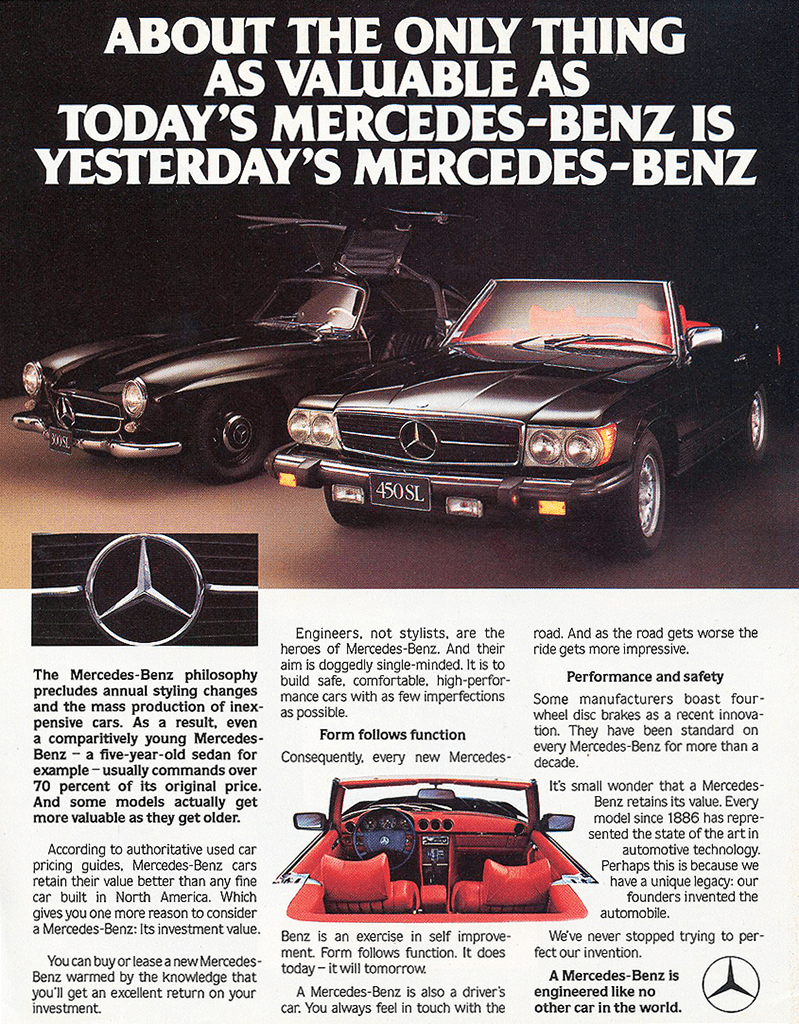
1980 Mercedes-Benz 450SL convertible

A 1980 Mercedes-Benz 450SL convertible sold for $27,000 at Mecum’s “Summer Special” auction in August 2020. I’ve previously written about the other two eighties SL versions: the 380SL and the 560SL. Perhaps it’s time to write about the 450SL.

In production since the 1972 model year, the Mercedes-Benz 450SL changed little in its final year, with a few new exterior colors and some new stereo choices. There were also multiple emissions-related changes to the powertrain, with horsepower ratings dropping from 180 bhp to 160 bhp and torque ratings increasing.

The sole powertrain for the 450SL remained a 4.5 liter/276 ci V8 with Bosch Jetronic fuel injection paired to a three-speed automatic. Car and Driver tested a 1980 450SL and recorded an 11.6-second 0-60 time, but raw acceleration likely wasn’t that important to SL buyers. Mileage also wasn’t great in a vehicle with a 3,730-pound curb weight—this SL was no longer anything resembling Sport Light. The 1980 EPA fuel economy rating was 16 mpg, and most owners report that number as somewhat hopeful. At least the sizeable 23.8-gallon gas tank allowed a range of close to 345 miles with a 10% fuel reserve.

1980 Mercedes-Benz 450SL advertisement

For 1980, the 450SL’s base price was a substantial $35,839—about $152,400 in today’s dollars, which is about 36% more than today’s AMG SL 43 convertible goes for. Standard exterior and mechanical equipment for this expensive car included tinted glass, variable-ratio power steering, power four-wheel disc brakes, and 205/70HR14 tires (a size still available thanks to Vredestein) mounted on 14 x 6 inch light-alloy wheels. Inside, air conditioning, adjustable MB-Tex bucket seats, cruise control, electric windows, and central locking were all included.

Options included a limited-slip differential, 15-inch wheels, leather bucket seats, and an array of Becker stereos. Like many other European cars of the early eighties, the 450SL did not have a standard stereo, though a power antenna was included.

The 450SL was a cultural icon, finding fans among various executives, celebrities, professional athletes, and rock stars when new. It was also a film and television star—famously driven by Richard Gere in American Gigolo, by Stephanie Powers and Robert Wagner on Hart to Hart, and by Patrick Duffy on Dallas.

The View From 2025

450SLs have many adherents to this day, and there is much club support. According to Hagerty’s valuation tools, all the money for a 1980 450SL in #1/Concours condition is $71,900, with a more normal #3/Good condition car going for $14,400. These SLs are always available in the Hemmings Motor News classifieds, on eBay Motors, on Bring a Trailer, and often at in person auctions. As I update this post in April 2025, there are eleven 1980 450SLs available for sale in Hemmings.

Make mine Astral Silver Metallic, please. Sometimes the cliché is correct.

Other eighties Mercedes-Benz models I have written about include the 1985 300CD Turbo coupe and 1986 560SEC coupe.

Last updated April 2025.

1980 Chevrolet Monza Sport 2+2 hatchback coupe

“Your kind of features. Your kind of fun.”

1980 was the Chevrolet Monza’s final year. Available in base coupe, 2+2 hatchback coupe, and Sport 2+2 hatchback coupe, the Monza received few changes for 1980. The biggest news that wasn’t about deleted models and options (there was no more wagon or V8) was probably the integration of 1979’s Spyder Appearance Package and Spyder Equipment Group into a single Spyder Equipment Package.

The Monza’s standard engine was the LX8 Iron Duke 86 bhp 2.5 liter/151 ci inline four with a Rochester 2SE two-barrel carburetor. The only engine option for 1980 was the LD5 110 bhp 3.8 liter/231 ci V6 with a Rochester M2ME two-barrel carburetor ($225). A four-speed manual was standard, with an optional three-speed automatic ($320) available.

Mileage with the inline four and four-speed manual was pretty impressive in 1980: 22 city/35 highway by the day’s standards. Spending $545 for the automatic and the V6 combination took mileage down to 20 city/27 highway. With the V6/automatic transmission pairing and an 18.5-gallon gas tank, a Monza owner could expect a range of 320 to 350 miles with a 10% fuel reserve.

Exterior and mechanical equipment for the $4,921 Monza Sport 2+2 Hatchback Coupe (approximately $21,200 in 2025 dollars) included tinted windows, a Delco Freedom battery, front disc/rear drum brakes, white-stripe tires, and full wheel covers. Inside, the Monza Sport 2+2 included a Sport steering wheel with a cushioned rim, high-back Sport front bucket seats in cloth/vinyl or all-vinyl, a console, color-keyed seat and shoulder belts, and a Delco AM radio (which could be deleted for a $52 credit).

Packages, Options, & Production Numbers

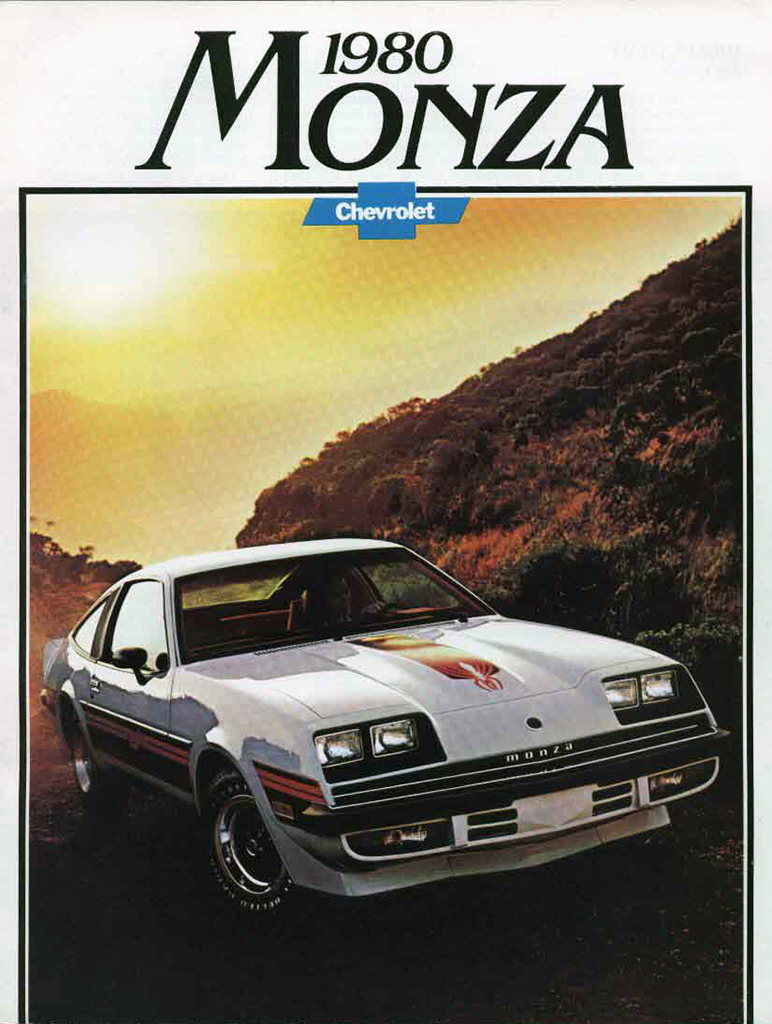
1980 Chevrolet Monza brochure cover

Featured on the cover of the 1980 Monza brochure, the expensive ($521, or about $2,200 in today’s dollars) Spyder Equipment Package added a Spyder hood decal, a body color front air dam and rear spoiler, black Sport mirrors, a sport suspension, and BR70-13 blackwall radial tires (nearly equivalent 195/70R13 tires are available from BF Goodrich) on 13-inch black-painted Rally II wheels with bright trim rings. About 37% of Sport 2+2 Hatchback Coupe buyers chose the Spyder Equipment Package.

Exterior and mechanical options included a Sky Roof manual sunroof ($193), variable-ratio power steering ($158), and power brakes ($76). Inside, you could add air conditioning ($531), a Comfortilt steering wheel ($73), and an AM/FM stereo cassette player ($188).

The Monza sold quite well in its final year—in fact, 1980 was the Monza’s best year out of its six years of production. Chevrolet produced over 169,000, with more than 95,000 being the base coupe.

The View From 2025

There is some club support for the Monza, and they occasionally come up for sale in Hemmings Motor News and on eBay Motors, though many are highly modified drag-racing cars. You do see a few on Bring a Trailer, though you have to sort through sixties Corvairs to find them.

Make mine Dark Blue Metallic, please.

Other 1980 model year Chevrolets I have written about include the Camaro Rally Sport coupe, the Camaro Z28 coupe, the Citation hatchback sedan, and the Corvette coupe. I also wrote about the 1980 Pontiac Sunbird Sport Hatch a few years ago.

Last updated October 2025.

Sa

1980 Cadillac Seville sedan

“Introducing Seville for the 80’s”

For 1980, the Cadillac Seville sedan could justifiably be called all-new. It switched from rear-wheel-drive to front-wheel-drive, used a completely different platform, and made a diesel engine standard.

Of course, the Seville’s exterior look was also completely changed. That styling—by Wayne Cady under Bill Mitchell’s direction—was instantly polarizing; words used in period reviews included striking, astonishing, controversial, and odd. Despite my pre-teen bent toward classically influenced cars, I did not like the new Seville’s design. Perhaps this was because I really liked the styling of the first-generation Seville.

The 1980 Seville’s standard engine was an LF9 105 bhp 5.7 liter/350 ci diesel V8. An L61 145 bhp 6.0 liter/368 ci V8 with fuel injection was a no-cost option. In California, the gasoline engine choice was a 5.7 liter/350 ci V8 with fuel injection.

As might be expected, fuel mileage ratings for the standard diesel were impressive, especially for a car with a 3,911 shipping weight. A Seville owner could expect 21 city/31 highway. With a 23-gallon gas tank, the range was an astounding 540 miles with a 10% fuel reserve—at least in theory. What wasn’t impressive was the Seville’s performance; Road & Track clocked a 0-60 mph time of 21 seconds.

The story was different but not necessarily better with the gas engine. With it, mileage was 14 city/22 highway, so the predicted range dropped to about 375 miles. Performance was notably better, but still not good with the 0-60 time at about 13 seconds.

Standard exterior and mechanical equipment on the $19,662 Seville (about $83,400 in 2025 dollars) included Soft-Ray glass, tungsten-halogen headlamps, a four-wheel independent suspension, electronic level control, four-wheel disc brakes, and P205/75R15 tires (a size still readily available) on 15-inch wheels. Inside, 50/45 Dual Comfort front seats, electronic climate control, and a tilt and telescope steering wheel were included.

Seville Elegante brochure page
Seville Elegante page from the 1980 Cadillac brochure

The $2,934 Elegante package included two-tone paint and 40/40 leather seats. Chrome-plated wire wheel covers were available at no extra cost.

Options included an Astroroof ($1,058), automatic door locks ($129), the Cadillac trip computer ($920), and an AM/FM stereo cassette ($225).

Famously, the Cadillac with the Deadhead sticker that passes Don Henley when he sings about “The Boys of Summer” was a second-generation Seville—likely a 1980 or a 1981.

The View From 2025

According to Hagerty’s valuation tools, all the money for a 1980 Cadillac Seville Elegante with the gas engine (they don’t list values for the diesel) in #1/Concours condition is $23,800, with a more normal #3/Good condition car going for $4,700.

Second-generation Cadillac Sevilles are often available in the Hemmings Motor News classifieds, on eBay Motors, and at online (Bring a Trailer) and in-person auctions. As I write this post, a Woodland Haze 1983 Seville with a Dark Briar Brown interior and 66,000 miles is for sale on Hemmings for $10,000.

Make mine an Elegante in its Sable Black/Sheffield Gray Firemist two-tone, please. Over time, the second-generation styling has grown on me—especially with two-tone paint. Mecum sold a striking Seaspray Green/Neptune Aqua two-tone at their Harrisburg auction in 2019.

Other eighties Cadillacs I have covered include the 1982 Eldorado Touring Coupe, the 1986 Eldorado coupe, the 1986 Fleetwood Brougham sedan, the 1988 Eldorado coupe, the 1989 Allanté convertible, and the 1989 Cadillac Sedan deVille.

Last updated March 2025.

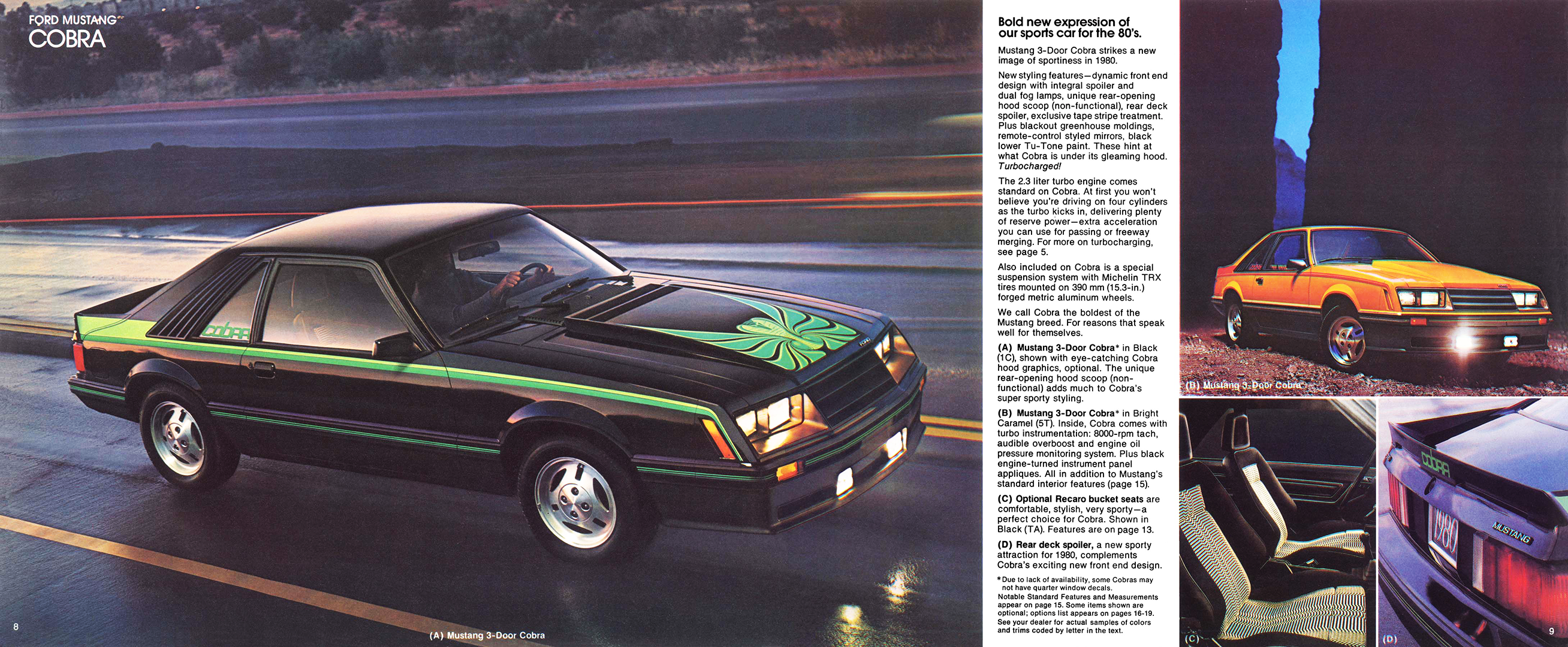
1980 Ford Mustang Cobra hatchback coupe

“A sports car for the 80’s.”

1980 was the second year for the Fox-body Mustang and brought few changes from the debut year—and some of those weren’t great, such as a downgraded V8. The Cobra inherited some features from the 1979 Pace Car, including a front spoiler, dual fog lamps, and a rear deck spoiler.

The standard powertrain on the base Mustang was Ford’s Lima 88 bhp 2.3 liter/140 ci inline four with a Motorcraft 5200 two-barrel carburetor matched with a four-speed manual. A Windsor 119 bhp 4.2 liter/255 ci V8 with a Motorcraft 2150 two-barrel carburetor was available with a three-speed automatic, but the top-of-the-line powertrain was a turbocharged version of the Lima inline four with a Holley 6500 two-barrel carburetor making 132 bhp paired with the four-speed manual. Thus, for 1980, the fastest available Mustang had a 0-60 time of a little under 11 seconds. With a 12.5-gallon fuel tank and 18 city/30 highway fuel mileage (about 15/25 by today’s standards), a Cobra‘s proud new owner could expect a range of about 225 to 270 miles with a 10% fuel reserve.

Cobra pages from the 1980 Ford Mustang brochure

Standard mechanical equipment on the $7,098 Cobra (about $30,600 in today’s dollars or just a little under what the 2026 Mustang EcoBoost fastback goes for) included the turbocharged inline four, the four-speed manual, a “special suspension system” with heavy duty front and rear stabilizer bars and special shock valving, a sport-tuned exhaust with bright tailpipe extension, and Michelin TRX 190/65R390 tires (they’re still available!) on 15.3-inch forged aluminum wheels. Exterior equipment included dual remote styled mirrors and black lower bodyside paint. A Cobra‘s interior didn’t have many upgrades, but you did get an 8,000-rpm tachometer and a black engine-turned instrument panel applique.

Standard equipment on all Mustang hatchback coupes included dual rectangular halogen headlamps, wraparound taillamps, a modified MacPherson strut front suspension, front disc/rear drum brakes, and rack and pinion steering. Inside, full instrumentation (tachometer, trip odometer, fuel/temperature/oil/alternator gauges), a sports steering wheel, color-keyed cut pile carpeting, all vinyl high-back bucket seats, a lockable glove box, and a cigarette lighter were included.

Options, Sales, & Period Reviews

Exterior and mechanical options included Cobra hood graphics ($88), a flip-up open air roof ($219), black liftgate louvers ($141), and a rear window/wiper washer ($79). Inside, you could choose SelectAir conditioning ($538), Recaro high-back bucket seats ($531), an electric rear window defroster ($96), interval windshield wipers ($39), a tilt steering wheel ($78), and the power lock group ($113). A series of stereos were available, with the most capable being an AM/FM stereo radio with a cassette tape player ($271). Higher-end stereos could be paired with the Premium Sound System ($94), which added a higher-power amplifier and more capable rear speakers.

1980 Ford Mustangs sold decently, accounting for about 23% of Ford’s overall sales in a down year. Reviews of the day were unhappy, but understanding about the loss of the 4.9 liter/302 ci V8 in the middle of the second oil crisis—Car and Driver stated that “Whether you like life with turbochargers or not, you might as well get used to it.”

The View From 2025

Folks are definitely collecting these early Fox-body Mustangs. According to Hagerty’s valuation tools, all the money for a 1980 Cobra in #1/Concours condition is an astounding $53,400, with a more normal #3/Good car going for $13,800. Cobras come up for sale occasionally in the Hemming’s Motor News classifieds, on eBay Motors, and on Bring a Trailer.

Make mine Black, I think, perhaps with those extra-cost Cobra hood graphics.

Later Fox-body Mustangs I have covered include the 1981 coupe, the 1982 GT hatchback coupe, the 1983 GT convertible, the 1984 SVO hatchback coupe, and the 1987 LX coupe.

Last updated October 2025.

1980 Buick Riviera S TYPE coupe

I’ve was on a Riviera kick in 2018, brought on (no lie!) by the appearance of a 1965 model in a Hallmark Movies & Mysteries movie. I covered the 1984 T-Type in 2016—here’s the 1980 S TYPE.

“… an impressive road car.”

In its second year, Buick’s sixth-generation Riviera gained little but revised body mounts and new side mirrors with a notably more integrated look. Buick continued to offer Riviera fans a slightly more sporty S TYPE (Buick’s brochure spelling) version, returning to a theme first present with the 1965 Riviera Grand Sport.

The S TYPE‘s standard powertrain was the LD5 170 bhp 3.8 liter/231 ci V6 with turbocharger and a Rochester M4ME four-barrel carburetor paired with a Turbo Hydra-matic automatic transmission. The LG4 155 bhp 5.7 liter/350 ci V8 with a Rochester M4ME four-barrel carburetor was optional (it was standard on the base Riviera). The S TYPE was spritely for a big (3,633 pound) coupe by 1980 standards, but not fast: 0-60 came in about 11 seconds, which compared well with the Cadillac Eldorado, [Chrysler] Imperial, Lincoln Continental Mark VI, and Oldsmobile Toronado. Fuel mileage was rated at 16 city/23 highway by the (rather unrealistic) standards of the day—with a 21.2-gallon fuel tank, range was about 305 miles with a 10% fuel reserve.

S TYPE pages from the 1980 Buick Riviera brochure

The $11,823 S TYPE (about $50,400 in 2025 dollars, or about what a 2025 Buick Envista Sport Touring SUV goes for) came with amber front park and turn signal lenses, tungsten-halogen high-beam headlights, dual remote black mirrors, and GR70-R15 tires (equivalent to P225/70R15, which is still a readily available size) on 15-inch wheels with Designer’s Sport wheel covers. Inside, cloth or vinyl bucket seats, sport steering wheel, storage console, and black-trimmed instrument panel were all standard. The 1980 S TYPE also included a Rallye ride-and-handling suspension with larger front and rear stabilizer bars and stiffer shock absorbers.

Standard exterior and mechanical features on all 1980 Rivieras included front-wheel drive, four-wheel independent suspension, automatic level control, Soft Ray tinted glass, power steering, and power front disc/rear drum brakes. Inside, every Riviera had air conditioning, electric door locks, power windows, a driver’s-side 6-way power seat, and an AM/FM stereo radio with automatic power antenna.

Options & Sales Numbers

Exterior and mechanical options included four-wheel disc brakes ($222), electric rear window defogger ($109), and the Astroroof ($1,058). Inside, automatic air conditioner ($150), Cruise-Master speed control ($118), Twilight Sentinel ($51), a passenger-side 6-way power seat ($179), and leather with vinyl bucket seats ($360) were all available. You couldn’t get the tilt and telescoping steering column on an S TYPE, but you could get a tilt only steering column ($83).

Sales of the S TYPE were decent in 1980—with 7,217 made, it accounted for about 15% of overall Riviera sales. For 1981, the Riviera S TYPE was supplanted by the T-Type.

The View From 2025

There’s robust discussion and support for sixth-generation Rivieras on the AACA’s Buick Riviera page, which is affiliated with the Riviera Owners Association. According to Hagerty’s valuation tools, all the money for a 1980 Riviera in #1/Concours condition is $37,200, with a more normal #3/Good car going for $10,900. S TYPEs also come up for sale every once in a while in the Hemming’s Motor News classifieds or on eBay Motors, though there aren’t any right now.

Make mine the extra-cost ($186) Gray Firemist, please. I love those Buick color names and believe everyone should have at least one Firemist.

Last updated May 2025.

1980 Chevrolet Camaro Rally Sport coupe

At Barrett-Jackson’s 2018 Northeast auction, a bright blue metallic 1980 Chevrolet Camaro Rally Sport coupe with black vinyl seats, a 3.8 liter/229 ci V6 with a two-barrel carburetor, an automatic, and 45,000 miles crossed the block. The hammer price was $4,700 for this honest, reasonably original car that no one ever tried to turn into something resembling a Z28. I find these non-top-of-the-line cars interesting because they are rarely saved, leading to something like what we have with 1957 Chevrolets, where you’d think 90% of them were Bel Airs.

“It’s an escape from the ordinary.”

For 1980, Chevrolet featured four versions of the Camaro. The base model was the Sport Coupe, followed by the Rally Sport, the Berlinetta, and the Z28. This post is about the Rally Sport, which cost $5,916 (almost exactly $25,000 in today’s dollars) and got a few changes in the final year of this particular iteration. A new blacked-out grille and a new three-tone striping package were visible, while a new standard V6 sat inside.

Rally Sport page from 1980 Camaro brochure
Rally Sport and Sport Coupe pages from the 1980 Chevrolet Camaro brochure

That new standard powertrain on the 1980 Rally Sport was the LC3 115 bhp 3.8 liter/229 ci V6 with a Rochester M2ME two-barrel carburetor paired with a three-speed manual. EPA fuel economy was 20 city/26 highway by the standards of the day—with a 20.9-gallon gas tank, a Camaro owner could expect to go 390 to 430 miles with a 10% fuel reserve. The trade-off was performance that belied the Camaro’s sporty looks: 0-60 in a little under 13 seconds with a top speed of 112 mph.

Optional powertrains included two V8s, both of which required power brakes ($81): the L39 120 bhp 4.4 liter/267 ci with a two-barrel carburetor ($180) and the LG4 155 bhp 5.0 liter/305 ci with a four-barrel carburetor ($295). An automatic ($358) was available with all three engines, while a four-speed manual was only available with the larger of the two V8s. The LG4/four-speed combination yielded notably better performance than the base powertrain: 0-60 in about 10 seconds. It didn’t make mileage that much worse—16 city/24 highway by 1980 standards.

Standard exterior and mechanical equipment on all Rally Sports included High Energy ignition, power steering, front stabilizer bar, sport mirrors, rear spoiler, concealed windshield wipers, front disc/rear drum brakes, and 205/75R14 steel-belted radial ply tires (a size still available thanks to Hancook and Kumho) on 14-inch color-keyed Rally wheels. Inside, flow-through ventilation system, contoured full-foam vinyl bucket seats, a “centre” (as spelled in the brochure) floor console, and cut-pile colour-keyed carpeting were included.

Options & Production Numbers

Exterior and mechanical options included removable glass panels ($695) and 14 x 7 aluminum wheels ($337). Inside, air conditioning ($566), intermittent windshield wiper system ($41), electric rear window defogger ($107), automatic speed control ($112), power door locks ($93), power windows ($143), a Custom interior ($68), a gauge package with a tachometer ($120), Comfortilt steering wheel ($81), and an AM/FM stereo radio with stereo cassette tape ($272) were all available.

Though the Z28 wasn’t the most popular Camaro, the Rally Sport did not hold up its end of the bargain (likely why it was gone in 1981). The leading seller remained the entry-level Sport Coupe (46% of production), followed by the Z28 (30%), the Berlinetta (16%), and the Rally Sport (8%).

The View From 2025

Badge for 2,500 web hits

According to Hagerty’s valuation tools, all the money for a 1980 Camaro Rally Sport with the LG4 V8, a four-speed, and T-tops in #1/Concours condition is an astounding $24,400, with a far more typical #3/Good car with same equipment going for $14,200. Values slide down substantially with the base equipment—a base V6 Rally Sport in #3 condition is only worth $10,300.

This generation of the Rally Sport maintains some presence in the Hemming’s Motor News classifieds, on eBay Motors, and at online auctions such as Bring a Trailer that cater to the eighties car market. As I update this post in February 2025, there’s a Bronze Metallic 1981 with the LG4, an automatic, and 77,000 miles for sale asking $16,000.

Make mine Bright Blue Metallic, please.

Last updated February 2025.