1986 Volkswagen Scirocco 16V hatchback coupe

“Igniting the exhilaration of true sports coupe performance.”

For 1986, the second-generation Scirocco gained a substantial amount of power, elevating it from a VW loyalist’s car to one considered by a wider range of sports coupe buyers. The engine was a notably upgraded version of the 90 bhp 8-valve 1.8 liter/109 ci inline four that shipped on the base Scirocco. The new 16-valve version made 123 bhp, changing the character of Volkswagen’s sportiest coupe.

With a curb weight of 2,380 pounds, Car and Driver recorded a 0-60 time of 8.0 seconds and a top speed of 124 mph for the 16V. Fuel economy was rated at 23 city/28 highway by the day’s standards (21/26 by modern measures). A 13.8-gallon gas tank meant that a Scirocco 16V‘s owner could expect a range of 295 to 315 miles with a 10% fuel reserve.

Classified as sub-compact by the EPA, the Scirocco was not a large car—its 165.7-inch length is three inches shorter than the current Golf GTI hatchback sedan. All Sciroccos continued to be assembled by Karmann in Osnabrück, Germany.
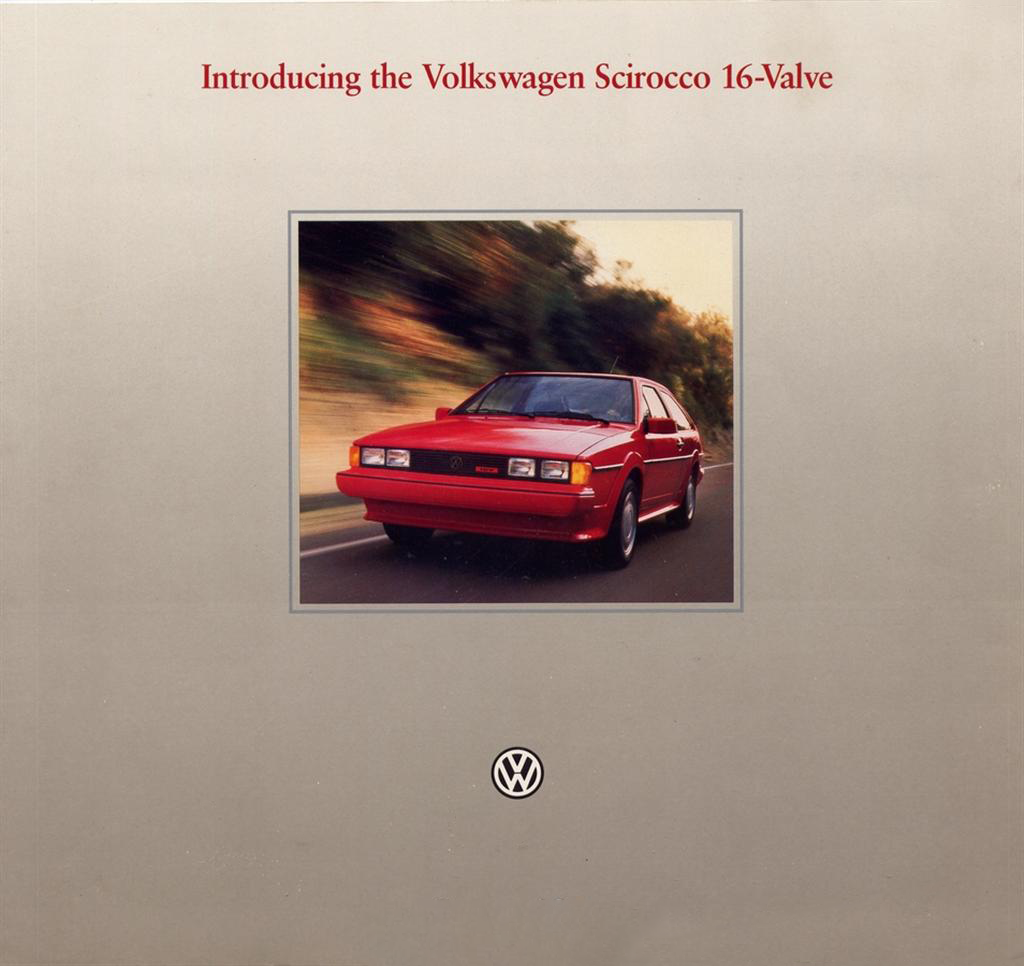
Cover of the 1986 Volkswagen Scirocco 16V brochure

The 1986 Scirocco 16V‘s base price was $11,980—about $36,000 in today’s dollars, or almost exactly what a 2026 Golf GTI hatchback sedan goes for. Standard exterior features included halogen headlamps, tinted glass, body colored rocker panels, wheelhouse flares, and a 16V-specific rear spoiler. Mechanical features of the 16V included front wheel drive (still on the window sticker in 1986), quick-ratio power rack and pinion steering, four wheel power disc brakes, and 185/60HR-14 steel belted radial tires (a size still readily available) on 14-inch Sport alloy wheels. Inside, reclining front Sport seats with height adjustment, a foldable rear seat, a leather-wrapped Sport steering wheel, a digital clock, and a stereo prep package were standard.

Options & Period Reviews

Options for the reasonably well-equipped Scirocco 16V were relatively few—a manual tilt and slide sunroof ($450), metallic paint, leather seats, air conditioning ($750), a power door locks and windows package ($445), cruise control, and an AM/FM stereo cassette radio with a cassette storage tray ($390).

Period reviews of the Scirocco 16V were good, though the exterior styling took some lumps for its lack of distinctiveness. Car and Driver stated that the new motor made for an “amazing transformation.” MotorWeek was a little iffy about the 16V‘s price in a very competitive market. Both Car and Driver and MotorWeek noted that the 16V was the fastest Volkswagen yet sold in the United States.

The View From 2026

Second-generation Sciroccos attract collector interest, and there is club support. They are sometimes available in the Hemmings Motor News classifieds, on eBay Motors, and at online auctions such as Bring a Trailer that cater to the eighties car market.

Make mine Tornado Red, please. The only colors available for the 16V in 1986 were Black, Tornado Red, and Flash Silver Metallic.

The only other Scirocco I’ve written about is the 1981 S. Other Volkswagens I have written about include the 1981 Dasher station wagon, the 1983 Rabbit GTI hatchback coupe, the 1985 Cabriolet, and the 1985 Jetta GLI sedan. Sports coupe competition for the 16V in 1986 included the Chevrolet Camaro Berlinetta, the Chevrolet Cavalier Z24, the Honda Prelude Si, and the Mercury Capri.
1989 Ford Taurus SHO sedan

“… superbly equipped …”

For 1989, Ford introduced a high-performance version of its Taurus family car, which Dearborn designated as the SHO.

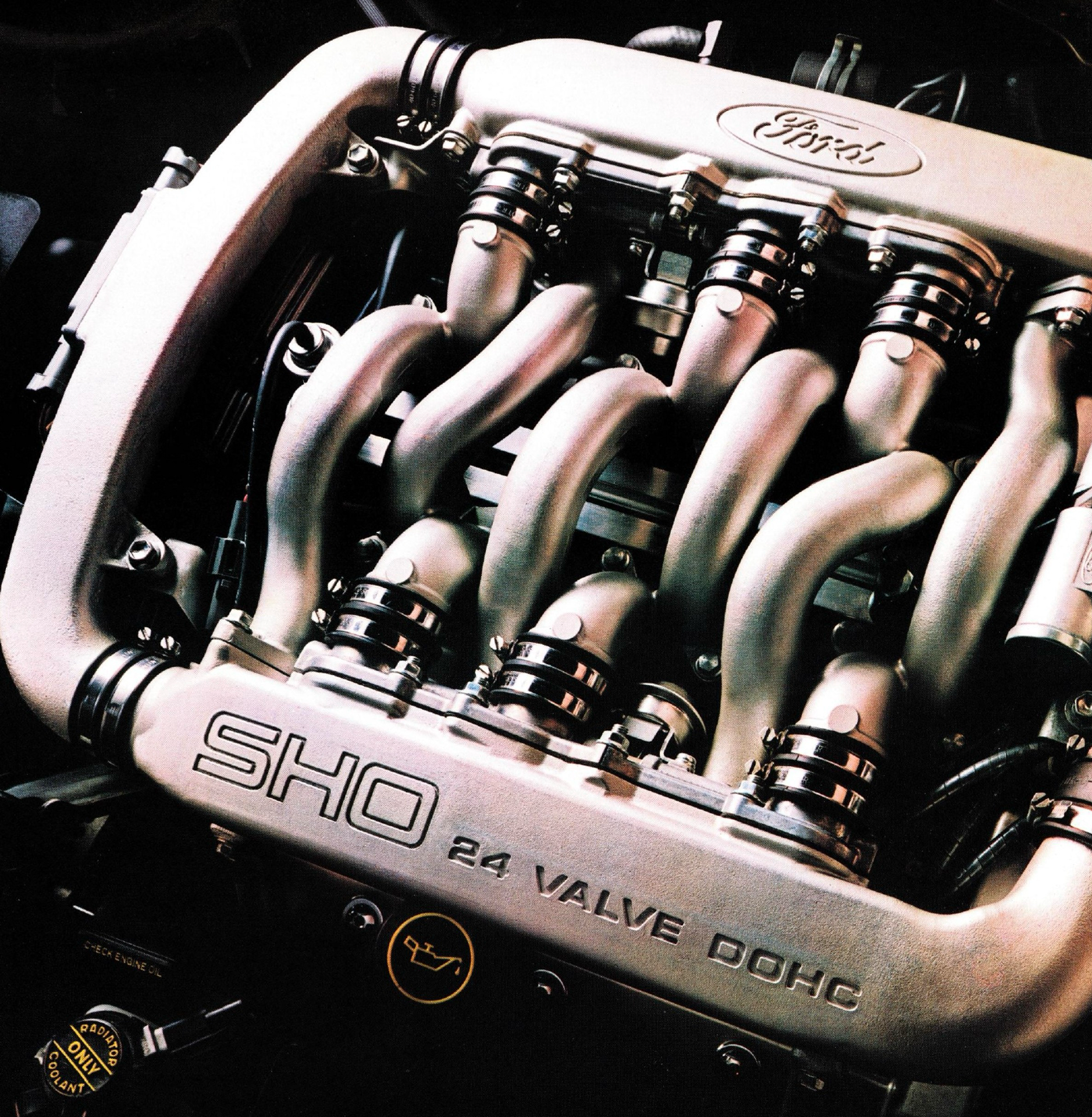
SHO engine photo from the 1989 Ford Taurus brochure

The centerpiece of the SHO was its engine. Designed and built by Yamaha, it was a 220 bhp Super High Output 3.0 liter/181 ci V6 with four valves per cylinder and sequential multiport electronic fuel injection. A five-speed manual was the only transmission initially available with the SHO. Car and Driver recorded a 0-60 time of 6.7 seconds and a top speed of 143 mph—astoundingly fast for a mainstream sedan in 1989. Mileage ratings were 18 city/26 highway by the day’s standard (16/24 by today’s measures). With an 18.6-gallon gas tank, a SHO‘s proud new owner could expect a range of between 335 and 365 miles with a 10% fuel reserve.

The 1989 Taurus SHO sedan’s base price was $19,739—about $53,400 in today’s dollars. Standard exterior and mechanical equipment included fog lamps, cornering lamps, a handling suspension, 4-wheel disc brakes, and P215/65VR15 black sidewall tires (a size still somewhat available) on 15-inch cast aluminum wheels. Inside, reclining cloth front bucket seats, a 6-way power driver seat adjustment, a center console, a leather-wrapped steering wheel, manual control air conditioning, power side windows, and power door locks were included.

One Package, Individual Options, & Period Reviews

Preferred equipment package 211A ($533) included an autolamp system, an illuminated entry system, and the High-Level Audio System.

Individual options included a power moonroof ($741), a keyless entry system ($137), electronic climate control air conditioning ($183), front bucket seats with leather seating surfaces ($489), a 6-way power passenger seat adjustment ($261), and a rear window defroster ($150).

Period reviews were extremely positive, and often seemed somewhat stunned by what Ford and Yamaha had achieved. Road & Track called the SHO “one of the great surprises for 1989” and, astoundingly, beat Car and Driver‘s 0-60 time by a tenth of a second. As for Car and Driver, their December 1988 issue called the 1989 SHO a “breakthrough car” and compared it to the 1964 Ford Mustang and the 1970 Datsun 240Z. MotorWeek was also enthusiastic.

The View From 2026

According to Hagerty’s valuation tools, a 1989 Taurus SHO in #1/Concours condition is $21,100, while a far more typical #3/Good car goes for $6,900. SHOs of this age come up for sale regularly in the Hemmings Motor News classifieds, on eBay Motors, and Bring a Trailer, so folks are saving them.

Make mine Light Titanium Clearcoat Metallic, please. There were only four exterior colors available with the 1989 SHO, and only one interior color (Titanium).

I have written about the first Taurus sedan. Other aerodynamically styled Ford Motor Company products I’ve written about include the 1983 Ford Thunderbird Turbo Coupe, the 1984 Ford Mustang SVO hatchback coupe, the 1984 Ford Tempo sedan, the 1984 Lincoln Continental Mark VII LSC coupe, the 1987 Ford Thunderbird standard coupe, and the 1988 Mercury Cougar XR-7 coupe.

1980 Mercury Capri hatchback coupe

“Every bit a driver’s car.”

1980 was the second year for the Fox-body Capri and brought few changes from the debut year, and some of those weren’t great, such as a downgraded V8. There was a new rear deck spoiler standard on all RS models.

The standard powertrain on the base Capri was Ford’s Lima 88 bhp 2.3 liter/140 ci inline four with a Holley-Weber two-barrel carburetor matched with a four-speed manual. Three engine options were available:

  • a 91 bhp 3.3 liter/200 ci inline six with a one-barrel carburetor ($169)
  • a Windsor 118 bhp 4.2 liter/255 ci V8 with a Motorcraft 2150 two-barrel carburetor ($288), which required the three-speed automatic ($340)
  • a Lima inline four with a Holley-Weber two-barrel carburetor and a turbocharger ($481). Sources disagree as to whether this engine was rated at 118 bhp, 120 bhp, or 132 bhp, but everyone agrees that it included a 12.5-gallon gas tank

Thus, for 1980, the fastest available Capri had a 0-60 time of a little under 11 seconds. With an 11.5-gallon gas tank and 23 city/38 highway fuel mileage, the owner of a Capri with the base four could expect a range of about 260 to 280 miles with a 10% fuel reserve.

The base 1980 Capri hatchback coupe went for $5,672—about $24,500 in 2026 dollars. Standard exterior and mechanical equipment included dual rectangular headlamps, dual paint stripes, a liftback third door, wraparound taillamps, rack-and-pinion steering, front disc/rear drum brakes, and P185/80R13 tires on 13-inch semi-styled steel wheels with trim rings. Inside, vinyl high-back front bucket seats, a fold-down rear seat, a Sport steering wheel, full instrumentation (tachometer, trip odometer, fuel/temperature/oil/alternator gauges), a lockable glove box, and a cigar lighter were included.

The Capri RS ($204) added a simulated hood scoop, a rear deck spoiler, dual remote control mirrors, and P175/75R14 black sidewall tires on 14-inch wheels with Sport wheel covers.

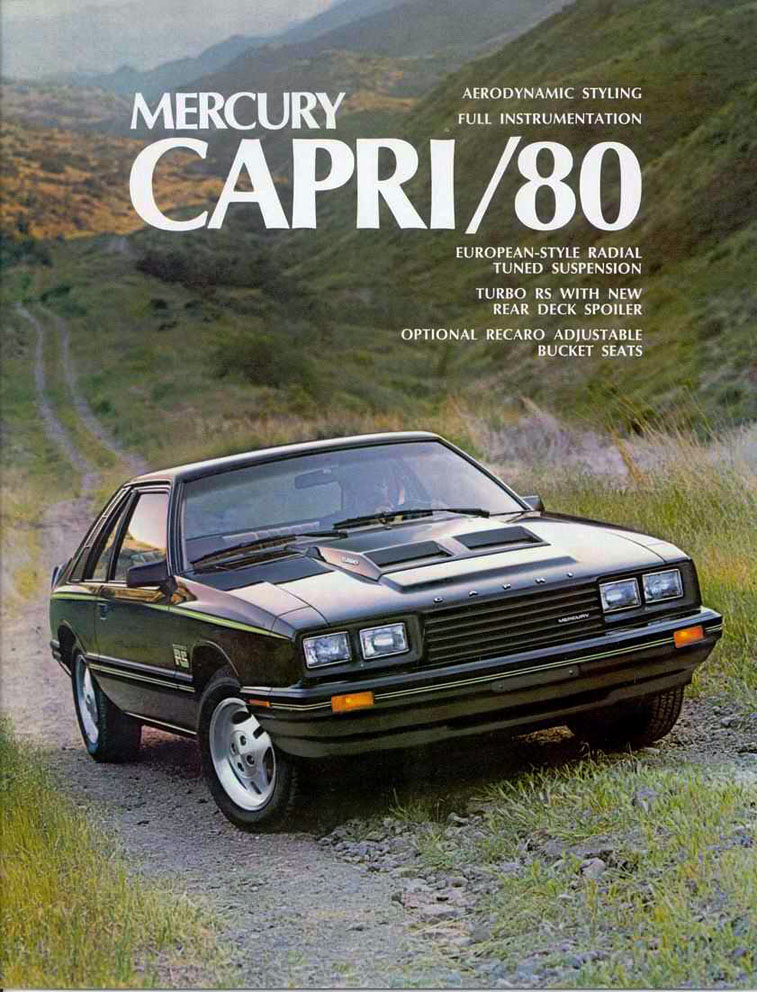
Front cover of the 1980 Mercury Capri brochure
Front cover of the 1980 Mercury Capri brochure, displaying an RS Turbo

The Turbo RS ($1,185) made the turbocharged 2.3 liter engine standard and added a sports-tuned exhaust system, the Rally Suspension package, and Michelin TRX 190/65R390 tires (they’re still available!) on 15.3-inch forged aluminum three-spoke wheels. Inside, low-back front bucket seats, Deluxe trim, and an 8,000 RPM tachometer were included. Power front disc brakes ($78) were a mandatory option. A base Turbo RS came to $6,935—about $30,000 in today’s dollars and almost what a 2026 Ford Mustang EcoBoost fastback goes for.

Taking a different direction, the comfortable Capri Ghia included P175/75R14 black sidewall tires with 14-inch wheels with Sport wheel covers. Inside, low-back front bucket seats with European type headrests, a four-spoke Luxury steering wheel with a woodtone insert, and Light Group were included. The Ghia‘s base price was $5,968. Power front disc brakes ($78) were a mandatory option.

Options & Production Numbers

Exterior and mechanical options included tinted glass ($65), a flip-up, removable moonroof ($219), power steering ($160), and power brakes ($78). Inside, Recaro adjustable front bucket seats, air conditioning ($538), an electric rear window defroster ($96), interval windshield wipers ($39), a tilt steering wheel ($78), and the power lock group ($113) were available. A series of five stereos was available, with the most capable being an AM/FM stereo radio with a cassette tape player.

The 1980 Capri sold decently. 79,984 were produced, accounting for 23% of Mercury’s overall sales in a brutally down year.

The View From 2026

Capris come up for sale occasionally in the Hemmings Motor News classifieds, on eBay Motors, and on Bring a Trailer.

Make mine Bright Bittersweet, please.

The only other Capri I have covered is the final-year 1986 hatchback coupe. Fox-body Mustangs I have covered include the 1980 Cobra hatchback coupe, the 1981 coupe, the 1982 GT hatchback coupe, the 1983 GT convertible, the 1984 SVO hatchback coupe, and the 1987 LX coupe.

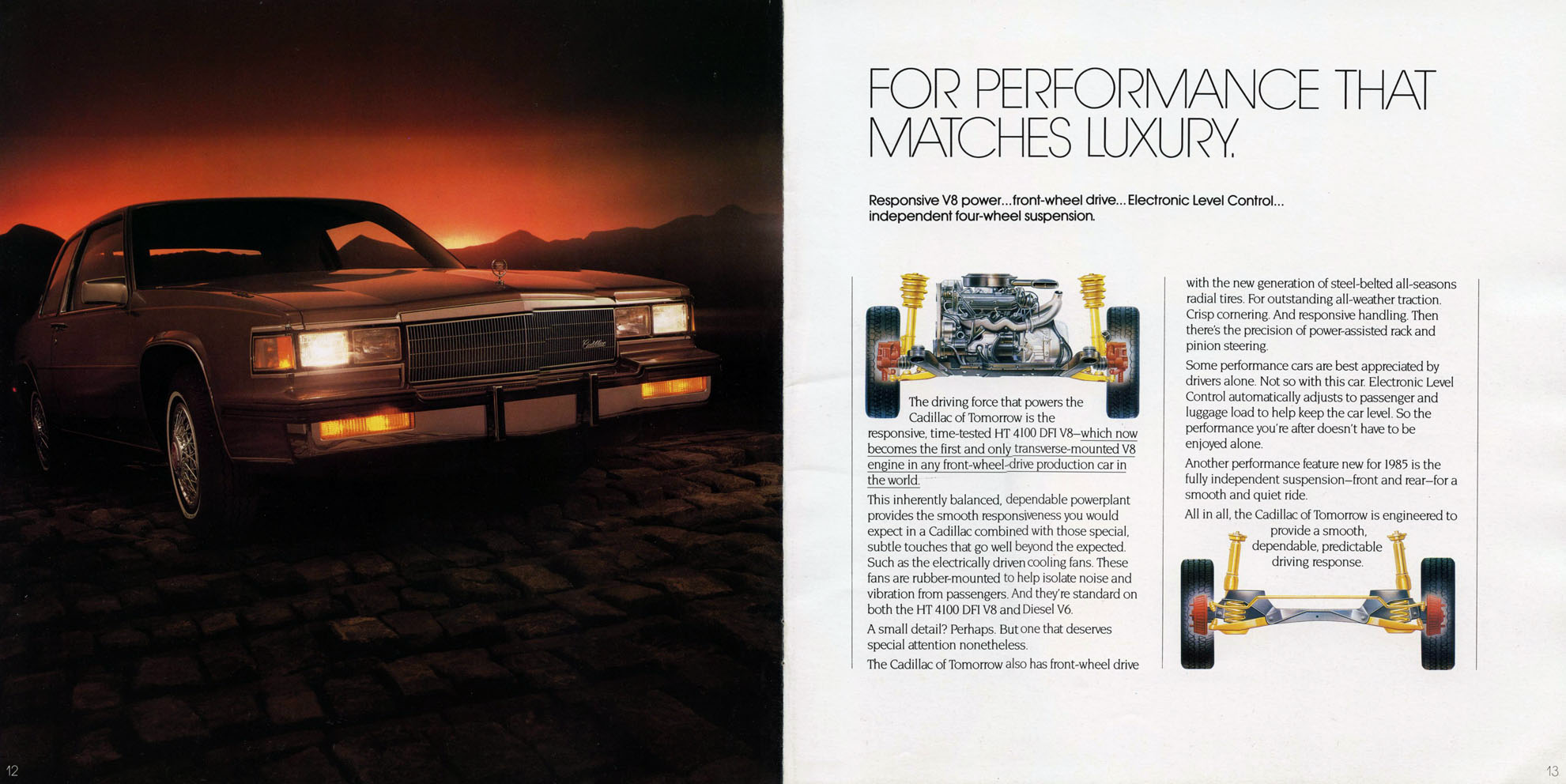
1985 Cadillac Coupe de Ville

“The Cadillac of tomorrow is here …”

Along with its sedan sister, the Cadillac Coupe de Ville was all-new for the 1985 model. Introduced in April 1984, it moved to front wheel drive and lost significant length, width, and weight compared to its immediate predecessor.

The Coupe de Ville’s powertrain was Cadillac’s 125 bhp HT-4100 4.1 liter/249 ci V8 with throttle body fuel injection paired with a four-speed automatic transmission. Fuel economy was 17 city/26 highway by the standards of the day (15/24 by today’s measures). Since the engine and transmission remained essentially the same and the Coupe de Ville was smaller and lighter, performance improved but still not very impressive: 0-60 improved to a little under 12 seconds.

Coupe pages from the 1985 Cadillac de Ville brochure

The 1985 Coupe de Ville’s base price was $18,355—about $57,700 in today’s dollars, or about what a loaded 2026 Cadillac CT5 Premium Luxury sedan goes for. Standard exterior and mechanical equipment included Soft Ray tinted glass, power front disc/rear drum brakes, power rack-and-pinion steering, and P205/75R14 white stripe all-seasons steel-belted radial tires on 14-inch wheels. Inside, a front notch bench seat, electrically powered door locks, electronic climate control, and an ETR AM/FM stereo signal seeking radio with scanner and digital display were included.

Options & Period Reception

Options included firemist paint ($235), aluminum alloy wheels ($429), cruise control ($185), Twilight Sentinel ($79), automatic door locks ($162), and the all-conquering Delco-GM/Bose Symphony Sound System ($895).

The challenge—of course—with downsizing the de Ville was that the target market did not appreciate downsizing. Many thought that the previous downsizing—in 1977—had been quite enough. Reviews from the “buff books” were a general “huh?”. Car and Driver wrote “Could it be that Cadillac is trying too hard to turn its efficient new sedan into an old-school luxocruiser?”

The View From 2026

According to Hagerty’s valuation tools, a 1985 Coupe de Ville in #1/Concours condition is $18,100, while a far more typical #3/Good car goes for $8,200. Coupe de Villes of this age come up for sale regularly in the Hemmings Motor News classifieds, on eBay Motors, and Bring a Trailer, so folks are saving them.

Make mine Corinthian Blue Firemist, please.

Other Cadillacs from the second half of the decade that I have written about include the 1986 Eldorado coupe, the 1986 Fleetwood Brougham sedan, the 1988 Cimarron sedan, the 1988 Eldorado coupe, the 1989 Allanté convertible, and the 1989 Sedan de Ville.

1989 Ford Thunderbird coupe

“The new spirit of Thunderbird …”

Ford’s Thunderbird personal luxury coupe was all new for 1989. The twelfth-generation ‘Bird was code-named MN12 and cost over a billion dollars to develop.

The standard Thunderbird’s powertrain was an Essex 140 bhp 3.8 liter/232 ci V6 with electronic sequential multi-port fuel injection paired with an automatic overdrive transmission. The Super Coupe‘s powertrain was an Essex 210 bhp 3.8 liter/232 ci V6 with a supercharger, an intercooler, and electronic sequential multi-port fuel injection paired with a 5-speed manual transmission. The automatic overdrive transmission was an option for the Super Coupe.

Page from the 1989 Ford Thunderbird brochure

The Thunderbird Standard‘s base price was $14,612. Exterior and mechanical equipment included tinted glass, power rack-and-pinion steering, power front disc/rear drum brakes, and P205/70R15 black sidewall tires on 15-inch stamped steel wheels. Inside, cloth front bucket seats with recliners, a full-length console with floor-mounted shift, air conditioning, and an electronic AM/FM stereo search radio with a digital clock were included.

Moving up to the $16,817 LX added speed-sensitive power steering, Luxury cloth front bucket seats with recliners, a six-way power driver’s seat, Luxury door trim and carpeting, and the power lock group.

The top-of-the-line Super Coupe ($19,823) included fog lamps, dual exhausts, a Traction-Lok rear axle, four-wheel disc brakes with an anti-lock braking system, and Goodyear Eagle P225/60VR16 performance tires on 16-inch cast aluminum wheels. Inside, articulated sport seats with power lumbar and power seat back bolster adjustments, a Sport soft-feel steering wheel, and performance instrumentation were included.

Packages, Options, Production Numbers, & Period Reviews

Each 1989 Thunderbird model offered a Preferred Equipment Package:

  • 151A was for the Standard coupe and cost $1,235. It included bright window moldings, styled road wheel covers, a six-way power driver’s seat, a tilt steering wheel, dual electric remote-control mirrors, a rear window defroster, speed control, the power lock group, the Luxury light/convenience group, and an electronic AM/FM stereo search radio with a cassette tape player
  • 162A was for the LX coupe and cost $735. It included P215/70R15 tires, aluminum wheels, a six-way power front passenger’s seat, front floor mats, a rear window defroster, a keyless entry system, the Luxury light/convenience group, and an electronic Premium cassette radio with Premium sound and a power radio antenna
  • 157A was for the Super Coupe and cost $1,327. It included a six-way power driver’s seat, a tilt steering wheel, a rear window defroster, speed control, the power lock group, and an electronic AM/FM stereo search radio with a cassette tape player

Individual options for all versions of the Thunderbird included clearcoat paint ($163), a power moonroof ($841), an anti-theft system ($183), a Ford JBL Audio System ($488), and a compact disc player ($491).

Ford sold 122,909 Thunderbirds in the 1989 model year, with about 11% being the Super Coupe. 63% of the Super Coupe versions came with a manual transmission. The 1989 Thunderbird Super Coupe won Motor Trend‘s Car of the Year award, and MotorWeek designated it as their best sports coupe. Many buff books mentioned the Thunderbird’s similarity to large BMW coupes.

The View From 2025

These Thunderbirds often appear for sale in the Hemmings Motor News classifieds, on eBay Motors, and on Bring a Trailer. As I write this blog entry in January 2026, there’s a Twilight Blue Clearcoat Metallic 1989 coupe with shadow blue cloth bucket seats and 10,000 miles for sale on Hemmings, asking $30,000.

Make mine Currant Red Clearcoat Metallic, please.

Other Thunderbirds I have written about in this blog include the 1980 coupe, the 1982 coupe, the 1983 Turbo Coupe, and the 1987 standard coupe. I’ve also written about the closely related Mercury Cougars—the 1980 XR-7 coupe and the 1988 XR-7 coupe.

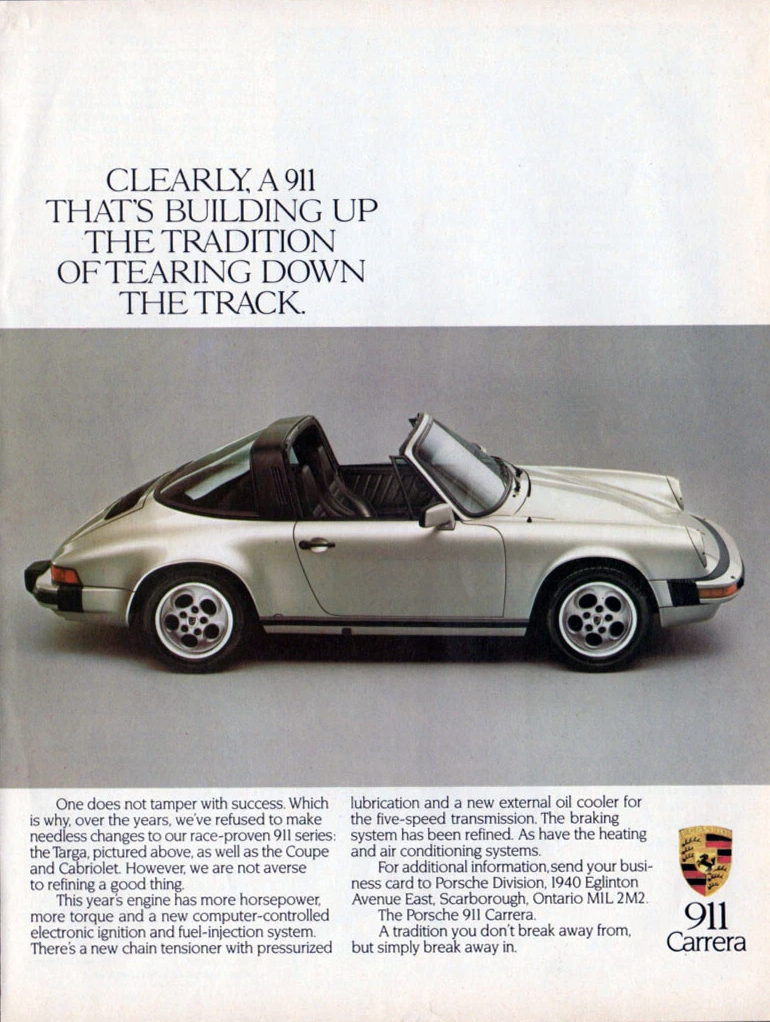
1984 Porsche 911 Carrera Targa

“One does not tamper with success.”

The storied Carrera name returned to Porsche’s 911 for the 1984 model year with big changes in the engine, suspension, and brakes.

The Carrera’s new engine was the 200 bhp 3.2 liter/193 ci flat six with Bosch Motronic fuel injection. With the standard Getrag five-speed manual transmission, 0-60 mph came in about 6.3 seconds, with a claimed top speed of 152 mph in the 2,866-pound curb weight Carrera Targa (the 2025 911 Carrera Targa is about 3,772 pounds). Fuel mileage was 19 city/32 highway by the day’s standards (15/23 by today’s measures) with premium gas. With a 21.1-gallon gas tank, a 911 Carrera’s proud new owner could expect a range of between 365 and 435 miles with a 10% fuel reserve.

Print advertisement for the 1984 Porsche 911 Carrera Targa

The 1984 911 Carrera Targa‘s base price was $33,450—about $107,300 in 2025 dollars and approximately 39% less than a 2025 Porsche 911 Targa 4S goes for. Standard exterior and mechanical equipment included halogen headlights, fog lights, and tinted glass, and power vented disc brakes on all four wheels. The front 185/70VR15 tires sat on 15 x 6 inch alloy wheels, while the rear 215/60VR15 tires were mounted on 15 x 7 inch alloy wheels (Pirelli still makes these tire sizes). Inside, reclining front bucket seats, a leather Sport steering wheel, power windows, and air conditioning (said not to be very capable) were included. A stereo was not included—Porsche evidently assumed that 911 buyers had their own ideas about what should be in that part of the dash—and Crutchfield still provides. Stuttgart did deign to provide “4 speaker stereo preparation with automatic power antenna.”

Options & Period Reviews

Exterior and mechanical options for the Targa included a limited slip differential ($590), front and rear spoilers ($1,325), and 16-inch forged alloy wheels (6 inches wide in the front, 7 inches wide in the back—and setting the buyer back $1,580). Inside, options included automatic heating control ($485), automatic cruise control, power door locks, a passenger power seat, an alarm system, and a Blaupunkt Monterey digital cassette radio.

Period reviews were enthusiastic. Car and Driver stated that the 911 Carrera had “rousing performance.”

The View From 2025

It’s little surprise that eighties 911 Carreras have maintained their value quite well. According to Hagerty’s valuation tools, all the money for a 1984 Porsche 911 Carrera Targa in #1/Concours condition is $126,000, with a more normal #3/Good condition car going for $60,000.

Porsche 911 Carrera Targas have (of course) excellent club support from many sources and are often available in the Hemmings Motor News classifieds, on eBay Motors, and on Bring a Trailer. As I update this blog entry in April 2025, a Moss Green Metallic 1986 Cabriolet with black leather seats is for sale on Hemmings, asking $60,000.

Make mine Gemini Gray Metallic, please.

This is the first 911 Targa I have blogged about. Other eighties 911 models I have written about include the 1980 SC coupe, the 1985 Carrera Cabriolet, the 1986 Turbo coupe, and the 1987 3.2 Carrera coupe. Other eighties Porsches I have covered include the 1980 924 hatchback coupe, the 1982 924 Turbo hatchback coupe, the 1982 928 hatchback coupe, the 1986 944 Turbo hatchback coupe, the 1987 928 S4 hatchback coupe, and the 1988 944 hatchback coupe.

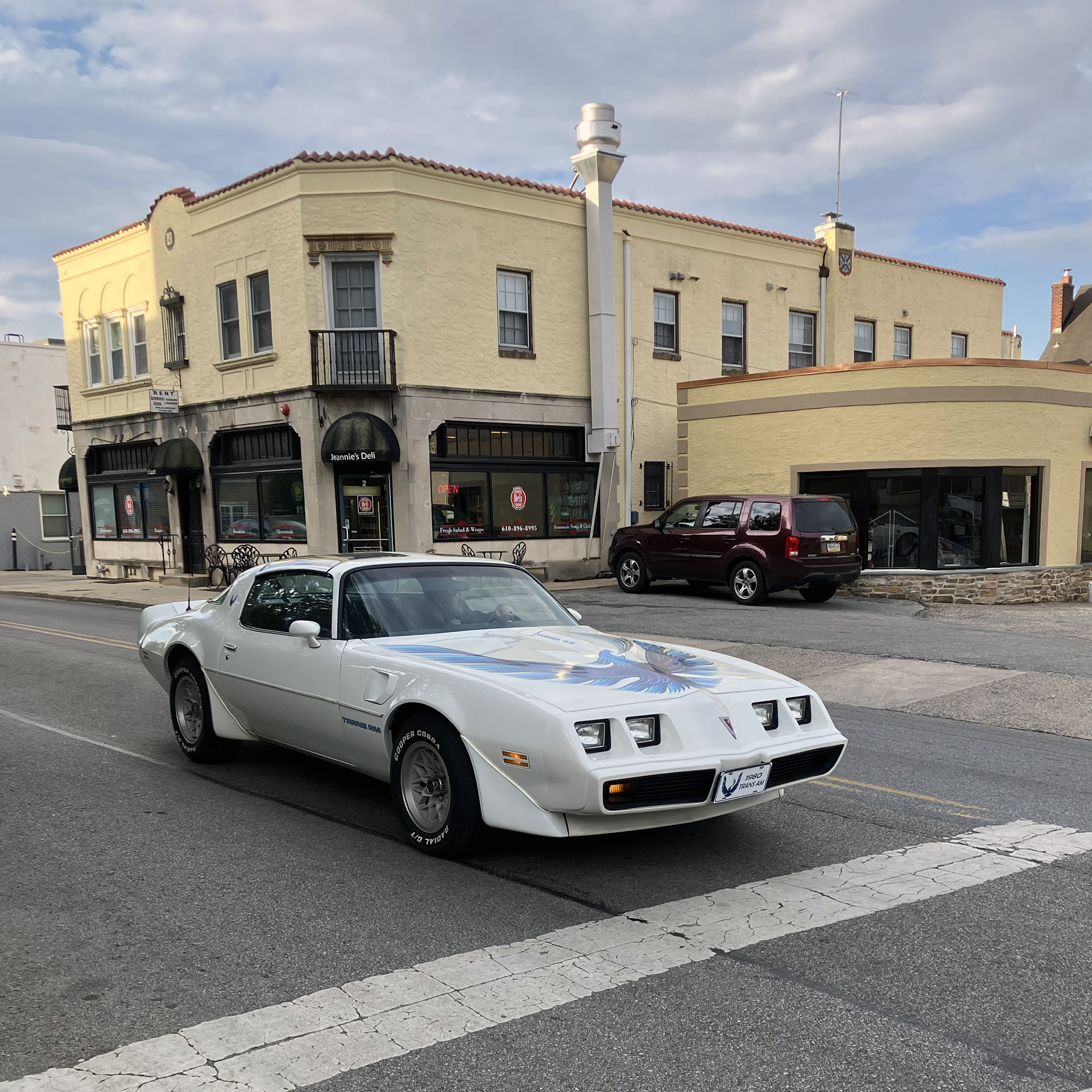
1980 Pontiac Firebird Turbo Trans Am coupe

Photo of 1980 Pontiac Firebird Turbo Trans Am coupe
The 1980 Pontiac Firebird Turbo Trans Am coupe my fiancée saw

On a lovely spring morning in early 2025, my fiancée was walking from her house toward the temporary train station in Ardmore, PA. On her way to the station, she saw and (more importantly for this blog post) photographed a 1980 Pontiac Firebird Turbo Trans Am in Cameo White smoothly idling at a stop sign. Underneath the image she texted me, she wrote, “You are escorting me to the train.”

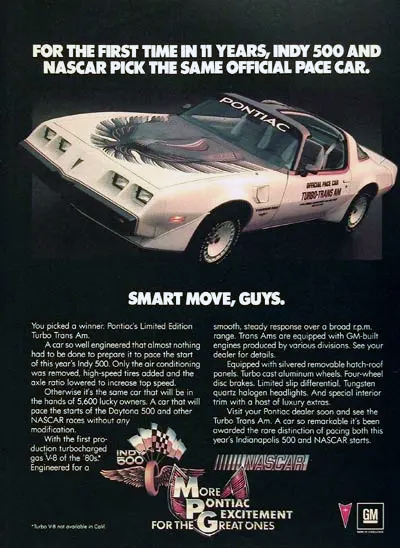
“You picked a winner.”

1980 was a transitional year mechanically for the second-generation Firebird and its Trans Am sub-model, though little else of significance changed. Gone was the 6.6 liter/403 ci V8, with the new top-of-the-line engine being a 4.9 liter/301 cu V8 with a turbocharger. Along with the engine changes, there was an asymmetrical hood design and a special hood decal for the Turbo Trans Am.

Pontiac could not do much about the general lack of space efficiency (the EPA rated the Firebird as a subcompact car), the high curb weight (about 3,700 pounds when the Mustang weighed about 2,800), and the relatively primitive technology.

Engines & Transmissions

The standard Trans Am engine was the Pontiac-built L37 155 bhp 4.9 liter/301 ci V8 with a four-barrel carburetor. The only choice for Trans Am purchasers in California was the Chevrolet-built LG4 145 bhp 5.0 liter/305 ci V8 with a four-barrel carburetor, but you did get a $180 credit.

The Trans Am’s most powerful engine was the $350 Pontiac-built LU8 210 bhp 4.9 liter/301 ci V8 with a Rochester Quadrajet four-barrel carburetor and an AiResearch TBO305 turbocharger. The turbo engine was emissions-certified only with the combination of air conditioning and a 3.08:1 rear axle ratio. All Trans Ams in 1980 came with a three-speed automatic—a one-year pause for the four-speed manual as Pontiac struggled to meet emissions regulations.

Combining a turbocharger, a carburetor, and primitive electronic engine controls was not easy, and reviews of one of the world’s first turbo V8s were mixed. The relatively primitive gas of the day meant that Pontiac had to retard the spark advance substantially to minimize detonation, which kept the turbocharger’s power return relatively low. As Car and Driver stated, “by the time the engine reaches 4000 rpm, the show is essential­ly over.”

Performance & Standard Equipment

A Turbo Trans Am would accelerate from 0-60 in a little over eight seconds (Car and Driver clocked 8.2), which was good for 1980. Fuel mileage was predictably bad—15 city/21 highway mpg by the day’s standards for the combination of the turbo engine and the automatic. With a 20.8-gallon fuel tank, Trans Am owners could expect to travel about 280 to 305 miles before refueling.

Standard exterior and mechanical equipment included in the $7,179 base price of the Trans Am (about $30,900 in today’s dollars) included a front center air dam, dual rectangular headlamps, a black-accented grille, a shaker hood and air cleaner, front and rear wheel opening air deflectors, a rear deck spoiler, a limited slip differential, power steering, power front disc/rear drum brakes, and 225/70-R15 blackwall tires (a size still readily available) on 15-inch Rally II wheels with trim rings. Inside, front bucket seats, a Formula steering wheel, a machined-trimmed instrument panel trim plate, rally gauges with a quartz clock and a tachometer, and a console were included.

Two Special Editions, Options, & Production Numbers

The black-and-gold Trans Am Special Edition package was $748 additional over a base Trans Am—$1,443 bundled with the removable locking hatch roof (otherwise known as T-tops). It included many exterior paint and trim details, including a gold/matte gold hood bird decal, gold headlight grilles, and gold wheels with gold center cap bird emblems. Inside, a gold dash panel, a gold-spoked steering wheel, gold door emblems, and a gold shifter emblem were included. 6,178 buyers took home a Special Edition—about 12% of Trans Am production.

Print advertisement for 1980 Pontiac Firebird Trans Am Pace Car
Print advertisement for the 1980 Pontiac Trans Am Pace Car

There was also a special edition of the Special Edition in completely different colors—the Indianapolis Pace Car Edition. The Indianapolis Pace Car Edition was Cameo White, with Soft Ray tinted glass on all windows, white Turbo cast aluminum wheels, silver T-tops, and oyster interior trim. Mechanical features included the LU8 turbocharged engine, turbo boost gauges, the WS6 special performance package, and four-wheel power disc brakes. Inside, a leather-wrapped steering wheel, Custom air conditioning, and a Delco-GM ETR AM/FM radio with a cassette player were included. All this extra content was a good thing because the Indianapolis Pace Car Edition listed for $11,020.52 (why not just round to the closest dollar?)—about $47,500 in 2025 dollars. After initially promising 5,600 in advertising, Pontiac ended up building 5,700, about 11% of 1980 Trans Am production.

Exterior and mechanical options available for the Trans Am included the WS6 special performance package ($281), tungsten quartz halogen headlamps ($27), white-lettered tires ($68), Turbo cast aluminum wheels, four-wheel power disc brakes ($162), and an automatic power antenna ($50). Inside, an electric rear window defroster ($107), power door locks ($93), Custom air conditioning ($566), a tilt steering wheel ($81), controlled cycle windshield wipers ($41), and a host of radios (seven!) were all available.

Pontiac built a total of 50,896 Trans Ams in the 1980 model year, with 22,176 (44%) having the turbo engine.

The View From 2025

Initially neglected by the collector car market and with many now used up, late second-generation Trans Ams in good or excellent shape are now getting interesting numbers—almost doubling in the past fifteen years. According to Hagerty’s valuation tools, all the money for a 1980 Turbo Trans Am with T-tops in #1/Concours condition is $69,000, while a more normal Turbo Trans Am in #3/Good condition is valued at $24,900. These Trans Ams are often available in the Hemmings Motor News classifieds, on eBay Motors, and on Bring A Trailer, and they frequently show up at in-person auctions.

Make mine the black-and-gold Special Edition, of course.

I evidently can’t help myself with eighties Trans Ams; I’ve also written about the 1981 coupe, the 1982 hatchback coupe, the 1984 15th Anniversary hatchback coupe, the 1985 hatchback coupe, and the 1989 Turbo hatchback coupe. I have also written about the 1986 SE hatchback coupe and the 1987 Formula hatchback coupe, but I probably should write about the base car at some point.

1982 Lamborghini Countach 5000S coupe

“… a technical evolution …”

Midway through the 1982 model year, the Lamborghini Countach received a larger version of its V12. With that, the model designation changed from LP400 S to 5000S. Just because (why not?), this version was also sometimes called the LP500 S.

The engine requires some more detail. The 4.8 liter/291 ci V12 came with six Weber carburetors and made 325 bhp in North American form. With the standard five-speed manual, the 0-60 time was 5.7 seconds. As might be expected, fuel economy by the day’s standards was not impressive—12 city/18 highway (10/13 by 2025 measures). At least the two 15.4-gallon gas tanks allowed a range of 320 to 370 miles before a 5000S driver had to search for more premium fuel.

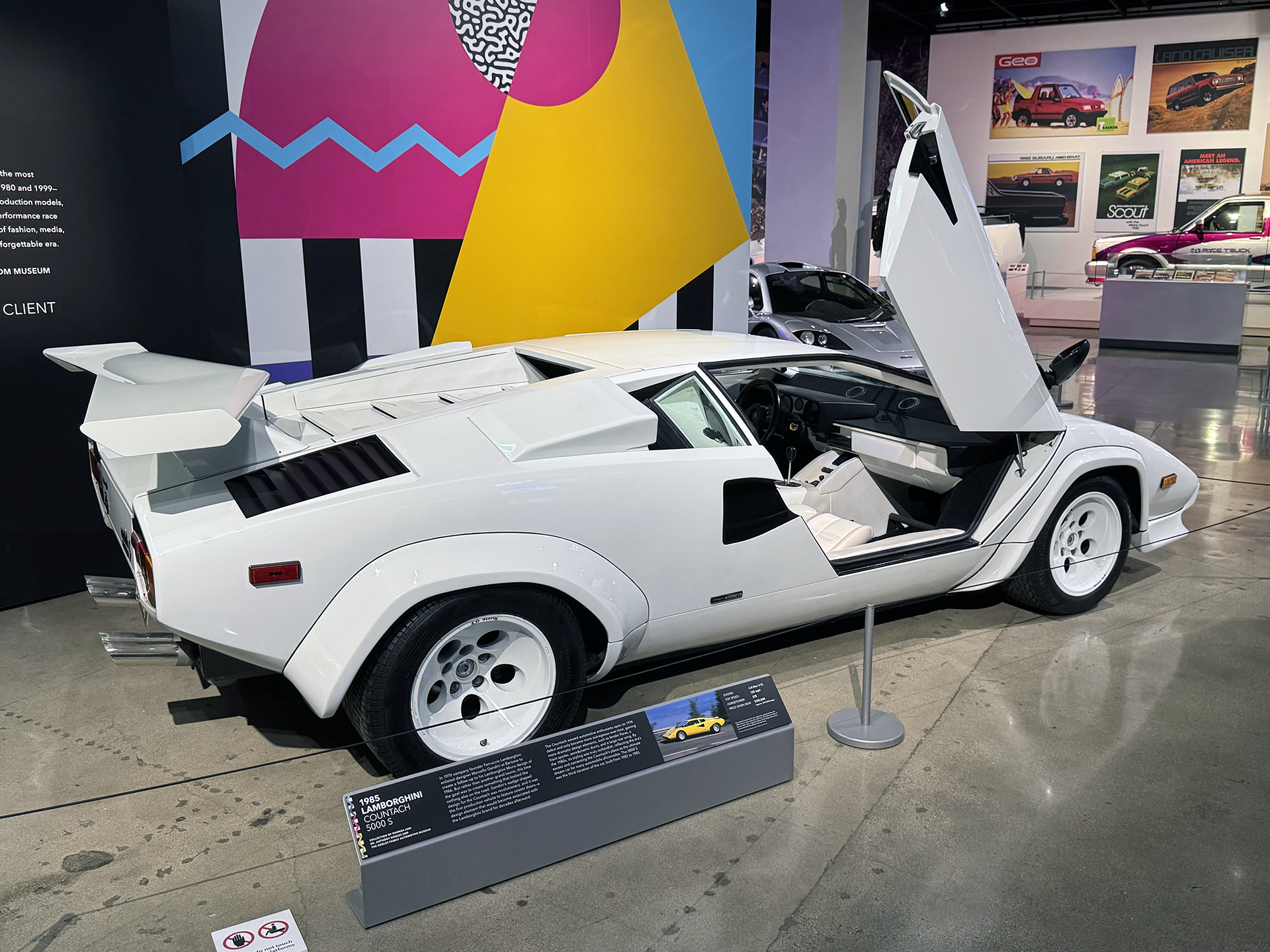
Photo of 1985 Lamborghini Countach 5000S coupe
1985 Lamborghini Countach 5000S coupe at the Peterson Museum

I saw Countachs of various types at the wonderful Petersen Automotive Museum in Los Angeles in late 2025, and it was a great reminder of how vertically short these cars are—the spec for the 5000S was 42.1 inches. When Lamborghini released the Countach LPI 800-4 homage for the 2022 model year, it was actually 2.7 inches taller.

The 1982 Countach 5000S‘s base price was an eye-watering $99,500—about $342,000 in today’s dollars, or about 14% less than what a 2026 Lamborghini Temerario coupe goes for (Lamborghinis have gotten no cheaper in the last forty years) . Standard exterior and mechanical equipment included rack-and-pinion steering, ventilated disc brakes, and 205/50ZR15 front tires and 345/35ZR15 rear tires (both Pirelli P7s) on 15-inch wheels. Inside, leather bucket seats, a tilt-and-telescoping steering wheel, and air conditioning were included.

Options & Production Numbers

Options included a rear wing ($5,500), a sports exhaust, gold wheels, and a series of stereos (including a $3,000 one from Alpine).

Lamborghini built 321 5000S Countachs from March 1982 through March 1985. At that point, the Countach Quattrovalvole took over.

The View From 2025

The view from 2025 is just fine, thank you—according to Hagerty’s valuation tools, all the money for a 1982 Countach 5000S in #1/Concours condition is an astounding $676,000. A more “normal” #3/Good condition example is valued at $407,000. 5000Ss frequently appear for sale in the Hemmings Motor News classifieds, on Bring a Trailer, and at in-person auctions.

Make mine Black, please.

The 5000S is the first Lamborghini I have written about in Eighties Cars. Another 1985 exotic I have written about is the Ferrari Testarossa coupe.

1986 Jeep CJ-7 SUV

“Only in a Jeep.”

1986 was the final model year for the Jeep CJ-7, which had debuted in 1976. Because of this, there were only minor trim and detail changes.

The CJ-7’s standard powertrain was an AMC 86 bhp 2.5 liter/150 ci inline four with electronic fuel injection paired with a four-speed manual transmission and part-time four wheel drive. An AMC 102 bhp 4.2 liter/258 ci inline six with a two-barrel carburetor was a $361 option. Both engines could be had with a five-speed manual ($250), but only the inline six could be paired with a Torque-flite automatic ($495).

Jeep CJs were neither economical nor fast—but most Jeep fanciers would have and do argue that isn’t the point. The spriteliest powertrain combination (inline six/five-speed) came in with fuel economy ratings of 17 city/21 highway by the day’s standards (15/20 by modern measures). With the standard 15.1-gallon gas tank, a CJ-7’s presumably happy owner could expect a range of 240 to 255 miles with a 10% fuel reserve. It’s no wonder many went for the $57 20-gallon extra capacity fuel tank, which promised ranges of over 300 miles.

Front cover of the 1986 Jeep CJ brochure

The 1986 CJ-7’s base price was $7,500—about $22,400 in today’s dollars. Standard exterior and mechanical equipment included a roll bar, a moveable tailgate, a swing away spare tire carrier, a front stabilizer bar, manual front disc brakes, and free-wheeling hubs. Inside, linen-grain vinyl high back bucket seats, a padded instrument panel, a day/night mirror, an electric washer and 2-speed wipers, a cigarette lighter, and a heater and defroster were included.

Packages, Options, & Production Numbers

Jeep offered two packages for the 1986 CJ-7:

  • The $1,253 Renegade package included special Renegade exterior graphics, rocker panel protection moldings, and 15 x 7 white styled steel wheels. Inside, a denim-look vinyl rear seat, a soft feel 3-spoke Sport steering wheel, and intermittent wipers were included.
  • The $3,304 Laredo package included a chrome grille panel with pinstripe, a hard top, a Laredo hood decal, and 15 x 7 chrome styled steel wheels. Inside, a leather-wrapped 3-spoke steering wheel, a console, a rear seat, courtesy lights, a tachometer and clock, and intermittent wipers were included. A Laredo with no other options came to $10,804—about $32,300 in 2025 dollars, or about 10% less than a 2026 Jeep Wrangler Sport 2-door goes for.

Individual options included heavy duty engine cooling ($57), power steering ($274), power disc brakes ($125), a rear Trac-lok differential ($255), a conventional spare tire ($94), and a tilt steering wheel ($118). Many CJ-7s exited dealer showrooms with stickers that were about twice the base price.

Jeep produced 25,929 CJ-7s in the 1986 model year. They marked the final version of the original Civilian Jeep from 1945, whose total production measured over 1.5 million units.

The View From 2025

CJ-7s have a devoted fanbase, and their values reflect that. According to Hagerty’s valuation tools, a 1986 CJ-7 Renegade with the inline six in #1/Concours condition is $48,800, while a more typical #3/Good condition example goes for $24,500. CJ-7s frequently show up for sale in the Hemmings Motor News classifieds, on eBay Motors, and on Bring a Trailer.

Make mine Garnet Metallic, please.

Other Jeeps I have written about include the 1982 CJ-8 Scrambler pickup truck and the 1983 Wagoneer Limited SUV.

1987 Chevrolet Cavalier RS convertible

Recently, a near-perfect low-mileage 1987 Chevrolet Cavalier RS convertible came up for auction on Bring a Trailer. This event made me painfully aware that I’d written about the Cavalier sedan and coupe, but somehow not the convertible—time to fix that.

“Sporty performance”

The Chevrolet Cavalier first came to market for the 1982 model year, initially available as a notchback coupe, a hatchback coupe, a notchback sedan, and a station wagon. In the middle of 1983, Chevrolet introduced a convertible version, initially available as the top-of-the-line CS. In 1984, the convertible transitioned to the sporty Type 10. The RS replaced the Type 10 in the 1986 model year, and the convertible went with it. From 1983 through 1987, Cavalier convertible conversions were done by ASC.

The RS convertible’s standard powertrain was the 90 bhp LL8 2.0 liter/121 ci inline four with electronic fuel injection and a four-speed manual. Optional power was the 125 bhp LB6 2.8 liter/173 ci V6 with multiport fuel injection ($660). Both a new-for-1987 Getrag-designed five-speed manual transmission ($75) and a three-speed automatic transmission ($490) were available.

Road tests of the first-generation Cavalier convertible are hard to come by, but 0-60 likely came in a little over 9 seconds with the five-speed/V6 combination. Fuel economy ratings for the same combination were 20 city/26 highway by the day’s standards. With a 14-gallon gas tank, a Cavalier convertible’s enthusiastic new owner could expect a range of 265 to 285 miles with a 10% fuel reserve.

Front cover of the 1987 Chevrolet full line brochure

The 1987 Cavalier RS convertible’s base price was $13,466—about $39,700 in 2025 dollars. Standard exterior and mechanical equipment included a power operated convertible top, tinted glass, left hand remote and right hand manual Sport mirrors, the F41 sport suspension, a front stabilizer bar, power steering, power front disc/rear drum brakes, and P195/70R13 all season radial ply blackwall tires (a size no longer readily available) on 13-inch Rally wheels with trim rings. Inside, Custom Cloth front bucket seats with recliners, a console, a Sport steering wheel, power windows, and an AM radio with dual front speakers were included.

Options & Production Numbers

Individual options available with the RS convertible included aluminum wheels ($212), air conditioning ($675), the Comfortilt steering wheel ($125), electronic speed control with resume speed ($175), an intermittent windshield wiper system ($55), and a power door lock system ($145). A series of four optional audio systems, ranging up to an ETR AM/FM stereo radio with seek and scan, a cassette player, a graphic equalizer, and a clock ($449), was available.

Chevrolet sold 5,826 Cavalier convertibles in the 1987 model year, making that the best production total for any year of the first-generation Cavalier convertible.

The View From 2025

People do collect these small convertibles. They maintain a reasonable presence in the Hemmings Motor News classifieds, on eBay Motors, and on Bring a Trailer.

Make mine Red—I think.

Other Cavaliers I have written about include the 1983 CS sedan and the 1986 Z24 coupe. The other J platform cars I have written about are the 1982 Cadillac Cimarron sedan, the 1984 Buick Skyhawk coupe, the 1984 Pontiac 2000 Sunbird S/E hatchback coupe, the 1985 Oldsmobile Firenza ES sedan, and the 1988 Cadillac Cimarron sedan.