
The inspiration for this blog entry is a loaded 1983 Chevrolet Cavalier CS sedan that one of my frequent readers owned back in the day.
“… one of today’s most advanced front-wheel-drive cars”
1983 was the second model year for Chevrolet’s Cavalier compact. The biggest news was likely in the powertrain: a 2.0 liter inline four with throttle-body fuel injection was the new standard engine, along with a newly optional five-speed manual transmission. Chevrolet announced a convertible version of the coupe in the middle of the model year.
The only engine available was the LQ5 86 bhp 2.0 liter/122 ci inline four with throttle-body fuel injection. The LQ5 had two fewer horsepower than the previous year’s L46 1.8 liter engine, but notably more grunt—an additional ten lb-ft of torque. The result was a meaningful half-second improvement in 0-60 times, though the Cavalier remained slow (even by 1983 standards). A four-speed manual remained standard, while a five-speed manual ($75) and an automatic ($395) were available. Fuel economy ratings with the five-speed manual were 25 city/41 highway by the day’s standards. With a 13.6-gallon gas tank, a Cavalier driver could expect a range of 330 to 360 miles with a 10% fuel reserve.
Standard equipment on the 1983 Cavalier was far sparer than it had been in 1982, when many potential buyers had blanched at the sedan’s $7,137 base price. Still, exterior and mechanical features on all Cavalier sedans did include front-wheel-drive, a front stabilizer bar, rack and pinion steering, power front disc/rear drum brakes, and P175/80R13 radial tires on 13 x 5 inch steel wheels. Inside, vinyl reclining front bucket seats and side window defoggers were included. For 1983, the sedan started at $5,999—about $19,800 in today’s dollars.
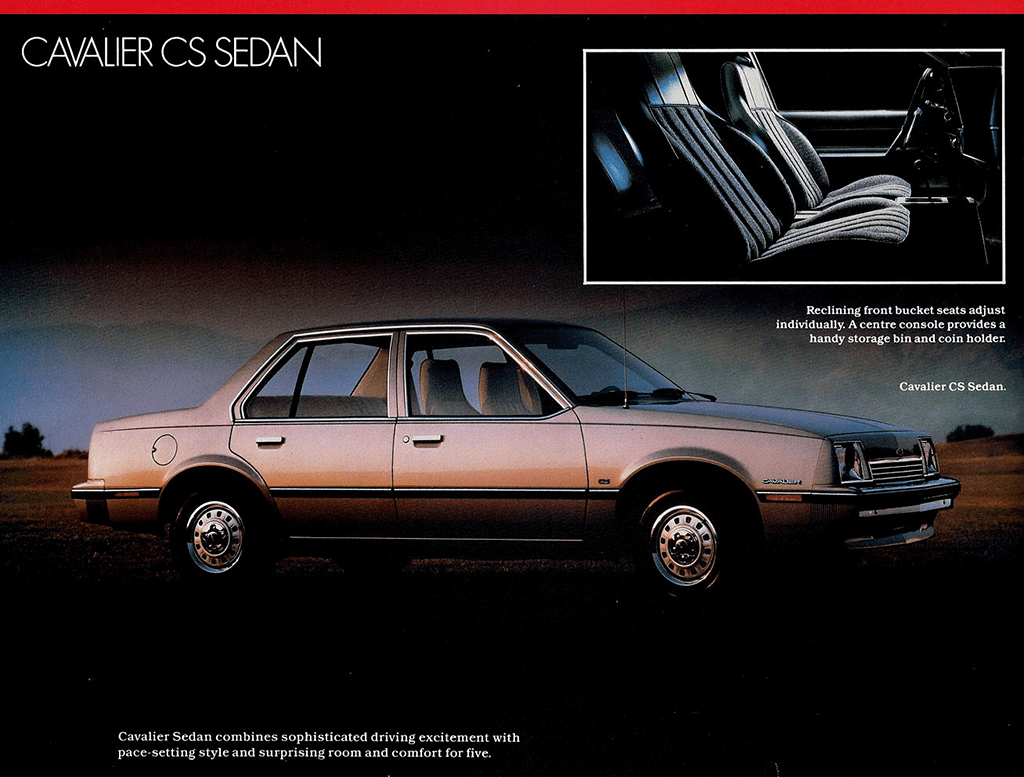
Moving up to the $6,484 CS added a glove compartment lock, a colour-keyed instrument panel, a cigarette lighter, an ashtray light, and an AM push-button radio with dual front speakers.
Only available with the CS, the CL package added Sport mirrors, a Custom interior with Custom reclining seats and adjustable head restraints, a three-spoke steering wheel with a black leather rim, and a right-hand visor vanity mirror.
Options & Production Numbers
Exterior and mechanical options for the CS sedan included tinted glass ($90), a removable sunroof ($295), Custom two-tone paint with pin striping ($176), halogen headlamps ($10), power steering ($195), and an F41 sport suspension ($49). Inside, power door locks ($170), power windows ($255), automatic speed control ($170), a six-way power driver’s seat ($210), a Comfortilt steering wheel ($99), and air conditioning ($625) were among the many options.
The 1983 Cavalier sold well, with 215,585 units exiting Chevrolet showrooms, making it the most popular model in the Chevrolet lineup. Of all Cavalier variants in 1983, the CS sedan was the most popular, accounting for almost a quarter of total sales—the convertible was, of course, the rarest, with a mere 607 sold.
The View From 2025
Despite this popularity when new, Cavaliers of this generation have now almost vanished, except for the convertibles and the higher-performance Z24 versions. “Civilian” Cavaliers do occasionally appear on eBay Motors and Bring a Trailer.
Make mine a Light Briar Brown over Dark Brown two-tone—just like my reader’s car.
The other J platform cars I have written about are the 1982 Cadillac Cimarron sedan, the 1984 Buick Skyhawk coupe, the 1984 Pontiac 2000 Sunbird S/E hatchback coupe, the 1985 Oldsmobile Firenza ES sedan, the 1986 Chevrolet Cavalier Z24 coupe, and the 1988 Cadillac Cimarron sedan. I really should write about a J-body wagon someday.
Last updated October 2025.

 Eighties Cars
Hi
I own a 1983 Chevrolet Cavalier CS two door and still drive it to car shows. I get a lot of reactions from people who can’t believe it is such great shape. It is garaged and I am very proud to show it. I would like to send you a pictures of it if you would be interested.
Thanks
Jim