1982 Ford EXP hatchback coupe

“Two-seat excitement in a world class coupe.”

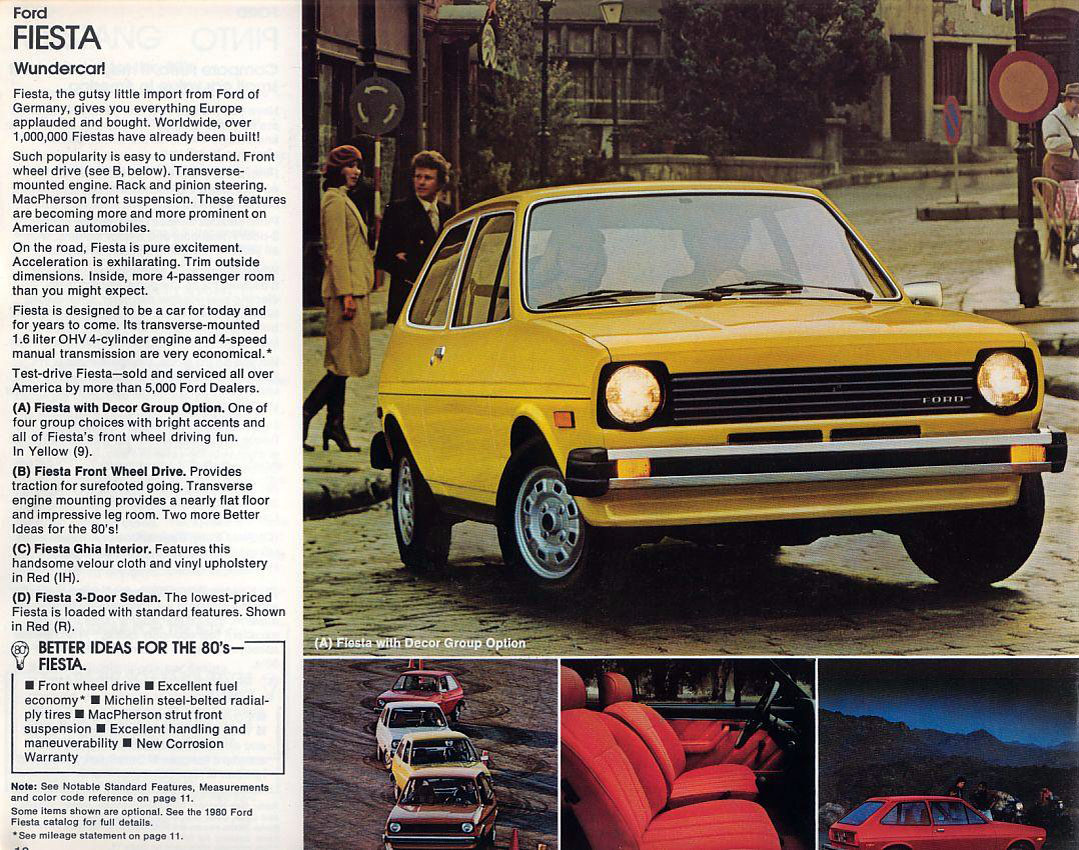
Ford’s EXP two-seat coupe was new for the 1982 model year and introduced early in April 1981. Ford’s first two-seat car since the 1957 Thunderbird, the EXP was designed for a far different purpose. Built on the same platform as the Ford Escort/Mercury Lynx twins and closely related to the Mercury LN7, the EXP was marketed as a car for buyers who wanted an efficient and decently equipped vehicle somewhat sportier than the Escort.

The design language of the EXP resembled that of the contemporary Fox-body Mustang. However, front-wheel-drive and a different platform made the proportions different, which some observers saw as ungainly (or worse). I remember thinking that it was different-looking, but not unattractive.

Ford’s new two-seater was a small car—a length of 170.3 inches makes the EXP more than half a foot shorter than the 2020 Honda Civic coupe. However, the EXP’s length was almost seven inches longer than an Escort hatchback coupe, while its height was over 2.5 inches shorter. Because Ford made the EXP reasonably well-equipped, its weight was about 125 pounds greater than the spare base Escort.

The EXP’s standard powertrain was a CVH 70 bhp 1.6 liter/98 ci inline four with a Motorcraft 740 two-barrel carburetor paired with a four-speed manual. An automatic transmission was optional for $411. EPA fuel economy ratings with the manual were 29 city/46 highway by the day’s standards. With an 11.3-gallon gas tank, an EXP owner could expect a range of 345 to 380 miles with a 10% fuel reserve.

What the EXP wasn’t was anything approaching quick. Figures are hard to find, but the EXP’s 0-60 time was likely about 14.5 seconds. Late in the extended 1982 model year, an HO version of the same engine became available, with 80 bhp. It likely dropped the EXP’s 0-60 time by more than a second, but in this case, HO did not mean fast.

1982 Ford EXP brochure cover

Standard exterior and mechanical equipment on the $7,387 EXP (about $25,200 in today’s dollars) included halogen headlamps, front-wheel-drive, a four-wheel independent suspension, rack and pinion steering, power front disc/rear drum brakes, and P165/80R13 tires (a size now hard to find) on 13-inch Sport styled steel wheels with trim rings. Inside, a Sport steering wheel, reclining high-back front bucket seats, a console, a tachometer, an electronic digital clock, and an AM radio with dual front speakers were included.

Packages, Options, & Production Numbers

The optional TR Performance Suspension Package included special handling tuned suspension components (a thicker stabilizer bar, stiffer shocks, and stiffer springs) and P165/70R 365 Michelin TRX tires (still available!) on a choice of either TR Sport aluminum wheels ($405) or Sport steel wheels ($204).

Exterior and mechanical options included tinted glass (initially $82 but standard later in the model year), a flip-up open air roof ($276), power steering ($190), and cast aluminum wheels ($232). Inside, options included an air conditioner ($611), fingertip speed control ($151), leather/vinyl reclining low back bucket seats ($138), and a few different stereo choices.

First-year sales of the EXP were decent: 98,258 in a model year that extended from April 1981 through September 1982. Following 1982, sales dropped precipitously—only 19,697 for 1983, 23,016 for 1984, 26,462 for 1985, 30,978 for 1986, and 25,888 for the EXP’s final year in 1987.

The View From 2025

I have not seen an EXP on the road in over fifteen years. EXPs rarely show up for sale in the Hemmings Motor News classifieds and on eBay Motors—in fact, they seem to have virtually vanished. Because Bring a Trailer is … Bring a Trailer, they have sold one EXP.

Make mine Bright Red, please.

I have previously written about the 1981 Escort hatchback coupe and the 1987 Mercury Lynx XR3 hatchback coupe. Perhaps someday I shall write about the short-lived Mercury LN7.

Last updated March 2025.

1985 Ford Eddie Bauer Bronco SUV

“… we’ve done it again …”

The big news for 1985’s Ford Bronco SUV was the November 1984 introduction of an Eddie Bauer edition, which became the new top-of-the-line. Of course, the full-size Bronco was not the first Ford to be “Bauerized”—that was actually the 1984 Ford Bronco II compact SUV.

1985 Frod Bronco brochure page
Eddie Bauer Bronco page from the 1985 Bronco brochure

The Eddie Bauer Bronco went for $15,972—about $49,200 in today’s dollars, or about what a 2025 Bronco Badlands 2 Door goes for. Exterior features distinctive to the Eddie Bauer Bronco included a specific two-tone paint treatment, dual accent bodyside paint stripes, privacy glass for the quarter windows, and Deluxe argent styled steel wheels.

Interior equipment for Ford’s new special edition included air conditioning, speed control, a tilt steering wheel, Light Group, and an AM/FM stereo radio. Upholstery included reclining all-tan cloth front captains chairs with folding armrests and zippered pouches on the seatbacks, a matching rear bench seat, a floor console, and deep 16 oz color-keyed carpeting.

Powertrains, Performance, & Fuel Economy

The Bronco’s powertrain story was not simple in 1985. All Bronco equipment levels (base, XLT, and Eddie Bauer) came standard with the 120 bhp Big Six 4.9 liter/300 ci inline six with a one-barrel carburetor. The year started with two engine options, both versions of theWindsor 5.8 liter/351 ci V8. At $1,041 was a 150 bhp example with a two-barrel carburetor, while an H.O. version with a four-barrel carburetor put out 210 bhp and cost $1,418. Arriving at about the same time that the Eddie Bauer edition did was a Windsor 190 bhp 4.9 liter/302 ci V8 with fuel injection, which set buyers back $1,202.

A four-speed manual was standard with the six and the smaller V8, while an automatic was the standard and only transmission with both of the 5.8 liter engines. The six could be ordered with a four-speed manual with overdrive, while the 4.9 liter V8 could be had with an overdrive automatic.

Mileage ratings sharply separated the six from all the V8s. With the Big Six and the four-speed manual, a Bronco owner could expect 16 city/21 highway. That dropped to 13/17 with the 5.0 liter V8 and was even worse with the two 5.8 liter engines. Thus, the Bronco’s range with its 25-gallon gas tank and a 10% fuel reserve could vary from a high of 415 miles to a low of 260 miles. Of course, the V8s were noticeably quicker—about two to four seconds faster to 60 mph.

Base Equipment, Options, & Production Numbers

Standard exterior and mechanical equipment on all Broncos included halogen headlights, tinted glass, a heavy-duty radiator, variable-ratio power steering, power front disc/rear drum brakes, and P235/75R15 tires (a size still readily available) on 15-inch wheels. Inside, dome lights, a locking glove box, and a rear flip/fold bench seat were included.

Options for the well-equipped Eddie Bauer Bronco included heavy-duty shocks and springs ($155), a Traction-Lok limited slip rear axle ($238), power windows ($239), and an AM/FM stereo radio with a cassette tape player ($235).

Bronco sales were up a little over 10% to 52,316 for the 1985 model year, easily outselling the competing Chevrolet Blazer and Dodge Ramcharger. Sales of the eighties Bronco would peak in 1989, with 66,730 moved.

The View From 2025

Along with other eighties SUVS, Broncos are attracting significant collector interest. According to Hagerty’s valuation tools, all the money for a 1985 Eddie Bauer Bronco with the 5.8 liter H.O. V8 (the most prized engine) in #1/Concours condition is $50,000, with a far more normal #3/Good condition version going for $29,900. Eighties Broncos are often available in the Hemmings Motor News classifieds, on eBay Motors, and on Bring a Trailer.

Make mine Dark Canyon Red Metallic, please.

Other 1985 Ford products I have written about include the Ford LTD LX sedan and the Merkur XR4Ti hatchback coupe. Other full-size eighties SUVs I have written about include the 1983 Jeep Wagoneer Limited, the 1985 Chevrolet C20 Suburban, the 1985 Chevrolet K5 Blazer, and the 1986 Dodge Ramcharger.

Last updated December 2025.

1987 Ford Thunderbird standard coupe

The inspiration for this blog entry is a 1987 Thunderbird standard coupe that one of my frequent readers owned. As I was pretty deep into writing it, the Hemmings blog just happened to re-publish an article that ran in Hemmings Classic Car earlier in 2020—also about the 1987 Thunderbird (though mainly about the Turbo Coupe). Luckily, I have a slightly different view, in what looks to be a rather long-form entry.

“In step with the times”

For 1987, Ford significantly revised the Thunderbird—even though it didn’t look that different, the late mid-life update of what had been a 1983 model year debut cost approximately $250 million. Few exterior parts were carried over from the 1986 model, with notable changes including composite headlights, a more pointed nose, flush-fitting side glass, and full-width taillamps. There were far less differences inside—Ford had spent all of the money on the exterior and mechanical revisions.

The standard engine for the 1987 Thunderbird was an Essex 120 bhp 3.8 liter/231 ci V6 with throttle-body fuel injection. Optional power on the base coupe and LX (and standard on the Sport) was a $638 Windsor 150 bhp 4.9 liter/302 ci V8 with sequential fuel injection. Both engines came with a four-speed automatic transmission. The most powerful engine available on any Thunderbird remained the Turbo Coupe-specific Lima 2.3 liter/140 ci inline four with a turbocharger and fuel injection. With the new for 1987 addition of an intercooler, this engine produced an impressive 190 bhp with the five-speed manual, but only 150 bhp with the automatic—a difference common among many Ford performance cars of the 1980s.

1987 Ford Thunderbird brochure page
Standard coupe page from the 1987 Ford Thunderbird brochure

Standard exterior and mechanical equipment on every 1987 Thunderbird standard coupe included dual aerodynamic halogen headlamps, tinted glass, power rack and pinion steering, power front disc/ rear drum brakes, and P215/70R14 tires (a size still readily available) on 14 x 5.5 inch wheels with Luxury wheel covers. Inside, the standard coupe included a reclining cloth split bench seat with a consolette, a quartz electric clock, and an electronic AM/FM stereo radio with four speakers. All of this cost $12,972—approximately $38,000 in today’s dollars or almost exactly what a 2025 Ford Mustang EcoBoost Premium Hatchback goes for.

Options & Packages

Exterior and mechanical options for the standard coupe included two-tone paint ($218), a power moonroof ($841), and cast aluminum wheels ($343). Inside, dual power seats ($302), a digital clock ($61), and a range of audio options, including the Premium Sound System, were available. There were three different upgrades from the standard version of the Thunderbird, each with a distinctive personality:

  • For an additional $2,411, the luxury-oriented LX included everything in the standard coupe and added dual remote-control electric mirrors, styled road wheels, an electronic digital clock, speed control, interval windshield wipers, power windows, and an electronic AM/FM stereo radio with a cassette player and four speakers. LX upholstery included a Luxury cloth split bench seat in a special sew style and a leather-wrapped steering wheel.
  • The Sport included everything in the standard coupe and added a heavy-duty battery, a Traction-Lok axle, styled road wheels, an electronic digital clock, a leather-wrapped steering wheel, speed control, and individual cloth seats with a full console. The Sport came standard with the 4.9 liter/302 ci V8 that was optional in the standard and LX versions, which Ford stated was its “driving force.” It cost $2,107 more than the standard coupe.
  • The top-of-the-line Turbo Coupe included everything in the standard coupe and added dual remote-control electric mirrors, Hella fog lamps, four-wheel disc brakes (newly anti-lock for 1987), a Traction-Lok axle, dual exhaust, and P225/60R16 Goodyear performance tires on 16 x 7 inch cast aluminum wheels. Inside, full analog instrumentation, interval windshield wipers, power windows, and adjustable articulated cloth sport bucket seats were standard for Turbo Coupe buyers. The Turbo Coupe cost $16,805—about $49,200 in today’s dollars and almost 30% more than the standard coupe. Ford confidently stated that it was “one of the most complete performance cars on the road today.”

Period Reviews & Production Numbers

Some in the automotive press were impressed by the Thunderbird’s substantial refresh for 1987, with Motor Trend giving it their Car of the Year award. Popular Mechanics was a little more even-handed; they liked many of the exterior changes but were unimpressed by the acceleration of either the V8 or the turbo four. Whatever the opinions were from the buff books, sales still slid substantially—dropping by almost 22% from 163,965 in 1986 to 128,135 in 1987.

The View From 2025

According to Hagerty’s valuation tools, a 1987 Thunderbird standard coupe in #1/Concours condition is currently valued at $16,300, while a more typical #3/Good condition car goes for $9,000. Turbo Coupes are worth substantially more, garnering $27,300 for a #1/Concours example.

These 1987 and 1988 Thunderbirds frequently appear for sale in the Hemming’s Motor News classifieds, eBay Motors, and Bring a Trailer. As I update this blog entry in August 2025, there’s a White 1988 coupe with cinnabar cloth bucket seats, the 302 ci V8, and 6,700 miles for sale on Hemmings, asking $12,500.

Make mine Medium Canyon Red, please.

Other Thunderbirds I have written about in this blog are the 1980 coupe and the 1983 Turbo Coupe (I’ve also written about the closely related 1988 Mercury Cougar XR-7 coupe). A sampling of the many other Fords I have written about includes the 1981 Escort hatchback coupe, the 1982 Mustang GT hatchback coupe, and the 1986 Taurus sedan.

Last updated August 2025.

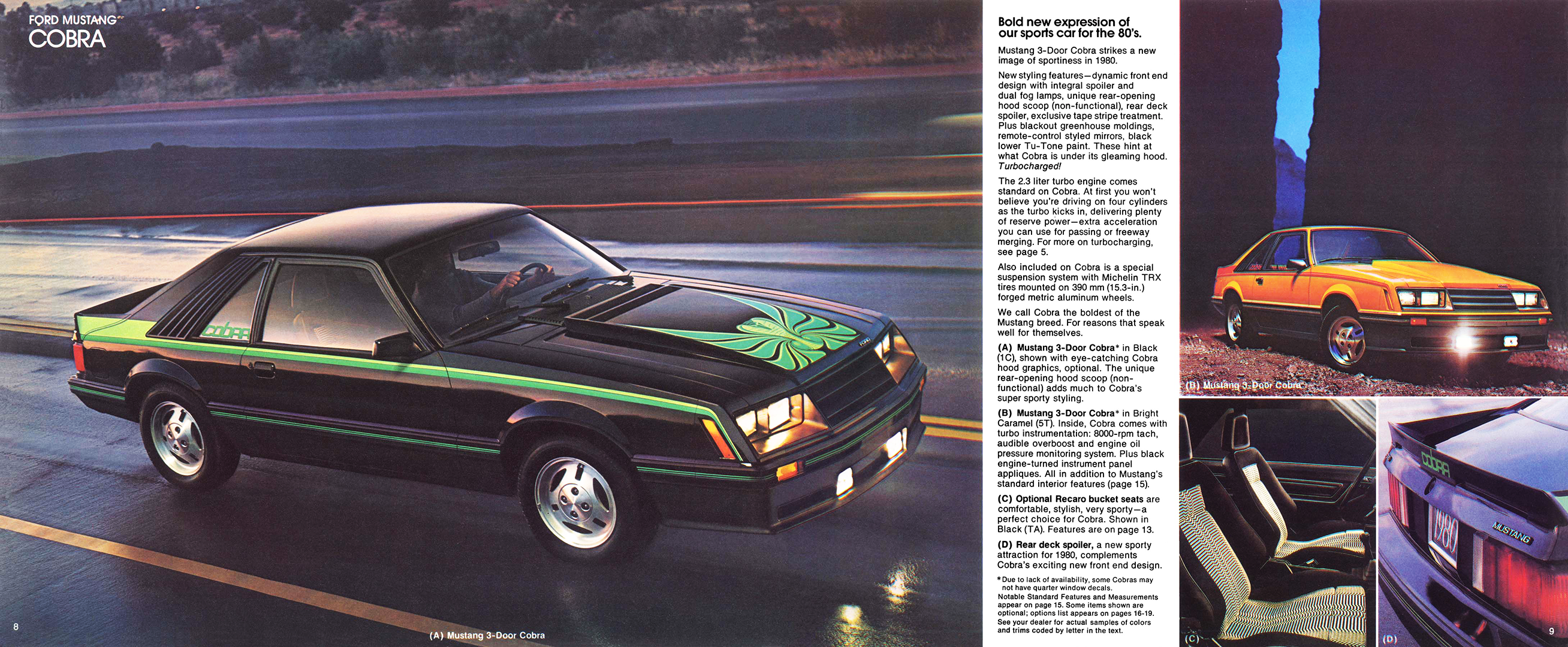
1980 Ford Mustang Cobra hatchback coupe

“A sports car for the 80’s.”

1980 was the second year for the Fox-body Mustang and brought few changes from the debut year—and some of those weren’t great, such as a downgraded V8. The Cobra inherited some features from the 1979 Pace Car, including a front spoiler, dual fog lamps, and a rear deck spoiler.

The standard powertrain on the base Mustang was Ford’s Lima 88 bhp 2.3 liter/140 ci inline four with a Motorcraft 5200 two-barrel carburetor matched with a four-speed manual. A Windsor 119 bhp 4.2 liter/255 ci V8 with a Motorcraft 2150 two-barrel carburetor was available with a three-speed automatic, but the top-of-the-line powertrain was a turbocharged version of the Lima inline four with a Holley 6500 two-barrel carburetor making 132 bhp paired with the four-speed manual. Thus, for 1980, the fastest available Mustang had a 0-60 time of a little under 11 seconds. With a 12.5-gallon fuel tank and 18 city/30 highway fuel mileage (about 15/25 by today’s standards), a Cobra‘s proud new owner could expect a range of about 225 to 270 miles with a 10% fuel reserve.

Cobra pages from the 1980 Ford Mustang brochure

Standard mechanical equipment on the $7,098 Cobra (about $30,600 in today’s dollars or just a little under what the 2026 Mustang EcoBoost fastback goes for) included the turbocharged inline four, the four-speed manual, a “special suspension system” with heavy duty front and rear stabilizer bars and special shock valving, a sport-tuned exhaust with bright tailpipe extension, and Michelin TRX 190/65R390 tires (they’re still available!) on 15.3-inch forged aluminum wheels. Exterior equipment included dual remote styled mirrors and black lower bodyside paint. A Cobra‘s interior didn’t have many upgrades, but you did get an 8,000-rpm tachometer and a black engine-turned instrument panel applique.

Standard equipment on all Mustang hatchback coupes included dual rectangular halogen headlamps, wraparound taillamps, a modified MacPherson strut front suspension, front disc/rear drum brakes, and rack and pinion steering. Inside, full instrumentation (tachometer, trip odometer, fuel/temperature/oil/alternator gauges), a sports steering wheel, color-keyed cut pile carpeting, all vinyl high-back bucket seats, a lockable glove box, and a cigarette lighter were included.

Options, Sales, & Period Reviews

Exterior and mechanical options included Cobra hood graphics ($88), a flip-up open air roof ($219), black liftgate louvers ($141), and a rear window/wiper washer ($79). Inside, you could choose SelectAir conditioning ($538), Recaro high-back bucket seats ($531), an electric rear window defroster ($96), interval windshield wipers ($39), a tilt steering wheel ($78), and the power lock group ($113). A series of stereos were available, with the most capable being an AM/FM stereo radio with a cassette tape player ($271). Higher-end stereos could be paired with the Premium Sound System ($94), which added a higher-power amplifier and more capable rear speakers.

1980 Ford Mustangs sold decently, accounting for about 23% of Ford’s overall sales in a down year. Reviews of the day were unhappy, but understanding about the loss of the 4.9 liter/302 ci V8 in the middle of the second oil crisis—Car and Driver stated that “Whether you like life with turbochargers or not, you might as well get used to it.”

The View From 2025

Folks are definitely collecting these early Fox-body Mustangs. According to Hagerty’s valuation tools, all the money for a 1980 Cobra in #1/Concours condition is an astounding $53,400, with a more normal #3/Good car going for $13,800. Cobras come up for sale occasionally in the Hemming’s Motor News classifieds, on eBay Motors, and on Bring a Trailer.

Make mine Black, I think, perhaps with those extra-cost Cobra hood graphics.

Later Fox-body Mustangs I have covered include the 1981 coupe, the 1982 GT hatchback coupe, the 1983 GT convertible, the 1984 SVO hatchback coupe, and the 1987 LX coupe.

Last updated October 2025.

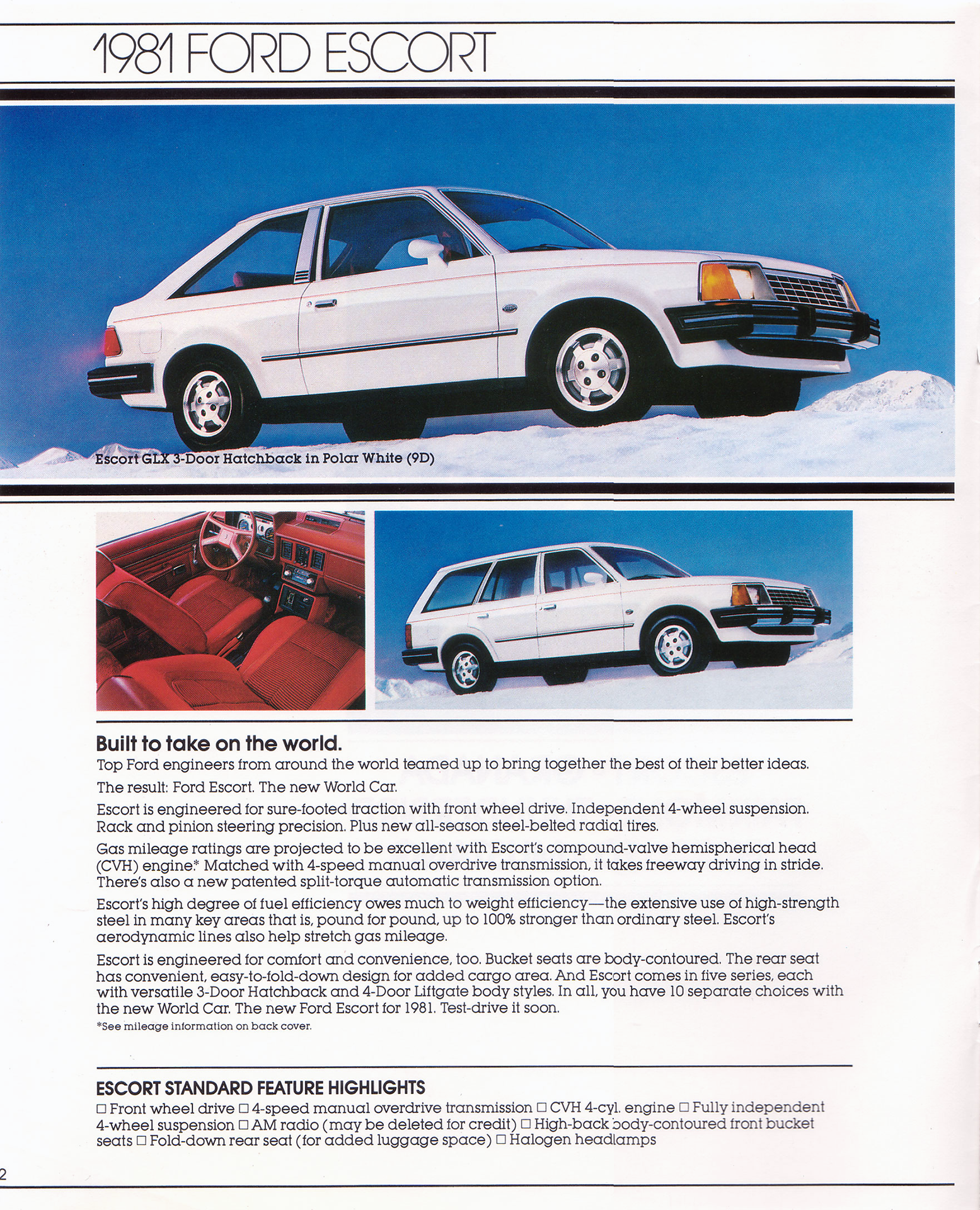
1981 Ford Escort hatchback coupe

“Built to take on the world.”

Ford’s biggest news for 1981 was the all-new Escort. Marketed as a “World Car,” the Escort replaced the unloved Pinto and represented a three billion dollar commitment from Ford. The new Escort was shorter, thinner, taller, and about 400 pounds lighter than the Pinto it supplanted.

The Escort’s standard powertrain was the Compound Valve Hemispherical (CVH) 65 bhp 1.6 liter/98 ci inline four with Holley-Weber 5740 2-barrel carburetor paired to a four-speed manual transmission (a three-speed automatic was a $344 option). Mileage with the standard powertrain was impressive: 28 city/43 highway by the day’s standards (about 23/31 by 2025 measures). Acceleration was less so: 0-60 came in about 14 seconds in the approximately 2,000-pound car. With a 10-gallon fuel tank, Escort drivers could expect a range of from 260 to 285 miles with a 10% fuel reserve.

Standard exterior and mechanical equipment on the $5,158 base Escort (about $19,600 in today’s dollars) included front wheel drive, rack-and-pinion steering, a fully independent four-wheel suspension, halogen headlamps, and P155/80R13 tires (a size still available thanks to Kumho) on 13-inch steel wheels. Inside, high-back body-contoured front bucket seats, a fold-down rear bench seat, and an AM radio were included.

As was often true with 1980s Fords, there were many trim levels. L added bright headlamp surrounds and a bright grill along with other brightwork. Moving up to the GL gave the purchaser reclining bucket seats and a four-spoke steering wheel. GLX added dual color-keyed remote sport mirrors, digital clock, locking glovebox, and P165/80R13 tires on styled steel wheels—but started at $6,476 (about $19,200 in 2018 dollars).

Fitting between the GL and the GLX in price, the somewhat sporty SS included black grill and headlamp housing, tape striping, and handling suspension ($37 for other Escorts).

Options & Production Numbers

Exterior and mechanical options included power brakes ($79) and power steering ($163). Inside, air conditioning ($530), fingertip speed control ($132), a floor console ($98), cloth/vinyl seat trim ($28), and an AM/FM stereo radio with cassette player ($187) were all available.

The first-year Escort and its platform-mate Mercury Lynx sold well: 193,000 Escort hatchback coupes, 128,000 Escort liftback sedans, 73,000 Lynx hatchback coupes, and 39,000 Lynx liftback sedans, making for a total of over 430,000.

The View From 2025

First-generation Escorts and Lynx’s were once so prevalent on American roads, but have virtually disappeared by now. You do occasionally see Escorts for sale in the Hemming’s Motor News classifieds and on eBay Motors, but there were none out there as I update this blog entry in June 2025. Bring a Trailer has sold a total of four first-generation US Escorts in a decade—the UK versions (deservedly) attract far more collector interest.

Make mine the extra-cost Medium Red Glow, please.

The only other 1981 Ford I have written about is the Mustang coupe. I have also written about the rare 1987 Mercury Lynx XR3 hatchback coupe.

Last updated June 2025.

1980 Ford Thunderbird coupe

“New Thunderbird elegance in a new size …”

To me, the 1980 Ford Thunderbird was one of those “why?” cars, though the competitive drivers were obvious. The third Ford based on the “Fox” platform (the Fairmont and the Mustang had come first), the eighth-generation ‘bird was one of the most radically downsized automobiles in the North American auto industry. In comparison to its 1979 predecessor, the base 1980 Thunderbird was 17 inches shorter and 900 pounds lighter.

Standard power for 1980 was a Windsor 118 bhp 4.2 liter/255 ci V8 with a Motorcraft two-barrel carburetor paired with a SelectShift three-speed automatic transmission. Powertrain upgrades were available: buyers could specify a $150 131 bhp 4.9 liter/302 ci V8 with a two-barrel carburetor and could then add a $133 automatic overdrive transmission (with that engine only).

With the standard powertrain, 0-60 mph took about 15 seconds in the 3,100-pound car—the best powertrain combination dropped that time to a far more respectable 11.1 seconds. Mileage was 18 city/26 highway by the day’s standards—with a 17.5-gallon gas tank, a Thunderbird owner could expect a range of 285 to 310 miles with a 10% fuel reserve.

Standard exterior and mechanical equipment on the $6,816 base Thunderbird (about $29,400 in today’s dollars) included variable ratio power rack-and-pinion steering, power front disc/rear drum brakes, a Thunderbird hood ornament with color-coordinated insert, full wheel covers, and P185/75R14 black sidewall tires on 14-inch wheels. Inside, a tweed cloth-and-vinyl Flight Bench seat, a day/night inside mirror, an electric clock, and an AM radio were all standard.

Packages, Options, & Production Numbers

Moving up to the $10,424 Town Landau (approximately $44,900 now) added a lot of equipment, including dual remote control mirrors, interval windshield wipers, and TR-type wide oval low-profile white sidewall radial tires on cast aluminum wheels. Inside, a velour cloth split front bench seat, six-way power driver’s seat, SelectAire air conditioning, power windows, power lock group, tilt steering wheel, and an electronic AM/FM stereo radio were included.

The top-of-the-line Silver Anniversary edition ($12,172 then, $52,400 now) added the 4.9 liter engine, the automatic overdrive transmission, Keyless Entry System, and a power antenna. Inside, Silver Anniversary buyers got a patterned luxury cloth split front bench seat, a leather-wrapped steering wheel, Fingertip Speed Control, and—of course—all kinds of Silver Anniversary badging.

Options included a power-operated moonroof ($219), an electronic information cluster ($275-$313), and leather upholstery ($349).

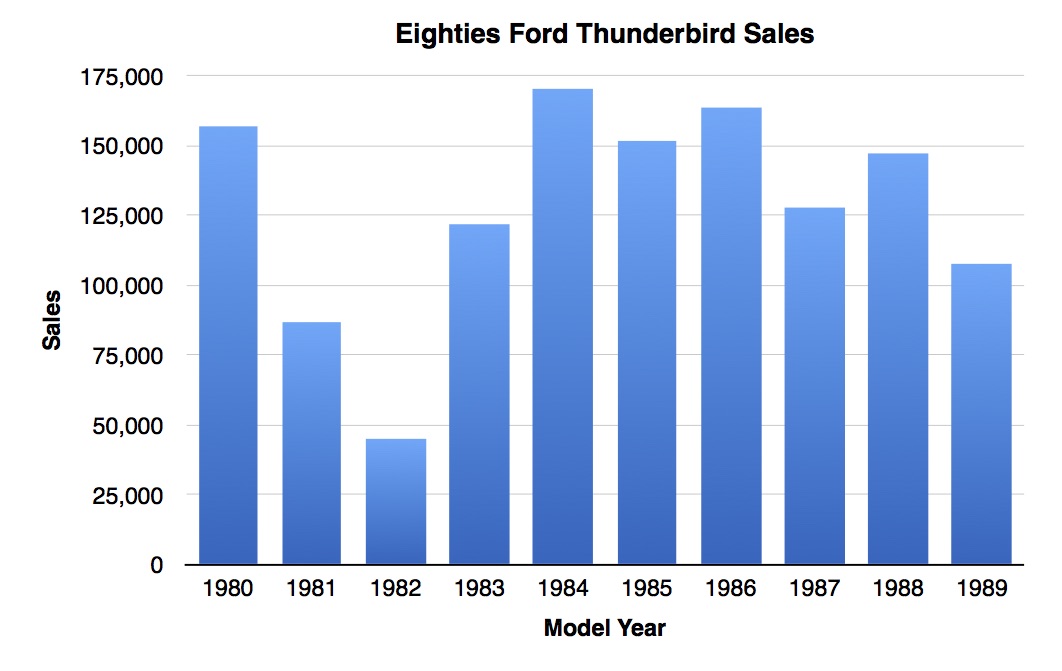
To say the market was not ready for the 1980 Thunderbird is a distinct understatement. Despite a much better level of standard equipment, the Thunderbird was only five inches longer than the plebian Fairmont. Sales of Ford’s halo model collapsed: dropping from 284,141 in 1979 to 156,803 in 1980, and losing almost a full percentage point of sales during a year when none of the main General Motors competitors in the personal luxury coupe market had more than a facelift.

It would get worse in the following two years: 86,693 in 1981 and 45,142 in 1982. By 1982, the Thunderbird was being handily outsold by all four of the mid-size GM coupes: Buick Regal, Chevrolet Monte Carlo, Oldsmobile Cutlass, and Pontiac Grand Prix. It would take the next Thunderbird design in 1983 to redress this balance.

The View From 2025

According to Hagerty’s valuation tools, a 1980 Thunderbird Silver Anniversary in #1/Concours condition is $25,500, with a far more typical #3/Good “normal” Thunderbird going for $8,800. This generation of Thunderbirds maintains some presence in the Hemming’s Motor News classifieds, on eBay Motors, and on Bring a Trailer. As I write this blog entry in October 2025, there’s a Silver Metallic 1980 with gray cloth seats and the 255 ci V8 on Hemmings, showing 73,000 miles and asking $11,500.

Make mine Midnight Blue Metallic, please—that’s one of the six Silver Anniversary edition colors.

Other eighties Thunderbirds I have written about include the 1982 coupe, the 1983 Turbo Coupe, and the 1987 standard coupe.

Last updated October 2025.

1983 Ford Thunderbird Turbo Coupe

A recent query about whether I had done a write-up on a Thunderbird Turbo Coupe compelled me to update this post written a few years ago, changing it enough to consider it a new entry.

“Ford presents a dramatic new balance of form and function.”

The aerodynamic styling of Ford’s 1983 Thunderbird was a breath of fresh air and a substantial change from the boxy and unloved eighth-generation 1980-1982 models, though the underlying components remained the Fox platform. For 1983, the Thunderbird came in base, Heritage, and Turbo Coupe models.

The Turbo Coupe featured Ford’s Lima 142 bhp 2.3 liter/140 ci inline four with Bosch L-Jetronic fuel injection and a Garrett turbocharger and came with a standard five-speed manual transmission. Road & Track recorded a 0-60 time of 9.7 seconds in a Turbo Coupe that weighed 3,420 pounds as tested. Ford’s new coupe didn’t just look aerodynamic—the drag coefficient was a very competitive 0.35. Fuel economy ratings for the Turbo Coupe were 21 city/33 highway by the standards of the day (17/24 by today’s standards). With an 18.0-gallon fuel tank, a Turbo Coupe owner could expect a range of between 330 and 435 miles with a 10% reserve—decent for a mid-size performance coupe in the early to mid-1980s.

The Turbo Coupe started at $11,790—approximately $30,300 in today’s dollars and nearly what a 2019 Mustang EcoBoost Premium Fastback (also with a turbocharged 2.3 liter inline four) costs. Standard exterior and mechanical features on the Turbo Coupe included variable ratio power rack-and-pinion steering, power brakes, power mirrors, a Traction-Lok limited-slip differential, Marchal foglamps, and Goodyear Eagle HR 205/70R-14 tires (a size still readily available) on 14-inch x 5.5-inch cast aluminum wheels. Inside, all Turbo Coupe buyers got a leather-wrapped steering wheel, articulated front seats, and an AM/FM stereo radio. Options included front cornering lamps ($68), tilt steering ($105), power door locks ($172), and a premium sound system ($179).

Reviews were quite good—Road & Track‘s tagline was “An enthusiast’s Bird comes soaring back”—and the newly aerodynamic Thunderbird sold well. After dropping down below 50,000 sales for the 1982 model year with the last of the eighth-generation ‘birds, the ninth generation would not see sales of less than 120,000 per year.

EightiesFordThunderbirdSales

According to Hagerty’s valuation tools, all the money for a 1983 Thunderbird Turbo Coupe in #1/Concours condition is $17,000, with a far more typical #3/Good car going for $6,700. Thunderbird Turbo Coupes only occasionally show up in the Hemming’s Motor News classifieds. You do see them more often on eBay Motors; as I update this blog entry in December 2018, there’s a 1985 Silver Clearcoat Metallic/Medium Charcoal Clearcoat Metallic two-tone Turbo Coupe with Oxford Gray cloth seats and 52,000 miles listed for $8,500. Make mine Silver, please.

Updated December 2018.

1985 Ford LTD LX sedan

“Because Mr. Bondurant shouldn’t have all the fun.”

Late in the 1984 model year, Ford added a performance-oriented model to the Fairmont-based LTD line. The LX was loosely based on a few sedans that Bob Bondurant had cobbled together for use at his high-performance driving school. For 1985, the LX wore the updated nose and tail that came along with all 1985 LTDs.

The engine was Ford’s 165 bhp 4.9 liter/302 ci Windsor V8 with electronic fuel injection. The only transmission available was a four-speed automatic transmission. 0-60 came in a respectable 9 seconds—faster than the Dodge 600ES and competitive with the Pontiac 6000 STE. Mileage was 19 city/23 highway by the day’s standards (17/22 by today’s measures). With a 16-gallon gas tank, the range was 280 to 300 miles with a 10% fuel reserve.

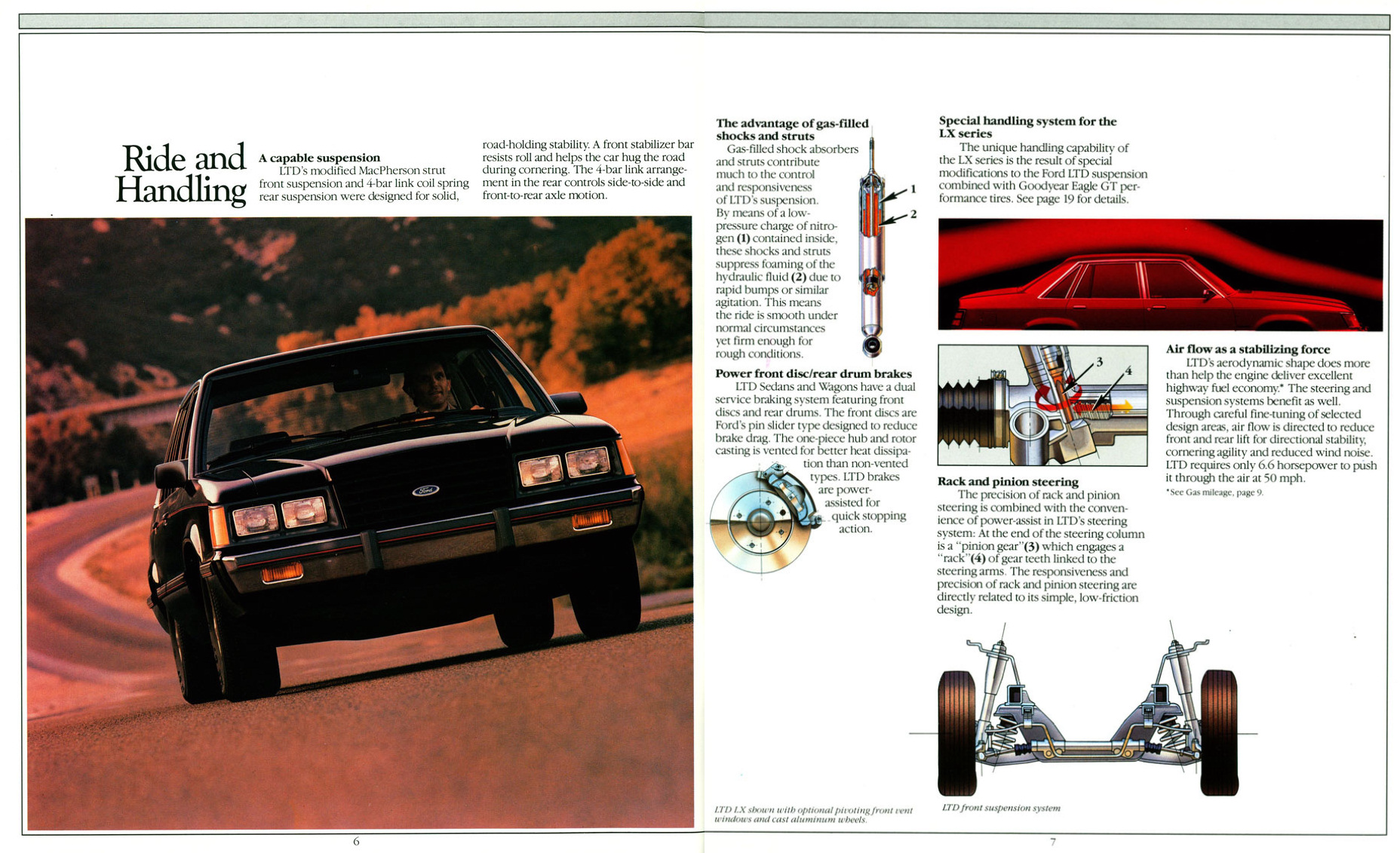
LX pages from the 1985 Ford LTD brochure

The 1985 LX had a base price of $11,421—about $35,200 in 2025 dollars. Standard exterior and mechanical equipment included quad rectangular halogen headlamps, power brakes, a Traction-Lok rear axle, a rear stabilizer bar, and P205/70HR Goodyear Eagle tires (a size still readily available) on 14-inch styled road wheels. Inside, dual power mirrors, lumbar-support bucket seats, a center console with a floor shifter for the transmission, brushed aluminum trim on the dash bezels, an upgraded instrument cluster with tachometer, a Tripminder computer, and an AM radio with dual front speakers (ah, the glamor!) were included.

Options included cast aluminum wheels ($224), air conditioning ($743), power windows ($272), power locks ($213), and an electronic AM/FM stereo radio with cassette ($409).

Like some other interesting Ford performance cars from the 1980s (I’m thinking of you, Mustang SVO), LTD LXs did not sell well, with only 3,260 sold over the 1984 and 1985 model years (there would be no 1986 LX).

The View From 2025

Likely because of the limited production numbers, you rarely see LTD LXs in the Hemmings Motor News classifieds or on eBay Motors. Bring a Trailer has sold a few eighties LTDs, but none of the LX variety. There is some enthusiast support.

Make mine Medium Charcoal Metallic, please.

The only other 1985 Ford product I’ve written about is the Ford Eddie Bauer Bronco SUV.

SaveLast updated October 2025.

1983 Ford Mustang GT convertible

I was driving westbound on the Schuylkill Expressway in Philadelphia on a morning in February 2015 when I saw a Fox Mustang convertible (red exterior, black top). A good enough reason to write a blog entry about these attractive cars.

“It’s not just a convertible … it’s a Mustang.”

For 1983, the big news for the Ford Mustang was the return of the convertible for the first time since the 1973 model year. Introduced on November 5th, 1982, the convertible was available only in the luxury GLX trim and the performance GT trim—lower-end L and GL trims remained with the notchback coupe (L and GL) and the hatchback coupe (GL). The GLX was also available only with V6 and V8 engines (no inline-four—turbo or not—would sully the drop-top experience).

The V6 engine choice for the GLX was the Essex 112 bhp 3.8 liter/231 ci with a two-barrel carburetor. Optional on the GLX ($595 additional) and standard on the GT was (of course) the Windsor 175 bhp 4.9 liter/302 ci V8 with a four-barrel carburetor.

Starting at $9,449 (about $30,800 in today’s dollars) and rising significantly during the middle of the model year to a non-trivial $12,467 (about $40,300 in 2025 funds, which is almost exactly what a 2025 Mustang EcoBoost convertible starts at), the GLX did come reasonably well equipped. Standard external and mechanical features included power front disc brakes, tinted glass, and an automatic transmission. Standard interior equipment included a light group and an AM radio.

convertible pages from the 1983 Ford Mustang brochure
Convertible pages from the 1983 Ford Mustang brochure

The GT version of the convertible listed for $13,479 (about $43,600 in 2025 dollars). Standard external and mechanical features included power front disc brakes, power steering, rear spoiler, and a five-speed manual transmission. Standard interior equipment included an AM radio.

All 1983 Mustangs included dual rectangular halogen headlamps, a modified MacPherson strut front suspension, front disc/rear drum brakes, and rack and pinion steering. Inside, full instrumentation (tachometer, trip odometer, fuel/temperature/oil/alternator gauges), full vinyl bucket seats, and a cigarette lighter were included.

Options & Production Numbers

The Mustang option list was long. Inside, air conditioning ($724), speed control ($170), power locks ($160), a tilt steering wheel ($105), and an AM/FM stereo radio with a cassette player ($199) were all available.

All 1983 Mustang convertibles came with a power top, and all windows rolled down—an emphasis Ford frequently made in reference to the Chrysler K car convertibles.

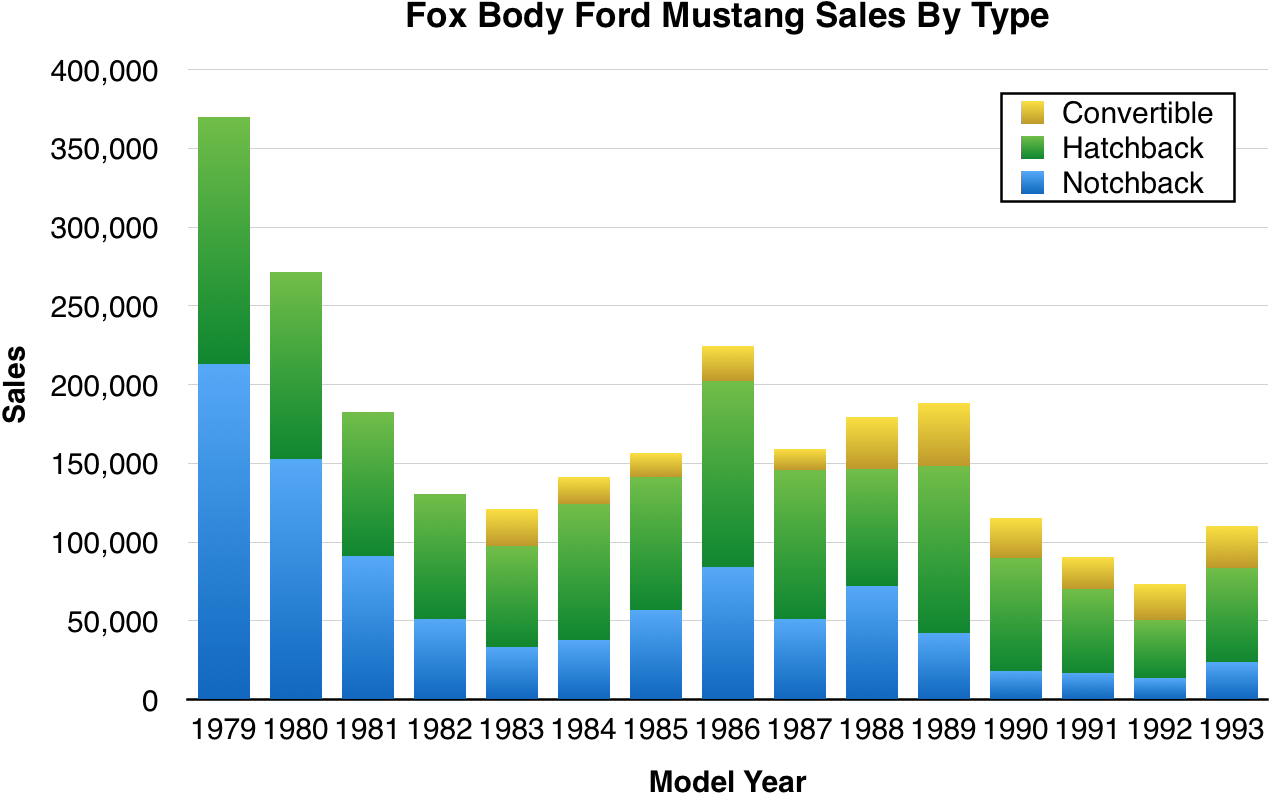
FoxBodyMustangSales

The 1983 Ford Mustang convertible sold reasonably well considering its expense (the GT convertible stickered for 45% more than the GT hatchback). For that year, it probably saved total Mustang sales from dropping below 100,000—helping hold that off until 1991. Between 1983 and 1993, Ford would sell over a quarter of a million of the pony car convertibles.

The View From 2025

There is strong club support for the 1983 Mustang, as there is for all Mustangs except the mid-seventies Mustang IIs. According to Hagerty’s valuation tools, all the money for a 1983 Mustang GT convertible in #1/Concours condition is $58,300, with a more typical #3/Good condition car going for $14,500. 1983 Mustangs often show up in the Hemming’s Motor News classifieds, on eBay Motors, and on Bring a Trailer—as I update this blog entry in March 2025, there’s a Red 1983 Mustang GLX convertible with a white top, a white vinyl interior, an aftermarket V8, and 89,000 miles available on Hemmings for $18,000.

Make mine that same Red, please.

Other Mustangs I have written about include the 1980 Cobra fastback coupe, the 1982 GT fastback coupe, and the 1984 SVO fastback coupe.

Last updated March 2025.

1984 Ford Mustang SVO hatchback coupe

With the announcement of the 2015 Mustang and its available EcoBoost turbocharged inline-four, my mind turned back to the 1984 to 1986 Mustang SVO.

“Sophisticated performance for the knowledgeable driver.”

Created by Ford’s Special Vehicle Operations department, the 1984 Ford Mustang SVO was an admirable attempt to take a different and more advanced approach to the pony car market. This version of the Fox-body Mustang was built around the Lima turbocharged and fuel-injected 2.3 liter/140 ci inline four, making 175 bhp paired with a Borg-Warner T5 five-speed manual. By the day’s standards, this combination yielded a reasonable 19 city/26 highway (it would be 17/24 by current standards). Car and Driver recorded a respectable 7.5 second 0-60 time and a 128 mph top speed.

1984 Ford Mustang advertisement

Other modifications over the standard Mustang included ventilated four-wheel power disc brakes (replacing the Mustang GT‘s front disc/rear drum setup), and a Koni suspension system featuring adjustable struts and shocks. 16 × 7 inch aluminum wheels with 225/50VR16 Goodyear NCT tires (a size still readily available) were standard for the first year—Gatorbacks didn’t become available until 1985.

The exterior featured an SVO-specific front grille, tinted glass, a hood with a functional scoop, and a “dual wing” spoiler that was also unique to the SVO. Inside, standard features included SVO-specific adjustable performance seats with lumbar support, a leather-wrapped tilt steering wheel, and an AM/FM stereo radio with a four-channel amplifier and four speakers.

Options & Production Numbers

You could have the interior in any color you wanted as long as that was Charcoal, but you did get to choose from the standard cloth or optional leather seats. A flip-up open air roof ($315), air conditioning ($743), a cassette player ($222), power door locks ($177), and power windows ($198) all remained optional—this was 1984, after all.

With a base price of $15,596 (about $49,300 in 2025 dollars or well more than what a loaded 2025 Mustang EcoBoost Premium Fastback goes for), sales did not come close to meeting Ford’s hopes—less than 10,000 buyers took home a Mustang SVO over its three years of production. The reasons for its relative failure were many, but I think the most significant problems were:

  • The average Mustang buyer was happier with a Mustang GT, which, with a base price of $9,578, cost substantially less.
  • The potential buyer of a vehicle with a turbocharged and intercooled four, four-wheel disc brakes, and an adjustable suspension wasn’t looking to Ford for this car.

The View From 2025

It is interesting to note that Ford was much more successful in the 1990s and 2000s in selling high-end Mustangs. They’ve also done decently with the 2.3 liter (there’s a coincidence!) 315 bhp EcoBoost turbocharged inline-four, which first became available in 2015.

According to Hagerty’s valuation tools, all the money for a 1984 Mustang SVO in #1/Concours condition is $36,200, with a more normal #3/Good car going for $9,800. SVOs often show up in the Hemming’s Motor News classifieds, on eBay Motors, and on Bring a Trailer—as I update this blog entry in March 2025, there’s a Black 1984 Mustang SVO with a Charcoal cloth interior and 66,000 miles asking $20,000 on Hemmings.

Make my SVO Silver Metallic, please.

Other Mustangs I have written about include the 1980 Cobra hatchback coupe, the 1982 GT hatchback coupe, and the 1983 GT convertible.

Last updated March 2025.