1981 Chrysler LeBaron coupe

“A personal car with classic style.”

1981 was the final model year for the coupe version of Chrysler’s M body, which had been around since 1977. For Chrysler, that last coupe would be the LeBaron.

The LeBaron’s standard engine was the 85 bhp Slant Six 3.7 liter/225 ci inline six with a one-barrel carburetor. Optional power was provided by the LA 130 bhp 5.2 liter/318 ci V8 with a two-barrel carburetor—an upcharge of $62. No matter what engine the buyer selected, the transmission was a three-speed TorqueFlite automatic.

For no apparent reason, both engines had higher horsepower ratings in California. The reason is more evident for the V8—California got a four-barrel carburetor (along with 35 more horsepower), while the other 49 states only rated a two-barrel. However, the Slant Six got a one-barrel carburetor in all fifty states, but five more horsepower in California. All of this meant that the California V8 version of the LeBaron was a relative screamer—almost two seconds faster in the 0-60 sprint than the 49 states version.

For 1981, the coupe was available in Special, Salon, and Medallion versions. Standard mechanical equipment on the $6,672 Special (about $25,600 in today’s dollars) included power steering, power front disc/rear drum brakes, and P195/75R15 glass-belted radial-ply white sidewall tires (a size still available in whitewall thanks to Coker Tire) on 15-inch Safety-Rim wheels with Deluxe wheel covers. Inside, a cloth and vinyl front bench seat and a glove box lock were included. Individual totals for the Special coupe and sedan are unknown, but the combined total was 11,980.

Coupe page from the 1981 Chrysler LeBaron brochure
Salon coupe page from the 1981 Chrysler LeBaron brochure

The $7,263 Salon added body-side accent stripes, dual horns, a left outside remote mirror, a day/night inside mirror, and a cloth and vinyl front seat with a center armrest. Chrysler built 17,485 LeBaron Salon coupes and sedans in the 1981 model year.

The $7,768 Medallion added a padded vinyl Landau roof, sill molding extensions, a rear deck accent stripe, Premier wheel covers, a trunk dress-up, a 60/40 cloth front seat, and a Luxury steering wheel. Only 7,635 1981 LeBaron Medallion coupes and sedans were produced.

Groups, Packages, & Individual Options

Many groups and packages were available with the LeBaron, and their pricing varied depending on whether you were starting with a Special, a Salon, or a Medallion.

  • The Deluxe Wiper/Washer Package included Deluxe windshield wipers with intermittent wipe and a windshield washer fluid level indicator.
  • The Light Package ($85-$99) included map/dome reading lights, a glove box light, an ash receiver light, fuel, temperature, and alternator warning lights, and a trunk light.
  • The Basic Group ($937-$1125) included tinted glass on all windows, a padded vinyl Landau roof, dual horns, manual air conditioning, and an AM radio. It also included both the Deluxe Wiper/Washer Package and the Light Package.
  • The Sport Appearance Package ($154-$258) included color-keyed styled steel road wheels, dual sport-styled remote control mirrors (painted or chromed), and a Luxury two-spoke steering wheel.
  • The Two-Tone Paint Package ($158) included a choice of two two-tone exterior paint combinations and color-break body accent stripes.
  • The Handling Package ($163) included special Firm-Feel power steering, heavy-duty shock absorbers, heavy-duty rear springs, a rear sway bar, and P205/75R15 steel-belted radial wider whitewall tires on extra-wide wheel rims.
  • The Protection Group ($58-$67) included door edge protectors and front and rear color-keyed floormats.
  • The Deluxe Insulation Package ($10-$109) included undercoating, special sound insulation, and a trunk dress-up.

Individual exterior and mechanical options included Starmist paint ($55), halogen headlamps ($40), a T-bar roof ($695), a power glass sunroof ($865), wire wheel covers ($106-$249), and forged aluminum wheels ($183-$326). Inside, cloth/vinyl bucket seats ($101 for the Salon coupe), a console ($106 for the Salon coupe), a leather-covered steering wheel ($21-$60), air conditioning ($606), automatic temperature control air conditioning ($656), power windows ($145-$202), and power door locks ($96-$136) were available. A series of seven radios ranged up to an AM/FM stereo radio with a CB ($355-$447).

The View From 2025

These LeBarons are rare on the ground, but they have not completely vanished. They’re gone from the Hemmings Motor News classifieds and eBay Motors, but Bring a Trailer has sold eight of this generation of LeBaron in the last six years, two of them coupes.

Make mine Burnished Silver Metallic, please. Just like in the brochure.

Other rear-wheel-drive coupes from Chrysler Corporation that I have written about include the 1980 Chrysler Cordoba, the 1983 Chrysler Cordoba, and the 1983 Imperial. I have written posts about two other M-bodies—the 1987 Chrysler Fifth Avenue sedan and the 1989 Dodge Diplomat sedan. Other 1981 personal luxury coupes include the Chevrolet Monte Carlo Sport Coupe and the Oldsmobile Cutlass Supreme.

1983 Chrysler Cordoba coupe

“We’ve Re-Engineered The American Luxury Car”

Chrysler’s Cordoba changed little in its final model year. The lower-priced LS version was no more. Some options were also gone—there was no more four-spoke steering wheel.

The spectacular success of the Cordoba in the mid-seventies—and all the hope it brought to Chrysler—was long gone by 1983. The first-generation’s mid-life refresh in 1978 was far from a success, but the results of the 1980 downsizing were even worse.

The Cordoba’s standard powertrain was the Slant Six 90 bhp 3.7 liter/225 ci inline six with a one-barrel carburetor mated to a three-speed TorqueFlite automatic transmission. Fuel economy ratings with the Slant Six were 18 city/24 highway by the day’s standards—not really competitive with GM’s intermediate coupes and showing the strain of a smaller engine in a relatively heavy (3,380 pound) car. With an 18-gallon gas tank, a Cordoba owner could expect a range of 280 to 305 miles with a 10% fuel reserve.

The optional engine was an LA 130 bhp 5.2 liter/318 ci V8 with a two-barrel carburetor. Fuel economy ratings with the V8 were 17 city/26 highway by 1983 standards, making the V8 a good choice if you could afford the extra $225.

1983 Chrysler Cordoba brochure cover

The 1983 Cordoba’s base price was $9,580—about $30,800 in today’s dollars. Standard exterior and mechanical equipment included a Special Edition landau roof, power steering, power front disc/rear drum brakes, and P195/75R15 glass belted radial white sidewall tires (a size now generally only available from specialty companies such as Coker Tire) on 15-inch wheels with Sport wheel covers. Inside, a cloth and vinyl front 60/40 seat with a folding center armrest and a passenger recliner, a two-spoke Luxury steering wheel, and an AM radio were included.

Packages, Options, & Production Numbers

Chrysler offered four packages for the 1983 Cordoba:

  • The $1,121 Basic Group included semi-automatic air conditioning, Deluxe wipers with intermittent wipe, and Light Group
  • The $114 Protection Group included color-keyed front and rear accessory floor mats and a litter container
  • The $143 Light Group included an underhood light, a door-ajar warning light, a map light, a glove box light, and a trunk light
  • The $587 Convertible Roof Package included a vinyl simulated convertible roof with simulated roof bows and a simulated rear convertible window

Individual exterior and mechanical options included wire wheel covers ($244), forged aluminum wheels ($107), and a power antenna ($60). Inside, leather and vinyl bucket seats ($529), a console ($75), a leather-wrapped steering wheel ($60), a tilt steering wheel ($99), semi-automatic air conditioning ($877), Deluxe wipers with intermittent wipe ($52), power windows ($180), and power door locks ($120). Three optional radios ranging up to an Electronic Search-Tune AM/FM stereo radio with a cassette player with Dolby system were available, with all including four speakers.

Chart of Chrysler Cordoba sales by model year

Chrysler sold 13,471 1983 Cordobas—less than one-tenth as many as were sold in each of the first three model years. Given those sale numbers—and those of the related Imperial and Mirada—it’s easy to see why all of these mid-size coupes would be gone in the 1984 model year.

The View From 2025

These Cordobas don’t seem to have made it as collectible cars. They’re seldom seen in either the Hemmings Motor News classifieds or on eBay Motors. Bring a Trailer has yet to auction a second-generation Cordoba.

Make mine Silver Crystal Coat, please.

Other real-wheel-drive eighties Chryslers I have written about include the 1980 Cordoba coupe, the 1981 New Yorker sedan, the 1983 Imperial coupe, and the 1987 Fifth Avenue sedan.

1983 Chrysler E Class sedan

“Chrysler’s largest front-wheel drive sedan.”

Chrysler’s E Class sedan was all-new for 1983, along with the closely related Chrysler New Yorker sedan and Dodge 600 sedan. Heavily based on the K-car, the E-body featured a wheelbase that was three inches longer than that of the LeBaron, Aries, and Reliant.

The standard powertrain consisted of the 94 bhp K 2.2-liter/134 ci inline four with a two-barrel carburetor paired with a TorqueFlite three-speed automatic transmission. A Mitsubishi 4G54 93 bhp 2.6 liter inline four with a two-barrel carburetor and more torque was a $259 option.

Making a larger and heavier car while retaining the same engine was not a recipe for performance—Consumer Guide recorded a 0-60 time of 17 seconds with the 2.2 liter engine. EPA fuel economy was rated at 24 city/32 highway by the day’s standards. With a smallish 13-gallon gas tank, an E Class owner could expect a range of 270 to 290 miles with a 10% fuel reserve.

1983 Chrysler E-Class brochure cover
Cover of the 1983 Chrysler E Class brochure

Standard exterior and mechanical equipment on the $9,341 Chrysler E Class (about $30,600 in today’s dollars) included halogen high and low beam headlamps, power rack-and-pinion steering, power front disc/rear drum brakes, and P185/70R14 steel belted radial ply tires on 14-inch wheels with Luxury wheel covers. Inside, the headlining Electronic Voice Alert System, a cloth front bench seat with a center armrest, a corporate Luxury steering wheel, a digital electronic clock, and a manually-tuned AM radio were included.

Options, Market Positioning, & Production Numbers

Exterior and mechanical options included two-tone paint ($170), tinted glass ($104), and cast aluminum wheels ($363). Inside, buyers could choose a cloth 50/50 bench seat with dual armrests and dual recliners ($267), tilt steering wheel ($105), air conditioning with bi-level ventilation ($732), Automatic Speed Control ($174), power windows ($255), power door locks ($170), the Electronic Travel Computer Cluster ($206), and three radios ranging up to an electronically tuned AM/FM stereo radio with a cassette player.

I recall Chrysler marketing these cars as a more contemporary alternative to the New Yorker, which shared the same platform but had a more traditional bent—a Chrysler press release stated that the E Class had “smart Euro styling.” Chrysler does this a lot—they did it again about 15 years later with the 300M and LHS.

Chrysler produced 39,258 E Classes for the 1983 model year, making it the second most popular Chrysler sedan—in 1983, the rear-wheel drive New Yorker Fifth Avenue remained the sales leader. Chrysler would sell another 32,237 in 1984, and then the E Class would leave the Chrysler marque and become the Plymouth Caravelle for 1985 (as it had been in the Canadian market from 1983 forward).

The View From 2025

The E Class was a common sight for about ten years, but they’re gone from the streets now—I haven’t seen one for decades. They’re almost never seen in either the Hemmings Motor News classifieds or on eBay Motors. As I write this blog entry in July 2025, Bring a Trailer is auctioning its first E Class—a 1984.

Make mine Nightwatch Blue, please.

Other K-platform related Chryslers I have written about include the 1982 LeBaron convertible, the 1984 Laser hatchback coupe, and the 1986 Town & Country convertible.

Chrysler Corporation’s Transition To Front-Wheel-Drive

I was working on a blog post on the 1981 Chrysler New Yorker, and I got to thinking about the nuts and bolts of Chrysler’s transition to front-wheel-drive in the United States. For this study, I looked at only non-imported cars (no Arrows, Colts, or Sapporos), and only at offerings from the Chrysler, Dodge, and Plymouth brands.

1977: the year before the Omni/Horizon hatchback sedan debuted, Chrysler Corporation had four platforms, all of them rear-wheel-drive. The F-body Aspen/Volaré compact was by far the sales leader—approximately 48% of Chrysler’s 1.2 million sales. The other offerings were the M-body premium mid-size (new for 1977, with the Dodge Diplomat sedan fated to make it all the way to 1989), the B-body mid-size, and the C-body full-size.

1978: the L-body Omni/Horizon hatchback sold well in its first year, with almost 167,000 exiting Dodge and Plymouth dealerships. These numbers comprised 15% of overall domestic production, with the Aspen/Volaré still being the sales leader. Chrysler Corporation sales declined by about 13%.

1979: a coupe version of the L-body made it to market, branded as Omni 024 and Horizon TC3. Overall Omni/Horizon sales were now 27% of total production, partly because Chrysler’s sales continued to collapse (off another 11%). Chrysler did bring the downsized rear-wheel-drive R-body full-size platform to market, replacing the C-body. 1979 was the last year that the Aspen/Volaré led Chrysler sales.

1980: Omni/Horizon sales increased by 2% to 264,000. They were now 41% of overall domestic production and by far the sales leader in another down year. The rear-wheel-drive J-body coupes (Cordoba and Mirada) replaced the B-body, but didn’t sell any better. 1980 was the final year for the Aspen/Volaré.

1981: a lot changed at your local Dodge or Plymouth showroom in 1981. The Aspen/Volaré was retired, putatively replaced by the heavily publicized Aries/Reliant K-body. Sales of the two front-wheel-drive platforms combined for 81% of overall production, and domestic Chrysler automobile production was up for the first time in many years.

1982: Chrysler added Super K models to the mix—really just slightly nicer versions of the Aries and Reliant. The Chrysler brand got its first front-wheel-drive offering with the LeBaron coupe, sedan, station wagon, and (late in the model year) convertible. The rear-wheel-drive C-body full-size was retired after only three years, with the New Yorker and Gran Fury marques transitioning to the rear-wheel-drive M-body mid-size platform. Despite the increased front-wheel-drive choices, their percentage of production increased only half a percent.

1983: Chrysler introduced the E-body—an extended version of the K-body with three more inches of wheelbase. Dodge got the 600 sedan, while Chrysler got two models—the E Class and the New Yorker (switching platforms yet again). Chrysler’s M-body offering was renamed to New Yorker Fifth Avenue, but I’m betting many potential buyers were still confused. 1983 was also the last year for the J-body coupes, with the Cordoba, Imperial, and Mirada going away.

1984: the sporty G-body Daytona and Laser hatchbacks were announced. Chrysler rebranded the rear-wheel-drive New Yorker Fifth Avenue as simply Fifth Avenue—probably a good idea. With only the M-body as a rear-wheel drive offering, the percentage of front-wheel-drive vehicles reached 88%.

1985: the Chrysler E Class vanished, but magically reappeared as the Plymouth Caravelle. The H-class mid-size sedan debuted in Lancer and LeBaron GTS forms. Dodge kept interest going in the aging L-body with increasingly quicker variants: 1985 had the Omni GLH and the Shelby Charger.

Chart of Chrysler's transition from rear-wheel-drive to front-wheel-drive

1986: unlike the previous five years, things were relatively quiet in 1986, with no model introductions or phase-outs. The K-body convertible was in its final year—there would be no Chrysler LeBarons (Mark Cross or Town & Country) or Dodge 600s after 1986.

1987: the Super K platform disappeared, and the P-body and front-wheel-drive J-body platforms debuted. The K-body offerings no longer included a LeBaron coupe or convertible, but the LeBaron sedan and station wagon and the Aries/Reliant twins were still good for a quarter of overall production. The percentage of front-wheel drive cars hit 90%, but Chrysler still sold over 100,000 of the M-body sedans, with the Chrysler Fifth Avenue being the leader.

1988: the front-wheel-drive C-body debuted, at that point the largest Chrysler front-wheel-drive offering—by an inch of wheelbase. It was seen in the Dodge Dynasty, and yet another version of the New Yorker—the end-of-the-line E-body based New Yorker was branded as New Yorker Turbo. Front-wheel-drive sales hit 93%.

1989: the E-body went away, with the A-body Dodge Spirit and Plymouth Acclaim sedans replacing it. For the first time since 1980, the K-body was not the best-selling platform—the C-body took over the sales crown in its second year, with 207,000 sold. Front-wheel-drive was now 97% of production.

1990: Chrysler Corporation discontinued three platforms in 1990. The K-body and H-body went away, but most important for this narrative is that the rear-wheel-drive M-body was gone. The transition was complete, but Chrysler would return to rear-wheel-drive in 1992 with the Dodge Viper.

1981 Chrysler New Yorker sedan

“So many reasons for superiority.”

For 1981, Chrysler’s full-size New Yorker sedan got few changes. The 5.9 liter/360 ci V8 was no longer available, but the optional four-barrel version of the 5.2 liter/318 ci V8 received a horsepower bump. There was a new grille, but otherwise, changes between a 1980 and a 1981 New Yorker are tricky to spot.

The standard powertrain for the New Yorker was the 130 bhp LA 5.2 liter/318 ci V8 with a two-barrel carburetor mated to a TorqueFlite three-speed automatic transmission. New Yorker buyers could choose a four-barrel version of the same engine ($68) that was rated at a respectable for 1981 165 bhp.

No matter which engine, performance was unimpressive in a car with a 3,900-pound curb weight. The 0-60 time was likely a little over 14 seconds with the base engine, with the optional mill dropping that number by about two seconds. Fuel economy was 17 city/26 highway by the day’s standards with the base engine and 16 highway/23 with the uprated one. With a 20.9-gallon gas tank, a New Yorker owner could expect a range of 330 to 405 miles with a 10% fuel reserve.

New Yorker page from the 1981 full-size Chrysler brochure

Standard exterior and mechanical equipment on the $10,463 1981 New Yorker (about $39,500 in today’s dollars) included tinted glass on all windows, a Landau padded vinyl roof, power front disc/rear drum brakes, and P205/75R15 steel-belted wide white sidewall tires on 15-inch wheels with Premier wheel covers. Inside, cloth and vinyl 60/40 individually adjustable seats with folding center armrest and passenger seat recliner, a Luxury steering wheel, manual control air conditioning, power windows, and an AM/FM stereo radio were included. Standard on the New Yorker, the Light Package included a trunk light, a glove box light, an ash receiver light, a rear door courtesy light, and an under hood light.

Packages, Options, & Production Numbers

Chrysler’s marketers seem to have reacted to challenging market conditions by giving buyers many choices of packages and options. Package choices for the New Yorker included:

  • The Basic package ($156) included a vinyl body-side molding, a right remote control convex mirror, deluxe windshield wipers, and undercoating.
  • The Premium Speaker System ($95) included two front and two piezo electric two-way coaxial rear speakers, along with a 15 watt per channel rear amplifier.
  • The Heavy-Duty package included a heavy-duty suspension, a 3.2 axle ratio, an auxiliary transmission oil cooler, a power steering oil cooler, and a 500-amp Long Life Maintenance Free battery. It required the optional four-barrel carburetted V8 and P225/70R15 steel belted radial tires.
  • The Open Road Handling package ($180) included a Firm Feel suspension (front and rear heavy-duty sway bars, heavy-duty shock absorbers, heavy-duty front torsion bars, heavy-duty rear springs), special Firm Feel power steering, and P225/70R15 steel belted wider white sidewall radial tires.
  • The Fifth Avenue Edition package ($1,822) included halogen headlights, cornering lamps, front fender louvers, special lighted quarter windows, wire wheel covers, a conventional spare tire, and a 500-amp Long Life Maintenance Free battery. Inside, Fifth Avenue buyers got a left power seat, deep pile carpets, front and rear floor mats, a Luxury steering with leather-wrapped rim, a tilt steering column, semi automatic temperature control air conditioning, semi-automatic speed control, power door locks, and a power deck lid. They also got the Premium Speaker System and a choice of four stereos, along with a power antenna (except with the CB choice).
  • The Carriage Roof package ($854) was only available with the Fifth Avenue Edition. It included a brushed stainless steel forward half roof cap and a padded Landau top with a small frenched backlight, bright surround moldings, and a forward bright transverse molding with integral electro luminescent lights.

Individual exterior and mechanical options included special paint ($68), a halogen headlamp system ($41), a power operated glass sun roof ($934), and styled aluminum road wheels ($321, $70 with the Fifth Avenue Edition). Inside, a leather 60/40 bench seat ($676), a tilt steering wheel ($84), and an electrically heated rear window defroster ($112 and required in New York State) were available. Three stereos were optional for the New Yorker, with the most pricey being the AM/FM stereo with a CB transceiver and a fixed tri band antenna ($261 and included with the Fifth Avenue Edition). A well-equipped New Yorker could easily run to about $13,300—real money in 1981 and about $50,100 in today’s dollars.

Despite the hopeful brochure slogans, it was clear in 1981 that the era of the big Chrysler was ending—New Yorker sales were off 36% to 6,548. The situation with the less-expensive Newport was even worse, with a decline of 67%. By the 1982 model year, full-size Chryslers would be gone, with the M-body New Yorker mid-size being Chrysler’s new top-of-the-line sedan. The R-bodies had only lasted three model years.

There were many reasons for this failure. Probably made worse by frightening build complexity, Chrysler’s quality was at perhaps its absolute nadir, and the word had gotten out. Overall automotive market conditions were also not great, with the early eighties being tough for many marques. Finally, there was legitimate and realistic concern that Chrysler might go out of business.

The View From 2025

There are not a lot of these handsome cars left. Hagerty doesn’t track New Yorkers built after 1970, so it’s hard to get a feel for values. They occasionally appear in the Hemmings Motor News classifieds, on eBay Motors, and on Bring a Trailer. In March 2025, a 1980 New Yorker Fifth Avenue Edition hammered for $11,000 at Mecum Glendale.

Make mine the extra-cost Mahogany Starmist, please.

Other eighties Chryslers I have written about include the 1980 Cordoba coupe, the 1982 LeBaron convertible, the 1983 Imperial coupe, the 1984 Laser hatchback coupe, the 1986 Town & Country convertible, and the 1987 Fifth Avenue sedan.

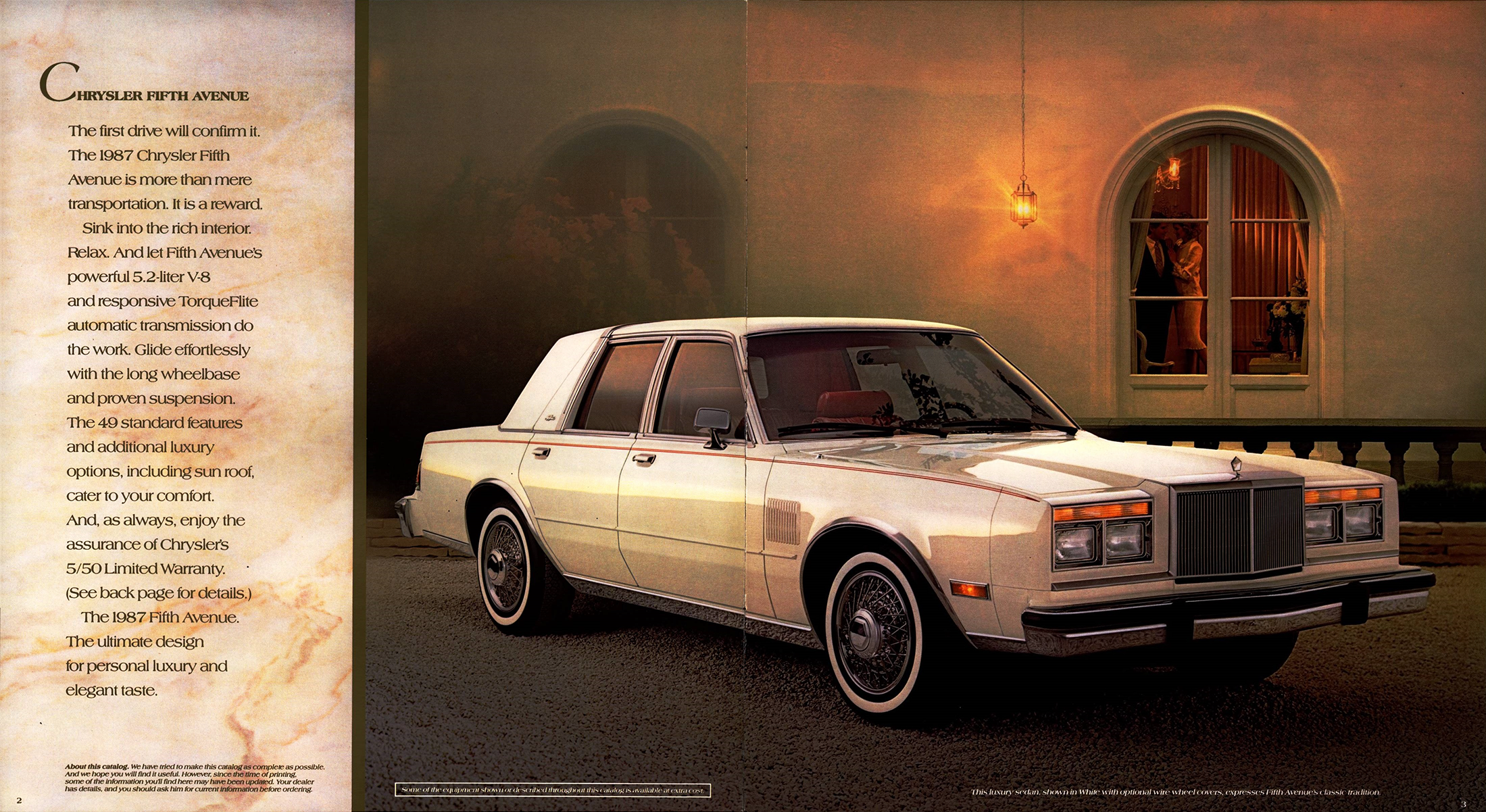
1987 Chrysler Fifth Avenue sedan

Up until a few years ago, I still occasionally saw M-body Fifth Avenues on the road. They were always well-kept, but also actually being driven. Now, they seem gone.

“Fifth Avenue remembers what fine car buyers demand!”

Little changed for 1987, Chrysler’s rear-wheel-drive Fifth Avenue sedan did receive an updated steering wheel. Otherwise, things continued along virtually the same as they had been since the M-body Chrysler went from the New Yorker Fifth Avenue name to the Fifth Avenue name in 1984.

The only powertrain available was an LA 140 bhp 5.2 liter/318 ci V8 with a Carter two-barrel carburetor paired with a TorqueFlite three-speed automatic transmission—the slant six had departed from the M-body after 1983. 0-60 came in about 12 seconds in a car with a 3,741-pound curb weight. Mileage ratings were 16 city/21 highway by 1987 standards—which equals 15 city/20 highway today. With an 18-gallon gas tank, a Fifth Avenue owner could expect a range of 285 to 300 miles with a 10% fuel reserve.

Pages from the 1987 Chrysler Fifth Avenue brochure

Standard exterior features on the $15,422 Fifth Avenue (about $41,700 in today’s dollars) included a color-keyed padded vinyl Landau roof and tinted glass on all windows. Mechanical features included power front disc/rear drum brakes, power-assisted steering, and P205/75R15 tires (a size still readily available) on 15-inch wheels with Premium wheel covers. Inside, an air conditioning/heater with automatic temperature control, power windows, a Luxury two-spoke steering wheel, and an AM radio were included.

Packages, Individual Options, & Production Numbers

The Luxury Equipment Discount Package added hood stripes, electroluminescent opera lights, and wire wheel covers with locks. Inside, the same package added automatic speed control, a tilt steering column, Deluxe intermittent windshield washers/wipers, a power deck lid release, and an AM stereo/FM stereo radio with the Premium speaker system and a power antenna. Added upholstery features with the package included a Corinthian (of course) leather 60/40 front seat with vinyl trim, dual front power seats, and a Luxury leather-wrapped two-spoke steering wheel. This substantial package cost $2,113 when ordered with the Ultimate Sound audio system and $2,251 if ordered without Chrysler’s top-of-the-line stereo. Either way, it added 14% to 15% to the Fifth Avenue’s base price.

A Two-Tone Paint Package ($485) was also available. This package included (natch!) two-tone paint with a choice of three colors matched with Radiant Silver, a special padded vinyl Landau roof with electroluminescent opera lights, and cast aluminum 15-inch wheels.

Individual options included a power glass sun roof ($1,076) and a left power seat ($240). A range of three optional car stereos topped out with the $609 Ultimate Sound system, which included an AM stereo/FM stereo radio, a cassette tape player with automatic reverse and Dynamic Noise Reduction (DNR), a five-band graphic equalizer, and a joystick balance/fader control. Many individual options cost less when ordered with the Luxury Equipment Discount Package.

Chrysler sold 70,579 Fifth Avenues in 1987, making it the single most popular Chrysler model, though all the various LeBaron models combined were good for far more sales. With tooling that had long since been paid for, all the M-body cars (the Dodge Diplomat and Plymouth Gran Fury were also in production) were probably good for Chrysler’s profits.

The View From 2025

These cars were the last of the old Chryslers, with a platform dating back to 1977 and some engineering elements that were far older. When rear-wheel-drive returned to big Chryslers in 2005, it was based on a Mercedes-Benz E-class platform. Earlier this year, I blogged about Chrysler Corporation’s Transition To Front-Wheel-Drive.

Though they are far from collector cars, Fifth Avenues of this generation are sometimes available in the Hemmings Motor News classifieds, on eBay Motors, and on Bring a Trailer. They also occasionally show up at in-person auctions.

Make mine Crimson Red, please.

Other rear-wheel-drive Chrysler products I have written about include the 1980 Chrysler Cordoba coupe, the 1980 Plymouth Volaré station wagon, the 1981 Chrysler New Yorker sedan, the 1983 Chrysler Cordoba coupe, the 1983 Imperial coupe, and the 1989 Dodge Diplomat sedan.

Last updated December 2025.

1980 Chrysler Cordoba coupe

I’m not sure I’ve ever seen a 1980 Cordoba—can that be true?

“A singular tradition.”

Chrysler’s Cordoba personal luxury was heavily revised for 1980, moving from the first-generation’s somewhat baroque styling to a more angular design. There was also a change in platform, with the Cordoba now based on the 1979 LeBaron coupe.

For the first time, the Cordoba’s base engine was a six—a 90 bhp 3.7 liter/225 ci version of the famous inline Slant Six with a one-barrel carburetor. Power options included a 5.2 liter/318 ci V8 with either a two-barrel carburetor (120 bhp/$230) or a four-barrel carburetor (155 bhp/$291) and a 185 bhp 5.9 liter/360 ci V8 with a four-barrel carburetor (which required the $192 Sport Handling package option package and less than 100 buyers paid $545 for). The 5.2 liter with the four-barrel carburetor was only for California and high-altitude sale. Chrysler paired all engines with a TorqueFlite automatic transmission.

With the Slant Six, the Cordoba was brutally slow even by 1980 standards—0-60 came in 17 second range with a top speed of 90 mph. Performance was notably better with the two 5.2 liter V8s and might even be described as spritely with the rare 5.9 liter engine. None of the powerplants yielded good fuel economy as they dragged around a 3,300-pound plus car with a three-speed automatic. The best was the Slant Six, rated at 17 mpg city, with the 5.9 liter getting a mere 13 mpg. With an 18-gallon fuel tank, Cordoba buyers could expect a range of between 210 and 275 miles with a 10% fuel reserve.

The 1980 Cordoba’s base price was $6,978—about $29,600 in 2025 dollars. Standard exterior and mechanical equipment on the Cordoba included tinted glass, power steering, power front disk/rear drum brakes, and P195/75R15 white sidewall tires on 15-inch wheels with Deluxe wheel covers. Inside, a heater and defroster, coat hooks, a cigarette lighter, and an AM radio were included. Standard upholstery was a cloth-and-vinyl split-back bench seat with a folding center armrest.

For a little less money than the standard Cordoba, Chrysler offered the LS ($6,745). It deleted the sill molding and carpeted trunk and changed the tires to black sidewall. The LS was upholstered with a cloth-and-vinyl bench seat.

Heading upmarket, the $7,248 Cordoba Crown added a padded Landau vinyl roof and Premier wheel covers. Inside, the Crown was upholstered with cloth-and-vinyl 60/40 seats with a folding center armrest and a passenger-side seatback recliner.

Corinthian Edition pages from the 1980 Cordoba brochure

Only available for the Cordoba Crown, the $1,818 Corinthian Edition package included chrome remote side mirrors and P205/75R15 “wider” whitewall tires on 15-inch wheels with wire wheel covers. Two colors were available—Black Walnut Metallic or a Designer’s Cream over Designer’s Beige paint treatment. Inside, deep cut-pile carpeting and a leather-wrapped tilt steering wheel were included. Of course, the package included leather/vinyl 60/40 seats and Corinthian Edition identification.

Options & Production Numbers

Individual exterior and mechanical options included an electric glass sunroof ($787) and forged aluminum road wheels ($334). Inside, air conditioning ($623), automatic speed control ($116), power windows ($148), and power door locks ($96) were available. The top-of-the-line radio was an AM/FM stereo with a CB transceiver and four speakers ($383), though the Cordoba’s brochure hyped the new $240 AM/FM stereo with cassette player and Dolby noise reduction. A final option was an extra cost 5/50 protection plan.

Cordoba sales dropped by about 37% to 46,406 in 1980, but I’m not willing to blame this entirely on the new design—very little was going right for the Chrysler division in 1980. The Cordoba’s percentage of overall Chrysler division sales actually increased in 1980—but Oldsmobile sold four times as many Cutlass Supreme coupes. Chrysler continued to make the Cordoba through the 1983 model year, with sales dropping each year. Its putative replacement for 1984 was the far different front-wheel-drive Laser XE hatchback coupe.

The View From 2025

Hagerty does not track values for any Cordoba, but they do occasionally show up in the Hemmings Motor News classifieds and on eBay Motors (no eighties Cordoba has yet made it to Bring a Trailer). As I update this post in April 2025, Hemmings is listing an Impact Red 1981 LS with white vinyl bucket seats and 28,000 miles for sale, asking $20,000.

Make mine Crimson Red Metallic, please.

Other rear-wheel-drive Chrysler products I have written about include the 1980 Plymouth Volaré station wagon, the 1981 Chrysler New Yorker sedan, and the 1983 Imperial coupe.

Last updated April 2025.

1982 Chrysler LeBaron convertible

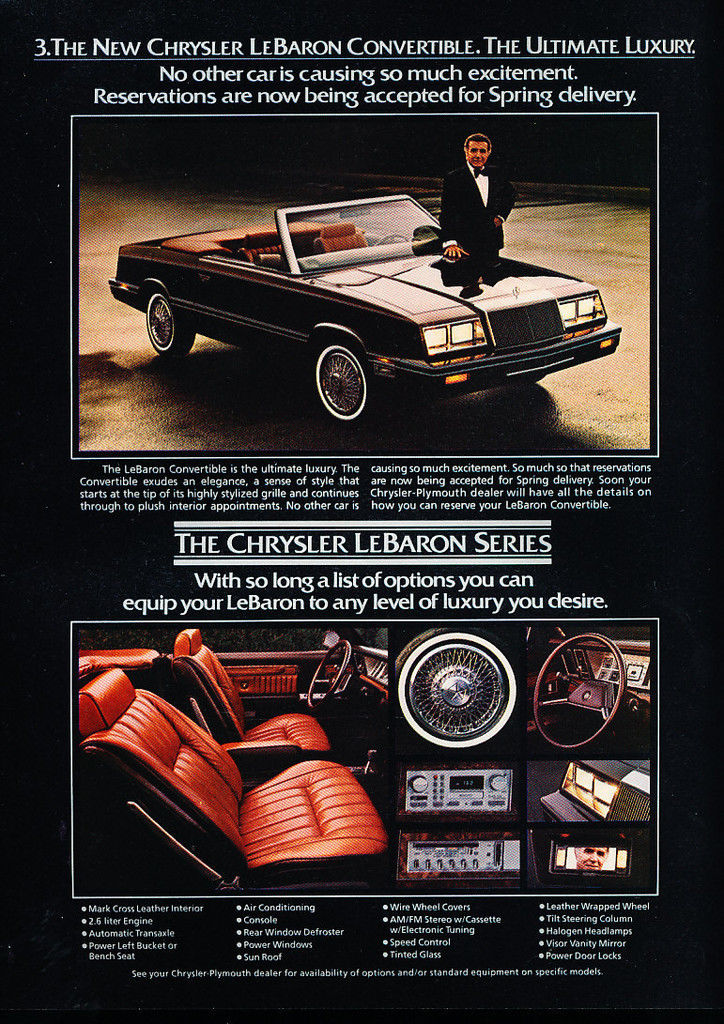
“No other car is causing so much excitement.”

The Chrysler LeBaron convertible was a mid-year introduction, becoming available in the spring of 1982. It was the first factory convertible from an American manufacturer available for sale in the United States since the 1976 Cadillac Eldorado.

All LeBarons were all-new for 1982. Based on the more plebeian Dodge Aries/Plymouth Reliant front-wheel-drive K cars that had been on sale for a year, the LeBaron (sometimes described as the Super-K) was a move at least slightly upmarket. Most exterior body panels were the same as the K. Notable styling differences were a waterfall-style grill (somewhat resembling that of the previous year’s rear-wheel-drive LeBaron), quad headlamps, relocation of the parking lamps and turn signals to the front bumper, and a full-width tail-lamp housing.

Chrysler used almost all of the standard K pieces inside the LeBaron. Recessed door handles and rocker type door locks were among the few changes, along with a different style of armrest and door pull. There was less vinyl trim, and the carpeting and other fabrics were of somewhat higher quality. A significant difference was the attention paid to noise, vibration, and harshness: between soundproofing, better parts, and suspension tuning, the LeBaron was upgraded from the base K in 26 separate ways.

Cars & Concepts in Brighton, Michigan heavily modified two-door LeBaron coupes on their way to becoming convertibles—the process included 32 steps. They installed a boxed-in backbone along the center of the car and welded a three-piece windshield header to the A-pillars. Next, Cars & Concepts installed new door glass and added door wedges. Finally, they added a new fiberglass panel to hold the rather small rear seats and mounted the convertible motor on the floor pan behind the rear bulkhead.

The convertible top itself had a plastic rear window and broad rear quarter panels; Car and Driver wrote that this created “a sort of Conestoga-wagon effect.” A button on the console actuated the top, and a padded top boot snapped into place when the top was lowered.

The base engine was a K 2.2 liter/135 ci inline four with a two-barrel Holley carburetor, producing 84 bhp. A two-barrel carburetted Mitsubishi G54B 2.6-liter/156 ci inline four with 92 bhp and 20 additional ft-lbs of torque was available for an added $171. Chrysler paired both engines with the TorqueFlite three-speed automatic transmission. Mileage with the base engine was 25 city/36 highway by the day’s standards. The optional engine was rated at 23 city/31 highway and brought the 0-60 time down from about 17 (aargh!) seconds to about 15 seconds.

1982 Chrysler LeBaron convertible advertisement

The LeBaron convertible’s base price was $11,698 (about $40,100 in today’s dollars and about 44% more than the 1982 LeBaron coupe). Standard exterior and mechanical equipment included dual outside mirrors (borrowed from the Dodge Omni 024), power brakes, power rack-and-pinion steering, and P185/70R14 whitewall tires (a size still readily available, though finding whitewalls might be tricky) on 14-inch wheels. Inside, vinyl front bucket seats with a folding center armrest, a digital clock, and an AM radio were included. 76% of convertible drivers moved up to Medallion trim, which boosted the price to $13,998 (about $48,000 in 2025 dollars) and added halogen headlamps, better gauges, and snazzier wheel covers.

Packages, Options, & Production Numbers

The Mark Cross package cost an additional $861, moved the sticker to a non-trivial $14,859 (about $50,900 in today’s dollars), and added the 2.6-liter engine, air conditioning, power windows, power door locks, and attractive Mark Cross leather/vinyl seats. Other options included cornering lamps ($57), cast aluminum wheels ($344), automatic speed control ($155), and an AM/FM stereo radio with electronic tuning and cassette player ($455).

First-year sales of LeBaron convertible were a respectable 12,825, especially given the shortened year and the relatively high price. In a piece of general eighties trivia, the first commercial cell phone call in history was made from a LeBaron convertible in October 1983.

The View From 2025

These convertibles started Chrysler’s long tradition of making convertibles that might occasionally be sporty but were not sports cars—a market niche they exited in 2014 with the demise of the Chrysler 200 convertible. I still like what Chrysler was trying to do, and I appreciate how these cars look, at least with the top down.

These cars are being collected and shown—I see them often at AACA judging meets. You see them for sale in the Hemming’s Motor News classifieds, on eBay Motors, and on Bring a Trailer: as I update this blog entry in October 2025, there’s a Pearl White 1982 LeBaron with 68,000 miles for sale on Hemmings, asking $6,900.

Make mine Mahogany Metallic, please, with the Mark Cross package.

Other K cars I have written about include the 1981 Plymouth Reliant coupe, the 1985 Dodge 600 Club Coupe, the 1986 Chrysler Town & Country convertible, and the 1987 Dodge Aries LE sedan.

Last updated October 2025.

Save

1984 Chrysler Laser hatchback coupe

In June 2022, a Saddle Brown Crystal 1984 Chrysler Laser XE with 17,000 miles came up for auction on Bring a Trailer. That was enough reason for me to substantially update this now ten-year-old post.

“The competition is good. We had to be better.”

Debuting in 1984, the Chrysler Laser was intended to be an upscale complement to the Dodge Daytona. Its equipment was not notably different from the Daytona’s, but the Laser had a more luxurious emphasis with a slightly softer suspension.

Two engines were available. The base engine, Chrysler’s 93 bhp 2.2 liter/135 ci inline four, was available with a standard five-speed manual transmission or a three-speed automatic transmission ($439). Mileage with the manual was 22 city/32 highway by 1984 standards (19/29 by today’s measures). Moving to the automatic helped city mileage a bit but dropped highway mileage significantly—23/27.

The more interesting engine was the optional Turbo I 142 bhp 2.2 liter/135 ci turbocharged inline four with the same transmission choices as the base engine. Depending on whether you were adding the turbo to the base Laser or the XE, the extra cost was either $934 or $872. Mileage with the hot setup (turbo and manual) was 20 city/27 highway by the day’s standards (18/25 by 2025 measures), while Road & Track recorded a 0-60 time of 8.6 seconds. Moving to the three-speed automatic once again killed highway mileage, making the ratings 20 and 23. With a 14-gallon gas tank, the owner of a five-speed/turbo Laser could expect a range of between 275 and 295 miles with a 10% fuel reserve.

1984 Chrysler Laser television commercial

Standard exterior and mechanical equipment on the base Laser (priced at $8,648 or about $27,500 in today’s dollars) included a rear spoiler, power-assisted rack and pinion steering, power front disc/rear drum brakes, and P185/75R14 steel belted radial black sidewall tires (a size still readily available) on 14-inch wheels with Premium wheelcovers. Inside, a leather-wrapped steering wheel, intermittent wipers, and an AM radio with a digital clock were included.

Moving up to Laser XE ($10,546 or about $33,500 in 2025 dollars) added features such as an electronic instrument cluster, tilt steering wheel, driver’s side sport seat, dual power side mirrors, and an AM/FM stereo radio.

Options, Period Reviews, & Production Numbers

Optional equipment included air conditioning ($737), cruise control ($179), rear defroster ($168 base/$143 XE), power windows ($185), power door locks ($125), and AM/FM stereo cassette ($285/$160). With all the trimmings, a Laser XE could fairly easily get to $12,900 or so or about $41,000 in today’s dollars—almost what a 2025 Dodge Hornet R/T SUV costs.

The buff books liked the presence of the Laser and Daytona on the market, but wanted more. The final paragraph of Road & Track’s review began with, “although we applaud the concept and basic execution of the Laser, the car badly needs refinement.” In particular, they complained of a booming resonance anytime the engine exceeded 2,000 RPM—not great in a sporty car that Chrysler claimed was a sports car.

The Laser sold decently in its first year, with almost 34,000 base coupes and nearly 26,000 XEs crossing dealer lots. These numbers were actually better than its Dodge Daytona sister car (with a total of almost 50,000 sold).

However, Chrysler must have been disappointed—this was an era where the Chevrolet Camaro, Ford Mustang, and Pontiac Firebird were routinely selling in the hundreds of thousands (the three models combined for 530,000 sold in 1984).

Chrysler would never see these first-year totals again—by 1987, the Laser would be gone, with the Daytona hanging on through the 1993 model year after a few pretty good years in the late 1980s.

DaytonaLaserSales

The View From 2025

Lasers rarely appear in the Hemmings Motor News classifieds, on eBay Motors, or on Bring a Trailer (the most recent BaT example was only the fifth in eight years). You see some Daytonas on eBay and BaT, but even they are relatively uncommon.

Not surprisingly, allpar.com has an interesting and detailed article on the front-wheel-drive Lasers and Daytonas—it is here.

Make mine Black, please.

Other sporty Chrysler corporation products I have written about include the 1985 Dodge Shelby Charger hatchback coupe and the 1985 Dodge Omni GLH hatchback sedan.

Last updated June 2025.

1983 Chrysler Imperial coupe

While out driving late in 2014, I saw an early 1980s Chrysler Imperial aggressively carving the back roads in the Philadelphia suburbs near where I live. The body design remains utterly distinctive: the alacrity with which the Imperial was moving makes me assume that it had the carburetor conversion and/or some other engine upgrade.

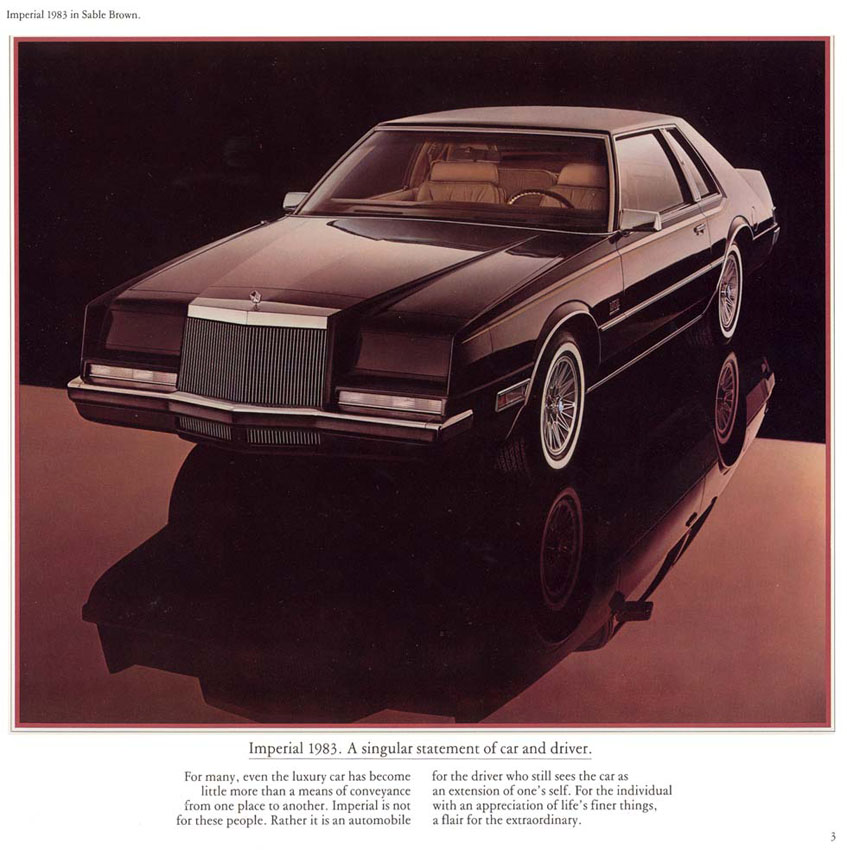
“A singular statement of car and driver.”

Chrysler introduced the “bustle back” Imperial for the 1981 model year, bringing it to market partly to reassure potential buyers that the company would remain in business. By 1983, the Cordoba-based luxury coupe was in its final year, selling a mere 1,427 units as all rear-wheel drive Chrysler products continued their decline.

For 1983, the powertrain continued to be the same: the LA 140 bhp electronic throttle-body fuel-injected 5.2 liter/318 ci V8 paired with a TorqueFlite three-speed automatic transmission. Despite notable attempts at increasing quality (each Imperial went on a five-and-a-half-mile test drive and received numerous other checks before shipping from the factory), the bleeding edge fuel injection continued to be stunningly unreliable—Chrysler frequently ended up replacing it with a carburetted system at the cost of $3,500 plus about 50 hours of labor.

Performance for the 3,900-pound coupe wasn’t impressive: 0-60 came in a little under 14 seconds. To be fair, neither the Cadillac Eldorado nor the Lincoln Continental Mark VI (the Imperial’s intended competitors) were notably faster in 1983. Fuel economy was rated at 16 city/26 highway by the day’s standards, giving a range of 305 to 340 miles with the 18-gallon gas tank and a 10% fuel reserve.

Page from the 1983 Chrysler Imperial brochure

Standard mechanical equipment for the quite well-equipped for 1983 $18,688 Imperial (approximately $61,500 in today’s dollars) included halogen headlights, power brakes, power steering, cruise control, and Goodyear Arriva P205/75R15 steel-belted radial whitewall tires (a size still readily available) on cast aluminum wheels. Exterior equipment included power heated mirrors, power windows, intermittent windshield wipers, and a rear window defroster. Interior equipment included “semi-automatic” air conditioning, a tilt steering wheel, leather and vinyl 60/40 power seats, and a 30-watt AM/FM stereo with cassette and power antenna.

Unusual standard equipment for 1983 in any car included an electronic instrument cluster, a garage door opener, and a two-year/30,000-mile warranty (a lot of warranty in those unreliable days). The only extra cost option was high altitude emissions ($75—why did Chrysler cheap out at this point?); no cost options included cloth and vinyl seats, Michelin tires, and wire wheel covers. Unlike in 1981 and 1982, there was no Frank Sinatra edition for 1983.

The View From 2025

Especially from the rear, the Imperial looks a lot like Cadillac’s 1980 Seville redesign, but seems to have been a separate idea—exterior design had begun in 1977. Not surprisingly, allpar.com has an interesting and detailed article on the 1981-1983 Chrysler Imperial—it is here.

According to Hagerty’s valuation tools, a 1983 Chrysler Imperial in #1/Concours condition is $26,100, with a more normal #3/Good condition car fetching $7,600. Imperials appear in the Hemmings Motor News classifieds and very occasionally on Bring a Trailer. When I updated this entry in April 2025, a Goldenrod Crystal Coat 1982 with 111,000 miles was available on Hemmings, asking $19,800.

Make mine Formal Black, please.

Other real-wheel-drive eighties Chryslers I have written about include the 1980 Cordoba coupe, the 1981 New Yorker sedan, the 1983 Cordoba coupe, and the 1987 Fifth Avenue sedan.

Last updated September 2025.