1989 Dodge Diplomat sedan

“Negotiate the road in a classic.”

For 1989, Dodge’s M-body Diplomat sedan was little changed. The base model was dropped, leaving only the mid-range Salon and the higher-end SE.

The powertrain remained the same—an LA 140 bhp 5.2 liter/318 ci V8 with a Carter two-barrel carburetor paired with a TorqueFlite three-speed automatic. With a 3,582-pound shipping weight, 0-60 came in about 12 seconds. Compared to other large rear-wheel-drive sedans, fuel economy was a somewhat uncompetitive 16 city/22 highway by the day’s standards (15/20 by today’s measures). With an 18-gallon gas tank, a Diplomat driver could expect a range of 285 to 305 miles with a 10% fuel reserve.

Standard exterior and mechanical equipment on the $11,995 Diplomat Salon sedan included quad halogen headlights, tinted glass, power-assisted steering, power-assisted front vented disk/rear drum brakes, and P205/75R15 steel-belted radial all-season white sidewall tires (a size still readily available, even as a whitewall) on 15-inch wheels with Deluxe wheel covers. Inside, a cloth/vinyl split-back bench seat with a folding center armrest and adjustable head restraints, tilt steering, a driver’s airbag, intermittent wipers, and an electronically tuned AM stereo/FM stereo with an integral digital clock and four speakers were included.

Diplomat SE photo from the 1989 Dodge brochure

The $14,795 SE added a full non-padded vinyl roof, Premium wheel covers, all-cloth individually adjustable front seats with dual seatback recliners, a lighted passenger mirror, chrome exterior dual power mirrors, automatic temperature control air conditioning, cruise control, an electrically heated rear window defroster, and the Protection Package. All of this extra equipment made for a 3,782-pound shipping weight—200 pounds more than the Salon.

Packages, Individual Options, & Production Numbers

By 1989, buying a Dodge Diplomat was all about the packages:

  • The Popular Equipment Discount Package ($1,141) included Premium wheel covers, automatic temperature control air conditioning, an electrically heated rear window defroster, chrome exterior dual power mirrors, and automatic speed control.
  • The SE Luxury Equipment Discount Package ($1,202) included wire wheel covers with locks, a driver’s side power seat, a Luxury leather-wrapped steering wheel, illuminated left and right vanity mirrors, power door locks, power windows, and a power deck lid release. It also included most but not all of the Light Package, including a headlight switch with time delay, a glove box light, a trunk light, and alternator, door ajar, engine oil temperature, and low fuel warning lights.
  • The Light Package ($122) included a headlight switch with time delay, a glove box light, and a trunk light. It also included alternator, door ajar, engine oil temperature, and low fuel warning lights.
  • The Protection Package ($185) included color-keyed vinyl bodyside moldings, black rear bumper guards, undercoating, and front and rear carpeted floor mats.

Individual options for both Diplomat versions included pearl clear coat paint ($41), power door locks ($201), and power windows ($294). Dodge also proudly offered a Premium electronically tuned AM stereo/FM stereo with up-and-down seek-and-scan and a cassette tape player ($262). The electronic cassette tape player included Dolby B noise reduction, automatic reverse, true fast forward and rewind, an automatic metal tape sensor, and tape program music search.

A full non-padded vinyl roof ($206), chrome exterior dual power mirrors ($164), and automatic temperature control air conditioning ($855) were available for the Salon. A power glass sunroof ($1,108) and a power antenna ($72) were SE-only options. A loaded SE could run to about $17,500—real money in 1989 and about $47,300 in today’s dollars.

Dodge sold a mere 5,709 Diplomats in the 1989 model year, sharply fewer than the 19,173 in 1988, when the base Diplomat was also available.

The View From 2025

The Diplomat was one of the last of Chrysler Corporation’s traditional rear-wheel-drive cars—the final year in a line that extended directly back to the original Diplomat in 1977, and had roots in the mid-1960s with the third-generation Dart. Earlier this year, I blogged about Chrysler Corporation’s Transition To Front-Wheel-Drive.

I’m going to declare these Diplomats as vanished, though I would not have said that a decade ago. They’re gone from the Hemmings Motor News classifieds and eBay Motors. Bring a Trailer has sold three Diplomats in the last five years, two of them sedans.

Make mine the extra-cost Twilight Blue Pearl Coat, please.

Four years ago, I wrote a post about the 1987 Chrysler Fifth Avenue sedan—an M-body sister to the Diplomat. Other rear-wheel-drive Chrysler products I have written about include the 1980 Chrysler Cordoba coupe, the 1980 Plymouth Volaré station wagon, the 1981 Chrysler New Yorker sedan, the 1983 Chrysler Cordoba coupe, and the 1983 Imperial coupe.

1984 Ford Tempo sedan

“Computer-refined design for five-passenger comfort”

The Ford Tempo and Mercury Topaz debuted for the 1984 model year in May 1983. Based on the Escort, they were putative replacements for the Ford Fairmont and Mercury Zephyr.

The Tempo’s base engine and transmission combination was the 2300 HSC 90 bhp 2.3 liter/140 ci inline four with a one-barrel carburetor paired with a four-speed manual. A Mazda-built 52 bhp 2.0 liter/122 ci diesel four was available for $588, but it isn’t clear how many bought it. Road & Track recorded a 0-60 time of 13.6 seconds with the optional five-speed manual ($76) and the gas engine. A three-speed automatic was $439 and was available only with the gas engine and the fancier GL and GLX trims.

1984 Ford Tempo print advertisement

The 1984 Tempo L sedan’s base price was $6,936—about $22,700 in today’s dollars. Standard exterior and mechanical equipment included single rectangular halogen headlamps, rack and pinion steering, power front disc/rear drum brakes, and P175/80R13 steel-belted radial ply black sidewall tires on 13-inch wheels with Deluxe wheel covers. Inside, individually adjustable front seats with cloth seating surfaces and reclining seat backs, Deluxe carpeting, a mini-console, an A-frame Luxury steering wheel, an inside hood release, and an AM radio with dual front speakers were included.

The $7,159 GL sedan added Luxury wheel covers, Luxury sound insulation, interval windshield wipers, and an electronic digital clock.

The $7,621 GLX sedan added bumper end cap extensions, dual door-mounted remote-control mirrors, a dual note horn, Luxury carpeting, and Luxury luggage compartment trim.

Groups, Packages, Individual Options, & Production Numbers

Ford offered four option groups and packages with the Tempo:

  • The Light/Convenience Group ($50-$85) included ashtray, glovebox, and engine compartment lights, rear door dome light switches, a swivel map light, a headlamps on buzzer, and a trip odometer
  • The Power Lock Group ($202-$254) included power door locks, a power decklid release, and a remote control fuel filler door
  • The Sports Appearance Group ($299) was only available with the GL and included styled steel wheels with trim rings, Sport front seats with a 4-way manual driver’s seat, rear seats with integral headrests, unique sew-style and fabric, a Sport steering wheel, and a Sport instrument cluster
  • The TR Performance Suspension Package ($366-$424) included Michelin TRX tires, TR-Type cast aluminum wheels, and special steering and suspension components

Individual exterior and mechanical options included tinted glass ($510), metallic glow paint ($63), a flip-up open air roof ($315), and power steering ($223). Inside, power side windows ($272), a driver’s side power seat ($224), Fingertip Speed Control ($176), and an electric rear window defroster ($140) were offered. A series of five optional radios were offered, ranging up to an electronic AM/FM stereo search radio with a cassette player ($396).

Options not available with the L included air conditioning ($743) and all-vinyl seats (no charge). A loaded GLX could easily reach $9,400—about $30,800 in today’s dollars, or about what a 2026 Ford Escape Active crossover goes for.

The Tempo sedan sold well in its extended debut year—Ford moved a total of 295,149, which was more than four times as many as the final-year 1983 Fairmont sedan.

The View From 2025

These cars have vanished. They’re gone from the Hemmings Motor News classifieds and eBay Motors. Bring a Trailer has sold four Tempos in the last four years, two of them sedans.

Make mine Dark Academy Blue Metallic, please.

Other eighties Ford sedans I have written about include the 1985 LTD LX and the 1986 Taurus.

1986 Yugo GV coupe

I have a personal connection with the Yugo. My father’s younger brother worked for Malcolm Bricklin for many years, including with Yugo America. Years later, my uncle made it to the front page of the Wall Street Journal in an article entitled A Drag Racer Turns Handicap Of His Yugo to His Advantage.

“Introducing the same old idea.”

Famously advertised with a base price of $3,990, the 1986 Yugo GV was a response to escalating prices—the average transaction price of a car in the United States had just passed $10,000. Built by Zastava in Yugoslavia, the Yugo was a shortened variant of the Fiat 128—a design dating from 1969. Serial entrepreneur Malcolm Bricklin saw potential in the Yugo and created Yugo America to import the car into the United States. The GV stood for Great Value.

The Yugo was a tiny car by mid-1980s standards, with a 139-inch length and an 84-inch wheelbase. The slightly more expensive 1986 Chevrolet Chevette hatchback coupe was 18% longer and had a 13% greater wheelbase, while the same year’s class-leading Honda Civic hatchback was 8% longer and had a 12% greater wheelbase. The also newly available Hyundai Excel hatchback coupe was notably larger.

Power, if you could call it that, was provided by a 55 bhp 1.1 liter/68 ci inline four with a two-barrel carburetor. A four-speed manual was standard, and Car and Driver recorded a 0-60 time of 14.0 seconds. Fuel mileage was rated at 25 city/31 highway by the day’s standards (22/29 by modern measures). With a small 8.4-gallon gas tank, a Yugo owner could expect a short range of 195 to 210 miles with a 10% fuel reserve.

1986 Yugo GV print advertisement

Standard exterior and mechanical equipment on the Yugo GV included opening front vent windows, a rear-window wiper, front-wheel-drive, rack and pinion steering, front disc/rear drum brakes, and 145R13 74H tires (now barely available) on 13-inch wheels. Inside, cloth/vinyl reclining front bucket seats, a fold-down rear seat, a rear-window defroster, and a small tool kit were included. A full-sized spare tire was stored under the hood.

The Yugo offered few options—neither air conditioning nor an automatic transmission were available for the 1986 model year. Yugo buyers could choose a variety of dealer-installed radios.

Many Jokes & One Survey

Yugo jokes were many. Just a few of them:

  • What do you call a Yugo with twin tailpipes? A wheelbarrow.
  • What do you call a Yugo with a flat tire? Totaled.
  • How do you make a Yugo go from 0 to 60 in five seconds? Push it off a cliff.
  • Why do Yugos have rear-window defrosters? To keep your hands warm.
  • How do you double the value of a Yugo? Fill the gas tank.
  • What’s on the first page of the Yugo owner’s manual? The bus schedule.

Popular Mechanics‘ owners survey for the Yugo GV found that Yugo buyers wanted a new car instead of a comparably-priced used one, and that, as one said, “you have to keep the car in perspective.”

The View From 2025

Oh, these are vanished. Bring a Trailer has sold a grand total of eight over nine years, and they’re long gone from Hemmings and eBay Motors.

Make mine Adriatic Blue, please.

1983 Chrysler Cordoba coupe

“We’ve Re-Engineered The American Luxury Car”

Chrysler’s Cordoba changed little in its final model year. The lower-priced LS version was no more. Some options were also gone—there was no more four-spoke steering wheel.

The spectacular success of the Cordoba in the mid-seventies—and all the hope it brought to Chrysler—was long gone by 1983. The first-generation’s mid-life refresh in 1978 was far from a success, but the results of the 1980 downsizing were even worse.

The Cordoba’s standard powertrain was the Slant Six 90 bhp 3.7 liter/225 ci inline six with a one-barrel carburetor mated to a three-speed TorqueFlite automatic transmission. Fuel economy ratings with the Slant Six were 18 city/24 highway by the day’s standards—not really competitive with GM’s intermediate coupes and showing the strain of a smaller engine in a relatively heavy (3,380 pound) car. With an 18-gallon gas tank, a Cordoba owner could expect a range of 280 to 305 miles with a 10% fuel reserve.

The optional engine was an LA 130 bhp 5.2 liter/318 ci V8 with a two-barrel carburetor. Fuel economy ratings with the V8 were 17 city/26 highway by 1983 standards, making the V8 a good choice if you could afford the extra $225.

1983 Chrysler Cordoba brochure cover

The 1983 Cordoba’s base price was $9,580—about $30,800 in today’s dollars. Standard exterior and mechanical equipment included a Special Edition landau roof, power steering, power front disc/rear drum brakes, and P195/75R15 glass belted radial white sidewall tires (a size now generally only available from specialty companies such as Coker Tire) on 15-inch wheels with Sport wheel covers. Inside, a cloth and vinyl front 60/40 seat with a folding center armrest and a passenger recliner, a two-spoke Luxury steering wheel, and an AM radio were included.

Packages, Options, & Production Numbers

Chrysler offered four packages for the 1983 Cordoba:

  • The $1,121 Basic Group included semi-automatic air conditioning, Deluxe wipers with intermittent wipe, and Light Group
  • The $114 Protection Group included color-keyed front and rear accessory floor mats and a litter container
  • The $143 Light Group included an underhood light, a door-ajar warning light, a map light, a glove box light, and a trunk light
  • The $587 Convertible Roof Package included a vinyl simulated convertible roof with simulated roof bows and a simulated rear convertible window

Individual exterior and mechanical options included wire wheel covers ($244), forged aluminum wheels ($107), and a power antenna ($60). Inside, leather and vinyl bucket seats ($529), a console ($75), a leather-wrapped steering wheel ($60), a tilt steering wheel ($99), semi-automatic air conditioning ($877), Deluxe wipers with intermittent wipe ($52), power windows ($180), and power door locks ($120). Three optional radios ranging up to an Electronic Search-Tune AM/FM stereo radio with a cassette player with Dolby system were available, with all including four speakers.

Chart of Chrysler Cordoba sales by model year

Chrysler sold 13,471 1983 Cordobas—less than one-tenth as many as were sold in each of the first three model years. Given those sale numbers—and those of the related Imperial and Mirada—it’s easy to see why all of these mid-size coupes would be gone in the 1984 model year.

The View From 2025

These Cordobas don’t seem to have made it as collectible cars. They’re seldom seen in either the Hemmings Motor News classifieds or on eBay Motors. Bring a Trailer has yet to auction a second-generation Cordoba.

Make mine Silver Crystal Coat, please.

Other real-wheel-drive eighties Chryslers I have written about include the 1980 Cordoba coupe, the 1981 New Yorker sedan, the 1983 Imperial coupe, and the 1987 Fifth Avenue sedan.

1983 Chrysler E Class sedan

“Chrysler’s largest front-wheel drive sedan.”

Chrysler’s E Class sedan was all-new for 1983, along with the closely related Chrysler New Yorker sedan and Dodge 600 sedan. Heavily based on the K-car, the E-body featured a wheelbase that was three inches longer than that of the LeBaron, Aries, and Reliant.

The standard powertrain consisted of the 94 bhp K 2.2-liter/134 ci inline four with a two-barrel carburetor paired with a TorqueFlite three-speed automatic transmission. A Mitsubishi 4G54 93 bhp 2.6 liter inline four with a two-barrel carburetor and more torque was a $259 option.

Making a larger and heavier car while retaining the same engine was not a recipe for performance—Consumer Guide recorded a 0-60 time of 17 seconds with the 2.2 liter engine. EPA fuel economy was rated at 24 city/32 highway by the day’s standards. With a smallish 13-gallon gas tank, an E Class owner could expect a range of 270 to 290 miles with a 10% fuel reserve.

1983 Chrysler E-Class brochure cover
Cover of the 1983 Chrysler E Class brochure

Standard exterior and mechanical equipment on the $9,341 Chrysler E Class (about $30,600 in today’s dollars) included halogen high and low beam headlamps, power rack-and-pinion steering, power front disc/rear drum brakes, and P185/70R14 steel belted radial ply tires on 14-inch wheels with Luxury wheel covers. Inside, the headlining Electronic Voice Alert System, a cloth front bench seat with a center armrest, a corporate Luxury steering wheel, a digital electronic clock, and a manually-tuned AM radio were included.

Options, Market Positioning, & Production Numbers

Exterior and mechanical options included two-tone paint ($170), tinted glass ($104), and cast aluminum wheels ($363). Inside, buyers could choose a cloth 50/50 bench seat with dual armrests and dual recliners ($267), tilt steering wheel ($105), air conditioning with bi-level ventilation ($732), Automatic Speed Control ($174), power windows ($255), power door locks ($170), the Electronic Travel Computer Cluster ($206), and three radios ranging up to an electronically tuned AM/FM stereo radio with a cassette player.

I recall Chrysler marketing these cars as a more contemporary alternative to the New Yorker, which shared the same platform but had a more traditional bent—a Chrysler press release stated that the E Class had “smart Euro styling.” Chrysler does this a lot—they did it again about 15 years later with the 300M and LHS.

Chrysler produced 39,258 E Classes for the 1983 model year, making it the second most popular Chrysler sedan—in 1983, the rear-wheel drive New Yorker Fifth Avenue remained the sales leader. Chrysler would sell another 32,237 in 1984, and then the E Class would leave the Chrysler marque and become the Plymouth Caravelle for 1985 (as it had been in the Canadian market from 1983 forward).

The View From 2025

The E Class was a common sight for about ten years, but they’re gone from the streets now—I haven’t seen one for decades. They’re almost never seen in either the Hemmings Motor News classifieds or on eBay Motors. As I write this blog entry in July 2025, Bring a Trailer is auctioning its first E Class—a 1984.

Make mine Nightwatch Blue, please.

Other K-platform related Chryslers I have written about include the 1982 LeBaron convertible, the 1984 Laser hatchback coupe, and the 1986 Town & Country convertible.

1987 Plymouth Turismo hatchback coupe

“Fun is affordable again.”

For 1987, Plymouth’s Turismo hatchback coupe was little changed as it headed into its final model year. The 2.2-liter engine became standard, along with argent Rallye wheels.

The Turismo’s standard powertrain was the K 96 bhp 2.2 liter/135 ci inline four with a two-barrel carburetor paired with a five-speed manual transmission. A three-speed automatic was available as part of the Basic package or the Duster package. 0-60 times are hard to come by for the Turismo, but I’m betting on a little over 10 seconds for the 2,281-pound car—with the five-speed. Fuel economy is better known—25 city/35 highway with the five-speed by the day’s standards (22/32 by today’s measures). With a 13-gallon gas tank, a Turismo driver could expect a range of 320 to 350 miles with a 10% fuel reserve.

Front cover of the 1987 Plymouth Turismo brochure

The $7,199 Turismo (about $21,200 in today’s dollars) had better base equipment for 1987 than it had in previous years. Standard exterior and mechanical equipment included tinted glass, black bodyside moldings, halogen headlights, an electric rear window defroster, a remote liftgate release, power brakes, and P165/80R13 steel belted radial tires (a size now only available from Michelin at considerable expense) on argent 13-inch Rallye steel wheels. Inside, cloth with vinyl trim low-back front bucket seats, a four-spoke color-keyed Sport steering wheel, and an electric rear window defroster were included.

Packages, Options, & Production Numbers

Plymouth offered three packages for the 1987 Turismo:

  • The $776 Basic package included the three-speed automatic and power-assisted steering.
  • The $575 Duster manual package included Duster and Plymouth decals, black dual remote control exterior mirrors, power-assisted steering, cloth with vinyl trim Sport reclining high-back front bucket seats with increased lateral support, Deluxe door trim panels with cloth inserts, a console, and an electronic tuning AM stereo/FM stereo radio with a digital clock and four speakers
  • The $1,009 Duster automatic package included Duster and Plymouth decals, black dual remote control exterior mirrors, the three-speed automatic, power-assisted steering, cloth with vinyl trim Sport reclining high-back front bucket seats with increased lateral support, Deluxe door trim panels with cloth inserts, a console, and an electronic tuning AM stereo/FM stereo radio with a digital clock and four speakers

There were few individual options, but they included California emissions, air conditioning ($701), and an AM/FM stereo cassette with Dynamic Noise Reduction and auto reverse ($246).

Plymouth sold 24,104 Turismos in its final model year—a far cry from the 52,162 sold two years prior. Introduced for 1987, the Sundance coupe would be the putative replacement going forward in Plymouth’s model line.

The View From 2025

I’m going to declare this version of the L-body as vanished. I haven’t seen a Turismo in the wild for decades, and they have little presence in the Hemmings Motor News classifieds or on eBay Motors. Bring a Trailer hasn’t sold any Turismos, though they did sell one of the Scamp pickup truck variants in 2019.

Make mine Garnet Red Pearl Coat, please.

Other Plymouths I have written about include the 1980 Horizon hatchback sedan, the 1980 Volaré station wagon, the 1981 Reliant coupe, and the 1984 Voyager minivan. I’ve also written about the 1983 and 1985 versions of the Dodge Shelby Charger hatchback coupe—the Turismo’s higher-performance sibling.

Last updated October 2025.

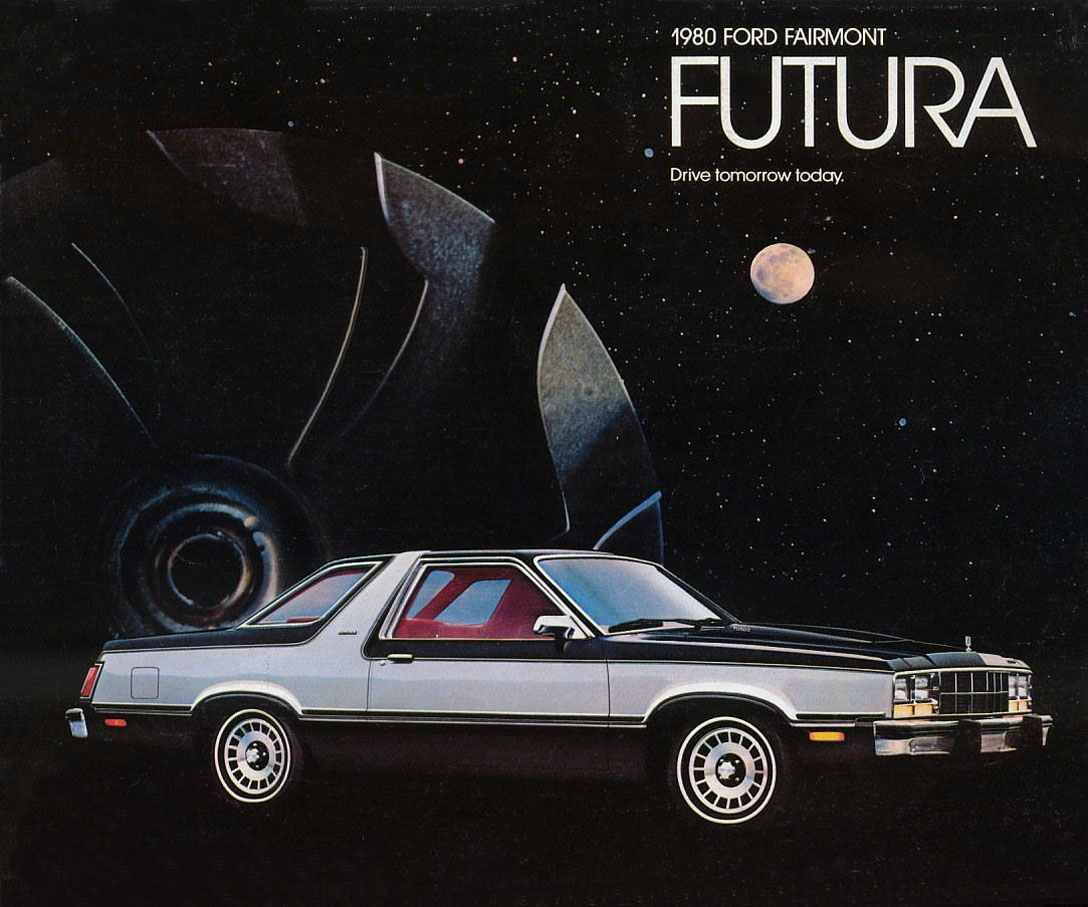
1980 Ford Fairmont Futura coupe

“Drive your Futura of tomorrow … today.”

1980 model year changes to Ford’s Fairmont Futura coupe included new engine choices and a new Tu-Tone paint treatment. Newly standard were P-metric steel-belted radial ply tires, high-illumination halogen headlamps, and a maintenance-free battery.

The Fairmont was the first of the Fox platforms to make it to market. Initially available for the 1978 model year, it replaced the Maverick as Ford’s compact offering. The Futura coupe’s distinctive wrapover B-pillar design came from a March 1976 Fairmont-based Thunderbird proposal.

Ford had been using the Fairmont name for a while by 1978—Ford of Australia had first used it in 1965. The Futura name was even older, dating back to a Lincoln concept car designed in 1954 and debuting as a higher-trim model of the Falcon in 1961.

Powertrains, Performance, & Standard Equipment

The Fairmont Futura’s standard engine was the Lima 88 bhp 2.3 liter/140 ci inline four with a two-barrel carburetor. The Thriftpower 91 bhp 3.3 liter/200 ci inline six with a one-barrel carburetor ($169) was available, and had 36% more torque than the four. A Windsor 119 bhp 4.2 liter/255 ci V8 with a two-barrel carburetor ($288) was also available—a substantial downgrade from the 139 bhp 4.9 liter/302 ci engine that had been available in 1978 and 1979.

There was once some argument, but it now seems reasonably clear that some Futuras were built with the heavily advertised turbocharged four ($481). This engine was rated at 120 bhp and included a prominent hood bulge with Turbo insignia. Reliability must not have met Ford’s expectations, because the turbocharged four didn’t make it to the 1981 model year.

A four-speed manual was standard with the base 2.3 liter inline four, while a four-speed manual with overdrive was standard with the 3.3 liter inline six. A SelectShift three-speed automatic ($340) was required with the turbocharged four and the V8, and optional for the two other engines.

Performance wasn’t great, but few domestic competitors were much better. Road & Track clocked a 15.8-second 0-60 time with the base powertrain. Best-case times with either the turbo four or the V8 were probably about two seconds better, but a Futura driver wasn’t looking to go racing.

Fuel economy ratings with the base powertrain were impressive: 28 city/38 highway by the day’s standards. The far more common 3.3 liter six/automatic combination was 20/27, with the V8 getting 18/26. The turbo came in at 19/26. With a 14-gallon fuel tank, Fairmont buyers with the 3.3 liter six and the automatic could expect a range of 270 to 295 miles.

Cover of the 1980 Ford Fairmont Futura brochure

The Fairmont Futura coupe’s base price was $5,531—$23,500 in today’s dollars. Standard exterior and mechanical equipment included dual rectangular halogen headlamps, wraparound taillamps, rack and pinion steering, front disc/rear drum brakes, and P-metric 14-inch black sidewall radial-ply radial tires on 14-inch wheels with Deluxe wheel covers. Inside, accent vinyl low-back front bucket seats and a Deluxe steering wheel hub were included.

Some of the Futura‘s standard interiors depended on the engine and transmission chosen. Buyers of the base 2.3 liter four with the four-speed manual and the turbocharged four with the automatic got low-back front bucket seats in pebble-grain vinyl. Buyers of the 3.3 liter six with the manual and the V8 with the automatic got a bench seat.

Packages, Options, & Production Numbers

The Ghia package ($193) included dual remote-control mirrors, a Ghia badge, plush cut-pile carpeting, a carpeted trunk, a Luxury steering wheel, a glove box lock, sun visors, and a right hand visor vanity mirror. Ghia buyers got a Flight Bench seat in either Luxury velour cloth or pebble-grain vinyl if they chose an automatic transmission, or bucket seats with the four-speed manual.

The Sports group ($114) included an over-the-roof tape stripe, color-keyed turbine wheel covers, and a charcoal/argent grille.

Individual exterior and mechanical options included power front disc brakes ($78) and power steering ($165). Inside, air conditioning ($671), a tilt steering wheel ($78), fingertip speed control ($116), power side windows ($135), and power door locks ($88) were available.

Ford produced 51,878 Futura coupes in 1980, making up 16% of overall Fairmont production in a year where overall Ford sales were down. 1,158 Fairmonts were turbos.

The View From 2025

It is striking both how many Fairmont versions there were and how much effort Ford put into marketing the Futura. Ford presented six versions of the Fairmont:

  • a 2-door sedan, which had a normal roofline and looked much plainer than the Futura
  • a 4-door sedan
  • the Futura coupe
  • the Futura sedan, which joined mid-year and had the same grille and many of the same features as the Futura coupe
  • a 4-door wagon
  • a Squire-branded 4-door wagon with woodgrain vinyl

Though the Futura got two full pages in the Fairmont brochure, Ford also made an eight-page Futura-specific brochure available.

Fairmont Futuras are not often seen for sale in any venue. AutoTrader Classic has an occasional Fairmont, while Bring a Trailer has sold a grand total of one Fairmont overall—a wagon. The word Fairmont appears in the Hemmings Motor News classifieds more as a component (of Model A replicas, for example) than a vehicle. One exception to this lack of sales visibility came in January 2024, when Barrett-Jackson auctioned a 1978 Ford Futura coupe for a $34,000 hammer price—it was the 100,000,000 U.S.-built Ford vehicle.

Make mine Candyapple Red, please.

Other 1980 Fords I have written about include the F-150 pickup truck, the Fiesta hatchback coupe, the Mustang Cobra hatchback coupe, and the Thunderbird coupe. I evidently do not write about a lot of Ford sedans.

1983 Pontiac Parisienne sedan

“It’s clean, uncluttered and handsome.”

In 1983, Pontiac’s Parisienne nameplate, a Canadian presence since 1958, became available in the United States. The story, of course, was not that simple. For the 1982 model year, Pontiac had moved the Bonneville nameplate from the full-size B-platform to the mid-size G-platform and discontinued the slightly less expensive Catalina altogether. Dealers were unhappy with losing the full-size car, and the sales numbers told the reason why.

19811982
Catalina coupe (B-platform)1,073
Catalina sedan (B-platform)6,456
Catalina Safari wagon (B-platform)2,912
Bonneville coupe (B-platform)14,317
Bonneville/Bonneville Brougham sedan (B-platform)55,451
Bonneville Safari wagon (B-platform)6,855
Bonneville G/Bonneville G Brougham sedan (G-platform)64,413
Bonneville G wagon (G-platform)16,100
LeMans/Grand LeMans coupe (G-platform)4,397
Le Mans/LeMans LJ/Grand LeMans sedan (G-platform)47,427
LeMans Safari/Grand LeMans Safari wagon (G-platform)30,041
Totals168,92980,513

By condensing the two platforms into one and dropping the admittedly low-selling coupes, Pontiac cut sales by more than half. Yes, the front-wheel-drive mid-size 6000 was introduced for 1982, but its 57,534 sales didn’t come close to making up for the rear-wheel-drive losses. So, halfway through the 1983 model year, Parisienne’s started to be sold in the United States.

The Parisienne’s base engine was the LD5 110 bhp 3.8 liter/231 ci V6 with a two-barrel carburetor. The LG4 150 bhp 5.0 liter/305 ci V8 with a four-barrel carburetor and the LF9 105 bhp 5.7 liter/350 ci diesel V8 were optional. A three-speed automatic was standard with the V6 and the diesel. A four-speed automatic was required with the gas V8 and optional for the diesel. Mileage with the gas V8 was 18 city/29 highway by the day’s standards (15/21 by today’s measures); with a 25.1-gallon fuel tank, a Parisienne owner could expect a range of about 405 to 530 miles with a 10% fuel reserve.

Page from the 1983 Pontiac Parisienne brochure

Standard exterior and mechanical equipment on the $9,609 base Parisienne sedan included two-tone paint, power steering, power front disc/rear drum brakes, and 205/75R15 blackwall steel-belted radial tires (a size still readily available) on 15-inch wheels with Deluxe wheel covers. Inside, a 50/50 split front seat, an instrument panel with simulated woodgrain trim, a glove compartment with lock and light, and an electric clock were included.

Moving up to the $9,879 Brougham added a 60/40 Luxury cloth front seat with a fold-down center armrest and a passenger recliner, along with Deluxe acoustical insulation.

Options & Production Numbers

Options were many (Pontiac only consented to list “major options” in the brochure), and included tungsten halogen headlamps, air conditioning, cruise control with resume speed feature, power windows, power door locks, an electric rear window defogger, a power antenna, and a choice of three radios ranging up to a Delco-GM stereo with a cassette player and a four-speaker system.

The Parisienne was not nearly as sporty (“We Build Excitement”) as most other products in Pontiac’s 1983 model line, but you could add a limited-slip differential axle, body color Sport mirrors, a gage package, and the Rally handling package, which required slightly wider P225/70R15 whitewall steel-belted radial tires.

Pontiac did feel that they needed to state the obvious about the Parisienne’s badge engineering. In fine print at the bottom of the last page of the brochure was this quote:

“Pontiac Parisienne models are equivalent to models offered by Chevrolet under the nameplate Caprice.”

With little differentiation and a short sales period, Parisienne sales were not high in 1983. Pontiac sold 9,279 base sedans, 5,139 Brougham sedans, and 3,027 station wagons. Sales would climb notably in the full-length 1984 model year—18,713 base sedans, 25,212 Brougham sedans, and 16,599 station wagons.

The View From 2025

Parisienne’s occasionally appear for sale in the Hemming’s Motor News classifieds, on eBay Motors, and on Bring a Trailer.

Other B-platform cars I have written about include the 1983 Chevrolet Caprice Classic sedan, the 1985 Chevrolet Caprice Classic station wagon, the 1987 Chevrolet Caprice Classic coupe, and the 1982 Oldsmobile Delta 88 Royale coupe. I have yet to write about the rear-wheel-drive Buick LeSabre.

1985 Chevrolet Celebrity Eurosport coupe

“Celebrity precision.”

1985 was the second year for the Eurosport version of Chevrolet’s Celebrity. Designated as RPO ZV8, the Eurosport followed one year after the introduction of Pontiac’s STE version of the 6000. Among the notable changes for 1985 was the addition of multi-port fuel injection for the H.O. V6, along with hydraulic motor mounts for all engines.

Powertrains, Performance, & Standard Equipment

Despite its sporting pretensions, the Eurosport came standard with the same LR8 Iron Duke 92 bhp 2.5 liter/151 ci inline four with throttle-body fuel injection and four-speed manual that was the base powertrain on “civilian” Celebrities. Many Eurosport buyers upgraded to the LB6 H.O. 130 bhp 2.8 liter/173 cu V6 ($435), which was paired with a choice of a three-speed automatic ($425) or a four-speed automatic ($600).

With the H.O. engine and the four-speed automatic, 0-60 times were a little over 10 seconds in the 2,700 pound Eurosport. Fuel economy was decent with the same powertrain—19 city/28 highway by the day’s standards (17/26 by 2025 standards). With a 16.4-gallon gas tank, a Eurosport owner could expect a range of 320 to 345 miles with a 10% reserve.

Eurosport coupe pages from the 1985 Chevrolet Celebrity brochure

Standard exterior and mechanical equipment on the $8,301 Eurosport coupe (about $25,000 in today’s dollars) included blackout exterior trim, a red accent stripe, fast-ratio power steering, a “special” version of the F41 sport suspension with gas-charged struts and shocks, and P195/75R-14 blackwall all-season steel-belted radial tires on 14 x 5.5 inch Rally wheels. Inside, blackout instrument panel trim and a Sport steering wheel were included—otherwise, a low-optioned Eurosport looked plain inside.

Standard equipment on all Celebrity coupes included “front-drive” (still worth noting in 1985 advertisements), rack and pinion steering, and power front disc/rear drum brakes. Inside, coupe buyers got a two-passenger cloth front bench seat with a center armrest, side window defoggers, and an AM push-button radio with dual front speakers.

Options & Production Numbers

With standard equipment relatively spare, many options were available for the 1985 Celebrity Eurosport coupe. Exterior and mechanical options included Custom Two-Tone paint ($148), tinted glass ($110), dual remote sport mirrors ($91), P195/70R-14 Goodyear Eagle GT blackwall tires ($60), and aluminum wheels ($306).

Inside, cloth reclining front bucket seats ($147), a console ($105), a Gage Package with trip odometer ($64), electronic speed control ($175), power door locks ($125), power windows ($185), air conditioning ($730), and a Comfortilt steering wheel ($110) were all available. Five different optional radios were available, with the top-of-the-line being the UX1 ETR AM stereo/FM stereo radio with seek and scan, cassette player with search and repeat, clock, graphic equalizer, and extended range sound system ($504).

A loaded Eurosport coupe could frequently near $12,000—real money in those days and about $36,400 now.

Production numbers for the 1985 Eurosport coupe are hard to come by, but we do know that Chevrolet sold a total of 29,010 Celebrity coupes in that year. The sedan (239,763 sold) and the wagon (86,149) did far better.

The View From 2025

Eurosports of any type rarely appear in the Hemming’s Motor News classifieds or on eBay Motors, and one has yet to be seen on Bring a Trailer.

Make mine Dark Blue Metallic, please.

Other A-bodies I’ve written about in this blog include the 1983 Pontiac 6000 STE sedan, the 1986 Buick Century sedan, and the 1989 Chevrolet Celebrity sedan—I guess I owe the Oldsmobile Cutlass Ciera some attention.

1981 Volkswagen Dasher station wagon

A 1981 Volkswagen Dasher station wagon sold for $7,600 on Bring a Trailer in February 2025. It was a brown diesel with a manual transmission—directly mapping to a certain internet cliché (except for being front-wheel-drive). I’m relatively spare on Volkswagen blog entries, so here we go.

“More luxury. More space.”

The Volkswagen Dasher station wagon was a small car, classified by the EPA as a subcompact. Its 97.2-inch wheelbase was half a foot shorter than the 2025 Golf GTI’s and its curb weight was slightly less than 2,200 pounds. Putative compact station wagon competition for the 1981 Dasher included the Ford Escort, the Honda Civic, the Plymouth Reliant, and the Renault 18i Sportwagon.

For its eighth and final year, the Dasher station wagon’s only powertrain was a 52 bhp 1.6 liter/97 ci diesel four paired with a four-speed manual transmission. Fuel mileage was quite good—36 mpg by the day’s standards. Diesel Dashers were slow, slow, slow—even by 1981 standards. 0-60 came in 19.3 seconds and VW claimed a top speed of 85 mph.

1981 Volkswagen print advertisement

Standard exterior and mechanical equipment on the $9,040 Dasher station wagon (about $34,400 in today’s dollars or about what a loaded 2025 Volkswagen Taos SEL compact SUV goes for) included front-wheel-drive, rack and pinion steering, power-assisted self-adjusting front disc/rear drum brakes, an electric rear window defogger/defroster, and 155/80R13 steel belted radial tires (a size still available from Kumho and Michelin) on 13-inch wheels with wheel covers. Inside, a padded steering wheel, a trip odometer, a quartz crystal chronometer, a wood-grained instrument panel, cut pile carpeting, and reclining front bucket seats in crushed velour were included.

Options

Options included tinted glass ($70), a manual sunroof ($260), 175/70R13 white sidewall tires ($130), air conditioning ($620), leatherette upholstery ($65), and an AM/FM stereo radio ($275).

The View From 2025

Dashers have largely vanished, which is what made so many take notice of that recent Bring a Trailer offering. There is limited collector interest in these cars, so it isn’t that surprising that Hagerty’s valuation tools do not track any 1981 Volkswagens. Dashers rarely appear in the Hemming’s Motor News classifieds, on eBay Motors, or on Bring a TrailerBaT has sold a grand total of three Dashers in eleven years.

Make mine Helios Blue Metallic, please.

Other Volkswagens I have written about include the 1981 Scirocco S hatchback coupe, the 1983 Rabbit GTI hatchback coupe, and the 1985 Cabriolet.

Last updated July 2025.