1983 Isuzu Impulse hatchback coupe

“Follow Your Impulse”

1983 was the first model year that Isuzu’s Impulse (known as the Piazza in most other parts of the world) became available in the United States. The first-generation Impulse was built on a variant of the aging rear-drive T-body chassis used by the lowly Chevrolet Chevette but was definitely aimed at a notably different market.

The Impulse came much better equipped than any Chevette: standard mechanical equipment for the $9,998 base price (about $32,300 in 2025 dollars) included four-wheel disc brakes and P195/60R14 tires (a size still readily available) on 14-inch alloy wheels. Inside, power steering, power windows, power door locks, cruise control, air conditioning, tinted glass, a tilt steering wheel, and an AM/FM stereo radio were all included. Optional equipment was spare, with only an improved stereo and turbine wheels available.

For 1983, power for the 2,700-pound Impulse was provided by a 90 bhp 1.9 liter/119 ci SOHC inline four with multi-point fuel injection (a turbocharged engine would not become available until 1985). Transmissions available were a standard five-speed manual and an optional four-speed automatic. Fuel economy with the manual transmission was 22 city/28 highway by the day’s standards (19/26 by 2025 standards). 0-60 took between 12 to 13 seconds, with a top speed of about 110 mph. With a 15.3-gallon fuel tank, you could expect a range of between 310 and 345 miles with a 10% fuel reserve.

Of course, the Impulse’s absolute killer feature was its exterior styling, which was very close to Giorgetto Giugiaro’s 1979 Ace Of Clubs show car. Road & Track put the Impulse on the cover of their June 1983 issue, with the tagline being “Sensuous show car hits the road.”
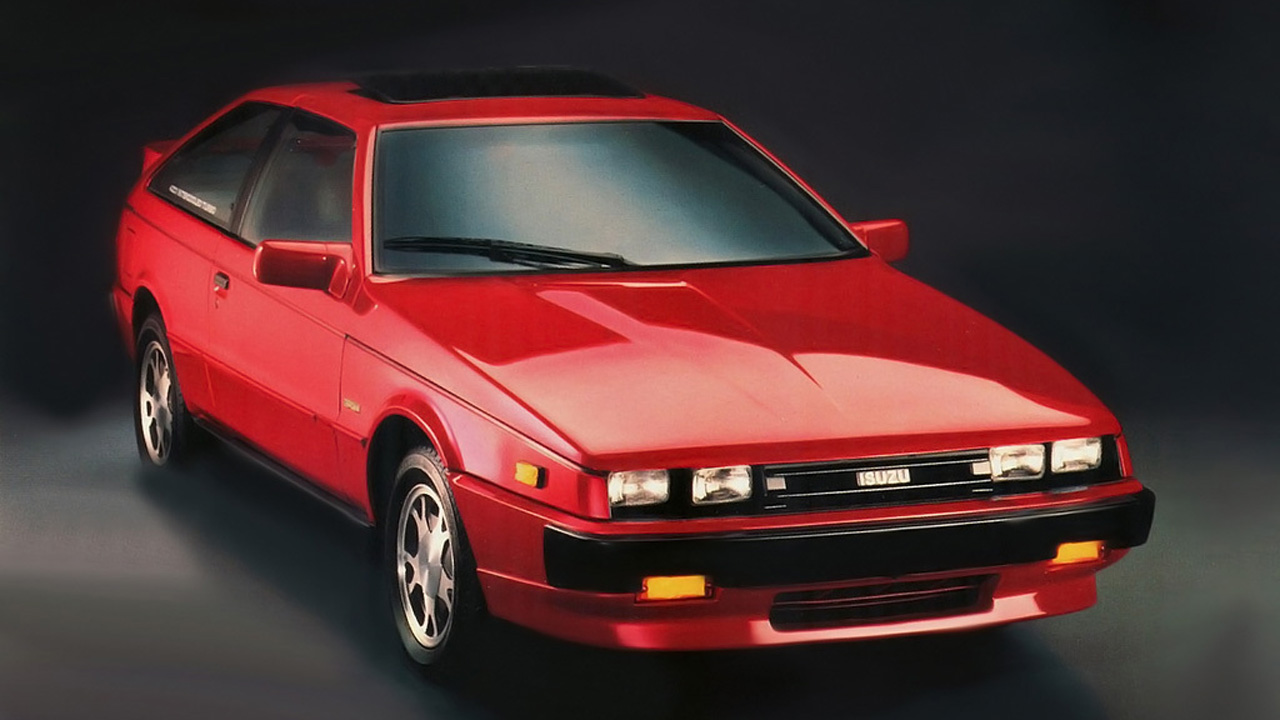
First-generation Isuzu Impulse, courtesy of Isuzu.

Isuzu must get real credit for messing as little as possible with Giugiaro’s excellent and differentiating design—few automakers were willing to leave as well enough alone as they did. They changed only a few things, adding slightly larger bumpers to meet the five mph DOT requirement, shortening the windshield and lengthening the hood to allow for easier installation of the engine on the assembly line, and enlarging the overall dimensions a few inches to allow for more interior space.

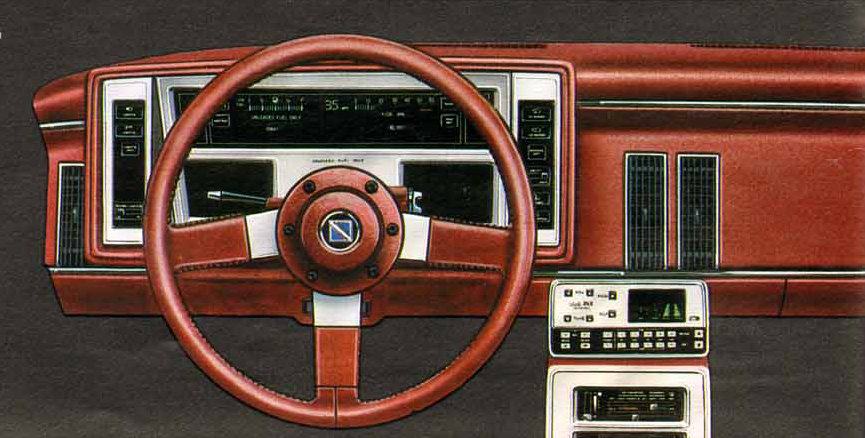
Isuzu also made the interior as close as possible to the original show car. In particular, two pods on either side of the steering wheel included most controls—and they adjusted with the standard tilt steering. All four seats were adjustable—rear seat adjustability was very unusual in subcompact cars in the 1980s.

The View From 2025

Impulses of this generation are rarely seen in the Hemming’s Motor News classifieds or on eBay Motors. They do occasionally appear on Bring a Trailer, with a 1984 Impulse auctioning off in November 2024.

Make mine Black, please.

Last updated in February 2025.
1988 Chevrolet Beretta GT coupe

“A car with performance that fulfills the promise offered by its exterior appearance.”

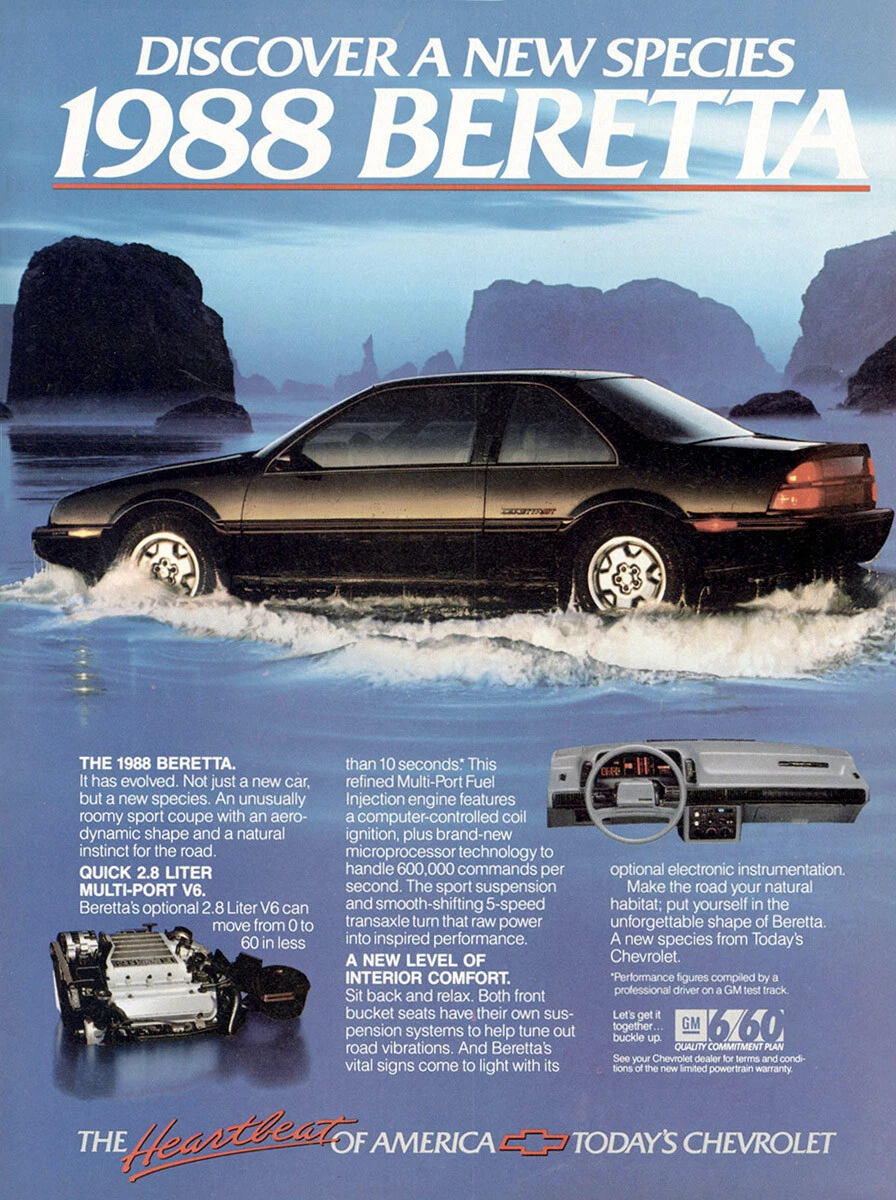
I always liked the Chevrolet Beretta’s styling. It was among the purest executions of the wedge in the 1980s (along with the Bertone/Fiat X1/9, the Pontiac Fiero, and the Triumph TR8).

Chevrolet soft-launched the Beretta as a 1987 model, selling it to rental car agencies. In its first full year of general availability in 1988, there were two Beretta models—the base coupe and the GT. The Beretta GT came standard with the LB6 130 bhp 2.8 liter/173 ci multi-port fuel-injected V6: a notable step up from the “Iron DukeLQ5 90 bhp 2.5 liter/151 ci throttle body fuel-injected inline four that came standard with the coupe.

0-60 mph came in a little over 9 seconds with the five-speed manual transmission and the V6—not that bad, but certainly not stunningly fast either. Fuel economy with the same powertrain combination was 19 city/29 highway by the day’s standards (17/27 by today’s measures). With a 13.5-gallon gas tank, a GT owner could expect a range of 265 to 290 miles with a 10% fuel reserve.

1988 Chevrolet Beretta print advertisement

Standard exterior and mechanical equipment on the $11,851 GT (approximately $33,300 in today’s dollars) included dual sport mirrors, power brakes, and P205/70R14 tires (a size still readily available) on 14-inch wheels. Inside, the Custom interior, tachometer, and an AM/FM stereo radio were all standard.

Packages & Options

The Beretta was one of the early examples of General Motors’ move to option packages as the preferred way to reduce the number of possible equipment combinations. The GT‘s option packages were:

  1. Air conditioning
  2. Floor mats, tilt steering wheel, cruise control, intermittent wipers
  3. Auxiliary lighting, power door locks, power trunk opener, power windows, AM/FM stereo cassette with digital clock

Optional equipment included the GT-only Z51 Performance Handling Package ($153 for larger stabilizer bars, firmer bushings, tuned struts and shocks, and Goodyear Eagle GT + 4 P205/60R15 tires on 15-inch styled steel wheels), rear window defogger ($145), electronic instrumentation ($156), two-tone paint ($123), and AM/FM stereo cassette with digital clock and graphic equalizer.

Midway through the model year, Chevrolet added a Beretta GTU package for $2,500. Designed to reflect the Berretta’s involvement in the IMSA GTU racing series, the GT-based GTU featured a front wraparound chin spoiler, a body color grille and body side moldings, lower rocker panel extensions, breakaway mirrors, a rear valance panel extension, a rear decklid spoiler, GTU graphics, and Goodyear Gatorback P205/55VR-16 tires on 16-inch aluminum alloy wheels.

The View From 2025

Not a lot of folks are collecting Berettas, but there are enthusiast sites. I have not seen one on the road in over a decade. Berettas are rarely seen in the Hemming’s Motor News classifieds or on eBay Motors, but Bring a Trailer has sold six over the last five years.

Make mine Maroon Metallic, please.

Other Chevrolet coupes from the second half of the eighties that I have written about include the 1985 Celebrity Eurosport, the 1986 Cavalier Z24, and the 1988 Corvette 35th Anniversary Edition.

Last updated October 2025.

1986 Cadillac Eldorado coupe

“Imaginatively new. Decidedly Cadillac.”

Is it possible to miss the market more than this? For the 1986 model year, Cadillac downsized the front wheel drive Eldorado coupe again. This time, the wheelbase dropped to 108 inches, and overall length was down by over 16 inches to 188 inches—what was supposed to be the top of the non-limousine Cadillac line was now about the size of a 1986 Chevrolet Celebrity (or a 2025 Cadillac CT4 sedan) and a full three feet shorter than the (admittedly massive) 1978 Eldorado.

EightiesEldoradoSales

Predictably, Eldorado buyers didn’t go for it. Sales collapsed from about 74,000 in 1985 to about 21,000 in 1986—definitely not what would be expected from a complete model revision. Six years later, GM had now managed to duplicate the carnage that Ford had experienced with its 1980 luxury vehicle downsizing. Notably, Ford Thunderbird, Lincoln Mark VII (the Continental name departed that year), and Mercury Cougar sales were all up for 1986, along with those of some of GM’s “junior” personal luxury coupes. The December 1987 issue of Special Interest Autos simply called the Eldorado/Riviera/Toronado downsizing “the E-body disaster” and speculated that it was costing GM half a billion dollars a year in lost profits.

1986 Cadillac Eldorado brochure page

So, what did those relatively few buyers get with their $24,251 (about $70,900 in today’s dollars) 1986 Eldorado? Standard exterior and mechanical equipment included power four-wheel disc brakes, power steering, and aluminum alloy wheels. Inside, front bucket seats, power mirrors, power windows, power door locks, a power trunk release, cruise control, electronic climate control, and an AM/FM stereo radio with power antenna were all included, so the Eldorado was at least pretty well equipped.

Packages, Options, & Performance Numbers

Moving up to the Biarritz (almost always the top-of-the-line Eldorado since 1956) cost either $3,095 (with cloth seats) or $3,495 (with leather seats) raising the price to either $27,346 ($79,900 today) or $27,746 ($81,100 today). Standard equipment on the Biarritz included nicer seats with power lumbar support, two-tone paint, and real walnut accents.

Options included a power Astroroof ($1,255), a nicely integrated cellular phone ($2,850), the FE2 touring suspension with 15-inch aluminum alloy wheels and 215/60R15 Goodyear Eagle GT tires ($155), and the Delco-GM/Bose Symphony Sound System ($895).

The Eldorado’s engine was Cadillac’s 130 bhp HT-4100 throttle body fuel injected 4.1 liter/249 ci V8 paired with a four-speed automatic transmission. Fuel economy was 17 city/26 highway by the standards of the day (15/24 by today’s standards). Since the engine and transmission remained the same and the Eldorado was smaller and lighter, performance was better but still not very impressive: 0-60 improved to about 11 seconds.

The View From 2025

According to Hagerty’s valuation tools, all the money for a 1986 Eldorado in #1/Concours condition is $19,100, with a far more typical #3/Good car going for $6,900. Eldorados of this age come up for sale regularly in the Hemmings Motor News classifieds, on eBay Motors, and Bring a Trailer, so folks are saving them.

Make mine Corinthian Blue Firemist, please.

Other Eldorados I have written about include the 1982 Touring Coupe, the 1984 Biarritz convertible, and the 1988 coupe.

Last updated March 2025.

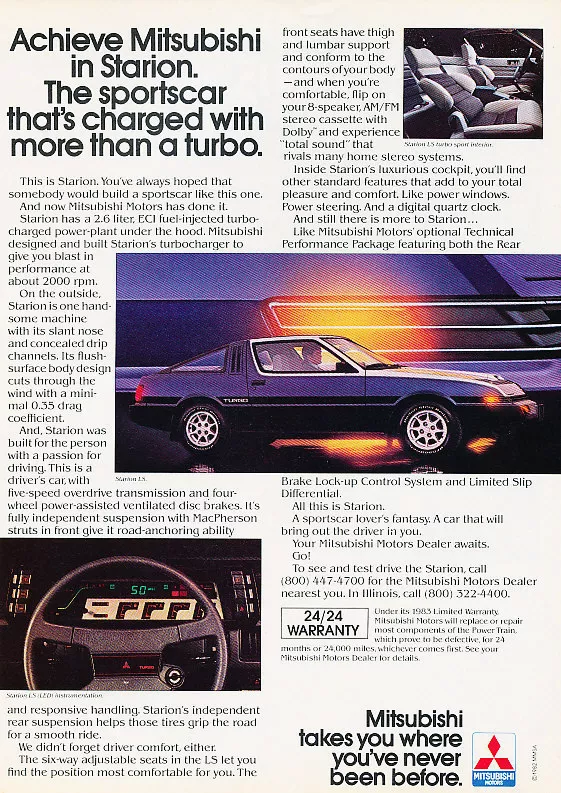
1983 Mitsubishi Starion hatchback coupe

Bring a Trailer had a Plymouth Conquest (the badge-engineered version of the Starion) up for auction in February 2025. I learned enough from the comments to want to update this elderly blog entry.

“The sportscar that’s charged with more than a turbo.”

The 1983 Mitsubishi Starion was a significant change of pace for Mitsubishi. Seen back in the day as a poor man’s Porsche 944 at about two-thirds of the price, the rear-wheel-drive Starion reached customers that Mitsubishi had never competed for before. Because of Chrysler’s relationship with Mitsubishi, nearly identical cars were sold starting in 1985, first as the Plymouth Conquest and Dodge Conquest and then as the Chrysler Conquest beginning in 1987 (gotta love branding).

For 1983, motive power was provided by the Astron G54B 145 bhp 2.6 liter/156 ci inline four with fuel injection and a turbocharger connected to a five-speed manual (no automatic transmission was available in 1983). 0-60 came in about 9 seconds in a car that weighed about 2,700 pounds. Mileage was 19 city/24 highway by the standards of the day (17/22 by today’s standards). With a relatively large 19.8-gallon gas tank, a Starion owner could expect a range of between 310 and 385 miles with a 10% fuel reserve.

1983 Mitsubishi Starion advertisement

At $12,079 (about $39,500 in today’s dollars), the base Starion EX included a fully independent suspension, four-wheel power-assisted ventilated disc brakes, power steering, P195/70R14 tires (a size still readily available), and 14-inch alloy wheels. Inside, power windows and a digital quartz clock were standard. Moving up to the LS—an additional $1,840, making the car a $45,600 purchase in 2025—added P215/60R15 tires and 15-inch wheels, air conditioning, six-way adjustable front seats, digital instrumentation, and an AM/FM stereo cassette with eight speakers.

Options & Production Numbers

Options included a sunroof, cruise control, and the Technical Performance Package. LS purchasers could go crazy and get leather seat facings and a single two-tone paint option (Italian Silver over Behring Blue Metallic).

Mitsubishi sold 6,297 Starions in the 1983 model year—pretty good for a make and model with little previous sporting reputation in North America. Period reviews were generally positive, and watching MotorWeek‘s treatment is interesting.

The View From 2025

I have not seen a Starion on the road in decades, but at least a few are being saved, and there is some online support. A quick perusal shows that lack of maintenance of the complex for its day engine causes most of the serious issues with this car.

You occasionally see Starions come up for sale in the Hemmings Motor News classifieds or on eBay Motors, but there were none for sale when I last checked—the later 3000 GT does better. Bring a Trailer auctions a fair amount—enough to have a specific category.

Make mine Safari Red, of course.

Last updated June 2025.

1983 Chevrolet S-10 Blazer SUV

“Tough Chevy trucks are taking charge”

1983 was the first year for Chevrolet’s S-10 Blazer SUV (along with its sister, the GMC S-15 Jimmy). Intended as a smaller complement to the full-sized K5 Blazer that had been in production since 1969, the S-10 Blazer found a ready market. Styling was good—derivative of the K5, but clean and appropriate for the size.

For 1983, the S-10 Blazer’s standard power was provided by the LQ2 83 bhp 2.0 liter/122 ci inline four with a two-barrel carburetor. Optional power was quite a step up: the $243 LR2 110 bhp 2.8 liter/173 ci V6 with a two-barrel carburetor was available (and very popular) and required power steering (an additional $247). Mileage with the V6 and the four-speed automatic transmission was 17 city/23 highway by the day’s standards (15/22 by today’s measures). With a 20.1-gallon fuel tank, a Blazer owner could expect a range of between 335 and 360 miles with a 10% fuel reserve.

The S-10 Blazer buyer had a choice of two or four-wheel-drive, with four-wheel-drive costing an additional $1,194. The four-wheel-drive versions came with the all-new “Insta-Trac,” meaning the driver could shift into (or out of) four-wheel-drive High at any speed. Selecting four-wheel-drive Low (for very slippery, rough, or steep terrain) required stopping the Blazer.

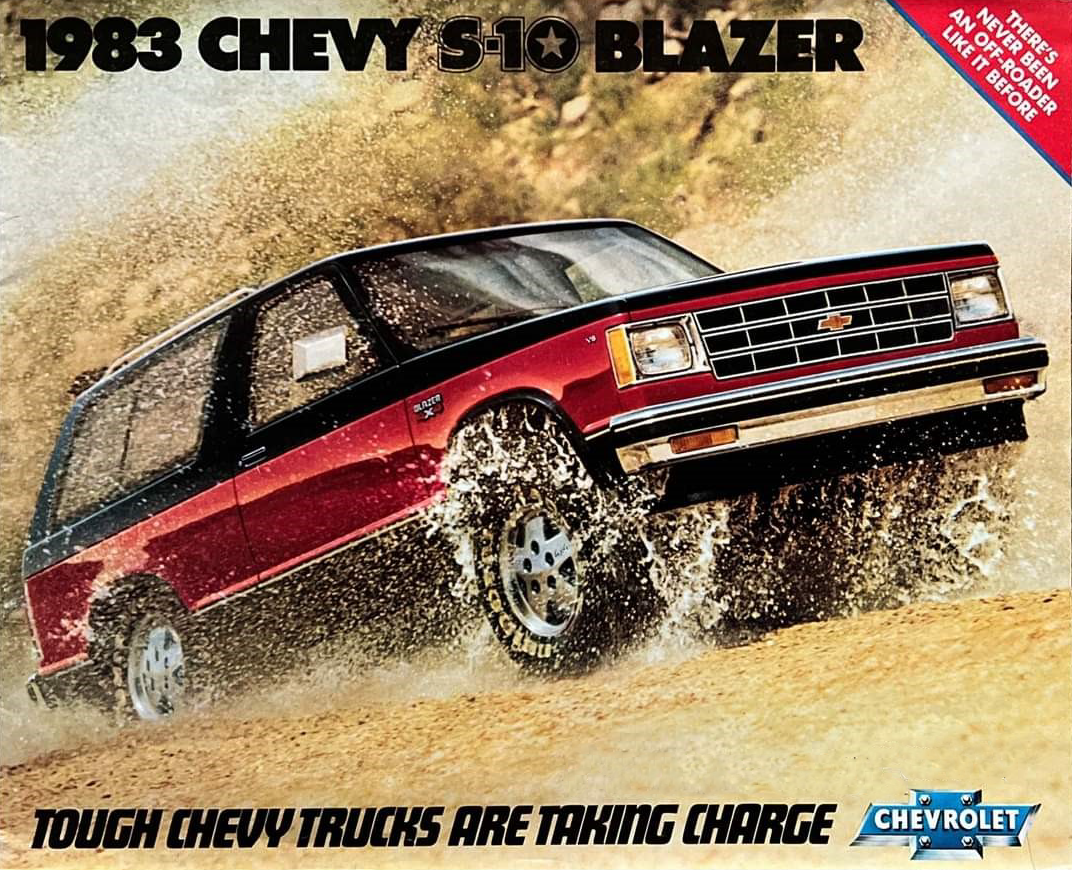
Cover of the 1983 Chevrolet S-10 Blazer brochure

Three trim levels were offered: base, Tahoe, and Sport. Standard equipment on base version ($9,423 with four-wheel-drive or approximately $30,900 in 2025 dollars) included P195/75R15 tires on 15-inch wheels, a heater, high back vinyl bucket seats, and color-keyed rubber floor mats. For $576, moving up to the Tahoe trim upgraded the truck with chrome trim, wheel trim rings, carpeting, and a gauge package.

At $944, the top-of-the-line Sport trim included features such as wheel trim rings, two-tone paint, color-keyed bumpers, reclining front seat backs, a console, a Sport steering wheel, a gauge package, and additional sound insulation.

Options & Production Numbers

Optional equipment included air conditioning ($690), cruise control ($185), a tilt steering wheel ($105), the Operating Convenience Package ($300 for power windows and power door locks), and an AM/FM stereo cassette ($555). Mechanically, you could get the Off-Road Package ($571 with the Tahoe or Sport trim), the Heavy-Duty Trailering Package ($193), and the Cold-Climate Package ($69 with the upper-level trims and air conditioning).

All of these options meant you could make an S-10 Blazer rather pricey—I fairly easily configured a four-wheel-drive Sport with the V6 and the four-speed automatic transmission to $15,039 or about $49,000 in today’s dollars.

First-year S-10 Blazer sales were quite strong, with over 106,000 sold of an all-new model that dropped over 1,500 pounds in curb weight compared to its big brother.

The View From 2025

You rarely see S-10 Blazers for sale in the Hemming’s Motor News classifieds. They are more prevalent on eBay Motors, but seeing one that has not been significantly modified is unusual. The advent of Bring a Trailer has brought more stock S-10 Blazers to the fore.

Make mine the Cinnamon Red/Sable Black two-tone—just like the one on the brochure cover.

Other 1983 Chevrolets I’ve written about include the Caprice Classic sedan, the Cavalier CS sedan, the Malibu sedan, and the Monte Carlo SS Sport Coupe.

Last updated April 2025.

1983 Pontiac 6000 STE sedan

“Enter the realm of the senses”

The 6000 STE was Pontiac’s 1980s attempt to make a car that could effectively compete with the BMWs and Audis of the age. Of course, Pontiac had been trying to do this for at least a decade, including two different generations of the Grand Am (1973-1975 and 1978-1980). Though hampered by the fundamental constraints of the front-wheel-drive A-platform, the 6000 STE was a committed attempt.

For 1983, the 6000 STE‘s power was provided by GM’s Chevrolet-built corporate “High Output” LH7 2.8 liter/173 ci V6 with a Rochester E2SE two-barrel carburetor, rated at a respectable for the era 135 bhp, but the only transmission available was (oog) a three-speed automatic. 0-60 came in about 9 seconds in the 3,000-pound car. Mileage was 19 city/24 highway by the day’s standards (17/22 by today’s measures). With a 15.6-gallon gas tank, range was an unimpressive 275 to 300 miles with a 10% fuel reserve.

Improvements over the standard Pontiac 6000 (and the other A-platform cars—the Buick Century, the Chevrolet Celebrity, and the Oldsmobile Cutlass Ciera) included a special steering rack and suspension tuning with a self-leveling rear air suspension. Four tungsten halogen headlamps paired with two inboard driving lamps gave the 6000 STE a distinctive and relatively unique face.

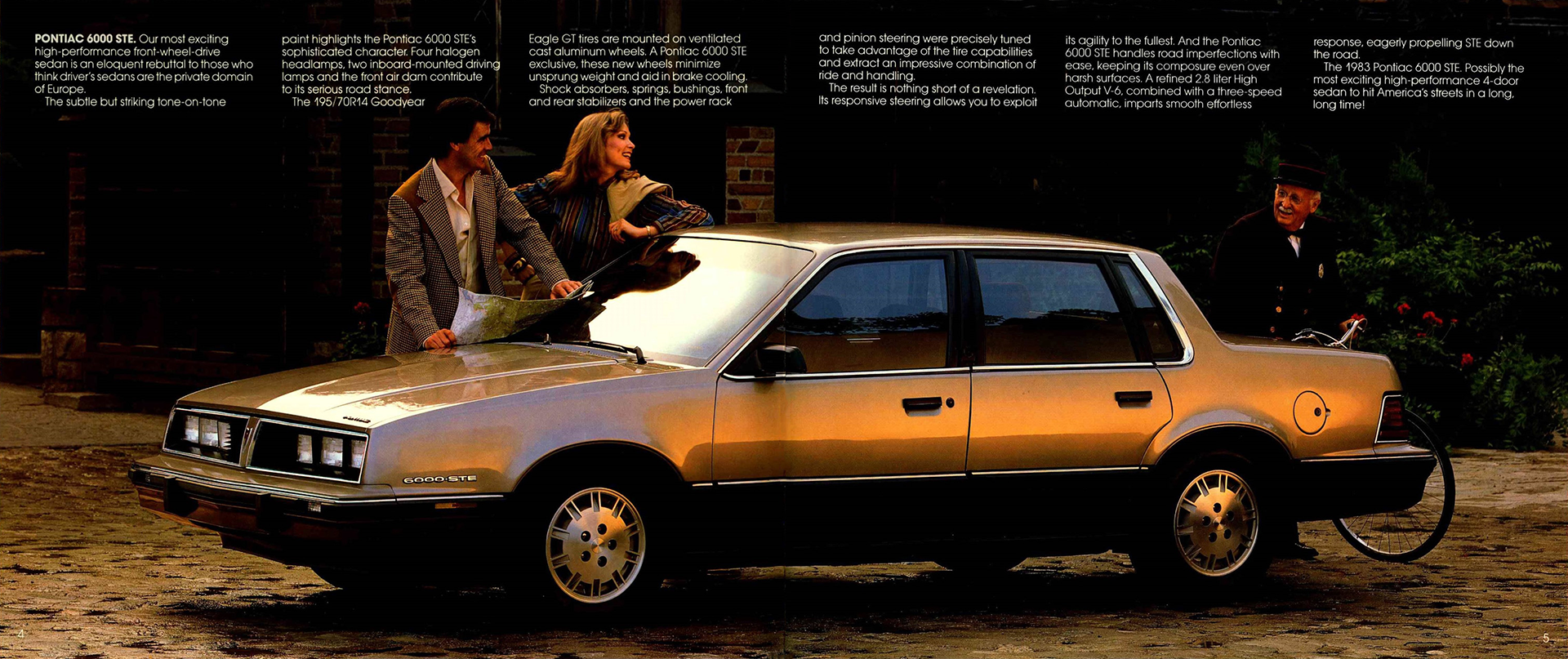
Pages from the 1983 Pontiac 6000 STE brochure

The 6000 STE came comfortably equipped for a sedan in 1983. Dual rectangular halogen headlamps, Soft-Ray tinted glass, power rack and pinion steering, power front disc/rear drum brakes, and 195/70R14 Goodyear Eagle GT tires (a size still readily available) on 14-inch aluminum wheels were standard. Standard interior features included 45/45 reclining front seats with a six-way manual adjustment and lumbar support, air conditioning, a rear window defroster, power door locks, power windows, power mirrors, cruise control, a tilt steering wheel, rally gauges with trip odometer, and a Delco-GM ETR AM/FM stereo radio with a cassette player and four speakers.

Options, Pricing, & Production Numbers

The only significant options available were a $295 vista vent roof and leather seating surfaces.

In 1983, 6,719 buyers paid around $13,572 (about $45,000 in 2025 dollars) for a 6000 STE, and it managed to make Car and Driver‘s 10Best Cars that year and the two following. The STE gained multi-port fuel injection in 1985 and various interior upgrades just about every year through 1989.

The View From 2026

Over time, the initial positive opinion there was of the 6000 STE seems to have faded—the most disparaging comment I’ve ever received on this site is about this car.

6000 STE‘s only occasionally show up in either the Hemmings Motor News classifieds or eBay Motors, and when they do, they are often not in the greatest of shape. Bring a Trailer has yet to feature a 6000 STE.

Please make mine the same Light Brown Metallic/Dark Brown Metallic two-tone as there is in the brochure picture above.

Other A-platform cars I have written about included the 1985 Chevrolet Celebrity Eurosport coupe, the 1985 Oldsmobile Cutlass Ciera sedan, the 1986 Buick Century sedan, and the 1989 Chevrolet Celebrity sedan.

Last updated February 2026.

1989 Nissan Maxima sedan

Familiar and comfortable with things Japanese at least partially from his time serving in the occupation forces following World War II, my grandfather purchased a couple of first Datsun and then Nissan Maximas over the years. When Nissan announced the new and much sportier third-generation version of the Maxima for the 1989 model year, I (firmly convinced of my twenty-year-old hipness) assumed that he would not purchase one. I was wrong: within a year, my grandfather was driving one of those new Maximas with the “4DSC” logo (an abbreviation for “4-Door Sports Car”) on a side window—an at least somewhat instructive lesson for this young man.

“Big enough to hold a meeting. Fast enough to keep it short.”

New for 1989, the third-generation Nissan Maxima was a significant change toward a more sporty image and reality, with attractive new styling and an independent rear suspension. I remember wondering if they had moved too far away from their previous conservative designs for their market. They hadn’t—the 1989 Maxima got good reviews and sold quite well, despite the elimination of the station wagon version.

The Maxima’s engine, a version of Nissan’s VG30E 3.0 liter/181 ci multi-port fuel-injected V6 (closely related to the standard powerplant in the Nissan 300ZX), was slightly upgraded for 1989 to 160 bhp and 182 lb.ft of torque.

As they had in previous years, Nissan sold two differentiated Maxima models for 1989: the luxury-oriented GXE and the significantly more sporty SE.

Standard exterior and mechanical equipment for the $17,499 (about $47,000 in today’s dollars) GXE included rack and pinion steering, keyless entry (a GXE-only feature), and 205/65R15 tires (a size still readily available) on 15-inch alloy wheels. Inside, you got air conditioning, cruise control, power windows, power door locks, and a rear window defogger. Fuel economy with the standard four-speed automatic transmission was decent at 19 mpg city/26 highway by the day’s standards on premium gasoline (17/24 by today’s measures). With an 18.5-gallon fuel tank, a GXE owner could expect a range of between 340 and 375 miles with a 10% fuel reserve.

Cover of the 1989 Nissan Maxima brochure

Moving to the $18,549 SE added a five-speed manual transmission (the four-speed automatic was optional on the SE), four-wheel disc brakes, wider wheels, and a spoiler, along with stiffer springs and sway bars. Inside, a moonroof, a Bose stereo, a leather steering wheel, and white-faced gauges with black markings were all included. With the five-speed, 0-60 mph came in a little under 9 seconds, and fuel economy (also on premium gasoline) was 20 city/26 highway by the day’s standards (18/24 by 2025 measures).

Options available for the Maxima included a sonar suspension system that adjusted damping based on road conditions, a fairly primitive heads-up display, and anti-lock brakes (SE only).

The View From 2025

People seem to remember these cars with affection, and I (and others) think the exterior styling has aged rather well, but I don’t see a lot of collecting, at least not yet. Third-generation Nissan Maximas only occasionally show up in the Hemming’s Motor News classifieds—you do see them a little more often on eBay Motors and Bring a Trailer.

Make mine my grandfather’s Winter Blue Metallic, please.

I have also written about the ur-Maxima—the 1981 Datsun 810 Maxima sedan.

Last updated August 2025.

1986 Ford Taurus sedan

“An automobile that evolved from a new way of thinking.”

Front cover of the 1986 Ford Taurus brochure

Ford’s 1986 Taurus marked an almost unbelievable change from the Fox-platform LTD that it replaced. Gone was the rear-wheel-drive and squarish looks, replaced by something front-wheel-drive with Jack Telnack’s completely different design.

The Taurus definitely looked different on the road, especially for a Ford. Getting beyond the looks, the base engine on the Taurus was the central fuel injected (CFI—otherwise known as throttle-body injection) 90 bhp HSC 2.5 liter/152 ci inline four. Optional was the fuel-injected 140 bhp Vulcan 3.0 liter/182 ci V6. Mileage with the base engine and the standard three-speed automatic transmission was 20 city/27 highway by the day’s standards of the day (18/24 by 2025 measures). Mileage with the top-of-the-line V6 and four-speed automatic transmission combination was rated at 20 city/28 highway.

Standard equipment on the $9,645 (about $28,600 in today’s dollars) base Taurus L was … fairly basic. Exterior and mechanical features include halogen headlamps, power steering, and power brakes. Inside, cloth seats (either bench or bucket) were standard, along with a rear window defroster and an AM radio with two speakers.

  • Intended to be the sportiest Taurus, the Taurus MT5 ended up being quite rare. It added a five-speed manual transmission with a floor console but paired that with the base engine. Power mirrors, intermittent wipers, tilt steering wheel, bucket seats, a tachometer, and AM/FM stereo radio with four speakers were also included.
  • The Taurus GL was the usual step up from the L and included the Vulcan V6 and the four-speed automatic as standard equipment. With a GL, you also got power mirrors, intermittent wipers, and an AM/FM stereo radio with four speakers.
  • The top of the line for 1986 was the Taurus LX (there was as yet no SHO). Beyond all the GL features, every LX included lower body cladding (you’ll have to believe me that it was at least a little hip at the time) and front cornering lamps. Inside, the LX came with air conditioning, power windows, and a tilt steering wheel.

Options, Production Numbers, & Period Reviews

Optional exterior and mechanical equipment available for every Taurus included 15-inch aluminum wheels, power antenna, power moonroof, keyless entry system, and an engine block heater. Inside, you could upgrade to six-way power seats, cruise control, and the Premium Sound System. An interesting option was the extended range fuel tank, which added 2.5 gallons to the standard 13.3-gallon tank—perhaps another 55 miles of range in the real world.

Options only available on the upmarket GL and LX models included an electronic air conditioner and leather seating surfaces (LX only).

A car that could have killed (or at least severely wounded) Ford if it had failed, the first-generation Taurus was instead very successful. Over 230,000 were sold in the 1986 model year alone, and the Taurus made Car and Driver‘s “10 Best” in 1986 in addition to being Motor Trend‘s “Car of the Year” (one of the few choices that MT made in the 1980s that hasn’t ended up being embarrassing).

The View From 2025

For such a popular car, you don’t see many “civilian” (non SHO) first-generation Taurus’s that have made it to forty. They’re rarely seen in the Hemmings Motor News classifieds or on eBay Motors. Bring a Trailer has yet to auction a 1986 Taurus.

Make mine Silver Clearcoat Metallic, please. If (as many claimed) the Taurus was imitating the Audi 5000, we might as well go all the way and use a proper German color.

Other aerodynamically styled Ford products I’ve written about include the 1983 Ford Thunderbird Turbo Coupe, the 1984 Ford Mustang SVO hatchback coupe, and the 1984 Lincoln Continental Mark VII LSC coupe.

Last updated August 2025.

1985 Buick Somerset Regal coupe

Welcome, Jalopnik and Autoblog readers! We have many meh cars at Eighties Cars—the unloved category covers most of them.

I saw a reasonably original Buick Somerset Regal with Dark Gray Metallic paint on a side road in Philadelphia in March 2104. It was the first one I’d seen in many years.

“There has never been a Buick quite like the Somerset Regal”

Buick’s Somerset Regal was a new model for 1985. Available initially only in coupe form, Buick’s version of the N-body (Oldsmobile had the Calais, and Pontiac had the Grand Am) was designed to at least partially replace the Skylark. It failed miserably, surviving for only three years before being subsumed back into the Skylark product line. Respectable first-year sales of 86,076 declined to 75,620 in 1986 and 46,501 in 1987.

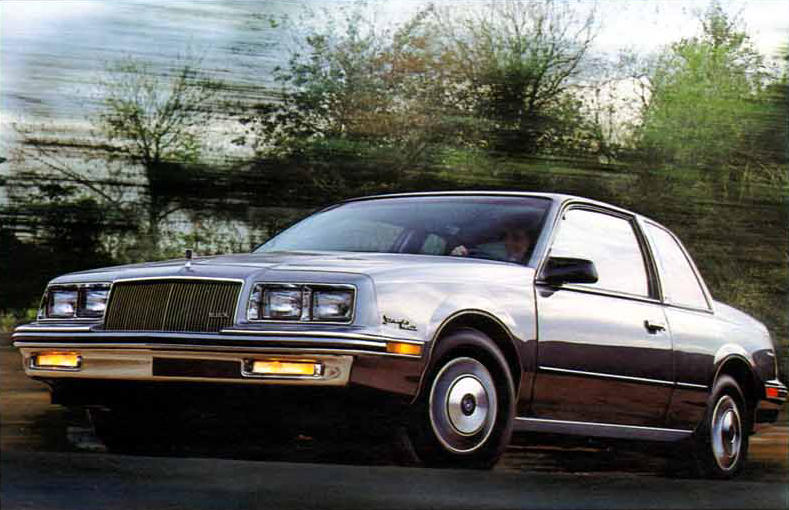
Exterior photo of Somerset Regal from 1985 Buick brochure
Exterior photo of the Somerset Regal from the 1985 Buick brochure

The Somerset Regal was not a big car by today’s standards. With 180 inches of length and a 103.4-inch wheelbase, it is within shouting distance of a 2025 Honda Civic sedan, which is 184.8 inches long and has a 107.7-inch wheelbase. Of course, cars, in general, have gotten a lot bigger in these thirty years—the Somerset Regal was notably more substantial than the 1985 Honda Accord.

The standard powertrain was a Tech IV 92 bhp 2.5 liter/151 ci inline four with throttle body fuel injection (a slightly upgraded Iron Duke) paired with a five-speed manual transmission, but I believe most buyers went with the optional ($425) three-speed automatic instead. The hot set-up (if you could call it that) was the optional ($560) LN7 125 bhp 3.0 liter/181 ci multi-port fuel-injected V6, available only with the automatic. 0-60 times ranged from 11 to 13 seconds.

Mileage for the inline four and five-speed manual combination was an impressive 24 city/34 highway by the day’s standards (21/31 by 2025 measures). Choosing the more realistic three-speed automatic cost two mpg, while upgrading to the V6 dropped you all the way down to 20 city/26 highway. With a 13.6-gallon gas tank, owners of the most profligate powertrain combination could expect a range of between 255 and 280 miles with a 10% fuel reserve.

Interior of the Somerset Regal brochure from the 1985 Buick brochure
Interior of the Somerset Regal from the 1985 Buick brochure

For the Somerset Regal’s $8,857 base price (about $27,300 in today’s dollars), standard equipment included power brakes, power steering, tungsten-halogen headlights, and body-colored bumpers. The interior included cloth or vinyl bucket seats, a center console, brushed metal accents, electronic digital instrumentation (somewhat upmarket at the time), and an AM radio. Moving up to the Limited trim added dual horns, chrome bumpers, and courtesy lamps, along with snazzier cloth seats and an upmarket steering wheel.

Standard features that date the Somerset Regal included the Delco Freedom II Plus battery, front and rear ashtrays in the console, and the P185/80R13 tires (now considered a trailer size) on 13-inch wheels.

Options

Options included the $645 air conditioning (in the mid-1980s not yet standard on most cars), cruise control ($175), leather seats ($275 and only available with the Limited), power door locks ($130), power windows ($195), Vista-Vent sunroof, Delco GM/Bose Music System AM/FM stereo cassette ($995!), cast-aluminum wheels ($229), and a Gran Touring suspension ($27).

The View From 2025

Badge for 2,500 web hits

These Somerset Regals are now almost completely gone. Bring a Trailer did sell a very rare 1986 Somerset T-Type (Buick removed the Regal part of the name after only one year) in mid-2023. I haven’t seen one in the Hemmings Motor News classifieds or on eBay Motors in several years.

Make mine Medium Blue Metallic, please.

I have also written about the 1985 Pontiac Grand Am coupe, which had a lot more success. Other smaller front wheel drive Buicks I have written about include the 1983 Skylark T TYPE coupe and the 1984 Skyhawk coupe.

Last updated in January 2026.

1980 AMC Eagle station wagon

This post was one of the first I wrote for this blog. Substantially revised and updated, it’s now also about twice as long.

“The Eagle has landed … on all fours!”

Essentially (and brilliantly) an AMC Concord with 4-wheel drive, the 1980 Eagle was available in all of the Concord’s body styles, so buyers had a choice between the 2-door sedan, the 4-door sedan, and the 4-door station wagon. The Eagle had a 3-inch taller ride height than the Concord and came with a stone/gravel deflector under the front bumper and 3-inch wide fender flares.

The Eagle came standard with AMC’s 110 bhp 4.2 liter/258 ci inline six with a two-barrel carburetor. A three-speed automatic was the only transmission available to help move the a vehicle with a 3,740-pound curb weight. Car and Driver recorded a 0-60 time of 13.2 seconds. Fuel economy ratings were 16 city/19 highway by the day’s standards. With a 22-gallon gas tank, an Eagle owner could expect a range of 285 to 310 miles with a 10% fuel reserve.

Station wagon page from the 1980 AMC Eagle brochure

The AMC Eagle station wagon’s base price was $7,549—about $32,600 in 2025 dollars or a little over what a 2025 Dodge Hornet GT AWD goes for. Standard exterior and mechanical equipment included pinstriping, power assisted recirculating ball steering, power front disk/rear drum brakes, and P195/75R15 glass belted radial white sidewall tires on 15-inch pressed steel wheels with styled wheel covers. Inside, individual reclining front seats in Sport vinyl, a folding rear seatback, cargo area carpeting and skid strips, and an electronic digital quartz clock were included.

Moving to the Limited trim level (an extra $400 or so) added individual reclining front seats in Chelsea leather or St. Lauren deep plush fabric, a Luxury woodgrain tilt steering wheel, power door locks, an AM radio, and a lockable cargo area storage compartment. The Limited also included Light Group, Visibility Group, Convenience Group, and Protection Group.

One Package, Individual Options, & Production Numbers

Only available with the 2-door sedan and the station wagon, the Sport Package ($299) included high beam halogen headlamps, Sport fog lamps, dual black remote mirrors, and P195/75R15 Goodyear Tiempo steel belted radial black sidewall tires. Inside, Durham Plaid fabric seat trim and a leather-wrapped steering wheel were added. Body pinstriping was deleted, and AMC blacked out everything they could think of—the bumpers (adding nerf strips), the grill, the windshield, the door frames, the lower body moldings (adding 4×4 graphics), the B pillar, the rear liftgate, and the rear taillamp assembly.

Individual options included tinted glass for all windows ($63), air conditioning ($513), cruise control, an electric rear window defroster ($89), and power windows combined with power door locks ($289). Wagon-specific options included woodgrain bodyside panels, a roof rack ($90), and a rear window wiper/washer. An AM/FM multiplex stereo radio was $236.

The Eagle was a significant hit for AMC in 1980, selling over 46,000 units, with the station wagon configuration selling about 56% of that total. AMC would sell them through the 1988 model year for a total of almost 200,000 built.

The View From 2025

AMC Eagles show up with some consistency in the Hemmings Motor News classifieds, on eBay Motors, and on Bring a Trailer. As I update this blog entry in October 2025, there are no 1980 Eagles, but there is a White 1984 station wagon with 141,000 miles for sale on Hemmings, asking $11,900.

Make mine Russet Metallic, please.

Other AMC/Jeep products I have written about include the 1982 Jeep CJ-8 Scrambler pickup truck, the 1983 Jeep Wagoneer Limited SUV, and the 1983 Renault Alliance sedan.

Last updated October 2025