1986 Hyundai Excel hatchback coupe

“The good-looking car at the great-looking price.”

Hyundai was new to the United States in 1986, and the first product they sold was the Excel, available in hatchback coupe, hatchback sedan, and sedan versions.

The Excel L‘s standard powertrain was a 4G15 68 bhp 1.5 liter/90 ci inline four with a carburetor paired with a four-speed manual. The GL and GLS upmarket trims included a five-speed manual and had a three-speed automatic available as an option. Whichever transmission was chosen, the Excel was not exactly fast: Car and Driver reported a 0-60 time of just over 16 seconds.

Fuel economy by 1986 standards was 28 city/31 highway with the four-speed manual—24/28 by current measures. Predictably, the five-speed manual was better on the highway than the three-speed automatic. With a 10.6-gallon fuel tank on all but the GLS/automatic combination, Excel owners could expect a range of between 235 to 300 miles with a 10% fuel reserve.

Designed by Giorgetto Giugiaro, the Excel’s styling was pleasing, if somewhat anonymous. At the time, some Hyundai executives were concerned that it looked a little too much like the concurrent Izuzu I-Mark/Chevrolet Spectrum—also designed by Giugiaro.

1986 Hyundai Excel advertisement

With a base price of $4,995 (about $14,700 in today’s dollars), the Excel L was the second cheapest car for sale in the United States—the Yugo GV was, of course, the most affordable. One of Hyundai’s strategies was to differentiate with standard equipment compared to the economy car competition. Thus, standard exterior and mechanical equipment included halogen headlamps, an electric rear window defroster, front-wheel drive, rack-and-pinion steering, power front disc/rear drum brakes, and name-brand Goodyear Corsa P155/80R13 all-season tires (a size still available) on 13-inch styled steel wheels. Inside, a lockable glove box, a color-keyed dash, vinyl reclining front bucket seats, and split fold-down rear seats were included.

Moving up to the $5,895 GL added tinted glass, styled steel wheels with hub covers and wheel trim rings, a remote hatch release, dual remote control rearview mirrors, an analog quartz clock, a full center console, cloth/vinyl front bucket seats, and Luxury door trim with cloth inserts.

The top-of-the-line $6,395 GLS included full wheel covers, thicker carpeting, a color-keyed Luxury steering wheel, cloth front bucket seats with driver’s side height and lumbar adjustment, and a Panasonic ETR AM/FM stereo cassette deck with auto-reverse and two speakers.

Options & Production Numbers

Individual options were few—a power sliding sunroof, Goodyear Corsa P175/70R13 all-season tires on aluminum alloy wheels, air conditioning, and a Panasonic ETR AM/FM stereo cassette deck with auto-reverse, Dolby noise reduction, and four speakers. Initial reviews of the Excel were decent and initial sales were quite strong, with 168,882 sold in the 1986 model year.

The View From 2025

The view of the Excel from today is not so kind. The Excel turned out to be notably less reliable than the Yugo and also had significant rust problems—even compared to other mid-1980s economy cars. Hyundai now barely acknowledges the Excel, though it occasionally gets mentioned in press releases. I haven’t seen a first-generation Excel in many years.

Make mine Medium Red Metallic, please.

This post is my first Hyundai article, but one of many on vanished vehicles.

Last updated April 2025.

1982 Chevrolet Camaro Z28 Indy 500 Commemorative Edition hatchback coupe

Every May, the Indianapolis 500 race is a “tentpole” event in the international racing schedule. Since 1911, there have been designated pace cars, with replica versions often sold. A 1982 Chevrolet Camaro Z28 Indy 500 Commemorative Edition with 2,630 miles sold for a $35,000 hammer price at the 2021 Mecum Indy. Are these distinctive and good-looking (I think) cars finally attracting significant interest?

“Even its shadow boasts performance”

The 1982 Chevrolet Camaro could reasonably be described as all-new. This moniker applied to the “pleasing and exciting” exterior, the interior, much of the chassis, and most of the engines. Road & Track stated that the new Camaro was “keenly anticipated.”

The Z28‘s standard powertrain was the LG4 145 bhp 5.0 liter/305 ci V8 with a four-barrel carburetor paired with a four-speed manual transmission. An optional LU5 Cross-Fire 5.0 liter/305 ci V8 with throttle-body fuel injection and 165 bhp set the buyer back $450 and required the $72 three-speed automatic transmission. 0-60 took just under 10 seconds with the base V8 and the four-speed manual, and shortened to 9 seconds with the top-of-the-line Cross-Fire motor and the automatic.

The Z28 had a base price of $9,700—about $33,600 in 2025 dollars. Standard exterior and mechanical equipment on all 1982 Z28s included a front air dam, “ground effect” lower body extensions, a rear spoiler, body-color dual Sport mirrors, power front disc/rear drum brakes, and 215/65R-15 tires (a size still readily available) on 15 x 7 inch 5-spoke aluminum wheels. Inside, every 1982 Z28 came with full instrumentation, an electric quartz analog clock, courtesy lamps, and a leather-wrapped steering wheel.

1982 Camaro Commerative Edition flyer
1982 Camaro Z28 Indy 500 Commemorative Edition flier

Standard equipment specific to the $10,999.26 (yes, that was really the price) Z50 Indy 500 Commemorative Edition included Silver Metallic/Blue two-tone accent paint, red accents on the wheels, specific commemorative edition decals, Custom interior trim, and blue Custom cloth bucket L/S Conteur (Chevrolet’s spelling) front seats.

Options, Production Numbers, & Period Reviews

Among the many options available for the Camaro Z28 were tinted glass ($88), removable glass roof panels ($790!), power windows ($165), a power door lock system ($106), an electric rear window defogger ($125), automatic speed control ($155), air conditioning ($675), a Comfortilt steering wheel ($95), and a host of radios ($111 to $390).

Chevrolet sold 6,360 Indy 500 Commemorative Edition cars in 1982, in addition to 63,563 “normal” Z28s. However, the most popular Camaro was actually the base Sport Coupe, which moved 78,761 units. The somewhat more luxurious Berlinetta sold another 39,744 copies.

Reviews of the new Camaro were decent. Road & Track liked the Z28‘s exterior and the handling, but bemoaned the interior packaging and the fuel mileage (EPA rated at 17 mpg but rarely attaining that in real life). Car and Driver famously accused the Z28 of being “Emily Post polite” but later retracted the remark.

The View From 2025

Third-generation Camaros attract plenty of collector interest, and there is substantial club support. According to Hagerty’s valuation tools, a 1982 Camaro Z28 hatchback coupe with the Cross-Fire motor in #1/Concours condition is $42,000, with a far more normal #3/Good condition version going for $13,500. 1982 Camaro Commemorative Editions are often available in the Hemmings Motor News classifieds, on eBay Motors, and at online (Bring a Trailer) and in-person auctions. As I update this blog entry in October 2025, a Commemorative Edition with the Cross-Fire, an automatic, and 40,000 miles is for sale on Hemmings, asking $20,000.

Other Camaros I have written about include the 1980 Rally Sport coupe, the 1980 Z28 coupe, the 1985 IROC-Z hatchback coupe, and the 1986 Berlinetta hatchback coupe. Pontiac Firebird Trans Ams with blog entries here include the 1981 coupe, the 1982 hatchback coupe, the 1984 15th Anniversary Edition hatchback coupe, the 1985 hatchback coupe, and the 1989 20th Anniversary Turbo hatchback coupe.

Last updated October 2025.

1982 Ford EXP hatchback coupe

“Two-seat excitement in a world class coupe.”

Ford’s EXP two-seat coupe was new for the 1982 model year and introduced early in April 1981. Ford’s first two-seat car since the 1957 Thunderbird, the EXP was designed for a far different purpose. Built on the same platform as the Ford Escort/Mercury Lynx twins and closely related to the Mercury LN7, the EXP was marketed as a car for buyers who wanted an efficient and decently equipped vehicle somewhat sportier than the Escort.

The design language of the EXP resembled that of the contemporary Fox-body Mustang. However, front-wheel-drive and a different platform made the proportions different, which some observers saw as ungainly (or worse). I remember thinking that it was different-looking, but not unattractive.

Ford’s new two-seater was a small car—a length of 170.3 inches makes the EXP more than half a foot shorter than the 2020 Honda Civic coupe. However, the EXP’s length was almost seven inches longer than an Escort hatchback coupe, while its height was over 2.5 inches shorter. Because Ford made the EXP reasonably well-equipped, its weight was about 125 pounds greater than the spare base Escort.

The EXP’s standard powertrain was a CVH 70 bhp 1.6 liter/98 ci inline four with a Motorcraft 740 two-barrel carburetor paired with a four-speed manual. An automatic transmission was optional for $411. EPA fuel economy ratings with the manual were 29 city/46 highway by the day’s standards. With an 11.3-gallon gas tank, an EXP owner could expect a range of 345 to 380 miles with a 10% fuel reserve.

What the EXP wasn’t was anything approaching quick. Figures are hard to find, but the EXP’s 0-60 time was likely about 14.5 seconds. Late in the extended 1982 model year, an HO version of the same engine became available, with 80 bhp. It likely dropped the EXP’s 0-60 time by more than a second, but in this case, HO did not mean fast.

1982 Ford EXP brochure cover

Standard exterior and mechanical equipment on the $7,387 EXP (about $25,200 in today’s dollars) included halogen headlamps, front-wheel-drive, a four-wheel independent suspension, rack and pinion steering, power front disc/rear drum brakes, and P165/80R13 tires (a size now hard to find) on 13-inch Sport styled steel wheels with trim rings. Inside, a Sport steering wheel, reclining high-back front bucket seats, a console, a tachometer, an electronic digital clock, and an AM radio with dual front speakers were included.

Packages, Options, & Production Numbers

The optional TR Performance Suspension Package included special handling tuned suspension components (a thicker stabilizer bar, stiffer shocks, and stiffer springs) and P165/70R 365 Michelin TRX tires (still available!) on a choice of either TR Sport aluminum wheels ($405) or Sport steel wheels ($204).

Exterior and mechanical options included tinted glass (initially $82 but standard later in the model year), a flip-up open air roof ($276), power steering ($190), and cast aluminum wheels ($232). Inside, options included an air conditioner ($611), fingertip speed control ($151), leather/vinyl reclining low back bucket seats ($138), and a few different stereo choices.

First-year sales of the EXP were decent: 98,258 in a model year that extended from April 1981 through September 1982. Following 1982, sales dropped precipitously—only 19,697 for 1983, 23,016 for 1984, 26,462 for 1985, 30,978 for 1986, and 25,888 for the EXP’s final year in 1987.

The View From 2025

I have not seen an EXP on the road in over fifteen years. EXPs rarely show up for sale in the Hemmings Motor News classifieds and on eBay Motors—in fact, they seem to have virtually vanished. Because Bring a Trailer is … Bring a Trailer, they have sold one EXP.

Make mine Bright Red, please.

I have previously written about the 1981 Escort hatchback coupe and the 1987 Mercury Lynx XR3 hatchback coupe. Perhaps someday I shall write about the short-lived Mercury LN7.

Last updated March 2025.

1987 Volvo 780 coupe

“The kind of Volvo you design when you’ve been designing Ferraris, Lamborghinis and Maseratis all your life.”

Designed and produced by Bertone and primarily based on the 760 sedan, the 780 was Volvo’s second attempt at a stylish coupe. The first was also a Bertone creation—the 262C built from 1977 through 1981. Beyond the handsome exterior, the interior was also specific to the 780—not merely a slightly re-purposed 760 design. Among the significant changes from the 760’s interior were a move from five seats to four, with individually-shaped seats for those in the rear.

The 780 used its design and a notably high standard equipment level as differentiators as Volvo attempted to move into higher-end markets. The 780’s base price was $34,785—about $81,700 in today’s dollars, which is well more than any Volvo vehicle’s sticker price in 2020. Back in 1987, the 780’s real competition was unclear. Was it the Acura Legend (also in its first year but much less expensive), the BMW 6-series (much more expensive), the Lincoln Mark VII (far less expensive—at least until many options were added), or some other car?

For 1987, the only powertrain available was the B280F 146 bhp 2.8 liter/174 ci V6 with Bosch LH-Jetronic fuel injection paired with a four-speed automatic transmission. 0-60 mph times were in the 11 second range—Volvo did not intend the 780 to be a sports coupe. Mileage in the 3,415-pound car was rated at 17 city/21 highway by the standards of the day (15/20 by today’s standards). With a relatively small 15.9-gallon fuel tank, 780 drivers could expect 250 to 270 miles of range with a 10% reserve.

1987 Volvo 780 advertisement

Standard exterior equipment for the 780 included tinted glass, a power moonroof with a sliding sunshade, dual power mirrors with a heating element, flush-lens halogen headlamps, front and rear fog lamps, and the Bertone name and logo on both C pillars. Mechanical features included power steering, four-wheel vented power disc brakes with ABS, and 205/60R15 tires (a size still readily available) on 15 x 6 inch 15-spoke alloy wheels.

Inside, the 780 came loaded, with full instrumentation including a tachometer, a power central locking system, power windows, automatic climate control, cruise control, and a driver’s side airbag. Upholstery highlights included heated eight-way power leather front bucket seats and beach burl wood trim. The standard stereo was an AM/FM ETR stereo cassette with a seven-band graphic equalizer, four speakers, a 200-watt amplifier, and a power antenna.

Volvo did not sell a lot of 780’s—but I don’t believe they expected to. Only 9,215 (other sources say 8,518) were produced over six years of production, with about 61% of those going to the United States market. There’s an enthusiast site at 780coupe.com, and folks do collect 780’s. You also sometimes see them in the Hemmings Motor News classifieds and on eBay Motors.

Make mine Blue Metallic, please.

This post is the first on a Volvo in Eighties Cars. There will be others—I definitely expect to get to the 240 wagon at some point.

1983 Renault Alliance sedan

A girlfriend of mine owned a light blue Renault Alliance, which she named “Pierre.”

“Driver appeal and room for five.”

Renault’s Alliance sedan debuted in 1983. Based on the Renault 9 and 11, the Alliance was re-engineered for the North American market and built in AMC’s Kenosha, WI assembly plant—the first front-wheel-drive car built there. The Alliance was available in four-door sedan and two-door coupe versions.

The Alliance’s only engine was Renault’s Cléon-Fonte 64 bhp 1.4 liter/85 ci inline four with Bendix central fuel injection, already over two decades old in its basic design. Transmissions for the sedan varied depending on equipment level; the L (there was no absolutely base sedan—only a coupe) came standard with a four-speed manual, while the better-equipped DL and Limited came with a five-speed manual. All three models could be ordered with an automatic ($420 for an L/$325 for others).

Despite a curb weight of around 2,000 pounds, the Alliance was not a fast car. 0-60 times ranged between 14 and 18 seconds, depending on transmission. On the other hand, fuel mileage ratings were impressive: the four-speed manual returned 37 city/54 highway by the day’s standards. Of course, applying modern standards lowers the numbers, but what would now be 29 city/37 highway still isn’t that bad. Interestingly, the five-speed manual didn’t do any better, despite the extra gear (it did help a little bit with acceleration and lowered noise at highway speeds). Even the automatic was reasonably efficient at 29 city/38 highway. With a 12.4-gallon gas tank, a new Alliance owner could expect a range of between 410 and 455 miles with a 10% fuel reserve.

1983 Renault Alliance advertisement

The Alliance L‘s base price was $6,270—about $20,700 in today’s dollars or almost exactly what a 2025 Nissan Versa SV sedan goes for. Standard mechanical equipment included front-wheel-drive, rack-and-pinion steering, power-assisted front disc/rear drum brakes, and 155/80GR13 tires (a size still available thanks to Kumho) on 13-inch wheels. Inside, vinyl bucket seats, a soft-feel steering wheel, a day/night mirror, and a trip odometer were included.

Moving up to the $6,905 DL added tinted glass, a dual-note horn, and 175/70SR13 tires (still readily available) with wheel trim rings. Inside, DL buyers got Deluxe six-way cloth reclining bucket seats, a color-keyed remote left mirror, a soft-hub steering wheel, a tachometer, and a digital clock.

The top-of-the-line Limited ($7,470) included halogen headlamps and Luxury wheel covers. Inside, Light Group, Visibility Group (dual remote mirrors, lighted visor mirror, and intermittent wipers), textured cloth reclining bucket seats, a rear center armrest, and luxury door panels were included.

Individual Options & Period Reviews

Individual exterior and mechanical options for the Alliance included two-tone paint ($199) and power steering ($199). Inside, power door locks ($170), speed control ($170), rear defroster ($130), air conditioning ($630), and a variety of radios were available. Leather bucket seats were available for the Limited only and set the buyer back $413.

Early on, the Alliance received many good reviews—in fact, it was Motor Trend‘s Car of the Year for 1983. Obtaining this particular plaudit led Renault to (really!) build an MT special edition for the Alliance late in the model year. MT-specific equipment included charcoal gray metallic paint, a decklid luggage rack, painted aluminum wheels, and a right-hand remote mirror. Inside, a leather-wrapped steering wheel and an electronic-tuning stereo radio with six speakers were included.

Those initial positive reviews of the Alliance have not aged well, and many disparaging articles have been written about MT‘s choice. They were not alone—Car and Driver included the Alliance on their 1983 “10 Best” list (26 years later they apologized). Perhaps reviewers of the day wanted the idea of the Alliance to work so much that it clouded their judgment of the actual product delivered.

The View From 2025

I have not seen an Alliance in well over a decade. Alliances rarely appear for sale in the Hemmings Motor News classifieds and on eBay Motors—in fact, they seem to have virtually vanished, despite the 623,573 made between the 1983 and 1987 model years. Bring a Trailer has sold a grand total of four in ten years.

Make mine Diamond Blue Metallic Clearcoat, please.

Another Renault I have written about is the 1982 Fuego hatchback coupe. I’ve also covered the 1980 AMC Eagle station wagon, the 1982 Jeep CJ-8 Scrambler pickup truck, and the 1983 Jeep Wagoneer Limited SUV.

Last updated October 2025.

1980 Cadillac Seville sedan

“Introducing Seville for the 80’s”

For 1980, the Cadillac Seville sedan could justifiably be called all-new. It switched from rear-wheel-drive to front-wheel-drive, used a completely different platform, and made a diesel engine standard.

Of course, the Seville’s exterior look was also completely changed. That styling—by Wayne Cady under Bill Mitchell’s direction—was instantly polarizing; words used in period reviews included striking, astonishing, controversial, and odd. Despite my pre-teen bent toward classically influenced cars, I did not like the new Seville’s design. Perhaps this was because I really liked the styling of the first-generation Seville.

The 1980 Seville’s standard engine was an LF9 105 bhp 5.7 liter/350 ci diesel V8. An L61 145 bhp 6.0 liter/368 ci V8 with fuel injection was a no-cost option. In California, the gasoline engine choice was a 5.7 liter/350 ci V8 with fuel injection.

As might be expected, fuel mileage ratings for the standard diesel were impressive, especially for a car with a 3,911 shipping weight. A Seville owner could expect 21 city/31 highway. With a 23-gallon gas tank, the range was an astounding 540 miles with a 10% fuel reserve—at least in theory. What wasn’t impressive was the Seville’s performance; Road & Track clocked a 0-60 mph time of 21 seconds.

The story was different but not necessarily better with the gas engine. With it, mileage was 14 city/22 highway, so the predicted range dropped to about 375 miles. Performance was notably better, but still not good with the 0-60 time at about 13 seconds.

Standard exterior and mechanical equipment on the $19,662 Seville (about $83,400 in 2025 dollars) included Soft-Ray glass, tungsten-halogen headlamps, a four-wheel independent suspension, electronic level control, four-wheel disc brakes, and P205/75R15 tires (a size still readily available) on 15-inch wheels. Inside, 50/45 Dual Comfort front seats, electronic climate control, and a tilt and telescope steering wheel were included.

Seville Elegante brochure page
Seville Elegante page from the 1980 Cadillac brochure

The $2,934 Elegante package included two-tone paint and 40/40 leather seats. Chrome-plated wire wheel covers were available at no extra cost.

Options included an Astroroof ($1,058), automatic door locks ($129), the Cadillac trip computer ($920), and an AM/FM stereo cassette ($225).

Famously, the Cadillac with the Deadhead sticker that passes Don Henley when he sings about “The Boys of Summer” was a second-generation Seville—likely a 1980 or a 1981.

The View From 2025

According to Hagerty’s valuation tools, all the money for a 1980 Cadillac Seville Elegante with the gas engine (they don’t list values for the diesel) in #1/Concours condition is $23,800, with a more normal #3/Good condition car going for $4,700.

Second-generation Cadillac Sevilles are often available in the Hemmings Motor News classifieds, on eBay Motors, and at online (Bring a Trailer) and in-person auctions. As I write this post, a Woodland Haze 1983 Seville with a Dark Briar Brown interior and 66,000 miles is for sale on Hemmings for $10,000.

Make mine an Elegante in its Sable Black/Sheffield Gray Firemist two-tone, please. Over time, the second-generation styling has grown on me—especially with two-tone paint. Mecum sold a striking Seaspray Green/Neptune Aqua two-tone at their Harrisburg auction in 2019.

Other eighties Cadillacs I have covered include the 1982 Eldorado Touring Coupe, the 1986 Eldorado coupe, the 1986 Fleetwood Brougham sedan, the 1988 Eldorado coupe, the 1989 Allanté convertible, and the 1989 Cadillac Sedan deVille.

Last updated March 2025.

1982 Renault Fuego hatchback coupe

A friend of mine mentioned recently that he once owned an early Renault Fuego Turbo. As good a reason as any to finally complete this blog post—one I’ve had “in the hopper” for years.

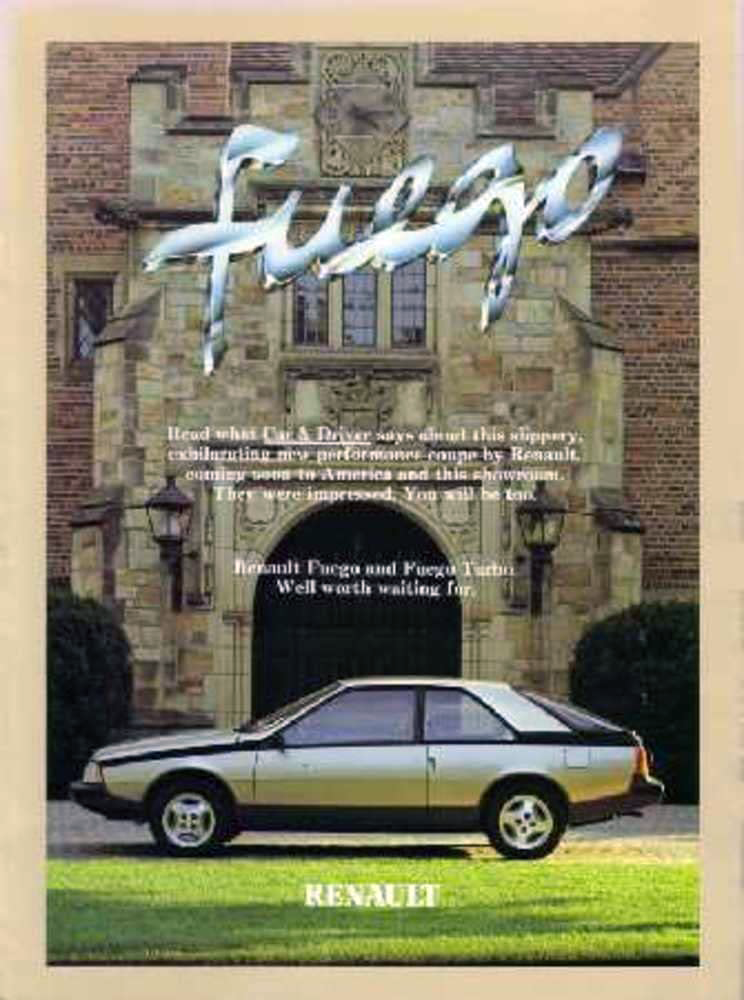
After some sales success in Europe, Renault’s Fuego hatchback coupe became available for sale in the United States in 1982. Based on the Renault 18 sedan and using its floorpan and drivetrain, the Fuego was a different approach to a sporty coupe from what most manufacturers offered in the early eighties. Designed by Michel Jardin, the Fuego’s exterior looked like nothing else on the market, though some saw faint echos of the Porsche 924 and 928.

Two versions of the Fuego were available on its debut in the USA: the base Fuego coupe and the line-leading Fuego Turbo. The coupe came with an 81 bhp 1.6 liter/101 ci inline four with Bosch L-Jetronic fuel injection mated with a five-speed manual transmission. The Turbo featured an A5L 107 bhp 1.6 liter/96 ci inline four with Bosch L-Jetronic fuel injection and a Garrett T3 turbocharger paired with the same five-speed transmission.

As one might expect, performance was notably different for the two models. With a 2,372-pound curb weight, owners of a new Fuego Turbo could expect a 0-60 time of little over 10 seconds. A base Fuego was about 3.5 seconds slower, putting it in the same category as other slow sporty coupes for 1982, such as Lima-powered Mustangs and Capris and Iron Duke-powered Camaros and Firebirds. Mileage ratings were impressive for either version—the Turbo registered 26 city/39 highway mileage rating by the standards of the day. With a 14.8-gallon fuel, a Fuego Turbo owner could expect a range of 390 to 435 miles with a 10% fuel reserve.

1982 Renault Fuego advertisement

Standard equipment for the $8,654 base Fuego included front-wheel-drive, rack-and-pinion steering, front disc/rear drum brakes, and P185/70R13 tires on 13-inch wheels.

Standard equipment on the $10,704 Fuego Turbo included power rack-and-pinion steering, 190/65 HR 365 (metric) Michelin TRX radial tires on 14.4-inch cast alloy wheels, air conditioning, and an AM/FM stereo. An electric sunroof was a $400 option.

Despite their success in Europe, Fuegos did not sell well in North America, which was Renault’s evident lot in life. Peak sales of 33,229 in 1982 declined every year going forward—by 1986, the Fuego’s last year in the US, they were a mere 4,152.

Those who did buy a Fuego reported that they were generally happy with their choice. A January 1983 Popular Mechanics Owner’s Report found that owners liked the handling and styling, but wanted more power.

According to Hagerty’s valuation tools, all the money for a 1982 Renault Fuego in #1/Concours condition is $5,400, with a more typical #3/Good condition example going for $1,700. For unclear reasons, Hagerty only has values for the base version and not the Turbo. Fuegos rarely show up for sale in the Hemmings Motor News classifieds and on eBay Motors—in fact, they seem to have basically vanished. There was an interesting write-up on the Fuego in OldMotors last year.

Make mine Silver Poly, please.

This post is another first—my first Renault. I should probably cover the Alliance I spent a portion of the early nineties in sometime soon …

1984 Plymouth Voyager van

1984 Plymouth Voyager on the National Mall
1984 Plymouth Voyager on the National Mall, courtesy of the HVA

In spring 2018, the Historic Vehicle Association placed a series of five notable vehicles in a glass case on the National Mall in Washington, DC. One of those vehicles was a 1984 Plymouth Voyager Limited Edition minivan—highly original, and with a mere 12,000 miles.

“The Magic Wagon.”

Few eighties vehicles changed the world as much as the Dodge Caravan/Plymouth Voyager twins—because few automobiles essentially create a new market segment. The essential glory of K-platform minivans was their splitting of the packaging differences between traditional station wagons and full-size vans, along with their utilization of front-wheel-drive. Astoundingly, Allpar writes that Chrysler had been working on the same basic idea since around 1972. A reason given that those early designs were not brought to market was that General Motors and Ford had not released their own versions. It took Lee Iaccoca’s arrival in late 1978 to finally get upper management support for the T-115 concept.

The Voyager’s standard powertrain was an 84 bhp 2.2 liter/135 ci inline four with a two-barrel carburetor paired with a five-speed manual. Powertrain options included a $439 three-speed automatic and a $259 105 bhp 2.6 liter/156 ci inline four with a two-barrel carburetor (which required the automatic).

For a mainstream vehicle in 1984, the Voyager came respectably equipped. Standard exterior and mechanical equipment ($8,290 or about $26,200 in today’s dollars) included tinted glass for all windows, a right hand sliding door with a vented window, quad halogen headlamps, power rack and pinion steering, and P185/75R14 blackwall tires on 14-inch wheels with bright wheel covers. Inside, a left hand remote control mirror, two-speed windshield wipers, cloth low back front bucket seats, a three-passenger rear seat, full-floor carpeting, and an AM ETR radio with a digital clock were included.

Packages, Options & Production Numbers

Moving up to the S.E./Special Edition package ($227) added black exterior window trim, black lower body paint, road styled wheels with bright centers and trim rings, and Deluxe cloth low back front bucket seats.

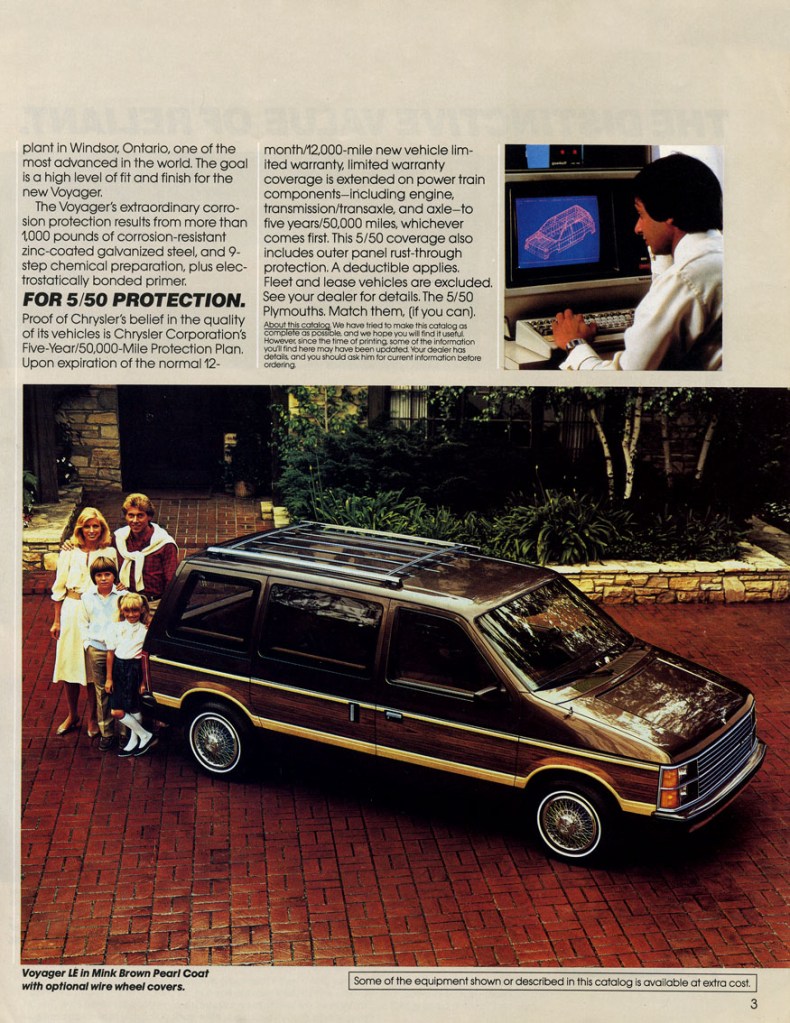
Page from the 1984 Plymouth Voyager brochure
L.E. page from the 1984 Plymouth Voyager brochure

The top-of-the-line L.E./Limited Edition package ($815) included everything from the S.E. package and added woodgrain exterior vinyl bodyside panels, dual horns, a Luxury steering wheel, and Luxury cloth high back front bucket seats with recliners.

Individual options included premium wheel covers ($203), a 20-gallon fuel tank ($43), air conditioning ($737), automatic speed control ($179), a rear window defroster ($143), power door locks ($176), and an AM/FM stereo with a cassette player ($389). A Seven-Passenger Seating Package ($336) was available with either the S.E. or the L.E.—that was Chrysler’s nomenclature for adding a third-row seat.

Of course, the Chrysler minivan twins were a huge success, with 209,895 sold in their initial model year. They also received good to great reviews from the automotive press—Car and Driver included them in their 1985 10Best Cars.

Ford and General Motors had notable trouble in responding. Both had competitors (Chevrolet Astro, Ford Aerostar, GMC Safari) in place by the 1986 model year, but the market found them wanting—in part because they were rear-wheel-drive. The first real competition for Chrysler did not come until the mid-nineties when Honda debuted the front-wheel-drive Odyssey.

The View From 2025

Despite their importance, just a few folks out there collect these minivans—though I did spot one at a car show several years ago. Chrysler minivans of this era rarely show up for sale in the Hemmings Motor News classifieds, on eBay Motors, or on Bring a Trailer—in fact, they now are seldom for sale anywhere.

Make mine Gunmetal Blue Pearl Coat, please.

Last updated April 2025.

1984 Maserati Biturbo coupe

After over six years of writing, this is the first Maserati to be featured in Eighties Cars.

“Formula One Performance in a Grand Touring Masterpiece”

After two years of European production, 1984 was the first model year that Maserati’s Pierangelo Andreani-styled Biturbo coupe was available in the United States. The Biturbo was a complete change of pace for Maserati, essentially designed to be an Italian-flavored BMW 3 series competitor.

Of course, the Biturbo was famous for—and named for—it’s engine, the first production twin-turbocharged powerplant in the world. For 1984’s move to the US market, displacement of the V6 was increased to 2.5 liters/152 cubic inches, which resulted in 192 bhp. Unsurprisingly for the era, a Weber two-barrel carburetor fed the fuel/air mixture. The only transmission available for 1984 was a five-speed manual.

page from 1984 maserati Biturbo brochure
Page from the 1984 Maserati Biturbo brochure

Maserati’s four-page brochure claimed a top speed of 130 mph and a 0-60 time of 6.9 seconds in the 2,650-pound Biturbo (quick in 1984), and period road tests came reasonably close to those figures. Fuel economy was less impressive—rated at 15 city/25 highway by the standards of the day (12/18 by today’s standards). With a sizeable 21.2-gallon gas tank, a Biturbo owner could expect a range of between 285 and 380 miles with a 10% fuel reserve.

Standard equipment on the $26,874 Biturbo (about $68,200 in today’s dollars or about what a 2020 Ghibli sedan costs) included a four-wheel independent suspension, rack and pinion steering, four-wheel power disc brakes, and Pirelli P6 195/60HR14 tires (a size still readily available) on 14 x 5.5 inch magnesium alloy wheels. The luxurious interior design was highly acclaimed at the time and remains attractive even to this day.

Initially, the Biturbo sold reasonably well in North America, aided by positive reviews—Popular Mechanics called it “the Clark Kent of cars.” However, a reputation for both engine unreliability (related to the blow-through carburetor/turbo combination) and spotty build quality quickly took its toll, and by 1985 many coupes sat on dealer lots. Decades later, this notoriety would end up landing the 1984 Biturbo on Time magazine’s The 50 Worst Cars of All Time list, where it joined other notably failed cars such as the 1982 Cadillac Cimarron. As always, as with any vehicle, there are different opinions.

According to Hagerty’s valuation tools, all the money for a 1984 Biturbo coupe in #1/Concours condition is currently $8,400, with a more normal #3/Good condition car going for a mere $3,200. These Biturbos sometimes show up for sale in the Hemmings Motor News classifieds and on eBay Motors, but are often in at least somewhat sketchy condition. Make mine Bordeaux, please.

1981 Datsun 810 Maxima sedan

“For the luxury minded who long to be Datsun driven.”

1981 brought the nicest Datsun yet for America, in the form of the 810 Maxima sedan. Datsun aimed high, advertising the Maxima as having the “luxury of a Mercedes” and the “sophistication of a Cadillac.” Nissan was in the process of transitioning away from the Datsun name, so the Maxima‘s official name was a clunky “Datsun 810 Maxima by Nissan.”

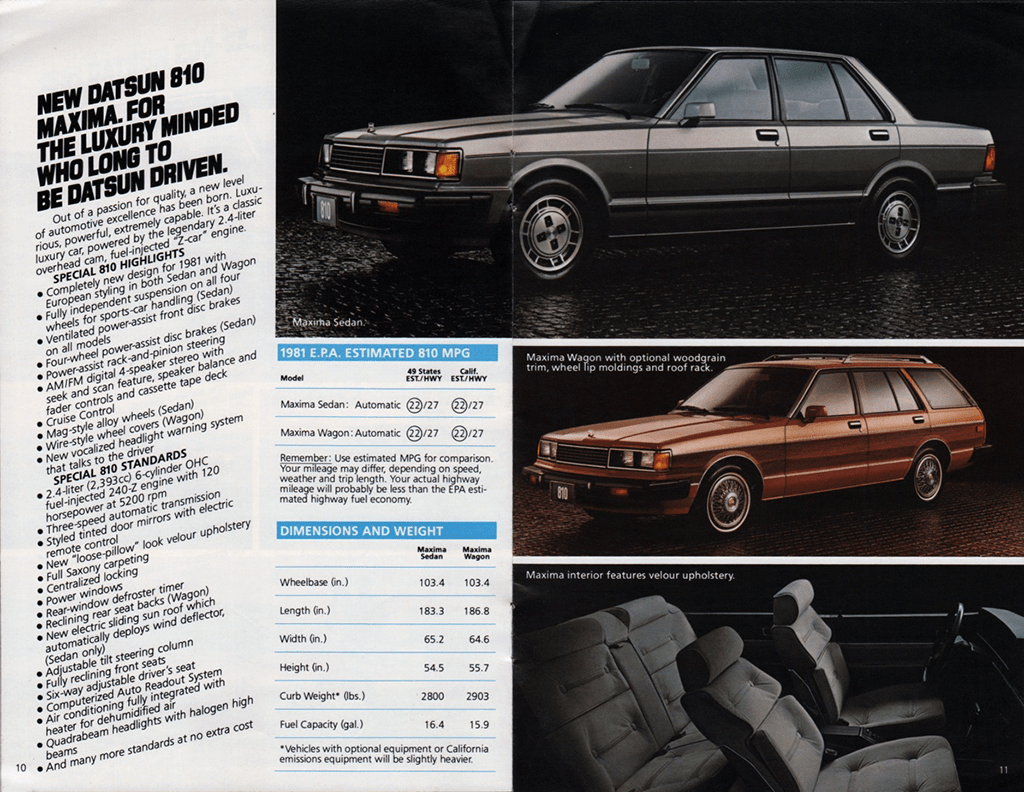
The only powertrain initially available for the Maxima was the L24E 118 bhp 2.4 liter/146 ci inline six with Bosch L-Jetronic fuel injection paired with a three-speed automatic. Luxury did not mean quick in 1981—Car and Driver recorded a 0-60 time of 10.5 seconds in a car with a 2,880-pound curb weight. EPA fuel economy ratings were 22 city/27 highway—with a 16.4-gallon gas tank, a Maxima owner could expect a range of 295 to 325 miles with a 10% fuel reserve. In the middle of the model year, the LD28 90 bhp 2.8 liter/170 ci diesel engine became available, with an impressive 28 city/35 highway rating,

Despite being the top of Datsun’s sedan line and “the roomiest and most comfortable Datsun ever created” to that point, the Maxima was not a particularly large car. With a 183.3 inch length, it was less than half an inch longer than today’s Nissan Sentra, which is classified as a compact car. In advertisements, Datsun stated that the Maxima was “about the size of a BMW 528i at less than half the price.” Both of these claims were true, but the Maxima was not yet a “4-Door Sports Car.”

810 Maxima pages from the 1981 Datsun brochure

Standard exterior equipment on the $10,879 1981 Maxima (about $41,400 in 2025 dollars or almost 25% more than a 2025 Nissan Altima SL sedan costs) included an electric sliding sun roof and Quadrabeam headlights with halogen high beams. Mechanical equipment included a fully independent suspension, power-assisted rack-and-pinion steering, four-wheel power-assisted disc brakes, and 185/70SR14 tires (a size still readily available) on 14-inch “mag-style” alloy wheels. Inside, centralized locking, power controls, a tilt steering column, cruise control, and an AM/FM digital four-speaker stereo with a cassette player were included. Standard upholstery included “loose-pillow” velour seats, fully reclining front seats, a six-way adjustable driver’s seat, and full Saxony carpeting. Famously, an early version of the vocalized warning system warned a Maxima‘s driver when the headlights were on.

There were few, if any, options available for the 1981 Maxima sedan. Reviews of the day generally liked the new car’s exterior styling, but the “buff books” complained that the Maxima was only available with a three-speed automatic and velour upholstery. Car and Driver‘s write-up in April 1981 stated: “What we have here seems to be a clear case of over-Americanization.”

The View From 2025

It isn’t that surprising that Hagerty’s valuation tools do not track any eighties Datsuns other than the Z-cars. Eighties Maximas rarely show up in the Hemming’s Motor News classifieds or on eBay Motors. Bring a Trailer has sold a grand total of one 1981 Maxima—which was a diesel.

Make mine Medium Gray Metallic, please.

I have also written about the much sportier 1989 Nissan Maxima sedan.

Last updated August 2025.