For 1989, Ford introduced a high-performance version of its Taurus family car, which Dearborn designated as the SHO.
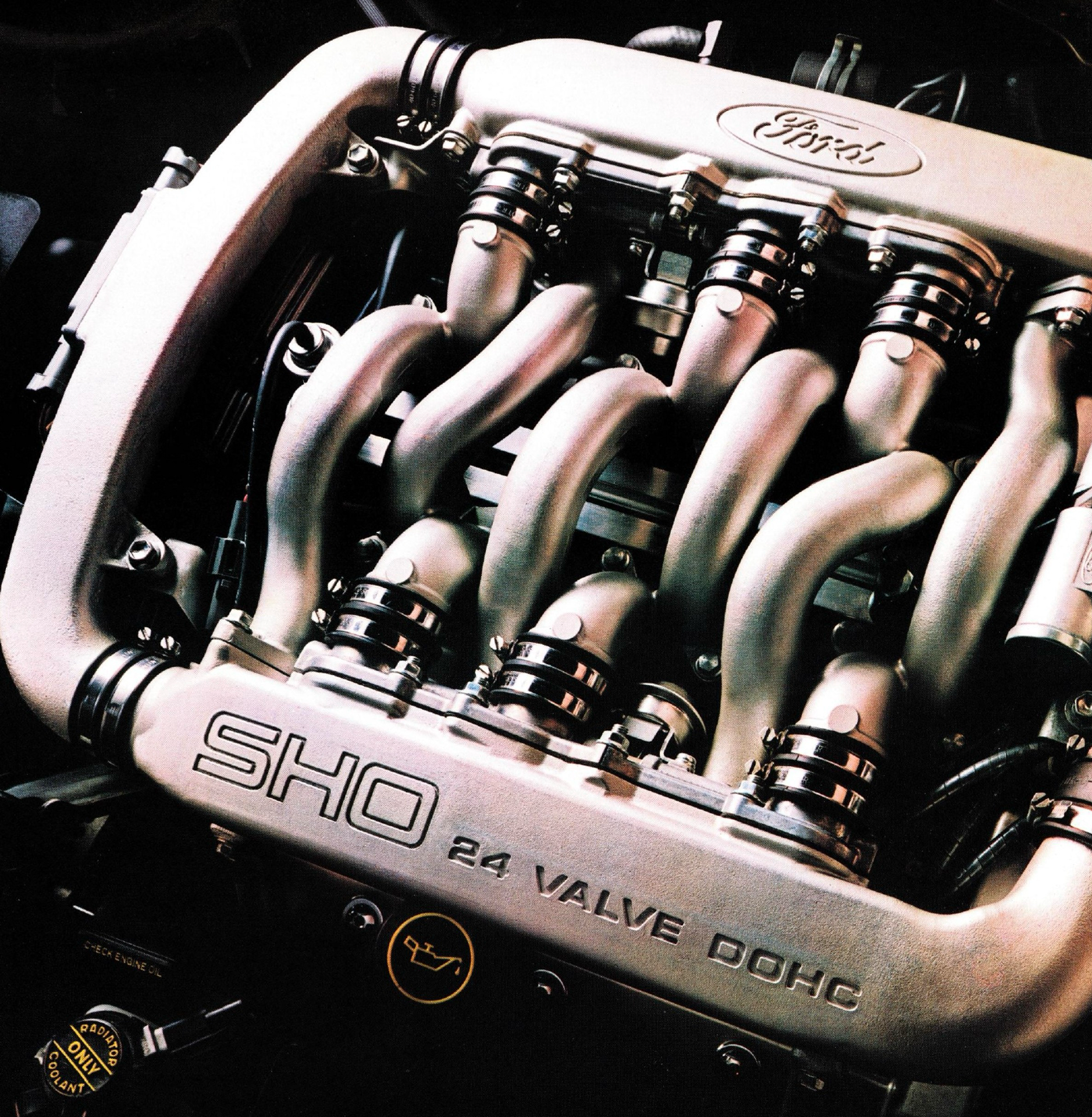
SHO engine photo from the 1989 Ford Taurus brochure
The centerpiece of the SHO was its engine. Designed and built by Yamaha, it was a 220 bhp Super High Output 3.0 liter/181 ci V6 with four valves per cylinder and sequential multiport electronic fuel injection. A five-speed manual was the only transmission initially available with the SHO. Car and Driver recorded a 0-60 time of 6.7 seconds and a top speed of 143 mph—astoundingly fast for a mainstream sedan in 1989. Mileage ratings were 18 city/26 highway by the day’s standard (16/24 by today’s measures). With an 18.6-gallon gas tank, a SHO‘s proud new owner could expect a range of between 335 and 365 miles with a 10% fuel reserve.
The 1989 Taurus SHO sedan’s base price was $19,739—about $53,400 in today’s dollars. Standard exterior and mechanical equipment included fog lamps, cornering lamps, a handling suspension, 4-wheel disc brakes, and P215/65VR15 black sidewall tires (a size still somewhat available) on 15-inch cast aluminum wheels. Inside, reclining cloth front bucket seats, a 6-way power driver seat adjustment, a center console, a leather-wrapped steering wheel, manual control air conditioning, power side windows, and power door locks were included.
One Package, Individual Options, & Period Reviews
Preferred equipment package 211A ($533) included an autolamp system, an illuminated entry system, and the High-Level Audio System.
Individual options included a power moonroof ($741), a keyless entry system ($137), electronic climate control air conditioning ($183), front bucket seats with leather seating surfaces ($489), a 6-way power passenger seat adjustment ($261), and a rear window defroster ($150).
Period reviews were extremely positive, and often seemed somewhat stunned by what Ford and Yamaha had achieved. Road & Track called the SHO “one of the great surprises for 1989” and, astoundingly, beat Car and Driver‘s 0-60 time by a tenth of a second. As for Car and Driver, their December 1988 issue called the 1989 SHO a “breakthrough car” and compared it to the 1964 Ford Mustang and the 1970 Datsun 240Z. MotorWeek was also enthusiastic.
The View From 2026
According to Hagerty’s valuation tools, a 1989 Taurus SHO in #1/Concours condition is $21,100, while a far more typical #3/Good car goes for $6,900. SHOs of this age come up for sale regularly in the Hemmings Motor News classifieds, on eBay Motors, and Bring a Trailer, so folks are saving them.
Make mine Light Titanium Clearcoat Metallic, please. There were only four exterior colors available with the 1989 SHO, and only one interior color (Titanium).
Ford’s Thunderbird personal luxury coupe was all new for 1989. The twelfth-generation ‘Bird was code-named MN12 and cost over a billion dollars to develop.
The standard Thunderbird’s powertrain was an Essex 140 bhp 3.8 liter/232 ci V6 with electronic sequential multi-port fuel injection paired with an automatic overdrive transmission. The Super Coupe‘s powertrain was an Essex 210 bhp 3.8 liter/232 ci V6 with a supercharger, an intercooler, and electronic sequential multi-port fuel injection paired with a 5-speed manual transmission. The automatic overdrive transmission was an option for the Super Coupe.
Page from the 1989 Ford Thunderbird brochure
The Thunderbird Standard‘s base price was $14,612. Exterior and mechanical equipment included tinted glass, power rack-and-pinion steering, power front disc/rear drum brakes, and P205/70R15 black sidewall tires on 15-inch stamped steel wheels. Inside, cloth front bucket seats with recliners, a full-length console with floor-mounted shift, air conditioning, and an electronic AM/FM stereo search radio with a digital clock were included.
Moving up to the $16,817 LX added speed-sensitive power steering, Luxury cloth front bucket seats with recliners, a six-way power driver’s seat, Luxury door trim and carpeting, and the power lock group.
The top-of-the-line Super Coupe ($19,823) included fog lamps, dual exhausts, a Traction-Lok rear axle, four-wheel disc brakes with an anti-lock braking system, and Goodyear Eagle P225/60VR16 performance tires on 16-inch cast aluminum wheels. Inside, articulated sport seats with power lumbar and power seat back bolster adjustments, a Sport soft-feel steering wheel, and performance instrumentation were included.
Packages, Options, Production Numbers, & Period Reviews
Each 1989 Thunderbird model offered a Preferred Equipment Package:
151A was for the Standard coupe and cost $1,235. It included bright window moldings, styled road wheel covers, a six-way power driver’s seat, a tilt steering wheel, dual electric remote-control mirrors, a rear window defroster, speed control, the power lock group, the Luxury light/convenience group, and an electronic AM/FM stereo search radio with a cassette tape player
162A was for the LX coupe and cost $735. It included P215/70R15 tires, aluminum wheels, a six-way power front passenger’s seat, front floor mats, a rear window defroster, a keyless entry system, the Luxury light/convenience group, and an electronic Premium cassette radio with Premium sound and a power radio antenna
157A was for the Super Coupe and cost $1,327. It included a six-way power driver’s seat, a tilt steering wheel, a rear window defroster, speed control, the power lock group, and an electronic AM/FM stereo search radio with a cassette tape player
Individual options for all versions of the Thunderbird included clearcoat paint ($163), a power moonroof ($841), an anti-theft system ($183), a Ford JBL Audio System ($488), and a compact disc player ($491).
Ford sold 122,909 Thunderbirds in the 1989 model year, with about 11% being the Super Coupe. 63% of the Super Coupe versions came with a manual transmission. The 1989 Thunderbird Super Coupe won Motor Trend‘s Car of the Year award, and MotorWeek designated it as their best sports coupe. Many buff books mentioned the Thunderbird’s similarity to largeBMWcoupes.
The View From 2025
These Thunderbirds often appear for sale in the Hemmings Motor News classifieds, on eBay Motors, and on Bring a Trailer. As I write this blog entry in January 2026, there’s a Twilight Blue Clearcoat Metallic 1989 coupe with shadow blue cloth bucket seats and 10,000 miles for sale on Hemmings, asking $30,000.
Ford’s sporty Probe hatchback coupe was all-new for 1989, adding another model line to Dearborn’s expansive list of offerings.
Few eighties cars came to market with as much of a backstory as the Probe. Most enthusiasts at the time knew that Ford’s original intention had been to make the new Mazda-based front-wheel-drive car the next-generation Mustang, replacing the beloved but aging rear-wheel-drive Fox-platform version. Autoweek magazine’s April 13, 1987 issue was the first to publicly reveal these plans in a cover story titled “Exclusive: The ’89 Mustang.” The response from Mustang traditionalists was visceral, and later in 1987, Ford decided to bring the new design to market as a separate model.
The Probe’s engine depended on the version. GL and LX models received a Mazda F2 110 bhp 2.2 liter/133 ci inline four with three valves per cylinder and multi-port electronic fuel injection. The top-of-the-line GT received the same engine, but with a turbocharger and an intercooler, resulting in 145 bhp and the designation of F2T. All Probes came standard with a five-speed manual transmission, but only the GL and the LX offered an electronically-controlled four-speed automatic with overdrive as an option.
Car and Driver recorded a 0-60 time of 6.7 seconds in the 1989 Probe GT—really fast for a car with a supposed 145 bhp (many period reviews believed the rating to be very conservative) and a 2,940-pound curb weight. Fuel economy for the GT was rated at 21 city/27 highway by the day’s standards (19/25 by today’s measures). With a 15.1-gallon gas tank, a Probe GT‘s owner could expect a range of 300 to 325 miles with a 10% fuel reserve.
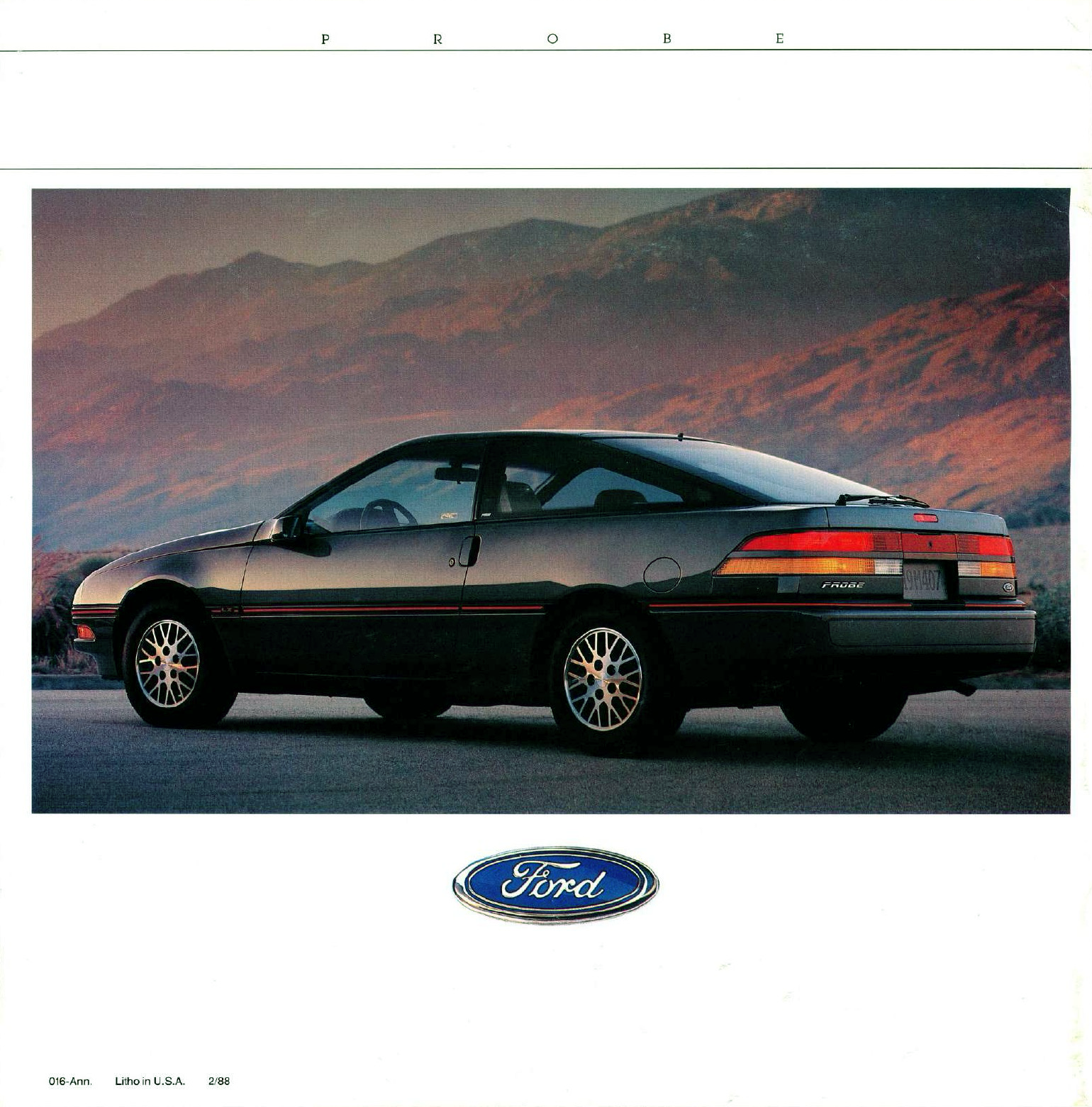
Rear cover of the 1989 Ford Probe brochure
The GL‘s base price was $10,459—about $28,300 in today’s dollars. Standard exterior and mechanical equipment included concealed/retractable halogen headlamps, power rack-and-pinion steering, power front disc/rear drum brakes, and P185/70SR14 steel-belted black sidewall radial tires (a size still readily available) on 14-inch wheels with standard Deluxe wheel covers. Inside, front bucket seats, 50/50 split fold-down rear seats, Deluxe cloth seat trim, full analog instrumentation with a tachometer, and an electronic AM/FM stereo radio were included.
The LX ($11,443) added complete tinted glass, Luxury wheel covers, all-cloth multi-adjustable front bucket seats, Luxury floor carpeting, a full console with a folding armrest and a storage bin, a rear window defroster, a remote liftgate release, a remote inside fuel filler release, and the Light Group.
Exterior and mechanical changes or additions with the GT ($13,593) included a unique front fascia with fog lamps, a unique rear end treatment with a two-tone spoiler, variable-assist power rack-and-pinion steering, power 4-wheel disc brakes, and P195/60VR15 Goodyear Eagle speed-rated performance steel-belted radial tires on 15-inch aluminum wheels. Inside, the GT included Sport cloth seat trim.
Packages, Individual Options, & Production Numbers
By 1989, Ford was delivering much of its optional equipment in Preferred Equipment Packages.
GL Preferred Equipment Package 250A was the base GL package.
GL Preferred Equipment Package 251A ($334) added complete tinted glass, dual electric remote mirrors, a tilt steering column/instrument cluster, interval windshield wipers and mist function, a rear window defroster, and the Light Group.
LX Preferred Equipment Package 252A was the base LX package.
LX Preferred Equipment Package 253A ($2,214) added a 6-way power driver seat adjustment, a leather-wrapped steering wheel and shift knob, an illuminated entry system, an electronic instrument cluster, speed control, an electronic air conditioner with push button controls, power windows, power door locks, a rear wiper/washer, a trip computer, and an electronic AM/FM stereo radio with a cassette tape player, premium sound system, and a power antenna.
GT Preferred Equipment Package 260A was the base GT package.
GT Preferred Equipment Package 261A ($2,621) added an anti-lock brake system, a 6-way power driver seat adjustment, a leather-wrapped steering wheel and shift knob, an illuminated entry system, speed control, and an electronic air conditioner with push button controls, power windows, power door locks, a trip computer, and an electronic AM/FM stereo radio with a cassette tape player, premium sound system, and a power antenna.
Individual options included a flip-up open air roof ($355), an air conditioner with manual controls ($927), power door locks ($155), and three optional stereos.
The 1989 Probe was a smash hit for Ford, with 162,889 made. Combining those numbers with the Mustang’s 206,789 produced definitely validated Ford’s decision to proceed with two separate models.
The View From 2025
I haven’t seen a Probe on the road in years. They’re gone from the Hemmings Motor News classifieds and eBay Motors, but Bring a Trailer has sold three of this generation of Probe in the last six years.
Make mine Deep Titanium Clearcoat Metallic, please.
For 1989, Dodge’s M-body Diplomat sedan was little changed. The base model was dropped, leaving only the mid-range Salon and the higher-end SE.
The powertrain remained the same—an LA 140 bhp 5.2 liter/318 ci V8 with a Carter two-barrel carburetor paired with a TorqueFlite three-speed automatic. With a 3,582-pound shipping weight, 0-60 came in about 12 seconds. Compared to other large rear-wheel-drive sedans, fuel economy was a somewhat uncompetitive 16 city/22 highway by the day’s standards (15/20 by today’s measures). With an 18-gallon gas tank, a Diplomat driver could expect a range of 285 to 305 miles with a 10% fuel reserve.
Standard exterior and mechanical equipment on the $11,995 Diplomat Salon sedan included quad halogen headlights, tinted glass, power-assisted steering, power-assisted front vented disk/rear drum brakes, and P205/75R15 steel-belted radial all-season white sidewall tires (a size still readily available, even as a whitewall) on 15-inch wheels with Deluxe wheel covers. Inside, a cloth/vinyl split-back bench seat with a folding center armrest and adjustable head restraints, tilt steering, a driver’s airbag, intermittent wipers, and an electronically tuned AM stereo/FM stereo with an integral digital clock and four speakers were included.
Diplomat SE photo from the 1989 Dodge brochure
The $14,795 SE added a full non-padded vinyl roof, Premium wheel covers, all-cloth individually adjustable front seats with dual seatback recliners, a lighted passenger mirror, chrome exterior dual power mirrors, automatic temperature control air conditioning, cruise control, an electrically heated rear window defroster, and the Protection Package. All of this extra equipment made for a 3,782-pound shipping weight—200 pounds more than the Salon.
Packages, Individual Options, & Production Numbers
By 1989, buying a Dodge Diplomat was all about the packages:
The Popular Equipment Discount Package ($1,141) included Premium wheel covers, automatic temperature control air conditioning, an electrically heated rear window defroster, chrome exterior dual power mirrors, and automatic speed control.
The SE Luxury Equipment Discount Package ($1,202) included wire wheel covers with locks, a driver’s side power seat, a Luxury leather-wrapped steering wheel, illuminated left and right vanity mirrors, power door locks, power windows, and a power deck lid release. It also included most but not all of the Light Package, including a headlight switch with time delay, a glove box light, a trunk light, and alternator, door ajar, engine oil temperature, and low fuel warning lights.
The Light Package ($122) included a headlight switch with time delay, a glove box light, and a trunk light. It also included alternator, door ajar, engine oil temperature, and low fuel warning lights.
The Protection Package ($185) included color-keyed vinyl bodyside moldings, black rear bumper guards, undercoating, and front and rear carpeted floor mats.
Individual options for both Diplomat versions included pearl clear coat paint ($41), power door locks ($201), and power windows ($294). Dodge also proudly offered a Premium electronically tuned AM stereo/FM stereo with up-and-down seek-and-scan and a cassette tape player ($262). The electronic cassette tape player included Dolby B noise reduction, automatic reverse, true fast forward and rewind, an automatic metal tape sensor, and tape program music search.
A full non-padded vinyl roof ($206), chrome exterior dual power mirrors ($164), and automatic temperature control air conditioning ($855) were available for the Salon. A power glass sunroof ($1,108) and a power antenna ($72) were SE-only options. A loaded SE could run to about $17,500—real money in 1989 and about $47,300 in today’s dollars.
Dodge sold a mere 5,709 Diplomats in the 1989 model year, sharply fewer than the 19,173 in 1988, when the base Diplomat was also available.
The View From 2025
The Diplomat was one of the last of Chrysler Corporation’s traditional rear-wheel-drive cars—the final year in a line that extended directly back to the original Diplomat in 1977, and had roots in the mid-1960s with the third-generation Dart. Earlier this year, I blogged about Chrysler Corporation’s Transition To Front-Wheel-Drive.
I’m going to declare these Diplomats as vanished, though I would not have said that a decade ago. They’re gone from the Hemmings Motor News classifieds and eBay Motors. Bring a Trailer has sold three Diplomats in the last five years, two of them sedans.
Make mine the extra-cost Twilight Blue Pearl Coat, please.
For the 1989 model year, the final big Lincoln of the 1980s remained essentially unchanged. The base version gained a fancier “Frenched” back window on its standard vinyl roof. Otherwise, only color and trim changes were visible.
The 1989 Town Car’s only available powertrain was a Windsor 150 bhp 4.9 liter/302 ci V8 with sequential multi-port fuel injection mated with a four-speed automatic with overdrive. An optional dual exhaust added 10 bhp. 0-60 came in a little over 11 seconds in a car with about a 4,100-pound curb weight. Fuel economy was 17 city/24 highway by the day’s standards (15/22 by 2025 measures). With a smallish 18.0-gallon gas tank (compared to the competition), a Town Car owner could expect a middling range of 300 to 330 miles with a 10% fuel reserve.
Front cover of the 1989 Lincoln Town Car brochure
The Town Car’s base price was $25,205 for 1989—approximately $67,700 in today’s dollars, or almost exactly what the 2025 Lincoln Aviator Reserve SUV goes for. Standard exterior and mechanical equipment included quad-rectangular halogen headlamps, tinted glass, power recirculating ball steering, power front disc/rear drum brakes, and P215/70R15 white sidewall steel-belted radial tires (a size still readily available) on 15-inch steel wheels with full wheel covers. Inside, 50/50 Twin Comfort Lounge cloth front seats, a six-way power driver’s seat, interval wipers, fingertip speed control, Automatic Climate Control, power windows, power vents, power door locks, and an AM/FM stereo cassette radio with a six-speaker Premium Sound System were included.
Series’, Options, & Production Numbers
For $3,301 over the base Continental, the Signature Series added the Comfort/Convenience Group, which included a six-way power front passenger’s seat, rear floor mats, dual illuminated visor vanity mirrors, a headlamp convenience system, and a power decklid pulldown. A Luxury half-vinyl coach roof with a frenched rear window, turbine-spoke aluminum wheels, and an illuminated/keyless entry system also came with the Signature Series.
For an additional $1,326, the Cartier Designer Series included everything in the Signature Series and added Dual-Shade paint in Silver Frost Clearcoat Metallic over Pewter Clearcoat Metallic, a Silver Frost coach roof, and maroon accent stripes. Inside, a leather-wrapped steering wheel and front floor mats with the Cartier logo were included. Cartier purchasers got a no-cost choice of either leather and cloth seat trim or all leather seat trim.
Exterior and mechanical options included a power glass moonroof ($1,420), a Traction-Lok differential ($101), and wire-spoke aluminum wheels ($873 for the base car, $395 otherwise). Interior options included an automatic-dim day/night mirror ($89), an Anti-Theft Alarm System ($200), a twelve-speaker Ford JBL Audio System with a 140-watt amplifier ($525), and a compact disc player ($617). The Cartier Designer Series was the only way to get Dual-Shade paint in the 1988 model year.
1989 was a good year for Lincoln’s traditional full-size sedan. 123,669 were sold, making the Town Car almost 60% of total Lincoln production, and marking the peak for the first-generation Town Car.
The View From 2025
Town Cars of this era attract collector interest—and there is club support. According to Hagerty’s valuation tools, a 1989 Town Car in #1/Concours condition is $26,900, with a far more normal #3/Good condition version going for $4,800. These Town Cars are often available in the Hemmings Motor News classifieds, on eBay Motors, and on Bring a Trailer. As I write this blog entry in September 2025, there’s a Cinnabar Clearcoat Metallic 1989 Town Car with 8,700 miles for sale on Hemmings, asking $34,500.
Make mine that same Cinnabar Clearcoat Metallic, please.
The 1989 model year brought the first significant changes to the exterior of the seventh-generation Riviera. The wheelbase and other hard points could not be easily or inexpensively modified, but Buick did extend the rear portion of the body by 11 inches. One version of that year’s brochure (which came with what must have seemed hip floppy discs) claimed that it was “noticeably longer,” while another stated that it was “reminiscent of classic Rivieras.” In the real world, there was no denying that the restyled exterior effectively called back to the suddenly beloved sixth generation. This was a strange symmetry, as Bill Mitchell passed in September 1988.
1989 Buick Riviera press release photo
Various other components also scaled up along with the body; the Riviera moved up to P205/70R15 tires on 15-inch wheels. The roofline had a wider sail panel, and side trim and rocker moldings were modified. New standard equipment included a driver’s side airbag (returning to the Riviera almost a quarter-century later than those first airbags), a leather-wrapped steering wheel, and a leather-wrapped shift handle.
Making all these changes only three years into the sixth generation Riviera’s life cycle marked a significant and unexpected effort, which was led by Anthony Derhake, vehicle chief engineer for the Riviera. What remained of the domestic personal luxury coupe market responded well—Riviera sales increased 146% (!) to 21,189, likely making Buick’s restyling and re-imagining well worth all that effort. Of course, those upgrades didn’t come free; the Riviera’s base price was up over 4% to $22,540 (about $60,300 in today’s dollars).
Amongst all this change, there was also a significant minus for folks who liked choices in their Rivieras: the T Type was no longer available. After eight years (ten if one counts the S Type), Buick essentially gave up on the idea of a specifically branded sporty Riviera for a second time. A $104 Gran Touring package featuring much of the performance-related equipment from the now-retired T-Type remained available.
Many of the changes for 1989 didn’t help Buick in its eternal goal—which continues to this day—of reaching more youthful buyers. Although temporarily successful, the move to more traditional styling was a complete abdication of the hopes for the Riviera that the division had articulated only three years prior.
One thing that didn’t change significantly for the 1989’s exterior was the colors. Eleven of the thirteen available colors remained precisely the same. The only exceptions were Sterling Silver (which changed its formulation but not its name) and a brand new extra-cost Pearlescent Diamond White offering.
Standard exterior equipment for the 1989 Riviera included Soft-Ray tinted glass, tungsten-halogen headlamps, coach lamps, an electric rear window defogger, and a power antenna. Mechanical equipment included four-wheel power disc brakes, power steering, a Dynaride four-wheel independent suspension with automatic level control, and P205/70R15 tires on 15-inch wheels with custom locking wire wheelcovers.
Inside, standard equipment included the Electronic Control Center, Electronic Touch Climate Control air conditioning, a tilt steering column, Electric Speed Control, and electric door locks. Interior trim and upholstery featured manual reclining cloth front bucket seats with an easy-entry passenger feature, a six-way power driver’s seat, and an operating console. An ETR AM/FM stereo radio with seek and scan, clock, and cassette tape player with auto-reverse, search/repeat, and Concert Sound speakers was standard.
The only available powertrain continued to be the LN3“3800” 165 bhp 3.8 liter/231 ci V6 with sequential fuel injection paired with a Turbo Hydramatic 440-T4 automatic transmission with overdrive. Fuel mileage ratings were 19 city/28 highway, with the highway number off one gallon from 1988 as the refreshed Riviera gained about 75 pounds along with its added length. The 1989 Riviera’s 0-60 mph time was once again a “respectable” 10 seconds due to its increased weight.
Options & Period Reviews
Exterior and mechanical options included an electric sliding Astroroof ($1,230), a Landau top ($695), and an anti-lock brake system ($925). Inside, you could get a 16-way adjustable driver’s bucket seat ($1,230) and a cellular telephone installed in the console armrest ($1,975). Buick offered two optional stereos, with the top-of-the-line being the Delco GM/Bose Gold Series Music System ($783), which included an ETR AM stereo-FM stereo radio with seek and scan, a clock, and a cassette tape player with Dolby noise reduction, auto-reverse, and search/repeat.
A new option for 1989 was the Remote Radio Keyless Entry System, which included automatic electric door locks. Pearlescent Diamond White paint ($210) also became available—an extra-cost three-stage paint option that wasn’t a Firemist paint but had the same price.
The $104 Gran Touring package included the Gran Touring suspension, a 2.97 performance axle ratio, fast-ratio power steering, and P215/60R15 Goodyear Eagle (Buick remained with Goodyear for tires for many years, but kept changing the specific fitment) blackwall tires on 15-inch aluminum wheels.
Along with the undeniable interest from potential owners, the 1989 exterior redesign also attracted at least some attention from the automotive press. Popular Mechanics stated that it was a “radical restyling” that counter-intuitively returned the Riviera “to the look of the past.”
The View From 2025
With the excellent support of the Riviera Owners Association, folks are collecting these late seventh-generation Rivieras. According to Hagerty’s valuation tools, a 1989 Buick Riviera in #1/Concours condition is $16,900, with a more normal #3/Good condition car going for $9,100.
Please make mine the extra-cost (but still gorgeous) Sapphire Blue Firemist.
Bentley’s Turbo R sedan debuted in 1985 but didn’t make it to the US until the 1989 model year. The Turbo R followed the Mulsanne Turbo, which debuted in 1982 and marked the first genuinely sporting Bentley in decades. Bentley stated that the R stood for “roadholding,” and the Turbo R had a completely revised suspension, with different dampers and stiffer anti-roll bars.
The Turbo R’s 6.75 liter/412 ci V8 had an estimated 335 bhp—for decades, Bentley didn’t state actual horsepower. The big V8 featured Bosch MK-Motronic fuel injection, a Garrett AiResearch turbocharger, and an intercooler. The transmission was GM’s Turbo Hydramatic THM-400. Considering that the Turbo R had a curb weight of 5,313 pounds, the 0-60 time of a little under 7 seconds was notable. Fuel economy was less impressive: a 9 city/12 highway rating by the day’s standards meant that the Turbo R was a recipient of the dreaded gas guzzler tax. Despite a sizeable 28.6-gallon gas tank filled with premium gasoline, the proud new owner of Turbo R could only expect a range of about 270 miles with a 10% fuel reserve.
1989 Bentley Turbo R advertisement
Standard exterior and mechanical equipment on the $165,000 Turbo R (about $438,000 in today’s dollars) included power rack and pinion steering, four-wheel anti-lock disc brakes, and 255/65VR15 tires (a size still available thanks to Avon) on 15-inch aluminum-alloy wheels. The traditional Connolly leather seats, burled walnut veneer dash, and lambswool carpeting seen in many Bentleys were present inside. More prosaic standard equipment included air conditioning, cruise control, power seats, power mirrors, and power windows. Bentley built 929 Turbo Rs for the 1989 model year, making it an unqualified success.
The View From 2025
Like all Bentleys, the Turbo R attracts collector interest and substantial club support. Perhaps driven by maintenance costs that are substantial if the car has not been rigorously maintained, values are not as high as one might think. According to Hagerty’s valuation tools, all the money for a 1989 Turbo R in #1/Concours condition is $26,000, with a far more normal #3/Good condition version going for $13,500.
Turbo R’s are often available in the Hemmings Motor News classifieds, and they sometimes show up at online (Bring a Trailer) and in-person auctions. As I update this post in March 2025, a Dark Oyster Metallic 1989 Turbo R with red leather front bucket seats and 66,000 miles is for sale on Hemmings for $44,500.
After over eight years, this post is the first on a Bentley in Eighties Cars. There will be others—I definitely expect to get to the aforementioned Mulsanne Turbo at some point.
“The standard for luxurious, smooth-riding American sedans …”
For 1989, Buick’s Electra Park Avenue received a new trim in the middle of the model year: Ultra. It became the new top-of-the-line Buick sedan.
The only powertrain for the Ultra or for any 1989 Electra was a “3800”LN3 165 bhp 3.8 liter/231 ci V6 with sequential fuel injection teamed with a four-speed automatic transmission. Mileage for the standard engine was 19 city/28 highway by the 1989 measures (17/26 by today’s standards). With an 18-gallon gas tank, an Ultra owner could expect a range of about 345 to 380 miles with a 10% fuel reserve. 0-60 mph took a little under 10 seconds.
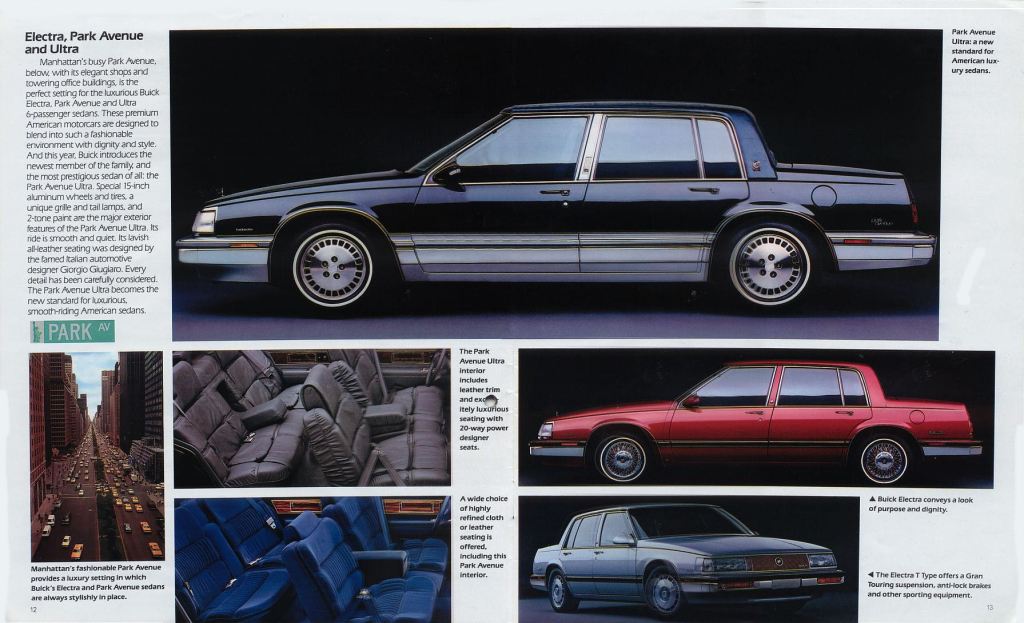
Electra pages from the 1989 Buick brochure
Buick piled on the bling for the Ultra—standard exterior equipment included Soft-Ray tinted glass, a unique grille texture, smoked tail lamps, chrome side pillars, a Sterling Silver lower accent paint treatment, and a silver accent body stripe. Mechanical equipment on the $26,218 (approximately $70,100 in 2025 dollars) car included a 4-wheel independent DynaRide suspension, power rack-and-pinion steering, power anti-lock front disk/rear drum brakes, and P205/70R15 whitewall tires (a size still readily available) on 15-inch aluminum wheels.
Inside the Ultra, air conditioning, an AM/FM stereo radio, burled elm trim on the doors and instrument panel, a tilt steering column, power door locks, power mirrors, and power windows were all standard. The all-leather seats were styled by famed Italian automobile designer Giorgetto Giugiaro, with the 55/45 front seats being 20-way for both driver and front passenger.
Options, Period Press, & Production Numbers
Optional items for 1989 included an electric sliding Astroroof ($1,230), a heavily-padded full vinyl top only available for the Ultra, cornering lamps ($60), Electronic Touch Climate Control air conditioning ($165), Twilight Sentinel headlamp control ($60), and the Delco/Bose Music System with ETR AM/FM stereo radio and cassette.
The Electra Park Avenue Ultra received good reviews, with one automotive writer comparing it favorably to the same year’s Mercedes-Benz 300 SE. First-year sales of the 1989 Park Avenue Ultra sedan were decent considering the short window of availability—Buick moved 4,815 examples.
The View From 2025
These mid to late 1980s C-bodies had a stately look about them. Big and (I think) handsome, they had a lot of interior room despite the second round of downsizing—with 111 cubic feet, they had only one cubic foot less than the previous generation rear-wheel-drive cars. C-body Park Avenue sedans of this era rarely come up for sale in the Hemming’s Motor News classifieds and on eBay Motors, but are sometimes seen on Bring a Trailer.
Make mine Claret Red over Sterling Silver, please. All Ultras came with two-tone exterior paint.
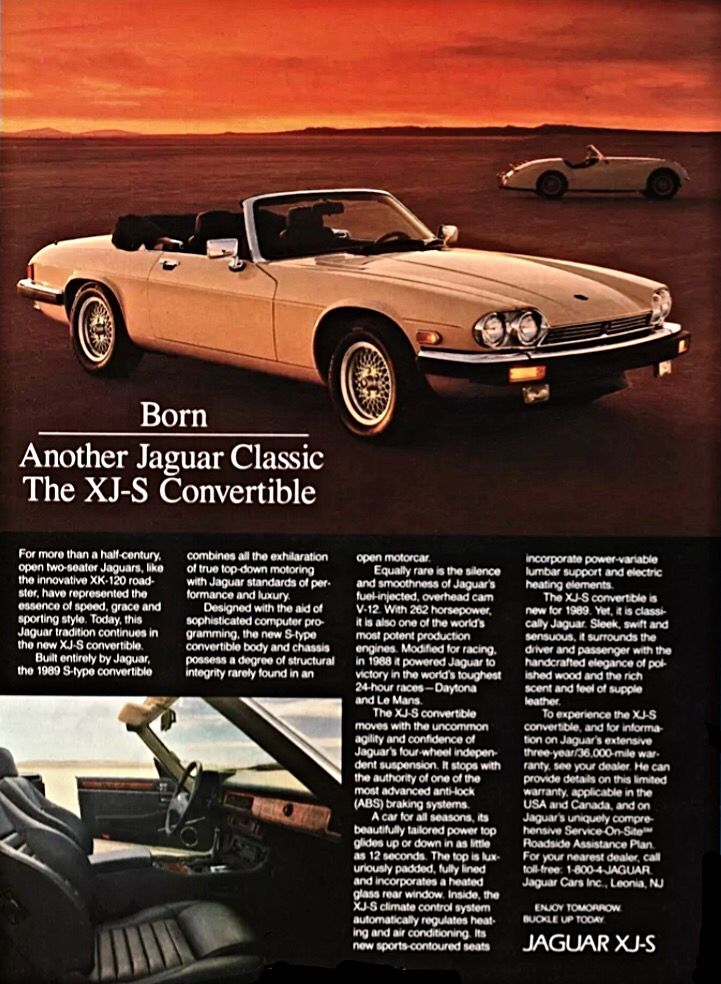
For 1989, a full convertible version of the Jaguar XJ-S finally became available after five years of the little-loved targa convertible. The power top, which could go up and down in as little as 12 seconds, was padded, lined, and included a heated glass rear window.
The only powertrain available for any XJ-S continued to be the 262 bhp H.E. 5.3 liter/326 ci V12 with Lucas-Bosch fuel injection paired with a three-speed automatic transmission sourced from General Motors (a powertrain that had been around since 1982). Performance was respectable for the almost 4,200-pound convertible: 0-60 mph in a little under 9 seconds. Mileage remained what you might expect from a thirsty V12—12 city/16 highway by the standards of the day (11/15 by today’s standards). With a 21.7-gallon fuel tank, an XJ-S owner could expect a range of between 250 and 275 miles, with a 10% fuel reserve.
1989 Jaguar XJ-S convertible advertisement
Standard equipment on the $57,000 car (about $151,300 in today’s dollars) included a four-wheel independent suspension, power steering, and four-wheel anti-lock power disc brakes. 15-inch alloy wheels were paired with Pirelli P600 235/60VR15 tires—which are still available!
Inside, the buyer received air conditioning with automatic temperature control, power windows, heated power mirrors, power door locks, intermittent windshield wipers, cruise control, and an AM/FM stereo cassette with Dolby and metal tape capability. New sport-contoured seats featured power-variable lumbar support and electric heating elements.
The View From 2025
The Jaguar XJ-S has good club support, and there are some restoration parts available. There’s also a free 738-page (!)ebook written by an XJ-S owner named Kirby Palm and featuring much hard-earned advice. Keeping an XJ-S at 100% is non-trivial—as it is with so many high-end eighties cars.
Like all Jaguars, XJ-S convertibles have a following and make frequent appearances in the Hemming’s Motor News classifieds, on eBay Motors, and on Bring a Trailer. According to Hagerty’s valuation tools, all the money for a 1989 XJ-S convertible in #1/Concours condition is $45,000, with a far more typical #3/Good car going for $16,400.
For unclear reasons, one, but only one, of the supermarkets in my area often has interesting eighties cars parked outside. In mid-December 2017, despite some snow on the ground, there was a 1989 Cadillac Sedan de Ville on “display” with classic car tags—good enough reason for this blog entry.
“… the definitive full-size luxury car”
Cadillac’s Sedan de Ville was substantially revised for 1989, marking the first time that it had been “up-sized” for almost two decades. Overall length increased by nearly nine inches, while the wheelbase increased by three inches. The styling of this C-body was more in the traditional Cadillac vein than the 1985-1988 cars, with vertical blades in the rear that somewhat resembled the fins of previous decades. Changes extended to the interior, with more comfortable seats, more room in the rear compartment, and a larger trunk. New options included a heated windshield defogger ($250) and a Delco-Bose GoldSeries music system with an AM stereo/FM stereo radio, a compact disc player, and extended-range rear speakers ($872).
Standard power for the front-wheel-drive Sedan de Ville continued to be the transverse-mounted HT 155 bhp 4.5 liter/273 ci V8 with throttle-body fuel injection paired with a Turbo Hydramatic 4T60 four-speed automatic transmission. 0-60 mph took about 10 seconds in the 3,470-pound car. Mileage was 17 city/25 highway by the day’s standards (15/23 by today’s measures)—with an 18-gallon gas tank, a de Ville owner could expect a range of about 310 to 340 miles with a 10% fuel reserve.
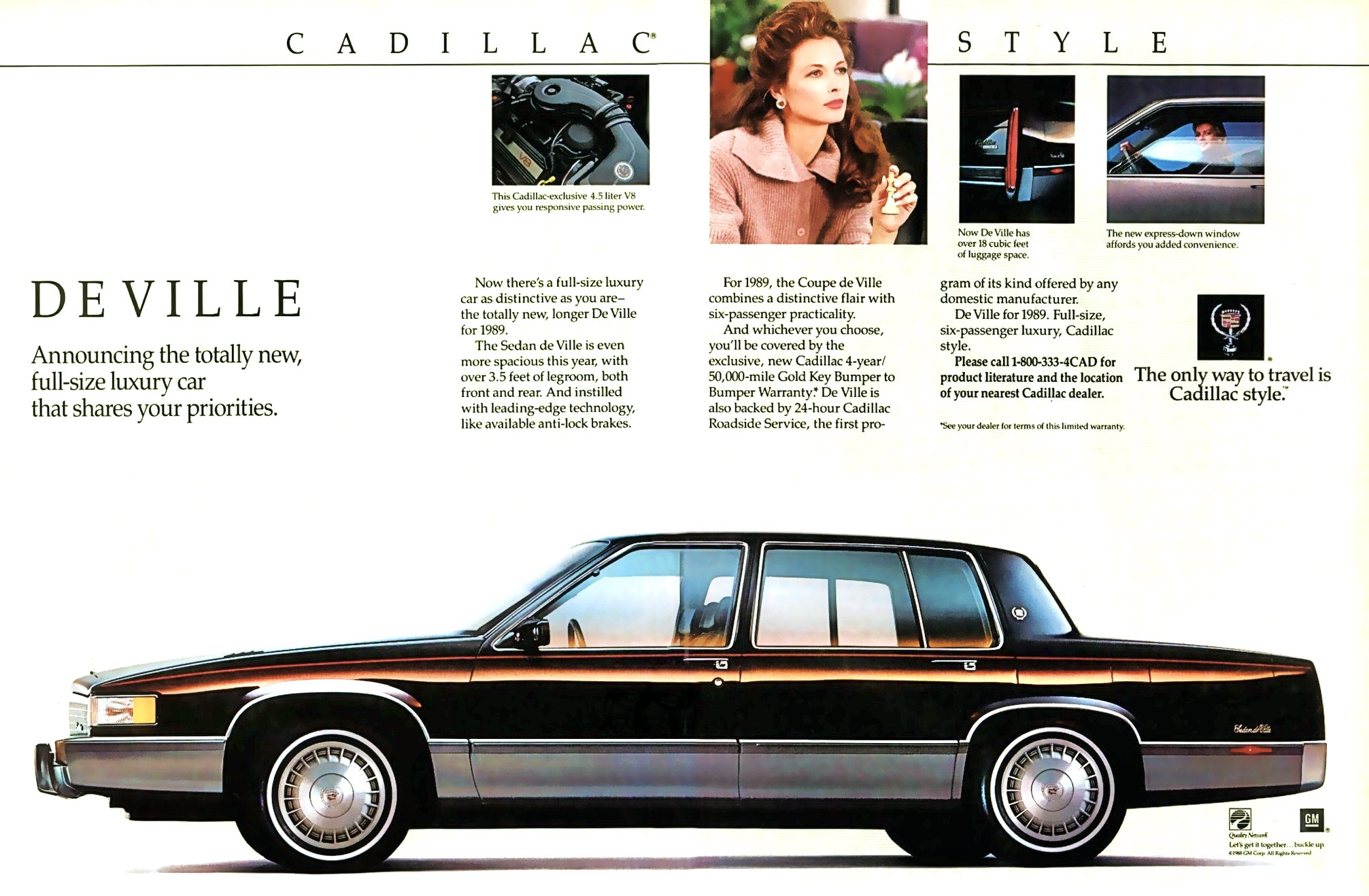
1989 Cadillac Sedan de Ville print advertisement
Standard exterior and mechanical equipment on the $25,760 Sedan de Ville (about $69,500 in today’s dollars or about what a loaded 2026 Cadillac CT5 sedan goes for) included tungsten-halogen headlamps, Soft-Ray tinted glass, power rack-and-pinion steering, power brakes, four-wheel independent suspension, and P205/70R15 Michelin steel-belted all seasons whitewall tires (a size still readily available) on 15-inch wheels. Inside, the Sedan de Ville was well equipped: electronic climate control, a six-way power driver’s seat, a tilt-and-telescope steering wheel, cruise control, power side mirrors, power windows (including an express-down driver’s side window), power door locks, and an AM/FM stereo with cassette player were all standard.
Options, Period Reviews, & Production Numbers
Exterior and mechanical options for the 1989 Sedan de Ville included Firemist paint ($240), an Astroroof ($1,355), an anti-lock braking system ($925), and aluminum alloy wheels ($480). Inside, leather seating areas ($560 and including leather-trimmed headrests), a leather-trimmed steering wheel ($115), a theft deterrent system ($225), a digital information cluster ($250), and a rear window defogger ($195) were available.
Reviews of the revised Sedan de Ville were generally positive—Motor Trend referred to the 1989 models as “upgunned”—and it sold well. Cadillac shipped 122,693, making it by far Cadillac’s most successful model for the year—the rear-wheel-drive D-body Brougham was a distant second place with 28,926.
The View From 2025
According to Hagerty’s valuation tools, a 1989 Sedan de Ville in #1/Concours condition is $17,300, with a far more typical #3/Good car going for $7,100 (only the top-of-the-line Allantés do really well among late eighties Cadillacs). This generation of de Villes does maintain a presence in the Hemmings Motor News classifieds, on eBay Motors, and on Bring a Trailer. When I last updated this blog entry in December 2025, there was a Medium Garnet Red Metallic 1989 with 36,000 miles for sale on Hemmings, asking $16,000.
Make mine that same Medium Garnet Red Metallic, please.





 Eighties Cars