1983 Ford Thunderbird Turbo Coupe

A recent query about whether I had done a write-up on a Thunderbird Turbo Coupe compelled me to update this post written a few years ago, changing it enough to consider it a new entry.

“Ford presents a dramatic new balance of form and function.”

The aerodynamic styling of Ford’s 1983 Thunderbird was a breath of fresh air and a substantial change from the boxy and unloved eighth-generation 1980-1982 models, though the underlying components remained the Fox platform. For 1983, the Thunderbird came in base, Heritage, and Turbo Coupe models.

The Turbo Coupe featured Ford’s Lima 142 bhp 2.3 liter/140 ci inline four with Bosch L-Jetronic fuel injection and a Garrett turbocharger and came with a standard five-speed manual transmission. Road & Track recorded a 0-60 time of 9.7 seconds in a Turbo Coupe that weighed 3,420 pounds as tested. Ford’s new coupe didn’t just look aerodynamic—the drag coefficient was a very competitive 0.35. Fuel economy ratings for the Turbo Coupe were 21 city/33 highway by the standards of the day (17/24 by today’s standards). With an 18.0-gallon fuel tank, a Turbo Coupe owner could expect a range of between 330 and 435 miles with a 10% reserve—decent for a mid-size performance coupe in the early to mid-1980s.

The Turbo Coupe started at $11,790—approximately $30,300 in today’s dollars and nearly what a 2019 Mustang EcoBoost Premium Fastback (also with a turbocharged 2.3 liter inline four) costs. Standard exterior and mechanical features on the Turbo Coupe included variable ratio power rack-and-pinion steering, power brakes, power mirrors, a Traction-Lok limited-slip differential, Marchal foglamps, and Goodyear Eagle HR 205/70R-14 tires (a size still readily available) on 14-inch x 5.5-inch cast aluminum wheels. Inside, all Turbo Coupe buyers got a leather-wrapped steering wheel, articulated front seats, and an AM/FM stereo radio. Options included front cornering lamps ($68), tilt steering ($105), power door locks ($172), and a premium sound system ($179).

Reviews were quite good—Road & Track‘s tagline was “An enthusiast’s Bird comes soaring back”—and the newly aerodynamic Thunderbird sold well. After dropping down below 50,000 sales for the 1982 model year with the last of the eighth-generation ‘birds, the ninth generation would not see sales of less than 120,000 per year.
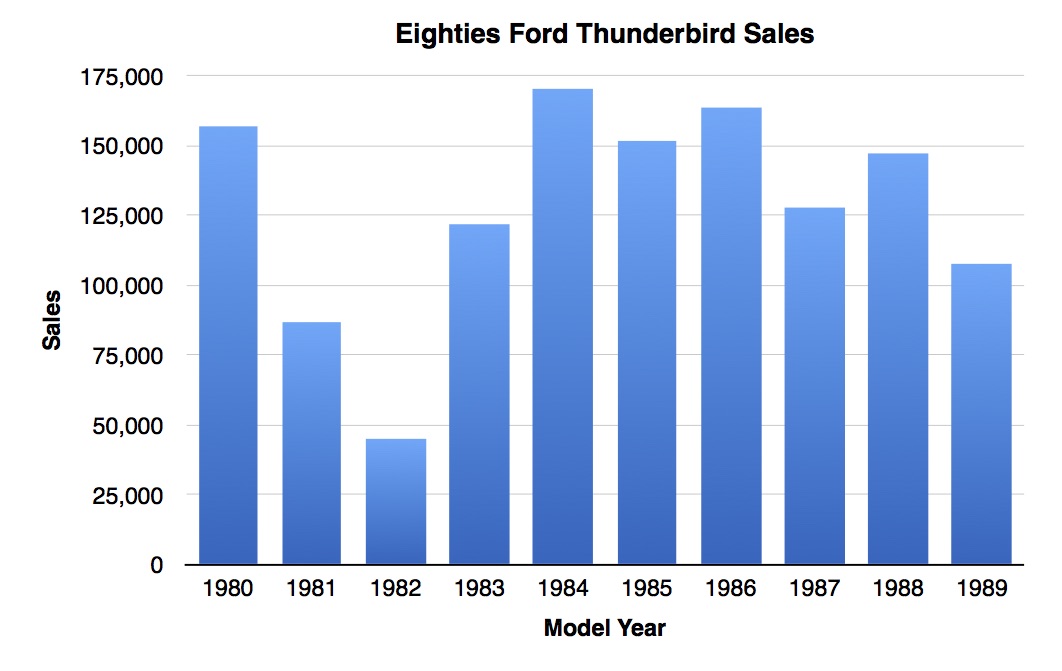
EightiesFordThunderbirdSales

According to Hagerty’s valuation tools, all the money for a 1983 Thunderbird Turbo Coupe in #1/Concours condition is $17,000, with a far more typical #3/Good car going for $6,700. Thunderbird Turbo Coupes only occasionally show up in the Hemming’s Motor News classifieds. You do see them more often on eBay Motors; as I update this blog entry in December 2018, there’s a 1985 Silver Clearcoat Metallic/Medium Charcoal Clearcoat Metallic two-tone Turbo Coupe with Oxford Gray cloth seats and 52,000 miles listed for $8,500. Make mine Silver, please.

Updated December 2018.
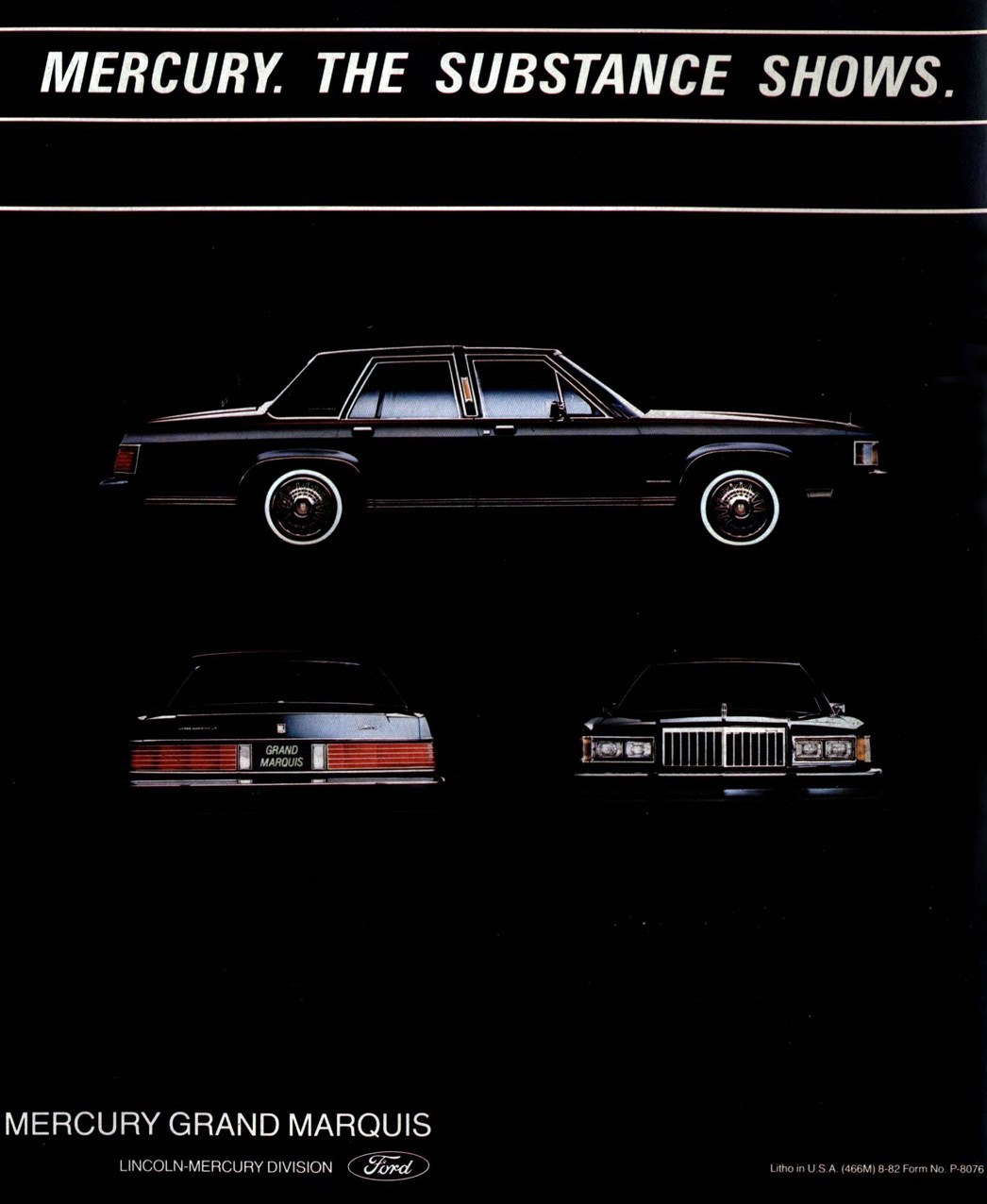
1983 Mercury Grand Marquis sedan

As I walked to the train in October 2017, I saw an eighties Mercury Grand Marquis sedan idling on Chestnut Street in Philadelphia. It stood out because of its size—at 214 inches, these cars are longer than a 2025 Lincoln Navigator—and its new for 1979 squareness. That was reason enough to write a relatively rare Mercury blog entry.

“A Lesson In Luxury”

For the 1983 model year, Mercury renamed all versions of the full-size Marquis to Grand Marquis and moved the Marquis name to the mid-size Fox platform. Other than the name change, changes for the Grand Marquis were relatively modest: there were new full-width wraparound tail lamps and a modified grille. New options included a remote locking fuel filler door ($24), locking wire wheel covers ($168), and a Tripminder trip computer ($261), which showed month/day/time, elapsed time, average speed, average MPG, instantaneous MPG, and gallons of fuel used. In their annual “Charting the Changes” roundup, Car and Driver once again made the ritual complaint that there was still no de Sad package.

The standard engine in 1983 was Ford’s 130 bhp 4.9 liter/302 ci V8 with fuel injection paired to a four-speed automatic. Somewhat strangely to our modern eyes, the optional power upgrade was a carburetted version of the same motor with 145 bhp. These were not fast cars—with an almost 3,800-pound curb weight, 0-60 came in about 12 seconds. Mileage with the standard powertrain was 17 city/27 highway by the day’s standards (14/20 by today’s standards). With the 18-gallon fuel tank, Grand Marquis drivers could expect a range of 275 to 355 miles with a 10% fuel reserve.

Standard exterior and mechanical equipment on the $10,718 Grand Marquis (about $34,700 in today’s dollars) included a coach vinyl roof, coach lamps, halogen headlamps, power brakes (front disc and rear drum), power steering, and P215/75R14 steel-belted white sidewall radial tires on 14-inch wheels with deluxe wheel covers. Inside, cloth/vinyl Twin Comfort Lounge seats with dual front seat recliners, a four-spoke Luxury (the Grand Marquis brochure mentioned luxury a lot) steering wheel, an analog quartz clock, and an AM/FM stereo radio with four speakers were included. Standard items that Mercury proudly listed that do not impress in 2025 included a front stabilizer bar, seat belt warning chimes, and carpeted lower door trim panels.

Packages, Options, & Production Numbers

Upgrading to the $11,273 LS added tinted glass, luxury cloth Twin Comfort Lounge seats, cloth-trimmed headrests, right-hand visor vanity mirror, map pockets in front seatback, luxury door trim with armrest woodtone inserts and courtesy lights, dual beam dome/map light, dual fold-down front center armrests, rear-seat folding center armrest, and the all-important LS badge on the rear decklid.

Exterior and mechanical options included the Traction-Lok differential ($95) and cast aluminum turbine spoke wheels ($361), which required P205/75R15 tires ($17). Interior options included manual air conditioning ($724), automatic air conditioning ($802), 6-way power driver’s seat ($210) or driver’s and passenger’s seats ($420), power door locks ($123), fingertip speed control ($170), and tilt steering wheel ($105). Audio options included a host of optional radios with 8-track or cassette player, a power antenna ($60), and the Premium Sound System with two additional speakers in the front doors, upgraded rear speakers, and an extra power amplifier ($175 base/$145 LS). Leather seating surfaces ($418) were only available on the LS. All these options meant that a loaded Grand Marquis LS could quickly get close to the Lincoln Town Car’s pricing territory—I quickly priced one to $14,584 (about $47,200 in 2025 dollars).

The Grand Marquis sold well for Mercury in 1983—72,207 sedans, 11,117 coupes, and 12,394 Colony Park wagons made it one of the division’s best sellers—23% of sales in a year when Mercury also offered the Capri, Cougar, LN7 (remember the LN7?), Lynx, Marquis, and Zephyr.

The View From 2025

The first-generation Grand Marquis sometimes shows up for sale in the Hemmings Motor News classifieds, on eBay Motors, and on Bring a Trailer.

Make mine Midnight Blue Metallic, I think.

Other Mercury’s I have written about include the 1986 Capri hatchback coupe, the 1987 Lynx XR3 hatchback coupe, and the 1988 Cougar XR-7 coupe.

Last updated March 2025.

Sav

Sav

Sa

1983 Volkswagen Rabbit GTI hatchback coupe

“Affordable German Performance.”

The 1983 Volkswagen Rabbit GTI three-door hatchback defined the “pocket rocket” for the US market, just as it had established it in Europe since 1977. The Giorgetto Giugiaro-designed Rabbit was a small car by modern standards—the 155.3-inch length puts it squarely in modern Mini territory and makes it more than a foot shorter than a 2026 Golf GTI.

Under the blacked-out, red-lined, and badged hood was a 90 bhp 1.8 liter/109 ci inline four with Bosch K-Jetronic fuel injection—an engine VW dared to declare was “brawny.” A five-speed manual transmission completed the rest of the powertrain—there was no optional automatic transmission.

Car and Driver recorded a 9.7 second 0-60 time (Road & Track managed a 10.6 second 0-60) in the 1,918-pound car—faster than the same year’s BMW 320i and many other sporting cars of the era. Top speed was 104 mph. Fuel economy was rated at 26 city/36 highway; a 10-gallon gas tank gave a 230 to 250-mile range with a 10% reserve.

1983 Volkswagen Rabbit GTI advertisement

The 1983 GTI’s base price was $7,990—about $26,400 in 2025 dollars, which is about 24% less than what a 2026 Golf GTI goes for. Standard exterior equipment included tinted glass, halogen headlights, a urethane front air dam, and a hatchback rear deck lid with rear wiper/washer. Standard mechanical equipment included front-wheel-drive, power-assisted ventilated front disc/rear drum brakes, rack and pinion steering, and Pirelli P6 185/60HR-14 radial tires (a size still readily available) mounted on 14 x 6 inch “Snowflake” alloy wheels. Inside, a sport steering wheel borrowed from the Scirocco, heavily bolstered cloth sports seats, a center console with additional gauges, and a golf-ball shift knob were included.

Options, Period Reviews, & Production Numbers

Options were relatively few and included fully integrated air conditioning (dealer-installed and $630), a sliding sunroof with a deflector ($285), extra-cost paint ($135), and an AM/FM stereo with a cassette player ($350).

The 1983 Rabbit GTI got good reviews—Car and Driver included it in their first 10Best, and Road & Track stated that “if you’re a car enthusiast, we may have the cure for your ills.” The GTI also sold well—Volkswagen built about 30,000 copies over two years at their Westmoreland County, PA plant.

The View From 2025

First-generation GTIs certainly have a following, but many were driven hard when no longer new, so there’s a paucity of creampuffs out there.

According to Hagerty’s valuation tools, all the money for a 1983 Rabbit GTI in #1/Concours condition is $64,800, with a more normal #3/Good condition car going for $17,600. Values are also up notably; that perfect #1 car was only $20,600 five years ago. GTIs are regularly featured in the Hemmings Motor News classifieds, on eBay Motors, and on Bring a Trailer.

Make mine Black, please.

I have also written about the 1981 Dasher station wagon, the 1981 Sirocco S hatchback coupe, the 1985 Cabriolet, and the 1985 Jetta GLI sedan.

Last updated October 2025.

1983 Ford Mustang GT convertible

I was driving westbound on the Schuylkill Expressway in Philadelphia on a morning in February 2015 when I saw a Fox Mustang convertible (red exterior, black top). A good enough reason to write a blog entry about these attractive cars.

“It’s not just a convertible … it’s a Mustang.”

For 1983, the big news for the Ford Mustang was the return of the convertible for the first time since the 1973 model year. Introduced on November 5th, 1982, the convertible was available only in the luxury GLX trim and the performance GT trim—lower-end L and GL trims remained with the notchback coupe (L and GL) and the hatchback coupe (GL). The GLX was also available only with V6 and V8 engines (no inline-four—turbo or not—would sully the drop-top experience).

The V6 engine choice for the GLX was the Essex 112 bhp 3.8 liter/231 ci with a two-barrel carburetor. Optional on the GLX ($595 additional) and standard on the GT was (of course) the Windsor 175 bhp 4.9 liter/302 ci V8 with a four-barrel carburetor.

Starting at $9,449 (about $30,800 in today’s dollars) and rising significantly during the middle of the model year to a non-trivial $12,467 (about $40,300 in 2025 funds, which is almost exactly what a 2025 Mustang EcoBoost convertible starts at), the GLX did come reasonably well equipped. Standard external and mechanical features included power front disc brakes, tinted glass, and an automatic transmission. Standard interior equipment included a light group and an AM radio.

convertible pages from the 1983 Ford Mustang brochure
Convertible pages from the 1983 Ford Mustang brochure

The GT version of the convertible listed for $13,479 (about $43,600 in 2025 dollars). Standard external and mechanical features included power front disc brakes, power steering, rear spoiler, and a five-speed manual transmission. Standard interior equipment included an AM radio.

All 1983 Mustangs included dual rectangular halogen headlamps, a modified MacPherson strut front suspension, front disc/rear drum brakes, and rack and pinion steering. Inside, full instrumentation (tachometer, trip odometer, fuel/temperature/oil/alternator gauges), full vinyl bucket seats, and a cigarette lighter were included.

Options & Production Numbers

The Mustang option list was long. Inside, air conditioning ($724), speed control ($170), power locks ($160), a tilt steering wheel ($105), and an AM/FM stereo radio with a cassette player ($199) were all available.

All 1983 Mustang convertibles came with a power top, and all windows rolled down—an emphasis Ford frequently made in reference to the Chrysler K car convertibles.

FoxBodyMustangSales

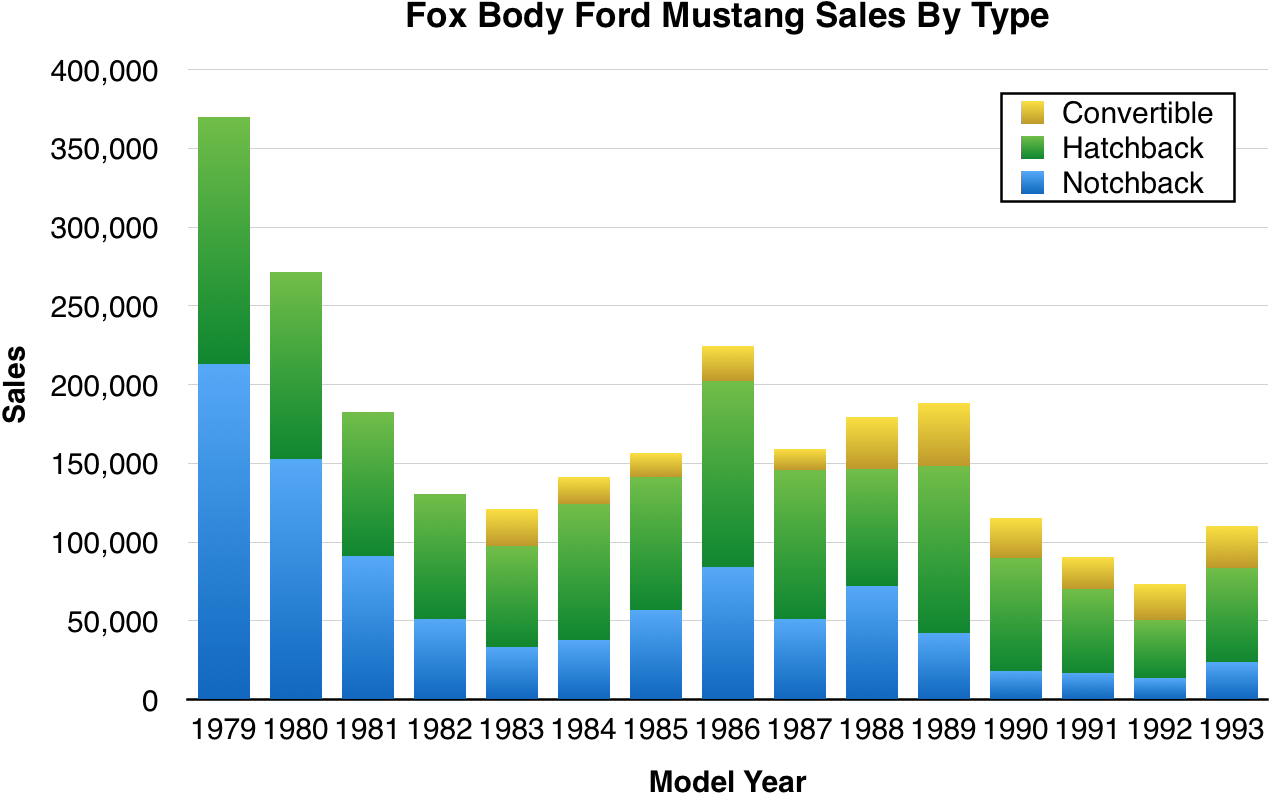
The 1983 Ford Mustang convertible sold reasonably well considering its expense (the GT convertible stickered for 45% more than the GT hatchback). For that year, it probably saved total Mustang sales from dropping below 100,000—helping hold that off until 1991. Between 1983 and 1993, Ford would sell over a quarter of a million of the pony car convertibles.

The View From 2025

There is strong club support for the 1983 Mustang, as there is for all Mustangs except the mid-seventies Mustang IIs. According to Hagerty’s valuation tools, all the money for a 1983 Mustang GT convertible in #1/Concours condition is $58,300, with a more typical #3/Good condition car going for $14,500. 1983 Mustangs often show up in the Hemming’s Motor News classifieds, on eBay Motors, and on Bring a Trailer—as I update this blog entry in March 2025, there’s a Red 1983 Mustang GLX convertible with a white top, a white vinyl interior, an aftermarket V8, and 89,000 miles available on Hemmings for $18,000.

Make mine that same Red, please.

Other Mustangs I have written about include the 1980 Cobra fastback coupe, the 1982 GT fastback coupe, and the 1984 SVO fastback coupe.

Last updated March 2025.

1983 Chrysler Imperial coupe

While out driving late in 2014, I saw an early 1980s Chrysler Imperial aggressively carving the back roads in the Philadelphia suburbs near where I live. The body design remains utterly distinctive: the alacrity with which the Imperial was moving makes me assume that it had the carburetor conversion and/or some other engine upgrade.

“A singular statement of car and driver.”

Chrysler introduced the “bustle back” Imperial for the 1981 model year, bringing it to market partly to reassure potential buyers that the company would remain in business. By 1983, the Cordoba-based luxury coupe was in its final year, selling a mere 1,427 units as all rear-wheel drive Chrysler products continued their decline.

For 1983, the powertrain continued to be the same: the LA 140 bhp electronic throttle-body fuel-injected 5.2 liter/318 ci V8 paired with a TorqueFlite three-speed automatic transmission. Despite notable attempts at increasing quality (each Imperial went on a five-and-a-half-mile test drive and received numerous other checks before shipping from the factory), the bleeding edge fuel injection continued to be stunningly unreliable—Chrysler frequently ended up replacing it with a carburetted system at the cost of $3,500 plus about 50 hours of labor.

Performance for the 3,900-pound coupe wasn’t impressive: 0-60 came in a little under 14 seconds. To be fair, neither the Cadillac Eldorado nor the Lincoln Continental Mark VI (the Imperial’s intended competitors) were notably faster in 1983. Fuel economy was rated at 16 city/26 highway by the day’s standards, giving a range of 305 to 340 miles with the 18-gallon gas tank and a 10% fuel reserve.

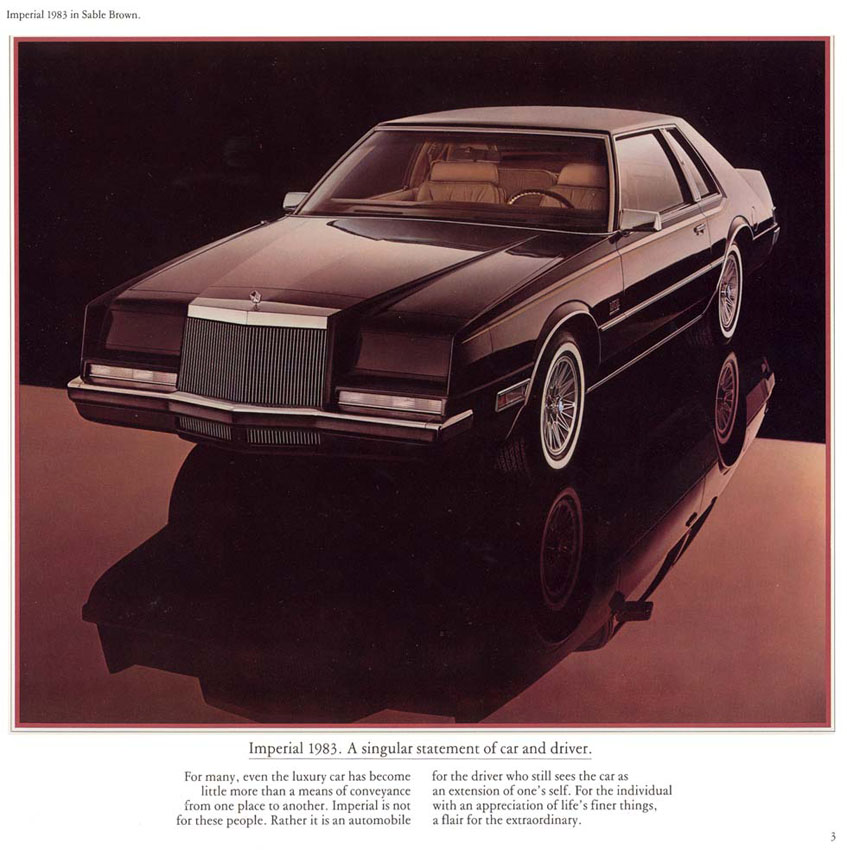
Page from the 1983 Chrysler Imperial brochure

Standard mechanical equipment for the quite well-equipped for 1983 $18,688 Imperial (approximately $61,500 in today’s dollars) included halogen headlights, power brakes, power steering, cruise control, and Goodyear Arriva P205/75R15 steel-belted radial whitewall tires (a size still readily available) on cast aluminum wheels. Exterior equipment included power heated mirrors, power windows, intermittent windshield wipers, and a rear window defroster. Interior equipment included “semi-automatic” air conditioning, a tilt steering wheel, leather and vinyl 60/40 power seats, and a 30-watt AM/FM stereo with cassette and power antenna.

Unusual standard equipment for 1983 in any car included an electronic instrument cluster, a garage door opener, and a two-year/30,000-mile warranty (a lot of warranty in those unreliable days). The only extra cost option was high altitude emissions ($75—why did Chrysler cheap out at this point?); no cost options included cloth and vinyl seats, Michelin tires, and wire wheel covers. Unlike in 1981 and 1982, there was no Frank Sinatra edition for 1983.

The View From 2025

Especially from the rear, the Imperial looks a lot like Cadillac’s 1980 Seville redesign, but seems to have been a separate idea—exterior design had begun in 1977. Not surprisingly, allpar.com has an interesting and detailed article on the 1981-1983 Chrysler Imperial—it is here.

According to Hagerty’s valuation tools, a 1983 Chrysler Imperial in #1/Concours condition is $26,100, with a more normal #3/Good condition car fetching $7,600. Imperials appear in the Hemmings Motor News classifieds and very occasionally on Bring a Trailer. When I updated this entry in April 2025, a Goldenrod Crystal Coat 1982 with 111,000 miles was available on Hemmings, asking $19,800.

Make mine Formal Black, please.

Other real-wheel-drive eighties Chryslers I have written about include the 1980 Cordoba coupe, the 1981 New Yorker sedan, the 1983 Cordoba coupe, and the 1987 Fifth Avenue sedan.

Last updated September 2025.

1983 Isuzu Impulse hatchback coupe

“Follow Your Impulse”

1983 was the first model year that Isuzu’s Impulse (known as the Piazza in most other parts of the world) became available in the United States. The first-generation Impulse was built on a variant of the aging rear-drive T-body chassis used by the lowly Chevrolet Chevette but was definitely aimed at a notably different market.

The Impulse came much better equipped than any Chevette: standard mechanical equipment for the $9,998 base price (about $32,300 in 2025 dollars) included four-wheel disc brakes and P195/60R14 tires (a size still readily available) on 14-inch alloy wheels. Inside, power steering, power windows, power door locks, cruise control, air conditioning, tinted glass, a tilt steering wheel, and an AM/FM stereo radio were all included. Optional equipment was spare, with only an improved stereo and turbine wheels available.

For 1983, power for the 2,700-pound Impulse was provided by a 90 bhp 1.9 liter/119 ci SOHC inline four with multi-point fuel injection (a turbocharged engine would not become available until 1985). Transmissions available were a standard five-speed manual and an optional four-speed automatic. Fuel economy with the manual transmission was 22 city/28 highway by the day’s standards (19/26 by 2025 standards). 0-60 took between 12 to 13 seconds, with a top speed of about 110 mph. With a 15.3-gallon fuel tank, you could expect a range of between 310 and 345 miles with a 10% fuel reserve.

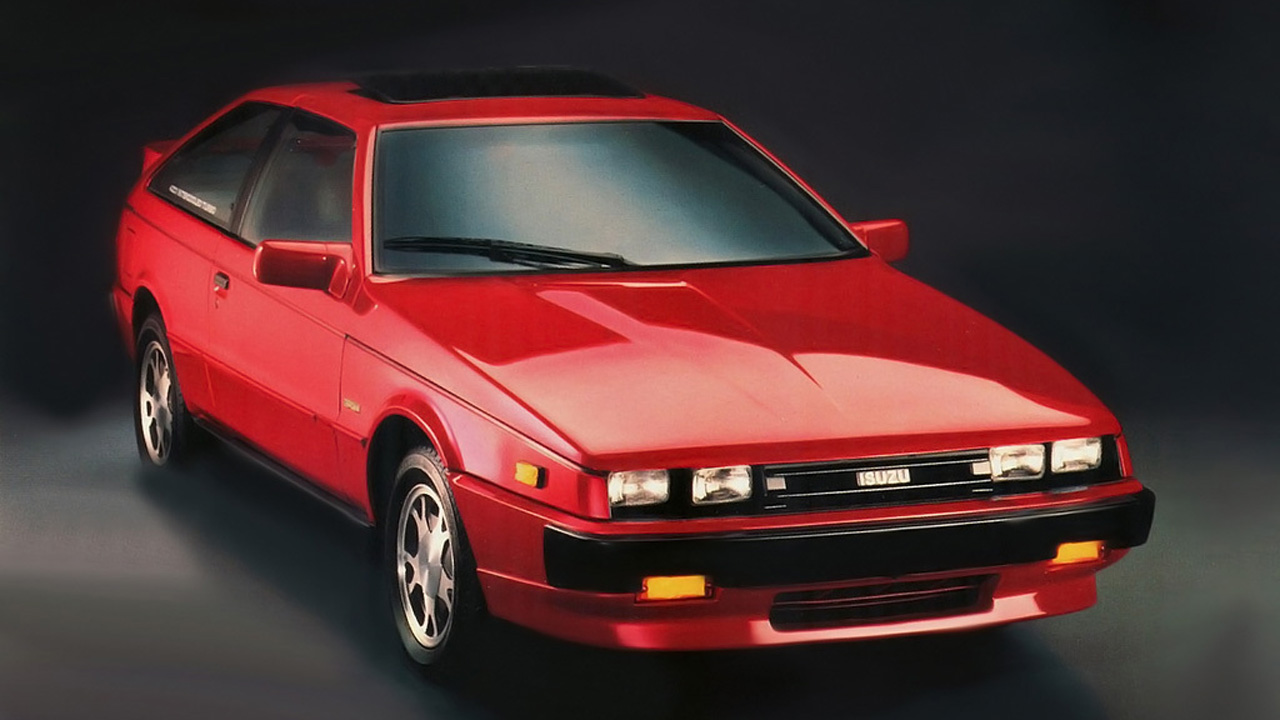
Of course, the Impulse’s absolute killer feature was its exterior styling, which was very close to Giorgetto Giugiaro’s 1979 Ace Of Clubs show car. Road & Track put the Impulse on the cover of their June 1983 issue, with the tagline being “Sensuous show car hits the road.”

First-generation Isuzu Impulse, courtesy of Isuzu.

Isuzu must get real credit for messing as little as possible with Giugiaro’s excellent and differentiating design—few automakers were willing to leave as well enough alone as they did. They changed only a few things, adding slightly larger bumpers to meet the five mph DOT requirement, shortening the windshield and lengthening the hood to allow for easier installation of the engine on the assembly line, and enlarging the overall dimensions a few inches to allow for more interior space.

Isuzu also made the interior as close as possible to the original show car. In particular, two pods on either side of the steering wheel included most controls—and they adjusted with the standard tilt steering. All four seats were adjustable—rear seat adjustability was very unusual in subcompact cars in the 1980s.

The View From 2025

Impulses of this generation are rarely seen in the Hemming’s Motor News classifieds or on eBay Motors. They do occasionally appear on Bring a Trailer, with a 1984 Impulse auctioning off in November 2024.

Make mine Black, please.

Last updated in February 2025.

1983 Ferrari 512 BBi coupe

I used to live about a mile from a Ferrari dealership. As I walked near it back in 2014, I saw a trailer parked around the corner with a low-slung sports car inside. Getting a little closer showed that it was definitely a 512. “Now that’s a Ferrari!”, I said. The man unloading the car chuckled as I walked away.

For 1983, Ferrari’s lovely Pinanfarina-designed 512 BBi received few, if any, changes. The BBi’s engine was Ferrari’s Tipo F110 A 340 bhp 4.9 liter/302 ci flat 12 with Bosch K-Jetronic fuel injection—the 512 had moved to fuel injection (and added the i) for the 1982 model year. When paired with the five-speed manual transmission, 0-60 came in about 5.5 seconds with a top speed of 170 mph or so—fast, fast, fast for 1983.

Photo of a 1983 Ferrari 512 BBi
Photo of a 1983 Ferrari 512 BBi, courtesy of Wikipedia photographer dave_7

Ferraris had gotten more luxurious: standard equipment on the 512 BBi included air conditioning (often said to be inadequate), leather seats, power mirrors, power windows, power door locks driven from the key, a Nardi steering wheel, and a Pioneer AM/FM stereo cassette deck with 7-band graphic equalizer.

Although the 512 BBi was not legal in the U.S., some importers converted them to U.S. specifications by adding catalytic converters, side reflectors, and larger bumpers.

Of course, there’s a fairly famous eighties music video associated with this car.

Sammy Hagar may have his issues, but the 512 BBi he drives in the video made for this song demonstrates exquisite taste. When interviewed by Motor Trend in 2008, he still owned it.

The View From 2025

There’s some really excellent support for 512s (and all Ferraris) from the folks on FerrariChat (who contributed to the original version of this post). According to Hagerty’s valuation tools, all the money for a 1983 512 BBi in #1/Concours condition is $345,000 (though recent auction results may make that seem low). A more “normal” #3/Good condition example is valued at $224,000. Ferrari 512s frequently appear for sale in the Hemmings Motor News classifieds, on Bring a Trailer, and at in-person auctions.

Make mine Rosso Corsa (red), please, though I’m quite tempted by how they look in Grigio (grey).

Other Ferraris I have written about include the 1985 308 GTB Quattrovalvole coupe and the 1985 Testarossa coupe.

Last updated February 2025.

1983 Audi Quattro hatchback coupe

“Totally different by design.”

Audi’s Quattro had been changing the perception of all-wheel-drive in Europe since late 1980, but finally made it to American soil for the 1983 model year with a few modifications (such as larger bumpers) specific to the market.

The only available engine was the WX turbocharged and fuel0-injected 2.1 liter inline five cylinder making 160 bhp and running on premium gas. This engine was paired with a five-speed manual transmission connected to (of course!) the Quattro generation I all-wheel-drive system with manually lockable center and rear differentials. Motor Trend clocked a 1983 Quattro with a 0-60 time of 7.9 seconds—not bad for the early eighties. Fuel economy was 17 city/28 highway by the day’s standards (14/20 by today’s measures).

The Quattro was an expensive car, especially for an eighties Audi—almost three times the cost of the far more plebeian Audi 80 coupe it was based on (and whose squarish styling it closely resembled). At $35,000 (about $114,000 in 2025 dollars), it was approximately $5,000 more than a 1983 Porsche 911. But, there was nothing like it.

Page from the 1983 Audi Quattro brochure

All 1983 Quattros included tinted glass, front and rear spoilers, halogen headlamps, an independent suspension, four-wheel power-assisted disc brakes, power rack and pinion steering, and 205/60R15 steel-belted radial tires (a size still readily available) on 6J x 15-inch light-alloy wheels. Inside, power door locks, power window lifts, full gauges, cruise control, and an AM/FM stereo cassette were all included.

Options & Production Numbers

Options for the 1983 Quattro were few—a removable sunroof panel ($450), special metallic exterior paint, leather upholstery ($1,500), electrically heated front seats, floor mats, and a rear-window wiper/washer ($210).

Total sales in the United States were only 664 over the three years between 1983 and 1985.

The View From 2025

Original (“Ur”) Quattros have a strong following. Quattros sometimes appear in the Hemming’s Motor News classifieds and Bring a Trailer, but there just aren’t that many to sell. According to Hagerty’s valuation tools, all the money for a 1983 Audi Quattro in #1/Concours condition is $100,000. A more “normal” Quattro in #3/Good condition is valued at $47,100.

Color is a tough choice here, but I’m going to violate my usual “it is a German car, it looks good in silver” rule and ask that mine be Mars Red.

The only other Audi I have written about is the 1984 5000S sedan.

Last updated April 2025.

1983 Mitsubishi Starion hatchback coupe

Bring a Trailer had a Plymouth Conquest (the badge-engineered version of the Starion) up for auction in February 2025. I learned enough from the comments to want to update this elderly blog entry.

“The sportscar that’s charged with more than a turbo.”

The 1983 Mitsubishi Starion was a significant change of pace for Mitsubishi. Seen back in the day as a poor man’s Porsche 944 at about two-thirds of the price, the rear-wheel-drive Starion reached customers that Mitsubishi had never competed for before. Because of Chrysler’s relationship with Mitsubishi, nearly identical cars were sold starting in 1985, first as the Plymouth Conquest and Dodge Conquest and then as the Chrysler Conquest beginning in 1987 (gotta love branding).

For 1983, motive power was provided by the Astron G54B 145 bhp 2.6 liter/156 ci inline four with fuel injection and a turbocharger connected to a five-speed manual (no automatic transmission was available in 1983). 0-60 came in about 9 seconds in a car that weighed about 2,700 pounds. Mileage was 19 city/24 highway by the standards of the day (17/22 by today’s standards). With a relatively large 19.8-gallon gas tank, a Starion owner could expect a range of between 310 and 385 miles with a 10% fuel reserve.

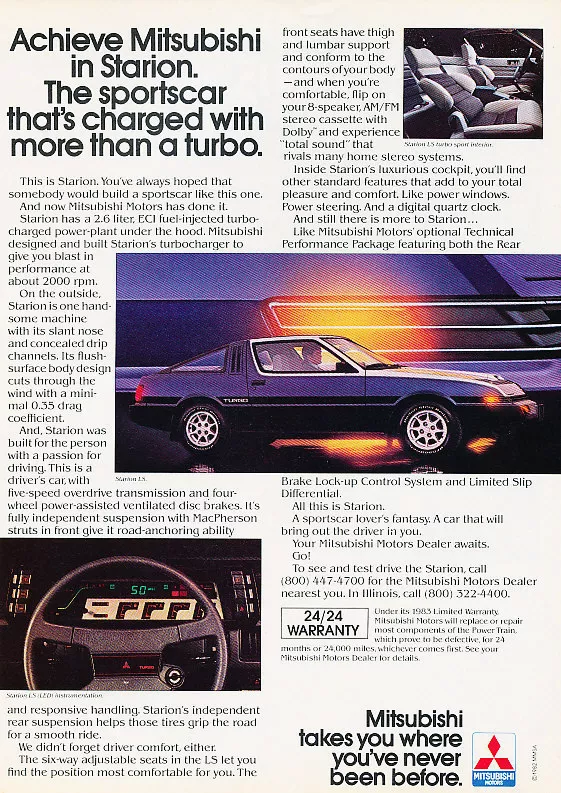
1983 Mitsubishi Starion advertisement

At $12,079 (about $39,500 in today’s dollars), the base Starion EX included a fully independent suspension, four-wheel power-assisted ventilated disc brakes, power steering, P195/70R14 tires (a size still readily available), and 14-inch alloy wheels. Inside, power windows and a digital quartz clock were standard. Moving up to the LS—an additional $1,840, making the car a $45,600 purchase in 2025—added P215/60R15 tires and 15-inch wheels, air conditioning, six-way adjustable front seats, digital instrumentation, and an AM/FM stereo cassette with eight speakers.

Options & Production Numbers

Options included a sunroof, cruise control, and the Technical Performance Package. LS purchasers could go crazy and get leather seat facings and a single two-tone paint option (Italian Silver over Behring Blue Metallic).

Mitsubishi sold 6,297 Starions in the 1983 model year—pretty good for a make and model with little previous sporting reputation in North America. Period reviews were generally positive, and watching MotorWeek‘s treatment is interesting.

The View From 2025

I have not seen a Starion on the road in decades, but at least a few are being saved, and there is some online support. A quick perusal shows that lack of maintenance of the complex for its day engine causes most of the serious issues with this car.

You occasionally see Starions come up for sale in the Hemmings Motor News classifieds or on eBay Motors, but there were none for sale when I last checked—the later 3000 GT does better. Bring a Trailer auctions a fair amount—enough to have a specific category.

Make mine Safari Red, of course.

Last updated June 2025.

1983 Honda Civic S hatchback coupe

Finding detailed information about the 1983 Honda Civic S turned out to be surprisingly hard, so this was initially my first “Short Take”—a post that I didn’t consider long enough to be a complete discussion. Time and better sources have changed that.

“We Make It Simple”

Honda continued to hit on all (four) cylinders in 1983 with the introduction of the Civic S.

The engine in the S was not specific to it, but was the optional EM 1.5 liter/91 ci inline four with a three-barrel carburetor, making 63 bhp. Car and Driver recorded a 0-60 time of 12.1 seconds and a top speed of 94 mph in the last of the second-generation Civics—only six years earlier, the Civic’s 0-60 time had been about 15 seconds. Mileage with the standard five-speed manual transmission was 35 city/46 highway by the day’s standards. With a 10.8-gallon gas tank, a Civic S driver could expect a range of 320 to 350 miles with a 10% fuel reserve.

1983 Honda Civic brochure cover

At $6,399 (about $21,100 in 2025 dollars and about 32% less than a 2025 Honda Civic hatchback costs), the 1500 S was the top of the two-door hatchback line and over 30% more than the base 1300 model. A handsome little car, the Civic S was fitted with firmer suspension (with rear stabilizer bar) and 165/70R13 Michelin tires (a size still available thanks to Vredestein) on 13-inch wheels. A red accent stripe encircled the S—this, a black grille, and blackout paint around the window frames set it apart from other Civics. Standard equipment on the S included a front spoiler, a tachometer, and a quartz digital clock.

Standard equipment on all 1983 Civics included front wheel drive, rack and pinion steering, power-assisted front disc/rear drum brakes, and MacPherson struts on all four corners. Inside, full carpeting, reclining front bucket seats with adjustable headrests, and a fold-down rear seat were included. Dealer-installed options included air conditioning and a radio.

The View From 2025

Second-generation Civics rarely show up for sale in the Hemmings Motor News classifieds but have more of a presence on eBay Motors—though most are either highly modified or with substantial miles. Bring a Trailer has auctioned nine examples from this Civic generation, including one black Civic S.

There were only two color choices for a 1983 Civic S. Make mine Black, please.

Other Hondas I have written about include the 1983 Accord sedan, the 1984 Civic DX hatchback coupe, the 1984 Civic CRX hatchback coupe, the 1985 CRX Si hatchback coupe, the 1986 Accord sedan, the 1986 Prelude Si coupe, and the 1988 Civic sedan.

Last updated August 2025.