1981 Chrysler LeBaron coupe

“A personal car with classic style.”

1981 was the final model year for the coupe version of Chrysler’s M body, which had been around since 1977. For Chrysler, that last coupe would be the LeBaron.

The LeBaron’s standard engine was the 85 bhp Slant Six 3.7 liter/225 ci inline six with a one-barrel carburetor. Optional power was provided by the LA 130 bhp 5.2 liter/318 ci V8 with a two-barrel carburetor—an upcharge of $62. No matter what engine the buyer selected, the transmission was a three-speed TorqueFlite automatic.

For no apparent reason, both engines had higher horsepower ratings in California. The reason is more evident for the V8—California got a four-barrel carburetor (along with 35 more horsepower), while the other 49 states only rated a two-barrel. However, the Slant Six got a one-barrel carburetor in all fifty states, but five more horsepower in California. All of this meant that the California V8 version of the LeBaron was a relative screamer—almost two seconds faster in the 0-60 sprint than the 49 states version.

For 1981, the coupe was available in Special, Salon, and Medallion versions. Standard mechanical equipment on the $6,672 Special (about $25,600 in today’s dollars) included power steering, power front disc/rear drum brakes, and P195/75R15 glass-belted radial-ply white sidewall tires (a size still available in whitewall thanks to Coker Tire) on 15-inch Safety-Rim wheels with Deluxe wheel covers. Inside, a cloth and vinyl front bench seat and a glove box lock were included. Individual totals for the Special coupe and sedan are unknown, but the combined total was 11,980.

Coupe page from the 1981 Chrysler LeBaron brochure
Salon coupe page from the 1981 Chrysler LeBaron brochure

The $7,263 Salon added body-side accent stripes, dual horns, a left outside remote mirror, a day/night inside mirror, and a cloth and vinyl front seat with a center armrest. Chrysler built 17,485 LeBaron Salon coupes and sedans in the 1981 model year.

The $7,768 Medallion added a padded vinyl Landau roof, sill molding extensions, a rear deck accent stripe, Premier wheel covers, a trunk dress-up, a 60/40 cloth front seat, and a Luxury steering wheel. Only 7,635 1981 LeBaron Medallion coupes and sedans were produced.

Groups, Packages, & Individual Options

Many groups and packages were available with the LeBaron, and their pricing varied depending on whether you were starting with a Special, a Salon, or a Medallion.

  • The Deluxe Wiper/Washer Package included Deluxe windshield wipers with intermittent wipe and a windshield washer fluid level indicator.
  • The Light Package ($85-$99) included map/dome reading lights, a glove box light, an ash receiver light, fuel, temperature, and alternator warning lights, and a trunk light.
  • The Basic Group ($937-$1125) included tinted glass on all windows, a padded vinyl Landau roof, dual horns, manual air conditioning, and an AM radio. It also included both the Deluxe Wiper/Washer Package and the Light Package.
  • The Sport Appearance Package ($154-$258) included color-keyed styled steel road wheels, dual sport-styled remote control mirrors (painted or chromed), and a Luxury two-spoke steering wheel.
  • The Two-Tone Paint Package ($158) included a choice of two two-tone exterior paint combinations and color-break body accent stripes.
  • The Handling Package ($163) included special Firm-Feel power steering, heavy-duty shock absorbers, heavy-duty rear springs, a rear sway bar, and P205/75R15 steel-belted radial wider whitewall tires on extra-wide wheel rims.
  • The Protection Group ($58-$67) included door edge protectors and front and rear color-keyed floormats.
  • The Deluxe Insulation Package ($10-$109) included undercoating, special sound insulation, and a trunk dress-up.

Individual exterior and mechanical options included Starmist paint ($55), halogen headlamps ($40), a T-bar roof ($695), a power glass sunroof ($865), wire wheel covers ($106-$249), and forged aluminum wheels ($183-$326). Inside, cloth/vinyl bucket seats ($101 for the Salon coupe), a console ($106 for the Salon coupe), a leather-covered steering wheel ($21-$60), air conditioning ($606), automatic temperature control air conditioning ($656), power windows ($145-$202), and power door locks ($96-$136) were available. A series of seven radios ranged up to an AM/FM stereo radio with a CB ($355-$447).

The View From 2025

These LeBarons are rare on the ground, but they have not completely vanished. They’re gone from the Hemmings Motor News classifieds and eBay Motors, but Bring a Trailer has sold eight of this generation of LeBaron in the last six years, two of them coupes.

Make mine Burnished Silver Metallic, please. Just like in the brochure.

Other rear-wheel-drive coupes from Chrysler Corporation that I have written about include the 1980 Chrysler Cordoba, the 1983 Chrysler Cordoba, and the 1983 Imperial. I have written posts about two other M-bodies—the 1987 Chrysler Fifth Avenue sedan and the 1989 Dodge Diplomat sedan. Other 1981 personal luxury coupes include the Chevrolet Monte Carlo Sport Coupe and the Oldsmobile Cutlass Supreme.

1981 Chrysler New Yorker sedan

“So many reasons for superiority.”

For 1981, Chrysler’s full-size New Yorker sedan got few changes. The 5.9 liter/360 ci V8 was no longer available, but the optional four-barrel version of the 5.2 liter/318 ci V8 received a horsepower bump. There was a new grille, but otherwise, changes between a 1980 and a 1981 New Yorker are tricky to spot.

The standard powertrain for the New Yorker was the 130 bhp LA 5.2 liter/318 ci V8 with a two-barrel carburetor mated to a TorqueFlite three-speed automatic transmission. New Yorker buyers could choose a four-barrel version of the same engine ($68) that was rated at a respectable for 1981 165 bhp.

No matter which engine, performance was unimpressive in a car with a 3,900-pound curb weight. The 0-60 time was likely a little over 14 seconds with the base engine, with the optional mill dropping that number by about two seconds. Fuel economy was 17 city/26 highway by the day’s standards with the base engine and 16 highway/23 with the uprated one. With a 20.9-gallon gas tank, a New Yorker owner could expect a range of 330 to 405 miles with a 10% fuel reserve.

New Yorker page from the 1981 full-size Chrysler brochure

Standard exterior and mechanical equipment on the $10,463 1981 New Yorker (about $39,500 in today’s dollars) included tinted glass on all windows, a Landau padded vinyl roof, power front disc/rear drum brakes, and P205/75R15 steel-belted wide white sidewall tires on 15-inch wheels with Premier wheel covers. Inside, cloth and vinyl 60/40 individually adjustable seats with folding center armrest and passenger seat recliner, a Luxury steering wheel, manual control air conditioning, power windows, and an AM/FM stereo radio were included. Standard on the New Yorker, the Light Package included a trunk light, a glove box light, an ash receiver light, a rear door courtesy light, and an under hood light.

Packages, Options, & Production Numbers

Chrysler’s marketers seem to have reacted to challenging market conditions by giving buyers many choices of packages and options. Package choices for the New Yorker included:

  • The Basic package ($156) included a vinyl body-side molding, a right remote control convex mirror, deluxe windshield wipers, and undercoating.
  • The Premium Speaker System ($95) included two front and two piezo electric two-way coaxial rear speakers, along with a 15 watt per channel rear amplifier.
  • The Heavy-Duty package included a heavy-duty suspension, a 3.2 axle ratio, an auxiliary transmission oil cooler, a power steering oil cooler, and a 500-amp Long Life Maintenance Free battery. It required the optional four-barrel carburetted V8 and P225/70R15 steel belted radial tires.
  • The Open Road Handling package ($180) included a Firm Feel suspension (front and rear heavy-duty sway bars, heavy-duty shock absorbers, heavy-duty front torsion bars, heavy-duty rear springs), special Firm Feel power steering, and P225/70R15 steel belted wider white sidewall radial tires.
  • The Fifth Avenue Edition package ($1,822) included halogen headlights, cornering lamps, front fender louvers, special lighted quarter windows, wire wheel covers, a conventional spare tire, and a 500-amp Long Life Maintenance Free battery. Inside, Fifth Avenue buyers got a left power seat, deep pile carpets, front and rear floor mats, a Luxury steering with leather-wrapped rim, a tilt steering column, semi automatic temperature control air conditioning, semi-automatic speed control, power door locks, and a power deck lid. They also got the Premium Speaker System and a choice of four stereos, along with a power antenna (except with the CB choice).
  • The Carriage Roof package ($854) was only available with the Fifth Avenue Edition. It included a brushed stainless steel forward half roof cap and a padded Landau top with a small frenched backlight, bright surround moldings, and a forward bright transverse molding with integral electro luminescent lights.

Individual exterior and mechanical options included special paint ($68), a halogen headlamp system ($41), a power operated glass sun roof ($934), and styled aluminum road wheels ($321, $70 with the Fifth Avenue Edition). Inside, a leather 60/40 bench seat ($676), a tilt steering wheel ($84), and an electrically heated rear window defroster ($112 and required in New York State) were available. Three stereos were optional for the New Yorker, with the most pricey being the AM/FM stereo with a CB transceiver and a fixed tri band antenna ($261 and included with the Fifth Avenue Edition). A well-equipped New Yorker could easily run to about $13,300—real money in 1981 and about $50,100 in today’s dollars.

Despite the hopeful brochure slogans, it was clear in 1981 that the era of the big Chrysler was ending—New Yorker sales were off 36% to 6,548. The situation with the less-expensive Newport was even worse, with a decline of 67%. By the 1982 model year, full-size Chryslers would be gone, with the M-body New Yorker mid-size being Chrysler’s new top-of-the-line sedan. The R-bodies had only lasted three model years.

There were many reasons for this failure. Probably made worse by frightening build complexity, Chrysler’s quality was at perhaps its absolute nadir, and the word had gotten out. Overall automotive market conditions were also not great, with the early eighties being tough for many marques. Finally, there was legitimate and realistic concern that Chrysler might go out of business.

The View From 2025

There are not a lot of these handsome cars left. Hagerty doesn’t track New Yorkers built after 1970, so it’s hard to get a feel for values. They occasionally appear in the Hemmings Motor News classifieds, on eBay Motors, and on Bring a Trailer. In March 2025, a 1980 New Yorker Fifth Avenue Edition hammered for $11,000 at Mecum Glendale.

Make mine the extra-cost Mahogany Starmist, please.

Other eighties Chryslers I have written about include the 1980 Cordoba coupe, the 1982 LeBaron convertible, the 1983 Imperial coupe, the 1984 Laser hatchback coupe, the 1986 Town & Country convertible, and the 1987 Fifth Avenue sedan.

1981 Ford Mustang coupe

“Sleek with clean lines that slice through the wind.”

For 1981, Ford’s Mustang gained a “rakish” new optional T-Roof and the availability of power windows. The base seats were now reclining. Otherwise, things generally stood pat.

The 1981 Mustang’s standard powertrain was the Lima 88 bhp 2.3 liter/140 ci inline-four paired with a four-speed manual transmission. Optional engines included the Thriftpower 94 bhp 3.3 liter/200 ci inline six ($213) and a 120 bhp 4.2 liter/255 ci V8 ($263). A five-speed manual ($152 and only available with the inline-four) and a Select-Shift automatic ($349 and required with the V8) were offered. Despite being relatively light, no 1981 Mustang was fast—Car and Driver recorded an 11.2 second 0-60 time with the V8.

EPA fuel economy ratings ranged from 23 mpg with the inline-four engine and either of the two manual transmissions to 19 mpg with either the inline six/four-speed or the V8/automatic transmission combinations. With a small 12.4-gallon gas tank, a Mustang V8 owner could expect a mere 190 to 210 miles with a 10% fuel reserve.

Standard Equipment, Sub-Models, & Packages

Standard equipment on all Mustangs included dual rectangular halogen headlamps, front disc/rear drum brakes, rack and pinion steering, and 13-inch P-metric steel-belted radial-ply tires on 13-inch wheels. Inside, fully reclining vinyl high-back front bucket seats, color-keyed cut-pile carpeting, and an AM radio were included.

The notchback and hatchback (Ford insisted on calling them 2-Door and 3-Door) had slightly different standard equipment. The notchback/2-Door went for $6,171 and included color keyed rear pillar louvers, full wheel covers, and a Deluxe steering wheel. The hatchback/3-door went for $6,408 (about $24,100 in today’s dollars) and included black rear pillar louvers, Sport wheels, a fold-down rear seat, and a Sports steering wheel.

The Ghia—available as a $6,645 notchback or a $6,729 hatchback—added Ghia insignia, bright rocker panel moldings, pinstripes, dual black remote control mirrors, and 14-inch P-metric steel-belted radial-ply tires on 14-inch wheels with turbine wheel covers. Inside, Ghia buyers got the Ghia sound insulation package, Luxury color-keyed cut-pile carpeting, and a Luxury 4-spoke steering wheel.

Cobra pages from the 1981 Mustang brochure

Mechanically, the $1,588 Cobra package added a Sport-tuned exhaust with bright tailpipe extension, a Handling Suspension System, and 195/65R 390 Michelin TRX black sidewall tires on 15.3-inch forged metric aluminum wheels. Exterior Cobra features included a Black lower Tu-Tone paint treatment, a front end integral spoiler, dual fog lamps, a non-functional rear-opening hood scoop, and a rear end spoiler. Internal Cobra features included an 8,000 RPM tachometer, black engine-turned design appliques, and a Cobra medallion on the instrument panel. A 2.3 liter turbocharged engine was initially supposed to be part of the Cobra package (and showed up in some brochures), but Ford tabled it in the United States because of reliability issues in the 1980 model year. A base Cobra was $7,966—about $30,000 in today’s dollars, which is almost what a base 2025 Mustang EcoBoost fastback goes for.

Options & Production Numbers

Exterior and mechanical options for all Mustangs included tinted glass ($76), metallic glow paint ($48), Tu-Tone paint, a flip-up open air roof, a T-Roof ($874), power front disc brakes ($76), variable ratio power steering ($163), and a Traction-Lok differential ($64). Inside, Recaro high-back bucket seats ($732), a console ($168), the SelectAire Conditioner ($560), a tilt steering wheel, two different leather-wrapped steering wheels (Sport or Luxury), fingertip speed control ($132), and power side windows ($140) were available. A choice of stereos ranging up to an AM/FM stereo radio with a cassette tape player ($174) could be ordered.

Options that look weird to our 2025 eyes included a carriage roof ($644) or a full vinyl roof ($115), both for the notchback only. Notchback purchasers could also specify an Interior Accent Group, which included a Deluxe sound package, fully relining low-back front bucket seats in a higher level of vinyl, and a passenger visor vanity mirror. Black liftgate louvers ($145) and a rear window wiper/washer ($85) could be ordered for the hatchback.

Mustang sales were lower in 1981 model year than in 1980, but automotive sales were generally down due to the concurrent recession. The base car continued to be by far the most popular—with the notchback (77,458 sold) and the hatchback (77,399) split almost exactly. Ghia‘s were also divided evenly—13,422 notchbacks and 14,273 hatchbacks. Only 1,821 hatchbacks were ordered with the Cobra package, which would be gone when the 1982 model year came around—more than replaced by the GT.

The View From 2025

According to Hagerty’s valuation tools, all the money for a 1981 Cobra V8 fastback in #1/Concours condition is $37,300, with a more normal #3/Good base Mustang inline four notchback going for $12,900. 1981 Mustangs sometimes appear in the Hemming’s Motor News classifieds, on eBay Motors, and on Bring a Trailer, but the absence of an impressive stock engine does seem to hold them back compared to the 1982 and later models.

Make mine Dark Cordovan Metallic, please.

Other Mustangs I have written about include the 1980 Cobra hatchback coupe, the 1982 GT hatchback coupe, the 1983 GT convertible, and the 1984 SVO hatchback coupe. I guess I’ll have to get to the second half of the Mustang’s decade at some point.

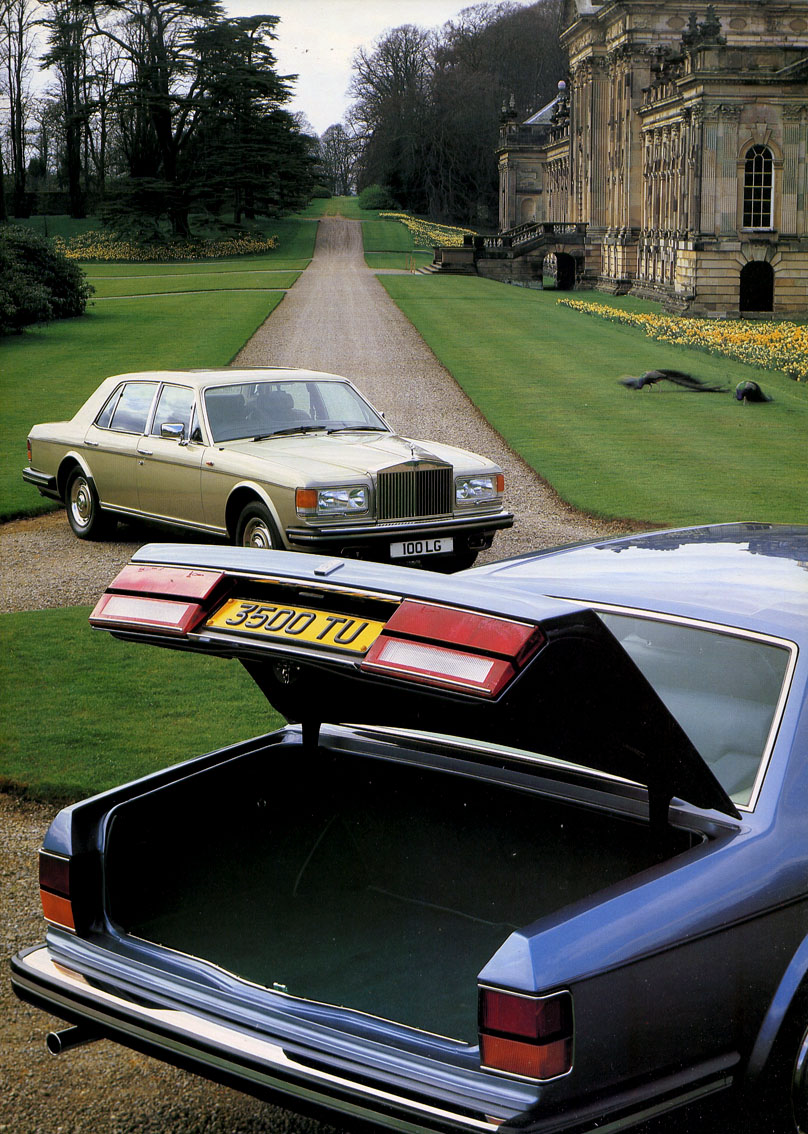
1981 Rolls-Royce Silver Spirit Mk 1 sedan

“Inheriting All The Traditions Of The Best Car In The World”

The introduction of the Silver Spirit in the United States waited one year after the model’s debut in England. The Silver Spirit and the slightly lengthened Silver Spur followed the long-running Silver Shadow and Silver Wraith II models.

The powertrain for Rolls-Royce sedans remained a 6.75 liter/413 ci V8 mated with a three-speed automatic. In 1981 guise with Bosch K-Jetronic fuel injection, the venerable V8 (development had begun in 1952) was rated at 175 bhp. Despite the Silver Spirit’s 4,900-pound curb weight, Car and Driver recorded a respectable 10.8-second 0-60 time. Fuel mileage was distinctly unrespectable—rated at 10 city/13 highway and triggering a $650 gas guzzler tax. With a large 28.6-gallon gas tank, a Silver Spirit owner could expect a range of 265 to 295 miles with a 10% fuel reserve.

The Silver Spirit retailed for an astounding $109,000—about $410,100 in 2025 dollars. This price was at a time when a top-of-the-line Mercedes-Benz 380 SEL went for $44,300, and the comparable BMW 733i was $32,000. Cadillac’s range-topping Seville was a “mere” $23,400.

Page from the 1981 Rolls-Royce Silver Spirit brochure

Standard exterior and mechanical equipment on the Silver Spirit included power-assisted rack and pinion steering, power four-wheel disc brakes, and 235/70HR-15 Michelin XVX tires (a size and type still readily available) on 15-inch wheels. Inside, wood burl trim, leather upholstery, adjustable front bucket seats, automatic speed control, automatic temperature control, and a Blaupunkt Bucharest stereo radio with a cassette player and four speakers were included. There were no formal options, though the factory would satisfy almost any color, upholstery, or trim request for an additional charge.

The View From 2025

Like all Rolls-Royces, the Silver Spirit attracts collector interest, and there is support from the Rolls-Royce forums. Like many late-model Rolls-Royces, Silver Spirits face extreme depreciation because of the costs of deferred maintenance.

According to Hagerty’s valuation tools, a 1981 Rolls-Royce Silver Spirit in #1/Concours condition is $16,300, with a more normal #3/Good condition car going for $8,200. Silver Spirits sometimes appear for sale in the Hemming’s Motor News classifieds, on eBay Motors, and on Bring a Trailer.

Make mine Tudor Red, please.

The Silver Spirit is the first Rolls-Royce I have written about, though I did write about the closely related 1989 Bentley Turbo R sedan. Thus, I have not yet written about the Camargue coupe or the Corniche convertible.

1981 Mercedes-Benz 380 SEL sedan

“Most capable cars in 95 years”

For 1981, Mercedes-Benz’s big W126 S-Class sedan made its way into the North American market after a year of sales in Europe. There were two offerings—a 300 SD diesel sedan and a 380 SEL with an extended wheelbase. The BMW 733i and the Jaguar XJ6 Series III were putative competitors, though the new Mercedes was considerably more expensive.

The 380 SEL’s only available powertrain was the M116 155 bhp 3.8 liter/234 ci V8 with Bosch K-Jetronic fuel injection paired with a four-speed automatic transmission. Road & Track clocked a 0-60 time of 10.1 seconds in a car with a 3,800-pound curb weight while mileage was 17 mpg by the day’s standards. With a relatively large 23.8-gallon fuel tank, range was between 330 and 365 miles with a 10% reserve.

1981 Mercedes-Benz 380 SEL and 300 SD advertisement

The 380 SEL listed for an eye-watering $44,298—about $165,900 in today’s dollars (a modern S 580 4MATIC sedan starts at $128,600). Standard exterior and mechanical included tinted glass, halogen head lamps, an automatic power antenna, power assisted four-wheel disc brakes, power steering, and Michelin XVS 205/70HR-14 tires (a size still available) on 14-inch light alloy wheels. Interior equipment included 8-way electrically adjusted front seats, an electrically adjustable rear seat, a choice of leather or velour upholstery, cruise control, climate control, electric windows, a central locking system, and an electronic AM/FM stereo radio with a cassette player.

Options, Production Numbers, & Period Reviews

Since the 380 SEL came loaded, there were not a lot of options beyond the exterior and interior colors. An electrically operated sliding roof ($795) and heated seats ($360) were available.

Production numbers are hard to come by, but an estimated 20,000 380 SELs were imported into the United States for the 1981 model year. Period reviews were extremely positive—Road & Track concluded theirs with “quite simply, Mercedes’ new S-class is a class unto itself.”

The View From 2025

There is excellent club support for the 380 SEL, as there is for almost all Mercedes-Benz’s. That same club support warns potential buyers against the M116 engine’s notorious timing chain issues, though I believe nearly all of the original single chains have been replaced with double chains by now. There’s also frequent mention that the 380 SEL’s climate control did not meet the standards of domestic luxury car manufacturers in the early eighties.

That said, the W126 is frequently cited as the best S-class ever made—substantially improving over the already impressive W116.

According to Hagerty’s valuation tools, all the money for a 1981 Mercedes-Benz 380 SEL in #1 condition is $42,600, with a more normal #3 condition car going for $13,400. 380 SELs frequently appear for sale in the Hemming’s Motor News classifieds, on eBay Motors, and on Bring A Trailer.

Make mine Astral Silver Metallic, please.

Other Mercedes-Benz models I have written about included the 1980 450SL convertible, the 1985 380SL convertible, the 1985 300SD coupe, the 1986 560SEC coupe, and the 1989 560SL convertible.

1981 Volkswagen Dasher station wagon

A 1981 Volkswagen Dasher station wagon sold for $7,600 on Bring a Trailer in February 2025. It was a brown diesel with a manual transmission—directly mapping to a certain internet cliché (except for being front-wheel-drive). I’m relatively spare on Volkswagen blog entries, so here we go.

“More luxury. More space.”

The Volkswagen Dasher station wagon was a small car, classified by the EPA as a subcompact. Its 97.2-inch wheelbase was half a foot shorter than the 2025 Golf GTI’s and its curb weight was slightly less than 2,200 pounds. Putative compact station wagon competition for the 1981 Dasher included the Ford Escort, the Honda Civic, the Plymouth Reliant, and the Renault 18i Sportwagon.

For its eighth and final year, the Dasher station wagon’s only powertrain was a 52 bhp 1.6 liter/97 ci diesel four paired with a four-speed manual transmission. Fuel mileage was quite good—36 mpg by the day’s standards. Diesel Dashers were slow, slow, slow—even by 1981 standards. 0-60 came in 19.3 seconds and VW claimed a top speed of 85 mph.

1981 Volkswagen print advertisement

Standard exterior and mechanical equipment on the $9,040 Dasher station wagon (about $34,400 in today’s dollars or about what a loaded 2025 Volkswagen Taos SEL compact SUV goes for) included front-wheel-drive, rack and pinion steering, power-assisted self-adjusting front disc/rear drum brakes, an electric rear window defogger/defroster, and 155/80R13 steel belted radial tires (a size still available from Kumho and Michelin) on 13-inch wheels with wheel covers. Inside, a padded steering wheel, a trip odometer, a quartz crystal chronometer, a wood-grained instrument panel, cut pile carpeting, and reclining front bucket seats in crushed velour were included.

Options

Options included tinted glass ($70), a manual sunroof ($260), 175/70R13 white sidewall tires ($130), air conditioning ($620), leatherette upholstery ($65), and an AM/FM stereo radio ($275).

The View From 2025

Dashers have largely vanished, which is what made so many take notice of that recent Bring a Trailer offering. There is limited collector interest in these cars, so it isn’t that surprising that Hagerty’s valuation tools do not track any 1981 Volkswagens. Dashers rarely appear in the Hemming’s Motor News classifieds, on eBay Motors, or on Bring a TrailerBaT has sold a grand total of three Dashers in eleven years.

Make mine Helios Blue Metallic, please.

Other Volkswagens I have written about include the 1981 Scirocco S hatchback coupe, the 1983 Rabbit GTI hatchback coupe, and the 1985 Cabriolet.

Last updated July 2025.

1980 Datsun 200-SX coupe

A 1980 Datsun 200-SX coupe sold for $10,000 at the 2025 Barrett-Jackson Scottsdale auction.

“Thrill-injected”

Datsun’s 200-SX was almost entirely new for 1980, with exterior styling notably changed and a significantly enhanced engine. Nissan advertised improved visibility and increased door opening for 1980, but the real upgrade was that the 200-SX was no longer as weird-looking as the 1975-1979 had been. Nissan was in the process of transitioning away from the Datsun name, so the 200-SX’s official name was a clunky “Datsun 200-SX by Nissan.” No matter what, marketing used 200-SX instead of 200SX in 1980, so I’ll follow that in this post.

The only engine available for the 1980 200-SX was the NAPS-Z Z20E 100 bhp 2.0 liter/120 ci inline four with L-Jetronic electronic fuel injection paired with either a five-speed manual or a three-speed automatic. Car and Driver recorded a 0-60 time of 13.3 seconds in the 2,620-pound coupe. EPA fuel economy ratings with the five-speed were 28 city/40 highway—with a 14.0-gallon gas tank, a 200-SX coupe’s owner could expect a range of 430 miles with a 10% fuel reserve.

200-SX pages from the 1980 Datsun brochure

Standard exterior and mechanical equipment on the $6,689 1980 200-SX Deluxe (about $28,300 in 2025 dollars or just a little more than a 2025 Nissan Altima S costs) included four-wheel power-assisted disc brakes, partially recessed windshield wipers, and 185/70SR14 tires (a size still readily available) on 14-inch wheels with full mag style wheel covers. Inside, a quartz sweephand clock, deep pile carpeting, and full reclining front bucket seats with soft vinyl upholstery were included.

Options & Production Numbers

The Sport Luxury (SL) package upgraded 200-SX buyers to soft cloth upholstery, a multi-warning system, a driver’s seat with adjustable lumbar and thigh support, and a four speaker AM/FM stereo radio with power antenna.

The 1980 200-SX had few individual options, and most of them—except for California emissions—seem to have been available only if you had already ponied up for the SL package. These options included power steering, a lift-out skyroof, two-tone paint, and air conditioning.

The buff books liked the 200-SX for its intended purpose—Car and Driver wrote that the new version had “better looks and better manners.” They gently asked for more power, but that would be a long time coming and only in slight increases for the coupe. The 200-SX got 103 bhp in 1982, and the third-generation coupe got 105 bhp in mid-1984 (only the hatchback would get the 133 bhp turbo option).

Nissan sold 92,514 200-SX coupes and hatchbacks in 1980—a notable success, and soundly beating many competitors. This version of the 200-SX would run for four years.

The View From 2025

There is limited collector interest in these second-generation 200-SXs, so it isn’t that surprising that Hagerty’s valuation tools do not track any eighties Datsuns or Nissans other than the Z-cars and Skylines. Eighties 200-SXs rarely appear in the Hemming’s Motor News classifieds, eBay Motors, or Bring a Trailer.

Make mine Satin Blue Metallic, please.

Other Datsuns I have written about include the 1980 280ZX hatchback coupe and the 1981 810 Maxima sedan. Later Nissans I have posted on include the 1984 300ZX hatchback coupe and the 1989 Maxima sedan.

1981 Volkswagen Scirocco S hatchback coupe

I’ve liked the styling of the first-generation Scirocco since it was new. It was, of course, designed by one of the all-time masters.

“For the most discriminating and demanding sports car enthusiasts”

1981 was the final model year for the first-generation Scirocco, which was first available in North America in 1975. Though the Scirocco used the same platform as the Golf, it was actually released about six months before the Golf.

With its basic form penned by Giorgetto Giugiaro—who seemed to have a hand in nearly every 1970s Volkswagen design—the Scirocco debuted at the 1973 Geneva Motor Show. Like the Karmann Ghia that it putatively replaced, the Scirocco was assembled by Karmann.

Classified as sub-compact by the EPA, the Scirocco was not a large car—its 155.7-inch length is more than a foot shorter than the current Golf GTI. For 1981, the configuration of the Scirocco sold in North America moved to a slightly large 1.7 liter engine, transitioned the standard transmission from a four-speed manual to a five-speed manual, and offered a new Scirocco S package.

The Scirocco’s standard powertrain was the EA827 74 bhp 1.7 liter/105 ci inline four with fuel injection mated with a five-speed manual. A three-speed automatic was optional. With a curb weight of 1,892 pounds, 0-60 came in a little over 11 seconds. Fuel economy was rated at 25 city/40 highway by the day’s standards. With a 10.6-gallon gas tank, a Scirocco owner could expect a range of 280 to 310 miles with a 10% fuel reserve.

Scirocco S pages from the 1981 brochure

Standard mechanical features on the $8,495 Scirocco (about $32,000 in today’s dollars or almost exactly what a 2025 Golf GTI goes for) included front-wheel-drive, rack-and-pinion steering, power-assisted front disc/rear drum brakes, and 175/70SR13 steel-belted radial tires (a size still readily available) on 13-inch wheels. Inside, a tachometer, a trip odometer, and front bucket seats were standard.

Packages & Options

A new package for 1981 was the S, which included black trim, a red VW radiator badge and belt-line moulding, a larger front spoiler, light alloy wheels, and specially designed striped cloth sport seats. The S package was available in three of the eight standard Scirocco colors and cost $520.

Options for the Scirocco were few—a sunroof, a rear window wiper/washer, the aforementioned three-speed automatic transmission, and air conditioning.

The View From 2025

First-generation Sciroccos attract collector interest, and there is club support. They are sometimes available in the Hemmings Motor News classifieds, on eBay Motors, and at online auctions such as Bring a Trailer that cater to the eighties car market.

Make mine Cirrus Gray Metallic, please.

Other Volkswagens I have written about include the 1981 Dasher station wagon, the 1983 Rabbit GTI hatchback coupe, and the 1985 Cabriolet.

Last updated April 2025.

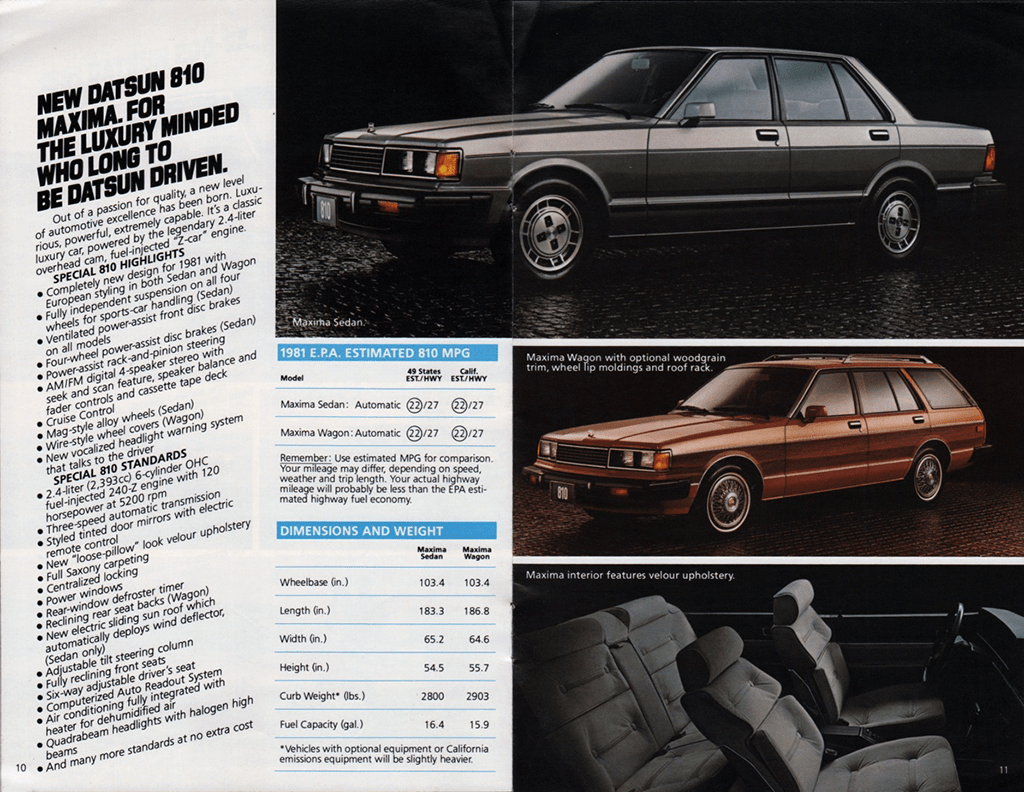
1981 Datsun 810 Maxima sedan

“For the luxury minded who long to be Datsun driven.”

1981 brought the nicest Datsun yet for America, in the form of the 810 Maxima sedan. Datsun aimed high, advertising the Maxima as having the “luxury of a Mercedes” and the “sophistication of a Cadillac.” Nissan was in the process of transitioning away from the Datsun name, so the Maxima‘s official name was a clunky “Datsun 810 Maxima by Nissan.”

The only powertrain initially available for the Maxima was the L24E 118 bhp 2.4 liter/146 ci inline six with Bosch L-Jetronic fuel injection paired with a three-speed automatic. Luxury did not mean quick in 1981—Car and Driver recorded a 0-60 time of 10.5 seconds in a car with a 2,880-pound curb weight. EPA fuel economy ratings were 22 city/27 highway—with a 16.4-gallon gas tank, a Maxima owner could expect a range of 295 to 325 miles with a 10% fuel reserve. In the middle of the model year, the LD28 90 bhp 2.8 liter/170 ci diesel engine became available, with an impressive 28 city/35 highway rating,

Despite being the top of Datsun’s sedan line and “the roomiest and most comfortable Datsun ever created” to that point, the Maxima was not a particularly large car. With a 183.3 inch length, it was less than half an inch longer than today’s Nissan Sentra, which is classified as a compact car. In advertisements, Datsun stated that the Maxima was “about the size of a BMW 528i at less than half the price.” Both of these claims were true, but the Maxima was not yet a “4-Door Sports Car.”

810 Maxima pages from the 1981 Datsun brochure

Standard exterior equipment on the $10,879 1981 Maxima (about $41,400 in 2025 dollars or almost 25% more than a 2025 Nissan Altima SL sedan costs) included an electric sliding sun roof and Quadrabeam headlights with halogen high beams. Mechanical equipment included a fully independent suspension, power-assisted rack-and-pinion steering, four-wheel power-assisted disc brakes, and 185/70SR14 tires (a size still readily available) on 14-inch “mag-style” alloy wheels. Inside, centralized locking, power controls, a tilt steering column, cruise control, and an AM/FM digital four-speaker stereo with a cassette player were included. Standard upholstery included “loose-pillow” velour seats, fully reclining front seats, a six-way adjustable driver’s seat, and full Saxony carpeting. Famously, an early version of the vocalized warning system warned a Maxima‘s driver when the headlights were on.

There were few, if any, options available for the 1981 Maxima sedan. Reviews of the day generally liked the new car’s exterior styling, but the “buff books” complained that the Maxima was only available with a three-speed automatic and velour upholstery. Car and Driver‘s write-up in April 1981 stated: “What we have here seems to be a clear case of over-Americanization.”

The View From 2025

It isn’t that surprising that Hagerty’s valuation tools do not track any eighties Datsuns other than the Z-cars. Eighties Maximas rarely show up in the Hemming’s Motor News classifieds or on eBay Motors. Bring a Trailer has sold a grand total of one 1981 Maxima—which was a diesel.

Make mine Medium Gray Metallic, please.

I have also written about the much sportier 1989 Nissan Maxima sedan.

Last updated August 2025.

1981 Triumph TR8 convertible

“Test drive the incredibly responsive TR8 today”

In its final year, Triumph’s TR8 gained Bosch L-Jetronic fuel injection for all fifty states (in 1980, fuel injection had been California-only). The original “the shape of things to come” TR7 design from 1975 remained, but the internals had come a long way.

Though the TRs had always been the “big” Triumphs since their introduction in 1953, big was a relative term. With a length of 160.1 inches, the TR8 was about six inches longer than today’s Mazda Miata convertible.

The standard powertrain was the Rover 133 bhp 3.5 liter/215 ci aluminum block V8 with Bosch L-Jetronic fuel injection paired with a five-speed manual transmission (a three-speed automatic was optional). That V8, of course, had its basic design dating from the 1961 model year and originally came from Buick.

The TR8’s performance was good compared to many sporty cars in 1981; 0-60 mph came in about 8.5 seconds in the 2,654-pound car. Fuel economy was rated at 16 mpg by the standards of the day. With a smallish 14.6-gallon fuel tank, a TR8 driver could expect a range of about 210 miles with a 10% fuel reserve.

1981 Triumph TR8 convertible advertisement

Standard exterior equipment on the rather dear $13,900 TR8 convertible (about $52,600 in today’s dollars) included a central hood bulge, tinted glass, and TR8 badges to easily differentiate it from the four-cylinder TR7. Mechanical equipment included dual exhausts, power-assisted rack-and-pinion steering, power front disc/ rear drum brakes, and 185/70HR13 steel-belted radial tires (a size still readily available) on 13 x 5.5 inch alloy wheels. Inside, full instrumentation, a heater/defroster with a three-speed fan, fully reclining multi-adjustable bucket seats, and a center console with a storage bin and lockable glovebox were included.

Options, Reviews, & Sales Numbers

Optional equipment included fog lamps, a luggage rack, air conditioning, and three different radios. Of these, only the air conditioning was an option from the factory—all other options were dealer-installed.

Reviews of the TR8 in the automotive press were reasonably complementary, which may have been at least partially because convertibles had become so rare. The V8 drew a lot of positive mentions, as did the roomy cockpit. Observed faults included the steering wheel blocking some gauges, the tiny ashtrays (it was indeed a different age), and the rear-mounted battery’s intrusion into the otherwise reasonably capacious trunk.

The 1981 TR8 was an unusual car even when new—a mere 415 were sold, compared to, say, the 40,408 only slightly more expensive Corvettes that Chevrolet managed to move in that same model year.

The View From 2025

Like all Triumphs, TR8s have a following and regularly appear in the Hemming’s Motor News classifieds and on Bring a Trailer. According to Hagerty’s valuation tools, all the money for a 1981 TR8 convertible in #1/Concours condition is $40,800, with a far more typical #3/Good car going for $12,200.

Many TR8s and TR7s had colors and color names that were very much of their age; examples are Aran Beige, Champagne, French Blue, Mimosa, Topaz, and Vermilion. Make mine the somewhat more conservative Poseidon Green Metallic, please.

Other cars from the UK that I have written about include the 1980 MG MGB convertible, the 1982 Rolls-Royce Silver Spirit MK 1 sedan, the 1982 Jaguar XJ-S H.E. coupe, the 1983 Jaguar XJ6 sedan, the 1987 Sterling 825 sedan, the 1989 Bentley Turbo R sedan, and the 1989 Jaguar XJ-S convertible.

Last updated May 2025.