1980 Pontiac Firebird Turbo Trans Am coupe

Photo of 1980 Pontiac Firebird Turbo Trans Am coupe
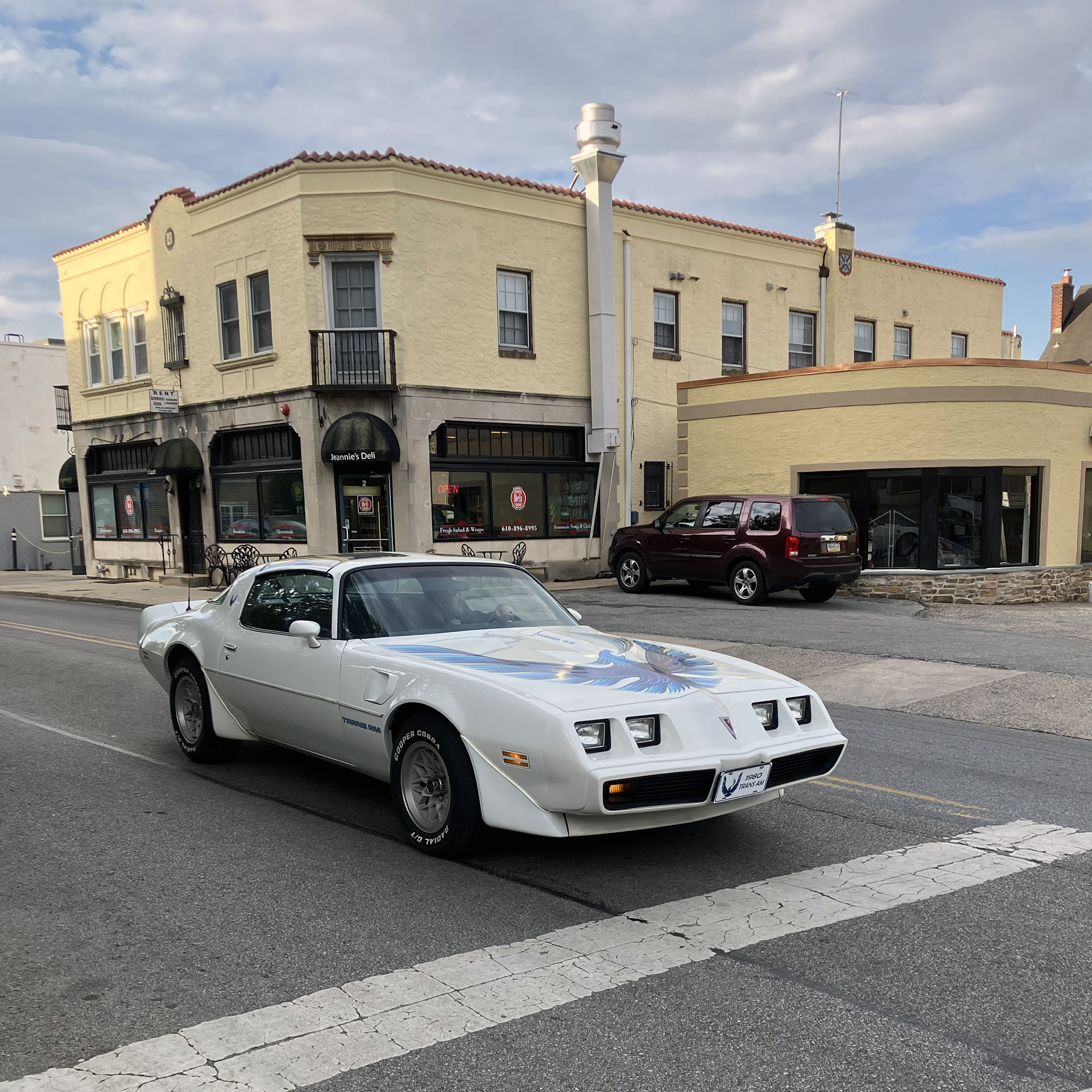
The 1980 Pontiac Firebird Turbo Trans Am coupe my fiancée saw

On a lovely spring morning in early 2025, my fiancée was walking from her house toward the temporary train station in Ardmore, PA. On her way to the station, she saw and (more importantly for this blog post) photographed a 1980 Pontiac Firebird Turbo Trans Am in Cameo White smoothly idling at a stop sign. Underneath the image she texted me, she wrote, “You are escorting me to the train.”

“You picked a winner.”

1980 was a transitional year mechanically for the second-generation Firebird and its Trans Am sub-model, though little else of significance changed. Gone was the 6.6 liter/403 ci V8, with the new top-of-the-line engine being a 4.9 liter/301 cu V8 with a turbocharger. Along with the engine changes, there was an asymmetrical hood design and a special hood decal for the Turbo Trans Am.

Pontiac could not do much about the general lack of space efficiency (the EPA rated the Firebird as a subcompact car), the high curb weight (about 3,700 pounds when the Mustang weighed about 2,800), and the relatively primitive technology.

Engines & Transmissions

The standard Trans Am engine was the Pontiac-built L37 155 bhp 4.9 liter/301 ci V8 with a four-barrel carburetor. The only choice for Trans Am purchasers in California was the Chevrolet-built LG4 145 bhp 5.0 liter/305 ci V8 with a four-barrel carburetor, but you did get a $180 credit.

The Trans Am’s most powerful engine was the $350 Pontiac-built LU8 210 bhp 4.9 liter/301 ci V8 with a Rochester Quadrajet four-barrel carburetor and an AiResearch TBO305 turbocharger. The turbo engine was emissions-certified only with the combination of air conditioning and a 3.08:1 rear axle ratio. All Trans Ams in 1980 came with a three-speed automatic—a one-year pause for the four-speed manual as Pontiac struggled to meet emissions regulations.

Combining a turbocharger, a carburetor, and primitive electronic engine controls was not easy, and reviews of one of the world’s first turbo V8s were mixed. The relatively primitive gas of the day meant that Pontiac had to retard the spark advance substantially to minimize detonation, which kept the turbocharger’s power return relatively low. As Car and Driver stated, “by the time the engine reaches 4000 rpm, the show is essential­ly over.”

Performance & Standard Equipment

A Turbo Trans Am would accelerate from 0-60 in a little over eight seconds (Car and Driver clocked 8.2), which was good for 1980. Fuel mileage was predictably bad—15 city/21 highway mpg by the day’s standards for the combination of the turbo engine and the automatic. With a 20.8-gallon fuel tank, Trans Am owners could expect to travel about 280 to 305 miles before refueling.

Standard exterior and mechanical equipment included in the $7,179 base price of the Trans Am (about $30,900 in today’s dollars) included a front center air dam, dual rectangular headlamps, a black-accented grille, a shaker hood and air cleaner, front and rear wheel opening air deflectors, a rear deck spoiler, a limited slip differential, power steering, power front disc/rear drum brakes, and 225/70-R15 blackwall tires (a size still readily available) on 15-inch Rally II wheels with trim rings. Inside, front bucket seats, a Formula steering wheel, a machined-trimmed instrument panel trim plate, rally gauges with a quartz clock and a tachometer, and a console were included.

Two Special Editions, Options, & Production Numbers

The black-and-gold Trans Am Special Edition package was $748 additional over a base Trans Am—$1,443 bundled with the removable locking hatch roof (otherwise known as T-tops). It included many exterior paint and trim details, including a gold/matte gold hood bird decal, gold headlight grilles, and gold wheels with gold center cap bird emblems. Inside, a gold dash panel, a gold-spoked steering wheel, gold door emblems, and a gold shifter emblem were included. 6,178 buyers took home a Special Edition—about 12% of Trans Am production.

Print advertisement for 1980 Pontiac Firebird Trans Am Pace Car
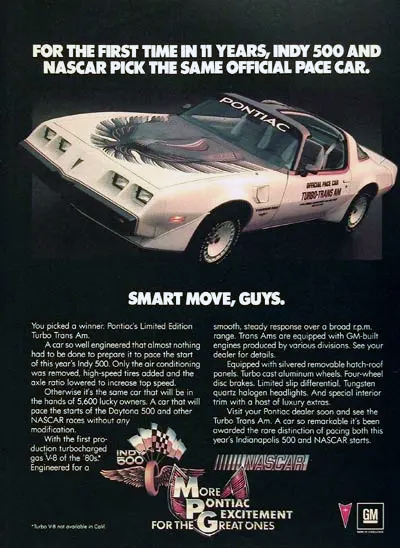
Print advertisement for the 1980 Pontiac Trans Am Pace Car

There was also a special edition of the Special Edition in completely different colors—the Indianapolis Pace Car Edition. The Indianapolis Pace Car Edition was Cameo White, with Soft Ray tinted glass on all windows, white Turbo cast aluminum wheels, silver T-tops, and oyster interior trim. Mechanical features included the LU8 turbocharged engine, turbo boost gauges, the WS6 special performance package, and four-wheel power disc brakes. Inside, a leather-wrapped steering wheel, Custom air conditioning, and a Delco-GM ETR AM/FM radio with a cassette player were included. All this extra content was a good thing because the Indianapolis Pace Car Edition listed for $11,020.52 (why not just round to the closest dollar?)—about $47,500 in 2025 dollars. After initially promising 5,600 in advertising, Pontiac ended up building 5,700, about 11% of 1980 Trans Am production.

Exterior and mechanical options available for the Trans Am included the WS6 special performance package ($281), tungsten quartz halogen headlamps ($27), white-lettered tires ($68), Turbo cast aluminum wheels, four-wheel power disc brakes ($162), and an automatic power antenna ($50). Inside, an electric rear window defroster ($107), power door locks ($93), Custom air conditioning ($566), a tilt steering wheel ($81), controlled cycle windshield wipers ($41), and a host of radios (seven!) were all available.

Pontiac built a total of 50,896 Trans Ams in the 1980 model year, with 22,176 (44%) having the turbo engine.

The View From 2025

Initially neglected by the collector car market and with many now used up, late second-generation Trans Ams in good or excellent shape are now getting interesting numbers—almost doubling in the past fifteen years. According to Hagerty’s valuation tools, all the money for a 1980 Turbo Trans Am with T-tops in #1/Concours condition is $69,000, while a more normal Turbo Trans Am in #3/Good condition is valued at $24,900. These Trans Ams are often available in the Hemmings Motor News classifieds, on eBay Motors, and on Bring A Trailer, and they frequently show up at in-person auctions.

Make mine the black-and-gold Special Edition, of course.

I evidently can’t help myself with eighties Trans Ams; I’ve also written about the 1981 coupe, the 1982 hatchback coupe, the 1984 15th Anniversary hatchback coupe, the 1985 hatchback coupe, and the 1989 Turbo hatchback coupe. I have also written about the 1986 SE hatchback coupe and the 1987 Formula hatchback coupe, but I probably should write about the base car at some point.

1980 Mercury Cougar XR-7 coupe

In October 2025, a Mercury Cougar XR-7 coupe with 16,000 miles came up for auction on Bring a Trailer. It was the first fifth-generation Cougar to appear on BaT—enough to get me to write a blog entry about this era of Mercury’s personal luxury car.

“From a pedigree of personal luxury.”

Mercury made big changes to the Cougar for the 1980 model year, moving from six separate models to just one. The Cougar sedan was gone entirely, and both the base and the Brougham coupes were no more. Only the XR-7 coupe remained, and it was all new.

The third Mercury based on the “Fox” platform (the Zephyr and the Capri had come first), the fifth-generation Cougar was one of the more radically downsized automobiles in the North American auto industry. In comparison to its 1979 predecessor, the 1980 Cougar XR-7 was 17 inches shorter and 700 pounds lighter.

Standard power for 1980 was a Windsor 118 bhp 4.2 liter/255 ci V8 with a Motorcraft two-barrel carburetor paired with a SelectShift three-speed automatic transmission. Powertrain upgrades were available; buyers could specify a $150 Windsor 131 bhp 4.9 liter/302 ci V8 with a two-barrel carburetor and then add a $138 automatic overdrive transmission (available only with that engine). Buyers who purchased both powertrain upgrades got a sprightlier car with a slightly longer range.

Windsor
(4.2 liter V8)
Windsor
(4.9 liter V8)
Windsor
(4.9 liter V8)
Transmission3-speed Select Shift3-speed Select Shift4-speed Automatic Overdrive
0-60 mph
(approximate)
14.9 seconds12.7 seconds11.1 seconds
Fuel mileage
(1982 standards)
18 city/26 highway17 city/26 highway17 city/29 highway
Range
(10% fuel reserve)
285 to 310 miles275 to 300 miles295 to 325 miles

The XR-7‘s base price was $6,569—about $28,300 in today’s dollars. Standard exterior and mechanical equipment included a half vinyl roof, variable ratio power rack-and-pinion steering, power front disc/rear drum brakes, and P185/75R14 black sidewall steel-belted radial tires on 14-inch wheels with full wheel covers. Inside, a cloth front Flight Bench seat, a four-spoke color-keyed steering wheel, a two-tier instrument panel, a trip odometer, and an analog clock were standard. The XR-7 had no standard radio of any type—interestingly, all Thunderbirds included at least an AM radio.

Groups, Individual Options, & Production Numbers

Mercury offered three groups to upgrade the base XR-7:

  • The Decor Group ($516) added Luxury wheel covers, dual bright remote control mirrors, Twin Comfort Lounge front seats, a Luxury steering wheel, and Deluxe seat belts
  • The Luxury Group ($1,987) added a Luxury half vinyl roof, dual remote control sail-mounted mirrors, and metric TR Type radial white sidewall tires on cast aluminum wheels. Inside, it included Twin Comfort Lounge front seats with Luxury trim, the Electronic Instrument Panel, a Luxury steering wheel, power windows, and Light Group
  • The Sports Group ($1,687) added a Tu-tone paint treatment, metric TR Type radial white sidewall tires on cast aluminum wheels, dual bright remote control mirrors, Recaro front bucket seats with a console, and power side windows

Individual options included tinted glass ($71), a flip-up moonroof ($219), air conditioning ($571), and automatic speed control ($108). Leather interior trim ($303) was only available with the Luxury Group. A choice of nine radios, ranging up to an AM/FM stereo with auto-search ($333), was available. A well-equipped Cougar XR-7 could easily reach $10,500—about $45,200 in 2025 dollars.

To say the market was not ready for the 1980 Cougar XR-7 is a distinct understatement. Despite a significantly higher level of standard equipment, the XR-7 was less than five inches longer than the Zephyr Z-7 coupe, whose base price was almost 20% less. Sales of Mercury’s halo coupe collapsed, dropping from 163,716 in 1979 to 58,082 in 1980, and losing substantial sales share during a year when none of the leading General Motors competitors in the personal luxury coupe market had more than a facelift.

The View From 2025

For unclear reasons, Hagerty’s valuation tools do not track any Cougar after 1973, although they do value Ford Thunderbirds through their entire production history. Fifth-generation Cougars occasionally appear in the Hemming’s Motor News classifieds and on eBay Motors. As I write this blog entry in October 2025, there’s a Medium Blue Metallic 1980 Cougar XR-7 coupe with a dark blue vinyl top and a blue interior for sale on Hemmings, showing 31,000 miles and asking $12,000.

Make mine the same Silver Metallic/Back Tu-tone that is in those brochure pages, please.

The only other Cougar I have written about so far is the 1988 XR-7 coupe. I’ve also written about the 1980 and 1982 versions of the Thunderbird. Other Mercury models include the 1983 Grand Marquis sedan, the 1984 Grand Marquis Colony Park LS station wagon, the 1986 Capri hatchback coupe, the 1987 Lynx XR3 hatchback coupe, and the 1988 Grand Marquis Colony Park station wagon.

1980 Buick Skylark sedan

“… a car to delight the driver in you.”

Along with the other X-cars, the Buick Skylark was all new for 1980. Only the model name was carried over as the Skylark moved from rear-wheel-drive to front-wheel-drive and downsized yet again, losing about a foot and a half in overall length.

The Skylark name was a long-running and important one to Buick. 1953’s gorgeous limited production Roadmaster Skylark convertible was followed by the smaller Century-based Skylark convertible in 1954. In the middle of the 1961 model year, the Skylark name was reintroduced as a luxury trim of the Special compact. For 1962, the Skylark became its own model. By 1964, the Skylark had become its own model line and had moved to an intermediate size. The intermediate rear wheel drive Skylark would continue for three generations (with one slight interruption in 1973-74).

Like with every other 1980 X-car, the Skylark’s standard engine was GM’s Iron Duke 90 bhp 2.5 liter/151 ci inline four with a Rochester Varajet II two-barrel carburetor, paired with a four-speed manual transmission. Fuel economy was 24 city/38 highway by the day’s standards (21/34 by today’s measures). With a 14-gallon gas tank, a Skylark’s driver could expect a range of 350 to 390 miles with a 10% fuel reserve. 0-60 times for the Iron Duke are hard to find, but were likely around 16 seconds for the four-speed manual transmission and probably about 19 seconds (oog) with the optional ($337) three-speed automatic transmission.

Spending $225 to upgrade to the LE2 2.8 liter/173 ci V6 with a Rochester Varajet II two-barrel carburetor got you 115 bhp and a 0-60 time of a little over 13 seconds. Fuel economy dropped substantially to 20 city/28 highway with the four-speed manual transmission. Moving to the three-speed automatic transmission dropped highway mileage to 27 mpg.

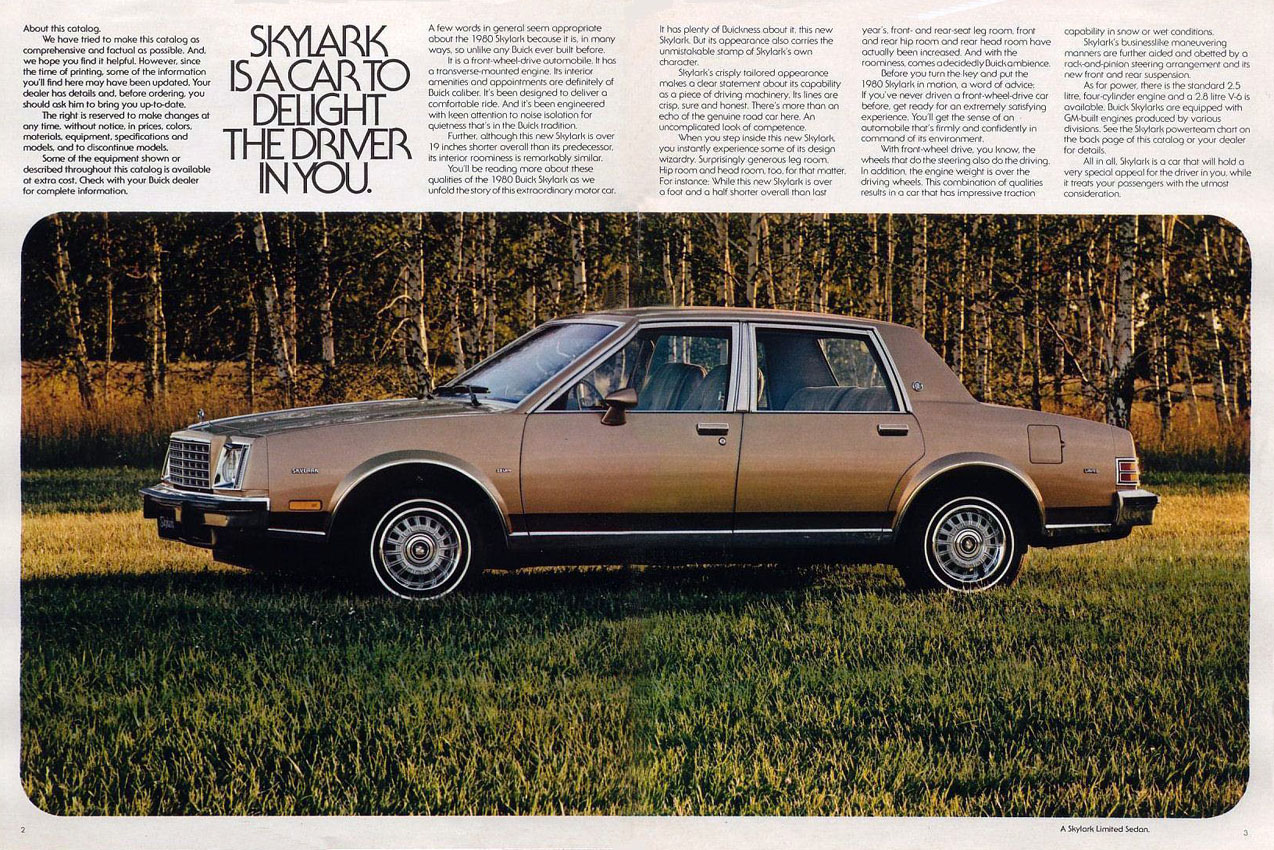
Sedan pages from the 1980 Buick Skylark brochure

Standard exterior and mechanical equipment on the $5,306 Buick Skylark sedan included front-wheel-drive, rack-and-pinion steering, front disc/rear drum brakes, and P185/80R13 fiberglass-belted radial-ply tires (a size now only marginally available) on 13-inch wheels. Inside, buyers got a no-cost choice of either a houndstooth cloth or a vinyl notchback front bench seat. A Delco AM radio with two front speakers and a windshield antenna was also included.

The $5,726 Skylark Limited included a distinctive hood ornament, wide rocker and wheel opening moldings, Deluxe wheel covers, and a gas strut under the hood. Inside, a choice of a Limited level brushed woven cloth or a vinyl notch back seat with a fold-down center armrest, door entry courtesy lights, a simulated wood grain instrument panel, a special acoustic insulation package, and a plush carpeted back window panel were present. Limited identification was, of course, included.

The $5,920 Skylark Sport Sedan included a specially styled grille, amber front park and turn lamps, front and rear bumper strips, black moldings, wheel opening moldings, Sport mirrors, smoked tail lamp lenses, a Rallye ride-and-handling package system, a larger rear stabilizer bar, and P205/70R-13 steel-belted radial-ply blackwall tires on Designers’ Sport wheels. Inside, the Sport Sedan included a Sport steering wheel and a black instrument panel with a voltmeter, a temperature gage, and a trip odometer.

Options & Production Numbers

The Skylark’s options list gives you a sense that Buick was trying to serve two masters. The base prices were affordable, but you could load the Skylark sedan up with thousands of dollars’ worth of options, bringing it close to a Century or a LeSabre.

Individual exterior and mechanical options for the Skylark included the Designers’ Accent paint treatment ($174), a Landau top, a long vinyl top, a Vista-Vent flip-open glass sunroof ($240), power steering ($164), power brakes ($76), and chrome-plated road wheels ($141). Inside, front bucket seats ($48), a 6-way power seat ($165), a full-length operating console, Cruise-Master speed control ($105), a tilt steering column ($75), air conditioning ($564), power windows ($189), and electric door locks ($123) were available.

Four Delco radios ranging up to an AM/FM stereo with a cassette tape player and a CB ($491) were available. Lower body sport stripes with a Hawk decal were available only for the Skylark Sports versions.

Buick sold 80,940 base Skylark sedans in the 1980 model year. Combined Limited and Sports Sedan sales totalled 86,948, with the vast majority being the Limited. The Skylark was 26% of Buick’s total production in 1980.

Despite an astounding nine recalls for the 1980 version, the Skylark’s yearly sales percentage declines were notably less than those of other X cars—by 1983, Buick was actually selling more Skylarks than Chevrolet was selling Citations. The fifth-generation Skylark sedan, which Buick called its “little limousine,” would continue through the 1985 model year and end up selling 729,523 copies over six model years.

The View From 2025

A few—but only a few—of the X-cars were saved, and Skylarks of this generation occasionally appear in the Hemming’s Motor News classifieds, on eBay Motors, and on Bring a Trailer.

Make mine Dark Red Metallic, please.

Other X-bodies I’ve written about in this blog included the 1980 Chevrolet Citation hatchback sedan, the 1981 Chevrolet Citation X-11 hatchback coupe, the 1982 Pontiac Phoenix SJ coupe, the 1983 Buick Skylark T TYPE coupe, the 1984 Oldsmobile Omega sedan, and the 1985 Chevrolet Citation II hatchback sedan.

1980 Porsche 911 SC coupe

“The Classic Sports Car Evolves”

For 1980, the SC version of Porsche’s long-running 911 continued with the Bosch K-Jetronic fuel-injected 172 bhp 3.0 liter/183 ci flat six. With the standard five-speed manual transmission, Car and Driver reached 60 mph in 6.0 seconds, with a top speed of 130 mph in the 2,700-pound 911 SC (the 2025 911 Carrera weighs approximately 3,350 pounds). Fuel mileage was 16 city/28 highway by the day’s standards with premium gas. With a 21.2-gallon gas tank, a 911 SC’s proud new owner could expect a 340 to 375 mile range with a 10% fuel reserve.

The 911 was certainly not an entry-level Porsche: in 1980, that was left to the 924 (starting at $15,970). The 911 SC’s $27,700 base price is about $119,300 in 2025 dollars and within 10% of what a 2025 911 Carrera coupe costs. Standard exterior and mechanical equipment included a front spoiler, tinted glass, a front oil cooler, rack and pinion steering, and four-wheel vented disc brakes. Inside, reclining front bucket seats, a center console, fold-down rear seats, power windows, an air conditioner, a quartz clock, a driver’s side mirror with electric defrost, and an electric rear window defogger were all standard.

Weissach Special Edition & Individual Options

1980 Porsche 911 SC Weissach Edition print advertisement

For 1980, American customers were offered a Special Edition 911 SC Weissach for a substantial $32,000 ($137,900 now or about what a 2025 911 Carrera T coupe costs). Porsche built 468 units, with included a flexible lip on the front spoiler, the original 911 Turbo Carerra’s wing on the decklid, Bilstein shocks, Fuchs wheels with Platinum Metallic painted centers, Pirelli CN30 radial tires, and Doric Gray leather front bucket seats with burgundy piping. Half were built in Black Metallic and half in Platinum Metallic.

Individual options for the 911 SC included metallic paint ($625), front rectangular fog lights, an electric sliding sunroof ($850), sport shock absorbers, Pirelli tires, and forged alloy wheels ($1,510). Inside, you could add genuine leather front bucket seats ($895), cruise control, a Porsche CR stereo, and an electric antenna with four speakers.

Period Reviews & Production Numbers

It’s hard to believe at this point, but in 1980 it was thought the 911 was on its way out, and car magazines considered this when they reviewed it. Car and Driver‘s tagline for their appreciative review was The Golden Oldie Hangs in There. Road & Track‘s equivalent was The more things change, the more they remain the same.

Porsche sold 4,242 911 SC coupes in the United States in the 1980 model year.

The View From 2025

911 SCs from the 1980s have held their values very well. According to Hagerty’s valuation tools, all the money for a 1980 Porsche 911 SC coupe in #1/Concours condition is $128,000, with a more normal #3/Good condition car going for $59,000. A targa version can sell for up to $123,000, while a Weissach Edition tops out at $133,000.

Porsche 911 SCs have (of course) excellent club support from many sources and are often available in the Hemmings Motor News classifieds, on eBay Motors, and on Bring a Trailer. As I updated this blog entry in October 2025, a Zinc Metallic 1982 coupe with a tan interior and 142,000 miles is for sale on Hemmings, asking $60,000.

Make mine Oak Green Metallic, please.

Other eighties Porsches I have written about include the 1980 924 hatchback coupe, the 1982 924 Turbo hatchback coupe, the 1982 928 hatchback coupe, the 1985 911 Carrera Cabriolet, the 1986 911 Turbo coupe, the 1986 944 Turbo hatchback coupe, the 1987 Porsche 911 Carrera coupe, and the 1988 944 hatchback coupe.

Last updated October 2025.

1980 Ford Pinto 2-door sedan

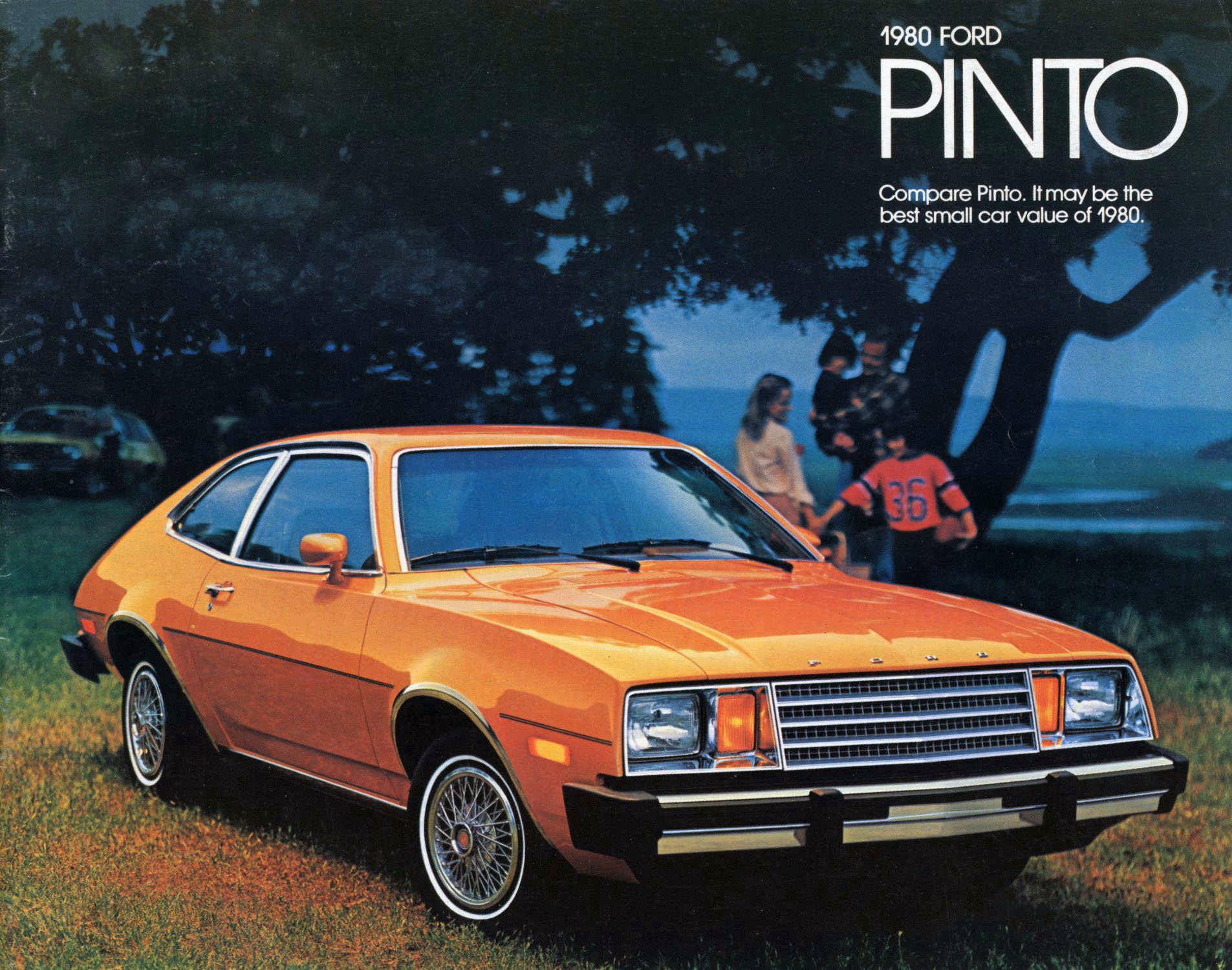
“It may be the best small car value of 1980.”

Ford’s Pinto was little changed in its final year, with minor trim and detail changes and the removal of the V6 engine option.

The only engine remaining was the Lima 88 bhp 2.3 liter/140 ci inline four with a two-barrel carburetor. A four-speed manual was standard, while a SelectShift automatic was optional ($340). 0-60 came in a little over 14 seconds with the manual. Fuel economy was 24 city/38 highway by the day’s standards. With a 13.0-gallon gas tank assembly that now included a longer fuel filler neck and a stronger fuel filler cap than in earlier years, a Pinto owner could expect a range of 295 to 325 miles with a 10% fuel reserve.

1980 Ford Pinto brochure cover

The 1980 Pinto 2-door sedan’s base price was $4,605—about $19,700 in today’s dollars and 30% less expensive than any 2025 Ford product. Standard exterior and mechanical equipment included tinted glass all around, vinyl insert bodyside moldings, rack and pinion steering, front disc/rear drum brakes, and 13-inch black sidewall steel-belted radial ply tires on 13-inch wheels with full wheel covers. Inside, all vinyl or cloth and vinyl high back bucket seats, a mini-console with a storage bin, and an AM pushbutton radio were included.

Packages, Options, & Production Numbers

The wide variety of packages and groups available for the 2-door sedan included:

  • Convenience Group ($118)—pivoting quarter windows, interval windshield wipers, day/night mirror, cigarette lighter
  • ESS Package ($313)—black accents, premium bodyside molding, styled steel wheels with trim rings, ESS nomenclature
  • Exterior Decor Group ($44)—bright grille and headlamp doors, along with bright rocker panel and wheellip moldings, bodyside accent stripes
  • Interior Accent Group ($50)—Deluxe steering wheel, day/night mirror, woodtone appliques, cigarette lighter, rear seat ashtray
  • Interior Decor Group ($238)—cloth/vinyl or all-vinyl low-back bucket seats, Deluxe door trim, Deluxe steering wheel, woodtone appliques, deluxe sound insulation package, courtesy light switch on passenger door
  • Light Group ($41)—map light, lights in glove box, ashtray, engine, and trunk, courtesy light switch on passenger door
  • Sports Package ($118)—3.08 performance rear axle with the manual transmission, Sport steering wheel with black metal spokes, instrumentation (tachometer, ammeter, temperature gauge)

Individual options included a flip-up open air roof ($219), Medium Red Glow metallic glow paint, a Tu-Tone paint/tape treatment, power front disc/rear drum brakes ($78), power steering ($160), the SelectAire conditioner ($538), and series of radios ranging up to an AM/FM stereo with cassette tape player and two door-mounted speakers ($191).

The best-selling Pinto remained the 2-door sedan (Ford’s description), which looked like it should be a hatchback but wasn’t. Ford sold 84,043 of the 2-door sedans (including the decontented Pony edition) compared to 61,542 of the Runabout, which actually was a hatchback but cost 3% more. The all-new Escort would follow in 1981, but that’s another story.

The View From 2025

I haven’t seen a Pinto in the wild for decades, and they have little presence in the Hemmings Motor News classifieds or on eBay Motors. Bring a Trailer has sold four 1980 Pintos in six years.

Make mine Dark Pine Metallic, please.

Other 1980 Fords I have written about include the Fairmont Futura coupe, the Mustang Cobra coupe, and the Thunderbird coupe.

1980 Ford Fairmont Futura coupe

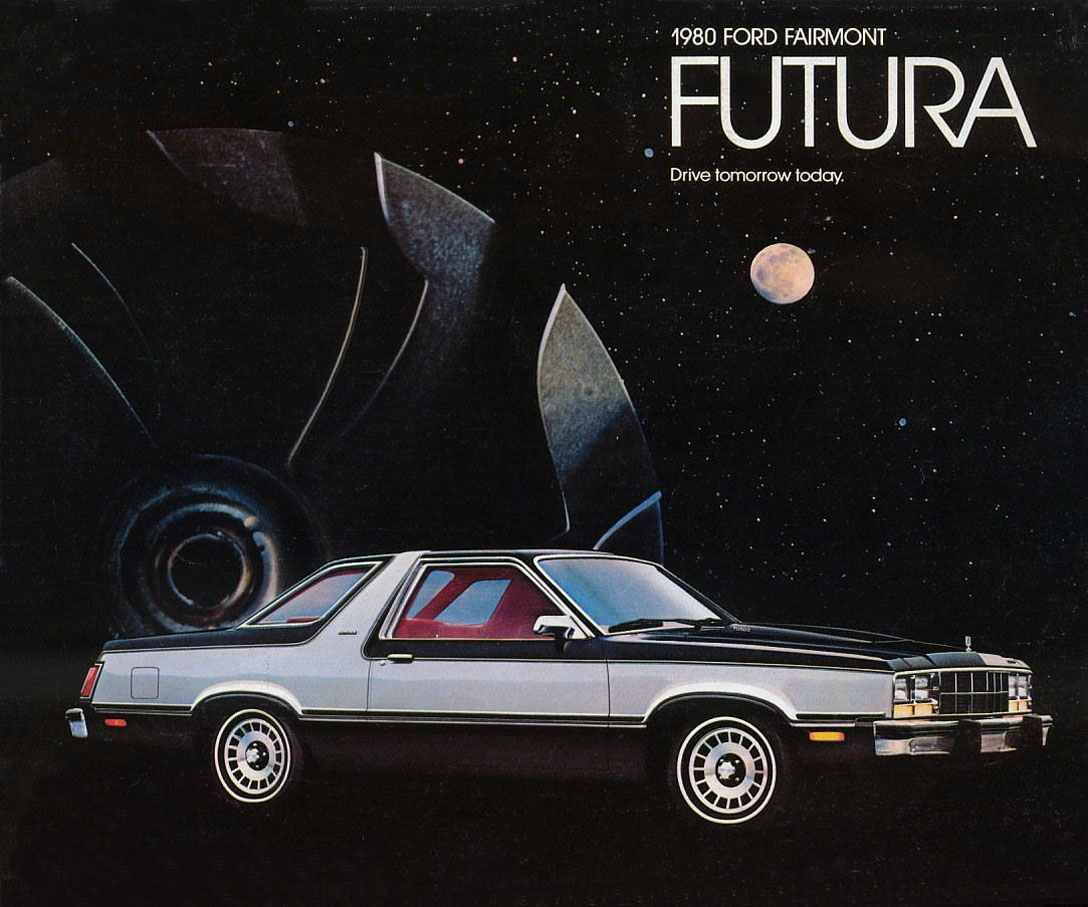
“Drive your Futura of tomorrow … today.”

1980 model year changes to Ford’s Fairmont Futura coupe included new engine choices and a new Tu-Tone paint treatment. Newly standard were P-metric steel-belted radial ply tires, high-illumination halogen headlamps, and a maintenance-free battery.

The Fairmont was the first of the Fox platforms to make it to market. Initially available for the 1978 model year, it replaced the Maverick as Ford’s compact offering. The Futura coupe’s distinctive wrapover B-pillar design came from a March 1976 Fairmont-based Thunderbird proposal.

Ford had been using the Fairmont name for a while by 1978—Ford of Australia had first used it in 1965. The Futura name was even older, dating back to a Lincoln concept car designed in 1954 and debuting as a higher-trim model of the Falcon in 1961.

Powertrains, Performance, & Standard Equipment

The Fairmont Futura’s standard engine was the Lima 88 bhp 2.3 liter/140 ci inline four with a two-barrel carburetor. The Thriftpower 91 bhp 3.3 liter/200 ci inline six with a one-barrel carburetor ($169) was available, and had 36% more torque than the four. A Windsor 119 bhp 4.2 liter/255 ci V8 with a two-barrel carburetor ($288) was also available—a substantial downgrade from the 139 bhp 4.9 liter/302 ci engine that had been available in 1978 and 1979.

There was once some argument, but it now seems reasonably clear that some Futuras were built with the heavily advertised turbocharged four ($481). This engine was rated at 120 bhp and included a prominent hood bulge with Turbo insignia. Reliability must not have met Ford’s expectations, because the turbocharged four didn’t make it to the 1981 model year.

A four-speed manual was standard with the base 2.3 liter inline four, while a four-speed manual with overdrive was standard with the 3.3 liter inline six. A SelectShift three-speed automatic ($340) was required with the turbocharged four and the V8, and optional for the two other engines.

Performance wasn’t great, but few domestic competitors were much better. Road & Track clocked a 15.8-second 0-60 time with the base powertrain. Best-case times with either the turbo four or the V8 were probably about two seconds better, but a Futura driver wasn’t looking to go racing.

Fuel economy ratings with the base powertrain were impressive: 28 city/38 highway by the day’s standards. The far more common 3.3 liter six/automatic combination was 20/27, with the V8 getting 18/26. The turbo came in at 19/26. With a 14-gallon fuel tank, Fairmont buyers with the 3.3 liter six and the automatic could expect a range of 270 to 295 miles.

Cover of the 1980 Ford Fairmont Futura brochure

The Fairmont Futura coupe’s base price was $5,531—$23,500 in today’s dollars. Standard exterior and mechanical equipment included dual rectangular halogen headlamps, wraparound taillamps, rack and pinion steering, front disc/rear drum brakes, and P-metric 14-inch black sidewall radial-ply radial tires on 14-inch wheels with Deluxe wheel covers. Inside, accent vinyl low-back front bucket seats and a Deluxe steering wheel hub were included.

Some of the Futura‘s standard interiors depended on the engine and transmission chosen. Buyers of the base 2.3 liter four with the four-speed manual and the turbocharged four with the automatic got low-back front bucket seats in pebble-grain vinyl. Buyers of the 3.3 liter six with the manual and the V8 with the automatic got a bench seat.

Packages, Options, & Production Numbers

The Ghia package ($193) included dual remote-control mirrors, a Ghia badge, plush cut-pile carpeting, a carpeted trunk, a Luxury steering wheel, a glove box lock, sun visors, and a right hand visor vanity mirror. Ghia buyers got a Flight Bench seat in either Luxury velour cloth or pebble-grain vinyl if they chose an automatic transmission, or bucket seats with the four-speed manual.

The Sports group ($114) included an over-the-roof tape stripe, color-keyed turbine wheel covers, and a charcoal/argent grille.

Individual exterior and mechanical options included power front disc brakes ($78) and power steering ($165). Inside, air conditioning ($671), a tilt steering wheel ($78), fingertip speed control ($116), power side windows ($135), and power door locks ($88) were available.

Ford produced 51,878 Futura coupes in 1980, making up 16% of overall Fairmont production in a year where overall Ford sales were down. 1,158 Fairmonts were turbos.

The View From 2025

It is striking both how many Fairmont versions there were and how much effort Ford put into marketing the Futura. Ford presented six versions of the Fairmont:

  • a 2-door sedan, which had a normal roofline and looked much plainer than the Futura
  • a 4-door sedan
  • the Futura coupe
  • the Futura sedan, which joined mid-year and had the same grille and many of the same features as the Futura coupe
  • a 4-door wagon
  • a Squire-branded 4-door wagon with woodgrain vinyl

Though the Futura got two full pages in the Fairmont brochure, Ford also made an eight-page Futura-specific brochure available.

Fairmont Futuras are not often seen for sale in any venue. AutoTrader Classic has an occasional Fairmont, while Bring a Trailer has sold a grand total of one Fairmont overall—a wagon. The word Fairmont appears in the Hemmings Motor News classifieds more as a component (of Model A replicas, for example) than a vehicle. One exception to this lack of sales visibility came in January 2024, when Barrett-Jackson auctioned a 1978 Ford Futura coupe for a $34,000 hammer price—it was the 100,000,000 U.S.-built Ford vehicle.

Make mine Candyapple Red, please.

Other 1980 Fords I have written about include the F-150 pickup truck, the Fiesta hatchback coupe, the Mustang Cobra hatchback coupe, and the Thunderbird coupe. I evidently do not write about a lot of Ford sedans.

1980 Ford F-150 pickup truck

“First new truck of the 80’s …”

For 1980, Ford’s pickup truck was nearly all-new, with a more aerodynamic body that reduced drag at highway speeds by up to 13%. There was also an increased emphasis on comfort, with increased legroom over 1979. Ford sold four versions of the full-size truck—the light-duty F-100, the F-150, the 3/4 ton F-250, and the 1-ton F-350. For this blog post, we’ll concentrate on the F-150, which was the best-selling of the four versions, and pick the more popular rear-wheel-drive example over the four-wheel-drive.

The standard engine was the 101 bhp Big Six 4.9 liter/300 ci six. A 130 bhp 4.9 liter/302 ci V8 ($315) and a 156 bhp 5.8 liter/351 ci V8 ($477) were optional. A three-speed manual transmission was standard on rear-wheel-drive F-150s, but many buyers chose the four-speed manual ($175), the four-speed manual with overdrive ($208), or the Select-Shift three-speed automatic ($408).

Pages from the 1980 Ford Pickup brochure

Standard exterior and mechanical equipment on the base $5,314 Custom F-150 short bed included a bright grille surround, an independent front suspension, power front disc/rear drum brakes, P215/75R15SL black sidewall tires (a size still readily available), and 15-inch wheels with argent hub caps. Inside, all vinyl seat trim, a coat hook, a dome light, and a glove box with a latch were included.

Packages

The 1980 Ford F-150 was replete with packages that ranged from making it a little nicer to reasonably luxurious.

  • The $339 Ranger package added a brushed aluminum lower bodyside molding and bright hub caps on the exterior. Inside, all-vinyl or cloth and vinyl seat trim, color keyed seat belts, and a cigarette lighter were included.
  • Exterior features of the $472 Ranger XLT package depended on whether the truck was Flareside or Styleside. Flareside pickups had tailgate trim with raised FORD letters in a contrasting color with a dual-colored tape stripe setting off the letters. Styleside pickups included a brushed aluminum tailgate applique with bright letters. Inside, all Ranger XLTs included grained vinyl seat trim with cloth inserts, carpeted lower door trim panels, bright aluminum door scuff plates, and color-keyed cut-pile carpeting.
  • Exterior features of the top-of-the-line Ranger Lariat package ($760) included a brushed aluminum lower bodyside molding with a black vinyl insert and (of course) three Lariat plaques. Inside, all Ranger Lariats included a unique seat trim sew style in cloth and vinyl or all-vinyl, thick cut-pile carpeting, a Luxury-type steering wheel, and an instrument panel with a polished woodtone applique and a bright Ranger Lariat script.
  • Free Wheeling package “A” ($407) included pinstriping, blackout grille, blackout headlamp doors, and Sport wheel covers.
  • Free Wheeling package “B” ($1,266) included everything in package “A” plus foglamps, bumper guards, the Handling Package, and 10-hole aluminum wheels. Flareside pickups received a bright channel bumper, while Styleside pickups got a bright rear contour bumper. Inside, a simulated leather-wrapped steering wheel and the Sports Instrumentation Package with tachometer, trip odometer, ammeter, and oil pressure gauge.

Options & Production Numbers

Individual options were many and included tinted glass on all windows ($36), a sliding rear window ($102), variable-ratio power steering ($215), white styled steel wheels ($161), and forged aluminum wheels available either with a brushed finish ($311) or a polished finish ($361). Inside, a tilt steering wheel ($83), air conditioning ($611), and Speed Control ($160) were available. A choice of five radios ranged up to an AM/FM stereo with cassette tape ($324). Despite the luxury emphasis, power door locks and power windows were not available—they wouldn’t be offered until 1982.

Ford sold 173,050 F-150s in the 1980 model year. That number sounds like a lot, but 1980 was a bad year for the automotive industry overall and an awful year for Ford, whose US market share dropped from 23.8% in 1979 to 20.5% in 1980. Of Ford trucks, only the imported Courier compact pickup would hold the line on sales volume.

The View From 2025

Folks are collecting these seventh-generation Ford pickup trucks. F-150s often appear for sale in the Hemming’s Motor News classifieds, on eBay Motors, and on Bring a Trailer. According to Hagerty‘s valuation tools, a 1980 Ford F-150 Styleside short bed with the 302 ci V8 in #1/Concours condition is $44,300, with a more normal #3/Good condition truck going for $13,000. A long bed subtracts around 2%, while the 351 ci V8 adds about 5%. Four-wheel-drive is worth an additional 14% or so.

Make mine Candyapple Red, please. I’m unsure if I want any of the four two-tone options.

Other Ford products from 1980 that I have written about include the Ford Fiesta hatchback coupe, the Ford Mustang Cobra hatchback coupe, the Ford Thunderbird coupe, and the Lincoln Continental Mark VI coupe. I’ve also written about the 1985 Eddie Bauer Bronco SUV.

1980 Porsche 924 hatchback coupe

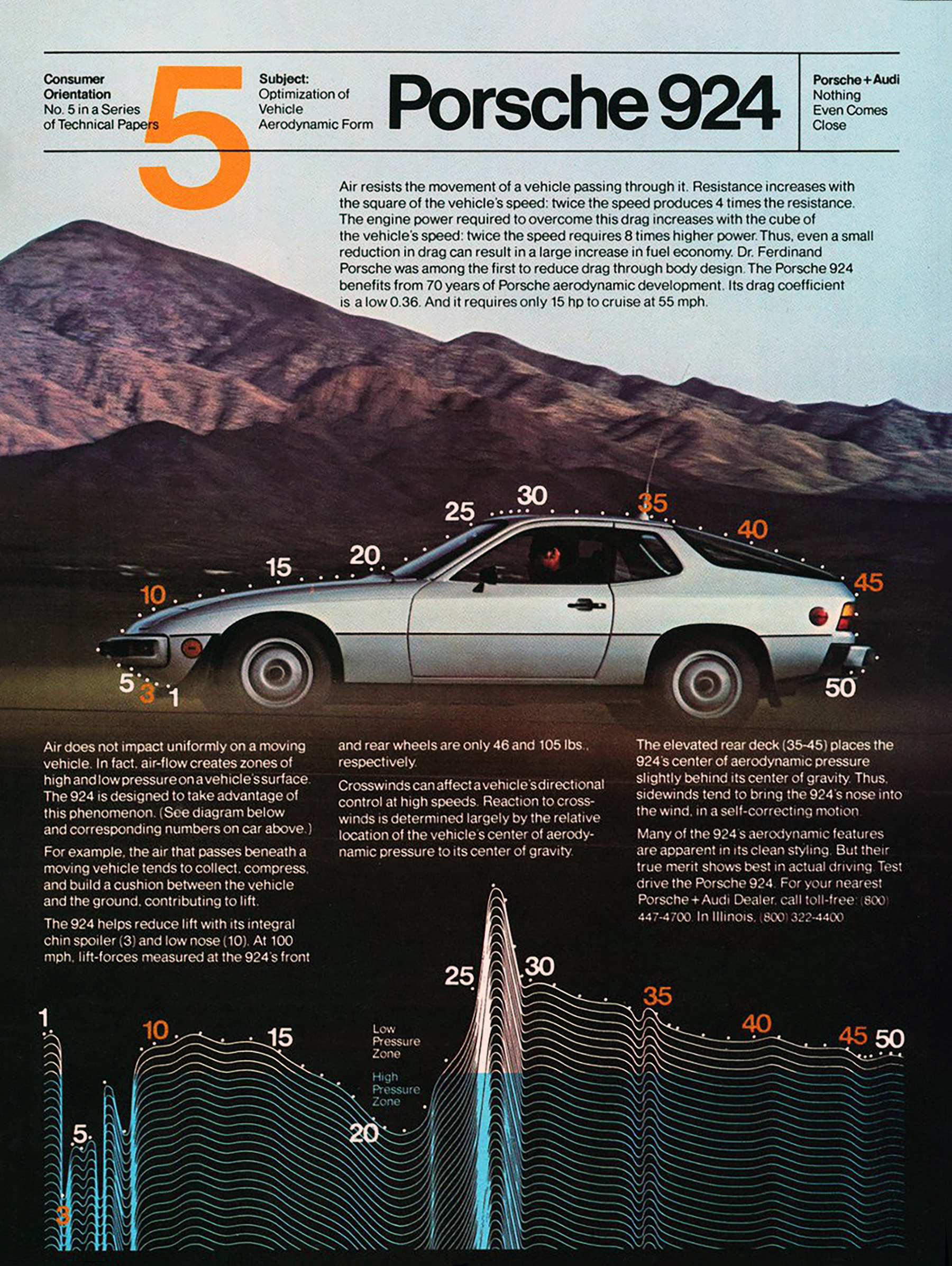
“Many of the 924’s aerodynamic features are apparent in its clean styling.”

For 1980, Porsche’s entry-level 924 generally stood pat. The five-speed transmission changed to an Audi design and a breakerless ignition system was added. Otherwise, a few exterior color changes marked the turn of the model year.

The 924’s engine remained the Volkswagen/Audi EA831 110 bhp 2.0 liter/121 ci inline four with Bosch K-Jetronic fuel injection. This engine—used in many applications—did not make the 924 quick. Period testing with the five-speed manual (an Audi-sourced three-speed automatic was optional) recorded 0-60 mph times of about 10.6 seconds in a car with a curb weight of a little over 2,600 pounds. Fuel economy ratings with the manual were 19 city/32 highway by the day’s standards. With a 17.4-gallon gas tank, a 924 driver could expect a range of 360 to 400 miles with a 10% fuel reserve.

1980 Porsche 924 print advertisement

The 924’s base price was $15,970—about $68,600 in today’s dollars, which is about 9% less than a 2025 Porsche 718 Cayman coupe goes for. Standard exterior and mechanical equipment included retractable headlights, an integral front spoiler, tinted glass, a manual antenna, a four-wheel independent suspension, a front stabilizer bar, rack and pinion steering, power assisted front disc brakes, and 165HR-14 tires on 14-inch wheels. Inside, reclining front bucket seats, a center console, full carpeting, intermittent windshield wipers, power windows, a tachometer, a quartz clock, and an electric window defogger were included.

Options & Production Numbers

Among the options available for the 924 were a removable top ($485), spoke type light alloy wheels ($545), a 4 spoke leather covered steering wheel ($185), heated outside mirrors ($110 each), and air conditioning ($725).

Porsche sold 3,700 examples of the base 924 in the United States in 1980, along with 3,440 units of the far sprightlier Turbo version.

The View From 2025

924s are often cited as “the car that saved Porsche,” and there is good club support for them, as there is for all Porsches. Folks are collecting 924s, though the lack of power limits their appeal. According to Hagerty‘s valuation tools, a 1980 Porsche 924 in #1/Concours condition is $34,000, with a more normal #3/Good condition car going for $8,500. Porsche 924s often show up for sale in the Hemmings Motor News classifieds, on eBay Motors, and on Bring a Trailer.

Make mine Inari Silver Metallic over Onyx Green Metallic, please. Two-tones were a thing in the early eighties.

Other eighties Porsches I have written about include the 1982 928 hatchback coupe, the 1982 Porsche 924 Turbo hatchback coupe, the 1985 911 Carrera Cabriolet, the 1986 944 Turbo hatchback coupe, the 1987 911 3.2 Carrera coupe, and the 1988 944 hatchback coupe.

1980 Oldsmobile Cutlass coupe

In the early 1980s, the Oldsmobile Cutlass in its various forms was often the best-selling car model of any type in the United States. Within the Cutlass line, the coupes were the most prevalent.

“Any wonder why it’s America’s best-selling mid-size?”

For 1980, Oldsmobile’s Cutlass coupe was little changed other than the return of quad headlamps. The significant Cutlass change was with the sedans, where most of the unpopular slantback models transitioned to notchbacks that resembled baby first-generation Cadillac Sevilles.

The standard engine remained the LD5 110 bhp 3.8 liter/231 ci V6 with a Rochester M2ME two-barrel carburetor. There were three optional engines: a $180 105 bhp 4.3 liter/261 ci V8 with a Rochester M2MC two-barrel carburetor, a $295 155 bhp 5.0 liter/305 ci V8 with a Rochester M4MC four-barrel carburetor, and a $960 105 bhp 5.7 liter/350 ci diesel V8. A three-speed automatic transmission was the only transmission available with any engine. Most early eighties Cutlasses were stylish but slow—0-60 came in a little under 15 seconds with the base V6. Mileage with the V6 was 21 city/30 highway by the day’s standards—with an 18.1-gallon gas tank, a Cutlass owner could expect a range of about 315 to 415 miles with a 10% fuel reserve.

Standard equipment on the $6,252 Cutlass Supreme (about $26,900 in today’s dollars) included power steering, power front disc brakes, and P195/75R14 steel-belted radial-ply blackwall tires (a size still available thanks to Hankook and Kumho) on 14-inch wheels. Inside, a Deluxe steering wheel and a Custom Sport bench seat with a center armrest and a choice of vinyl or cloth were included.

Moving up to the Cutlass Supreme Brougham ($6,691) added snazzier exterior moldings, full wheel discs, and a divided cloth velour bench seat with individual controls.

Calais page from the 1980 Oldsmobile Cutlass brochure

Described as “the grand touring Cutlass,” the $6,716 Cutlass Calais added special painted wheel discs, tungsten halogen high beam headlamps, a Rallye suspension, reclining front bucket seats in cloth or vinyl, a Rallye gage instrument cluster, and a Custom Sport steering wheel.

Available only on the Calais, the $1,425 4-4-2 package added the L34 170 bhp 5.7 liter/350 ci V8 not available on any other Cutlass. Other 4-4-2 equipment included Sport mirrors, a Sport console, an electric digital clock, and P205/70R14 raised white-letter steel-belted radial-ply tires on aluminum Sport wheels. A choice of 4-4-2 only gold trim over black paint or gold trim over white paint color schemes along with W-30 insignia meant that everyone would know you had the sportiest and by far the fastest Cutlass for 1980.

Options & Production Numbers

Optional exterior and mechanical equipment included cast-aluminum wheels, tungsten halogen high beam headlamps, an engine block heater, a limited-slip differential, a power antenna, dual Sport mirrors, an electric rear window defogger, a sunroof, and a T-roof with lift-out panels. Inside, you could add either Four-Season ($601) or Tempmatic air conditioning, a Tilt-Away steering wheel, automatic cruise control, power windows, power door locks, bucket seats, a digital or regular electric clock, and a series of radios. Oldsmobile also offered value packages that combined various popular options at a discount.

The Cutlass coupe sure was popular—Oldsmobile sold 169,597 Cutlass Supreme coupes in the 1980 model year, along with another 77,875 Cutlass Supreme Brougham coupes and 26,269 Cutlass Calais coupes for a total of well over a quarter of a million. Olds made it well known that the Cutlass brand overall continued to be the most popular car in the United States.

A mere 866 Cutlasses were ordered with the 4-4-2 option—a hint to Olds that they should further emphasize luxury over sport. Lansing would bring back the 4-4-2 in 1985 as a replacement for the 1983-1984 Hurst/Olds.

The View From 2025

A few folks are collecting these cars, but they aren’t that common at shows. You do see Cutlasses for sale in the Hemming’s Motor News classifieds, on eBay Motors, and on Bring a Trailer.

Make mine Dark Claret Metallic, please.

Other Cutlasses I have written about include the 1981 Cutlass Supreme coupe and the 1985 Oldsmobile Cutlass Supreme coupe. I have written about many other Oldsmobiles—highlights include the 1982 Toronado Brougham coupe and the 1985 Ninety-Eight Regency sedan.

Last updated September 2025.

1980 Toyota Corolla Tercel Liftback

“… a price that belies its good looks.”

1980 was the first year that Toyota sold the Corolla Tercel in the United States. Despite its name, the front-wheel-drive Tercel was not related in any meaningful way to the rear-wheel-drive Corolla. Still, Toyota evidently figured that adding the Corolla name would make buyers more confident in their purchasing decision. The Tercel was available as a 2-Door Sedan and a 3-Door Liftback (a four-door sedan would arrive one year later).

The Corolla Tercel Liftback was a small and light car, with a 160-inch length (about 22 inches shorter than a 2025 Corolla) and a curb weight of 2,030 pounds. The Liftback’s standard powertrain combined a 60 bhp 1.5 liter/99 ci inline four paired to a five-speed manual (a three-speed automatic was optional). Unusually for a front-wheel-drive car, the Tercel’s engine was longitudinally placed, which Toyota claimed resulted in easier serviceability.

Road & Track clocked a 0-60 time of 14.8 seconds in a loaded Tercel Liftback SR-5. As might be expected with a 99 cubic inch engine and a five-speed, fuel economy was impressive—33 city/43 highway by the day’s standards. With an 11.9-gallon fuel tank, a Tercel driver could expect a range of 330 to 365 miles with a 10% fuel reserve.

Corolla Tercel Liftback pages from the 1980 Corolla brochure

At $4,848 (about $20,500 in today’s dollars or a little less than a 2025 Corolla LE sedan goes for), the Corolla Tercel Liftback Deluxe had more standard equipment than the 2-Door Sedan, which was the loss leader at $4,198. Standard exterior and mechanical equipment included body side moldings, front-wheel-drive, rack-and-pinion steering, power-assisted front disc/rear drum brakes, and 145SR13 steel-belted radial ply whitewall tires on 13-inch wheels. Inside, vinyl reclining hi-back front bucket seats, a split-back fold-down rear seat, brushed nap wall-to-wall carpeting, an electric rear window defogger, and a day/night rear view mirror were included.

Packages & Options

The $600 SR-5 package required the five-speed manual and added black accents, “brazen” side striping, and 165/70SR13 steel-belted radial ply tires (a size still available thanks to Vredestein) on 13-inch wheels. Inside, SR-5 features included cloth reclining low-back front bucket seats, a rear deck cover, a cargo compartment light, an electric tachometer, and an AM/FM/MPX stereo radio.

Options were relatively few, but did include aluminum alloy wheels ($215), a rear window washer/wiper ($75), and factory (not dealer-installed) air conditioning ($520).

The View From 2025

I haven’t seen a first-generation Tercel in decades—they seem to have largely vanished. Tercels rarely appear in the Hemming’s Motor News classifieds or on eBay Motors, but they do occasionally show up on Bring a Trailer.

Make mine Light Blue Metallic, please.

Other Toyotas I have written about include the 1981 Celica Sport Coupe, the 1982 Celica Supra hatchback coupe, the 1983 Camry sedan, and the 1985 MR2 coupe. This list hints that I should write about an actual Corolla soon.

Last updated March 2025.