1989 Ford Thunderbird coupe

“The new spirit of Thunderbird …”

Ford’s Thunderbird personal luxury coupe was all new for 1989. The twelfth-generation ‘Bird was code-named MN12 and cost over a billion dollars to develop.

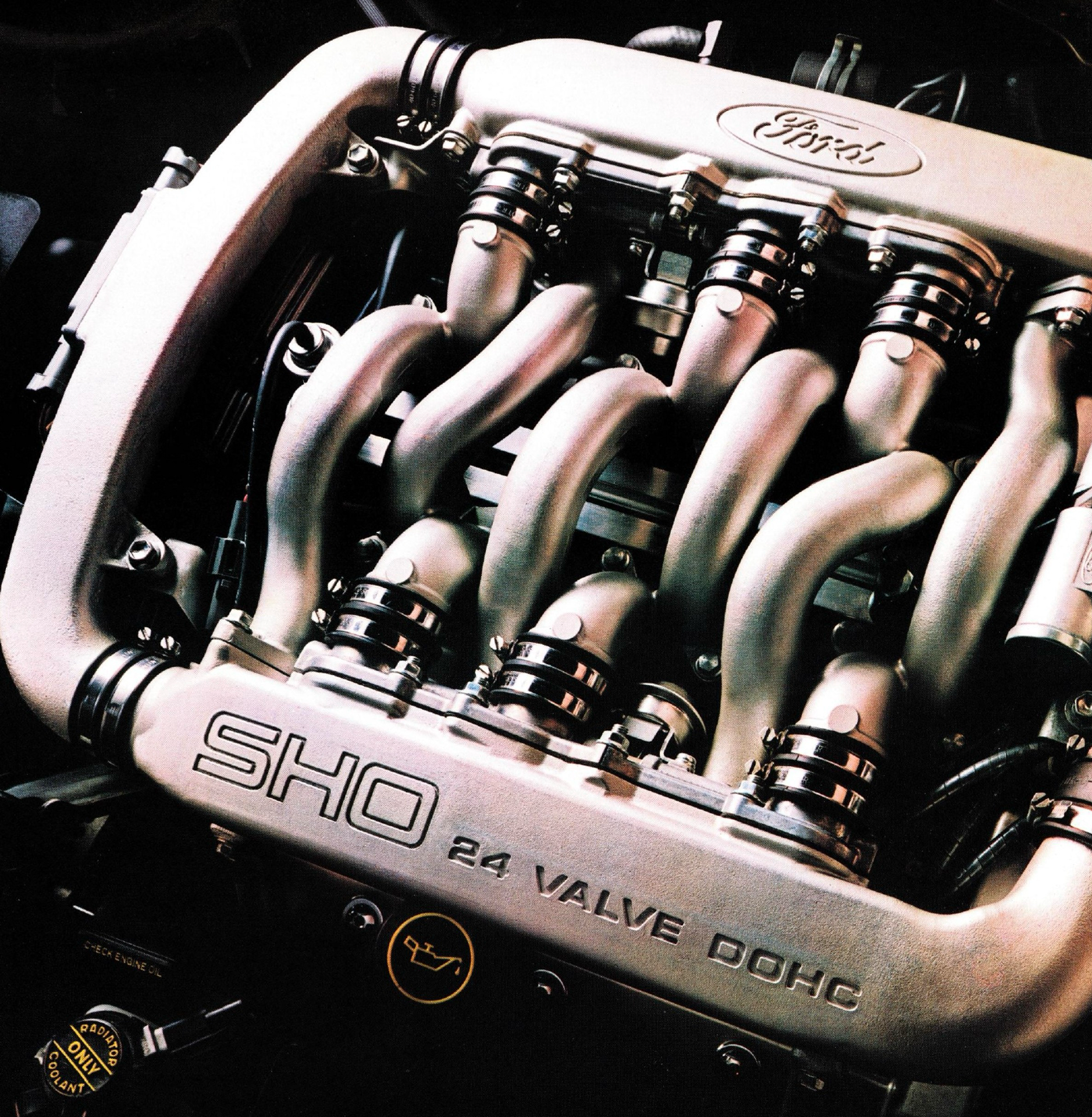
The standard Thunderbird’s powertrain was an Essex 140 bhp 3.8 liter/232 ci V6 with electronic sequential multi-port fuel injection paired with an automatic overdrive transmission. The Super Coupe‘s powertrain was an Essex 210 bhp 3.8 liter/232 ci V6 with a supercharger, an intercooler, and electronic sequential multi-port fuel injection paired with a 5-speed manual transmission. The automatic overdrive transmission was an option for the Super Coupe.

Page from the 1989 Ford Thunderbird brochure

The Thunderbird Standard‘s base price was $14,612. Exterior and mechanical equipment included tinted glass, power rack-and-pinion steering, power front disc/rear drum brakes, and P205/70R15 black sidewall tires on 15-inch stamped steel wheels. Inside, cloth front bucket seats with recliners, a full-length console with floor-mounted shift, air conditioning, and an electronic AM/FM stereo search radio with a digital clock were included.

Moving up to the $16,817 LX added speed-sensitive power steering, Luxury cloth front bucket seats with recliners, a six-way power driver’s seat, Luxury door trim and carpeting, and the power lock group.

The top-of-the-line Super Coupe ($19,823) included fog lamps, dual exhausts, a Traction-Lok rear axle, four-wheel disc brakes with an anti-lock braking system, and Goodyear Eagle P225/60VR16 performance tires on 16-inch cast aluminum wheels. Inside, articulated sport seats with power lumbar and power seat back bolster adjustments, a Sport soft-feel steering wheel, and performance instrumentation were included.

Packages, Options, Production Numbers, & Period Reviews

Each 1989 Thunderbird model offered a Preferred Equipment Package:

  • 151A was for the Standard coupe and cost $1,235. It included bright window moldings, styled road wheel covers, a six-way power driver’s seat, a tilt steering wheel, dual electric remote-control mirrors, a rear window defroster, speed control, the power lock group, the Luxury light/convenience group, and an electronic AM/FM stereo search radio with a cassette tape player
  • 162A was for the LX coupe and cost $735. It included P215/70R15 tires, aluminum wheels, a six-way power front passenger’s seat, front floor mats, a rear window defroster, a keyless entry system, the Luxury light/convenience group, and an electronic Premium cassette radio with Premium sound and a power radio antenna
  • 157A was for the Super Coupe and cost $1,327. It included a six-way power driver’s seat, a tilt steering wheel, a rear window defroster, speed control, the power lock group, and an electronic AM/FM stereo search radio with a cassette tape player

Individual options for all versions of the Thunderbird included clearcoat paint ($163), a power moonroof ($841), an anti-theft system ($183), a Ford JBL Audio System ($488), and a compact disc player ($491).

Ford sold 122,909 Thunderbirds in the 1989 model year, with about 11% being the Super Coupe. 63% of the Super Coupe versions came with a manual transmission. The 1989 Thunderbird Super Coupe won Motor Trend‘s Car of the Year award, and MotorWeek designated it as their best sports coupe. Many buff books mentioned the Thunderbird’s similarity to large BMW coupes.

The View From 2025

These Thunderbirds often appear for sale in the Hemmings Motor News classifieds, on eBay Motors, and on Bring a Trailer. As I write this blog entry in January 2026, there’s a Twilight Blue Clearcoat Metallic 1989 coupe with shadow blue cloth bucket seats and 10,000 miles for sale on Hemmings, asking $30,000.

Make mine Currant Red Clearcoat Metallic, please.

Other Thunderbirds I have written about in this blog include the 1980 coupe, the 1982 coupe, the 1983 Turbo Coupe, and the 1987 standard coupe. I’ve also written about the closely related Mercury Cougars—the 1980 XR-7 coupe and the 1988 XR-7 coupe.

End of the Year Review: 2025

Typewriter icon with 2025 date

2025 was a good year for Eighties Cars, with page views up a substantial 91% over 2024. We managed an all-time high of 76 new blog entries in 2025—one every five days on average.

Post counts were divided into 66 featuring a specific car, 4 covering auctions, and 6 miscellaneous posts. Three marques made their first appearance in a specific post in 2025—Lamborghini, Rolls-Royce, and Yugo. You cannot say that we don’t discuss a wide range of vehicles on Eighties Cars

I look at the end-of-year results for the blog’s most-viewed posts every December. For 2025, it once again looked like the key to an individual post’s popularity was often in the rarity of the other coverage available for that particular vehicle. We’ll discuss this year’s top ten most-viewed posts in reverse order.

10) 1989 Buick Electra Park Avenue Ultra sedan—this 2020 post about the top-of-the-line Buick for 1989 (more expensive than the Riviera) dropped five spots in 2025.

9) 1989 Chevrolet Celebrity sedan—this 2016 post, which was inspired by a work colleague’s Celebrity, returned to the top ten after a five-year pause. Most Celebrity coverage I have seen is about the sporty Eurosport version, not the far better selling base car.

8) 1983 Ford Eddie Bauer Bronco SUV—the highest ranking SUV this year is a new entrant to the top ten list.

7) 1980 Pontiac Grand Prix SJ coupe—a relatively recent post from early 2022 shows some staying power. Down three spots in 2025 for Pontiac’s final SJ version of the Grand Prix.

6) 1985 Buick Somerset Regal coupe—this post has been picked up by other websites a few times, including in 2018 by Jalopnik. Hilariously, I’m not sure I would have ever gotten around to writing about the Somerset Regal if I hadn’t seen one on the streets of Philadelphia back in 2014. Down three steps this year, this post is the fourth most popular entry since Eighties Cars debuted over a decade ago.

5) 1987 Mercury Lynx XR3 hatchback coupe—Mercury is, of course, an orphan make, but this blog entry has been viewed about six times more than my write-up on the related 1981 Ford Escort hatchback coupe. Down four spots this year.

4) 1988 Cadillac Eldorado coupe—this late 2018 post on the emergency 1988 Eldorado restyle never stood out until this year, when its views went up 279%. It edged the far more glamorous 1984 Eldorado Biarritz convertible by a solid 28% (we won’t talk about how the 1986 Eldorado coupe did).

3) 1989 Cadillac Sedan de Ville—this post on the final de Ville of the decade did well, but not great, for eight years after it was first written. This year, somewhat inexplicably, it is this year’s highest-ranking new entrant.

2) 1981 Oldsmobile Cutlass Supreme coupe—this post is #1 all-time (over 5,700 views), and repeats at number two for 2025. Popularity when new does not always equal collectability now, and Hagerty has yet to track the values of “civilian” (non-Hurst/Olds, 442) eighties Cutlass Supreme.

1) 1980 Pontiac Sunbird Sport Hatch—up nine slots this year (top five all-time with over 4,100 views). Perhaps the salient example of my rarity theory—any first-generation Sunbird coming up for sale is now a rare sight.

Five posts that did not make it into the top ten in 2025 after doing so in 2024 were the 1983 Honda Civic S hatchback coupe (still the best performing Asian vehicle at #12), the 1984 Dodge Daytona Turbo Z hatchback coupe, the 1985 Chevrolet C20 Suburban Silverado SUV, the 1988 Mercury Cougar XR-7 coupe, and the 1989 Buick Park Avenue Ultra sedan. The top European car for 2025 was the Jaguar XJ6 Series III, at #11. An entry coming on strong at the end of 2025 was a recent post on the 1980 Porsche 911 SC coupe.

Thanks to all who viewed this blog in 2025!

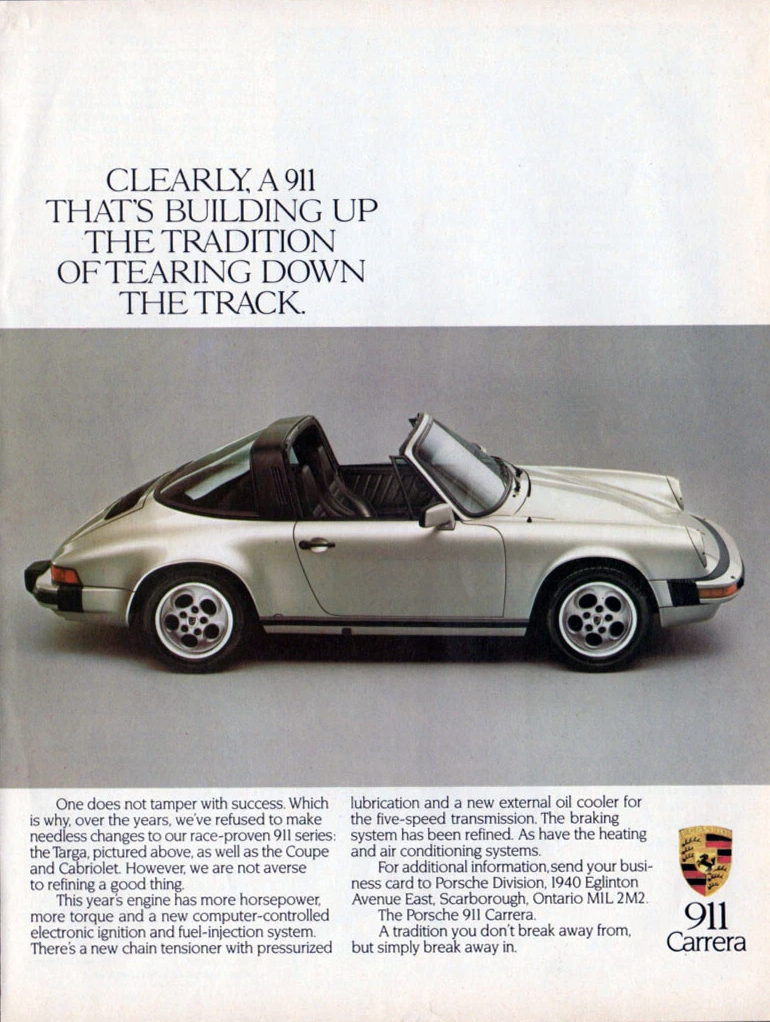
1984 Porsche 911 Carrera Targa

“One does not tamper with success.”

The storied Carrera name returned to Porsche’s 911 for the 1984 model year with big changes in the engine, suspension, and brakes.

The Carrera’s new engine was the 200 bhp 3.2 liter/193 ci flat six with Bosch Motronic fuel injection. With the standard Getrag five-speed manual transmission, 0-60 mph came in about 6.3 seconds, with a claimed top speed of 152 mph in the 2,866-pound curb weight Carrera Targa (the 2025 911 Carrera Targa is about 3,772 pounds). Fuel mileage was 19 city/32 highway by the day’s standards (15/23 by today’s measures) with premium gas. With a 21.1-gallon gas tank, a 911 Carrera’s proud new owner could expect a range of between 365 and 435 miles with a 10% fuel reserve.

Print advertisement for the 1984 Porsche 911 Carrera Targa

The 1984 911 Carrera Targa‘s base price was $33,450—about $107,300 in 2025 dollars and approximately 39% less than a 2025 Porsche 911 Targa 4S goes for. Standard exterior and mechanical equipment included halogen headlights, fog lights, and tinted glass, and power vented disc brakes on all four wheels. The front 185/70VR15 tires sat on 15 x 6 inch alloy wheels, while the rear 215/60VR15 tires were mounted on 15 x 7 inch alloy wheels (Pirelli still makes these tire sizes). Inside, reclining front bucket seats, a leather Sport steering wheel, power windows, and air conditioning (said not to be very capable) were included. A stereo was not included—Porsche evidently assumed that 911 buyers had their own ideas about what should be in that part of the dash—and Crutchfield still provides. Stuttgart did deign to provide “4 speaker stereo preparation with automatic power antenna.”

Options & Period Reviews

Exterior and mechanical options for the Targa included a limited slip differential ($590), front and rear spoilers ($1,325), and 16-inch forged alloy wheels (6 inches wide in the front, 7 inches wide in the back—and setting the buyer back $1,580). Inside, options included automatic heating control ($485), automatic cruise control, power door locks, a passenger power seat, an alarm system, and a Blaupunkt Monterey digital cassette radio.

Period reviews were enthusiastic. Car and Driver stated that the 911 Carrera had “rousing performance.”

The View From 2025

It’s little surprise that eighties 911 Carreras have maintained their value quite well. According to Hagerty’s valuation tools, all the money for a 1984 Porsche 911 Carrera Targa in #1/Concours condition is $126,000, with a more normal #3/Good condition car going for $60,000.

Porsche 911 Carrera Targas have (of course) excellent club support from many sources and are often available in the Hemmings Motor News classifieds, on eBay Motors, and on Bring a Trailer. As I update this blog entry in April 2025, a Moss Green Metallic 1986 Cabriolet with black leather seats is for sale on Hemmings, asking $60,000.

Make mine Gemini Gray Metallic, please.

This is the first 911 Targa I have blogged about. Other eighties 911 models I have written about include the 1980 SC coupe, the 1985 Carrera Cabriolet, the 1986 Turbo coupe, and the 1987 3.2 Carrera coupe. Other eighties Porsches I have covered include the 1980 924 hatchback coupe, the 1982 924 Turbo hatchback coupe, the 1982 928 hatchback coupe, the 1986 944 Turbo hatchback coupe, the 1987 928 S4 hatchback coupe, and the 1988 944 hatchback coupe.

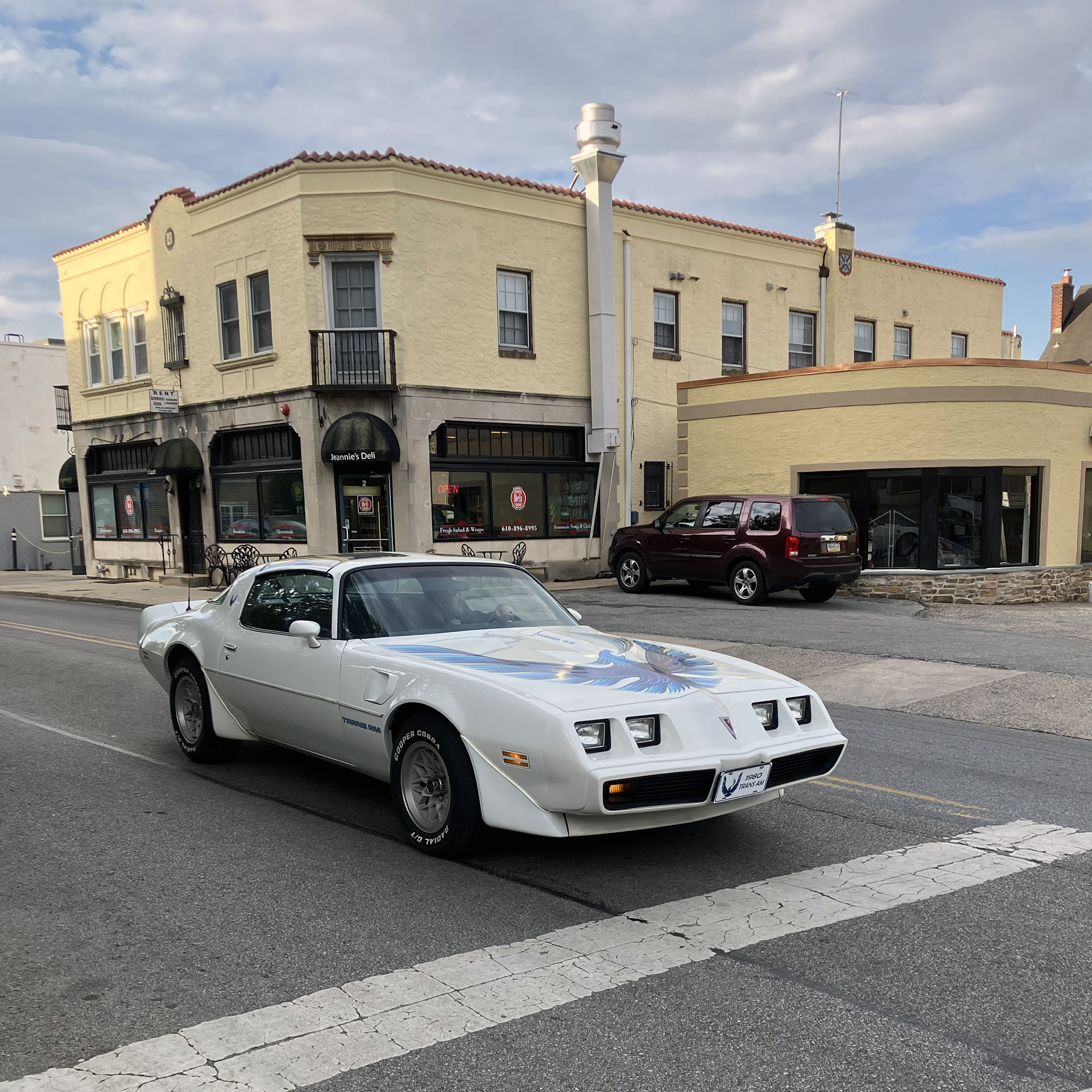
1980 Pontiac Firebird Turbo Trans Am coupe

Photo of 1980 Pontiac Firebird Turbo Trans Am coupe
The 1980 Pontiac Firebird Turbo Trans Am coupe my fiancée saw

On a lovely spring morning in early 2025, my fiancée was walking from her house toward the temporary train station in Ardmore, PA. On her way to the station, she saw and (more importantly for this blog post) photographed a 1980 Pontiac Firebird Turbo Trans Am in Cameo White smoothly idling at a stop sign. Underneath the image she texted me, she wrote, “You are escorting me to the train.”

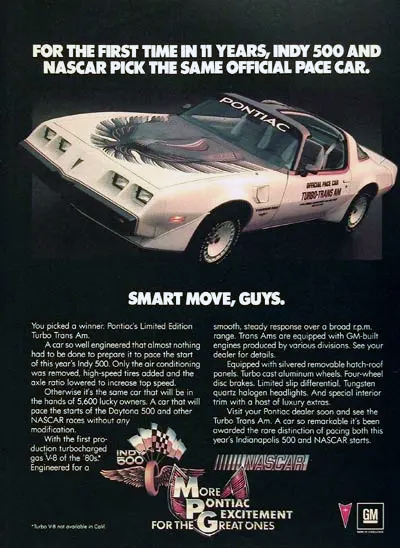
“You picked a winner.”

1980 was a transitional year mechanically for the second-generation Firebird and its Trans Am sub-model, though little else of significance changed. Gone was the 6.6 liter/403 ci V8, with the new top-of-the-line engine being a 4.9 liter/301 cu V8 with a turbocharger. Along with the engine changes, there was an asymmetrical hood design and a special hood decal for the Turbo Trans Am.

Pontiac could not do much about the general lack of space efficiency (the EPA rated the Firebird as a subcompact car), the high curb weight (about 3,700 pounds when the Mustang weighed about 2,800), and the relatively primitive technology.

Engines & Transmissions

The standard Trans Am engine was the Pontiac-built L37 155 bhp 4.9 liter/301 ci V8 with a four-barrel carburetor. The only choice for Trans Am purchasers in California was the Chevrolet-built LG4 145 bhp 5.0 liter/305 ci V8 with a four-barrel carburetor, but you did get a $180 credit.

The Trans Am’s most powerful engine was the $350 Pontiac-built LU8 210 bhp 4.9 liter/301 ci V8 with a Rochester Quadrajet four-barrel carburetor and an AiResearch TBO305 turbocharger. The turbo engine was emissions-certified only with the combination of air conditioning and a 3.08:1 rear axle ratio. All Trans Ams in 1980 came with a three-speed automatic—a one-year pause for the four-speed manual as Pontiac struggled to meet emissions regulations.

Combining a turbocharger, a carburetor, and primitive electronic engine controls was not easy, and reviews of one of the world’s first turbo V8s were mixed. The relatively primitive gas of the day meant that Pontiac had to retard the spark advance substantially to minimize detonation, which kept the turbocharger’s power return relatively low. As Car and Driver stated, “by the time the engine reaches 4000 rpm, the show is essential­ly over.”

Performance & Standard Equipment

A Turbo Trans Am would accelerate from 0-60 in a little over eight seconds (Car and Driver clocked 8.2), which was good for 1980. Fuel mileage was predictably bad—15 city/21 highway mpg by the day’s standards for the combination of the turbo engine and the automatic. With a 20.8-gallon fuel tank, Trans Am owners could expect to travel about 280 to 305 miles before refueling.

Standard exterior and mechanical equipment included in the $7,179 base price of the Trans Am (about $30,900 in today’s dollars) included a front center air dam, dual rectangular headlamps, a black-accented grille, a shaker hood and air cleaner, front and rear wheel opening air deflectors, a rear deck spoiler, a limited slip differential, power steering, power front disc/rear drum brakes, and 225/70-R15 blackwall tires (a size still readily available) on 15-inch Rally II wheels with trim rings. Inside, front bucket seats, a Formula steering wheel, a machined-trimmed instrument panel trim plate, rally gauges with a quartz clock and a tachometer, and a console were included.

Two Special Editions, Options, & Production Numbers

The black-and-gold Trans Am Special Edition package was $748 additional over a base Trans Am—$1,443 bundled with the removable locking hatch roof (otherwise known as T-tops). It included many exterior paint and trim details, including a gold/matte gold hood bird decal, gold headlight grilles, and gold wheels with gold center cap bird emblems. Inside, a gold dash panel, a gold-spoked steering wheel, gold door emblems, and a gold shifter emblem were included. 6,178 buyers took home a Special Edition—about 12% of Trans Am production.

Print advertisement for 1980 Pontiac Firebird Trans Am Pace Car
Print advertisement for the 1980 Pontiac Trans Am Pace Car

There was also a special edition of the Special Edition in completely different colors—the Indianapolis Pace Car Edition. The Indianapolis Pace Car Edition was Cameo White, with Soft Ray tinted glass on all windows, white Turbo cast aluminum wheels, silver T-tops, and oyster interior trim. Mechanical features included the LU8 turbocharged engine, turbo boost gauges, the WS6 special performance package, and four-wheel power disc brakes. Inside, a leather-wrapped steering wheel, Custom air conditioning, and a Delco-GM ETR AM/FM radio with a cassette player were included. All this extra content was a good thing because the Indianapolis Pace Car Edition listed for $11,020.52 (why not just round to the closest dollar?)—about $47,500 in 2025 dollars. After initially promising 5,600 in advertising, Pontiac ended up building 5,700, about 11% of 1980 Trans Am production.

Exterior and mechanical options available for the Trans Am included the WS6 special performance package ($281), tungsten quartz halogen headlamps ($27), white-lettered tires ($68), Turbo cast aluminum wheels, four-wheel power disc brakes ($162), and an automatic power antenna ($50). Inside, an electric rear window defroster ($107), power door locks ($93), Custom air conditioning ($566), a tilt steering wheel ($81), controlled cycle windshield wipers ($41), and a host of radios (seven!) were all available.

Pontiac built a total of 50,896 Trans Ams in the 1980 model year, with 22,176 (44%) having the turbo engine.

The View From 2025

Initially neglected by the collector car market and with many now used up, late second-generation Trans Ams in good or excellent shape are now getting interesting numbers—almost doubling in the past fifteen years. According to Hagerty’s valuation tools, all the money for a 1980 Turbo Trans Am with T-tops in #1/Concours condition is $69,000, while a more normal Turbo Trans Am in #3/Good condition is valued at $24,900. These Trans Ams are often available in the Hemmings Motor News classifieds, on eBay Motors, and on Bring A Trailer, and they frequently show up at in-person auctions.

Make mine the black-and-gold Special Edition, of course.

I evidently can’t help myself with eighties Trans Ams; I’ve also written about the 1981 coupe, the 1982 hatchback coupe, the 1984 15th Anniversary hatchback coupe, the 1985 hatchback coupe, and the 1989 Turbo hatchback coupe. I have also written about the 1986 SE hatchback coupe and the 1987 Formula hatchback coupe, but I probably should write about the base car at some point.

1982 Lamborghini Countach 5000S coupe

“… a technical evolution …”

Midway through the 1982 model year, the Lamborghini Countach received a larger version of its V12. With that, the model designation changed from LP400 S to 5000S. Just because (why not?), this version was also sometimes called the LP500 S.

The engine requires some more detail. The 4.8 liter/291 ci V12 came with six Weber carburetors and made 325 bhp in North American form. With the standard five-speed manual, the 0-60 time was 5.7 seconds. As might be expected, fuel economy by the day’s standards was not impressive—12 city/18 highway (10/13 by 2025 measures). At least the two 15.4-gallon gas tanks allowed a range of 320 to 370 miles before a 5000S driver had to search for more premium fuel.

Photo of 1985 Lamborghini Countach 5000S coupe
1985 Lamborghini Countach 5000S coupe at the Peterson Museum

I saw Countachs of various types at the wonderful Petersen Automotive Museum in Los Angeles in late 2025, and it was a great reminder of how vertically short these cars are—the spec for the 5000S was 42.1 inches. When Lamborghini released the Countach LPI 800-4 homage for the 2022 model year, it was actually 2.7 inches taller.

The 1982 Countach 5000S‘s base price was an eye-watering $99,500—about $342,000 in today’s dollars, or about 14% less than what a 2026 Lamborghini Temerario coupe goes for (Lamborghinis have gotten no cheaper in the last forty years) . Standard exterior and mechanical equipment included rack-and-pinion steering, ventilated disc brakes, and 205/50ZR15 front tires and 345/35ZR15 rear tires (both Pirelli P7s) on 15-inch wheels. Inside, leather bucket seats, a tilt-and-telescoping steering wheel, and air conditioning were included.

Options & Production Numbers

Options included a rear wing ($5,500), a sports exhaust, gold wheels, and a series of stereos (including a $3,000 one from Alpine).

Lamborghini built 321 5000S Countachs from March 1982 through March 1985. At that point, the Countach Quattrovalvole took over.

The View From 2025

The view from 2025 is just fine, thank you—according to Hagerty’s valuation tools, all the money for a 1982 Countach 5000S in #1/Concours condition is an astounding $676,000. A more “normal” #3/Good condition example is valued at $407,000. 5000Ss frequently appear for sale in the Hemmings Motor News classifieds, on Bring a Trailer, and at in-person auctions.

Make mine Black, please.

The 5000S is the first Lamborghini I have written about in Eighties Cars. Another 1985 exotic I have written about is the Ferrari Testarossa coupe.

1986 Jeep CJ-7 SUV

“Only in a Jeep.”

1986 was the final model year for the Jeep CJ-7, which had debuted in 1976. Because of this, there were only minor trim and detail changes.

The CJ-7’s standard powertrain was an AMC 86 bhp 2.5 liter/150 ci inline four with electronic fuel injection paired with a four-speed manual transmission and part-time four wheel drive. An AMC 102 bhp 4.2 liter/258 ci inline six with a two-barrel carburetor was a $361 option. Both engines could be had with a five-speed manual ($250), but only the inline six could be paired with a Torque-flite automatic ($495).

Jeep CJs were neither economical nor fast—but most Jeep fanciers would have and do argue that isn’t the point. The spriteliest powertrain combination (inline six/five-speed) came in with fuel economy ratings of 17 city/21 highway by the day’s standards (15/20 by modern measures). With the standard 15.1-gallon gas tank, a CJ-7’s presumably happy owner could expect a range of 240 to 255 miles with a 10% fuel reserve. It’s no wonder many went for the $57 20-gallon extra capacity fuel tank, which promised ranges of over 300 miles.

Front cover of the 1986 Jeep CJ brochure

The 1986 CJ-7’s base price was $7,500—about $22,400 in today’s dollars. Standard exterior and mechanical equipment included a roll bar, a moveable tailgate, a swing away spare tire carrier, a front stabilizer bar, manual front disc brakes, and free-wheeling hubs. Inside, linen-grain vinyl high back bucket seats, a padded instrument panel, a day/night mirror, an electric washer and 2-speed wipers, a cigarette lighter, and a heater and defroster were included.

Packages, Options, & Production Numbers

Jeep offered two packages for the 1986 CJ-7:

  • The $1,253 Renegade package included special Renegade exterior graphics, rocker panel protection moldings, and 15 x 7 white styled steel wheels. Inside, a denim-look vinyl rear seat, a soft feel 3-spoke Sport steering wheel, and intermittent wipers were included.
  • The $3,304 Laredo package included a chrome grille panel with pinstripe, a hard top, a Laredo hood decal, and 15 x 7 chrome styled steel wheels. Inside, a leather-wrapped 3-spoke steering wheel, a console, a rear seat, courtesy lights, a tachometer and clock, and intermittent wipers were included. A Laredo with no other options came to $10,804—about $32,300 in 2025 dollars, or about 10% less than a 2026 Jeep Wrangler Sport 2-door goes for.

Individual options included heavy duty engine cooling ($57), power steering ($274), power disc brakes ($125), a rear Trac-lok differential ($255), a conventional spare tire ($94), and a tilt steering wheel ($118). Many CJ-7s exited dealer showrooms with stickers that were about twice the base price.

Jeep produced 25,929 CJ-7s in the 1986 model year. They marked the final version of the original Civilian Jeep from 1945, whose total production measured over 1.5 million units.

The View From 2025

CJ-7s have a devoted fanbase, and their values reflect that. According to Hagerty’s valuation tools, a 1986 CJ-7 Renegade with the inline six in #1/Concours condition is $48,800, while a more typical #3/Good condition example goes for $24,500. CJ-7s frequently show up for sale in the Hemmings Motor News classifieds, on eBay Motors, and on Bring a Trailer.

Make mine Garnet Metallic, please.

Other Jeeps I have written about include the 1982 CJ-8 Scrambler pickup truck and the 1983 Wagoneer Limited SUV.

1987 Chevrolet Cavalier RS convertible

Recently, a near-perfect low-mileage 1987 Chevrolet Cavalier RS convertible came up for auction on Bring a Trailer. This event made me painfully aware that I’d written about the Cavalier sedan and coupe, but somehow not the convertible—time to fix that.

“Sporty performance”

The Chevrolet Cavalier first came to market for the 1982 model year, initially available as a notchback coupe, a hatchback coupe, a notchback sedan, and a station wagon. In the middle of 1983, Chevrolet introduced a convertible version, initially available as the top-of-the-line CS. In 1984, the convertible transitioned to the sporty Type 10. The RS replaced the Type 10 in the 1986 model year, and the convertible went with it. From 1983 through 1987, Cavalier convertible conversions were done by ASC.

The RS convertible’s standard powertrain was the 90 bhp LL8 2.0 liter/121 ci inline four with electronic fuel injection and a four-speed manual. Optional power was the 125 bhp LB6 2.8 liter/173 ci V6 with multiport fuel injection ($660). Both a new-for-1987 Getrag-designed five-speed manual transmission ($75) and a three-speed automatic transmission ($490) were available.

Road tests of the first-generation Cavalier convertible are hard to come by, but 0-60 likely came in a little over 9 seconds with the five-speed/V6 combination. Fuel economy ratings for the same combination were 20 city/26 highway by the day’s standards. With a 14-gallon gas tank, a Cavalier convertible’s enthusiastic new owner could expect a range of 265 to 285 miles with a 10% fuel reserve.

Front cover of the 1987 Chevrolet full line brochure

The 1987 Cavalier RS convertible’s base price was $13,466—about $39,700 in 2025 dollars. Standard exterior and mechanical equipment included a power operated convertible top, tinted glass, left hand remote and right hand manual Sport mirrors, the F41 sport suspension, a front stabilizer bar, power steering, power front disc/rear drum brakes, and P195/70R13 all season radial ply blackwall tires (a size no longer readily available) on 13-inch Rally wheels with trim rings. Inside, Custom Cloth front bucket seats with recliners, a console, a Sport steering wheel, power windows, and an AM radio with dual front speakers were included.

Options & Production Numbers

Individual options available with the RS convertible included aluminum wheels ($212), air conditioning ($675), the Comfortilt steering wheel ($125), electronic speed control with resume speed ($175), an intermittent windshield wiper system ($55), and a power door lock system ($145). A series of four optional audio systems, ranging up to an ETR AM/FM stereo radio with seek and scan, a cassette player, a graphic equalizer, and a clock ($449), was available.

Chevrolet sold 5,826 Cavalier convertibles in the 1987 model year, making that the best production total for any year of the first-generation Cavalier convertible.

The View From 2025

People do collect these small convertibles. They maintain a reasonable presence in the Hemmings Motor News classifieds, on eBay Motors, and on Bring a Trailer.

Make mine Red—I think.

Other Cavaliers I have written about include the 1983 CS sedan and the 1986 Z24 coupe. The other J platform cars I have written about are the 1982 Cadillac Cimarron sedan, the 1984 Buick Skyhawk coupe, the 1984 Pontiac 2000 Sunbird S/E hatchback coupe, the 1985 Oldsmobile Firenza ES sedan, and the 1988 Cadillac Cimarron sedan.

1989 Ford Probe hatchback coupe

“A performance you won’t forget.”

Ford’s sporty Probe hatchback coupe was all-new for 1989, adding another model line to Dearborn’s expansive list of offerings.

Few eighties cars came to market with as much of a backstory as the Probe. Most enthusiasts at the time knew that Ford’s original intention had been to make the new Mazda-based front-wheel-drive car the next-generation Mustang, replacing the beloved but aging rear-wheel-drive Fox-platform version. Autoweek magazine’s April 13, 1987 issue was the first to publicly reveal these plans in a cover story titled “Exclusive: The ’89 Mustang.” The response from Mustang traditionalists was visceral, and later in 1987, Ford decided to bring the new design to market as a separate model.

The Probe’s engine depended on the version. GL and LX models received a Mazda F2 110 bhp 2.2 liter/133 ci inline four with three valves per cylinder and multi-port electronic fuel injection. The top-of-the-line GT received the same engine, but with a turbocharger and an intercooler, resulting in 145 bhp and the designation of F2T. All Probes came standard with a five-speed manual transmission, but only the GL and the LX offered an electronically-controlled four-speed automatic with overdrive as an option.

Car and Driver recorded a 0-60 time of 6.7 seconds in the 1989 Probe GTreally fast for a car with a supposed 145 bhp (many period reviews believed the rating to be very conservative) and a 2,940-pound curb weight. Fuel economy for the GT was rated at 21 city/27 highway by the day’s standards (19/25 by today’s measures). With a 15.1-gallon gas tank, a Probe GT‘s owner could expect a range of 300 to 325 miles with a 10% fuel reserve.

Rear cover of the 1989 Ford Probe brochure

The GL‘s base price was $10,459—about $28,300 in today’s dollars. Standard exterior and mechanical equipment included concealed/retractable halogen headlamps, power rack-and-pinion steering, power front disc/rear drum brakes, and P185/70SR14 steel-belted black sidewall radial tires (a size still readily available) on 14-inch wheels with standard Deluxe wheel covers. Inside, front bucket seats, 50/50 split fold-down rear seats, Deluxe cloth seat trim, full analog instrumentation with a tachometer, and an electronic AM/FM stereo radio were included.

The LX ($11,443) added complete tinted glass, Luxury wheel covers, all-cloth multi-adjustable front bucket seats, Luxury floor carpeting, a full console with a folding armrest and a storage bin, a rear window defroster, a remote liftgate release, a remote inside fuel filler release, and the Light Group.

Exterior and mechanical changes or additions with the GT ($13,593) included a unique front fascia with fog lamps, a unique rear end treatment with a two-tone spoiler, variable-assist power rack-and-pinion steering, power 4-wheel disc brakes, and P195/60VR15 Goodyear Eagle speed-rated performance steel-belted radial tires on 15-inch aluminum wheels. Inside, the GT included Sport cloth seat trim.

Packages, Individual Options, & Production Numbers

By 1989, Ford was delivering much of its optional equipment in Preferred Equipment Packages.

  • GL Preferred Equipment Package 250A was the base GL package.
  • GL Preferred Equipment Package 251A ($334) added complete tinted glass, dual electric remote mirrors, a tilt steering column/instrument cluster, interval windshield wipers and mist function, a rear window defroster, and the Light Group.
  • LX Preferred Equipment Package 252A was the base LX package.
  • LX Preferred Equipment Package 253A ($2,214) added a 6-way power driver seat adjustment, a leather-wrapped steering wheel and shift knob, an illuminated entry system, an electronic instrument cluster, speed control, an electronic air conditioner with push button controls, power windows, power door locks, a rear wiper/washer, a trip computer, and an electronic AM/FM stereo radio with a cassette tape player, premium sound system, and a power antenna.
  • GT Preferred Equipment Package 260A was the base GT package.
  • GT Preferred Equipment Package 261A ($2,621) added an anti-lock brake system, a 6-way power driver seat adjustment, a leather-wrapped steering wheel and shift knob, an illuminated entry system, speed control, and an electronic air conditioner with push button controls, power windows, power door locks, a trip computer, and an electronic AM/FM stereo radio with a cassette tape player, premium sound system, and a power antenna.

Individual options included a flip-up open air roof ($355), an air conditioner with manual controls ($927), power door locks ($155), and three optional stereos.

The 1989 Probe was a smash hit for Ford, with 162,889 made. Combining those numbers with the Mustang’s 206,789 produced definitely validated Ford’s decision to proceed with two separate models.

The View From 2025

I haven’t seen a Probe on the road in years. They’re gone from the Hemmings Motor News classifieds and eBay Motors, but Bring a Trailer has sold three of this generation of Probe in the last six years.

Make mine Deep Titanium Clearcoat Metallic, please.

Other late eighties Ford coupes I have written about include the 1987 Mustang LX and the 1987 Thunderbird.

1981 Chrysler LeBaron coupe

“A personal car with classic style.”

1981 was the final model year for the coupe version of Chrysler’s M body, which had been around since 1977. For Chrysler, that last coupe would be the LeBaron.

The LeBaron’s standard engine was the 85 bhp Slant Six 3.7 liter/225 ci inline six with a one-barrel carburetor. Optional power was provided by the LA 130 bhp 5.2 liter/318 ci V8 with a two-barrel carburetor—an upcharge of $62. No matter what engine the buyer selected, the transmission was a three-speed TorqueFlite automatic.

For no apparent reason, both engines had higher horsepower ratings in California. The reason is more evident for the V8—California got a four-barrel carburetor (along with 35 more horsepower), while the other 49 states only rated a two-barrel. However, the Slant Six got a one-barrel carburetor in all fifty states, but five more horsepower in California. All of this meant that the California V8 version of the LeBaron was a relative screamer—almost two seconds faster in the 0-60 sprint than the 49 states version.

For 1981, the coupe was available in Special, Salon, and Medallion versions. Standard mechanical equipment on the $6,672 Special (about $25,600 in today’s dollars) included power steering, power front disc/rear drum brakes, and P195/75R15 glass-belted radial-ply white sidewall tires (a size still available in whitewall thanks to Coker Tire) on 15-inch Safety-Rim wheels with Deluxe wheel covers. Inside, a cloth and vinyl front bench seat and a glove box lock were included. Individual totals for the Special coupe and sedan are unknown, but the combined total was 11,980.

Coupe page from the 1981 Chrysler LeBaron brochure
Salon coupe page from the 1981 Chrysler LeBaron brochure

The $7,263 Salon added body-side accent stripes, dual horns, a left outside remote mirror, a day/night inside mirror, and a cloth and vinyl front seat with a center armrest. Chrysler built 17,485 LeBaron Salon coupes and sedans in the 1981 model year.

The $7,768 Medallion added a padded vinyl Landau roof, sill molding extensions, a rear deck accent stripe, Premier wheel covers, a trunk dress-up, a 60/40 cloth front seat, and a Luxury steering wheel. Only 7,635 1981 LeBaron Medallion coupes and sedans were produced.

Groups, Packages, & Individual Options

Many groups and packages were available with the LeBaron, and their pricing varied depending on whether you were starting with a Special, a Salon, or a Medallion.

  • The Deluxe Wiper/Washer Package included Deluxe windshield wipers with intermittent wipe and a windshield washer fluid level indicator.
  • The Light Package ($85-$99) included map/dome reading lights, a glove box light, an ash receiver light, fuel, temperature, and alternator warning lights, and a trunk light.
  • The Basic Group ($937-$1125) included tinted glass on all windows, a padded vinyl Landau roof, dual horns, manual air conditioning, and an AM radio. It also included both the Deluxe Wiper/Washer Package and the Light Package.
  • The Sport Appearance Package ($154-$258) included color-keyed styled steel road wheels, dual sport-styled remote control mirrors (painted or chromed), and a Luxury two-spoke steering wheel.
  • The Two-Tone Paint Package ($158) included a choice of two two-tone exterior paint combinations and color-break body accent stripes.
  • The Handling Package ($163) included special Firm-Feel power steering, heavy-duty shock absorbers, heavy-duty rear springs, a rear sway bar, and P205/75R15 steel-belted radial wider whitewall tires on extra-wide wheel rims.
  • The Protection Group ($58-$67) included door edge protectors and front and rear color-keyed floormats.
  • The Deluxe Insulation Package ($10-$109) included undercoating, special sound insulation, and a trunk dress-up.

Individual exterior and mechanical options included Starmist paint ($55), halogen headlamps ($40), a T-bar roof ($695), a power glass sunroof ($865), wire wheel covers ($106-$249), and forged aluminum wheels ($183-$326). Inside, cloth/vinyl bucket seats ($101 for the Salon coupe), a console ($106 for the Salon coupe), a leather-covered steering wheel ($21-$60), air conditioning ($606), automatic temperature control air conditioning ($656), power windows ($145-$202), and power door locks ($96-$136) were available. A series of seven radios ranged up to an AM/FM stereo radio with a CB ($355-$447).

The View From 2025

These LeBarons are rare on the ground, but they have not completely vanished. They’re gone from the Hemmings Motor News classifieds and eBay Motors, but Bring a Trailer has sold eight of this generation of LeBaron in the last six years, two of them coupes.

Make mine Burnished Silver Metallic, please. Just like in the brochure.

Other rear-wheel-drive coupes from Chrysler Corporation that I have written about include the 1980 Chrysler Cordoba, the 1983 Chrysler Cordoba, and the 1983 Imperial. I have written posts about two other M-bodies—the 1987 Chrysler Fifth Avenue sedan and the 1989 Dodge Diplomat sedan. Other 1981 personal luxury coupes include the Chevrolet Monte Carlo Sport Coupe and the Oldsmobile Cutlass Supreme.

1988 Pontiac Fiero Formula coupe

“Rejoice! Fiero Formula is here.”

In the Fiero’s final year, Pontiac introduced the Formula. Following the Firebird’s lead, the Formula had most of the mechanical components of the top-of-the-line GT, but the look of the original Fiero coupe. The front and rear suspensions for all Fieros was also completely revised, and Bright Yellow was introduced as a mid-year color.

It is a canard of General Motors’ behavior that they discontinue a car as soon as they finally get it right. No more central example exists than the Pontiac Fiero. The Fiero came to market in 1984 with ridiculous expectations, partially driven by Pontiac and in part by how the public sees two-seat mid-engine cars. What had initially been designed as a somewhat sporty commuter car became a significant part of Pontiac’s We Build Excitement strategy.

The painful fact that the Fiero’s mechanical parts were from the low end of the General Motors parts bin soon became stunningly obvious. Citation and Chevette suspension parts were abundant, and the only available engine was the distinctly uninspiring 2.5 liter/151 ci Iron Duke inline four with fuel injection, featuring all of 92 bhp. Predictably, handling and acceleration did not meet expectations. Then, of course, the recalls came—four in all for the 1984 Fiero.

By 1988, Pontiac had gone a long way toward fixing some of the underlying issues. The 2.8 liter/173 ci V6 was made available in 1985, its 140 bhp and multi-port fuel injection both major upgrades. In 1986, the fastback GT body style was added, and a five-speed manual transmission became available for the V6, though only late in the model year. In 1987, the Iron Duke‘s horsepower increased by 6 bhp. Finally, in 1988, the suspension was completely revised (with some Lotus influence).

The Formula‘s standard powertrain was the L44 135 bhp 2.8 liter/173 ci V6 with multi-port fuel injection paired with a five-speed manual—a three-speed automatic ($490) was available. Road & Track recorded a 0-60 time of 8.0 seconds with the five-speed Formula. Mileage in a car with a 2,775-pound curb weight was 17 city/27 highway by the day’s standards (15/25 by today’s measures). With the Fiero’s small 11.9-gallon gas tank, range was between 215 and 235 miles with a 10% fuel reserve.

Fiero pages from the 1988 Pontiac brochure

The Fiero Formula‘s base price was $10,999—approximately $31,000 in today’s dollars, which is about what a 2025 Mazda MX-5 Miata Sport goes for. Standard exterior and mechanical equipment included retracting halogen headlamps, a rear deck spoiler, a tuned dual-port performance exhaust, the WS6 performance suspension, rack-and-pinion steering, power 4-wheel disc brakes, and P205/60R15 front and P215/60R15 rear Goodyear Eagle GT+4 tires (both sizes still readily available) on 15-inch Diamond-Spoke aluminum wheels. Inside, reclining bucket seats, a Rally four-spoke steering wheel, a full-length console, side window defoggers, and a Delco ETR AM/FM stereo radio were included.

Options Groups, Individual Options, & Production Numbers

Pontiac offered three option groups with the Fiero Formula:

  • Option Group I included tinted glass, a tilt steering wheel, and controlled cycle windshield wipers.
  • Option Group II included everything in Option Group I, along with air conditioning, lamp group, a passenger visor vanity mirror, and cruise control.
  • Option Group III ($1,516) included everything in Option Group II, along with power door locks and power windows.

Individual options included a removable sunroof, tinted glass ($120), air conditioning ($775), power windows ($234), controlled cycle windshield wipers ($55), a tilt steering wheel ($125), and an electric rear window defogger ($145). Two optional stereos were available, with the range-topper being the $272 UX1 Delco ETR AM stereo/FM stereo radio with a cassette player, a graphic equalizer, and a clock.

Pontiac sold 5,684 copies of the Fiero Formula in 1988. Both the coupe (13,910) and the GT ($6,849) sold more units, but the Formula did sell better than 1987’s SE.

The View From 2025

Fieros have a good club following and a reasonably strong presence in the Hemmings Motor News classifieds, on eBay Motors, and on Bring a Trailer. According to Hagerty’s valuation tools, a 1988 Fiero Formula in #1/Concours condition is $22,800, while a more common #3/Good condition car is $7,700.

Make mine Medium Red Metallic, please.

Other Fieros I have written about include the 1984 coupe and the 1986 GT coupe. Other late eighties Pontiacs include the 1987 Firebird Formula hatchback coupe, the 1987 Grand Prix coupe, the 1988 Grand Prix coupe, and the 1989 Pontiac 20th Anniversary Turbo Firebird Trans Am hatchback coupe.

Save

Save

Save

Save

Save