
“… a car to delight the driver in you.”
Along with the other X-cars, the Buick Skylark was all new for 1980. Only the model name was carried over as the Skylark moved from rear-wheel-drive to front-wheel-drive and downsized yet again, losing about a foot and a half in overall length.
The Skylark name was a long-running and important one to Buick. 1953’s gorgeous limited production Roadmaster Skylark convertible was followed by the smaller Century-based Skylark convertible in 1954. In the middle of the 1961 model year, the Skylark name was reintroduced as a luxury trim of the Special compact. For 1962, the Skylark became its own model. By 1964, the Skylark had become its own model line and had moved to an intermediate size. The intermediate rear wheel drive Skylark would continue for three generations (with one slight interruption in 1973-74).
Like with every other 1980 X-car, the Skylark’s standard engine was GM’s Iron Duke 90 bhp 2.5 liter/151 ci inline four with a Rochester Varajet II two-barrel carburetor, paired with a four-speed manual transmission. Fuel economy was 24 city/38 highway by the day’s standards (21/34 by today’s measures). With a 14-gallon gas tank, a Skylark’s driver could expect a range of 350 to 390 miles with a 10% fuel reserve. 0-60 times for the Iron Duke are hard to find, but were likely around 16 seconds for the four-speed manual transmission and probably about 19 seconds (oog) with the optional ($337) three-speed automatic transmission.
Spending $225 to upgrade to the LE2 2.8 liter/173 ci V6 with a Rochester Varajet II two-barrel carburetor got you 115 bhp and a 0-60 time of a little over 13 seconds. Fuel economy dropped substantially to 20 city/28 highway with the four-speed manual transmission. Moving to the three-speed automatic transmission dropped highway mileage to 27 mpg.
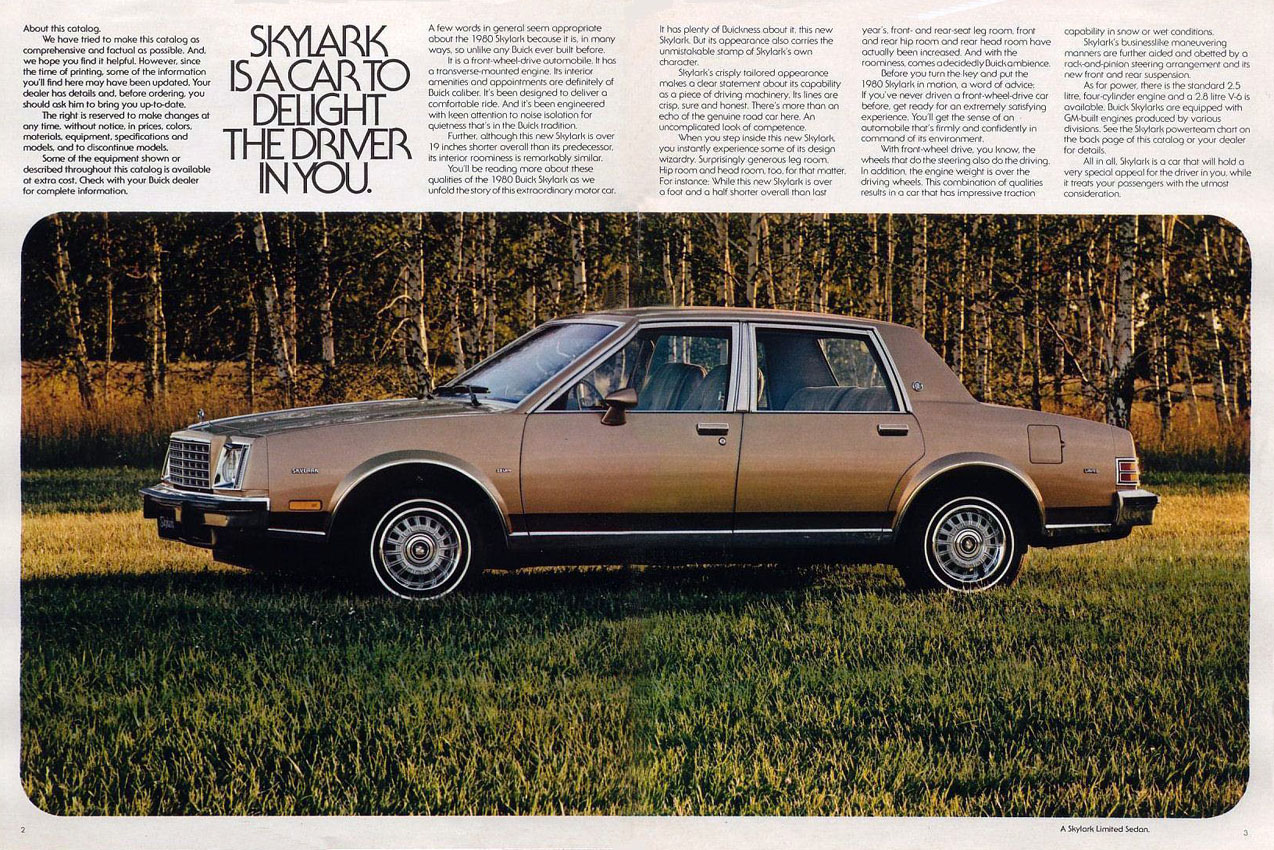
Standard exterior and mechanical equipment on the $5,306 Buick Skylark sedan included front-wheel-drive, rack-and-pinion steering, front disc/rear drum brakes, and P185/80R13 fiberglass-belted radial-ply tires (a size now only marginally available) on 13-inch wheels. Inside, buyers got a no-cost choice of either a houndstooth cloth or a vinyl notchback front bench seat. A Delco AM radio with two front speakers and a windshield antenna was also included.
The $5,726 Skylark Limited included a distinctive hood ornament, wide rocker and wheel opening moldings, Deluxe wheel covers, and a gas strut under the hood. Inside, a choice of a Limited level brushed woven cloth or a vinyl notch back seat with a fold-down center armrest, door entry courtesy lights, a simulated wood grain instrument panel, a special acoustic insulation package, and a plush carpeted back window panel were present. Limited identification was, of course, included.
The $5,920 Skylark Sport Sedan included a specially styled grille, amber front park and turn lamps, front and rear bumper strips, black moldings, wheel opening moldings, Sport mirrors, smoked tail lamp lenses, a Rallye ride-and-handling package system, a larger rear stabilizer bar, and P205/70R-13 steel-belted radial-ply blackwall tires on Designers’ Sport wheels. Inside, the Sport Sedan included a Sport steering wheel and a black instrument panel with a voltmeter, a temperature gage, and a trip odometer.
Options & Production Numbers
The Skylark’s options list gives you a sense that Buick was trying to serve two masters. The base prices were affordable, but you could load the Skylark sedan up with thousands of dollars’ worth of options, bringing it close to a Century or a LeSabre.
Individual exterior and mechanical options for the Skylark included the Designers’ Accent paint treatment ($174), a Landau top, a long vinyl top, a Vista-Vent flip-open glass sunroof ($240), power steering ($164), power brakes ($76), and chrome-plated road wheels ($141). Inside, front bucket seats ($48), a 6-way power seat ($165), a full-length operating console, Cruise-Master speed control ($105), a tilt steering column ($75), air conditioning ($564), power windows ($189), and electric door locks ($123) were available.
Four Delco radios ranging up to an AM/FM stereo with a cassette tape player and a CB ($491) were available. Lower body sport stripes with a Hawk decal were available only for the Skylark Sports versions.
Buick sold 80,940 base Skylark sedans in the 1980 model year. Combined Limited and Sports Sedan sales totalled 86,948, with the vast majority being the Limited. The Skylark was 26% of Buick’s total production in 1980.
Despite an astounding nine recalls for the 1980 version, the Skylark’s yearly sales percentage declines were notably less than those of other X cars—by 1983, Buick was actually selling more Skylarks than Chevrolet was selling Citations. The fifth-generation Skylark sedan, which Buick called its “little limousine,” would continue through the 1985 model year and end up selling 729,523 copies over six model years.
The View From 2025
A few—but only a few—of the X-cars were saved, and Skylarks of this generation occasionally appear in the Hemming’s Motor News classifieds, on eBay Motors, and on Bring a Trailer.
Make mine Dark Red Metallic, please.
Other X-bodies I’ve written about in this blog included the 1980 Chevrolet Citation hatchback sedan, the 1981 Chevrolet Citation X-11 hatchback coupe, the 1982 Pontiac Phoenix SJ coupe, the 1983 Buick Skylark T TYPE coupe, the 1984 Oldsmobile Omega sedan, and the 1985 Chevrolet Citation II hatchback sedan.

 Eighties Cars