
1985 Volvo 740 Turbo station wagon

“… an unmistakable outlaw edge.”

The 700 series Volvos had been available in the United States for a few years before Volvo brought the station wagon to our shores to offer Volvo loyalists a step up from the aging 240. The most interesting version of the 700 series wagon to enthusiasts was the 740 Turbo, which was formally introduced in the middle of the 1985 model year.

The 740 Turbo‘s standard engine was a B230FT 160 bhp 2.3 liter/141 ci inline four with fuel injection, a Garrett T3 turbocharger, and an intercooler. A four-speed manual was standard, while a four-speed automatic with overdrive was optional. Car and Driver recorded a 0-60 time of 7.9 seconds in a 740 Turbo sedan with the manual. With the manual, mileage in the 3,042-pound car was rated at 19 city/25 highway by the day’s standards (17/23 by today’s standards). With a 15.8-gallon fuel tank, 740 Turbo drivers could expect 285 to 310 miles of range with a 10% reserve.

1985 Volvo 740 Turbo station wagon advertisement

The 1985 740 Turbo station wagon’s base price was $21,340—about $64,400 in today’s dollars or about what a 2025 V90 Cross Country Ultra station wagon goes for. Standard exterior and mechanical equipment included tinted windows, a front spoiler, halogen high and low beam headlights, a manual sunroof, power-assisted rack-and-pinion steering, power-assisted disc brakes, and 195/60R15 Michelin MXV tires (a size still readily available) on 15-inch wheels. Inside, a rear window wiper/washer, power door locks, cargo tie-down rings, and air conditioning were included. Trim and upholstery features included adjustable front bucket seats with integrated head rests and lumbar support, a heated driver’s seat, a 60/40 split rear seat, and full carpeting including the trunk.

Options & Reviews

Like all Volvo models in the 1980s, the 740 Turbo had few individual factory options—you chose the exterior and interior colors, and that was about it. Cruise control and an AM/FM-stereo radio/cassette with four speakers ($800) were available.

The automobile press of the day liked the 740 Turbo wagon, and it’s interesting to watch MotorWeek‘s review. Common complaints were the lack of an oil pressure gauge—considered essential for turbocharged engines at that time—along with the “archaic” driver’s seat height adjustment. Everyone also felt the need to comment on the Volvo’s very square design.

The View from 2025

All vintage Volvos have strong club support, and there is definite collector interest in the 740 Turbo. 740 Turbo station wagons are often available in the Hemmings Motor News classifieds, on eBay Motors, and at online auctions such as Bring a Trailer that cater to the eighties car market.

Make mine Silver, please.

Other Volvos that have been covered in Eighties Cars are the 1985 240 station wagon and the 1987 780 coupe. I should write about a Volvo sedan or two at some point.
1985 Volvo 240 station wagon

When I was growing up in the Philadelphia suburbs in the mid-eighties, Volvo 240 station wagons were everywhere. They were respected, but not appreciated. Now, they’re becoming collector cars, and I see them infrequently.

“… a car whose quality you can both see and feel.”

For 1985, Volvo’s 240 sedan and station wagon gained a revised “low friction” engine with slightly increased horsepower. Otherwise, there were few changes to a design that had been in production since the 1975 model year.

The 240’s standard powertrain was a B230F 114 bhp 2.3 liter/141 ci inline four with fuel injection paired to a four-speed manual. A four-speed automatic with overdrive was optional. 0-60 mph likely took a little over 12 seconds with either transmission. With the manual transmission, mileage in the 3,042-pound car was rated at 23 city/28 highway by the day’s standards (20/26 by today’s standards). With a 15.9-gallon gas tank, 240 drivers could expect 330 to 365 miles of range with a 10% fuel reserve.

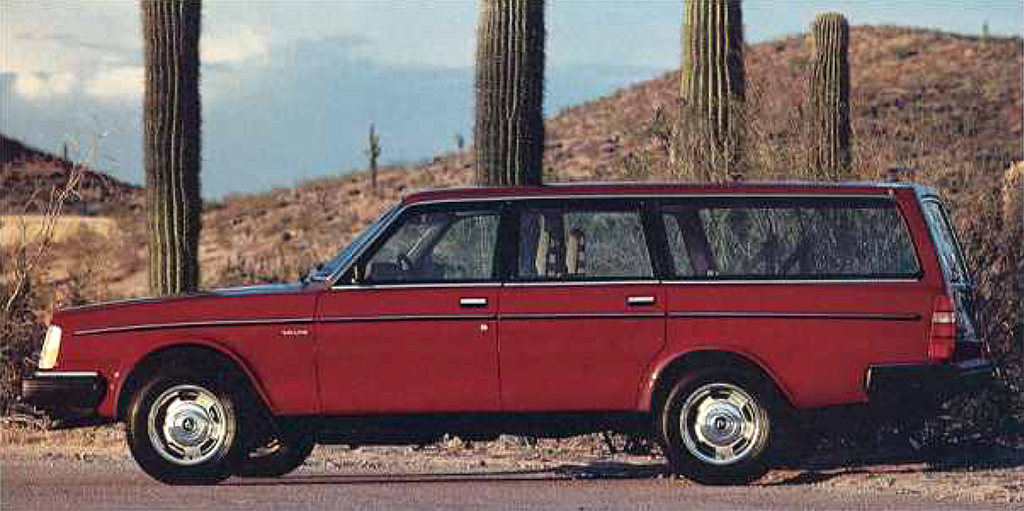
Volvo 240 DL station wagon photo from the 1985 Volvo brochure

By 1985, the 240 was no longer as spare as it had been a few years before. Standard exterior and mechanical equipment for the $14,690 240 DL station wagon (about $45,300 in today’s dollars) included tinted windows, a front spoiler, power-assisted rack-and-pinion steering, power-assisted disc brakes, and 195/75R14 tires on 14-inch wheels. Inside, a rear window wiper/washer, power door locks, cargo tie-down rings, and air conditioning were included. Trim and upholstery features included adjustable front bucket seats with integrated head rests and lumbar support and full interior carpeting.

Moving up to GL added an engine compartment light, power windows, an intermittent setting for the rear window wiper/washer, a small diameter steering wheel (I’m not sure why this was notable or a positive), and a heated driver’s seat.

Volvo 240s had few individual factory options—you chose the trim level and the color, and that was about it. They continued to sell in decent numbers—the 1985 240 station wagon moved about 68,000 units worldwide.

The View from 2025

All vintage Volvos have strong club support, and there is definite collector interest in what 240 owners call “bricks”—enough for Hagerty to offer a buyer’s guide. According to Hagerty’s valuation tools, all the money for a 1985 Volvo 240 GL station wagon in #1/Concours condition is $52,300, with a far more normal #3/Good condition version going for $13,800. 240 station wagons are often available in the Hemmings Motor News classifieds, on eBay Motors, and at online auctions such as Bring a Trailer that cater to the eighties car market.

Make mine Dark Red, please.

Other Volvos that have been covered in Eighties Cars include the 1985 740 Turbo station wagon and the 1987 780 coupe.

Last updated November 2025.

1987 Volvo 780 coupe

“The kind of Volvo you design when you’ve been designing Ferraris, Lamborghinis and Maseratis all your life.”

Designed and produced by Bertone and primarily based on the 760 sedan, the 780 was Volvo’s second attempt at a stylish coupe. The first was also a Bertone creation—the 262C built from 1977 through 1981. Beyond the handsome exterior, the interior was also specific to the 780—not merely a slightly re-purposed 760 design. Among the significant changes from the 760’s interior were a move from five seats to four, with individually-shaped seats for those in the rear.

The 780 used its design and a notably high standard equipment level as differentiators as Volvo attempted to move into higher-end markets. The 780’s base price was $34,785—about $81,700 in today’s dollars, which is well more than any Volvo vehicle’s sticker price in 2020. Back in 1987, the 780’s real competition was unclear. Was it the Acura Legend (also in its first year but much less expensive), the BMW 6-series (much more expensive), the Lincoln Mark VII (far less expensive—at least until many options were added), or some other car?

For 1987, the only powertrain available was the B280F 146 bhp 2.8 liter/174 ci V6 with Bosch LH-Jetronic fuel injection paired with a four-speed automatic transmission. 0-60 mph times were in the 11 second range—Volvo did not intend the 780 to be a sports coupe. Mileage in the 3,415-pound car was rated at 17 city/21 highway by the standards of the day (15/20 by today’s standards). With a relatively small 15.9-gallon fuel tank, 780 drivers could expect 250 to 270 miles of range with a 10% reserve.

1987 Volvo 780 advertisement

Standard exterior equipment for the 780 included tinted glass, a power moonroof with a sliding sunshade, dual power mirrors with a heating element, flush-lens halogen headlamps, front and rear fog lamps, and the Bertone name and logo on both C pillars. Mechanical features included power steering, four-wheel vented power disc brakes with ABS, and 205/60R15 tires (a size still readily available) on 15 x 6 inch 15-spoke alloy wheels.

Inside, the 780 came loaded, with full instrumentation including a tachometer, a power central locking system, power windows, automatic climate control, cruise control, and a driver’s side airbag. Upholstery highlights included heated eight-way power leather front bucket seats and beach burl wood trim. The standard stereo was an AM/FM ETR stereo cassette with a seven-band graphic equalizer, four speakers, a 200-watt amplifier, and a power antenna.

Volvo did not sell a lot of 780’s—but I don’t believe they expected to. Only 9,215 (other sources say 8,518) were produced over six years of production, with about 61% of those going to the United States market. There’s an enthusiast site at 780coupe.com, and folks do collect 780’s. You also sometimes see them in the Hemmings Motor News classifieds and on eBay Motors.

Make mine Blue Metallic, please.

This post is the first on a Volvo in Eighties Cars. There will be others—I definitely expect to get to the 240 wagon at some point.