1985 Volkswagen Jetta GLI sedan

“… a true German road car …”

Volkswagen’s Jetta sedan was all-new for the North American market for the 1985 model year. The top-of-the-line version (and the one that attracted the most attention from the “buff books”) was the GLI. The Jetta was a small car by modern standards—the 171.7-inch length makes it more than a foot shorter than the 2025 Jetta.

Under the hood was a 100 bhp 1.8 liter/109 ci inline four with Bosch KE-Jetronic fuel injection. A five-speed manual transmission completed the rest of the powertrain—an automatic transmission was optional. Car and Driver recorded a 10.9-second 0-60 time and a 108 mph top speed in a vehicle with a 2,460-pound curb weight. Fuel economy was rated at 26 city/32 highway (23/29 by today’s measures); a 14.5-gallon gas tank gave a 340 to 375-mile range with a 10% fuel reserve.

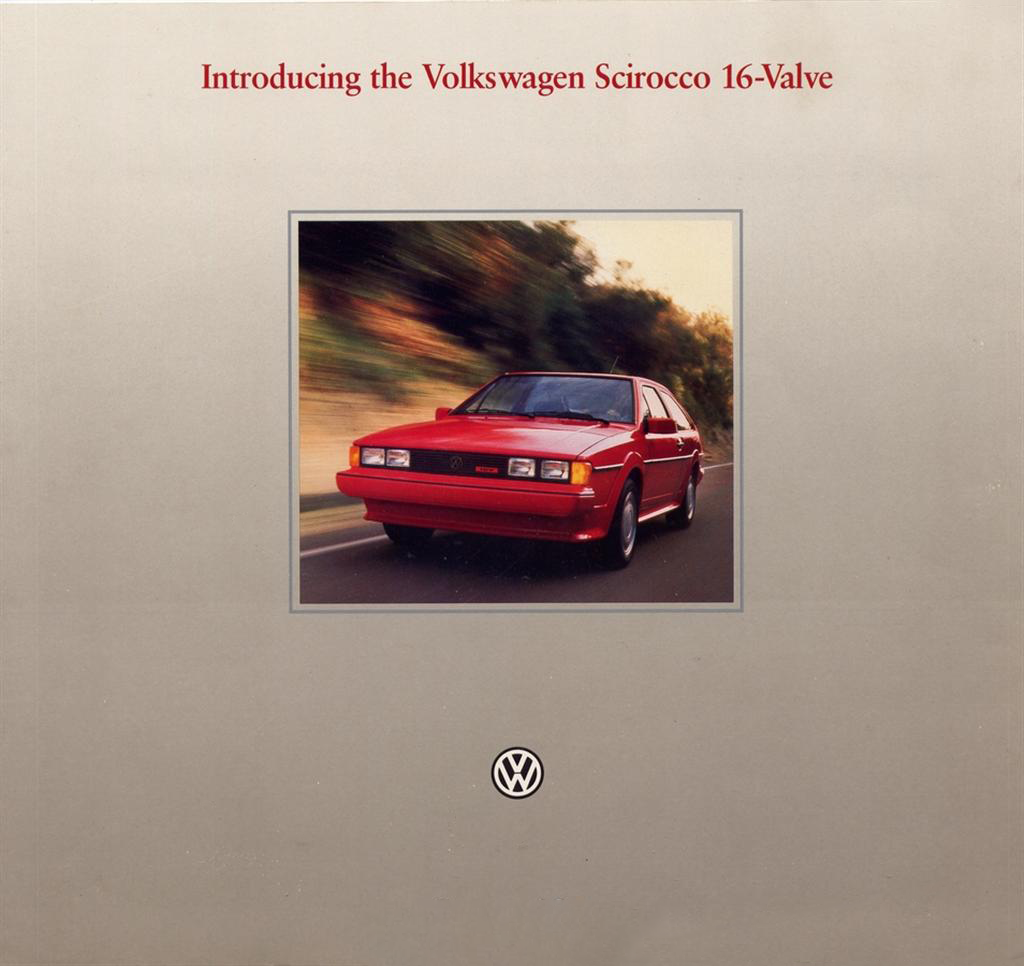
Front cover of the 1985 Volkswagen Jetta GLI brochure

The Jetta GLI’s base price was $10,315—about $31,600 in 2025 dollars and just a little less than the 2025 Jetta GLI goes for. Standard exterior and mechanical equipment included a front spoiler, aerodynamic halogen headlights, tinted glass, quick ratio power assisted rack and pinion steering, power-assisted four wheel disc brakes with the front brakes ventilated, and 185/60HR14 performance series steel belted radial tires (a size still readily available) on 14-inch styled alloy wheels. Inside, fully reclining front sport bucket seats with adjustable headrests, a 4-spoke leather-wrapped Sport steering wheel, a leather shift knob, a center console, and an electric rear window defroster were included.

Options & Period Reviews

Individual options were relatively few and included a manual sunroof ($335), metallic paint ($150), air conditioning ($725), cruise control, and an AM/FM stereo cassette with four speakers ($575). The $595 power-assist group included power windows, power door locks, and power mirrors.

The 1985 Jetta GLI got good reviews—Car and Driver‘s tagline was “one of the most capable sport sedans.”

The View From 2025

Second-generation Jettas have a following, and GLIs are occasionally featured in the Hemming’s Motor News classifieds, eBay Motors, and Bring a Trailer.

Make mine Black, please.

I have also written about the 1981 Dasher station wagon, the 1981 Sirocco S hatchback coupe, the 1983 Rabbit GTI hatchback coupe, and the 1985 Cabriolet.

1981 Volkswagen Dasher station wagon

A 1981 Volkswagen Dasher station wagon sold for $7,600 on Bring a Trailer in February 2025. It was a brown diesel with a manual transmission—directly mapping to a certain internet cliché (except for being front-wheel-drive). I’m relatively spare on Volkswagen blog entries, so here we go.

“More luxury. More space.”

The Volkswagen Dasher station wagon was a small car, classified by the EPA as a subcompact. Its 97.2-inch wheelbase was half a foot shorter than the 2025 Golf GTI’s and its curb weight was slightly less than 2,200 pounds. Putative compact station wagon competition for the 1981 Dasher included the Ford Escort, the Honda Civic, the Plymouth Reliant, and the Renault 18i Sportwagon.

For its eighth and final year, the Dasher station wagon’s only powertrain was a 52 bhp 1.6 liter/97 ci diesel four paired with a four-speed manual transmission. Fuel mileage was quite good—36 mpg by the day’s standards. Diesel Dashers were slow, slow, slow—even by 1981 standards. 0-60 came in 19.3 seconds and VW claimed a top speed of 85 mph.

1981 Volkswagen print advertisement

Standard exterior and mechanical equipment on the $9,040 Dasher station wagon (about $34,400 in today’s dollars or about what a loaded 2025 Volkswagen Taos SEL compact SUV goes for) included front-wheel-drive, rack and pinion steering, power-assisted self-adjusting front disc/rear drum brakes, an electric rear window defogger/defroster, and 155/80R13 steel belted radial tires (a size still available from Kumho and Michelin) on 13-inch wheels with wheel covers. Inside, a padded steering wheel, a trip odometer, a quartz crystal chronometer, a wood-grained instrument panel, cut pile carpeting, and reclining front bucket seats in crushed velour were included.

Options

Options included tinted glass ($70), a manual sunroof ($260), 175/70R13 white sidewall tires ($130), air conditioning ($620), leatherette upholstery ($65), and an AM/FM stereo radio ($275).

The View From 2025

Dashers have largely vanished, which is what made so many take notice of that recent Bring a Trailer offering. There is limited collector interest in these cars, so it isn’t that surprising that Hagerty’s valuation tools do not track any 1981 Volkswagens. Dashers rarely appear in the Hemming’s Motor News classifieds, on eBay Motors, or on Bring a TrailerBaT has sold a grand total of three Dashers in eleven years.

Make mine Helios Blue Metallic, please.

Other Volkswagens I have written about include the 1981 Scirocco S hatchback coupe, the 1983 Rabbit GTI hatchback coupe, and the 1985 Cabriolet.

Last updated July 2025.

1981 Volkswagen Scirocco S hatchback coupe

I’ve liked the styling of the first-generation Scirocco since it was new. It was, of course, designed by one of the all-time masters.

“For the most discriminating and demanding sports car enthusiasts”

1981 was the final model year for the first-generation Scirocco, which was first available in North America in 1975. Though the Scirocco used the same platform as the Golf, it was actually released about six months before the Golf.

With its basic form penned by Giorgetto Giugiaro—who seemed to have a hand in nearly every 1970s Volkswagen design—the Scirocco debuted at the 1973 Geneva Motor Show. Like the Karmann Ghia that it putatively replaced, the Scirocco was assembled by Karmann.

Classified as sub-compact by the EPA, the Scirocco was not a large car—its 155.7-inch length is more than a foot shorter than the current Golf GTI. For 1981, the configuration of the Scirocco sold in North America moved to a slightly large 1.7 liter engine, transitioned the standard transmission from a four-speed manual to a five-speed manual, and offered a new Scirocco S package.

The Scirocco’s standard powertrain was the EA827 74 bhp 1.7 liter/105 ci inline four with fuel injection mated with a five-speed manual. A three-speed automatic was optional. With a curb weight of 1,892 pounds, 0-60 came in a little over 11 seconds. Fuel economy was rated at 25 city/40 highway by the day’s standards. With a 10.6-gallon gas tank, a Scirocco owner could expect a range of 280 to 310 miles with a 10% fuel reserve.

Scirocco S pages from the 1981 brochure

Standard mechanical features on the $8,495 Scirocco (about $32,000 in today’s dollars or almost exactly what a 2025 Golf GTI goes for) included front-wheel-drive, rack-and-pinion steering, power-assisted front disc/rear drum brakes, and 175/70SR13 steel-belted radial tires (a size still readily available) on 13-inch wheels. Inside, a tachometer, a trip odometer, and front bucket seats were standard.

Packages & Options

A new package for 1981 was the S, which included black trim, a red VW radiator badge and belt-line moulding, a larger front spoiler, light alloy wheels, and specially designed striped cloth sport seats. The S package was available in three of the eight standard Scirocco colors and cost $520.

Options for the Scirocco were few—a sunroof, a rear window wiper/washer, the aforementioned three-speed automatic transmission, and air conditioning.

The View From 2025

First-generation Sciroccos attract collector interest, and there is club support. They are sometimes available in the Hemmings Motor News classifieds, on eBay Motors, and at online auctions such as Bring a Trailer that cater to the eighties car market.

Make mine Cirrus Gray Metallic, please.

Other Volkswagens I have written about include the 1981 Dasher station wagon, the 1983 Rabbit GTI hatchback coupe, and the 1985 Cabriolet.

Last updated April 2025.

1985 Volkswagen Cabriolet

“Once again Volkswagen brings a breath of fresh air to the automotive world.”

For the 1985 model year, Volkswagen changed the name of its Rabbit-based convertible in the United States from Rabbit Convertible to Cabriolet. One reason for the Cabriolet rename was likely its base price—at $11,595 (about $35,600 in today’s dollars) around 66% higher than the Golf hatchback coupe’s base price. Another driver was that the Cabriolet retained the Mk1 Rabbit as its basis, rather than joining the Mk2 hatchback coupes and sedans, which were new for 1985 in the United States. All Cabriolets were built by Karmann Coachworks, with most components supplied by Volkswagen, and all had a Karmann badge placed forward of both doors.

The Cabriolet’s standard powertrain was the JH 90 bhp 1.8 liter/109 ci inline four with Bosch K-Jetronic fuel injection paired with a five-speed manual transmission. An automatic transmission was available. Motor Week recorded a 0-60 time of 11.8 seconds with the five-speed in the approximately 2,275-pound Cabriolet.

Volkswagen’s Cabriolet brochure boasted that it was “perhaps the most efficient way to drive from one place to another with the wind in your hair.” This statement was likely correct in 1985; with the five-speed manual, fuel economy ratings by mid-eighties standards were 24 city/29 highway (21/26 by 2025 standards). With a 13.8-gallon gas tank, a Cabriolet owner could expect a range of between 290 and 330 miles with a 10% fuel reserve.

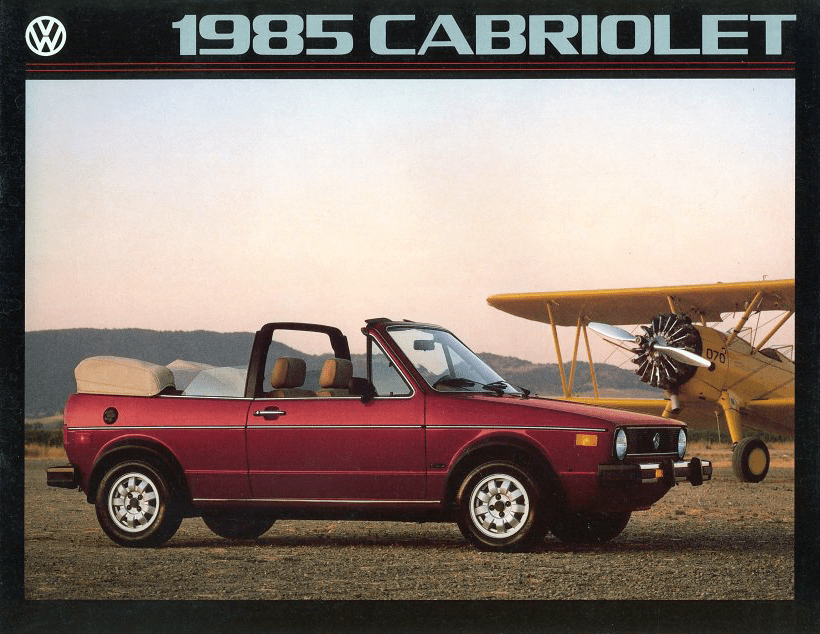
1985 Volkswagen Cabriolet brochure cover

Standard exterior equipment for the Cabriolet included an insulated three-layer convertible top with a heated glass rear window, a boot for the top, tinted glass, and remote-controlled mirrors. Mechanical equipment included front-wheel-drive, a sport suspension, rack-and-pinion steering, power ventilated front disc/rear drum brakes, and 175/70SR13 tires (a size still readily available) on 13-inch wheels. Inside, reclining front bucket seats, full instrumentation, and an electronic AM/FM stereo cassette with four speakers were included.

Options, Competition, & Production Numbers

Options were relatively few: metallic paint, white sidewall tires, 13-inch light-alloy wheels, power steering, cruise control ($200), air conditioning ($725), and cloth sports seats. The Triple White Bestseller package included Alpine White paint, a white convertible top, and white seats. Later in the model year, the usual Wolfsburg Edition promotion was available, with Flash Silver Clearcoat Metallic paint, 185/60HR14 steel-belted radial tires, 14-inch alloy wheels, power steering, a full leather interior, and sports seats.

The mid-priced four-seat convertible market for 1985—all in the $10,500 to $13,500 range—was suddenly rather crowded. In addition to the Volkswagen, potential convertible buyers could choose from the AMC Renault Alliance, the Chevrolet Cavalier/Pontiac Sunbird J-cars, the Chrysler LeBaron/Dodge 600 K-cars, the Ford Mustang/Mercury Capri Fox-bodies, and the Toyota Celica. Despite this various and varied competition, Volkswagen sold an impressive 12,637 Cabriolets in 1985.

The View From 2025

There is definite collector interest in the Cabriolets, and there’s also a lot of information on Cabby Info. Cabriolets are regularly featured in the Hemming’s Motor News classifieds, eBay Motors, and Bring a Trailer.

Make mine Flash Silver Metallic, please.

Other Volkswagens I have written about include the 1981 Dasher station wagon, the 1981 Scirocco S hatchback coupe, the 1983 Rabbit GTI hatchback coupe, and the 1985 Jetta GLI sedan. I’ll have to get to the Quantum and the Vanagon at some point.

Last updated August 2025.

1983 Volkswagen Rabbit GTI hatchback coupe

“Affordable German Performance.”

The 1983 Volkswagen Rabbit GTI three-door hatchback defined the “pocket rocket” for the US market, just as it had established it in Europe since 1977. The Giorgetto Giugiaro-designed Rabbit was a small car by modern standards—the 155.3-inch length puts it squarely in modern Mini territory and makes it more than a foot shorter than a 2026 Golf GTI.

Under the blacked-out, red-lined, and badged hood was a 90 bhp 1.8 liter/109 ci inline four with Bosch K-Jetronic fuel injection—an engine VW dared to declare was “brawny.” A five-speed manual transmission completed the rest of the powertrain—there was no optional automatic transmission.

Car and Driver recorded a 9.7 second 0-60 time (Road & Track managed a 10.6 second 0-60) in the 1,918-pound car—faster than the same year’s BMW 320i and many other sporting cars of the era. Top speed was 104 mph. Fuel economy was rated at 26 city/36 highway; a 10-gallon gas tank gave a 230 to 250-mile range with a 10% reserve.

1983 Volkswagen Rabbit GTI advertisement

The 1983 GTI’s base price was $7,990—about $26,400 in 2025 dollars, which is about 24% less than what a 2026 Golf GTI goes for. Standard exterior equipment included tinted glass, halogen headlights, a urethane front air dam, and a hatchback rear deck lid with rear wiper/washer. Standard mechanical equipment included front-wheel-drive, power-assisted ventilated front disc/rear drum brakes, rack and pinion steering, and Pirelli P6 185/60HR-14 radial tires (a size still readily available) mounted on 14 x 6 inch “Snowflake” alloy wheels. Inside, a sport steering wheel borrowed from the Scirocco, heavily bolstered cloth sports seats, a center console with additional gauges, and a golf-ball shift knob were included.

Options, Period Reviews, & Production Numbers

Options were relatively few and included fully integrated air conditioning (dealer-installed and $630), a sliding sunroof with a deflector ($285), extra-cost paint ($135), and an AM/FM stereo with a cassette player ($350).

The 1983 Rabbit GTI got good reviews—Car and Driver included it in their first 10Best, and Road & Track stated that “if you’re a car enthusiast, we may have the cure for your ills.” The GTI also sold well—Volkswagen built about 30,000 copies over two years at their Westmoreland County, PA plant.

The View From 2025

First-generation GTIs certainly have a following, but many were driven hard when no longer new, so there’s a paucity of creampuffs out there.

According to Hagerty’s valuation tools, all the money for a 1983 Rabbit GTI in #1/Concours condition is $64,800, with a more normal #3/Good condition car going for $17,600. Values are also up notably; that perfect #1 car was only $20,600 five years ago. GTIs are regularly featured in the Hemmings Motor News classifieds, on eBay Motors, and on Bring a Trailer.

Make mine Black, please.

I have also written about the 1981 Dasher station wagon, the 1981 Sirocco S hatchback coupe, the 1985 Cabriolet, and the 1985 Jetta GLI sedan.

Last updated October 2025.