1987 Plymouth Turismo hatchback coupe

“Fun is affordable again.”

For 1987, Plymouth’s Turismo hatchback coupe was little changed as it headed into its final model year. The 2.2-liter engine became standard, along with argent Rallye wheels.

The Turismo’s standard powertrain was the K 96 bhp 2.2 liter/135 ci inline four with a two-barrel carburetor paired with a five-speed manual transmission. A three-speed automatic was available as part of the Basic package or the Duster package. 0-60 times are hard to come by for the Turismo, but I’m betting on a little over 10 seconds for the 2,281-pound car—with the five-speed. Fuel economy is better known—25 city/35 highway with the five-speed by the day’s standards (22/32 by today’s measures). With a 13-gallon gas tank, a Turismo driver could expect a range of 320 to 350 miles with a 10% fuel reserve.

Front cover of the 1987 Plymouth Turismo brochure

The $7,199 Turismo (about $21,200 in today’s dollars) had better base equipment for 1987 than it had in previous years. Standard exterior and mechanical equipment included tinted glass, black bodyside moldings, halogen headlights, an electric rear window defroster, a remote liftgate release, power brakes, and P165/80R13 steel belted radial tires (a size now only available from Michelin at considerable expense) on argent 13-inch Rallye steel wheels. Inside, cloth with vinyl trim low-back front bucket seats, a four-spoke color-keyed Sport steering wheel, and an electric rear window defroster were included.

Packages, Options, & Production Numbers

Plymouth offered three packages for the 1987 Turismo:

  • The $776 Basic package included the three-speed automatic and power-assisted steering.
  • The $575 Duster manual package included Duster and Plymouth decals, black dual remote control exterior mirrors, power-assisted steering, cloth with vinyl trim Sport reclining high-back front bucket seats with increased lateral support, Deluxe door trim panels with cloth inserts, a console, and an electronic tuning AM stereo/FM stereo radio with a digital clock and four speakers
  • The $1,009 Duster automatic package included Duster and Plymouth decals, black dual remote control exterior mirrors, the three-speed automatic, power-assisted steering, cloth with vinyl trim Sport reclining high-back front bucket seats with increased lateral support, Deluxe door trim panels with cloth inserts, a console, and an electronic tuning AM stereo/FM stereo radio with a digital clock and four speakers

There were few individual options, but they included California emissions, air conditioning ($701), and an AM/FM stereo cassette with Dynamic Noise Reduction and auto reverse ($246).

Plymouth sold 24,104 Turismos in its final model year—a far cry from the 52,162 sold two years prior. Introduced for 1987, the Sundance coupe would be the putative replacement going forward in Plymouth’s model line.

The View From 2025

I’m going to declare this version of the L-body as vanished. I haven’t seen a Turismo in the wild for decades, and they have little presence in the Hemmings Motor News classifieds or on eBay Motors. Bring a Trailer hasn’t sold any Turismos, though they did sell one of the Scamp pickup truck variants in 2019.

Make mine Garnet Red Pearl Coat, please.

Other Plymouths I have written about include the 1980 Horizon hatchback sedan, the 1980 Volaré station wagon, the 1981 Reliant coupe, and the 1984 Voyager minivan. I’ve also written about the 1983 and 1985 versions of the Dodge Shelby Charger hatchback coupe—the Turismo’s higher-performance sibling.

Last updated October 2025.

Chrysler Corporation’s Transition To Front-Wheel-Drive

I was working on a blog post on the 1981 Chrysler New Yorker, and I got to thinking about the nuts and bolts of Chrysler’s transition to front-wheel-drive in the United States. For this study, I looked at only non-imported cars (no Arrows, Colts, or Sapporos), and only at offerings from the Chrysler, Dodge, and Plymouth brands.

1977: the year before the Omni/Horizon hatchback sedan debuted, Chrysler Corporation had four platforms, all of them rear-wheel-drive. The F-body Aspen/Volaré compact was by far the sales leader—approximately 48% of Chrysler’s 1.2 million sales. The other offerings were the M-body premium mid-size (new for 1977, with the Dodge Diplomat sedan fated to make it all the way to 1989), the B-body mid-size, and the C-body full-size.

1978: the L-body Omni/Horizon hatchback sold well in its first year, with almost 167,000 exiting Dodge and Plymouth dealerships. These numbers comprised 15% of overall domestic production, with the Aspen/Volaré still being the sales leader. Chrysler Corporation sales declined by about 13%.

1979: a coupe version of the L-body made it to market, branded as Omni 024 and Horizon TC3. Overall Omni/Horizon sales were now 27% of total production, partly because Chrysler’s sales continued to collapse (off another 11%). Chrysler did bring the downsized rear-wheel-drive R-body full-size platform to market, replacing the C-body. 1979 was the last year that the Aspen/Volaré led Chrysler sales.

1980: Omni/Horizon sales increased by 2% to 264,000. They were now 41% of overall domestic production and by far the sales leader in another down year. The rear-wheel-drive J-body coupes (Cordoba and Mirada) replaced the B-body, but didn’t sell any better. 1980 was the final year for the Aspen/Volaré.

1981: a lot changed at your local Dodge or Plymouth showroom in 1981. The Aspen/Volaré was retired, putatively replaced by the heavily publicized Aries/Reliant K-body. Sales of the two front-wheel-drive platforms combined for 81% of overall production, and domestic Chrysler automobile production was up for the first time in many years.

1982: Chrysler added Super K models to the mix—really just slightly nicer versions of the Aries and Reliant. The Chrysler brand got its first front-wheel-drive offering with the LeBaron coupe, sedan, station wagon, and (late in the model year) convertible. The rear-wheel-drive C-body full-size was retired after only three years, with the New Yorker and Gran Fury marques transitioning to the rear-wheel-drive M-body mid-size platform. Despite the increased front-wheel-drive choices, their percentage of production increased only half a percent.

1983: Chrysler introduced the E-body—an extended version of the K-body with three more inches of wheelbase. Dodge got the 600 sedan, while Chrysler got two models—the E Class and the New Yorker (switching platforms yet again). Chrysler’s M-body offering was renamed to New Yorker Fifth Avenue, but I’m betting many potential buyers were still confused. 1983 was also the last year for the J-body coupes, with the Cordoba, Imperial, and Mirada going away.

1984: the sporty G-body Daytona and Laser hatchbacks were announced. Chrysler rebranded the rear-wheel-drive New Yorker Fifth Avenue as simply Fifth Avenue—probably a good idea. With only the M-body as a rear-wheel drive offering, the percentage of front-wheel-drive vehicles reached 88%.

1985: the Chrysler E Class vanished, but magically reappeared as the Plymouth Caravelle. The H-class mid-size sedan debuted in Lancer and LeBaron GTS forms. Dodge kept interest going in the aging L-body with increasingly quicker variants: 1985 had the Omni GLH and the Shelby Charger.

Chart of Chrysler's transition from rear-wheel-drive to front-wheel-drive

1986: unlike the previous five years, things were relatively quiet in 1986, with no model introductions or phase-outs. The K-body convertible was in its final year—there would be no Chrysler LeBarons (Mark Cross or Town & Country) or Dodge 600s after 1986.

1987: the Super K platform disappeared, and the P-body and front-wheel-drive J-body platforms debuted. The K-body offerings no longer included a LeBaron coupe or convertible, but the LeBaron sedan and station wagon and the Aries/Reliant twins were still good for a quarter of overall production. The percentage of front-wheel drive cars hit 90%, but Chrysler still sold over 100,000 of the M-body sedans, with the Chrysler Fifth Avenue being the leader.

1988: the front-wheel-drive C-body debuted, at that point the largest Chrysler front-wheel-drive offering—by an inch of wheelbase. It was seen in the Dodge Dynasty, and yet another version of the New Yorker—the end-of-the-line E-body based New Yorker was branded as New Yorker Turbo. Front-wheel-drive sales hit 93%.

1989: the E-body went away, with the A-body Dodge Spirit and Plymouth Acclaim sedans replacing it. For the first time since 1980, the K-body was not the best-selling platform—the C-body took over the sales crown in its second year, with 207,000 sold. Front-wheel-drive was now 97% of production.

1990: Chrysler Corporation discontinued three platforms in 1990. The K-body and H-body went away, but most important for this narrative is that the rear-wheel-drive M-body was gone. The transition was complete, but Chrysler would return to rear-wheel-drive in 1992 with the Dodge Viper.

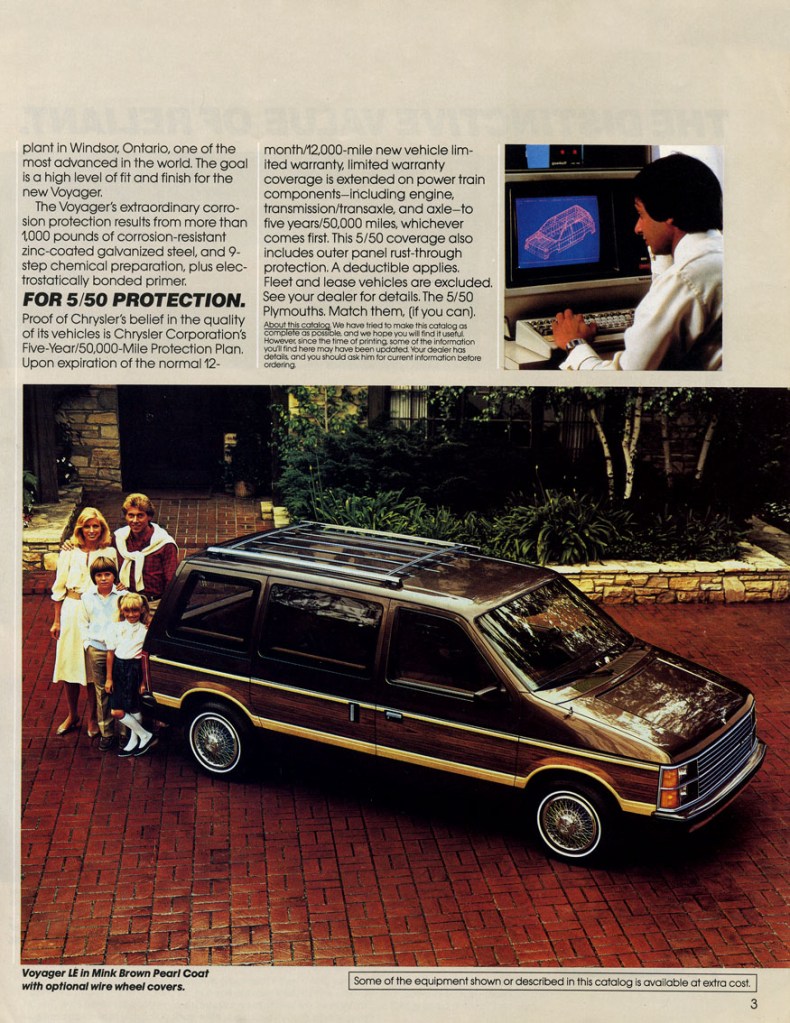
1984 Plymouth Voyager van

1984 Plymouth Voyager on the National Mall
1984 Plymouth Voyager on the National Mall, courtesy of the HVA

In spring 2018, the Historic Vehicle Association placed a series of five notable vehicles in a glass case on the National Mall in Washington, DC. One of those vehicles was a 1984 Plymouth Voyager Limited Edition minivan—highly original, and with a mere 12,000 miles.

“The Magic Wagon.”

Few eighties vehicles changed the world as much as the Dodge Caravan/Plymouth Voyager twins—because few automobiles essentially create a new market segment. The essential glory of K-platform minivans was their splitting of the packaging differences between traditional station wagons and full-size vans, along with their utilization of front-wheel-drive. Astoundingly, Allpar writes that Chrysler had been working on the same basic idea since around 1972. A reason given that those early designs were not brought to market was that General Motors and Ford had not released their own versions. It took Lee Iaccoca’s arrival in late 1978 to finally get upper management support for the T-115 concept.

The Voyager’s standard powertrain was an 84 bhp 2.2 liter/135 ci inline four with a two-barrel carburetor paired with a five-speed manual. Powertrain options included a $439 three-speed automatic and a $259 105 bhp 2.6 liter/156 ci inline four with a two-barrel carburetor (which required the automatic).

For a mainstream vehicle in 1984, the Voyager came respectably equipped. Standard exterior and mechanical equipment ($8,290 or about $26,200 in today’s dollars) included tinted glass for all windows, a right hand sliding door with a vented window, quad halogen headlamps, power rack and pinion steering, and P185/75R14 blackwall tires on 14-inch wheels with bright wheel covers. Inside, a left hand remote control mirror, two-speed windshield wipers, cloth low back front bucket seats, a three-passenger rear seat, full-floor carpeting, and an AM ETR radio with a digital clock were included.

Packages, Options & Production Numbers

Moving up to the S.E./Special Edition package ($227) added black exterior window trim, black lower body paint, road styled wheels with bright centers and trim rings, and Deluxe cloth low back front bucket seats.

Page from the 1984 Plymouth Voyager brochure
L.E. page from the 1984 Plymouth Voyager brochure

The top-of-the-line L.E./Limited Edition package ($815) included everything from the S.E. package and added woodgrain exterior vinyl bodyside panels, dual horns, a Luxury steering wheel, and Luxury cloth high back front bucket seats with recliners.

Individual options included premium wheel covers ($203), a 20-gallon fuel tank ($43), air conditioning ($737), automatic speed control ($179), a rear window defroster ($143), power door locks ($176), and an AM/FM stereo with a cassette player ($389). A Seven-Passenger Seating Package ($336) was available with either the S.E. or the L.E.—that was Chrysler’s nomenclature for adding a third-row seat.

Of course, the Chrysler minivan twins were a huge success, with 209,895 sold in their initial model year. They also received good to great reviews from the automotive press—Car and Driver included them in their 1985 10Best Cars.

Ford and General Motors had notable trouble in responding. Both had competitors (Chevrolet Astro, Ford Aerostar, GMC Safari) in place by the 1986 model year, but the market found them wanting—in part because they were rear-wheel-drive. The first real competition for Chrysler did not come until the mid-nineties when Honda debuted the front-wheel-drive Odyssey.

The View From 2025

Despite their importance, just a few folks out there collect these minivans—though I did spot one at a car show several years ago. Chrysler minivans of this era rarely show up for sale in the Hemmings Motor News classifieds, on eBay Motors, or on Bring a Trailer—in fact, they now are seldom for sale anywhere.

Make mine Gunmetal Blue Pearl Coat, please.

Last updated April 2025.

1981 Plymouth Reliant coupe

Lee Iacocca passed in July 2019 after leading a full life—he was 94. In his honor, I revised my write-up on one of his most famous creations.

“right for the times we drive in”

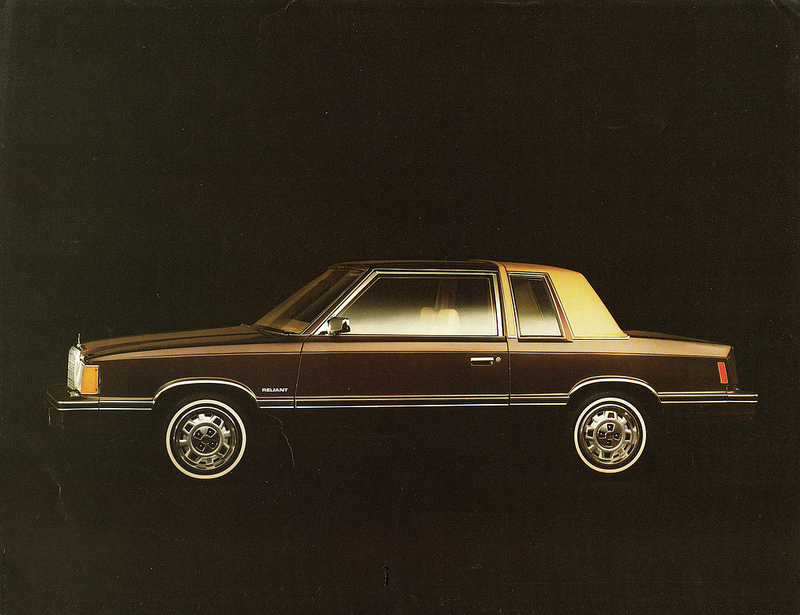
The 1981 Plymouth Reliant and its sibling, the Dodge Aries, are the K-body cars often (and reasonably) credited with saving Chrysler in the early 1980s. The first K cars were basic transportation, famously (like the GM X cars a year before) with no roll-down rear windows and just barely mid-size by the EPA’s classification—with an overall length of 176 inches, the Reliant coupe is almost exactly as long as a 2025 Mini Countryman.

The standard powertrain was an 84 bhp 2.2 liter/135 ci inline four with a Holley two-barrel carburetor paired with a four-speed manual. A Mitsubishi built 92 bhp 2.6 liter/156 ci inline four was optional for $159 and required both power steering ($174) and the three-speed TorqueFlite automatic ($360). Gas mileage with the base powertrain combination was rated at 29 city/41 highway by the day’s standards (23/29 by today’s measures). With a 13-gallon gas tank, a Reliant coupe with the standard engine and transmission could travel between 305 and 410 miles with a 10% fuel reserve.

1981PlymouthReliant
1981 Plymouth Reliant two-door coupe, scan courtesy of Alden Jewell

For $5,880 (about $22,200 in 2025 dollars), you got a Reliant coupe with front-wheel drive, rack-and-pinion steering, front disc/rear drum brakes, and P175/75R13 tires (a size that isn’t generally available anymore) on 13-inch wheels. Inside, a cloth and vinyl split back bench seat and an AM radio were included. The base coupe was only available in Pearl White, Natural Suede Tan, and Formal Black.

Spending another $435 on your Reliant coupe moved you up to Custom trim, which added quarter-window louvers, halogen headlights, a cigarette lighter, a color-keyed Deluxe two-spoke steering wheel, a digital clock, and a glove box lock. You also got many more exterior and interior color choices.

The top-of-the-line Special Edition (SE) Reliant coupes ($6,789 or about $25,600 in today’s dollars) added dual horns, deluxe wheel covers, special sound insulation, a cloth bench seat, and a snazzier “luxury” two-spoke steering wheel. Cloth bucket seats ($91) were only available with the SE.

Options, Production Numbers, & Performance

External and mechanical options for all Reliant coupes included tinted glass ($75), a glass sunroof ($246), and power brakes ($82). Both the mid-range upgrade P185/75R13 tires and the P165/75R14 upmarket tires (a size that fit the mid-90s Plymouth Neon compact just fine) are still readily available.

Inside, air conditioning cost $605 and required tinted glass, power brakes, and power steering—things were tightly engineered in the early 1980s. Other options included automatic speed control ($132), intermittent wipers ($44), a tilt steering wheel ($81), power door locks ($93), power front seats ($173 and said to be quite rare), along with a variety of radios up to an AM/FM radio with a cassette tape player and four speakers ($224).

The Reliant sold well in 1981—between the coupe and the sedan, Plymouth moved 101,127. Motor Trend managed to get a 2.2 liter with the automatic to do 0-60 in 12.4 seconds—they tried with another Reliant running the same combination, and it took 14.0 (oog) seconds. Top speed (if you could call it that) ranged from 88 to 96 mph in the 2,350-pound car.

The View From 2025

In 2025, Plymouth Reliants coupes rarely come up for sale in the Hemmings Motor News classifieds, on eBay Motors, or on Bring a Trailer, though you do see them occasionally on Craigslist. I haven’t seen a coupe in the wild for many years.

Make mine Baron Red, I think.

Other K-body and K-body based cars I have covered in this blog include the 1982 Chrysler LeBaron convertible, the 1984 Chrysler Laser hatchback coupe, the 1984 Dodge Daytona hatchback coupe, the 1985 Dodge 600 Club Coupe, and the 1986 Chrysler Town & Country convertible, and the 1987 Dodge Aries LE sedan. I also did a short commentary on an unidentified K-car wagon called Some Quiet Love For A K Car.

Last updated April 2025.

1980 Plymouth Volaré station wagon

“Value where it counts.”

For 1980, Plymouth’s Volaré got a new grille but was otherwise little changed aside from a few new options. 1980 would be the Volaré’s last year—the Reliant would replace it in 1981.

The Volaré’s standard engine continued to be Chrysler’s evergreen 3.7 liter/225 ci Slant Six with a Holley one-barrel carburetor, making 90 bhp and giving a 0-60 time of a little over 16 seconds. Optional power was (of course) the LA 5.2 liter/318 ci V8 with a Carter two-barrel carburetor, making 120 bhp, costing an additional $211, and bringing the 0-60 time down to about 14.5 seconds. A three-speed manual was standard with the six, but a TorqueFlite automatic was required with the V8. Mileage with the three-speed manual and the six was (ooog) 16—with the 18-gallon fuel tank, a Volaré driver could expect a 235 to 260-mile range with a 10% fuel reserve.

Station wagon pages from the 1980 Plymouth Volare brochure
Station wagon pages from the 1980 Plymouth Volaré brochure

Standard exterior and mechanical equipment on the $5,422 Volaré station wagon (about $23,100 in today’s dollars) included power front disc/rear drum brakes, a torsion bar front suspension, and P195/75R14 glass-belted radial-ply tires. Inside, a heater, a defroster, a three-spoke steering wheel, an all-vinyl bench seat, and an AM radio were included.

Options, Packages, & Production Numbers

Exterior and mechanical options included halogen headlamps ($37), a power liftgate ($24), a luggage rack ($91), a rear wiper/washer system ($64), and cast aluminum road wheels ($287). Inside, air conditioning ($543), automatic speed control ($106), an electronic digital clock with a fluorescent display ($55), carpeting in the rear ($69), lockable storage bins ($24), and a range of stereos were available.

A Premier package ($831) added woodtone trim on the body sides, rear gate, instrument panel, and glove box door, along with a hood ornament, deluxe wheel covers, and 60/40 individually adjustable vinyl seats. You could also get (but few did) the $721 Sport Wagon package, which included fender flares, front air dam, tape stripes, black grille highlights, dual sport mirrors, aTuff three-spoke color-keyed steering wheel, and eight-spoke road wheels with trim rings. Finally, the Handling/Performance package ($385) included heavy-duty shocks, Firm-Feel power steering, and FR70x14 Aramid-belted radial tires.

Like almost every Chrysler product in 1980, sales of the Volaré station wagon were not good. At 16,895, they were well less than half of 1979’s total of 44,085. Sales would recover substantially with the release of the Reliant station wagon in 1981.

The View From 2025

Plymouth Volarés and Dodge Aspens were once common on American roads, but have virtually disappeared by now. You do occasionally see them for sale in the Hemming’s Motor News classifieds, on eBay Motors, and on Bring a Trailer, but there are no Volaré station wagons out there as I updated this blog entry in April 2025.

Make mine Light Cashmere, please, with the Premier package. Beige seems somehow correct.

Other Plymouths I have written about include the 1980 Horizon hatchback sedan, the 1981 Reliant coupe, and the 1984 Voyager minivan.

Last updated April 2025.

1980 Plymouth Horizon hatchback sedan

The October 2017 issue of Hemmings Classic Car included an article on an “Unbelievable Restoration of a 1979 Plymouth Horizon,” which certainly falls into my “Who Saves These Cars?” category. In honor of this, I updated a blog entry on the 1980 Horizon.

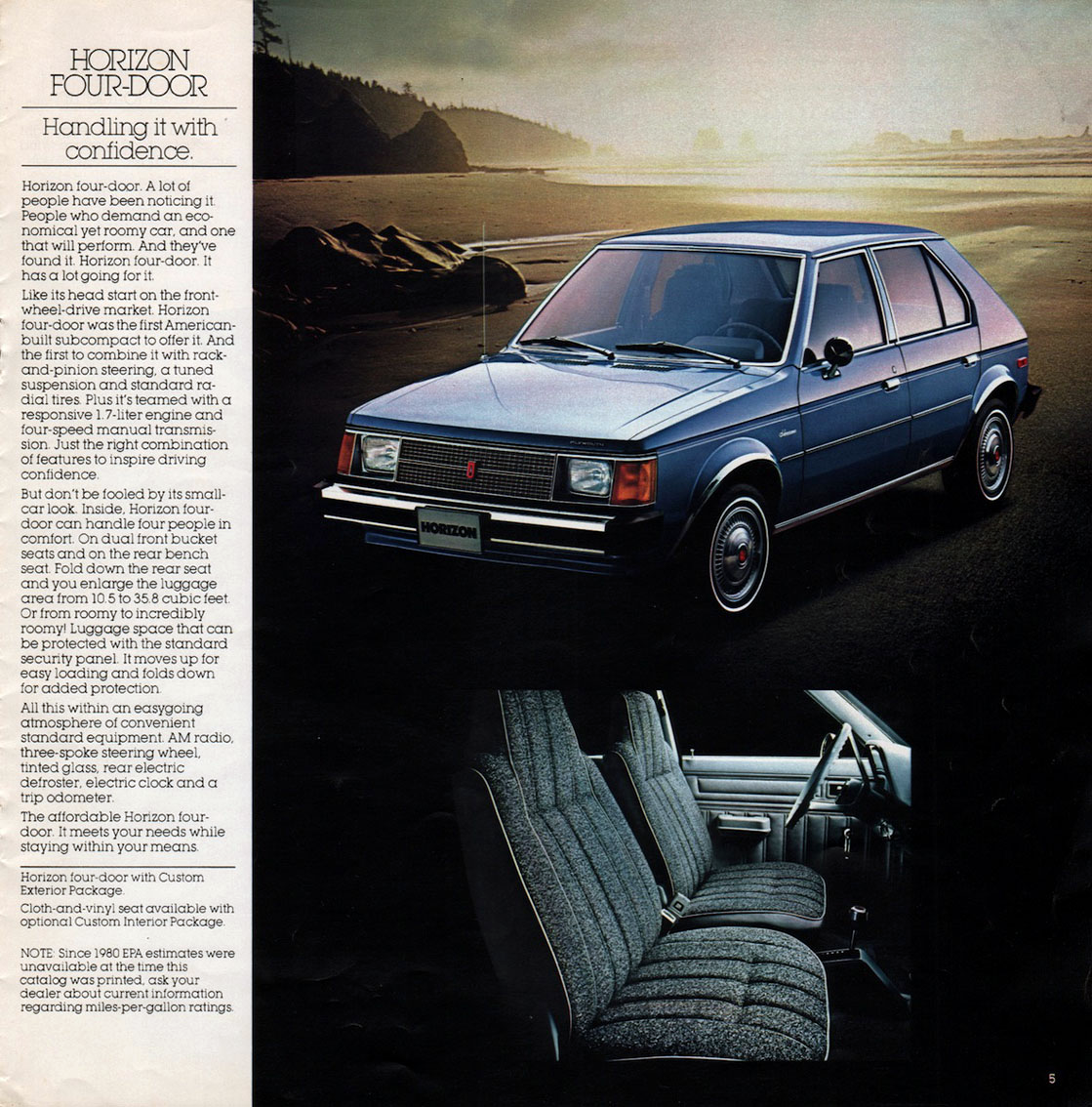
“Handling it with confidence.”

1980 was the third model year for Chrysler’s “Omnirizon” front-wheel drive subcompact. Once again, the only available engine was a Volkswagen-sourced 1.7 liter/105 ci four-cylinder with a Holley two-barrel carburetor and all of 65 bhp. With the standard four-speed manual transmission, 0-60 came in about 14.5 seconds in the 2,135-pound car. Fuel economy was rated at 24 city/31 highway by the day’s standards, so the 13-gallon gas tank gave a range of 265 to 285 miles with a 10% fuel reserve.

Four-door page from the 1980 Plymouth Horizon brochure

Standard exterior and mechanical equipment on the $5,526 car (about $23,900 in today’s dollars) included rack and pinion steering, front disc/rear drum brakes, a rear electric defroster, tinted glass, and P155/80R13 glass-belted radial tires (a size still available from Kumho) on 13-inch wheels. Standard interior equipment included a heater, an AM radio, and an electric clock.

A variety of exterior and interior packages were available to dress up the rather spare base Horizon. The Custom exterior package ($101) added some bright moldings to the outside of the car. Moving up to the Premium exterior ($207) added some more bright moldings and deluxe wheel covers. The Premium Woodgrain exterior added (natch!) woodgrain appliques on the body sides and lower liftgate pane. The Custom ($112) interior added a glove box lock, a cigarette lighter, custom door panels, and custom vinyl seats. The top-of-the-line Premium ($355) interior added a color-keyed console, a “luxury” three-spoke steering wheel, premium door panels, and a reclining passenger-side seatback.

Options & Production Numbers

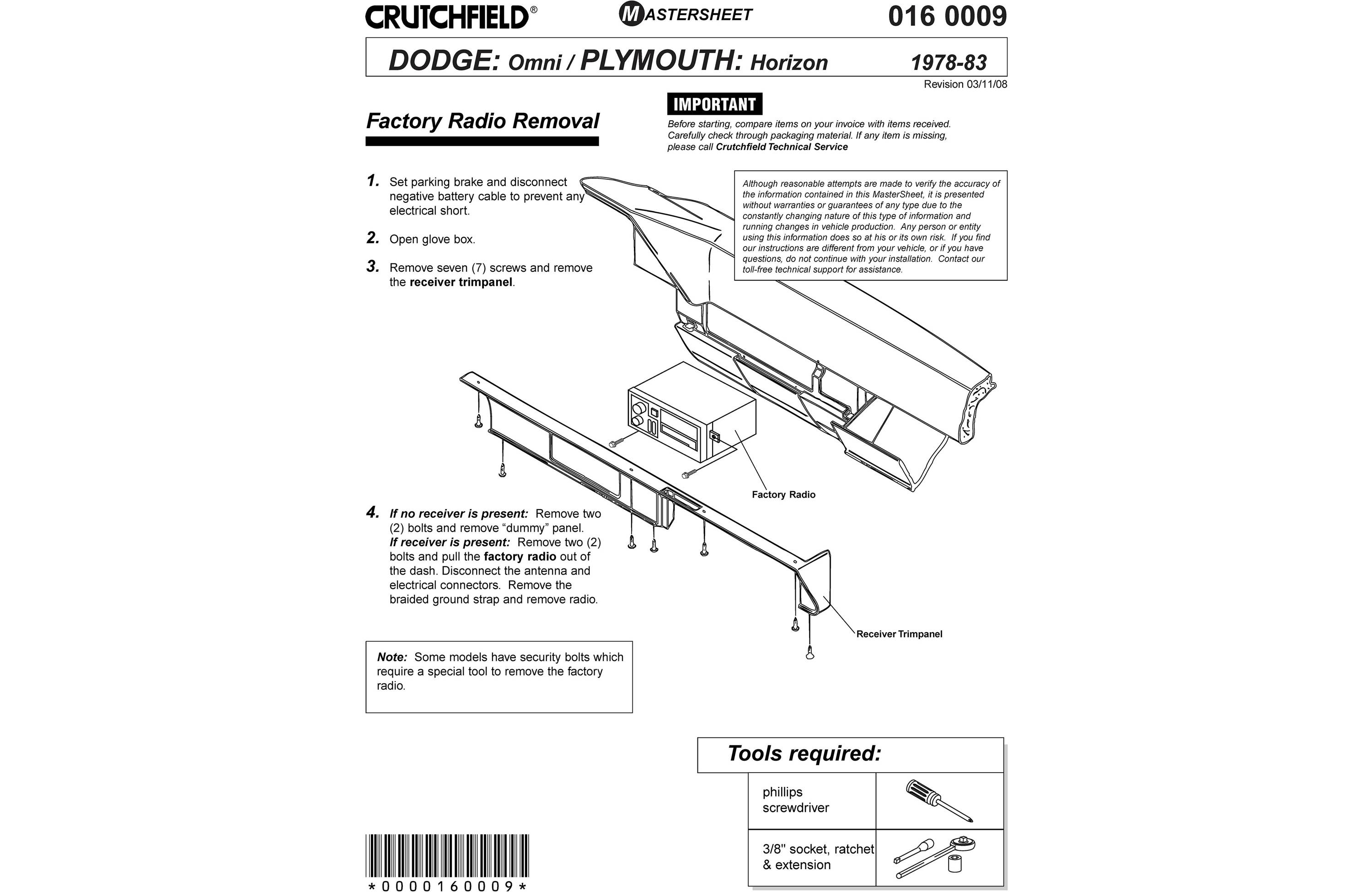
Exterior and mechanical options included a removable flip-up glass sun roof ($182), power steering ($161), power front brakes ($77), and a three-speed TorqueFlite automatic transmission ($340) which further slowed the Horizon’s acceleration. Inside, air conditioning ($541), a sport steering wheel ($40), and an AM/FM stereo radio ($93) were available—there were no eight-tracks or cassettes available as factory stereos (it was left to Crutchfield and others to provide those upgrades—and they still do).

The Horizon continued to sell reasonably well in the 1980 model year, with almost 86,000 units sold. The slightly sportier two-door TC3 hatchback added another 60,000 or so units. Combined, the two models accounted for 58% of Plymouth’s dire 1980 automobile sales totals in the United States (Plymouth’s other offerings for that year included the Arrow, Champ, Gran Fury, Sapparo, and Volaré).

The View From 2025

1000 views badge

A few folks are trying to save “Omnirizons”—including that fellow featured in Hemmings Classic Car (journalist Robert Suhr)—but you rarely see these cars for sale in the Hemming’s Motor News classifieds, on eBay Motors, or on Bring a Trailer. The exception, of course, is the later and much faster Dodge Omni GLH.

Make mine Crimson Red Metallic, please.

Other Plymouths I have written about include the 1980 Volaré station wagon, the 1981 Reliant coupe, and the 1984 Voyager minivan. I have also written about Chrysler’s transition to front-wheel-drive.

Last updated October 2025.

Some Quiet Love For A K Car

I walked to the local supermarket today to secure some Coca-Cola which we had somehow run short of. We’re located on the southeastern edge of what most weather forecasters seem to think is going to be a full-out blizzard over the next day and a half or so.

It’s only a couple of blocks to the supermarket. On the way is a little tan house which almost always has an original Natural Suede Tan Dodge Aries or Plymouth Reliant station wagon parked next to it. There is no garage for the wagon, so usually it sits out in the weather and rust is definitely showing in parts of that famously squared-off body.

An original K car wagon sits under snow and a car cover this morning
An early Chrysler corporation K car station wagon sits quietly under a little snow and a car cover this morning

This morning, however, there was a fitted blue car cover on the wagon to help protect it from this particular storm, which has just begun.

I may be projecting here, but I choose to see a lot of love and caring for an old and hardworking friend. Is that cover original or new (you can still get them) ? Does it only go on when the predictions are as dire as today’s? How many miles does that wagon have?

Questions, questions, questions. I don’t think I’ve ever seen the owner — if I do, maybe I’ll ask a few.