1987 Ford Mustang LX 2-door sedan

“You get the more formal look of the sedan with the high performance of the GT.”

For the 1987 model year, Ford’s Fox-body Mustang received a facelift of both its interior and exterior. Ford restyled the front end, which gave the aging design (work had begun on the Fox-body Mustang in 1976) more of an “aero” look, in keeping with the overall mid-1980s Ford styling direction embodied by the Thunderbird and Taurus. The quarter glass windows were now each a single larger flush piece of glass with “Mustang” lettering at the bottom rear corners, replacing the smaller glass paired with louvers that had been in use since the 1979 model year. Taillights on the LX were revised with clear lenses for the turn signals. The interior received an all-new dash, center console, and revised seat and door trim.

With the SVO gone, the remaining models were the LX and the GT. Ford discontinued the V6 option, leaving only the standard 90 bhp Lima 2.3 liter/140 ci inline four with new-for-1987 fuel injection and the optional 225 bhp Windsor 4.9 liter/302 ci V8 with sequential fuel injection, which was part of an $1,885 5.0L EFI HO V-8 Engine Package. A five-speed manual transmission was standard, while a four-speed automatic was a $515 option.

From a performance and fuel economy perspective, the inline four LX and the V8 LX might as well have been different cars. The Lima-based Mustang with the manual took about 13.3 seconds to get to 60 mph, with the automatic/inline four combination being a few tenths worse. The payoff was fuel economy—25 city/31 highway by the day’s standards for the base powertrain (22/28 by today’s measures). The automatic was about 10% less efficient. With a 15.4-gallon gas tank, an LX owner with the base powertrain could expect an impressive range of 350 to 385 miles with a 10% fuel reserve.

In marked contrast, the Windsor-based Mustang with the manual took about 6.2 seconds to get to 60 mph, with the automatic version taking about 6.7 seconds. Fuel economy was 16 city/24 highway by the day’s standards (15/22 by 2025 measures). Interestingly, the automatic was about 13% more efficient when paired with the V8. An LX owner with the V8 and five-speed manual could expect a range of 260 to 275 miles with a 10% fuel reserve.
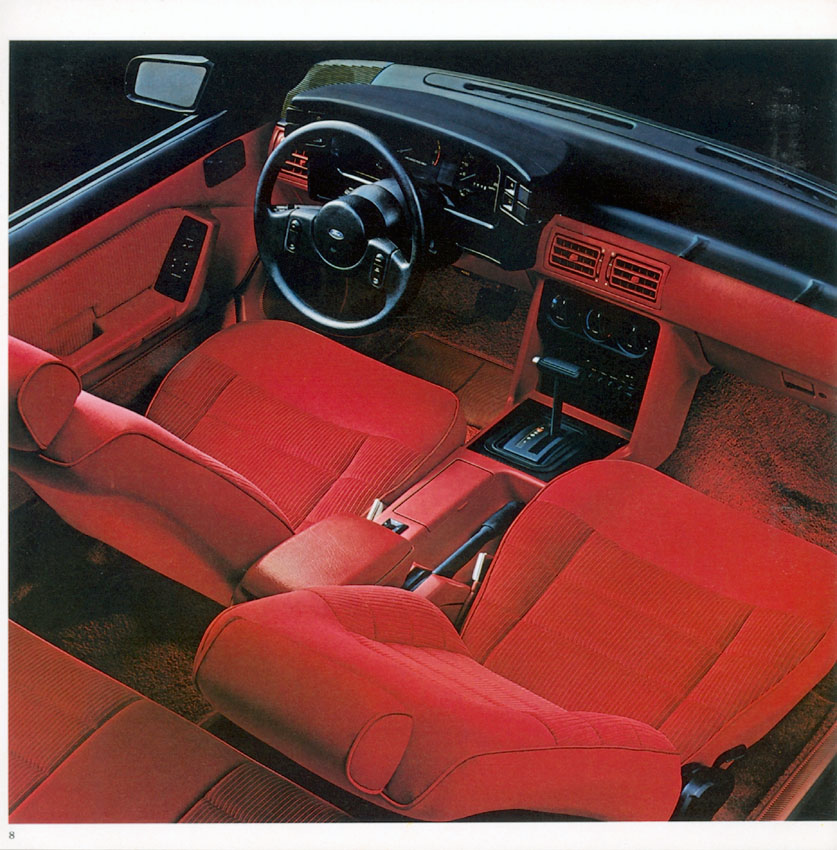
LX interior page from the 1987 Ford Mustang brochure

The 1987 Mustang LX 2-door sedan (Ford’s nomenclature) had a base price of $8,043—about $23,500 in today’s dollars, which is approximately 26% less than a base 2025 Mustang costs. Standard exterior and mechanical equipment included power rack and pinion steering, power front disc/rear drum brakes, and P195/75R14 black sidewall steel-belted radial tires on 14-inch wheels with turbine wheel covers. Inside, reclining cloth low back front bucket seats, Light Group, full instrumentation, a console, and an electronic AM/FM stereo search radio with four speakers were included.

Groups, Packages, & Individual Options

Seven groups and packages were available for the Mustang LX 2-door sedan:

  • Preferred Equipment Group 240A was the base package
  • Light Group was included with the base package and included lights for the engine compartment, the luggage compartment, the ashtray, and the glove box. A dual beam dome/map light and a headlamps on reminder chime were also included
  • Special Value Group 240A (no cost for inline four/$735 for V8) included Power Lock Group, an electronic AM/FM stereo radio with cassette tape player, speed control, and styled road wheels
  • Power Lock Group ($244) included power door locks, a remote locking fuel door, and a trunk release
  • Climate Control Group ($1,005 for inline four/$978 for V8) included tinted glass, a heavy-duty battery, air conditioning, and a rear window defroster
  • Custom Equipment Group ($624) included dual electric remote control mirrors, power side windows, dual illuminated visor mirrors, a tilt steering wheel, and a graphic equalizer
  • The 5.0L EFI HO V-8 Engine Package ($1,885) included a Traction-Lok axle, GT suspension system components, a 15:1 steering ratio, a heavy-duty battery, P225/60VR15 handling tires, and cast aluminum wheels

Exterior and mechanical options for the Mustang LX 2-door included complete tinted glass ($120) and wire style wheel covers. Inside, a tilt steering wheel ($124), an air conditioner ($788), and power front side windows were available. Stereo options included an electronic AM/FM stereo radio with cassette tape player ($178), a graphic equalizer ($218), and the Premium Sound System ($168 for six upgraded speakers and a 4-channel power amplifier). The Handling Suspension Package and cast aluminum wheels were optional with the inline four but included with the V8.

Period Reviews & Production Numbers

The enthusiast press—including Car and Driver, Hot Rod, and Motor Trend—swiftly realized that the LX 2-door sedan with the V8 was 80 pounds lighter than the GT, which made it slightly quicker. At $9,928, the V8 LX was also 16% cheaper than the GT, making it one of the outstanding performance bargains of the 1980s.

Production data is surprisingly uncertain (wouldn’t the Mustang have been worth paying attention to?), but some of the more likely data states that Ford sold 43,257 Mustang LX 2-door sedans, of which 4,888 (or 11%) were V8s.

The View From 2025

There is strong club support for the 1987 Mustang, as there is for all Mustangs except the mid-seventies Mustang IIs. According to Hagerty’s valuation tools, all the money for a 1987 Mustang notchback coupe in #1/Concours condition is $52,500, with a more typical #3/Good condition car going for $18,600. 1987 Mustangs often show up in the Hemming’s Motor News classifieds, on eBay Motors, and on Bring a Trailer—BaT has sold three 2-door 1987 LXs over the years.

Make mine Medium Shadow Blue Metallic, please. One quarter of the 12 Mustang colors for 1987 were blues.

Other Mustangs I have written about include the 1980 Cobra hatchback coupe, the 1981 coupe, the 1982 GT hatchback coupe, the 1983 GT convertible, and the 1984 SVO hatchback coupe.

1981 Ford Mustang coupe

“Sleek with clean lines that slice through the wind.”

For 1981, Ford’s Mustang gained a “rakish” new optional T-Roof and the availability of power windows. The base seats were now reclining. Otherwise, things generally stood pat.

The 1981 Mustang’s standard powertrain was the Lima 88 bhp 2.3 liter/140 ci inline-four paired with a four-speed manual transmission. Optional engines included the Thriftpower 94 bhp 3.3 liter/200 ci inline six ($213) and a 120 bhp 4.2 liter/255 ci V8 ($263). A five-speed manual ($152 and only available with the inline-four) and a Select-Shift automatic ($349 and required with the V8) were offered. Despite being relatively light, no 1981 Mustang was fast—Car and Driver recorded an 11.2 second 0-60 time with the V8.

EPA fuel economy ratings ranged from 23 mpg with the inline-four engine and either of the two manual transmissions to 19 mpg with either the inline six/four-speed or the V8/automatic transmission combinations. With a small 12.4-gallon gas tank, a Mustang V8 owner could expect a mere 190 to 210 miles with a 10% fuel reserve.

Standard Equipment, Sub-Models, & Packages

Standard equipment on all Mustangs included dual rectangular halogen headlamps, front disc/rear drum brakes, rack and pinion steering, and 13-inch P-metric steel-belted radial-ply tires on 13-inch wheels. Inside, fully reclining vinyl high-back front bucket seats, color-keyed cut-pile carpeting, and an AM radio were included.

The notchback and hatchback (Ford insisted on calling them 2-Door and 3-Door) had slightly different standard equipment. The notchback/2-Door went for $6,171 and included color keyed rear pillar louvers, full wheel covers, and a Deluxe steering wheel. The hatchback/3-door went for $6,408 (about $24,100 in today’s dollars) and included black rear pillar louvers, Sport wheels, a fold-down rear seat, and a Sports steering wheel.

The Ghia—available as a $6,645 notchback or a $6,729 hatchback—added Ghia insignia, bright rocker panel moldings, pinstripes, dual black remote control mirrors, and 14-inch P-metric steel-belted radial-ply tires on 14-inch wheels with turbine wheel covers. Inside, Ghia buyers got the Ghia sound insulation package, Luxury color-keyed cut-pile carpeting, and a Luxury 4-spoke steering wheel.

Cobra pages from the 1981 Mustang brochure

Mechanically, the $1,588 Cobra package added a Sport-tuned exhaust with bright tailpipe extension, a Handling Suspension System, and 195/65R 390 Michelin TRX black sidewall tires on 15.3-inch forged metric aluminum wheels. Exterior Cobra features included a Black lower Tu-Tone paint treatment, a front end integral spoiler, dual fog lamps, a non-functional rear-opening hood scoop, and a rear end spoiler. Internal Cobra features included an 8,000 RPM tachometer, black engine-turned design appliques, and a Cobra medallion on the instrument panel. A 2.3 liter turbocharged engine was initially supposed to be part of the Cobra package (and showed up in some brochures), but Ford tabled it in the United States because of reliability issues in the 1980 model year. A base Cobra was $7,966—about $30,000 in today’s dollars, which is almost what a base 2025 Mustang EcoBoost fastback goes for.

Options & Production Numbers

Exterior and mechanical options for all Mustangs included tinted glass ($76), metallic glow paint ($48), Tu-Tone paint, a flip-up open air roof, a T-Roof ($874), power front disc brakes ($76), variable ratio power steering ($163), and a Traction-Lok differential ($64). Inside, Recaro high-back bucket seats ($732), a console ($168), the SelectAire Conditioner ($560), a tilt steering wheel, two different leather-wrapped steering wheels (Sport or Luxury), fingertip speed control ($132), and power side windows ($140) were available. A choice of stereos ranging up to an AM/FM stereo radio with a cassette tape player ($174) could be ordered.

Options that look weird to our 2025 eyes included a carriage roof ($644) or a full vinyl roof ($115), both for the notchback only. Notchback purchasers could also specify an Interior Accent Group, which included a Deluxe sound package, fully relining low-back front bucket seats in a higher level of vinyl, and a passenger visor vanity mirror. Black liftgate louvers ($145) and a rear window wiper/washer ($85) could be ordered for the hatchback.

Mustang sales were lower in 1981 model year than in 1980, but automotive sales were generally down due to the concurrent recession. The base car continued to be by far the most popular—with the notchback (77,458 sold) and the hatchback (77,399) split almost exactly. Ghia‘s were also divided evenly—13,422 notchbacks and 14,273 hatchbacks. Only 1,821 hatchbacks were ordered with the Cobra package, which would be gone when the 1982 model year came around—more than replaced by the GT.

The View From 2025

According to Hagerty’s valuation tools, all the money for a 1981 Cobra V8 fastback in #1/Concours condition is $37,300, with a more normal #3/Good base Mustang inline four notchback going for $12,900. 1981 Mustangs sometimes appear in the Hemming’s Motor News classifieds, on eBay Motors, and on Bring a Trailer, but the absence of an impressive stock engine does seem to hold them back compared to the 1982 and later models.

Make mine Dark Cordovan Metallic, please.

Other Mustangs I have written about include the 1980 Cobra hatchback coupe, the 1982 GT hatchback coupe, the 1983 GT convertible, and the 1984 SVO hatchback coupe. I guess I’ll have to get to the second half of the Mustang’s decade at some point.

1980 Ford Mustang Cobra hatchback coupe

“A sports car for the 80’s.”

1980 was the second year for the Fox-body Mustang and brought few changes from the debut year—and some of those weren’t great, such as a downgraded V8. The Cobra inherited some features from the 1979 Pace Car, including a front spoiler, dual fog lamps, and a rear deck spoiler.

The standard powertrain on the base Mustang was Ford’s Lima 88 bhp 2.3 liter/140 ci inline four with a Motorcraft 5200 two-barrel carburetor matched with a four-speed manual. A Windsor 119 bhp 4.2 liter/255 ci V8 with a Motorcraft 2150 two-barrel carburetor was available with a three-speed automatic, but the top-of-the-line powertrain was a turbocharged version of the Lima inline four with a Holley 6500 two-barrel carburetor making 132 bhp paired with the four-speed manual. Thus, for 1980, the fastest available Mustang had a 0-60 time of a little under 11 seconds. With a 12.5-gallon fuel tank and 18 city/30 highway fuel mileage (about 15/25 by today’s standards), a Cobra‘s proud new owner could expect a range of about 225 to 270 miles with a 10% fuel reserve.

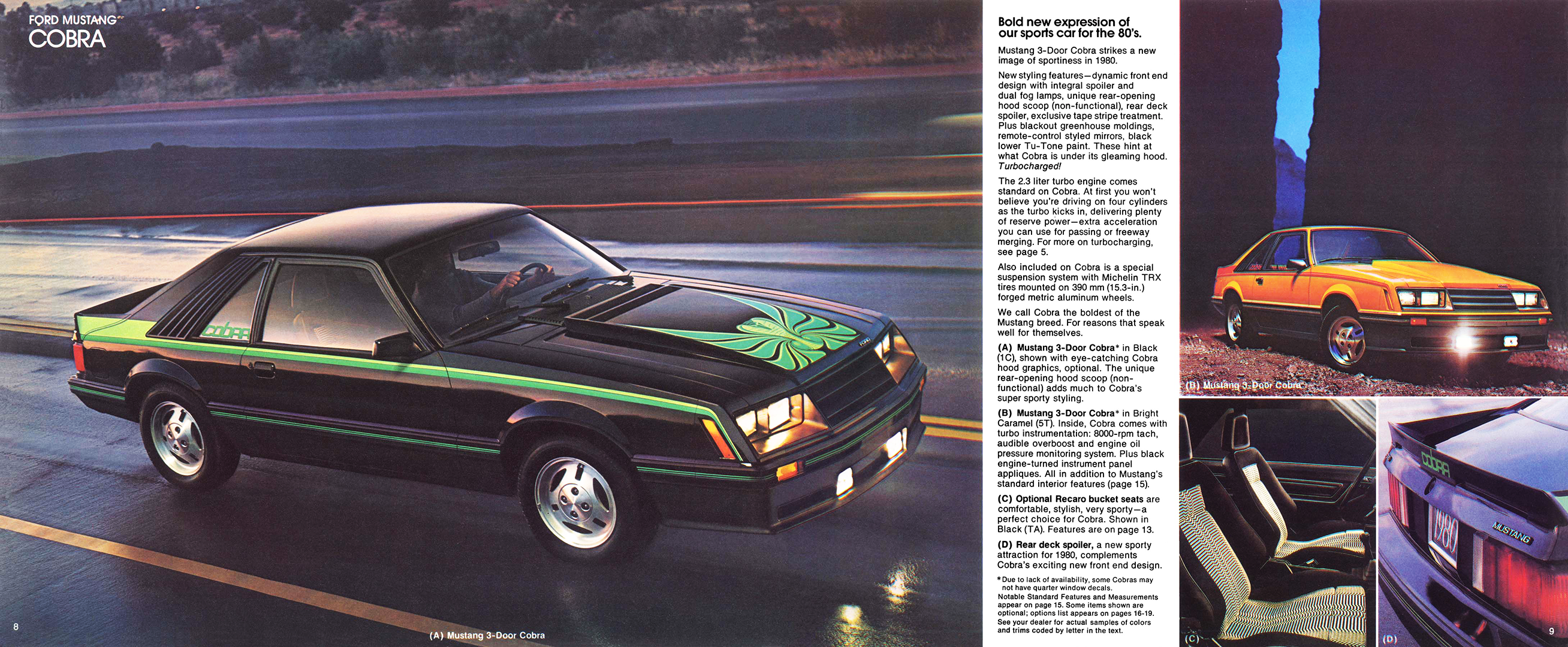
Cobra pages from the 1980 Ford Mustang brochure

Standard mechanical equipment on the $7,098 Cobra (about $30,600 in today’s dollars or just a little under what the 2026 Mustang EcoBoost fastback goes for) included the turbocharged inline four, the four-speed manual, a “special suspension system” with heavy duty front and rear stabilizer bars and special shock valving, a sport-tuned exhaust with bright tailpipe extension, and Michelin TRX 190/65R390 tires (they’re still available!) on 15.3-inch forged aluminum wheels. Exterior equipment included dual remote styled mirrors and black lower bodyside paint. A Cobra‘s interior didn’t have many upgrades, but you did get an 8,000-rpm tachometer and a black engine-turned instrument panel applique.

Standard equipment on all Mustang hatchback coupes included dual rectangular halogen headlamps, wraparound taillamps, a modified MacPherson strut front suspension, front disc/rear drum brakes, and rack and pinion steering. Inside, full instrumentation (tachometer, trip odometer, fuel/temperature/oil/alternator gauges), a sports steering wheel, color-keyed cut pile carpeting, all vinyl high-back bucket seats, a lockable glove box, and a cigarette lighter were included.

Options, Sales, & Period Reviews

Exterior and mechanical options included Cobra hood graphics ($88), a flip-up open air roof ($219), black liftgate louvers ($141), and a rear window/wiper washer ($79). Inside, you could choose SelectAir conditioning ($538), Recaro high-back bucket seats ($531), an electric rear window defroster ($96), interval windshield wipers ($39), a tilt steering wheel ($78), and the power lock group ($113). A series of stereos were available, with the most capable being an AM/FM stereo radio with a cassette tape player ($271). Higher-end stereos could be paired with the Premium Sound System ($94), which added a higher-power amplifier and more capable rear speakers.

1980 Ford Mustangs sold decently, accounting for about 23% of Ford’s overall sales in a down year. Reviews of the day were unhappy, but understanding about the loss of the 4.9 liter/302 ci V8 in the middle of the second oil crisis—Car and Driver stated that “Whether you like life with turbochargers or not, you might as well get used to it.”

The View From 2025

Folks are definitely collecting these early Fox-body Mustangs. According to Hagerty’s valuation tools, all the money for a 1980 Cobra in #1/Concours condition is an astounding $53,400, with a more normal #3/Good car going for $13,800. Cobras come up for sale occasionally in the Hemming’s Motor News classifieds, on eBay Motors, and on Bring a Trailer.

Make mine Black, I think, perhaps with those extra-cost Cobra hood graphics.

Later Fox-body Mustangs I have covered include the 1981 coupe, the 1982 GT hatchback coupe, the 1983 GT convertible, the 1984 SVO hatchback coupe, and the 1987 LX coupe.

Last updated October 2025.

1983 Ford Mustang GT convertible

I was driving westbound on the Schuylkill Expressway in Philadelphia on a morning in February 2015 when I saw a Fox Mustang convertible (red exterior, black top). A good enough reason to write a blog entry about these attractive cars.

“It’s not just a convertible … it’s a Mustang.”

For 1983, the big news for the Ford Mustang was the return of the convertible for the first time since the 1973 model year. Introduced on November 5th, 1982, the convertible was available only in the luxury GLX trim and the performance GT trim—lower-end L and GL trims remained with the notchback coupe (L and GL) and the hatchback coupe (GL). The GLX was also available only with V6 and V8 engines (no inline-four—turbo or not—would sully the drop-top experience).

The V6 engine choice for the GLX was the Essex 112 bhp 3.8 liter/231 ci with a two-barrel carburetor. Optional on the GLX ($595 additional) and standard on the GT was (of course) the Windsor 175 bhp 4.9 liter/302 ci V8 with a four-barrel carburetor.

Starting at $9,449 (about $30,800 in today’s dollars) and rising significantly during the middle of the model year to a non-trivial $12,467 (about $40,300 in 2025 funds, which is almost exactly what a 2025 Mustang EcoBoost convertible starts at), the GLX did come reasonably well equipped. Standard external and mechanical features included power front disc brakes, tinted glass, and an automatic transmission. Standard interior equipment included a light group and an AM radio.

convertible pages from the 1983 Ford Mustang brochure
Convertible pages from the 1983 Ford Mustang brochure

The GT version of the convertible listed for $13,479 (about $43,600 in 2025 dollars). Standard external and mechanical features included power front disc brakes, power steering, rear spoiler, and a five-speed manual transmission. Standard interior equipment included an AM radio.

All 1983 Mustangs included dual rectangular halogen headlamps, a modified MacPherson strut front suspension, front disc/rear drum brakes, and rack and pinion steering. Inside, full instrumentation (tachometer, trip odometer, fuel/temperature/oil/alternator gauges), full vinyl bucket seats, and a cigarette lighter were included.

Options & Production Numbers

The Mustang option list was long. Inside, air conditioning ($724), speed control ($170), power locks ($160), a tilt steering wheel ($105), and an AM/FM stereo radio with a cassette player ($199) were all available.

All 1983 Mustang convertibles came with a power top, and all windows rolled down—an emphasis Ford frequently made in reference to the Chrysler K car convertibles.

FoxBodyMustangSales

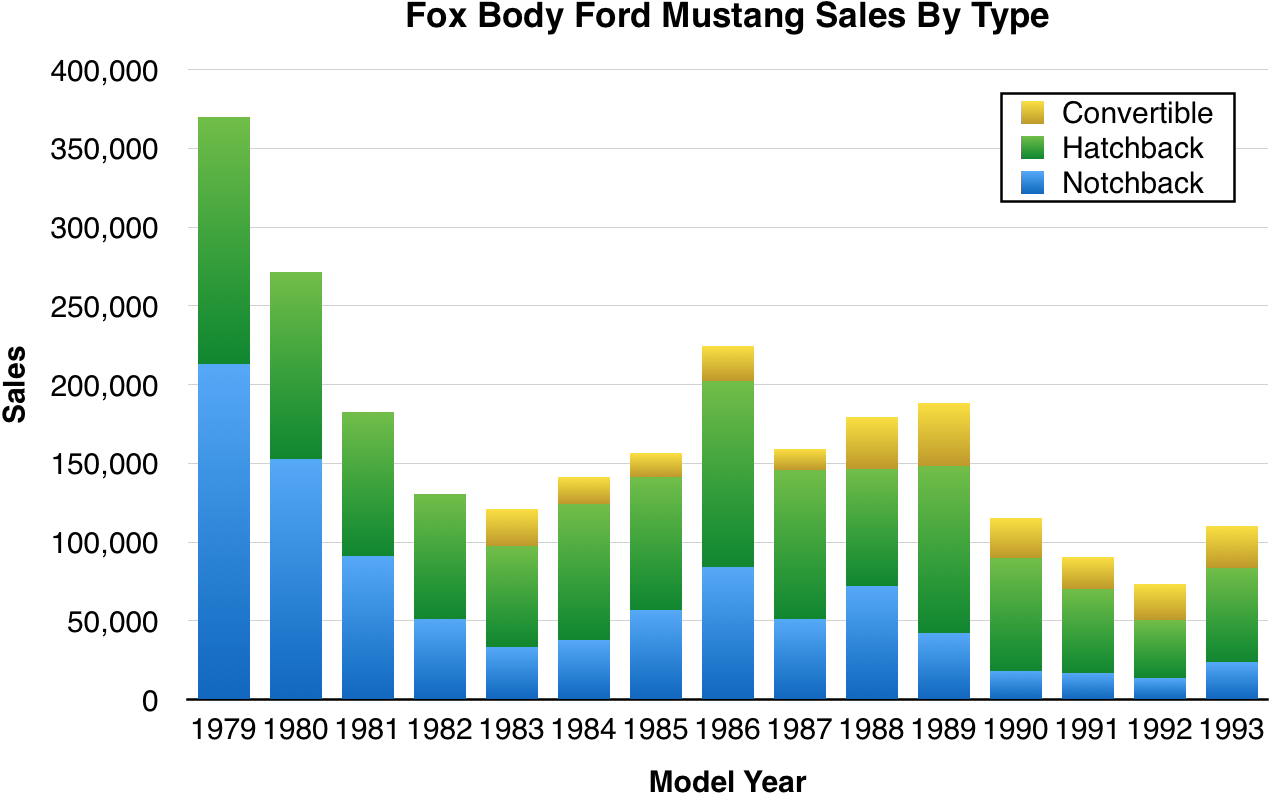
The 1983 Ford Mustang convertible sold reasonably well considering its expense (the GT convertible stickered for 45% more than the GT hatchback). For that year, it probably saved total Mustang sales from dropping below 100,000—helping hold that off until 1991. Between 1983 and 1993, Ford would sell over a quarter of a million of the pony car convertibles.

The View From 2025

There is strong club support for the 1983 Mustang, as there is for all Mustangs except the mid-seventies Mustang IIs. According to Hagerty’s valuation tools, all the money for a 1983 Mustang GT convertible in #1/Concours condition is $58,300, with a more typical #3/Good condition car going for $14,500. 1983 Mustangs often show up in the Hemming’s Motor News classifieds, on eBay Motors, and on Bring a Trailer—as I update this blog entry in March 2025, there’s a Red 1983 Mustang GLX convertible with a white top, a white vinyl interior, an aftermarket V8, and 89,000 miles available on Hemmings for $18,000.

Make mine that same Red, please.

Other Mustangs I have written about include the 1980 Cobra fastback coupe, the 1982 GT fastback coupe, and the 1984 SVO fastback coupe.

Last updated March 2025.

1984 Ford Mustang SVO hatchback coupe

With the announcement of the 2015 Mustang and its available EcoBoost turbocharged inline-four, my mind turned back to the 1984 to 1986 Mustang SVO.

“Sophisticated performance for the knowledgeable driver.”

Created by Ford’s Special Vehicle Operations department, the 1984 Ford Mustang SVO was an admirable attempt to take a different and more advanced approach to the pony car market. This version of the Fox-body Mustang was built around the Lima turbocharged and fuel-injected 2.3 liter/140 ci inline four, making 175 bhp paired with a Borg-Warner T5 five-speed manual. By the day’s standards, this combination yielded a reasonable 19 city/26 highway (it would be 17/24 by current standards). Car and Driver recorded a respectable 7.5 second 0-60 time and a 128 mph top speed.

1984 Ford Mustang advertisement

Other modifications over the standard Mustang included ventilated four-wheel power disc brakes (replacing the Mustang GT‘s front disc/rear drum setup), and a Koni suspension system featuring adjustable struts and shocks. 16 × 7 inch aluminum wheels with 225/50VR16 Goodyear NCT tires (a size still readily available) were standard for the first year—Gatorbacks didn’t become available until 1985.

The exterior featured an SVO-specific front grille, tinted glass, a hood with a functional scoop, and a “dual wing” spoiler that was also unique to the SVO. Inside, standard features included SVO-specific adjustable performance seats with lumbar support, a leather-wrapped tilt steering wheel, and an AM/FM stereo radio with a four-channel amplifier and four speakers.

Options & Production Numbers

You could have the interior in any color you wanted as long as that was Charcoal, but you did get to choose from the standard cloth or optional leather seats. A flip-up open air roof ($315), air conditioning ($743), a cassette player ($222), power door locks ($177), and power windows ($198) all remained optional—this was 1984, after all.

With a base price of $15,596 (about $49,300 in 2025 dollars or well more than what a loaded 2025 Mustang EcoBoost Premium Fastback goes for), sales did not come close to meeting Ford’s hopes—less than 10,000 buyers took home a Mustang SVO over its three years of production. The reasons for its relative failure were many, but I think the most significant problems were:

  • The average Mustang buyer was happier with a Mustang GT, which, with a base price of $9,578, cost substantially less.
  • The potential buyer of a vehicle with a turbocharged and intercooled four, four-wheel disc brakes, and an adjustable suspension wasn’t looking to Ford for this car.

The View From 2025

It is interesting to note that Ford was much more successful in the 1990s and 2000s in selling high-end Mustangs. They’ve also done decently with the 2.3 liter (there’s a coincidence!) 315 bhp EcoBoost turbocharged inline-four, which first became available in 2015.

According to Hagerty’s valuation tools, all the money for a 1984 Mustang SVO in #1/Concours condition is $36,200, with a more normal #3/Good car going for $9,800. SVOs often show up in the Hemming’s Motor News classifieds, on eBay Motors, and on Bring a Trailer—as I update this blog entry in March 2025, there’s a Black 1984 Mustang SVO with a Charcoal cloth interior and 66,000 miles asking $20,000 on Hemmings.

Make my SVO Silver Metallic, please.

Other Mustangs I have written about include the 1980 Cobra hatchback coupe, the 1982 GT hatchback coupe, and the 1983 GT convertible.

Last updated March 2025.

1982 Ford Mustang GT hatchback coupe

This post was one of the earliest in this blog. I’ve updated it to reflect both changes in my posting style and substantial improvements in available data.

“If excitement is your master key, this one opens all the doors.”

The 1982 Ford Mustang GT marked the return to form of America’s definitive pony car and ignited a second round of the power wars with the then brand new third generation Camaro and Firebird. Along with the new GT trim level, the new high output (H.O.) version of the venerable 4.9 liter/302 ci V8 was up to 157 bhp—quite an upgrade from 1981’s 4.2 liter/255 ci engine.

157 bhp feels quaint these days—the lowest horsepower engine for the 2025 Mustang is the 315 bhp turbo four. Still, the 1981 Mustang had topped out at (oog…) 120 bhp and as tested 0-60 times in the 2,600 pound GT dropped by over 3 seconds for 1982, with Motor Trend recording a 6.9-second time in a test car they acknowledged might be a little warmed over. Road & Track timed an 8.0 second 0-60 time in a more civilian GT.

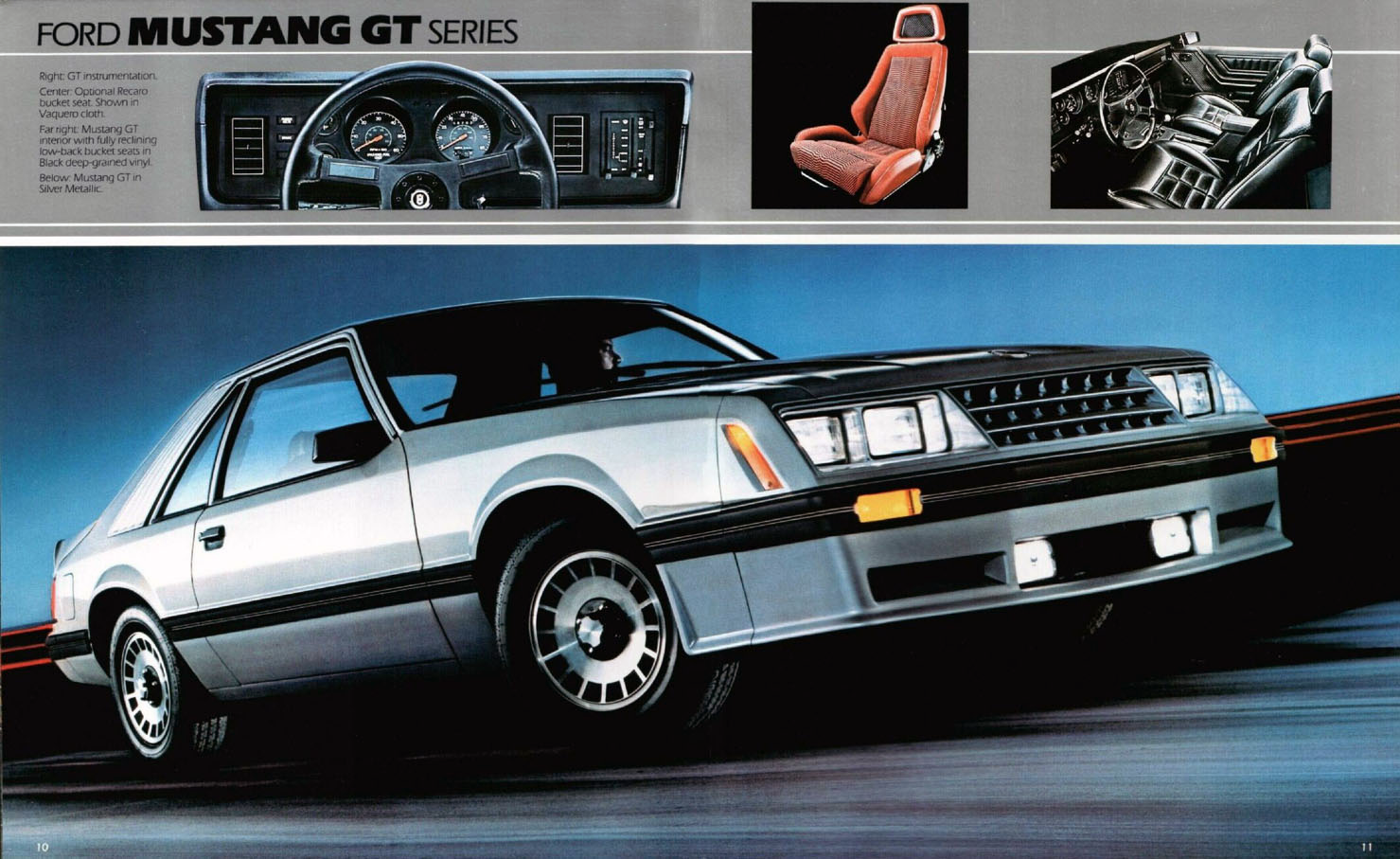
GT pages from the 1982 Ford Mustang brochure

You could get the H.O. engine with any Mustang, but the hot setup was with the GT, which offered a four-speed manual transmission and a 3.08:1 rear axle ratio with a Traction-Lok limited slip differential. Other options that were standard with the $8,308 GT (about $28,800 in today’s dollars) with the 302 were power steering and traction bars. The GT also received cast aluminum wheels, a front air dam, dual fog lamps, a forward-facing hood scoop, and the same rear spoiler initially featured on the first year of the Fox-body Mustang 1979 Pace Car.

Options, Period Reviews, & Production Numbers

Options for the Mustang GT included the SelectAire Conditioner ($676), snazzy Recaro high-back bucket seats ($834), power side windows ($165), and an AM/FM stereo with either 8-track or cassette player ($178)—it seems that 1982 was Ford’s crossover year for 8-track versus cassette.

Period reviews were overwhelmingly positive—Motor Trend stated that the 1982 GT was “it’s the best-balanced, most capable Mustang ever done.” Road & Track mentioned that Ford was leading the “U.S. industry in restoring exhilarating engine performance to the list of options.”

Ford built 23,447 Mustang GTs in the 1982 model year, marking a solid success and attracting a lot of notice. At 45,901 produced, the best seller continued to be the far more vanilla GL fastback.

The View From 2025

This generation of the Mustang GT often appears in the Hemming’s Motor News classifieds, on eBay Motors, and on Bring a Trailer. According to Hagerty’s valuation tools, a 1982 Ford Mustang GT in #1/Concours condition is $44,700, with a more normal #3/Good car going for $12,700.

I only have four exterior color choices with a 1982 Mustang GT—make mine Bright Red, please.

Other Mustangs I have written about include the 1980 Cobra hatchback coupe, the 1981 coupe, the 1983 GT convertible, the 1984 SVO hatchback coupe, and the 1987 LX coupe.

Last updated September 2025.