
1986 Jeep CJ-7 SUV

“Only in a Jeep.”

1986 was the final model year for the Jeep CJ-7, which had debuted in 1976. Because of this, there were only minor trim and detail changes.

The CJ-7’s standard powertrain was an AMC 86 bhp 2.5 liter/150 ci inline four with electronic fuel injection paired with a four-speed manual transmission and part-time four wheel drive. An AMC 102 bhp 4.2 liter/258 ci inline six with a two-barrel carburetor was a $361 option. Both engines could be had with a five-speed manual ($250), but only the inline six could be paired with a Torque-flite automatic ($495).

Jeep CJs were neither economical nor fast—but most Jeep fanciers would have and do argue that isn’t the point. The spriteliest powertrain combination (inline six/five-speed) came in with fuel economy ratings of 17 city/21 highway by the day’s standards (15/20 by modern measures). With the standard 15.1-gallon gas tank, a CJ-7’s presumably happy owner could expect a range of 240 to 255 miles with a 10% fuel reserve. It’s no wonder many went for the $57 20-gallon extra capacity fuel tank, which promised ranges of over 300 miles.

Front cover of the 1986 Jeep CJ brochure

The 1986 CJ-7’s base price was $7,500—about $22,400 in today’s dollars. Standard exterior and mechanical equipment included a roll bar, a moveable tailgate, a swing away spare tire carrier, a front stabilizer bar, manual front disc brakes, and free-wheeling hubs. Inside, linen-grain vinyl high back bucket seats, a padded instrument panel, a day/night mirror, an electric washer and 2-speed wipers, a cigarette lighter, and a heater and defroster were included.

Packages, Options, & Production Numbers

Jeep offered two packages for the 1986 CJ-7:

  • The $1,253 Renegade package included special Renegade exterior graphics, rocker panel protection moldings, and 15 x 7 white styled steel wheels. Inside, a denim-look vinyl rear seat, a soft feel 3-spoke Sport steering wheel, and intermittent wipers were included.
  • The $3,304 Laredo package included a chrome grille panel with pinstripe, a hard top, a Laredo hood decal, and 15 x 7 chrome styled steel wheels. Inside, a leather-wrapped 3-spoke steering wheel, a console, a rear seat, courtesy lights, a tachometer and clock, and intermittent wipers were included. A Laredo with no other options came to $10,804—about $32,300 in 2025 dollars, or about 10% less than a 2026 Jeep Wrangler Sport 2-door goes for.

Individual options included heavy duty engine cooling ($57), power steering ($274), power disc brakes ($125), a rear Trac-lok differential ($255), a conventional spare tire ($94), and a tilt steering wheel ($118). Many CJ-7s exited dealer showrooms with stickers that were about twice the base price.

Jeep produced 25,929 CJ-7s in the 1986 model year. They marked the final version of the original Civilian Jeep from 1945, whose total production measured over 1.5 million units.

The View From 2025

CJ-7s have a devoted fanbase, and their values reflect that. According to Hagerty’s valuation tools, a 1986 CJ-7 Renegade with the inline six in #1/Concours condition is $48,800, while a more typical #3/Good condition example goes for $24,500. CJ-7s frequently show up for sale in the Hemmings Motor News classifieds, on eBay Motors, and on Bring a Trailer.

Make mine Garnet Metallic, please.

Other Jeeps I have written about include the 1982 CJ-8 Scrambler pickup truck and the 1983 Wagoneer Limited SUV.
1983 Jeep Wagoneer Limited SUV

When Jeep was about to introduce a brand new Wagoneer and Grand Wagoneer in 2020, my thoughts turned back to the nowclassic eighties Wagoneers.

In addition to my historical interest, there’s a personal reason for these thoughts. Back in the eighties, I walked to my local high school almost every day. On cold winter mornings, I’d be trudging alone toward school, and sometimes I’d hear the quiet rumble of a Wagoneer’s V8 behind me along with a female voice. “Get in, John,” she’d say—and I would, grateful for the Wagoneer’s warmth and the lady’s company. I remember you, Patricia, and I hope you are doing well.

“The Ultimate Wagon.”

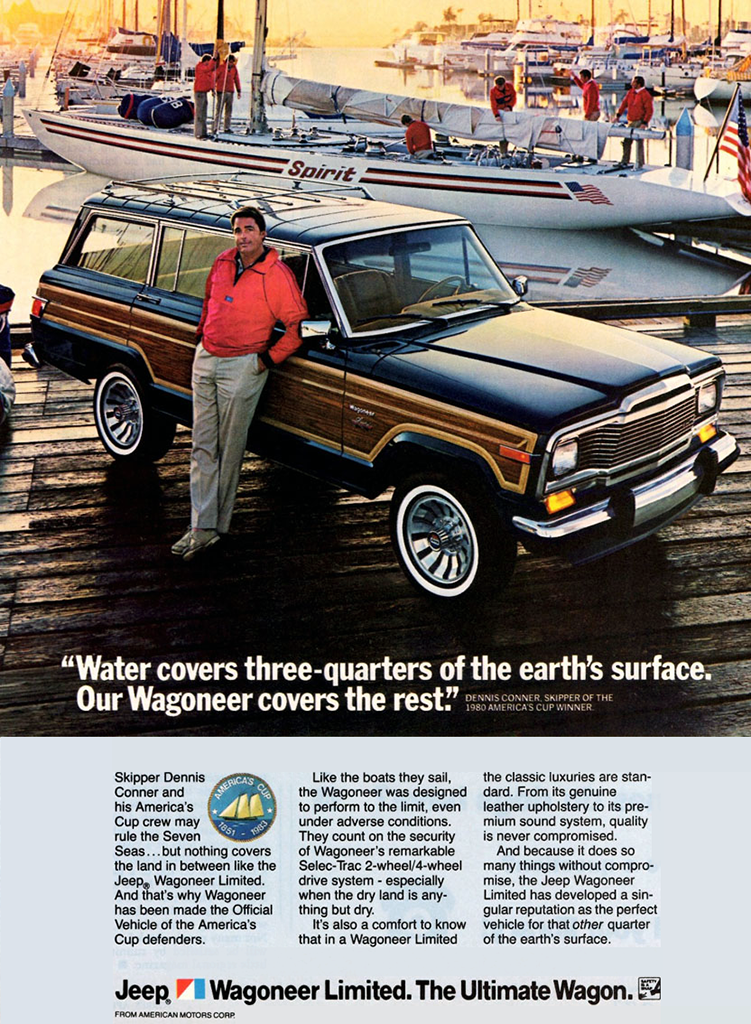
For 1983, Jeep’s Wagoneer gained a new Selec-Trac four-wheel-drive system, which replaced the decade-old Quadra-Trac system. Jeep also changed the Wagoneer’s trims. 1982’s base Custom trim was no longer available, with what had been the Brougham package now marking the base trim. The loaded Limited trim continued as the top of the Wagoneer line.

The standard engine for the Brougham was a 115 bhp 4.2 liter/258 ci inline six with a two-barrel carburetor. Optional on the Brougham and standard on the Limited was a 175 bhp 5.9 liter/360 ci V8 with a two-barrel carburetor. Mileage was, of course, awful, especially with the V8—the Limited got 12 city/16 highway by the day’s standards. With a 20.3-gallon gas tank, a Limited owner could expect a range of 210 to 230 miles with a 10% fuel reserve. Wagoneers could go just about anywhere, but they couldn’t go that far. They also wouldn’t get there that fast: 0-60 mph took about 16 seconds.

The $13,173 1983 Wagoneer Brougham was about $43,500 in today’s dollars—almost exactly what a base 2025 Grand Cherokee Limited goes for. Standard mechanical equipment included power variable-ratio steering, power front disc/rear drum brakes, and P225/75R15 white sidewall tires (a size still readily available) on 15-inch wheels with full wheel covers. Inside, Coventry checked cloth or Deluxe grain vinyl front and rear bench seats, Custom interior trim, Light Group, and an AM/FM stereo radio were included.

1983 Jeep Wagoneer advertisement
1983 Jeep Wagoneer Limited magazine advertisement

Moving to the upscale Wagoneer Limited added tinted glass, a tilt steering wheel, cruise control, power windows, power door locks, air conditioning, and a premium audio system with electronic tuning. Limited trim and upholstery included leather bucket seats up front, power seats for the driver and front passenger, a leather-wrapped steering wheel, and extra-thick 22-ounce carpeting in the seating area. All of this equipment raised the Limited‘s price to $16,889—$57,700 in today’s dollars, which is 2025 Grand Cherokee Overland money (current Wagoneers are far more dear).

Options & Production Numbers

Options for the Limited included halogen fog lamps ($82), a power sun roof ($1,637), an electric rear window defroster ($184), and a cassette tape player ($300).

Sales of the SJ Wagoneer rose by almost 28% in the 1983 model year, with the 18,478 produced accounting for 21% of overall Jeep production.

The View From 2025

Today, Wagoneers of this era have many adherents—in fact, there’s a company that makes its entire business restoring them. According to Hagerty’s valuation tools, all the money for a 1983 Wagoneer Limited in #1/Concours condition is an astounding $59,100, with a more normal #3/Good condition car going for $27,600.

SJ Jeep Wagoneers are often available in the Hemmings Motor News classifieds, on eBay Motors, on Bring a Trailer, and at in-person auctions. As I update this post in October 2025, a Steel Gray Metallic 1983 Wagoneer Brougham with woodgrain sides and nutmeg leather bucket seats is for sale on Hemmings, asking $37,000.

Make mine Deep Maroon Metallic, please.

I have written about one other Jeep in this blog—the 1982 CJ-8 Scrambler pickup truck. Years ago, I wrote about the 1980 AMC Eagle station wagon.

Last updated October 2025.

1982 Jeep CJ-8 Scrambler pickup truck

One of the many Hallmark vehicle ornaments my ex-wife purchased for me over the years is a 1982 Jeep Scrambler—with a Christmas tree in the bed, of course. It’s part of their All-American Trucks collection.

“… America’s first small 4×4 pickup …”

1982 was the second year for Jeep’s CJ-8 Scrambler pickup truck. For 1982, the Scrambler gained a substantially wider front and rear tread but otherwise was little changed from its debut year.

Based on the Jeep CJ-7 SUV, the Scrambler filled a requirement for a reasonably compact truck in the AMC’s Jeep line, as it was more than 16 inches shorter and almost a thousand pounds lighter than the smallest of Jeep’s J10 Pickup offerings. Its wheelbase was 9.5 inches longer than the CJ-7s, which brought a smoother ride. Of course, the Scrambler had that slightly over five-foot-long truck bed, which some found deficient compared to the more common six-foot bed.

The Scrambler’s standard powertrain continued to be an 86 bhp Iron Duke 2.5 liter/151 ci inline four with a two-barrel carburetor paired with a four-speed manual. The Iron Duke was, of course, sourced from General Motors. One optional engine was available—a $145 110 bhp 4.2 liter/258 ci inline six with a two-barrel carburetor. Either engine could be paired with a five-speed manual, which added $199 to the price and was newly available for 1982, while the inline six could also be mated with a $409 Torque-flite automatic. All Scramblers came with Quadra-Trac part-time four-wheel drive.

The performance of Jeep’s small truck wasn’t exactly sparkling—Car and Driver measured a 0-60 time of 17 seconds with the inline four and the four-speed manual. The inline six gave better—though not great—performance, with 0-60 times in the 12 to 14 second range depending on transmission. Fuel economy ratings for the standard powertrain were 23 city/28 highway by the day’s standards. With a 15-gallon gas tank, a Scrambler owner could reasonably expect a range of 245 to 265 miles with a 10% fuel reserve.

The Scrambler’s base price was $7,588—about $26,300 in today’s dollars, which is well under what a base 2025 Jeep Gladiator pickup truck costs. Standard exterior and mechanical equipment included dual outside rearview mirrors, a drop down tailgate, skid plates for the fuel tank and transfer case, front disc/rear drum brakes, and H78 x 15 Suburbanite XG tires on 15-inch wheels. Inside, linen grain vinyl bucket seats and a color-keyed vinyl mat were included.

Sport packages page from the 1982 Jeep Scrambler brochure

Two Sport packages were available. The first, Sport SR ($799), included Scrambler hood lettering available in three different colors, a spare wheel lock, and high back forward pivoting bucket seats trimmed in denim-look vinyl. Goodyear Tracker P/G OWL L78 x 15 tires sat on 15 x 6 inch white styled steel wheels. Convenience Group was part of SR, featuring an 8-inch day/night mirror, an under hood light, and courtesy lights. Finally, the SR include Decor Group, which included rocker panel protection molding, sports steering wheel, front frame panel, and instrument panel overlay.

The second package, Sport SL ($1,999), included everything in the Sport SR package, with various replacements or additions, the most visible of which was a half-cab hardtop or soft-top. Outside, the SL added two-color Scrambler hood lettering, beltline and door inset pin stripes, and additional chrome trim. Mechanical changes in the SL included hood insulation and heavy duty shocks, while P235/75R15 Wrangler OWL tires were mated with 15 x 7 inch chrome plated styled steel wheels. Inside, the SL included Special high back forward pivoting vinyl bucket seats, Special console and trim panels, a black leather-wrapped steering wheel, a clock, and a tachometer.

Individual Options & Production Numbers

Exterior and mechanical options included a polycarbonate top ($695), a soft vinyl top ($280), halogen fog lamps ($90), power brakes ($95), variable-ratio power steering ($229), a Heavy-Duty cooling system ($103), and a 20-gallon fuel tank. Inside, air conditioning ($650), a tilt steering wheel ($90), and an AM/FM stereo radio ($224) were available.

Scrambler sales for 1982 were … okay, with 7,759 produced, making it 12% of overall Jeep production in a down year for the marque where only Cherokee sales increased. The Scrambler did outsell the larger Jeep J10/J20 Pickup for the second straight model year—but that wouldn’t last.

The View From 2025

Scramblers have a devoted fanbase, and their values reflect that. According to Hagerty’s valuation tools, all the money for a 1982 CJ-8 ScramblerSport SL in #1/Concours condition is $53,800, with a more typical #3/Good condition example going for $32,700. Scramblers frequently show up for sale in the Hemmings Motor News classifieds, on eBay Motors, and on Bring a Trailer.

Make mine Deep Maroon Metallic, please.

This post is the first on Eighties Cars to be informed in some way by my recent acquisition of Flory’s American Light Trucks & Utility Vehicles, 1967–1989. Allpar and Hemmings also were valuable sources as I completed this blog entry. Astoundingly, this was the first Jeep I have covered in a specific post, though Jeeps frequently show up in auction coverage and I wrote about the 1980 Eagle early on. A Wagoneer post wasn’t far behind.

Last updated October 2025.