1989 Ford Thunderbird coupe

“The new spirit of Thunderbird …”

Ford’s Thunderbird personal luxury coupe was all new for 1989. The twelfth-generation ‘Bird was code-named MN12 and cost over a billion dollars to develop.

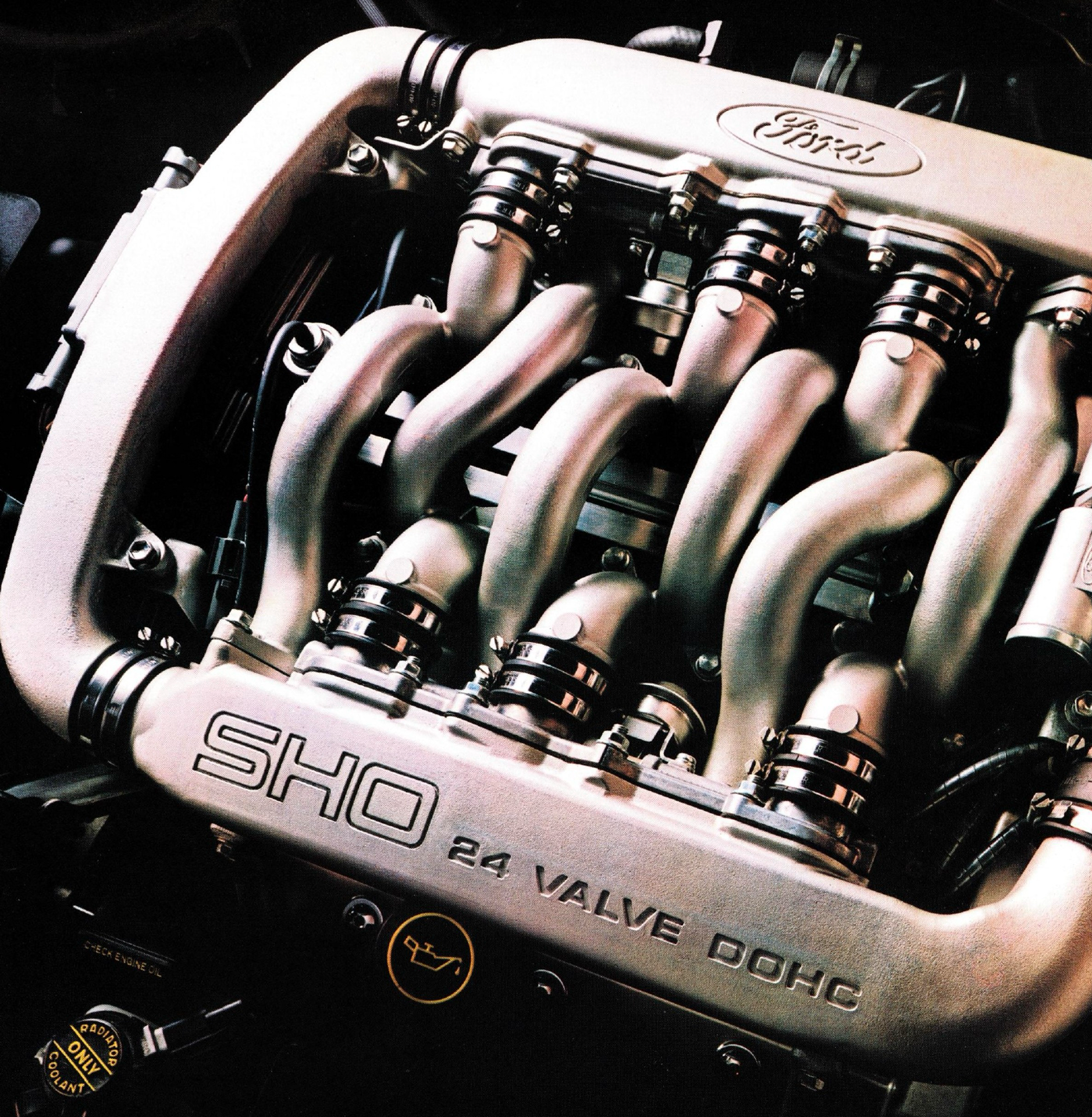
The standard Thunderbird’s powertrain was an Essex 140 bhp 3.8 liter/232 ci V6 with electronic sequential multi-port fuel injection paired with an automatic overdrive transmission. The Super Coupe‘s powertrain was an Essex 210 bhp 3.8 liter/232 ci V6 with a supercharger, an intercooler, and electronic sequential multi-port fuel injection paired with a 5-speed manual transmission. The automatic overdrive transmission was an option for the Super Coupe.

Page from the 1989 Ford Thunderbird brochure

The Thunderbird Standard‘s base price was $14,612. Exterior and mechanical equipment included tinted glass, power rack-and-pinion steering, power front disc/rear drum brakes, and P205/70R15 black sidewall tires on 15-inch stamped steel wheels. Inside, cloth front bucket seats with recliners, a full-length console with floor-mounted shift, air conditioning, and an electronic AM/FM stereo search radio with a digital clock were included.

Moving up to the $16,817 LX added speed-sensitive power steering, Luxury cloth front bucket seats with recliners, a six-way power driver’s seat, Luxury door trim and carpeting, and the power lock group.

The top-of-the-line Super Coupe ($19,823) included fog lamps, dual exhausts, a Traction-Lok rear axle, four-wheel disc brakes with an anti-lock braking system, and Goodyear Eagle P225/60VR16 performance tires on 16-inch cast aluminum wheels. Inside, articulated sport seats with power lumbar and power seat back bolster adjustments, a Sport soft-feel steering wheel, and performance instrumentation were included.

Packages, Options, Production Numbers, & Period Reviews

Each 1989 Thunderbird model offered a Preferred Equipment Package:

  • 151A was for the Standard coupe and cost $1,235. It included bright window moldings, styled road wheel covers, a six-way power driver’s seat, a tilt steering wheel, dual electric remote-control mirrors, a rear window defroster, speed control, the power lock group, the Luxury light/convenience group, and an electronic AM/FM stereo search radio with a cassette tape player
  • 162A was for the LX coupe and cost $735. It included P215/70R15 tires, aluminum wheels, a six-way power front passenger’s seat, front floor mats, a rear window defroster, a keyless entry system, the Luxury light/convenience group, and an electronic Premium cassette radio with Premium sound and a power radio antenna
  • 157A was for the Super Coupe and cost $1,327. It included a six-way power driver’s seat, a tilt steering wheel, a rear window defroster, speed control, the power lock group, and an electronic AM/FM stereo search radio with a cassette tape player

Individual options for all versions of the Thunderbird included clearcoat paint ($163), a power moonroof ($841), an anti-theft system ($183), a Ford JBL Audio System ($488), and a compact disc player ($491).

Ford sold 122,909 Thunderbirds in the 1989 model year, with about 11% being the Super Coupe. 63% of the Super Coupe versions came with a manual transmission. The 1989 Thunderbird Super Coupe won Motor Trend‘s Car of the Year award, and MotorWeek designated it as their best sports coupe. Many buff books mentioned the Thunderbird’s similarity to large BMW coupes.

The View From 2025

These Thunderbirds often appear for sale in the Hemmings Motor News classifieds, on eBay Motors, and on Bring a Trailer. As I write this blog entry in January 2026, there’s a Twilight Blue Clearcoat Metallic 1989 coupe with shadow blue cloth bucket seats and 10,000 miles for sale on Hemmings, asking $30,000.

Make mine Currant Red Clearcoat Metallic, please.

Other Thunderbirds I have written about in this blog include the 1980 coupe, the 1982 coupe, the 1983 Turbo Coupe, and the 1987 standard coupe. I’ve also written about the closely related Mercury Cougars—the 1980 XR-7 coupe and the 1988 XR-7 coupe.

1989 Ford Probe hatchback coupe

“A performance you won’t forget.”

Ford’s sporty Probe hatchback coupe was all-new for 1989, adding another model line to Dearborn’s expansive list of offerings.

Few eighties cars came to market with as much of a backstory as the Probe. Most enthusiasts at the time knew that Ford’s original intention had been to make the new Mazda-based front-wheel-drive car the next-generation Mustang, replacing the beloved but aging rear-wheel-drive Fox-platform version. Autoweek magazine’s April 13, 1987 issue was the first to publicly reveal these plans in a cover story titled “Exclusive: The ’89 Mustang.” The response from Mustang traditionalists was visceral, and later in 1987, Ford decided to bring the new design to market as a separate model.

The Probe’s engine depended on the version. GL and LX models received a Mazda F2 110 bhp 2.2 liter/133 ci inline four with three valves per cylinder and multi-port electronic fuel injection. The top-of-the-line GT received the same engine, but with a turbocharger and an intercooler, resulting in 145 bhp and the designation of F2T. All Probes came standard with a five-speed manual transmission, but only the GL and the LX offered an electronically-controlled four-speed automatic with overdrive as an option.

Car and Driver recorded a 0-60 time of 6.7 seconds in the 1989 Probe GTreally fast for a car with a supposed 145 bhp (many period reviews believed the rating to be very conservative) and a 2,940-pound curb weight. Fuel economy for the GT was rated at 21 city/27 highway by the day’s standards (19/25 by today’s measures). With a 15.1-gallon gas tank, a Probe GT‘s owner could expect a range of 300 to 325 miles with a 10% fuel reserve.

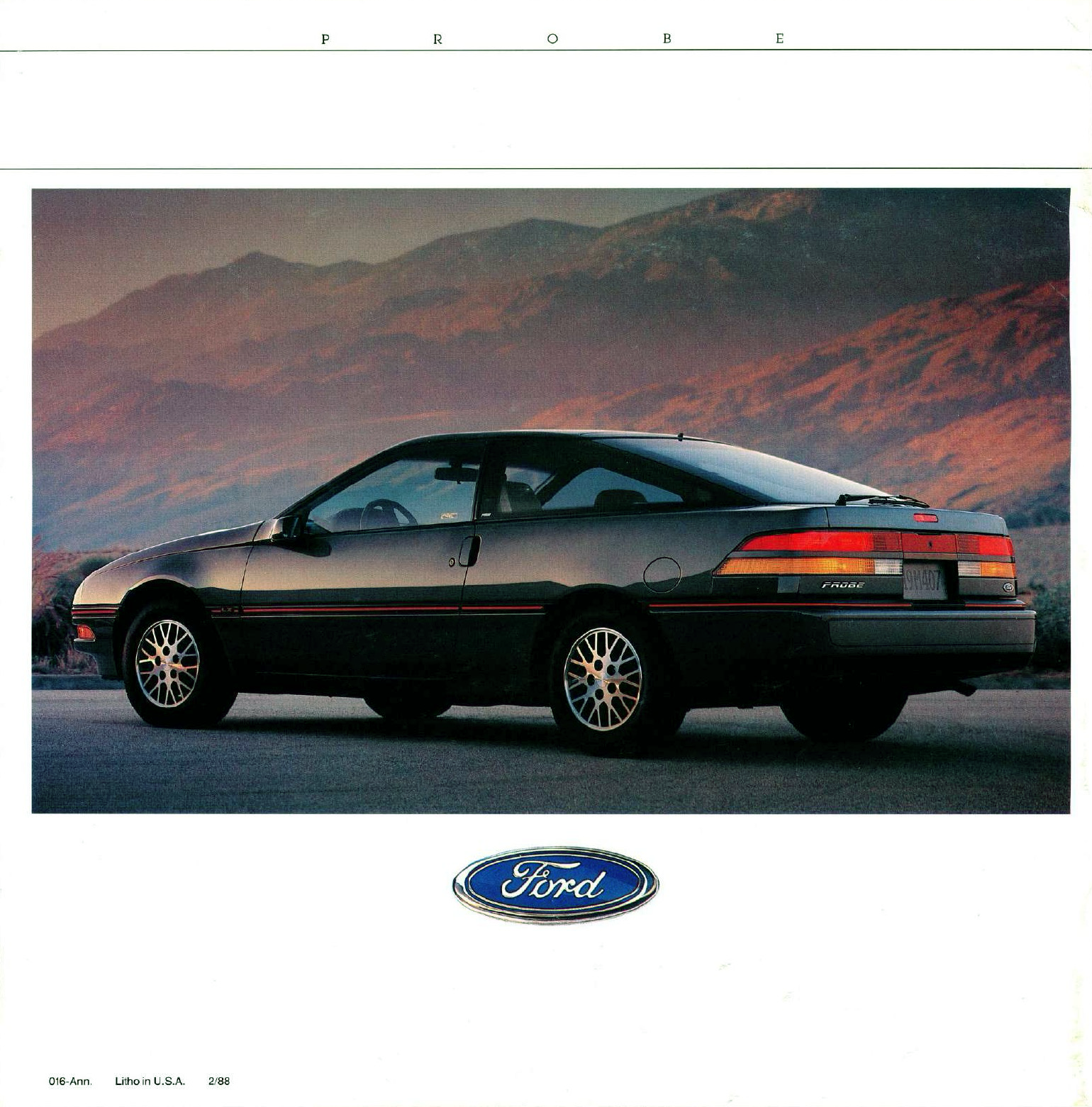
Rear cover of the 1989 Ford Probe brochure

The GL‘s base price was $10,459—about $28,300 in today’s dollars. Standard exterior and mechanical equipment included concealed/retractable halogen headlamps, power rack-and-pinion steering, power front disc/rear drum brakes, and P185/70SR14 steel-belted black sidewall radial tires (a size still readily available) on 14-inch wheels with standard Deluxe wheel covers. Inside, front bucket seats, 50/50 split fold-down rear seats, Deluxe cloth seat trim, full analog instrumentation with a tachometer, and an electronic AM/FM stereo radio were included.

The LX ($11,443) added complete tinted glass, Luxury wheel covers, all-cloth multi-adjustable front bucket seats, Luxury floor carpeting, a full console with a folding armrest and a storage bin, a rear window defroster, a remote liftgate release, a remote inside fuel filler release, and the Light Group.

Exterior and mechanical changes or additions with the GT ($13,593) included a unique front fascia with fog lamps, a unique rear end treatment with a two-tone spoiler, variable-assist power rack-and-pinion steering, power 4-wheel disc brakes, and P195/60VR15 Goodyear Eagle speed-rated performance steel-belted radial tires on 15-inch aluminum wheels. Inside, the GT included Sport cloth seat trim.

Packages, Individual Options, & Production Numbers

By 1989, Ford was delivering much of its optional equipment in Preferred Equipment Packages.

  • GL Preferred Equipment Package 250A was the base GL package.
  • GL Preferred Equipment Package 251A ($334) added complete tinted glass, dual electric remote mirrors, a tilt steering column/instrument cluster, interval windshield wipers and mist function, a rear window defroster, and the Light Group.
  • LX Preferred Equipment Package 252A was the base LX package.
  • LX Preferred Equipment Package 253A ($2,214) added a 6-way power driver seat adjustment, a leather-wrapped steering wheel and shift knob, an illuminated entry system, an electronic instrument cluster, speed control, an electronic air conditioner with push button controls, power windows, power door locks, a rear wiper/washer, a trip computer, and an electronic AM/FM stereo radio with a cassette tape player, premium sound system, and a power antenna.
  • GT Preferred Equipment Package 260A was the base GT package.
  • GT Preferred Equipment Package 261A ($2,621) added an anti-lock brake system, a 6-way power driver seat adjustment, a leather-wrapped steering wheel and shift knob, an illuminated entry system, speed control, and an electronic air conditioner with push button controls, power windows, power door locks, a trip computer, and an electronic AM/FM stereo radio with a cassette tape player, premium sound system, and a power antenna.

Individual options included a flip-up open air roof ($355), an air conditioner with manual controls ($927), power door locks ($155), and three optional stereos.

The 1989 Probe was a smash hit for Ford, with 162,889 made. Combining those numbers with the Mustang’s 206,789 produced definitely validated Ford’s decision to proceed with two separate models.

The View From 2025

I haven’t seen a Probe on the road in years. They’re gone from the Hemmings Motor News classifieds and eBay Motors, but Bring a Trailer has sold three of this generation of Probe in the last six years.

Make mine Deep Titanium Clearcoat Metallic, please.

Other late eighties Ford coupes I have written about include the 1987 Mustang LX and the 1987 Thunderbird.

1984 Ford Tempo sedan

“Computer-refined design for five-passenger comfort”

The Ford Tempo and Mercury Topaz debuted for the 1984 model year in May 1983. Based on the Escort, they were putative replacements for the Ford Fairmont and Mercury Zephyr.

The Tempo’s base engine and transmission combination was the 2300 HSC 90 bhp 2.3 liter/140 ci inline four with a one-barrel carburetor paired with a four-speed manual. A Mazda-built 52 bhp 2.0 liter/122 ci diesel four was available for $588, but it isn’t clear how many bought it. Road & Track recorded a 0-60 time of 13.6 seconds with the optional five-speed manual ($76) and the gas engine. A three-speed automatic was $439 and was available only with the gas engine and the fancier GL and GLX trims.

1984 Ford Tempo print advertisement

The 1984 Tempo L sedan’s base price was $6,936—about $22,700 in today’s dollars. Standard exterior and mechanical equipment included single rectangular halogen headlamps, rack and pinion steering, power front disc/rear drum brakes, and P175/80R13 steel-belted radial ply black sidewall tires on 13-inch wheels with Deluxe wheel covers. Inside, individually adjustable front seats with cloth seating surfaces and reclining seat backs, Deluxe carpeting, a mini-console, an A-frame Luxury steering wheel, an inside hood release, and an AM radio with dual front speakers were included.

The $7,159 GL sedan added Luxury wheel covers, Luxury sound insulation, interval windshield wipers, and an electronic digital clock.

The $7,621 GLX sedan added bumper end cap extensions, dual door-mounted remote-control mirrors, a dual note horn, Luxury carpeting, and Luxury luggage compartment trim.

Groups, Packages, Individual Options, & Production Numbers

Ford offered four option groups and packages with the Tempo:

  • The Light/Convenience Group ($50-$85) included ashtray, glovebox, and engine compartment lights, rear door dome light switches, a swivel map light, a headlamps on buzzer, and a trip odometer
  • The Power Lock Group ($202-$254) included power door locks, a power decklid release, and a remote control fuel filler door
  • The Sports Appearance Group ($299) was only available with the GL and included styled steel wheels with trim rings, Sport front seats with a 4-way manual driver’s seat, rear seats with integral headrests, unique sew-style and fabric, a Sport steering wheel, and a Sport instrument cluster
  • The TR Performance Suspension Package ($366-$424) included Michelin TRX tires, TR-Type cast aluminum wheels, and special steering and suspension components

Individual exterior and mechanical options included tinted glass ($510), metallic glow paint ($63), a flip-up open air roof ($315), and power steering ($223). Inside, power side windows ($272), a driver’s side power seat ($224), Fingertip Speed Control ($176), and an electric rear window defroster ($140) were offered. A series of five optional radios were offered, ranging up to an electronic AM/FM stereo search radio with a cassette player ($396).

Options not available with the L included air conditioning ($743) and all-vinyl seats (no charge). A loaded GLX could easily reach $9,400—about $30,800 in today’s dollars, or about what a 2026 Ford Escape Active crossover goes for.

The Tempo sedan sold well in its extended debut year—Ford moved a total of 295,149, which was more than four times as many as the final-year 1983 Fairmont sedan.

The View From 2025

These cars have vanished. They’re gone from the Hemmings Motor News classifieds and eBay Motors. Bring a Trailer has sold four Tempos in the last four years, two of them sedans.

Make mine Dark Academy Blue Metallic, please.

Other eighties Ford sedans I have written about include the 1985 LTD LX and the 1986 Taurus.

1982 Ford Thunderbird coupe

For some reason, I’m always interested in the last year of a “failed” model. Usually, not much gets changed, as the manufacturer’s hopes have already been dashed. For Labor Day 2025, we’ll cover the fruits of Ford’s labors for the 1982 model year.

“Three distinctive series, each built to be driven with pride.”

For 1982, Ford’s Thunderbird personal luxury coupe added a 3.8 liter V6 option, and removed the 4.9 liter V8 option. A Tripminder trip computer was a new option, and the gas tank size increased to 21 gallons. Otherwise, Ford changed little besides colors and trims.

Ford engine availability and power ratings were still in decline in 1982—except if you were purchasing a Mustang. The Thunderbird’s standard powertrain was the Thriftpower Six 87 bhp 3.3 liter/200 ci inline six with a one-barrel carburetor paired with a SelectShift three-speed automatic transmission. Powertrain upgrades were available: buyers could specify the aforementioned Essex 112 bhp 3.8 liter/232 ci V6 with a two-barrel carburetor or the Windsor 120 bhp 4.2 liter/255 ci V8 with a Motorcraft two-barrel carburetor. Both of the optional engines cost $241.

The Thunderbird was a notably different car depending on the engine choice. Looking at the table, it’s hard not to believe that the new Essex engine was the winner—almost as quick as the Windsor V8, and with notably better fuel mileage than either the inline six or the V8.

Thriftpower Six
(3.3 liter inline six)
Essex
(3.8 liter V6)
Windsor
(4.2 liter V8)
0-60 mph
(approximate)
17.3 seconds13.2 seconds12.6 seconds
Fuel mileage
(1982 standards)
17 city/24 highway19 city/30 highway17 city/26 highway
Range
(10% fuel reserve)
315 to 345 miles375 to 415 miles330 to 365 miles

Standard exterior and mechanical equipment on the $8,492 base Thunderbird (about $29,400 in today’s dollars) included concealed rectangular halogen headlamps, variable ratio power rack and pinion steering, power front disc/rear drum brakes, full wheel covers, and P-metric white sidewall steel-belted radial ply tires. Inside, a Flight bench seat in fine-ribbed cloth and vinyl trim, a day/night inside mirror, a trip odometer, a quartz electric clock, and an AM radio were included.

Packages, Options, & Production Numbers

Ford continued to decontent the $9,703 Town Landau (approximately $33,600 now), so its price was closer to the base Thunderbird compared to 1980. Moving up still added Luxury wheel covers, dual remote control mirrors, diagnostic warning lights, interval windshield wipers, a tilt steering wheel, and an AM/FM stereo radio. The Luxury vinyl roof—a padded rear half vinyl roof with a color-coordinated wrapover band and coach lamps—was also standard on the Town Landau. Finally, the included Interior Decor Group added cloth covered head restraints (vinyl if vinyl trim was purchased), Decor door trim panels with assist straps, and a choice of either split bench seats with dual recliners in higher level knit cloth fabric or bucket seats with console.

For the second year, the Heritage edition was the top-of-the-line Thunderbird ($12,472 then, $43,100 now). Exterior and mechanical features the Heritage edition added over the Town Landau included front cornering lamps, complete tinted glass, rocker panel moldings, the 3.8 liter V6 engine, an Automatic Overdrive transmission, and wire wheel covers. Inside, the Heritage edition included a 6-way power driver’s seat, an electronic instrument cluster, air conditioning with manual controls, the power lock group, and an AM/FM stereo search radio.

Every Heritage edition buyer also got a padded rear half vinyl roof with a brushed aluminum wrapover band, coach lamps, and a frenched backlight. They also received the Interior Luxury Group, which included split bench seats with dual recliners in crushed velour cloth, cloth covered head restraints, a Luxury steering wheel, an automated parking brake release, a right hand visor illuminated vanity mirror, 18-oz floor carpeting, burled rosewood woodtone instrument and door panel appliques, the Light Group (dual beam map light, instrument panel courtesy lights, and engine compartment light), power side windows, interval windshield wipers, diagnostic warning lights, an electronic digital clock, and Luxury luggage compartment trim.

Individual options included a flip-up open-air roof ($276), metallic glow paint ($80), a Tu-Tone paint/tape treatment ($128-206), the Keyless Entry System ($319), Recaro bucket seats with a console ($523/$405/$222 depending on series), the SelectAire conditioner with automatic temperature control ($754 for all but the Heritage, which charged $78), and the Tripminder trip computer ($215-261). Nine different audio selections were available, ranging up to an electronic AM/FM stereo search radio with a cassette tape player and the Dolby noise reduction system ($318/$233/$87), which could be paired with the Premium Sound System ($133-187).

Ford sold 45,142 Thunderbirds in the 1982 model year, which was the lowest number since 1975. It was handily outsold by all four of the mid-size GM coupes: Buick Regal, Chevrolet Monte Carlo, Oldsmobile Cutlass, and Pontiac Grand Prix. It would take the next Thunderbird design in 1983 to redress this balance.

The View From 2025

According to Hagerty’s valuation tools, a 1982 Thunderbird with the V8 in #1/Concours condition is $17,400, with a far more typical #3/Good “normal” Thunderbird with the six going for $6,500. This generation of Thunderbirds maintains a presence in the Hemmings Motor News classifieds, on eBay Motors, and on Bring a Trailer, but you see very few 1982 examples. As I update this blog entry in October 2025, there’s a Silver Metallic 1980 with gray cloth seats and the 255 ci V8 on Hemmings, showing 73,000 miles and asking $11,500.

Make mine the extra-cost Medium Blue Glow, please.

Other eighties Thunderbirds I have written about include the 1980 coupe, the 1983 Turbo Coupe, and the 1987 standard coupe.

Last updated October 2025.

1987 Ford Mustang LX 2-door sedan

“You get the more formal look of the sedan with the high performance of the GT.”

For the 1987 model year, Ford’s Fox-body Mustang received a facelift of both its interior and exterior. Ford restyled the front end, which gave the aging design (work had begun on the Fox-body Mustang in 1976) more of an “aero” look, in keeping with the overall mid-1980s Ford styling direction embodied by the Thunderbird and Taurus. The quarter glass windows were now each a single larger flush piece of glass with “Mustang” lettering at the bottom rear corners, replacing the smaller glass paired with louvers that had been in use since the 1979 model year. Taillights on the LX were revised with clear lenses for the turn signals. The interior received an all-new dash, center console, and revised seat and door trim.

With the SVO gone, the remaining models were the LX and the GT. Ford discontinued the V6 option, leaving only the standard 90 bhp Lima 2.3 liter/140 ci inline four with new-for-1987 fuel injection and the optional 225 bhp Windsor 4.9 liter/302 ci V8 with sequential fuel injection, which was part of an $1,885 5.0L EFI HO V-8 Engine Package. A five-speed manual transmission was standard, while a four-speed automatic was a $515 option.

From a performance and fuel economy perspective, the inline four LX and the V8 LX might as well have been different cars. The Lima-based Mustang with the manual took about 13.3 seconds to get to 60 mph, with the automatic/inline four combination being a few tenths worse. The payoff was fuel economy—25 city/31 highway by the day’s standards for the base powertrain (22/28 by today’s measures). The automatic was about 10% less efficient. With a 15.4-gallon gas tank, an LX owner with the base powertrain could expect an impressive range of 350 to 385 miles with a 10% fuel reserve.

In marked contrast, the Windsor-based Mustang with the manual took about 6.2 seconds to get to 60 mph, with the automatic version taking about 6.7 seconds. Fuel economy was 16 city/24 highway by the day’s standards (15/22 by 2025 measures). Interestingly, the automatic was about 13% more efficient when paired with the V8. An LX owner with the V8 and five-speed manual could expect a range of 260 to 275 miles with a 10% fuel reserve.

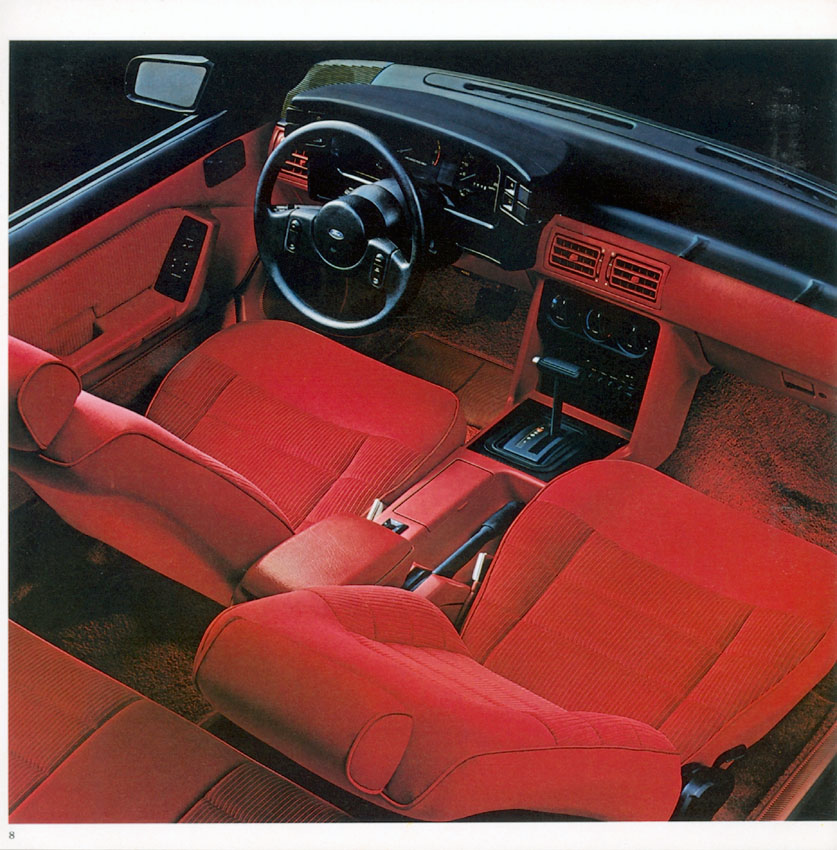
LX interior page from the 1987 Ford Mustang brochure

The 1987 Mustang LX 2-door sedan (Ford’s nomenclature) had a base price of $8,043—about $23,500 in today’s dollars, which is approximately 26% less than a base 2025 Mustang costs. Standard exterior and mechanical equipment included power rack and pinion steering, power front disc/rear drum brakes, and P195/75R14 black sidewall steel-belted radial tires on 14-inch wheels with turbine wheel covers. Inside, reclining cloth low back front bucket seats, Light Group, full instrumentation, a console, and an electronic AM/FM stereo search radio with four speakers were included.

Groups, Packages, & Individual Options

Seven groups and packages were available for the Mustang LX 2-door sedan:

  • Preferred Equipment Group 240A was the base package
  • Light Group was included with the base package and included lights for the engine compartment, the luggage compartment, the ashtray, and the glove box. A dual beam dome/map light and a headlamps on reminder chime were also included
  • Special Value Group 240A (no cost for inline four/$735 for V8) included Power Lock Group, an electronic AM/FM stereo radio with cassette tape player, speed control, and styled road wheels
  • Power Lock Group ($244) included power door locks, a remote locking fuel door, and a trunk release
  • Climate Control Group ($1,005 for inline four/$978 for V8) included tinted glass, a heavy-duty battery, air conditioning, and a rear window defroster
  • Custom Equipment Group ($624) included dual electric remote control mirrors, power side windows, dual illuminated visor mirrors, a tilt steering wheel, and a graphic equalizer
  • The 5.0L EFI HO V-8 Engine Package ($1,885) included a Traction-Lok axle, GT suspension system components, a 15:1 steering ratio, a heavy-duty battery, P225/60VR15 handling tires, and cast aluminum wheels

Exterior and mechanical options for the Mustang LX 2-door included complete tinted glass ($120) and wire style wheel covers. Inside, a tilt steering wheel ($124), an air conditioner ($788), and power front side windows were available. Stereo options included an electronic AM/FM stereo radio with cassette tape player ($178), a graphic equalizer ($218), and the Premium Sound System ($168 for six upgraded speakers and a 4-channel power amplifier). The Handling Suspension Package and cast aluminum wheels were optional with the inline four but included with the V8.

Period Reviews & Production Numbers

The enthusiast press—including Car and Driver, Hot Rod, and Motor Trend—swiftly realized that the LX 2-door sedan with the V8 was 80 pounds lighter than the GT, which made it slightly quicker. At $9,928, the V8 LX was also 16% cheaper than the GT, making it one of the outstanding performance bargains of the 1980s.

Production data is surprisingly uncertain (wouldn’t the Mustang have been worth paying attention to?), but some of the more likely data states that Ford sold 43,257 Mustang LX 2-door sedans, of which 4,888 (or 11%) were V8s.

The View From 2025

There is strong club support for the 1987 Mustang, as there is for all Mustangs except the mid-seventies Mustang IIs. According to Hagerty’s valuation tools, all the money for a 1987 Mustang notchback coupe in #1/Concours condition is $52,500, with a more typical #3/Good condition car going for $18,600. 1987 Mustangs often show up in the Hemming’s Motor News classifieds, on eBay Motors, and on Bring a Trailer—BaT has sold three 2-door 1987 LXs over the years.

Make mine Medium Shadow Blue Metallic, please. One quarter of the 12 Mustang colors for 1987 were blues.

Other Mustangs I have written about include the 1980 Cobra hatchback coupe, the 1981 coupe, the 1982 GT hatchback coupe, the 1983 GT convertible, and the 1984 SVO hatchback coupe.

1980 Ford Pinto 2-door sedan

“It may be the best small car value of 1980.”

Ford’s Pinto was little changed in its final year, with minor trim and detail changes and the removal of the V6 engine option.

The only engine remaining was the Lima 88 bhp 2.3 liter/140 ci inline four with a two-barrel carburetor. A four-speed manual was standard, while a SelectShift automatic was optional ($340). 0-60 came in a little over 14 seconds with the manual. Fuel economy was 24 city/38 highway by the day’s standards. With a 13.0-gallon gas tank assembly that now included a longer fuel filler neck and a stronger fuel filler cap than in earlier years, a Pinto owner could expect a range of 295 to 325 miles with a 10% fuel reserve.

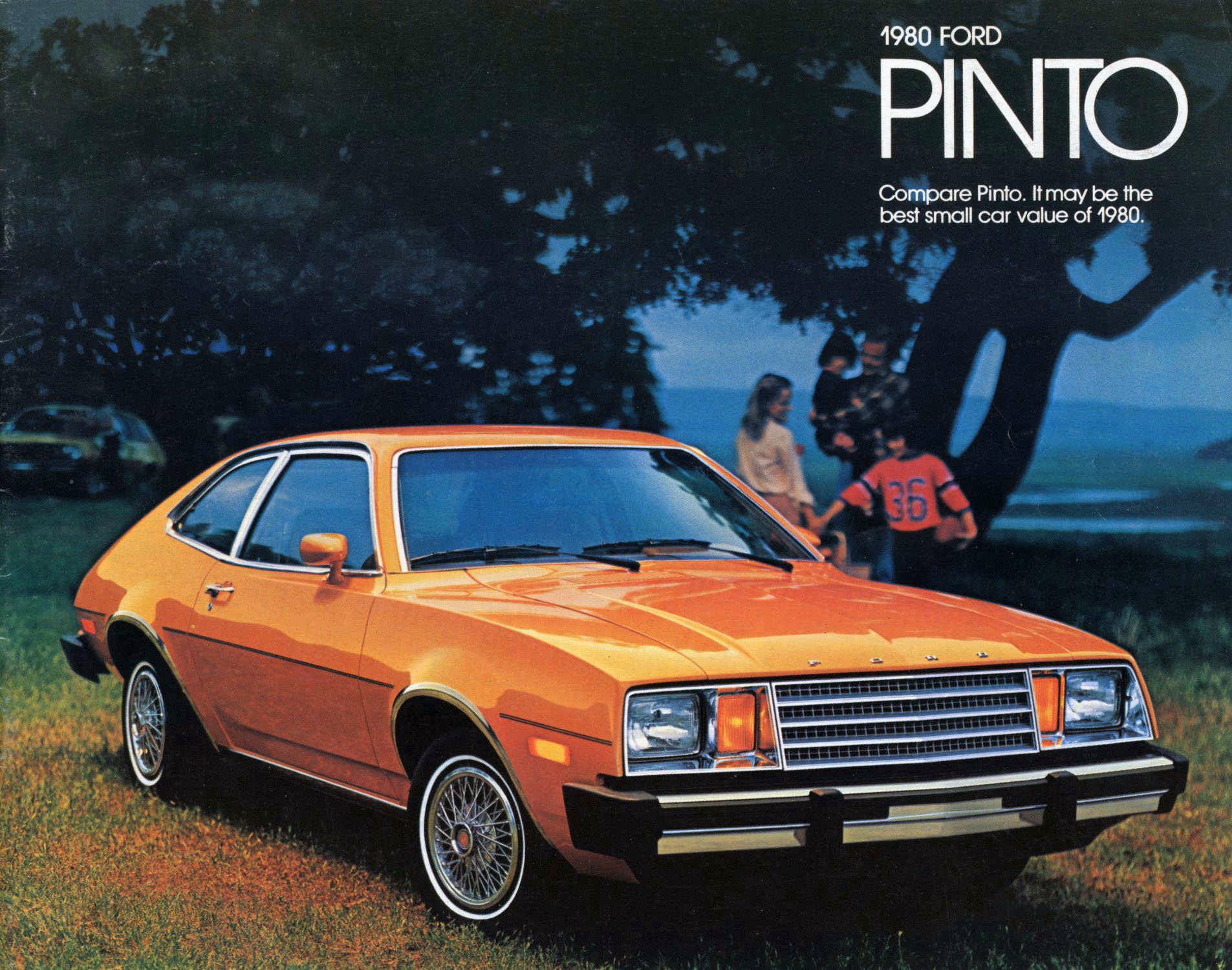
1980 Ford Pinto brochure cover

The 1980 Pinto 2-door sedan’s base price was $4,605—about $19,700 in today’s dollars and 30% less expensive than any 2025 Ford product. Standard exterior and mechanical equipment included tinted glass all around, vinyl insert bodyside moldings, rack and pinion steering, front disc/rear drum brakes, and 13-inch black sidewall steel-belted radial ply tires on 13-inch wheels with full wheel covers. Inside, all vinyl or cloth and vinyl high back bucket seats, a mini-console with a storage bin, and an AM pushbutton radio were included.

Packages, Options, & Production Numbers

The wide variety of packages and groups available for the 2-door sedan included:

  • Convenience Group ($118)—pivoting quarter windows, interval windshield wipers, day/night mirror, cigarette lighter
  • ESS Package ($313)—black accents, premium bodyside molding, styled steel wheels with trim rings, ESS nomenclature
  • Exterior Decor Group ($44)—bright grille and headlamp doors, along with bright rocker panel and wheellip moldings, bodyside accent stripes
  • Interior Accent Group ($50)—Deluxe steering wheel, day/night mirror, woodtone appliques, cigarette lighter, rear seat ashtray
  • Interior Decor Group ($238)—cloth/vinyl or all-vinyl low-back bucket seats, Deluxe door trim, Deluxe steering wheel, woodtone appliques, deluxe sound insulation package, courtesy light switch on passenger door
  • Light Group ($41)—map light, lights in glove box, ashtray, engine, and trunk, courtesy light switch on passenger door
  • Sports Package ($118)—3.08 performance rear axle with the manual transmission, Sport steering wheel with black metal spokes, instrumentation (tachometer, ammeter, temperature gauge)

Individual options included a flip-up open air roof ($219), Medium Red Glow metallic glow paint, a Tu-Tone paint/tape treatment, power front disc/rear drum brakes ($78), power steering ($160), the SelectAire conditioner ($538), and series of radios ranging up to an AM/FM stereo with cassette tape player and two door-mounted speakers ($191).

The best-selling Pinto remained the 2-door sedan (Ford’s description), which looked like it should be a hatchback but wasn’t. Ford sold 84,043 of the 2-door sedans (including the decontented Pony edition) compared to 61,542 of the Runabout, which actually was a hatchback but cost 3% more. The all-new Escort would follow in 1981, but that’s another story.

The View From 2025

I haven’t seen a Pinto in the wild for decades, and they have little presence in the Hemmings Motor News classifieds or on eBay Motors. Bring a Trailer has sold four 1980 Pintos in six years.

Make mine Dark Pine Metallic, please.

Other 1980 Fords I have written about include the Fairmont Futura coupe, the Mustang Cobra coupe, and the Thunderbird coupe.

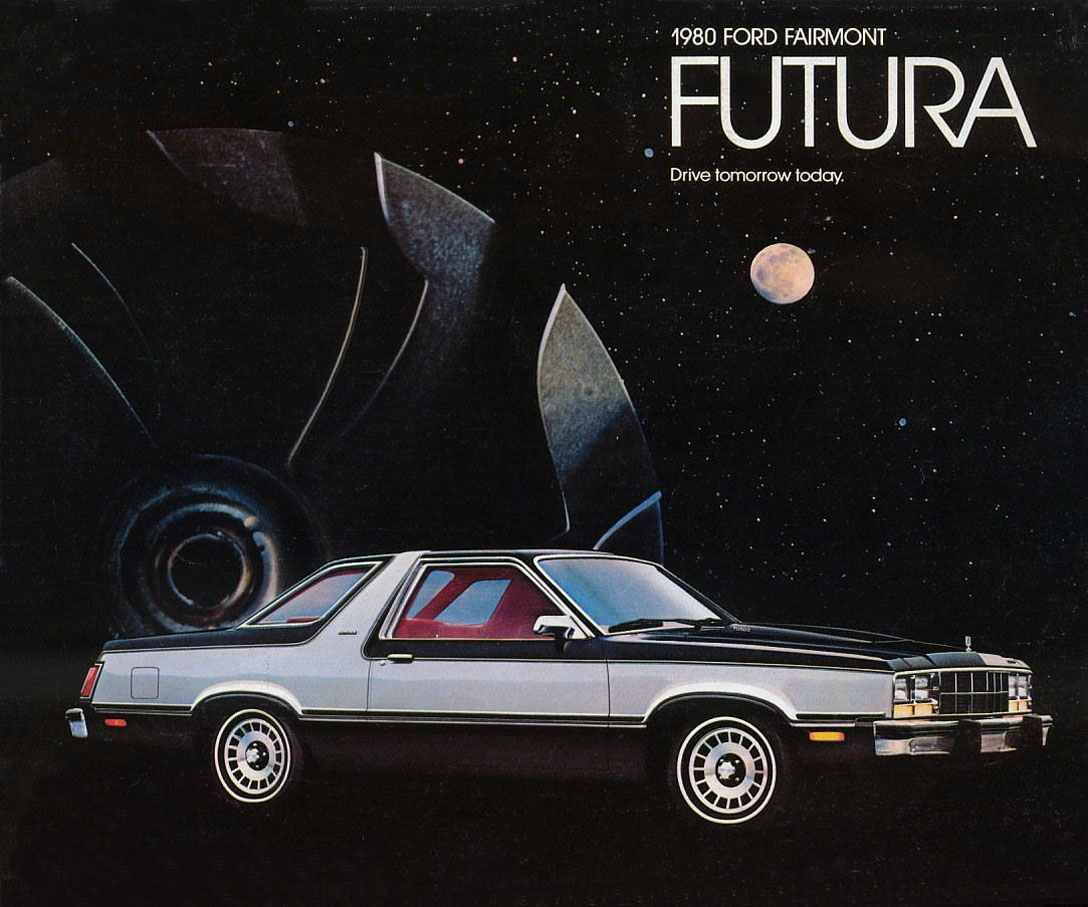
1980 Ford Fairmont Futura coupe

“Drive your Futura of tomorrow … today.”

1980 model year changes to Ford’s Fairmont Futura coupe included new engine choices and a new Tu-Tone paint treatment. Newly standard were P-metric steel-belted radial ply tires, high-illumination halogen headlamps, and a maintenance-free battery.

The Fairmont was the first of the Fox platforms to make it to market. Initially available for the 1978 model year, it replaced the Maverick as Ford’s compact offering. The Futura coupe’s distinctive wrapover B-pillar design came from a March 1976 Fairmont-based Thunderbird proposal.

Ford had been using the Fairmont name for a while by 1978—Ford of Australia had first used it in 1965. The Futura name was even older, dating back to a Lincoln concept car designed in 1954 and debuting as a higher-trim model of the Falcon in 1961.

Powertrains, Performance, & Standard Equipment

The Fairmont Futura’s standard engine was the Lima 88 bhp 2.3 liter/140 ci inline four with a two-barrel carburetor. The Thriftpower 91 bhp 3.3 liter/200 ci inline six with a one-barrel carburetor ($169) was available, and had 36% more torque than the four. A Windsor 119 bhp 4.2 liter/255 ci V8 with a two-barrel carburetor ($288) was also available—a substantial downgrade from the 139 bhp 4.9 liter/302 ci engine that had been available in 1978 and 1979.

There was once some argument, but it now seems reasonably clear that some Futuras were built with the heavily advertised turbocharged four ($481). This engine was rated at 120 bhp and included a prominent hood bulge with Turbo insignia. Reliability must not have met Ford’s expectations, because the turbocharged four didn’t make it to the 1981 model year.

A four-speed manual was standard with the base 2.3 liter inline four, while a four-speed manual with overdrive was standard with the 3.3 liter inline six. A SelectShift three-speed automatic ($340) was required with the turbocharged four and the V8, and optional for the two other engines.

Performance wasn’t great, but few domestic competitors were much better. Road & Track clocked a 15.8-second 0-60 time with the base powertrain. Best-case times with either the turbo four or the V8 were probably about two seconds better, but a Futura driver wasn’t looking to go racing.

Fuel economy ratings with the base powertrain were impressive: 28 city/38 highway by the day’s standards. The far more common 3.3 liter six/automatic combination was 20/27, with the V8 getting 18/26. The turbo came in at 19/26. With a 14-gallon fuel tank, Fairmont buyers with the 3.3 liter six and the automatic could expect a range of 270 to 295 miles.

Cover of the 1980 Ford Fairmont Futura brochure

The Fairmont Futura coupe’s base price was $5,531—$23,500 in today’s dollars. Standard exterior and mechanical equipment included dual rectangular halogen headlamps, wraparound taillamps, rack and pinion steering, front disc/rear drum brakes, and P-metric 14-inch black sidewall radial-ply radial tires on 14-inch wheels with Deluxe wheel covers. Inside, accent vinyl low-back front bucket seats and a Deluxe steering wheel hub were included.

Some of the Futura‘s standard interiors depended on the engine and transmission chosen. Buyers of the base 2.3 liter four with the four-speed manual and the turbocharged four with the automatic got low-back front bucket seats in pebble-grain vinyl. Buyers of the 3.3 liter six with the manual and the V8 with the automatic got a bench seat.

Packages, Options, & Production Numbers

The Ghia package ($193) included dual remote-control mirrors, a Ghia badge, plush cut-pile carpeting, a carpeted trunk, a Luxury steering wheel, a glove box lock, sun visors, and a right hand visor vanity mirror. Ghia buyers got a Flight Bench seat in either Luxury velour cloth or pebble-grain vinyl if they chose an automatic transmission, or bucket seats with the four-speed manual.

The Sports group ($114) included an over-the-roof tape stripe, color-keyed turbine wheel covers, and a charcoal/argent grille.

Individual exterior and mechanical options included power front disc brakes ($78) and power steering ($165). Inside, air conditioning ($671), a tilt steering wheel ($78), fingertip speed control ($116), power side windows ($135), and power door locks ($88) were available.

Ford produced 51,878 Futura coupes in 1980, making up 16% of overall Fairmont production in a year where overall Ford sales were down. 1,158 Fairmonts were turbos.

The View From 2025

It is striking both how many Fairmont versions there were and how much effort Ford put into marketing the Futura. Ford presented six versions of the Fairmont:

  • a 2-door sedan, which had a normal roofline and looked much plainer than the Futura
  • a 4-door sedan
  • the Futura coupe
  • the Futura sedan, which joined mid-year and had the same grille and many of the same features as the Futura coupe
  • a 4-door wagon
  • a Squire-branded 4-door wagon with woodgrain vinyl

Though the Futura got two full pages in the Fairmont brochure, Ford also made an eight-page Futura-specific brochure available.

Fairmont Futuras are not often seen for sale in any venue. AutoTrader Classic has an occasional Fairmont, while Bring a Trailer has sold a grand total of one Fairmont overall—a wagon. The word Fairmont appears in the Hemmings Motor News classifieds more as a component (of Model A replicas, for example) than a vehicle. One exception to this lack of sales visibility came in January 2024, when Barrett-Jackson auctioned a 1978 Ford Futura coupe for a $34,000 hammer price—it was the 100,000,000 U.S.-built Ford vehicle.

Make mine Candyapple Red, please.

Other 1980 Fords I have written about include the F-150 pickup truck, the Fiesta hatchback coupe, the Mustang Cobra hatchback coupe, and the Thunderbird coupe. I evidently do not write about a lot of Ford sedans.

1980 Ford F-150 pickup truck

“First new truck of the 80’s …”

For 1980, Ford’s pickup truck was nearly all-new, with a more aerodynamic body that reduced drag at highway speeds by up to 13%. There was also an increased emphasis on comfort, with increased legroom over 1979. Ford sold four versions of the full-size truck—the light-duty F-100, the F-150, the 3/4 ton F-250, and the 1-ton F-350. For this blog post, we’ll concentrate on the F-150, which was the best-selling of the four versions, and pick the more popular rear-wheel-drive example over the four-wheel-drive.

The standard engine was the 101 bhp Big Six 4.9 liter/300 ci six. A 130 bhp 4.9 liter/302 ci V8 ($315) and a 156 bhp 5.8 liter/351 ci V8 ($477) were optional. A three-speed manual transmission was standard on rear-wheel-drive F-150s, but many buyers chose the four-speed manual ($175), the four-speed manual with overdrive ($208), or the Select-Shift three-speed automatic ($408).

Pages from the 1980 Ford Pickup brochure

Standard exterior and mechanical equipment on the base $5,314 Custom F-150 short bed included a bright grille surround, an independent front suspension, power front disc/rear drum brakes, P215/75R15SL black sidewall tires (a size still readily available), and 15-inch wheels with argent hub caps. Inside, all vinyl seat trim, a coat hook, a dome light, and a glove box with a latch were included.

Packages

The 1980 Ford F-150 was replete with packages that ranged from making it a little nicer to reasonably luxurious.

  • The $339 Ranger package added a brushed aluminum lower bodyside molding and bright hub caps on the exterior. Inside, all-vinyl or cloth and vinyl seat trim, color keyed seat belts, and a cigarette lighter were included.
  • Exterior features of the $472 Ranger XLT package depended on whether the truck was Flareside or Styleside. Flareside pickups had tailgate trim with raised FORD letters in a contrasting color with a dual-colored tape stripe setting off the letters. Styleside pickups included a brushed aluminum tailgate applique with bright letters. Inside, all Ranger XLTs included grained vinyl seat trim with cloth inserts, carpeted lower door trim panels, bright aluminum door scuff plates, and color-keyed cut-pile carpeting.
  • Exterior features of the top-of-the-line Ranger Lariat package ($760) included a brushed aluminum lower bodyside molding with a black vinyl insert and (of course) three Lariat plaques. Inside, all Ranger Lariats included a unique seat trim sew style in cloth and vinyl or all-vinyl, thick cut-pile carpeting, a Luxury-type steering wheel, and an instrument panel with a polished woodtone applique and a bright Ranger Lariat script.
  • Free Wheeling package “A” ($407) included pinstriping, blackout grille, blackout headlamp doors, and Sport wheel covers.
  • Free Wheeling package “B” ($1,266) included everything in package “A” plus foglamps, bumper guards, the Handling Package, and 10-hole aluminum wheels. Flareside pickups received a bright channel bumper, while Styleside pickups got a bright rear contour bumper. Inside, a simulated leather-wrapped steering wheel and the Sports Instrumentation Package with tachometer, trip odometer, ammeter, and oil pressure gauge.

Options & Production Numbers

Individual options were many and included tinted glass on all windows ($36), a sliding rear window ($102), variable-ratio power steering ($215), white styled steel wheels ($161), and forged aluminum wheels available either with a brushed finish ($311) or a polished finish ($361). Inside, a tilt steering wheel ($83), air conditioning ($611), and Speed Control ($160) were available. A choice of five radios ranged up to an AM/FM stereo with cassette tape ($324). Despite the luxury emphasis, power door locks and power windows were not available—they wouldn’t be offered until 1982.

Ford sold 173,050 F-150s in the 1980 model year. That number sounds like a lot, but 1980 was a bad year for the automotive industry overall and an awful year for Ford, whose US market share dropped from 23.8% in 1979 to 20.5% in 1980. Of Ford trucks, only the imported Courier compact pickup would hold the line on sales volume.

The View From 2025

Folks are collecting these seventh-generation Ford pickup trucks. F-150s often appear for sale in the Hemming’s Motor News classifieds, on eBay Motors, and on Bring a Trailer. According to Hagerty‘s valuation tools, a 1980 Ford F-150 Styleside short bed with the 302 ci V8 in #1/Concours condition is $44,300, with a more normal #3/Good condition truck going for $13,000. A long bed subtracts around 2%, while the 351 ci V8 adds about 5%. Four-wheel-drive is worth an additional 14% or so.

Make mine Candyapple Red, please. I’m unsure if I want any of the four two-tone options.

Other Ford products from 1980 that I have written about include the Ford Fiesta hatchback coupe, the Ford Mustang Cobra hatchback coupe, the Ford Thunderbird coupe, and the Lincoln Continental Mark VI coupe. I’ve also written about the 1985 Eddie Bauer Bronco SUV.

1981 Ford Mustang coupe

“Sleek with clean lines that slice through the wind.”

For 1981, Ford’s Mustang gained a “rakish” new optional T-Roof and the availability of power windows. The base seats were now reclining. Otherwise, things generally stood pat.

The 1981 Mustang’s standard powertrain was the Lima 88 bhp 2.3 liter/140 ci inline-four paired with a four-speed manual transmission. Optional engines included the Thriftpower 94 bhp 3.3 liter/200 ci inline six ($213) and a 120 bhp 4.2 liter/255 ci V8 ($263). A five-speed manual ($152 and only available with the inline-four) and a Select-Shift automatic ($349 and required with the V8) were offered. Despite being relatively light, no 1981 Mustang was fast—Car and Driver recorded an 11.2 second 0-60 time with the V8.

EPA fuel economy ratings ranged from 23 mpg with the inline-four engine and either of the two manual transmissions to 19 mpg with either the inline six/four-speed or the V8/automatic transmission combinations. With a small 12.4-gallon gas tank, a Mustang V8 owner could expect a mere 190 to 210 miles with a 10% fuel reserve.

Standard Equipment, Sub-Models, & Packages

Standard equipment on all Mustangs included dual rectangular halogen headlamps, front disc/rear drum brakes, rack and pinion steering, and 13-inch P-metric steel-belted radial-ply tires on 13-inch wheels. Inside, fully reclining vinyl high-back front bucket seats, color-keyed cut-pile carpeting, and an AM radio were included.

The notchback and hatchback (Ford insisted on calling them 2-Door and 3-Door) had slightly different standard equipment. The notchback/2-Door went for $6,171 and included color keyed rear pillar louvers, full wheel covers, and a Deluxe steering wheel. The hatchback/3-door went for $6,408 (about $24,100 in today’s dollars) and included black rear pillar louvers, Sport wheels, a fold-down rear seat, and a Sports steering wheel.

The Ghia—available as a $6,645 notchback or a $6,729 hatchback—added Ghia insignia, bright rocker panel moldings, pinstripes, dual black remote control mirrors, and 14-inch P-metric steel-belted radial-ply tires on 14-inch wheels with turbine wheel covers. Inside, Ghia buyers got the Ghia sound insulation package, Luxury color-keyed cut-pile carpeting, and a Luxury 4-spoke steering wheel.

Cobra pages from the 1981 Mustang brochure

Mechanically, the $1,588 Cobra package added a Sport-tuned exhaust with bright tailpipe extension, a Handling Suspension System, and 195/65R 390 Michelin TRX black sidewall tires on 15.3-inch forged metric aluminum wheels. Exterior Cobra features included a Black lower Tu-Tone paint treatment, a front end integral spoiler, dual fog lamps, a non-functional rear-opening hood scoop, and a rear end spoiler. Internal Cobra features included an 8,000 RPM tachometer, black engine-turned design appliques, and a Cobra medallion on the instrument panel. A 2.3 liter turbocharged engine was initially supposed to be part of the Cobra package (and showed up in some brochures), but Ford tabled it in the United States because of reliability issues in the 1980 model year. A base Cobra was $7,966—about $30,000 in today’s dollars, which is almost what a base 2025 Mustang EcoBoost fastback goes for.

Options & Production Numbers

Exterior and mechanical options for all Mustangs included tinted glass ($76), metallic glow paint ($48), Tu-Tone paint, a flip-up open air roof, a T-Roof ($874), power front disc brakes ($76), variable ratio power steering ($163), and a Traction-Lok differential ($64). Inside, Recaro high-back bucket seats ($732), a console ($168), the SelectAire Conditioner ($560), a tilt steering wheel, two different leather-wrapped steering wheels (Sport or Luxury), fingertip speed control ($132), and power side windows ($140) were available. A choice of stereos ranging up to an AM/FM stereo radio with a cassette tape player ($174) could be ordered.

Options that look weird to our 2025 eyes included a carriage roof ($644) or a full vinyl roof ($115), both for the notchback only. Notchback purchasers could also specify an Interior Accent Group, which included a Deluxe sound package, fully relining low-back front bucket seats in a higher level of vinyl, and a passenger visor vanity mirror. Black liftgate louvers ($145) and a rear window wiper/washer ($85) could be ordered for the hatchback.

Mustang sales were lower in 1981 model year than in 1980, but automotive sales were generally down due to the concurrent recession. The base car continued to be by far the most popular—with the notchback (77,458 sold) and the hatchback (77,399) split almost exactly. Ghia‘s were also divided evenly—13,422 notchbacks and 14,273 hatchbacks. Only 1,821 hatchbacks were ordered with the Cobra package, which would be gone when the 1982 model year came around—more than replaced by the GT.

The View From 2025

According to Hagerty’s valuation tools, all the money for a 1981 Cobra V8 fastback in #1/Concours condition is $37,300, with a more normal #3/Good base Mustang inline four notchback going for $12,900. 1981 Mustangs sometimes appear in the Hemming’s Motor News classifieds, on eBay Motors, and on Bring a Trailer, but the absence of an impressive stock engine does seem to hold them back compared to the 1982 and later models.

Make mine Dark Cordovan Metallic, please.

Other Mustangs I have written about include the 1980 Cobra hatchback coupe, the 1982 GT hatchback coupe, the 1983 GT convertible, and the 1984 SVO hatchback coupe. I guess I’ll have to get to the second half of the Mustang’s decade at some point.

1980 Ford Fiesta hatchback coupe

In late 2021, Bring a Trailer featured a 1980 Ford Fiesta with unknown mileage selling at no reserve—it went for $7,200.

Ford’s first-generation Fiesta was in its final year of availability in the United States, soon to be replaced by the Escort. Because of this, the 1980 Fiesta had only minor trim and detail changes.

The Fiesta’s standard powertrain was a transverse-mounted 66 bhp 1.6 liter/98 ci inline four with a two-barrel carburetor paired with a four-speed manual. Ford’s full-line brochure stated that Fiesta acceleration was “exhilarating.” In reality, 0-60 mph took between 11 and 12 seconds in a car with a shipping weight of 1,726 pounds. The EPA rated fuel economy at an impressive 26 city/38 highway by the day’s standards. With a 10-gallon gas tank, a Fiesta owner could expect a range of 260 to 290 miles with a 10% fuel reserve.

Classified by the EPA as a subcompact, the Fiesta was a small car even in 1980, and is tiny by modern standards. With a 90-inch wheelbase and a 147.1-inch length, it gives up 8 inches of wheelbase and over 5 inches of length to a modern MINI Cooper. In 1980 brochures, Ford used the old trick of putting the car in the foreground and putting models at some indeterminate distance in the background.

Fiesta page from the 1980 Ford brochure

Standard equipment for the $5,032 Fiesta (about $21,400 in today’s dollars) included front wheel drive, a MacPherson strut front suspension, rack and pinion steering, front disc brakes, and Michelin 155-12 steel-belted radial tires on 12-inch argent road wheels. Inside, the Fiesta included all-vinyl high back front bucket seats, a fold-down rear seat, and color-keyed passenger compartment carpeting.

Options & Production Numbers

Options included a manually-operated flip-up open-air sunroof ($219), tinted glass ($55), an electric rear window defroster ($96), white sidewall tires ($70), air conditioning ($475 and not available in European versions), and an AM/FM stereo radio ($183). Decor Group and a Ghia interior which included velour and cloth upholstery were also available.

1980 Fiesta sales were off 11% from 1979, but Ford still moved 68,841.

The View From 2025

I haven’t seen a first-generation Fiesta on the streets for many years, and they are rarely seen on eBay Motors or in the Hemmings Motor News classifieds. Apparently, Bring A Trailer auctions one of these Fiestas about once a year.

Make mine Venetian Red, please.

Last updated April 2025.