1987 Pontiac Firebird Formula hatchback coupe

“The thrill of pure, uncluttered driving excitement is back.”

For 1987, the Formula returned to Pontiac’s offerings after a six-year pause. The general messaging of the Formula was all the performance of the Trans Am, but with few of the Trans Am’s exterior add-ons and little of the interior comfort of the Trans Am GTA. At $12,413—about $36,600 in today’s dollars—the Formula was 14% less expensive than a Trans Am.

The Formula’s standard powertrain was the LG4 170 bhp 5.0 liter/305 ci V8 with a four-barrel carburetor paired with a five-speed manual. The LB9 185 bhp 5.0 liter/305 ci V8 with tuned port injection ($745) and the big dog B2L 210 bhp 5.7 liter/350 ci V8 with tuned port injection ($1,045) were available options. The 5.7-liter engine required the four-speed automatic ($490).

Performance had improved steadily since 1982, yielding a zero to sixty times of about seven seconds. Mileage with arguably the sportiest combination (5.0 liter tuned port injection and five-speed) was 16 city/26 highway by the day’s standards (15/24 by 2025 measures), with the 5.7 liter/automatic transmission combination only slightly worse. With a smallish (approximately 16.0-gallon) fuel tank, a Formula owner with the base powertrain could expect a range of between 280 and 300 miles with a 10% fuel reserve.

Firebird Formula pages from the 1987 Pontiac brochure

Standard exterior and mechanical equipment on the 1987 Firebird Formula included a front air dam, a dome hood, a body color aero deck rear spoiler, a special performance suspension, power brakes, and P245/50VR16 Goodyear Eagle tires on Hi-Tech 16″ x 8″ aluminum wheels. Inside, reclining cloth front bucket seats, cloth rear folding seats, a Formula three-spoke steering wheel, a full-length console with instrument panel, complete analog instrumentation, side window defoggers, and a Delco AM radio were included.

Packages, Individual Options, & Production Numbers

By 1987, General Motors was finally figuring out the build complexity costs of tens or hundreds of individual options. Thus, packages came into play.

  • The Formula Package I ($1,273) included body side moldings, air conditioning with Soft Ray tinted glass, a tilt steering wheel, and a Delco ETR AM/FM stereo with seek, scan, and clock.
  • The Formula Package II ($1,842) included everything in Formula Package I plus cruise control, controlled-cycle windshield wipers, power windows, power door locks, and a deck lid release.

Individual options not included in either of the packages included a removable glass hatch roof ($920), a limited slip differential ($100), an electric rear window defogger ($145), and a series of radios ranging up to the “Touch Control” ETR AM stereo/FM stereo with seek-scan, search-replay/auto reverse cassette, graphic equalizer, and clock ($529).

Pontiac sold 13,164 Formulas in the 1987 model year, accounting for about 16% of overall Firebird sales (the base Firebird coupe was the best seller with approximately 47% of sales). Third-generation Formula sales would peak at 16,670 in 1989, and would never approach that total again.

The View From 2025

I believe the Formula‘s somewhat restrained looks (compared to the Trans Am) have aged well, and their comparative rarity makes them special.

According to Hagerty‘s valuation tools, a 1987 Firebird Formula with the base 5.0 liter V8 and the manual in #1/Concours condition is $25,600, with a far more normal #3/Good condition version going for $9,800. Late-1980s Formulas are sometimes available in the Hemmings Motor News classifieds, on eBay Motors, and on Bring a Trailer.

Make mine Flame Red Metallic, please.

Other eighties Firebirds I have written about include the 1981 Trans Am coupe, the 1982 Trans Am hatchback coupe, the 1985 Trans Am hatchback coupe, the 1986 SE hatchback coupe, and the 1989 Turbo Trans Am hatchback coupe. Someday, I’ll get to a base Firebird—I guess the question is what year.

Last updated November 2025.

1984 Pontiac Firebird Trans Am 15th Anniversary Edition hatchback coupe

I clearly remember a 15th Anniversary Edition Trans Am being displayed inside Marsh Pontiac’s small showroom on the Lincoln Highway in Ardmore, PA.

Published back in late 2020, the initial version of this post got more than the usual amount of facts wrong. I pulled it and believe I have fixed most of the issues.

“… leaves the also-rans even further behind …”

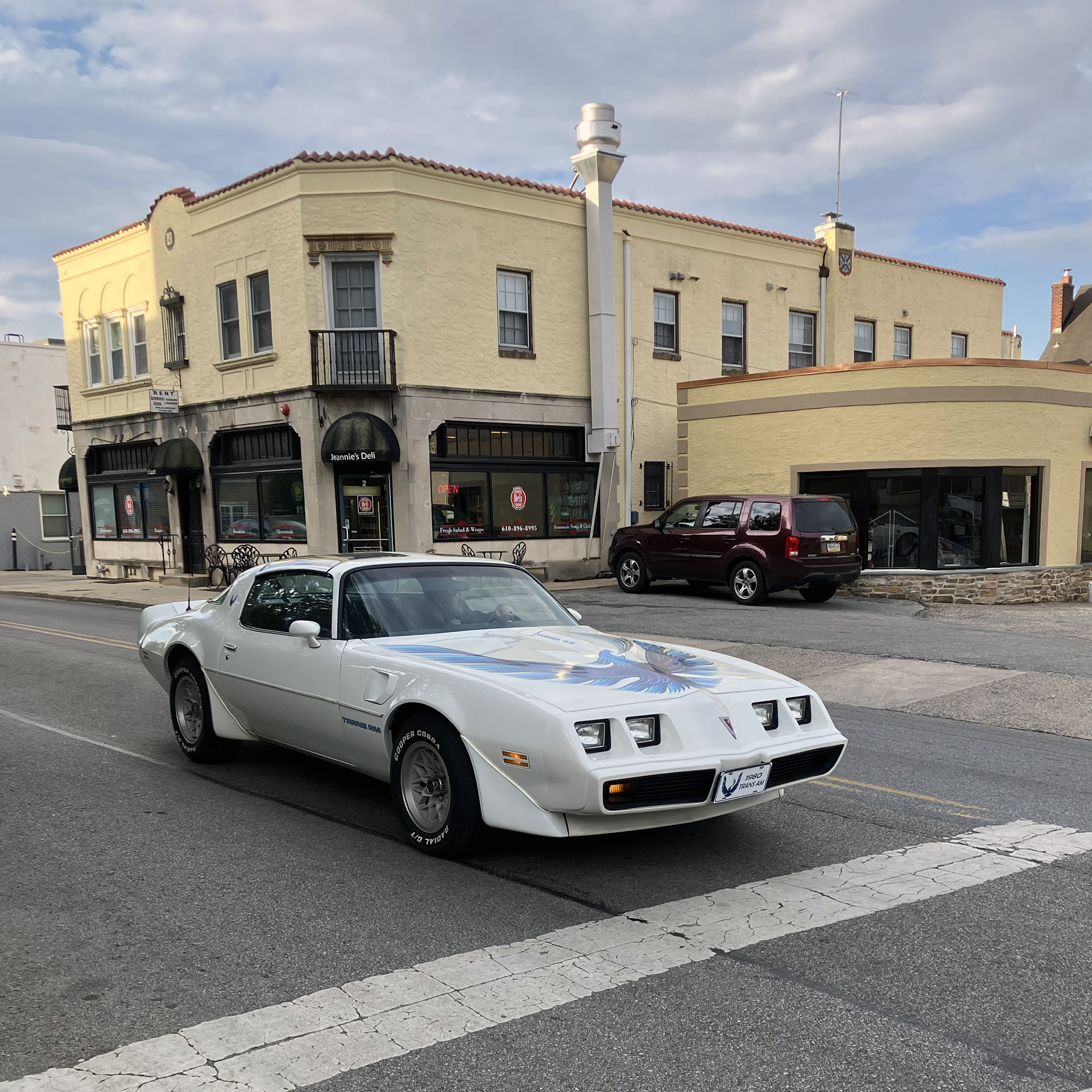
For 1984, Pontiac announced a special edition Trans Am to commemorate the Firebird sub-model’s 15th year.

1984 Goodyear Eagle VR print advertisement

The 15th Anniversary Edition was $14,188—$10,689 for a base Trans Am plus $3,499 for the package (about $44,600 in today’s dollars). It featured white paint with blue graphics that hearkened back to the original 1969 Trans Am. Other exterior components included the Aero Package and T-tops—both optional on “normal” Trans Ams. Mechanical features included the L69 H.O. 190 bhp 5.0 liter/305 ci V8 with a four-barrel carburetor, a special handling package, four-wheel power disc brakes, and P245/50R16 Goodyear Eagle VR tires (a size still readily available) on 16 x 8 inch white hi-tech turbo aluminum wheels.

As had been true in many previous Trans Am special editions, the 15th Anniversary Edition Trans Am featured Recaro front bucket seats—these had leather bolsters with cloth inserts. Other interior features specific to the special edition included a leather-wrapped formula steering wheel and leather shift knob. Standard equipment on all 1984 Trans Ams included sport mirrors, a rear deck spoiler, concealed tungsten halogen headlamps, rally gauges, a console, and power steering.

Only the top-of-the-line engine for 1984 was available with the 15th Anniversary Edition, but there was a choice of transmissions. A five-speed manual came standard, with an automatic being a $295 option. 0-60 times from various car magazines came in at around seven seconds—two to three seconds better than it had been just three years prior in 1982. Fuel economy ratings were 16 city/27 highway by 1984 standards (13/20 by today’s measures). With a smallish 13.3-gallon gas tank, a Trans Am owner could expect a range of 200 to 255 miles with a 10% fuel reserve.

Options, Period Reviews, & Production Numbers

Trans Ams (even special editions ones) did not come loaded in 1984—by the time the 20th Anniversary Edition came around in 1989, that would no longer be so. Exterior and mechanical options included Soft-Ray tinted glass ($110), an electric rear window defogger ($140), and a limited slip differential ($95).

Interior options included air conditioning ($730), power windows ($215), a power antenna ($60), and a Delco AM/FM stereo cassette with a five-band graphic equalizer ($590). Upholstery and trim options included six-way power seats ($215 each), a tilt steering wheel ($110), luggage compartment trim ($110), and cloth floor mats ($20 front/$15 rear). It wasn’t uncommon to see a 15th Anniversary Edition Trans Am with over $3,000 in additional options.

Reviews of the 15th Anniversary Edition were positive. Motor Trend stated that the updated Trans Am’s “5-speed’s shift linkage is merely the best we’ve seen from Detroit in years.”

Pontiac built a symbolic 1,500 15th Anniversary Editions—500 with the five-speed manual and 1,000 with the automatic. Those 1,500 were a small part of the 55,374 total Trans Ams made in the 1984 model year, with those sales less than half of 128,304 Firebirds sold (Pontiac sold a lot of base Firebirds). Both the Trans Am numbers and the overall Firebird sales marked an eighties peak for Pontiac, with only 1980 and 1982 coming close.

The View From 2025

15th Anniversary Edition Trans Ams do attract some collector interest. According to Hagerty’s valuation tools, all the money for a 15th Anniversary Edition Trans Am with the five-speed in #1/Concours condition is $38,000, with a far more normal #3/Good condition version with an automatic going for $12,900. These Trans Ams are often available in the Hemmings Motor News classifieds, on eBay Motors, and on Bring A Trailer, and they sometimes show up at auction.

Make mine White, please—it’s not like I have a choice.

I evidently can’t help myself with eighties Trans Ams; I’ve also written about the 1981, the 1982, the 1985, and the 1989 Turbo. I have written about the 1986 SE, but I probably should write about the Formula at some point—perhaps even the base car.

Last updated March 2025.

1981 Pontiac Firebird Trans Am coupe

“Soul Survivor”

1981 was the last year for the second-generation Firebird and, thus, also the final year for the second-generation Trans Am. With the third-generation cars on the way, Pontiac’s eleven-year-old F-car received only minor changes. The “screaming chicken” decal on the hood was now two colors, compared to the four-color decal from 1979 and 1980. Not much could be done about the general lack of space efficiency (the EPA rated the Firebird as a subcompact car), the high curb weight (about 3,700 pounds when the Mustang weighed about 2,800), and the relatively primitive technology.

Engines & Transmissions

The standard Trans Am powertrain was the Pontiac-built L37 150 bhp 4.9 liter/301 ci V8 with a four-barrel carburetor paired with a three-speed automatic. The only choice for Trans Am purchasers who wanted a manual transmission was the Chevrolet-built LG4 145 bhp 5.0 liter/305 ci V8 with a four-barrel carburetor, but you did get a $147 credit.

The top engine was the $437 Pontiac-built LU8 200 bhp 4.9 liter/301 ci V8 with a four-barrel carburetor and an AiResearch turbocharger, which also added a hood-mounted boost gauge. The turbo engine was emissions-certified only with the combination of air conditioning, an automatic transmission, and a 3.08:1 ratio rear axle. For a period of time during the 1981 model year, Pontiac also required rear disc brakes and a limited-slip differential to get that turbo power.

Combining a turbocharger, carburetors, and primitive electronic engine controls was not easy, and reviews of one of the world’s first turbo V8’s were mixed. The relatively primitive gas of the day meant that Pontiac had to retard spark substantially to minimize detonation, which kept the power returns of the turbocharger relatively low. As Car and Driver stated, “by the time the engine reaches 4000 rpm, the show is essential­ly over.”

Performance & Standard Equipment

A Turbo Trans Am would accelerate from 0-60 in a little over eight seconds (Car and Driver clocked 8.2), which was good for 1981. Fuel mileage was predictably bad—15 city/21 highway mpg by the day’s standards for the combination of the turbo engine and the automatic. With a 21-gallon fuel tank, Trans Am owners could expect to travel about 280 to 305 miles before refueling.

Standard exterior and mechanical equipment included in the $8,322 base price of the Trans Am (about $31,700 in today’s dollars) included a black accent grille and headlamp bezels, dual rectangular headlamps, front and rear wheel opening air deflectors, chrome side-splitter tailpipe extensions, a shaker hood, power front disc/rear drum brakes, power steering, and P225/70R15 blackwall tires (a size still readily available) on 15-inch Rally II wheels. Inside front bucket seats, a floor console, a bright engine-turned dash plate, and rally gauges with a tachometer were standard.

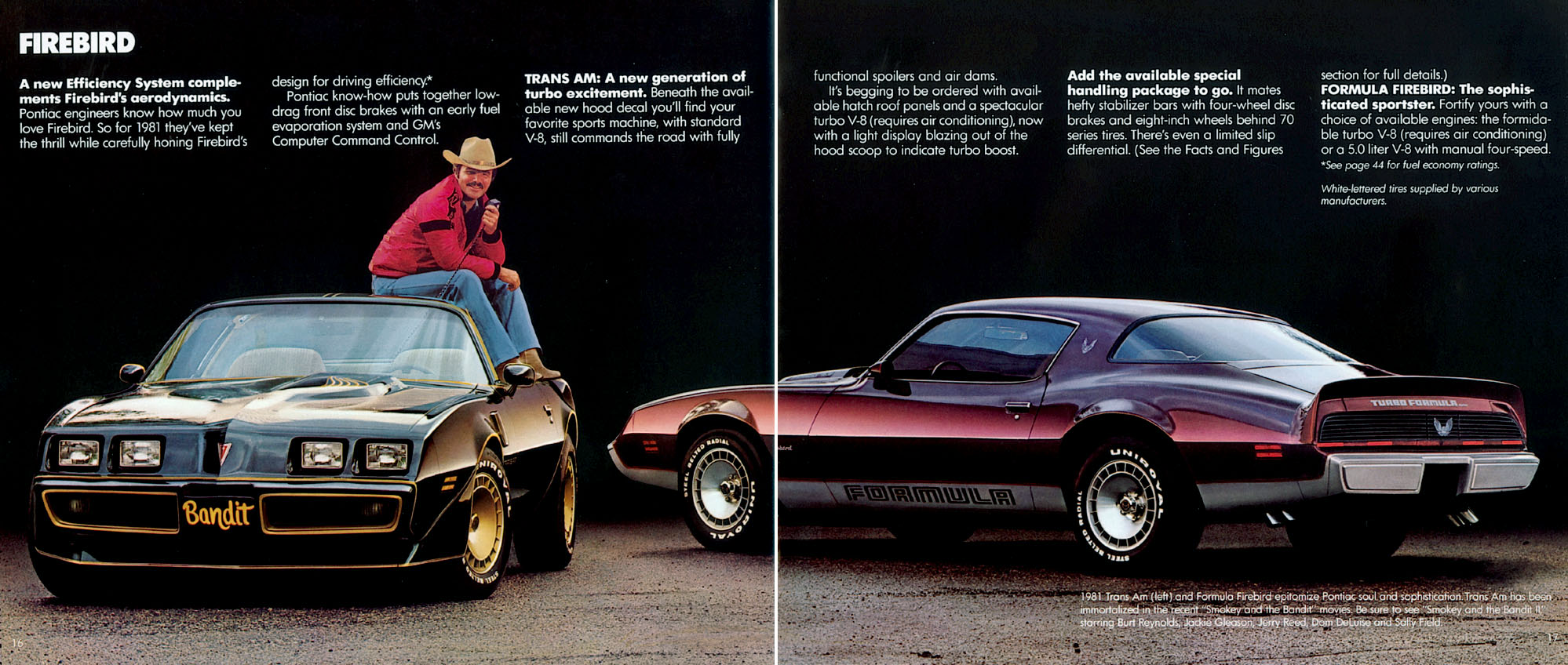
Firebird pages from the 1981 Pontiac brochure

Packages & Options

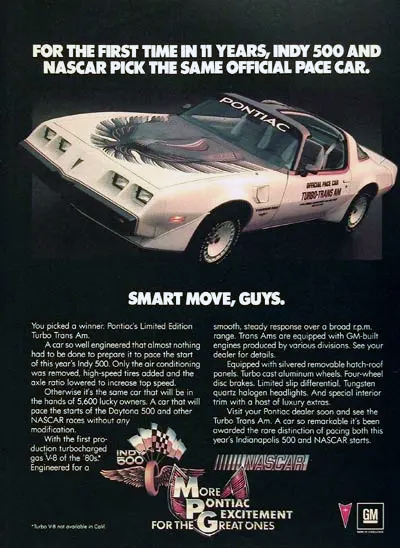
The Trans Am Special Edition package was $735 additional over a base Trans Am—$1,430 bundled with the removable locking hatch roof (otherwise known as T-tops). There was also a special edition of the Special Edition—the NASCAR Daytona 500 Pace Car, resplendent in oyster white with a black and red interior. It included the LU8 turbocharged engine, the WS6 special performance package, four-wheel power disc brakes, and a limited-slip differential. Inside, the most notable upgrade from other Turbo Trans Ams was Recaro front seats—among the best available production seats from any manufacturer in 1981. All this extra content was a good thing because the NASCAR Daytona 500 Pace Car listed for $12,257—about $46,700 in 2025 dollars.

Exterior and mechanical options available for the Trans Am included the WS6 special performance package, a limited-slip differential, tungsten quartz halogen headlamps ($29), white-lettered tires, cast aluminum wheels, four-wheel power disc brakes, and an automatic power antenna ($50). Inside, an electric rear window defroster ($115), power door locks ($99), Custom air conditioning ($600), Custom bucket seats, and a host of radios (seven!) were all available.

The View From 2025

1000 views badge

Initially neglected by the collector market and with many now used up, late second-generation Trans Ams in good or excellent shape are now getting interesting numbers—almost doubling in the past ten years. According to Hagerty’s valuation tools, all the money for a 1981 Trans Am NASCAR Daytona 500 Pace Car in #1/Concours condition is $69,300, with a more normal non-Turbo Trans Am in #3/Good condition version valued at $14,800. These Trans Ams are often available in the Hemmings Motor News classifieds, on eBay Motors, and on Bring A Trailer, and they frequently show up at in-person auctions.

Make mine the black and gold Special Edition, of course. The NASCAR Daytona 500 Pace Car is tempting, if only for those Recaro seats.

I evidently can’t help myself with eighties Trans Ams; I’ve also written about the 1982 hatchback coupe, the 1984 15th Anniversary hatchback coupe, the 1985 hatchback coupe, and the 1989 Turbo hatchback coupe. I have written about the 1986 SE hatchback coupe and the 1987 Formula hatchback coupe, but I probably should write about the base car at some point.

Last updated September 2025.

1989 Pontiac 20th Anniversary Turbo Firebird Trans Am hatchback coupe

Originally posted on the fourth of July in 2014, here’s some eighties American iron.

“The Only Modification It Needed To Pace The Indy 500 Was A Decal.”

For 1989, there was big news in the Pontiac camp was the release of the 20th Anniversary Turbo Firebird Trans Am, which was essentially a Trans AM GTA coupe with an exclusive engine option and some specific trim elements.

Rated at 250 bhp but actually making about 300 bhp, the LC2 3.8 liter/231 ci sequential fuel-injected, turbocharged, and intercooled V6 was teamed with the 200-4R four-speed automatic transmission. Mileage was 16 city/24 highway by the day’s standards (15/22 by today’s standards), and nobody cared. What they did care about was the acceleration—Car and Driver managed to achieve a 4.6 second 0-60 time (Pontiac had claimed 5.5 seconds) and a top speed of 153 mph. At least in power, the third generation Trans Am had come a long way from 1982

1989 Pontiac Firebird brochure cover, courtesy of Flickr user Alden Jewell.
1989 Pontiac Firebird brochure cover, courtesy of Flickr user Alden Jewell

For $31,198 (about $82,800 in 2025 dollars), 20th Anniversary Turbo Firebird Trans Am buyers got all the Trans Am GTA exterior and mechanical equipment, which included fog lamps, a power antenna, four-wheel disc brakes, special performance package, a limited slip differential, and 245/50-VR16 black sidewall tires (a size still readily available) mounted on gold 16 x 8 diamond-spoke aluminum wheels. Turbo Trans Am-specific additions included larger brake rotors and softer front springs. In addition, there were Turbo Trans Am emblems on the fenders and 20th emblems on the nose and rear pillars.

Inside, standard GTA equipment included air conditioning, power door locks, power windows, power mirrors, tilt steering, cruise control, a rear window defroster, a power deck lid release, and an AM/FM stereo cassette with equalizer and steering wheel controls. Turbo Trans Am owners also got a turbo-boost gauge inside the tachometer face.

Options & Production Numbers

Pontiac built a total of 1,550 Turbo Trans Ams for sale (there were another 5 test cars), with 85% of them being t-tops with leather bucket seats (buyers could order cloth bucket seats and/or the hardtop, but few did). Period window stickers show the t-top roof and the custom leather interior combined in a value option package.

The View From 2025

Unlike many other eighties cars, 1989 Turbo Trans Ams hold their value just fine. According to Hagerty’s valuation tools, all the money for a 1989 20th Anniversary Turbo Trans Am in #1/Concours condition is $66,400, though some have sold for more. A more “normal” #3/Good condition example is valued at $29,900. Turbo Trans Ams often come up for sale in the Hemmings Motor News classifieds and on eBay Motors, but many are now sold at auction, whether online (Bring a Trailer) or in-person.

Make mine White, please. As with many other General Motors special editions, there’s no color option.

I evidently can’t help myself with eighties Trans Ams; I’ve written about the 1981, the 1982, the 1984 15th Anniversary, and the 1985. I have also written about the 1986 SE, but I probably should write about the Formula at some point—perhaps even the base car.

Last updated March 2025.

1982 Pontiac Firebird Trans Am hatchback coupe

“From saber-like nose to rakish tail, the Trans Am is a brilliant orchestration of aerodynamic function.”

It is hard now to remember how new and wildly aerodynamic the 1982 Pontiac Firebird Trans Am looked when it debuted—Car and Driver wrote that its “exterior sculpturing is an absolute knockout.” The Trans Am suddenly made every other American car (and more than a few European ones) look like they were standing still.

The Trans Am didn’t just look aerodynamic, either: the drag coefficient of .323 is still respectable even in 2025. Pontiac’s choice of pop-up headlights (over the Camaro’s open headlights) and careful airflow tuning yielded an impressive result. According to Autopolis’ excellent article on the 1980-1981 Turbo Trans Am, the third-generation Trans Am’s distinctive hood bulge was intended for a turbocharged V8.

Unfortunately, the mechanicals did not come close to backing up the looks. The top-of-the-line engine for the Trans Am was the LU5 Cross-Fire 165 bhp 5.0 liter/305 ci V8 with throttle-body fuel injection—and that was only available with a three-speed automatic transmission, yielding about a nine-second zero to sixty time (Motor Trend managed to do it in 8.89 seconds). If you wanted the four-speed manual transmission, the best engine choice available on the Trans Am was the base LG4 145 bhp 5.0 liter/305 ci V8 with a four-barrel carburetor—and approximately ten seconds from 0 to 60 mph.

These performance challenges, however, did not prevent Pontiac from implying the world in its commercials for the Trans Am—and having Richard Basehart do the narration.

Standard exterior and mechanical equipment on the $9,658 Trans Am (about $33,500 in today’s dollars) included power brakes (front disc/rear drum), hidden electronically-controlled halogen headlamps, dual sport mirrors, an all-glass rear hatch, a rear decklid spoiler, and 205/70R14 steel-belted radial tires (still a readily available size) on 14-inch turbo cast-aluminum wheels. Inside, reclining front bucket seats, a folding rear seat, a Formula steering wheel, and side window defoggers were included.

Options & Production Numbers

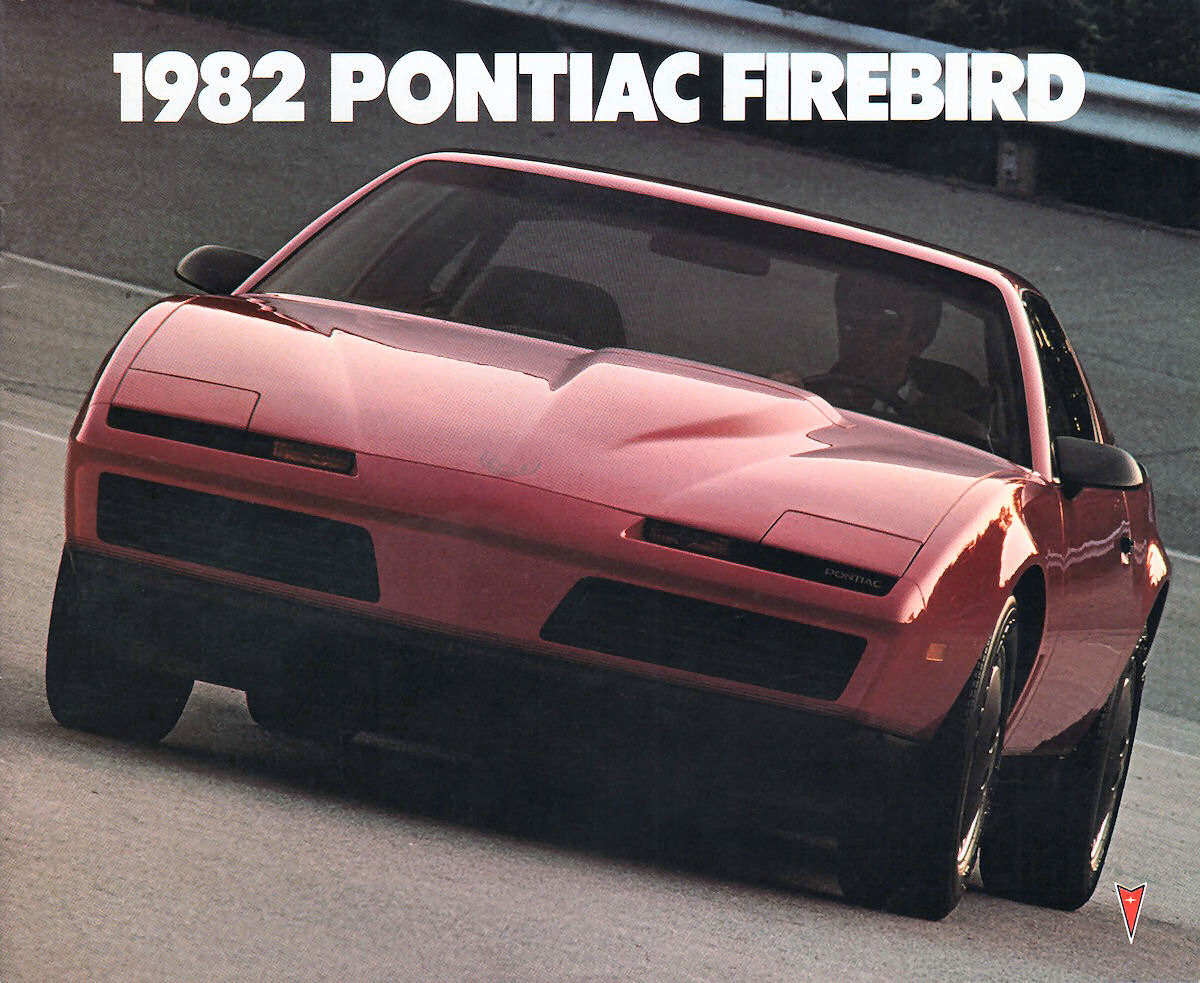
Cover of the 1982 Pontiac Firebird brochure

Options included a special performance package ($387 bought you the special handling package, four-wheel disc brakes, and 215/65R15 blackwall tires on 15 x 7 aluminum wheels), tinted glass, a rear hatch washer/wiper, power windows ($165), power door locks ($106), a tilt steering wheel ($95), and air conditioning ($675).

Pontiac sold 52,962 Trans Ams in the 1982 model year, with 2,000 of those having the Recaro package.

The View From 2025

Third-generation Firebirds have a strong following, and 1982 Trans Ams appear regularly in the Hemming’s Motor News classifieds, on eBay Motors, and on Bring a Trailer. According to Hagerty’s valuation tools, a 1982 Trans Am with the Cross-Fire engine, the Recaro package, and T-tops in #1/Concours condition is $34,600, with a more normal #3/Good base Trans Am going for $9,800.

Please make mine Black, but I think I’d hold out for the 1983 version and its five-speed manual transmission/190 bhp L69 HO engine combination.

I evidently can’t help myself with eighties Trans Ams; I’ve written about the 1981, the 1984, the 1985, and the 1989 Turbo. I have also written about the 1986 SE and the 1987 Formula, but I probably should write about the base car at some point.
Last updated November 2025.