1985 Ferrari 308 GTB Quattrovalvole coupe

“Only those who dare … truly live”

1985 was the final year for the Ferrari 308 (the 328 would follow in 1986). Ferrari’s least expensive two-seater was also overshadowed in the public view by the release of its big brother Testarossa.

The engine was Ferrari’s Tipo F105AB 2.9 liter/179 ci V8 with Bosch K-Jetronic fuel injection and four valves per cylinder (thus Quattrovalvole), making 230 bhp and mated to a five-speed manual transmission. In the 3,200 pound GTB, this was good for period 0-60 times of under 7 seconds. Mileage was pretty awful compared to some of the 308’s fuel-injected competition—10 city/16 highway by the day’s standards (9/15 by today’s standards). With an 18.5-gallon gas tank, 308 owners could expect a chastening 200 to 215 mile range with a 10% fuel reserve.

Ferrari 308 GTB Quattrovalvole, courtesy of Ferrari

Standard exterior and mechanical equipment on the $54,000 GTB (about $134,000 in 2020 dollars) included four-wheel disc brakes, rack and pinion steering, and 16-inch alloy wheels. Inside, leather bucket seats, power windows, tinted glass, and a heated rear window were all included. Available options included metallic paint, a deep front spoiler, a satin black finished aerofoil at the rear of the roof, 16 x 8 inch Speedline wheels with Pirelli P7 tires, air conditioning, and cloth seat centers.

The lovely Pininfarina styling that first appeared in 1975 had aged well with relatively few changes. Debuting for the 1983 model year, the Quattrovalvole could be differentiated from previous 308s by the addition of a slim black louvered panel on the hood to aid radiator exhaust air exit and a redesigned radiator grille with rectangular driving lights on each side. Also new were power-operated side mirrors carrying small enamel Ferrari badges and rectangular side repeaters. The interior also received some minor updates, such as a satin black three-spoke steering wheel with a triangular center.

The View From 2025

Values for the 308 have gone up and down over the last decade. According to Hagerty’s valuation tools, all the money for a 1985 Ferrari 308 GTB Quattrovalvole in #1/Concours condition is currently an astounding $234,000, with the targa-top GTS in the same condition getting $174,000 (the GTB is far rarer, at about 20% of overall Quattrovalvole production). Prices drop significantly for more normal #3/Good condition cars—$128,000 for a GTB and $108,000 for a GTS. Ferrari 308s frequently appear for sale in the Hemmings Motor News classifieds, on Bring a Trailer, and at in-person auctions.

Make mine Rosso Corso, of course. Is there really a question?

Other Ferraris I have written about in this blog include the 1983 Berlinetta Boxer 512i coupe and the aforementioned 1985 Testarossa coupe.

Last updated March 2025.

1983 Ferrari 512 BBi coupe

I used to live about a mile from a Ferrari dealership. As I walked near it back in 2014, I saw a trailer parked around the corner with a low-slung sports car inside. Getting a little closer showed that it was definitely a 512. “Now that’s a Ferrari!”, I said. The man unloading the car chuckled as I walked away.

For 1983, Ferrari’s lovely Pinanfarina-designed 512 BBi received few, if any, changes. The BBi’s engine was Ferrari’s Tipo F110 A 340 bhp 4.9 liter/302 ci flat 12 with Bosch K-Jetronic fuel injection—the 512 had moved to fuel injection (and added the i) for the 1982 model year. When paired with the five-speed manual transmission, 0-60 came in about 5.5 seconds with a top speed of 170 mph or so—fast, fast, fast for 1983.

Photo of a 1983 Ferrari 512 BBi
Photo of a 1983 Ferrari 512 BBi, courtesy of Wikipedia photographer dave_7

Ferraris had gotten more luxurious: standard equipment on the 512 BBi included air conditioning (often said to be inadequate), leather seats, power mirrors, power windows, power door locks driven from the key, a Nardi steering wheel, and a Pioneer AM/FM stereo cassette deck with 7-band graphic equalizer.

Although the 512 BBi was not legal in the U.S., some importers converted them to U.S. specifications by adding catalytic converters, side reflectors, and larger bumpers.

Of course, there’s a fairly famous eighties music video associated with this car.

Sammy Hagar may have his issues, but the 512 BBi he drives in the video made for this song demonstrates exquisite taste. When interviewed by Motor Trend in 2008, he still owned it.

The View From 2025

There’s some really excellent support for 512s (and all Ferraris) from the folks on FerrariChat (who contributed to the original version of this post). According to Hagerty’s valuation tools, all the money for a 1983 512 BBi in #1/Concours condition is $345,000 (though recent auction results may make that seem low). A more “normal” #3/Good condition example is valued at $224,000. Ferrari 512s frequently appear for sale in the Hemmings Motor News classifieds, on Bring a Trailer, and at in-person auctions.

Make mine Rosso Corsa (red), please, though I’m quite tempted by how they look in Grigio (grey).

Other Ferraris I have written about include the 1985 308 GTB Quattrovalvole coupe and the 1985 Testarossa coupe.

Last updated February 2025.

1985 Ferrari Testarossa coupe

When it debuted for the 1985 model, the Ferrari Testarossa had big shoes to fill—it replaced the undeniably beautiful Berlinetta Boxer, which itself had replaced the undeniably beautiful Daytona.

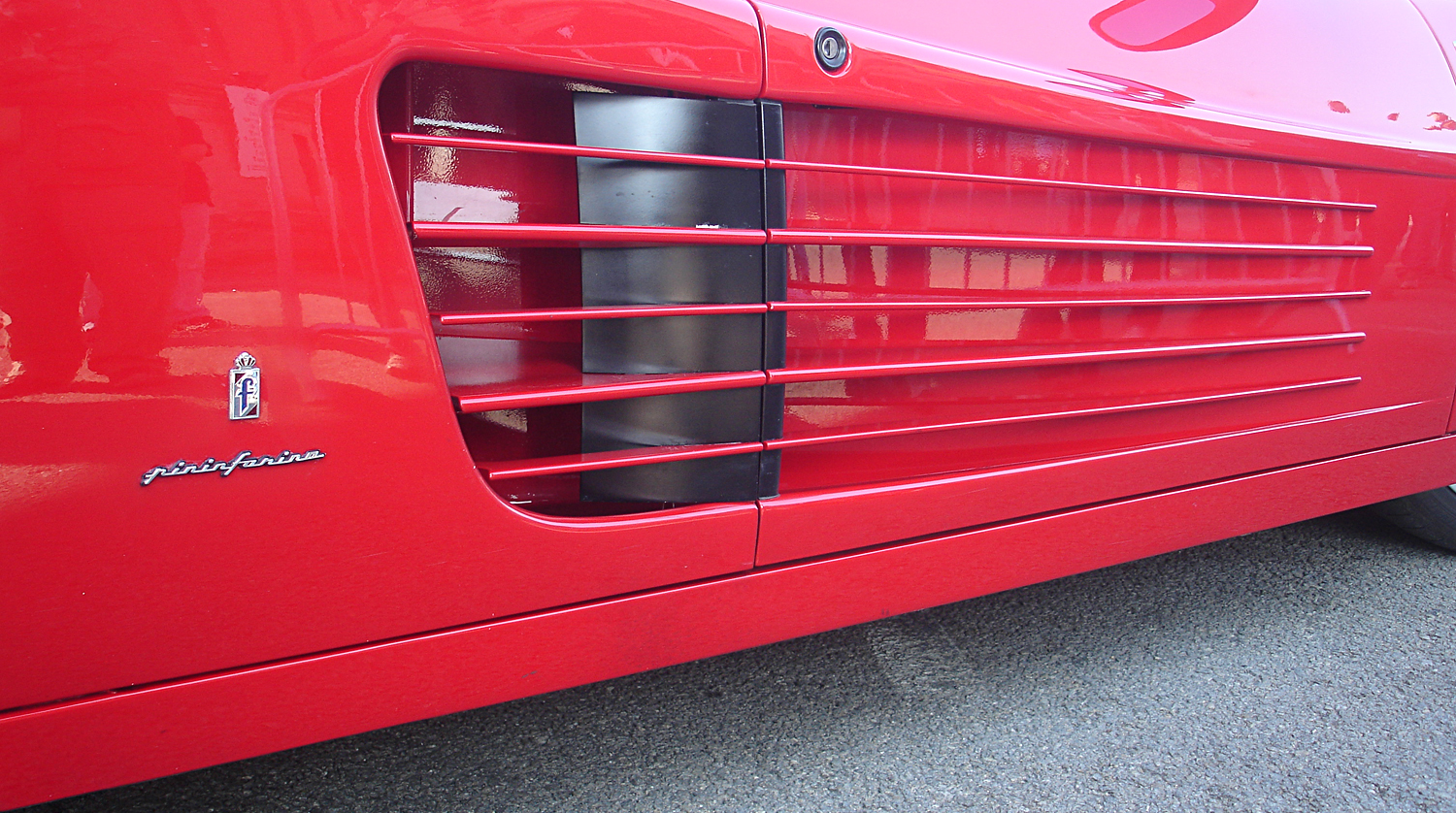
testarossaintake
Close up of the “cheese grater” side strakes on the Ferrari Testarossa.

Sergio Pininfarina’s styling for the Testarossa was not undeniably beautiful, but it definitely was striking. The defining feature was the side strakes covering the radiator intakes, often referred to as “cheese graters.”

The strakes were at least functional, feeding the two side radiators that cooled the Bosch K-Jetronic port fuel-injected 4.9 liter/302 ci 380 bhp flat 12 cylinder engine—crazy power for the mid-1980s. Mileage (not that the target market cared) was flat-out awful10 city/15 highway by the day’s standards (9/14 by today’s standards). At least the 30.4-gallon gas tank meant you could go around 315 to 340 miles before looking for more fuel.

The Testarossa was a Ferrari that reflected the times—it was big (almost six inches wider and 200 pounds heavier than the Berlinetta Boxer it replaced) and flashy. It was also pricey; at $90,000 and up (over $272,000 in 2025 dollars), four times as expensive as a 1985 Corvette (not that too many buyers were cross-shopping the two). You did get at least a little comfort for your money—air conditioning, power seats, and power windows were all standard.

There continues to be disagreement over how good a car—or, more importantly, how good a Ferrari—the Testarossa was. It was undoubtedly fast: 0-60 came in 5.2 seconds, and top speed was about 180 mph.

The View From 2025

There is strong club support for the Testarossa, as there is for all Ferraris. According to Hagerty’s valuation tools, all the money for a 1985 Testarossa in #1/Concours condition is $253,000, with a more “normal” (if any Ferrari can be normal) #3/Good condition car going for $106,000. You see them advertised in the Hemming’s Motor News classifieds, though often it’s a notice of an auction. Bring a Trailer also auctions a reasonable amount of Testarossas.

Make mine that same Rosso Corsa, with the tan interior. My ex-wife prefers the “Miami Vice” white, but I think Testarossas (along with many Ferraris) left our list forever when she found out that you or your very expensive mechanic have to remove the engine from the car to do a “major service” every five years or 30,000 miles.

Other eighties Ferraris I have written about include the 1983 Berlinetta Boxer 512i coupe and the 1985 308 GTB Quattrovalvole coupe.

Updated in March 2025.