
1980 Datsun 200-SX coupe

A 1980 Datsun 200-SX coupe sold for $10,000 at the 2025 Barrett-Jackson Scottsdale auction.

“Thrill-injected”

Datsun’s 200-SX was almost entirely new for 1980, with exterior styling notably changed and a significantly enhanced engine. Nissan advertised improved visibility and increased door opening for 1980, but the real upgrade was that the 200-SX was no longer as weird-looking as the 1975-1979 had been. Nissan was in the process of transitioning away from the Datsun name, so the 200-SX’s official name was a clunky “Datsun 200-SX by Nissan.” No matter what, marketing used 200-SX instead of 200SX in 1980, so I’ll follow that in this post.

The only engine available for the 1980 200-SX was the NAPS-Z Z20E 100 bhp 2.0 liter/120 ci inline four with L-Jetronic electronic fuel injection paired with either a five-speed manual or a three-speed automatic. Car and Driver recorded a 0-60 time of 13.3 seconds in the 2,620-pound coupe. EPA fuel economy ratings with the five-speed were 28 city/40 highway—with a 14.0-gallon gas tank, a 200-SX coupe’s owner could expect a range of 430 miles with a 10% fuel reserve.

200-SX pages from the 1980 Datsun brochure

Standard exterior and mechanical equipment on the $6,689 1980 200-SX Deluxe (about $28,300 in 2025 dollars or just a little more than a 2025 Nissan Altima S costs) included four-wheel power-assisted disc brakes, partially recessed windshield wipers, and 185/70SR14 tires (a size still readily available) on 14-inch wheels with full mag style wheel covers. Inside, a quartz sweephand clock, deep pile carpeting, and full reclining front bucket seats with soft vinyl upholstery were included.

Options & Production Numbers

The Sport Luxury (SL) package upgraded 200-SX buyers to soft cloth upholstery, a multi-warning system, a driver’s seat with adjustable lumbar and thigh support, and a four speaker AM/FM stereo radio with power antenna.

The 1980 200-SX had few individual options, and most of them—except for California emissions—seem to have been available only if you had already ponied up for the SL package. These options included power steering, a lift-out skyroof, two-tone paint, and air conditioning.

The buff books liked the 200-SX for its intended purpose—Car and Driver wrote that the new version had “better looks and better manners.” They gently asked for more power, but that would be a long time coming and only in slight increases for the coupe. The 200-SX got 103 bhp in 1982, and the third-generation coupe got 105 bhp in mid-1984 (only the hatchback would get the 133 bhp turbo option).

Nissan sold 92,514 200-SX coupes and hatchbacks in 1980—a notable success, and soundly beating many competitors. This version of the 200-SX would run for four years.

The View From 2025

There is limited collector interest in these second-generation 200-SXs, so it isn’t that surprising that Hagerty’s valuation tools do not track any eighties Datsuns or Nissans other than the Z-cars and Skylines. Eighties 200-SXs rarely appear in the Hemming’s Motor News classifieds, eBay Motors, or Bring a Trailer.

Make mine Satin Blue Metallic, please.

Other Datsuns I have written about include the 1980 280ZX hatchback coupe and the 1981 810 Maxima sedan. Later Nissans I have posted on include the 1984 300ZX hatchback coupe and the 1989 Maxima sedan.
1981 Datsun 810 Maxima sedan

“For the luxury minded who long to be Datsun driven.”

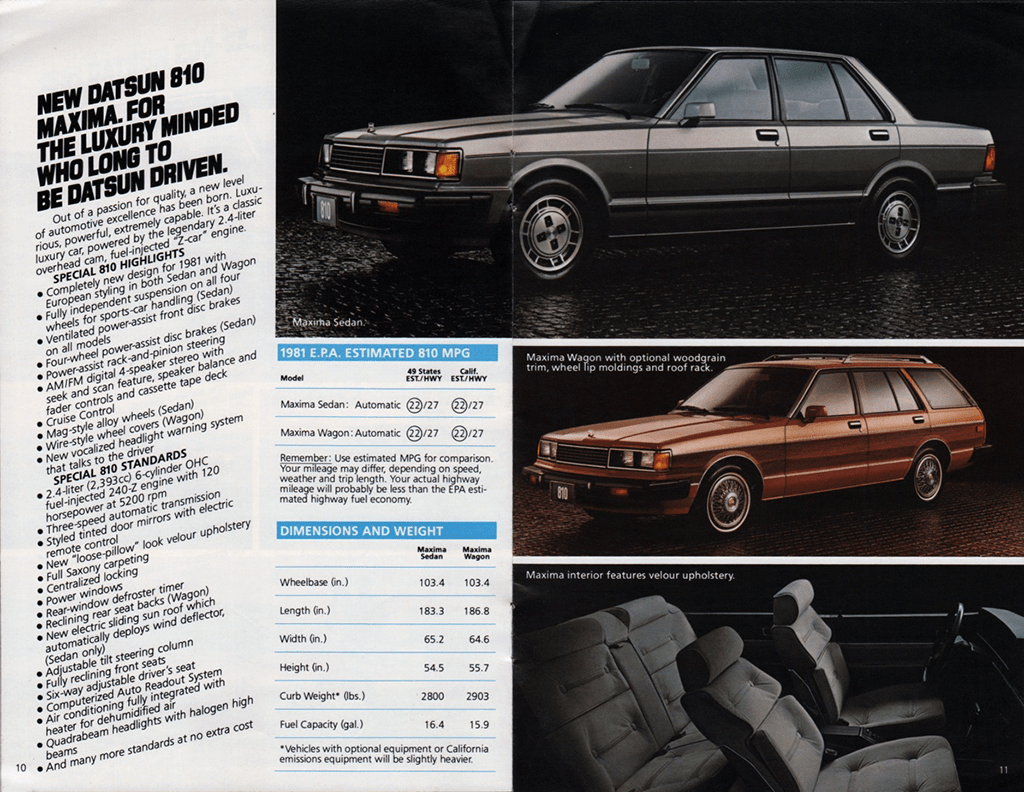
1981 brought the nicest Datsun yet for America, in the form of the 810 Maxima sedan. Datsun aimed high, advertising the Maxima as having the “luxury of a Mercedes” and the “sophistication of a Cadillac.” Nissan was in the process of transitioning away from the Datsun name, so the Maxima‘s official name was a clunky “Datsun 810 Maxima by Nissan.”

The only powertrain initially available for the Maxima was the L24E 118 bhp 2.4 liter/146 ci inline six with Bosch L-Jetronic fuel injection paired with a three-speed automatic. Luxury did not mean quick in 1981—Car and Driver recorded a 0-60 time of 10.5 seconds in a car with a 2,880-pound curb weight. EPA fuel economy ratings were 22 city/27 highway—with a 16.4-gallon gas tank, a Maxima owner could expect a range of 295 to 325 miles with a 10% fuel reserve. In the middle of the model year, the LD28 90 bhp 2.8 liter/170 ci diesel engine became available, with an impressive 28 city/35 highway rating,

Despite being the top of Datsun’s sedan line and “the roomiest and most comfortable Datsun ever created” to that point, the Maxima was not a particularly large car. With a 183.3 inch length, it was less than half an inch longer than today’s Nissan Sentra, which is classified as a compact car. In advertisements, Datsun stated that the Maxima was “about the size of a BMW 528i at less than half the price.” Both of these claims were true, but the Maxima was not yet a “4-Door Sports Car.”

810 Maxima pages from the 1981 Datsun brochure

Standard exterior equipment on the $10,879 1981 Maxima (about $41,400 in 2025 dollars or almost 25% more than a 2025 Nissan Altima SL sedan costs) included an electric sliding sun roof and Quadrabeam headlights with halogen high beams. Mechanical equipment included a fully independent suspension, power-assisted rack-and-pinion steering, four-wheel power-assisted disc brakes, and 185/70SR14 tires (a size still readily available) on 14-inch “mag-style” alloy wheels. Inside, centralized locking, power controls, a tilt steering column, cruise control, and an AM/FM digital four-speaker stereo with a cassette player were included. Standard upholstery included “loose-pillow” velour seats, fully reclining front seats, a six-way adjustable driver’s seat, and full Saxony carpeting. Famously, an early version of the vocalized warning system warned a Maxima‘s driver when the headlights were on.

There were few, if any, options available for the 1981 Maxima sedan. Reviews of the day generally liked the new car’s exterior styling, but the “buff books” complained that the Maxima was only available with a three-speed automatic and velour upholstery. Car and Driver‘s write-up in April 1981 stated: “What we have here seems to be a clear case of over-Americanization.”

The View From 2025

It isn’t that surprising that Hagerty’s valuation tools do not track any eighties Datsuns other than the Z-cars. Eighties Maximas rarely show up in the Hemming’s Motor News classifieds or on eBay Motors. Bring a Trailer has sold a grand total of one 1981 Maxima—which was a diesel.

Make mine Medium Gray Metallic, please.

I have also written about the much sportier 1989 Nissan Maxima sedan.

Last updated August 2025.

1980 Datsun 280-ZX hatchback coupe

Yutaka Katayama passed on February 19th, 2015, after a long and full life—he was 105. “Mr. K” was the person most responsible for bringing the Z car to market. It is beyond the purview of this blog to head back to the original and groundbreaking 240Z, but we can take a look at the second-generation 280-ZX.

“It’s Black. It’s Gold. And it is awesome.”

For 1980, the 280-ZX received a ‘T’ bar roof and a new digital clock for the GL version, but Datsun otherwise mostly stood pat for the standard car. There were five new colors available.

Power continued to be provided by the L28E 135 bhp 2.8 liter/168 ci V6 with multi-port fuel injection. Car and Driver recorded a 0-60 time of 9.4 seconds in the 2,970-pound coupe—reasonably competitive in 1980. The top speed was about 117 mph.

With the standard five-speed manual transmission, EPA fuel economy ratings were 21 city/31 highway by 1980 standards. Moving to the three-speed automatic transmission significantly impacted mileage—ratings on the sticker were 19/26. With a 21.2-gallon gas tank, an owner of a manual-equipped 280ZX could expect an impressive range of 405 to 445 miles with a 10% fuel reserve.

Standard exterior and mechanical equipment on the $9,899 280-ZX Deluxe (about $41,800 in 2025 dollars or about what a current Nissan Z Sport starts at) included tinted glass, a power antenna, a four-wheel independent suspension, four-wheel power disc brakes, rack-and-pinion steering, and P195/75HR14 tires (a size still readily available) on 14-inch steel disc wheels. Inside, a six-way driver’s seat with lumbar support, a quartz sweephand clock, and an AM/FM stereo radio with three speakers were standard.

Stepping up to the $12,238 Grand Luxury (GL) added a ‘T’ bar roof, a rear window wiper/washer, power recirculating ball steering, and aluminum alloy wheels. Inside, Datsun added cruise control, fully integrated air conditioning, a quartz digital clock, a lockable hidden storage compartment, a six-way adjustable seat with lumbar adjustment for the passenger, and an AM/FM stereo radio with four speakers and surround sound control.

Special Editions & Options

1980 Datsun 280-ZX advertisement
1980 Datsun 280-ZX 10th Anniversary Edition advertisement

For 1980, there was also a 10th Anniversary Edition (auto manufacturers were beginning to become aware that anniversary cars could really bring the buyers) available in two different two-tones: either Thunder Black and Rallye Red or Thunder Black and Golden Mist Metallic. The 10th Anniversary Edition went for $13,850—about $59,700 in today’s dollars, or almost exactly what a 2026 Nissan Z Heritage Edition goes for.

Standard exterior and mechanical equipment on the loaded 10th Anniversary Edition included everything on the GL, along with the aforementioned two-tone paint, special badging, headlamp washers, and Goodyear Wingfoot radial tires on alloy wheels with colored inserts. Inside, a limited edition numbered plaque, automatic heating and air conditioning, leather six-way bucket seats, a Hitachi AM/FM stereo radio with cassette, and power windows were included. Period window stickers show no options for the 10th Anniversary Edition.

Exterior and mechanical options for the “normal” 280-ZX included a blackout package (Deluxe), mag-style cast aluminum wheels (Deluxe), two-tone paint (GL), and rear window shade louvers (of course). Buyers could add fully integrated air conditioning (Deluxe), leather seating surfaces (GL), a CB one-hand mic system, and the usual cassette and 8-track stereo choices to the interior.

Production Numbers & Period Reviews

Overall production numbers for the 280-ZX were impressive—Nissan reported 53,687 sold for the 1980 model year. Interestingly, 1980 was the worst year of five for the 280-ZX—86,007 were sold in 1979. Of the 1980 sales, 3,000 were the 10th Anniversary Edition—2,500 black/gold and 500 black/red.

Contemporary reviews were glass-half-full. Car and Driver‘s tagline was “A Japanese Corvette,” and they talked about Datsun discreetly following Chevrolet in terms of price and features. The new ‘T’ bar roof was generally liked for both its availability and its execution—as Popular Mechanics stated, this was the “closest the car would come to being a convertible.”

The View From 2025

There is good club support for the 280-ZX, though not quite at the level available for the now-classic original 240Z. According to Hagerty’s valuation tools, all the money for a 1980 280-ZX coupe in #1/Concours condition is $84,400, with a more typical number #3/Good condition car going for $13,200. 280-ZXs often appear in the Hemming’s Motor News classifieds, on eBay Motors, and on Bring a Trailer.

Lord help me, I would like one in the black and gold two-tone …

Other Datsuns I have written about include the 1980 200-SX coupe and the 1981 810 Maxima sedan. Later Nissans I have posted on include the 1984 300ZX hatchback coupe and the 1989 Maxima sedan.

Last updated in September 2025.