1984 Chevrolet Corvette hatchback coupe

As a high school student in the early to mid-1980s, I worked part-time at Frankel Chevrolet (a dealership in Ardmore, Pennsylvania). I’ll never forget seeing my first C4 Corvette in early 1983: small block V8 engine with “Cross-Fire Injection” rumbling, lovely over-engineered retractable headlamps up and on, fancy new metallic paint with clear coat looking its best in the setting sun. Viewing this car was a visceral experience for a fifteen-year-old. It was the exact moment when my opinion of Corvettes changed from a grudging respect (I was more of a BMW and Pontiac fan then) to “I will have one of those someday.”

“You’ve never seen anything like this before.”

The phrase “all-new” is rarely accurate in cars, but the 1984 Corvette was close. Only the standard powertrain carried over from 1982, and even that was changed in some visible (a brand new magnesium air cleaner) and measurable (an additional five bhp) ways. The exterior, interior, suspension, and steering were truly all-new for the Corvette.

The standard powertrain was the L83 Cross-Fire 205 bhp 5.7 liter/350 ci V8 with throttle-body fuel injection paired with a Turbo-Hydramatic four-speed automatic transmission. The Doug Nash 4+3 manual transmission with automatic overdrive was available as a no-cost option, but only became available about halfway through the extended 1984 model year. Car and Driver recorded a 0-60 time of 6.7 seconds (Road & Track took 7.1 seconds) and a top speed of 138 mph. Estimated fuel economy was 16 city/28 highway by the day’s standards. With a 20-gallon gas tank, a Corvette coupe’s proud new owner could expect a range of between 325 and 355 miles with a 10% fuel reserve.

Cutaway page from the 1984 Chevrolet Corvette brochure
David Kimble’s cutaway page in the 1984 Chevrolet Corvette brochure

The 1984 Corvette’s base price was $22,361—about $74,200 in today’s dollars or a little over what a 2026 Corvette Stingray 1LT coupe goes for. Standard exterior and mechanical equipment included a one-piece removable fiberglass roof panel, a frameless rear glass hatch, single rectangular hidden headlamps, integral grille-mounted halogen fog lamps, rack-and-pinion power steering, power disc brakes, and P255/50VR-16 tires on 16 x 8.5 inch cast alloy aluminum wheels. Inside, air conditioning, power windows, a tilt and telescope steering wheel, a driver information system, cloth bucket seats, and an AM/FM stereo radio with a power antenna were all included.

Options & Production Numbers

The Z51 Performance Handling Package ($600) included a quicker steering gear, a performance axle ratio, an engine oil cooler, an additional radiator fan, higher-rated Delco-Bilstein shock absorbers, thicker stabilizer bars, and 9.5 inch rear wheels.

Optional exterior and mechanical equipment included two-tone paint ($428), a removable transparent roof panel ($595), a performance axle ratio ($22), and Delco-Bilstein shock absorbers ($189). Optional interior equipment included cruise control ($185), a power door lock system ($165), custom adjustable sports seats ($625), leather seats ($400), a six-way power driver’s seat ($225), and the Delco-GM/Bose Music System ($895).

Chevrolet rarely makes Corvette television commercials, but they usually produce one when introducing a new generation. For the 1984, they pulled out all the stops, at least by the standards of eighties automobile commercials—a spacesuit, lasers, and a cheesy jingle all make an appearance.

The new generation Corvette was very well-received by buyers. Chevrolet sold 51,547 in about eighteen months, making 1984 the second best sales year ever (only 1979 had a higher production total).

Period Reviews & Owner Feedback

Reviews of Chevrolet’s pride were positive but evenhanded. Car and Driver disliked the fact that the new generation was no lighter than the previous generation—a Corvette complaint that extends to today. Many writers also commented on the “Tokyo by Night” digital instrument panel.

Within a year or so, there would start to be an acknowledgment from the automotive press that the optional and heavily hyped Z51 performance handling package was suitable for only the most perfect roads. In their owner’s report, Popular Mechanics quoted a New York salesman as saying “bad ride on rough roads,” while a Texas retiree stated “body rattle is frustrating.” Chevrolet began to adjust beginning in the 1985 model year, but early C4 Corvettes continued to be seen as having an unnecessarily rough ride.

The View From 2025

There’s been a lot written about the 1984 Corvette—both good and bad—and I doubt I have much to add. Despite being pushed back several months from an actual 1983 model year release, it still felt rushed. On the other hand, many people think of the almost all-new fourth-generation Corvettes as the first “modern” version of Chevrolet’s sports car. However, modern is undoubtedly a fluid concept now—more than forty years later. Developed in the late 1970s and early 1980s, the C4s were the first Corvettes with rack-and-pinion steering and a removable one-piece “targa” roof.

There is strong club support for the 1984 Corvette, as there is for all Corvettes. According to Hagerty’s valuation tools, a 1984 Corvette with a clear top and the 4+3 manual in #1/Concours condition is $35,500, with a more typical number #3/Good condition car going for $8,400. 1984 Corvettes are regularly featured in the Hemmings Motor News classifieds, on eBay Motors, and on Bring a Trailer. Early C4s are also often seen at in-person auctions such as Barrett-Jackson and Mecum. As I update this blog entry in October 2025, a Gold Metallic car with saddle cloth adjustable sport bucket seats and 34,000 miles is available on Hemmings, asking $18,000.

Make mine Light Blue Metallic, please. That 1984 Corvette I mentioned seeing earlier was Light Blue Metallic, and I bought, drove extensively, and eventually sold a 1985 model in the same color.

Other Corvettes I have written about include the 1980 coupe, the 1981 coupe, the 1982 coupe, the 1986 convertible, and the 1988 35th Anniversary coupe.

Last updated October 2025.
My Eighties Car Departs

In the spring of 2021, I had a major medical issue that involved lower back surgery. Close followers of this blog might have noticed the paucity of posts between late January and late May.

When I returned home from not one but two hospitals, one of the first things that came to mind was what to do with my 1985 Chevrolet Corvette coupe. With its hard-riding Z51 sport suspension and challenging entry/exit, this car is not for someone who has had back surgery—and I don’t believe in keeping cars around that we don’t drive.

After thinking about it for a while, I decided to auction my Corvette on Bring a Trailer at no reserve—there was nothing that would want me to keep the car. I chose Bring a Trailer in part because I wanted to reach a wide audience: I figured that my 1985’s Light Blue Metallic color was a love it or hate it deal, and I wanted potential bidders to be able to self-sort.

I filled out the vehicle submission form, and the next step was to get the car photographed. Bring a Trailer‘s assigned professional came out in mid-July on what must have been the hottest day of the summer. He took many both accurate and complimentary photos of the car.

In late August, the auction began. Like most Bring a Trailer auctions, it ran for slightly over a week. I was eager not to misrepresent the car but equally interested in putting its best face forward. This desire meant that I spent a lot of time in the comments section.

The 1985 leaves

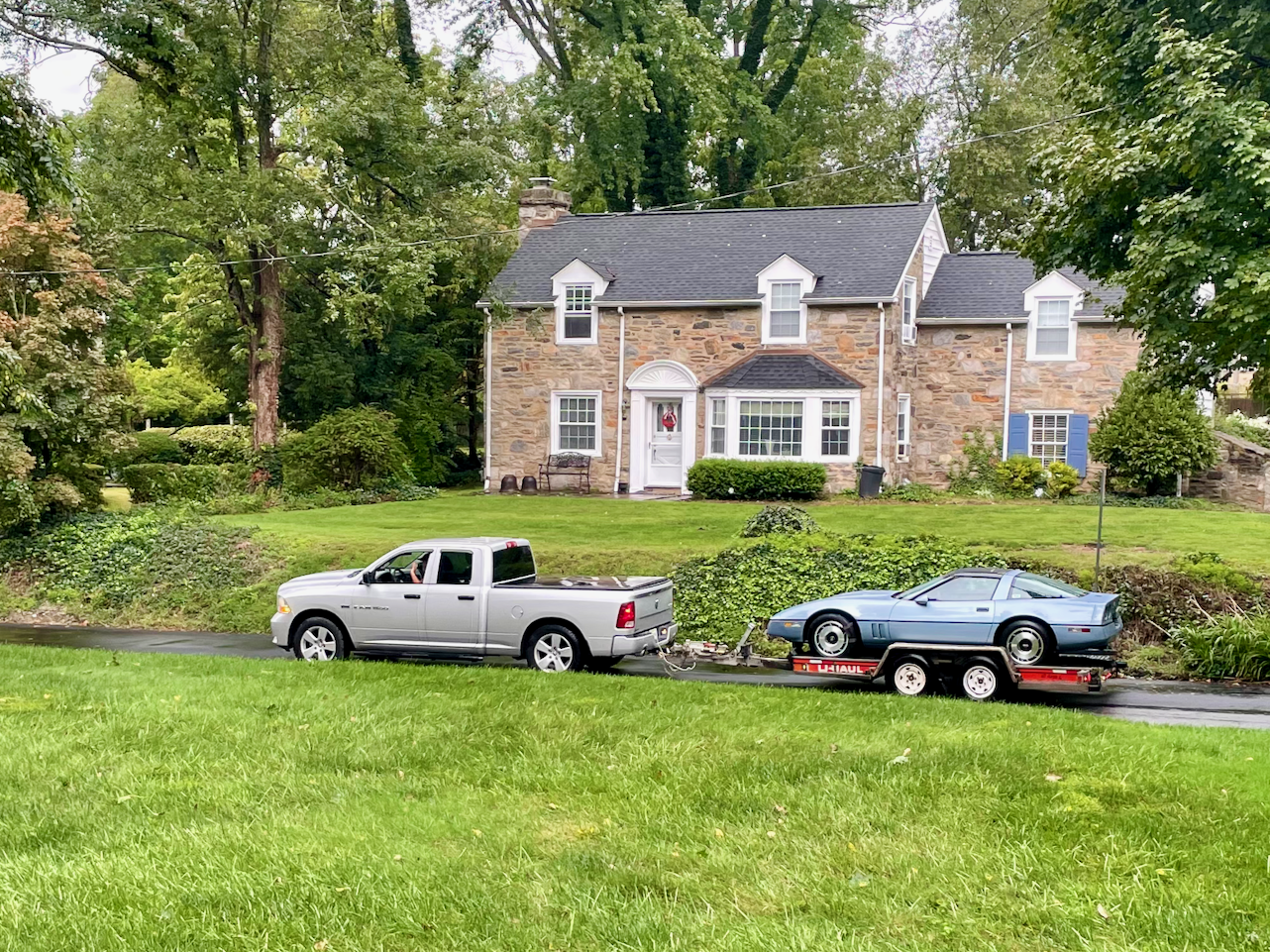
Three days after the auction ended, the winning buyer sent one of his employees out to pick up the car. He loaded the car onto an open trailer (very on-brand for the purchase venue) in the light rain. A few minutes later, he drove away, and my life with a 1985 Corvette ended.

I was sad to see the Corvette go, but not unhappy. My view is that the car owed us nothing—we enjoyed it for seventeen years and it was our ticket to many interesting experiences. I hope the new owner has as much fun with this C4 as we did.

1981 Chevrolet Corvette coupe

“Corvette is a rolling showcase of new technology …”

For 1981, Chevrolet’s Corvette gained a new standard powertrain—the L81 190 bhp 5.7 liter/350 ci V8 with a Rochester four-barrel carburetor combined with a four-speed manual transmission (a three-speed automatic was a no-cost option). The new engine featured Computer Command Control, which automatically adjusted the ignition timing and the fuel/air mixture. Chevrolet engineers also replaced the steel rear leaf spring with a fiberglass one in cars with the automatic.

With the four-speed manual, 0-60 came in about 8 seconds—quick for a 1981 model year car. Fuel economy was 14 city/20 highway by the day’s standards with either transmission. With a 23.7-gallon gas tank, one of the 40,606 proud new owners of a 1981 Corvette could expect a range of 295 to 325 miles with a 10% fuel reserve.

For the $16,258.52 base price at the beginning of the model year (about $62,100 in 2025 dollars), Corvette buyers got removable roof panels, a Delco Freedom II battery, four-wheel power disc brakes, power steering, dual sport mirrors, and P225/70R15 tires (a size still readily available) on 15 x 8 inch rally wheels. Inside, air conditioning, power windows, a tilt-telescopic steering column, an AM/FM radio with dual front speakers, a quartz clock, and a choice of either cloth/vinyl or leather/vinyl bucket seats were all standard.

Options & Production Numbers

Exterior and mechanical options included two-tone paint ($399), aluminum wheels ($428), and a power antenna ($55). Inside, buyers could add power door locks ($145), cruise control ($155), and a rear window defogger ($119). 1981 was the first year that the AM/FM stereo radio with a cassette player ($423) was more popular than the AM/FM stereo radio with an 8-track player ($386). New options included a power driver’s seat ($183) and electric twin remote sport mirrors ($117).

1981 was the first year Corvettes were produced in two factories at one time. The new Bowling Green, Kentucky plant produced its first Corvette on June 1, 1981, while the St. Louis plant was making its last Corvettes—the final St. Louis Corvette was built on August 1, 1981. All St. Louis Corvettes were painted with lacquer paints, while the new Bowling Green plant had a brand new paint facility and used enamels with clear top coats.

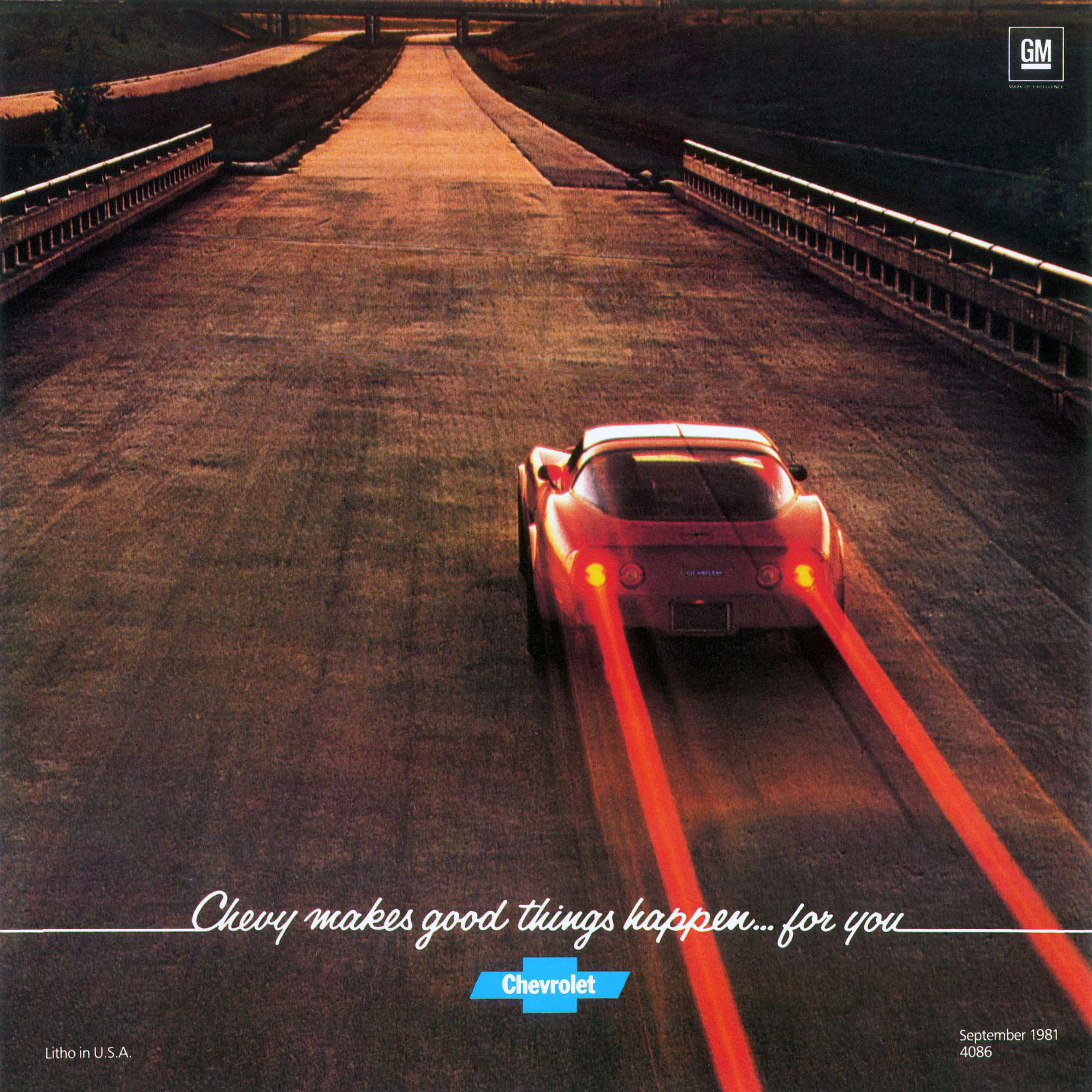
1981 Chevrolet Corvette brochure cover
Cover of the 1981 Chevrolet Corvette brochure

One of the two 1981 Corvette brochures has what I think is one of the best visual expressions of the “shark” Corvette as its fold-out cover. A silhouetted 1981 is in the foreground, with the image of the curving path it has just traversed carved with a time-lapse of its taillights.

The View From 2025

There is strong club support for the 1981 Corvette, as there is for all Corvettes. According to Hagerty’s valuation tools, a loaded 1981 Corvette in #1/Concours condition is $35,500, with a more normal #3/Good condition car going for $15,500. 1981 Corvettes often appear in the Hemmings Motor News classifieds, on eBay Motors, and on Bring a Trailer. As I updated this blog entry in October 2025, there was a Red Corvette with Silver leather bucket seats and 46,000 miles available on Hemming’s, asking $29,000.

Make mine Autumn Red/Dark Claret, please—two-tones seem appropriate for 1981.

Other Corvettes I have written about in this blog include the 1980 coupe, the 1982 coupe, the 1984 hatchback coupe, the 1986 convertible, and the 1988 35th Anniversary Edition hatchback coupe. I also wrote about traveling long distances in an eighties Corvette.

Last updated October 2025.

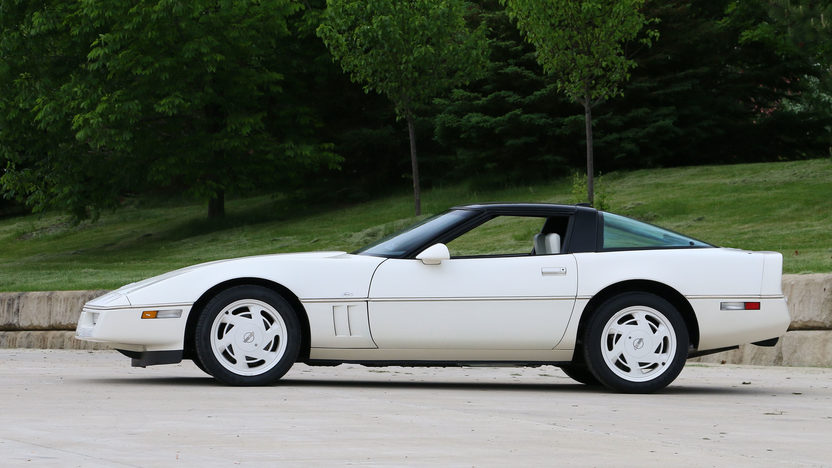
1988 Chevrolet Corvette 35th Anniversary Edition hatchback coupe

One of the Corvettes judged at an NCRS Mid-Atlantic Regional I attended in 2019 was a 35th Anniversary Edition Corvette coupe. This made it time to write a blog entry about one of the most striking of eighties Corvettes.

“… the influential sports car of the modern era.”

For 1988, the big news for Chevrolet’s Corvette was the 35th Anniversary Edition coupe, which was introduced late in the model year at the New York Auto Show. It was only the second anniversary edition Corvette, following 1978’s Silver Anniversary version. Chevrolet had missed the 30th anniversary (there were no 1983 Corvettes), and one senses that General Motors’ marketing team didn’t want to let another one go by without acknowledgment.

Other improvements for 1988 included carpeted door sills, solution-dyed carpet, and improved “flow-through” ventilation for coupes. A less restrictive muffler system which provided five extra horsepower was standard on coupes with the optional 3.07:1 rear axle ratio (this new muffler system was considered too loud for the standard axle coupes and any convertible). The standard brake rotors were thickened, and Chevrolet made suspension geometry changes to improve control during heavy braking. The Z51 and Z52 packages were upgraded to include P275/40ZR-17 Goodyear Eagle tires on 17 x 9.5 inch wheels. Only available in coupes, the Z51 package also included larger front brake rotors and calipers than in 1987.

The Corvette’s standard powertrain continued to be the L98 5.7 liter/350 ci V8 with fuel injection paired with a four-speed automatic with overdrive. Depending on the rear axle ratio, horsepower for the coupe was either 240 bhp or 245 bhp. Top speed for the 1988 Corvette was about 155 mph, and Car and Driver recorded a 0-60 time of 5.6 seconds. Estimated fuel economy was 16 city/25 highway by the day’s standards (15/23 by today’s measures). With a 20-gallon fuel tank, a Corvette owner could expect a range of 340 to 370 miles with a 10% fuel reserve.

Standard exterior and mechanical equipment in the $29,489 base Corvette coupe (about $81,600 in today’s dollars) included power steering, power anti-lock disc brakes, and P255/60ZR16 tires (a size still available thanks to BF Goodrich) on 16-inch x 8.5-inch wheels. Inside, air conditioning, power windows, power door locks, a tilt-telescopic steering wheel, cruise control, and an ETR AM/FM stereo radio with a clock were all included.

Photo of 1988 35th Anniversary Chevrolet Corvette
1988 Chevrolet Corvette 35th Anniversary Edition, photo courtesy of Mecum.

Additional equipment on the $34,284 35th Anniversary Edition coupe (about $94,900 in 2025 dollars or about what a loaded 2025 Stingray coupe goes for) included white leather seats without the otherwise standard perforations, a white steering wheel, and a black roof bow. In a preview of early 1990s Corvettes, the rub strips were body color instead of the usual black.

Options, Packages, & Production Numbers

Optional exterior and mechanical equipment included an electric rear window defogger ($129), the Doug Nash 4+3 manual transmission (no cost), and a performance axle ratio ($22). Optional interior equipment included power driver’s and power passenger’s seats ($240 each), electronic air conditioning ($150), and a Delco/Bose AM/FM stereo radio with a cassette player ($773).

Two handling packages were available: the Z51 performance handling package ($1,295 for a radiator boost fan, Delco-Bilstein shock absorbers, an engine oil cooler, a heavy-duty radiator, 17 x 9.5 inch wheels, P275/40ZR-17 tires, and a fast steering ratio), and the Z52 sport handling package ($970 for Delco-Bilstein shock absorbers, 17 x 9.5 inch wheels, and P275/40ZR-17 tires). 

To me, the 35th Anniversary Edition is one of the most differentiated of eighties C4 Corvettes, with only the Callaway Turbos being more distinctive. Chevrolet built 2,050 35th Anniversary Edition coupes, making availability restricted—but not that restricted. This number was out of a total of 15,382 coupes, with an additional 7,407 convertibles sold.

The View From 2025

There is strong club support for the 1988 Corvette, as there is for all Corvettes. According to Hagerty’s valuation tools, all the money for a 1988 35th Anniversary Edition coupe in #1/Concours condition is $47,700, with a more typical number #3/Good condition car going for $11,400. 1988 Corvettes often show up in the Hemming’s Motor News classifieds, on eBay Motors, and on Bring a Trailer—as I update this blog entry in April 2025, there’s a 35th Anniversary Edition coupe with 8,100 miles for sale on Hemmings, asking $30,000.

Other eighties Corvettes I have covered include the 1980 coupe, the 1981 coupe, the 1982 coupe, the 1984 hatchback coupe, and the 1986 convertible.

Last updated April 2025.

1986 Chevrolet Corvette convertible

“Yes to wind. Yes to sunshine.”

For 1986, the big news for Corvette was the return of the convertible, gone since 1975. Other improvements included Bosch ABS II anti-lock brakes, a Vehicle Anti-Theft System (VATS), and the mid-year introduction of aluminum cylinder heads.

The standard powertrain was the L98 235 bhp 5.7 liter/350 ci V8 with fuel injection paired with a Turbo-Hydramatic four-speed automatic transmission. Car and Driver recorded a 0-60 time of 6.0 seconds and a top speed of 144 mph. Estimated fuel economy was 17 city/24 highway by the standards of the day (15/22 by today’s standards). With a 20-gallon fuel tank, a Corvette convertible’s proud new owner could expect a range of between 335 and 370 miles with a 10% fuel reserve.

Built in collaboration with ASC, the convertible included a manual top, a rear-hinged deck panel to cover the top, and an X-brace underneath the floor. The newly-required high-mounted rear brake light was integrated into the rear fascia. Even the gas filler cover was different from the coupe—square because there was no rounded rear hatchback glass for it to wrap around.

1986 Chevrolet Corvette convertible brochure page
1986 Chevrolet Corvette brochure page

Standard exterior and mechanical equipment for the $32,032 Corvette convertible (about $93,612 in today’s dollars or about what a well-equipped 2025 Corvette Stingray convertible goes for) included a Delco Freedom Plus II battery, power operated quartz-halogen retractable headlamps, power rack-and-pinion steering, power brakes, and P255/50VR-16 tires on 16 x 9.5 inch cast alloy aluminum wheels. Inside, air conditioning, power windows, Tilt-Telescopic steering wheel, driver information system, cloth bucket seats, and an AM/FM stereo radio with power antenna were all included.

Options & Production Numbers

Optional exterior and mechanical equipment included a performance axle ratio ($22) and Delco-Bilstein shock absorbers ($189)—the Doug Nash 4+3 manual transmission was a no-cost option. Optional interior equipment included cruise control ($185), a power door lock system ($175), electronic control air conditioning ($150), a six-way power driver’s seat ($225), and the Delco-GM/Bose Music System ($895). The Z51 Performance Handling Package was not available with the convertible.

The return of the Corvette convertible was well-received—Chevrolet sold 7,315 in about half a model year, even at $5,000 more than the coupe. Reviews were also good; Car and Driver stated that the convertible was “a mighty hospitable carriage.”

The View From 2025

There is strong club support for the 1986 Corvette, as there is for all Corvettes. According to Hagerty’s valuation tools, all the money for a 1986 Corvette convertible in #1/Concours condition is $31,500, with a more normal number #3/Good condition car going for $10,800. 1986 Corvette convertibles are regularly featured in the Hemming’s Motor News classifieds and on eBay Motors—as I write this in December 2018, there’s a Yellow car with black leather seats and 29,000 miles available on Hemmings for $17,900.

Make mine White, with red leather seats—the “heritage colors” that match the first Corvette back in 1953.

Last updated February 2025.

1980 Chevrolet Corvette coupe

“How many other cars can you name at a single glance?”

For the 1980 model year, Chevrolet stylists substantially redesigned the Corvette’s long-running “shark” body style for the third time since its debut in the 1968 model year. The front and rear bumper caps were modified with integrated spoilers that decreased the drag coefficient by 14% to 0.443. Chevrolet engineers also managed to remove 167 pounds of curb weight from the Corvette by reducing the thickness of body panels and using aluminum for more parts. For the first time, air conditioning was standard—it had been an option since 1963. Power windows were also newly standard equipment.

There were two engine options for all states but California, both 5.7 liter/350 ci small blocks with four-barrel carburetors: the standard 190 bhp L48 and the optional ($595) 230 bhp L82. The four-speed manual transmission was only available with the L48—the L82 and the California-only 180 bhp 5.0 liter/305 ci LG4 could only be combined with the three-speed automatic transmission. With the relatively rare (about 12% of production) L82 and automatic transmission combination, Car and Driver recorded a 0-60 time of 7.6 seconds and a top speed of 123 mph.

Fuel economy was 14 city/20 highway by the day’s standards with either 350 ci and either transmission. With a 24.1-gallon gas tank, a Corvette’s proud new owner could expect a range of 300 to 330 miles.

1980 Chevrolet Corvette brochure cover
Cover of the 1980 Chevrolet Corvette brochure

The Corvette’s base was $13,140.24 at the beginning of the model year—about $56,400 in 2025 dollars, which is about 20% less than a 2025 Corvette Stingray coupe costs. Corvette buyers got removable roof panels, power-operated retractable headlights, a Delco Freedom battery, four-wheel power disc brakes, power steering, dual remote-control sport mirrors, a choice of transmissions, and P225/70R15 steel-belted radial-ply tires (a size still readily available) on 15-inch wheels. Inside, air conditioning, power windows, a tilt-telescopic steering column, an electric clock, an AM/FM radio, cut-pile carpeting, and a choice of either cloth/vinyl or leather/vinyl bucket seats were all standard.

Options, Production Numbers, & Reviews

Exterior and mechanical options included aluminum wheels ($407), P255/60R15 tires ($426), and a power antenna ($56). Inside, buyers could add power door locks ($140), cruise control ($123), rear window defogger ($109), and dual rear speakers ($52). 1980 would be the last year that the AM/FM stereo radio with 8-track player ($155) would be more popular than the AM/FM stereo radio with cassette player ($173).

The redesign probably kept Corvette sales from dropping as much as they otherwise would have, but they were still off more than 13,000 units from 1979 as the shark aged. The tagline for Car and Driver‘s review of the 1980 Corvette was “America’s only sports car, but that doesn’t excuse everything.”

The View From 2025

There is strong club support for the 1980 Corvette, as there is for all Corvettes. According to Hagerty’s valuation tools, a loaded 1980 Corvette with the L82 engine in #1/Concours condition is $38,100, with a more normal L48-engined car in number #3/Good condition going for $14,900.

1980 Corvettes often appear in the Hemming’s Motor News classifieds (Hemmings currently has twenty for sale), on eBay Motors, and on Bring a Trailer. They are also frequently seen at in-person auctions such as Barrett-Jackson and Mecum. As I update this post in August 2025, a Dark Claret Metallic one with the L82, oyster leather seats, and 28,000 miles is available on Hemmings, asking $19,000.

Make mine White with red leather seats, please—the “heritage” colors.

Other third-generation Corvettes I have written about include the 1981 coupe and the 1982 coupe. 1980 Chevrolet models include the Camaro Rally Sport coupe, the Camaro Z28 coupe, the Citation hatchback sedan, and the Monza Sport 2+2 hatchback coupe.

Last updated August 2025.

1982 Chevrolet Corvette coupe

“Cross-Fire injection adds to the Corvette performance equation.”

1982 was the final year for the “shark” Corvette, but the first year for the L83 Cross-Fire 5.7 liter/350 ci V8—a throttle body fuel-injected design that put out a respectable for the day 200 bhp and 285 lb-ft of torque. The downside was that it was only available with a four-speed automatic transmission; a manual transmission would not return until the middle of the 1984 model year.

Top speed for the 1982 Corvette was 125 mph, and Road & Track managed a 0-60 time of 7.9 seconds. Estimated fuel economy was 15 city/26 highway by the day’s standards—not bad for a fairly large V8 with primitive engine controls. With a 23.7 gallon gas tank, a 1982 Corvette owner could expect a range of 355 to 390 miles with a 10% fuel reserve—notably better than one year earlier.

The heavily-hyped Cross-Fire was an intermediary step for General Motors on the way to true multi-port electronic fuel injection for Chevrolet’s small-block V8. For Corvette, it brought the best horsepower in a standard engine since 1972, though it was not the relative screamer that the L82 (optional from 1973 to 1980) had been. However, the flat intake manifold design compromised fuel injection’s potential fuel economy gains—real improvements would wait until 1985’s L98.

Other changes for 1982 included the availability of the Collector Edition, as well as many new exterior paint colors and interior color options. Lost in the Cross-Fire publicity was the move from a three-speed automatic to a four-speed automatic transmission.

rear cover of 1982 Chevrolet Corvette brochure
Rear cover of 1982 Chevrolet Corvette brochure

Standard exterior and mechanical equipment in the $18,290 base Corvette (about $63,400 in today’s dollars) included tinted glass for all windows, removable roof panels, a Delco Freedom II battery, power steering, four-wheel power disc brakes, and P225/70R15 tires (a size still readily available) on 15-inch by 8-inch steel rally wheels. Inside, air conditioning, power windows, a Tilt-Telescopic steering wheel with a leather-wrapped rim, a quartz analog clock, and an AM/FM stereo radio with dual front speakers were all included.

The Collector Edition, Individual Options, & Production Numbers

The $22,538 Collector Edition (about $78,200 in 2025 dollars and about what a 2026 Corvette Stingray 2LT coupe goes for) added a functional hatchback (a first for Corvette), P255/60R15 Goodyear Eagle GT tires, aluminum wheels, and specific Silver Beige paint, striping, seats, and interior trim—along with a 23% addition to the base price.

Individual exterior and mechanical options included power sport mirrors ($125), power door locks ($155), cruise control ($165), electric rear window defogger ($129), gymkhana suspension (only $61 for specially tuned shock absorbers, higher-rate rear spring, and a rear stabilizer bar), two-tone paint ($428), aluminum wheels ($458), and  P255/60R15 Goodyear Eagle GT tires ($543). Optional interior equipment included a six-way power driver’s seat ($197) and an AM/FM stereo radio with a cassette player ($423).

Options that date this car include the stereo radio with a cassette player and Citizens Band radio ($755), the stereo radio with an 8-track player ($755), and the radio delete (-$124). Corvette buyers piled on the options in 1982: the average buyer ordered $2,195 worth, raising the sticker to $20,485 (about $71,100 in today’s dollars).

In its final year, the shark still sold decently—but the end for a car that featured many design components from 1963 was in sight. Chevrolet moved 25,407, of which 6,759 (about 27%) were the pricey Collector Edition.

The View From 2025

There is strong club support for the 1982 Corvette, as there is for all Corvettes. According to Hagerty’s valuation tools, a loaded non-Collector Edition 1982 Corvette in #1/Concours condition is $42,700, with a more typical number #3/Good condition car going for $17,200. 1982 Corvettes are regularly featured in the Hemmings Motor News classifieds, eBay Motors, and Bring a Trailer. As I update this blog entry in September 2025, there’s a Silver Metallic over Dark Claret Metallic two-tone Corvette with red cloth seats and 15,000 miles for sale on Hemmings, asking $30,000.

Make mine one of the relatively rare (and absolutely gorgeous) Silver Green Metallic cars, with the silver green leather seats.

Other Corvettes I have written about include the 1980 coupe, the 1981 coupe, the 1984 hatchback coupe, the 1986 convertible, and the 1988 35th Anniversary hatchback coupe.

Last updated September 2025.

Some Long Distance Travel In An Eighties Car

Last month, my wife and I took a 6,281 mile “jaunt” in my eighties car – a 29 1/2 year old 1985 Light Blue Metallic Chevrolet Corvette coupe.

Last year, Lauren challenged me, causing me to me to write this … screed in May 2013:

“It’s Not The Same As It Was In 2004 …

… I took the 1985 out for some miles today and I noticed some things.

It’s a more tenuous feeling taking her out than it was in 2004. Of course, that was 33,000 miles ago, but the car seems more … fragile. I’m mindful of all that sweat equity (mine and many others) in it and the knowledge that it is now so … old. Less and less early C4s on the road for any reason and she’ll be thirty (!) years old in November 2014.

The car judges well and drives acceptably but the problems remain present and they are a litany: the “dumb as a bag of rocks” computer, the creaks and rattles in the interior, the passenger side power window near death, the console light that keeps slowly melting the console plastic, the seats and steering wheel not far from a recovery, the repaint that is who knows how many thousands of miles out, the characteristic droops on both front and rear bumpers that will need to be fixed with the repaint. They’re known problems and they can get fixed: but some of them (seats, repaint, bumpers) will require cubic dollars.

Continue reading “Some Long Distance Travel In An Eighties Car”