1980 Chevrolet Camaro Rally Sport coupe

At Barrett-Jackson’s 2018 Northeast auction, a bright blue metallic 1980 Chevrolet Camaro Rally Sport coupe with black vinyl seats, a 3.8 liter/229 ci V6 with a two-barrel carburetor, an automatic, and 45,000 miles crossed the block. The hammer price was $4,700 for this honest, reasonably original car that no one ever tried to turn into something resembling a Z28. I find these non-top-of-the-line cars interesting because they are rarely saved, leading to something like what we have with 1957 Chevrolets, where you’d think 90% of them were Bel Airs.

“It’s an escape from the ordinary.”

For 1980, Chevrolet featured four versions of the Camaro. The base model was the Sport Coupe, followed by the Rally Sport, the Berlinetta, and the Z28. This post is about the Rally Sport, which cost $5,916 (almost exactly $25,000 in today’s dollars) and got a few changes in the final year of this particular iteration. A new blacked-out grille and a new three-tone striping package were visible, while a new standard V6 sat inside.
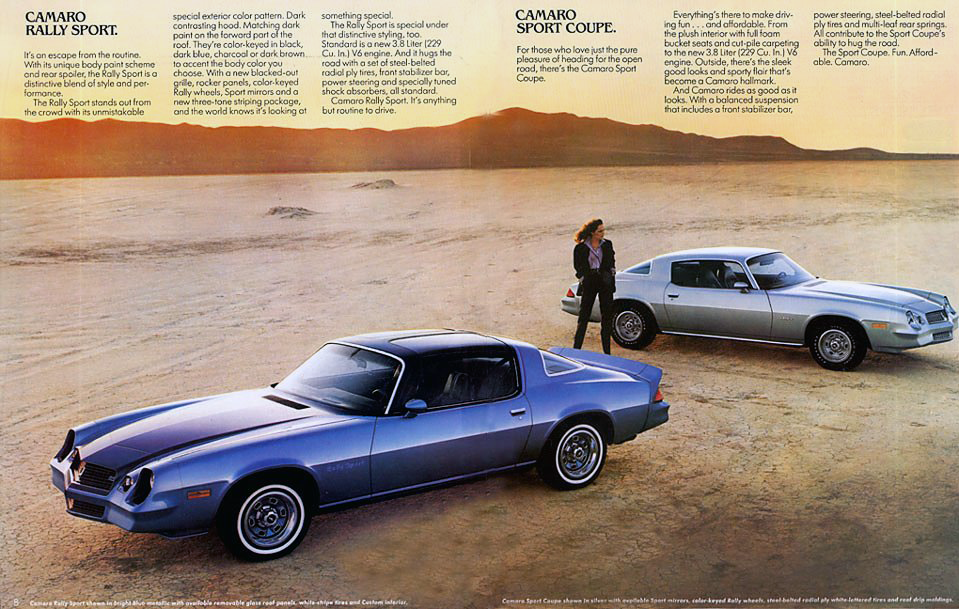
Rally Sport page from 1980 Camaro brochure
Rally Sport and Sport Coupe pages from the 1980 Chevrolet Camaro brochure

That new standard powertrain on the 1980 Rally Sport was the LC3 115 bhp 3.8 liter/229 ci V6 with a Rochester M2ME two-barrel carburetor paired with a three-speed manual. EPA fuel economy was 20 city/26 highway by the standards of the day—with a 20.9-gallon gas tank, a Camaro owner could expect to go 390 to 430 miles with a 10% fuel reserve. The trade-off was performance that belied the Camaro’s sporty looks: 0-60 in a little under 13 seconds with a top speed of 112 mph.

Optional powertrains included two V8s, both of which required power brakes ($81): the L39 120 bhp 4.4 liter/267 ci with a two-barrel carburetor ($180) and the LG4 155 bhp 5.0 liter/305 ci with a four-barrel carburetor ($295). An automatic ($358) was available with all three engines, while a four-speed manual was only available with the larger of the two V8s. The LG4/four-speed combination yielded notably better performance than the base powertrain: 0-60 in about 10 seconds. It didn’t make mileage that much worse—16 city/24 highway by 1980 standards.

Standard exterior and mechanical equipment on all Rally Sports included High Energy ignition, power steering, front stabilizer bar, sport mirrors, rear spoiler, concealed windshield wipers, front disc/rear drum brakes, and 205/75R14 steel-belted radial ply tires (a size still available thanks to Hancook and Kumho) on 14-inch color-keyed Rally wheels. Inside, flow-through ventilation system, contoured full-foam vinyl bucket seats, a “centre” (as spelled in the brochure) floor console, and cut-pile colour-keyed carpeting were included.

Options & Production Numbers

Exterior and mechanical options included removable glass panels ($695) and 14 x 7 aluminum wheels ($337). Inside, air conditioning ($566), intermittent windshield wiper system ($41), electric rear window defogger ($107), automatic speed control ($112), power door locks ($93), power windows ($143), a Custom interior ($68), a gauge package with a tachometer ($120), Comfortilt steering wheel ($81), and an AM/FM stereo radio with stereo cassette tape ($272) were all available.

Though the Z28 wasn’t the most popular Camaro, the Rally Sport did not hold up its end of the bargain (likely why it was gone in 1981). The leading seller remained the entry-level Sport Coupe (46% of production), followed by the Z28 (30%), the Berlinetta (16%), and the Rally Sport (8%).

The View From 2025

Badge for 2,500 web hits

According to Hagerty’s valuation tools, all the money for a 1980 Camaro Rally Sport with the LG4 V8, a four-speed, and T-tops in #1/Concours condition is an astounding $24,400, with a far more typical #3/Good car with same equipment going for $14,200. Values slide down substantially with the base equipment—a base V6 Rally Sport in #3 condition is only worth $10,300.

This generation of the Rally Sport maintains some presence in the Hemming’s Motor News classifieds, on eBay Motors, and at online auctions such as Bring a Trailer that cater to the eighties car market. As I update this post in February 2025, there’s a Bronze Metallic 1981 with the LG4, an automatic, and 77,000 miles for sale asking $16,000.

Make mine Bright Blue Metallic, please.

Last updated February 2025.

1983 Ford Thunderbird Turbo Coupe

A recent query about whether I had done a write-up on a Thunderbird Turbo Coupe compelled me to update this post written a few years ago, changing it enough to consider it a new entry.

“Ford presents a dramatic new balance of form and function.”

The aerodynamic styling of Ford’s 1983 Thunderbird was a breath of fresh air and a substantial change from the boxy and unloved eighth-generation 1980-1982 models, though the underlying components remained the Fox platform. For 1983, the Thunderbird came in base, Heritage, and Turbo Coupe models.

The Turbo Coupe featured Ford’s Lima 142 bhp 2.3 liter/140 ci inline four with Bosch L-Jetronic fuel injection and a Garrett turbocharger and came with a standard five-speed manual transmission. Road & Track recorded a 0-60 time of 9.7 seconds in a Turbo Coupe that weighed 3,420 pounds as tested. Ford’s new coupe didn’t just look aerodynamic—the drag coefficient was a very competitive 0.35. Fuel economy ratings for the Turbo Coupe were 21 city/33 highway by the standards of the day (17/24 by today’s standards). With an 18.0-gallon fuel tank, a Turbo Coupe owner could expect a range of between 330 and 435 miles with a 10% reserve—decent for a mid-size performance coupe in the early to mid-1980s.

The Turbo Coupe started at $11,790—approximately $30,300 in today’s dollars and nearly what a 2019 Mustang EcoBoost Premium Fastback (also with a turbocharged 2.3 liter inline four) costs. Standard exterior and mechanical features on the Turbo Coupe included variable ratio power rack-and-pinion steering, power brakes, power mirrors, a Traction-Lok limited-slip differential, Marchal foglamps, and Goodyear Eagle HR 205/70R-14 tires (a size still readily available) on 14-inch x 5.5-inch cast aluminum wheels. Inside, all Turbo Coupe buyers got a leather-wrapped steering wheel, articulated front seats, and an AM/FM stereo radio. Options included front cornering lamps ($68), tilt steering ($105), power door locks ($172), and a premium sound system ($179).

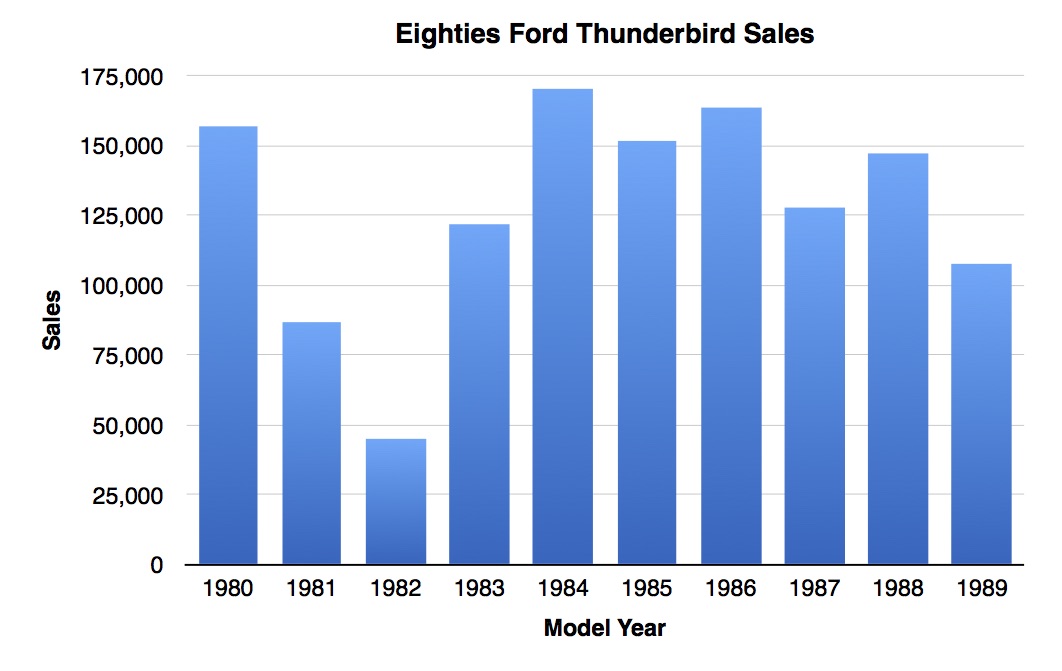
Reviews were quite good—Road & Track‘s tagline was “An enthusiast’s Bird comes soaring back”—and the newly aerodynamic Thunderbird sold well. After dropping down below 50,000 sales for the 1982 model year with the last of the eighth-generation ‘birds, the ninth generation would not see sales of less than 120,000 per year.

EightiesFordThunderbirdSales

According to Hagerty’s valuation tools, all the money for a 1983 Thunderbird Turbo Coupe in #1/Concours condition is $17,000, with a far more typical #3/Good car going for $6,700. Thunderbird Turbo Coupes only occasionally show up in the Hemming’s Motor News classifieds. You do see them more often on eBay Motors; as I update this blog entry in December 2018, there’s a 1985 Silver Clearcoat Metallic/Medium Charcoal Clearcoat Metallic two-tone Turbo Coupe with Oxford Gray cloth seats and 52,000 miles listed for $8,500. Make mine Silver, please.

Updated December 2018.

1987 Chevrolet Caprice Classic coupe

For somewhat unclear reasons, this was my most popular post on this blog for several years. Because of this, I updated it about five years ago to reflect both changes in my posting style and substantial improvements in available data.

“… the personal flair of a distinctive coupe.”

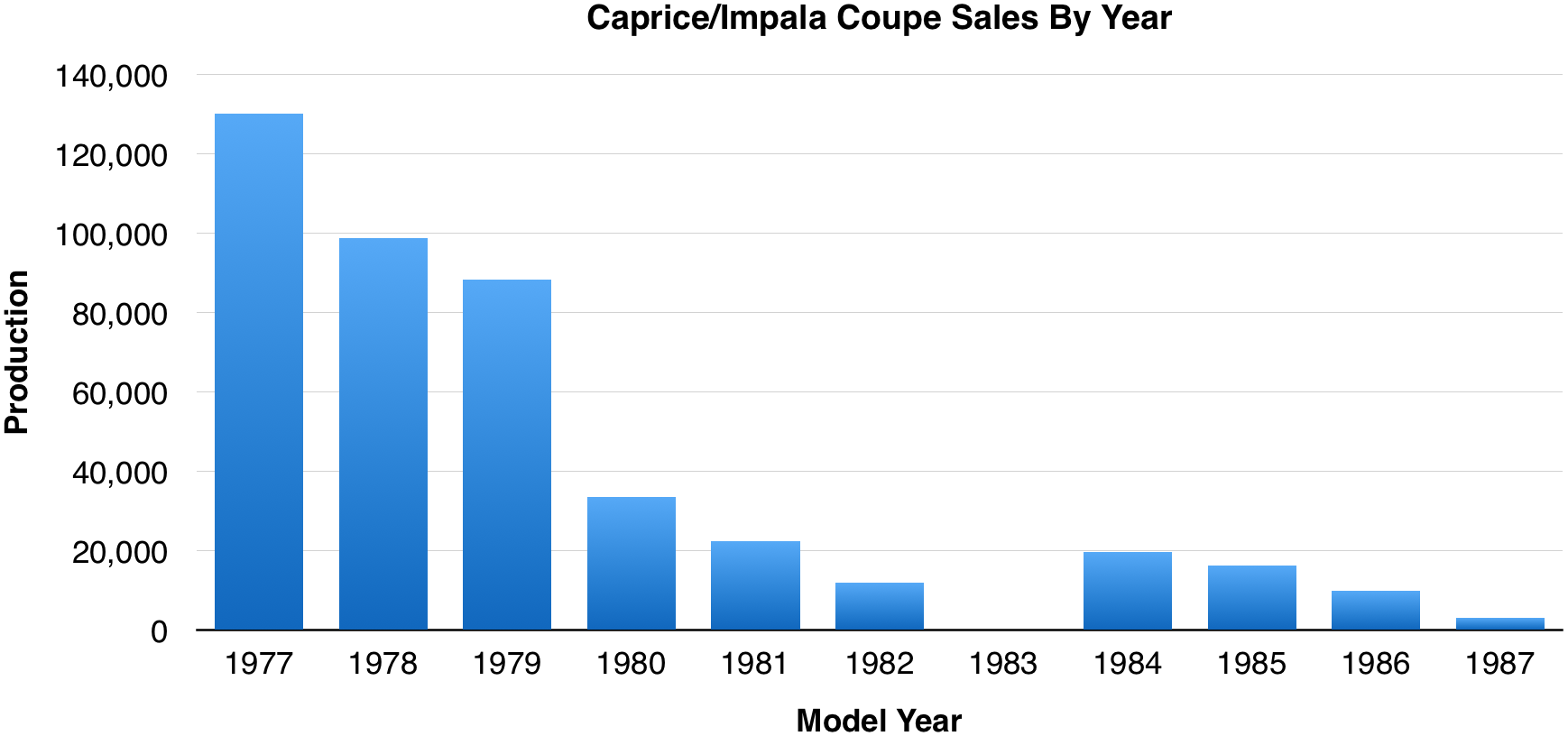
ChevroletCoupeSales

1987 was the final model year for Chevrolet’s Caprice Classic coupe, with only 3,110 made. Beginning in 1988, the Caprice would soldier on with just the sedan and wagon, as the once very popular big American coupes continued to lose favor.

The standard power team on the coupe (and sedan) was the LB4 140 bhp 4.3 liter/262 ci V6 with throttle-body fuel injection and a three-speed automatic transmission. Mileage was rated at 18 city/23 highway by the day’s standards (16/22 by modern measures).

Optional power was the LG4 165 bhp 5.0 liter/305 ci V8 with a four-barrel carburetor paired with a four-speed automatic transmission (I see what you did there, Chevrolet). In 1987, this combination was rated at 18 city/25 highway (16/23 by 2025 standards). With a large 25-gallon fuel tank, you could reasonably expect a comfortable range of about 440 to 480 miles with a 10% fuel reserve—impressive for a 3,600-pound full-size car back then. Even with the V8, these cars were not fast—0-60 came in about 10.5 seconds.

Coupe pages from the 1987 Chevrolet Caprice Classic brochure

Standard equipment for the $11,392 coupe (about $33,000 in today’s dollars) included power steering, power brakes, halogen headlights, and P205/75R15 all-season radial tires (a size still readily available) on 15-inch wheels. Inside, a full-width cloth bench seat, Quiet Sound Group, and an AM radio were standard.

Optional equipment included air conditioning ($775), cruise control ($175), power door locks ($145), power windows ($210), power seats ($240 each), power trunk opener ($50), a 50/50 split-front seat ($195), and AM/FM stereo cassette with graphic equalizer ($435).

Flights of Fancy

I have fun sometimes (often?) building a “unicorn” configuration for these old cars. When I was working at the local Chevrolet dealership in the mid-eighties, I dreamed up a Caprice S. Here’s what optional equipment it would have required, all still available in 1987:

  • F41 Sport Suspension (includes a rear stabilizer bar, 15-inch by 7-inch wheels, and sportier shock absorbers)
  • LG4 5.0 liter/305 ci V8
  • P225/70R-15 tires
  • Sport wheel covers
  • Limited slip differential
  • Performance axle ratio
  • Heavy-duty cooling
  • Dual power Sport mirrors
  • Special instrumentation/gauge package

So, a “John-configured” coupe would have listed for at least $15,096—real money in 1987 and about $43,700 in 2025 dollars. A desperate product planner might have tried to get the leather seats from the Brougham available in the Coupe and maybe scored some black wall tires, but that’s another story …

The View From 2025

Badge for 2,500 web hits

These big and (I think) handsome coupes occasionally appear in the Hemmings Motor News classifieds, on eBay Motors, and on Bring a Trailer. However, Hagerty’s valuation tools do not track Caprice Classic values between 1975 and 1991.

Make mine Silver Metallic, please, though I’m tempted by the Black/Medium Gray Metallic two-tone.

Other B-platform cars I have written about include the 1983 Chevrolet Caprice Classic sedan, the 1985 Chevrolet Caprice Classic station wagon, and the 1982 Oldsmobile Delta 88 Royale coupe.

Last updated April 2025.