1983 Chevrolet Camaro Z28 hatchback coupe

“… just about everything a road car should be.”

In its second year, changes to the third-generation Chevrolet Camaro Z28  centered on the powertrain. The Z28 gained a new standard Borg-Warner five-speed manual transmission and a new optional four-speed automatic. Both carryover V8 engines gained horsepower, and a new top-of-the-line H.O. engine became available mid-year. Detail changes included new patterns for the optional L/S Conteur bucket seats that repeated the Camaro name in the design. Chevrolet refined the instrument panel graphics, and electronically tuned stereo radios were newly available.

All Z28 engines for 1982 were variations of the Chevrolet’s 5.0 liter/305 ci V8. The Z28‘s standard engine was the LG4 with a four-barrel carburetor, uprated five bhp to 150 bhp. An optional $450 LU5 Cross-Fire with throttle-body fuel injection gained 10 bhp to 175 bhp and required the $295 automatic. In April 1983, the L69 H.O. with 190 bhp became available for $505 and required the five-speed.

Motor Trend recorded a 0-60 time of 7.4 seconds with the top-of-the-line H.O. motor and the five-speed—about 1.5 seconds faster than the best from 1982. Fuel economy ratings for the H.O. were 16 city/26 highway by the day’s standards—the highway rating two mpg better than 1982’s base engine. With a 16.1-gallon gas tank, a Z28 owner with the H.O. could expect a range of 250 to 270 miles with a 10% fuel reserve.

Z28 cutaway pages from the 1983 Chevrolet Camaro brochure

The 1983 Z28‘s base price was $10,336—about $34,200 in 2025 dollars. Standard exterior and mechanical equipment on all 1983 Z28s included a front air dam, “ground effects” rocker molding design, body-color dual Sport mirrors, a rear deck spoiler, power steering, a power front disc/rear drum brake system, and P215/65R-15 steel-belted radial ply white letter tires (a size still readily available) on 15 x 7 inch 5-spoke aluminum wheels. Inside, every 1982 Z28 came with vinyl reclining front bucket seats, a fold-down rear seat, a leather-wrapped steering wheel, special instrumentation, and a quartz analog electric clock.

Options & Production Numbers

Exterior and mechanical options available for the Camaro Z28 include tinted glass ($105), electric twin remote Sport mirrors ($89), removable glass roof panels ($825!), a rear window wiper/washer ($120), a power antenna ($60), a limited slip differential ($95), and four-wheel power disk brakes ($179). Interior options included power windows ($180), a power door lock system ($120), an electric rear window defogger ($135), automatic speed control with resume speed ($170), air conditioning ($725), a Comfortilt steering wheel ($105), and Deluxe luggage compartment trim ($164).
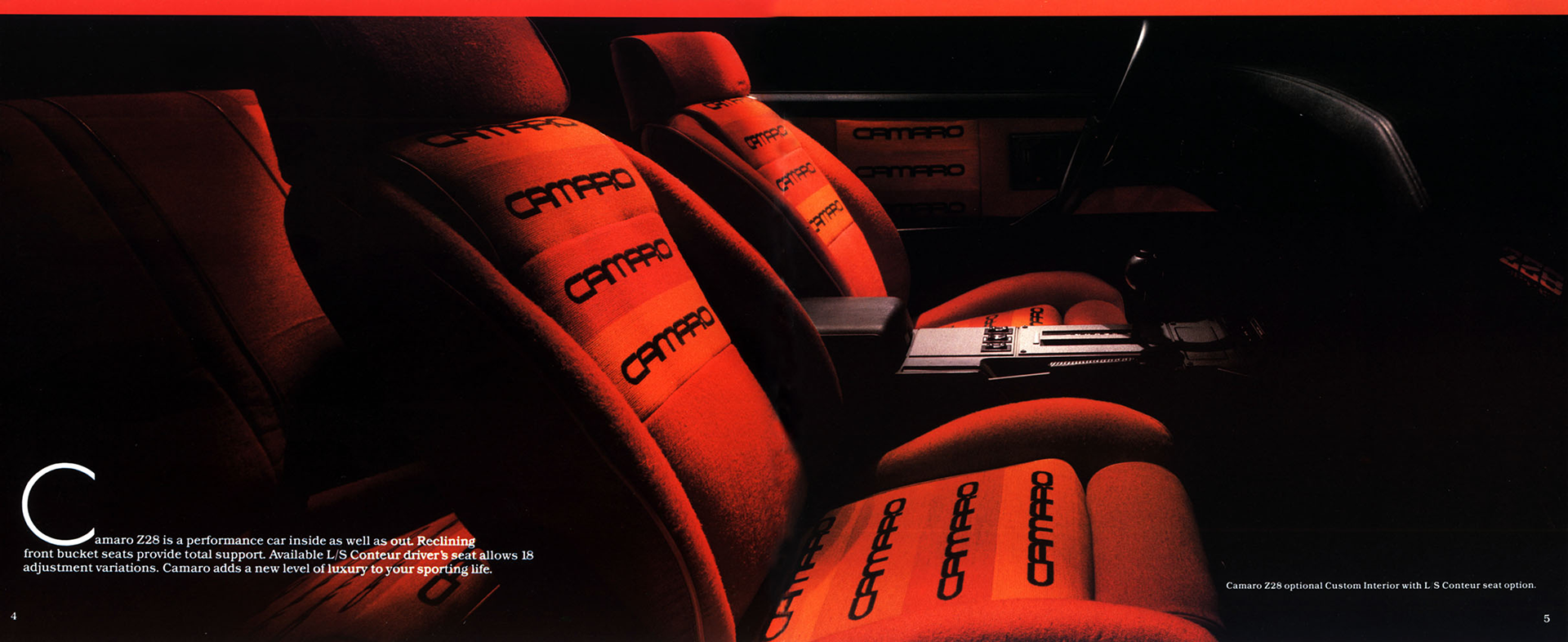
Z28 Custom interior pages in the 1983 Chevrolet Camaro brochure

The Custom interior included the Berlinetta-style seats, seat trim, and door trim, and then added some Z28-specific touches. Pricing for a Custom interior depended on which seats were paired with it, and topped out with the cloth L/S Conteur bucket seats ($650). Five different radios were available, with the fanciest being an electronically tuned AM/FM stereo radio with seek/scan and clock ($520). A loaded Z28 could easily hit $15,000—real money in 1983 and almost $50,000 in today’s dollars.

Chevrolet sold 62,100 Z28s in the 1983 model year. However, the most popular Camaro remained the base Sport Coupe, which moved 63,806 units. The somewhat more luxurious Berlinetta sold another 27,925 copies.

The View From 2025

Third-generation Camaros attract plenty of collector interest, and there is substantial club support. According to Hagerty’s valuation tools, a 1983 Camaro Z28 hatchback coupe with the H.O. motor and t-tops in #1/Concours condition is $46,400, while a far more typical #3/Good condition version goes for $14,600. 1983 Camaro Z28s are often available in the Hemmings Motor News classifieds, on eBay Motors, and at online (Bring a Trailer) and in-person auctions. As I write this blog entry in October 2025, a Silver Metallic Z28 with the Cross-Fire, an automatic, and 4,200 miles is for sale on Hemmings, asking $28,000.

Make mine Red, please.

Other Camaros I have written about include the 1980 Rally Sport coupe, the 1980 Z28 coupe, the 1982 Z28 Indy 500 Commemorative Edition hatchback coupe, the 1984 Sport Coupe hatchback coupe, the 1985 IROC-Z hatchback coupe, and the 1986 Berlinetta hatchback coupe.

1984 Chevrolet Camaro Sport Coupe

In early 2022, Bring a Trailer featured a 1984 Chevrolet Camaro Sport Coupe that was generally original except for the wheels and tires. It sold for $8,000.

“Looks. Performance. Price.”

For 1984, the Chevrolet Camaro Sport Coupe had relatively few changes. A four-speed automatic became the only automatic available (1983 Camaros had three-speed and four-speed automatic options). Steel-belted radial tires were newly standard on all Camaros, and all manual transmission vehicles received a hydraulic clutch.

The standard powertrain for the Sport Coupe continued to be the LQ9Iron Duke” 92 bhp 2.5 liter inline four with fuel injection, paired with a four-speed manual transmission. Optional engines were two: the LC1 107 bhp 2.8 liter V6 with a two-barrel carburetor ($250) and the LG4 150 bhp 5.0 liter V8 with a four-barrel carburetor ($550). A five-speed manual ($125) and a four-speed automatic ($525) were optional.

With the standard powertrain, the Sport Coupe was all show, no go. 0-60 tests of four-cylinder F-cars are rare to nonexistent, but reasonable estimates are in the high 14 to high 15 second range. For all that trouble, mileage wasn’t that impressive: 24 city/36 highway by the day’s standards. With a 15.5-gallon gas tank, a four-cylinder Sport Coupe owner could expect a range of 340 to 375 miles with a 10% fuel reserve.

The hot setup for the Sport Coupe, such as it was, was the LG4 V8 paired with the four-speed automatic (five-speed manuals with V8s were Z28-only in 1984). For a total of $1,075, this combination changed the car’s character, with the 0-60 time dropping by almost four seconds compared to the base four. These changes did not mean that a V8 Sport Coupe would see anything but the taillights of a Z28 with the 190 bhp “H.O.” V8. Fuel economy ratings with the V8 also dropped significantly to 18 city/29 highway, but a slightly larger 16.1-gallon fuel tank reduced the range penalty—a V8 Sport Coupe owner could expect a 280 to 305 mile range.

Perhaps the most engaging Sport Coupe—but certainly not the fastest—was the LC1 V6/five-speed manual combination. At $375 over the base car, it was about a second faster from 0-60 mph. Fuel economy ratings of 20 city/31 highway along with a 16.1-gallon fuel tank meant a 330 to 330 mile fuel range.

Sport Coupe pages from the 1984 Camaro brochure

Standard exterior and mechanical equipment for the $8,097 Sport Coupe (about $26,000 in today’s dollars) included dual black side mirrors, fast-ratio power steering, power front disc/rear drum brakes, and P195/75R14 radial tires (a size still reasonably available) on 14-inch body-colored wheels with hubcaps. Inside, reclining front vinyl bucket seats, a floor console, and an AM radio were included.

Options & Production Numbers

Options were many and included body color Sport mirrors ($139), a rear deck spoiler ($69), tinted glass ($110), removable glass roof panels ($850), and four-wheel power disc brakes ($179 and V8-only). Inside, buyers could add a gage package with a tachometer ($149), Deluxe luggage compartment trim ($164 and including a locking rear compartment storage cover), Custom cloth bucket seats ($359 and including quiet sound group), and air conditioning ($730).

Six different optional radios were available, with the top-of-the-line being an electronically tuned AM/FM stereo radio with seek and scan, cassette tape, clock, and graphic equalizer ($493). A well-equipped Sport Coupe could easily sticker for substantially more than a base Berlinetta or Z28.

The 1984 Sport Coupe sold quite well—Chevrolet moved 127,292 units, making it about 49% of overall Camaro sales. 1984 would be the peak for Sport Coupe sales in the 1980s, and it isn’t obvious why.

The View From 2025

Third-generation Camaros have substantial forum support and they attract collector interest. According to Hagerty’s valuation tools, a 1984 Camaro Sport Coupe with the V8 in #1/Concours condition is $21,400, with a far more normal #3/Good condition version going for $7,000. V6 versions get a 30% deduction, while four-cylinder cars go for half price. These Camaros are often available in the Hemmings Motor News classifieds, on eBay Motors, and at online auctions such as Bring a Trailer that cater to the eighties car market.

Make mine Charcoal Metallic, please.

Other third-generation Camaro hatchback coupes I have written about include the 1982 Z28 Indy 500 Commemorative Edition, the 1985 IROC-Z, and the 1986 Berlinetta. I have yet to write about any of the 1987 through 1989 Camaro convertibles.

Last updated October 2025.

1982 Chevrolet Camaro Z28 Indy 500 Commemorative Edition hatchback coupe

Every May, the Indianapolis 500 race is a “tentpole” event in the international racing schedule. Since 1911, there have been designated pace cars, with replica versions often sold. A 1982 Chevrolet Camaro Z28 Indy 500 Commemorative Edition with 2,630 miles sold for a $35,000 hammer price at the 2021 Mecum Indy. Are these distinctive and good-looking (I think) cars finally attracting significant interest?

“Even its shadow boasts performance”

The 1982 Chevrolet Camaro could reasonably be described as all-new. This moniker applied to the “pleasing and exciting” exterior, the interior, much of the chassis, and most of the engines. Road & Track stated that the new Camaro was “keenly anticipated.”

The Z28‘s standard powertrain was the LG4 145 bhp 5.0 liter/305 ci V8 with a four-barrel carburetor paired with a four-speed manual transmission. An optional LU5 Cross-Fire 5.0 liter/305 ci V8 with throttle-body fuel injection and 165 bhp set the buyer back $450 and required the $72 three-speed automatic transmission. 0-60 took just under 10 seconds with the base V8 and the four-speed manual, and shortened to 9 seconds with the top-of-the-line Cross-Fire motor and the automatic.

The Z28 had a base price of $9,700—about $33,600 in 2025 dollars. Standard exterior and mechanical equipment on all 1982 Z28s included a front air dam, “ground effect” lower body extensions, a rear spoiler, body-color dual Sport mirrors, power front disc/rear drum brakes, and 215/65R-15 tires (a size still readily available) on 15 x 7 inch 5-spoke aluminum wheels. Inside, every 1982 Z28 came with full instrumentation, an electric quartz analog clock, courtesy lamps, and a leather-wrapped steering wheel.

1982 Camaro Commerative Edition flyer
1982 Camaro Z28 Indy 500 Commemorative Edition flier

Standard equipment specific to the $10,999.26 (yes, that was really the price) Z50 Indy 500 Commemorative Edition included Silver Metallic/Blue two-tone accent paint, red accents on the wheels, specific commemorative edition decals, Custom interior trim, and blue Custom cloth bucket L/S Conteur (Chevrolet’s spelling) front seats.

Options, Production Numbers, & Period Reviews

Among the many options available for the Camaro Z28 were tinted glass ($88), removable glass roof panels ($790!), power windows ($165), a power door lock system ($106), an electric rear window defogger ($125), automatic speed control ($155), air conditioning ($675), a Comfortilt steering wheel ($95), and a host of radios ($111 to $390).

Chevrolet sold 6,360 Indy 500 Commemorative Edition cars in 1982, in addition to 63,563 “normal” Z28s. However, the most popular Camaro was actually the base Sport Coupe, which moved 78,761 units. The somewhat more luxurious Berlinetta sold another 39,744 copies.

Reviews of the new Camaro were decent. Road & Track liked the Z28‘s exterior and the handling, but bemoaned the interior packaging and the fuel mileage (EPA rated at 17 mpg but rarely attaining that in real life). Car and Driver famously accused the Z28 of being “Emily Post polite” but later retracted the remark.

The View From 2025

Third-generation Camaros attract plenty of collector interest, and there is substantial club support. According to Hagerty’s valuation tools, a 1982 Camaro Z28 hatchback coupe with the Cross-Fire motor in #1/Concours condition is $42,000, with a far more normal #3/Good condition version going for $13,500. 1982 Camaro Commemorative Editions are often available in the Hemmings Motor News classifieds, on eBay Motors, and at online (Bring a Trailer) and in-person auctions. As I update this blog entry in October 2025, a Commemorative Edition with the Cross-Fire, an automatic, and 40,000 miles is for sale on Hemmings, asking $20,000.

Other Camaros I have written about include the 1980 Rally Sport coupe, the 1980 Z28 coupe, the 1985 IROC-Z hatchback coupe, and the 1986 Berlinetta hatchback coupe. Pontiac Firebird Trans Ams with blog entries here include the 1981 coupe, the 1982 hatchback coupe, the 1984 15th Anniversary Edition hatchback coupe, the 1985 hatchback coupe, and the 1989 20th Anniversary Turbo hatchback coupe.
Last updated October 2025.

1980 Chevrolet Camaro Rally Sport coupe

At Barrett-Jackson’s 2018 Northeast auction, a bright blue metallic 1980 Chevrolet Camaro Rally Sport coupe with black vinyl seats, a 3.8 liter/229 ci V6 with a two-barrel carburetor, an automatic, and 45,000 miles crossed the block. The hammer price was $4,700 for this honest, reasonably original car that no one ever tried to turn into something resembling a Z28. I find these non-top-of-the-line cars interesting because they are rarely saved, leading to something like what we have with 1957 Chevrolets, where you’d think 90% of them were Bel Airs.

“It’s an escape from the ordinary.”

For 1980, Chevrolet featured four versions of the Camaro. The base model was the Sport Coupe, followed by the Rally Sport, the Berlinetta, and the Z28. This post is about the Rally Sport, which cost $5,916 (almost exactly $25,000 in today’s dollars) and got a few changes in the final year of this particular iteration. A new blacked-out grille and a new three-tone striping package were visible, while a new standard V6 sat inside.

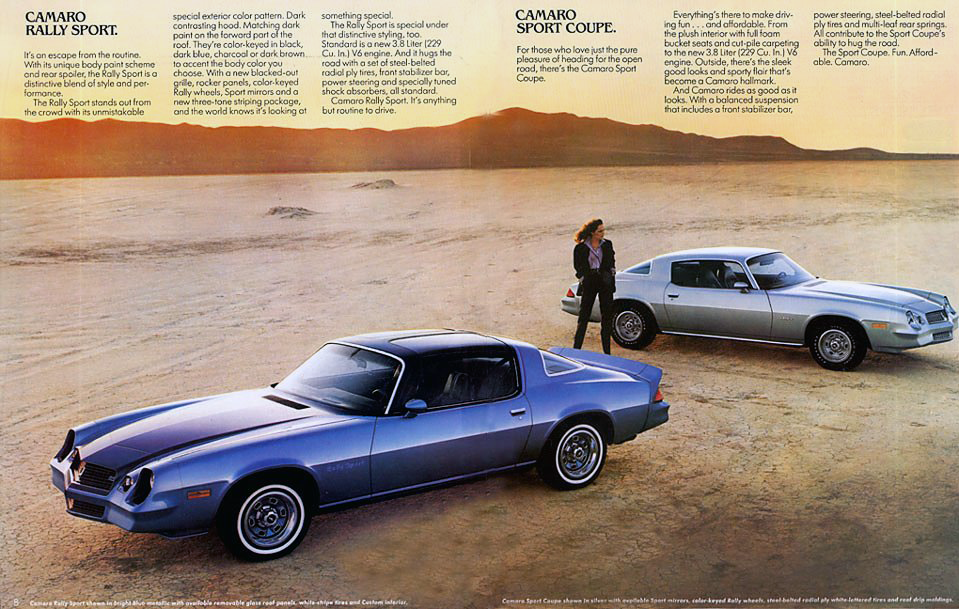
Rally Sport page from 1980 Camaro brochure
Rally Sport and Sport Coupe pages from the 1980 Chevrolet Camaro brochure

That new standard powertrain on the 1980 Rally Sport was the LC3 115 bhp 3.8 liter/229 ci V6 with a Rochester M2ME two-barrel carburetor paired with a three-speed manual. EPA fuel economy was 20 city/26 highway by the standards of the day—with a 20.9-gallon gas tank, a Camaro owner could expect to go 390 to 430 miles with a 10% fuel reserve. The trade-off was performance that belied the Camaro’s sporty looks: 0-60 in a little under 13 seconds with a top speed of 112 mph.

Optional powertrains included two V8s, both of which required power brakes ($81): the L39 120 bhp 4.4 liter/267 ci with a two-barrel carburetor ($180) and the LG4 155 bhp 5.0 liter/305 ci with a four-barrel carburetor ($295). An automatic ($358) was available with all three engines, while a four-speed manual was only available with the larger of the two V8s. The LG4/four-speed combination yielded notably better performance than the base powertrain: 0-60 in about 10 seconds. It didn’t make mileage that much worse—16 city/24 highway by 1980 standards.

Standard exterior and mechanical equipment on all Rally Sports included High Energy ignition, power steering, front stabilizer bar, sport mirrors, rear spoiler, concealed windshield wipers, front disc/rear drum brakes, and 205/75R14 steel-belted radial ply tires (a size still available thanks to Hancook and Kumho) on 14-inch color-keyed Rally wheels. Inside, flow-through ventilation system, contoured full-foam vinyl bucket seats, a “centre” (as spelled in the brochure) floor console, and cut-pile colour-keyed carpeting were included.

Options & Production Numbers

Exterior and mechanical options included removable glass panels ($695) and 14 x 7 aluminum wheels ($337). Inside, air conditioning ($566), intermittent windshield wiper system ($41), electric rear window defogger ($107), automatic speed control ($112), power door locks ($93), power windows ($143), a Custom interior ($68), a gauge package with a tachometer ($120), Comfortilt steering wheel ($81), and an AM/FM stereo radio with stereo cassette tape ($272) were all available.

Though the Z28 wasn’t the most popular Camaro, the Rally Sport did not hold up its end of the bargain (likely why it was gone in 1981). The leading seller remained the entry-level Sport Coupe (46% of production), followed by the Z28 (30%), the Berlinetta (16%), and the Rally Sport (8%).

The View From 2025

Badge for 2,500 web hits

According to Hagerty’s valuation tools, all the money for a 1980 Camaro Rally Sport with the LG4 V8, a four-speed, and T-tops in #1/Concours condition is an astounding $24,400, with a far more typical #3/Good car with same equipment going for $14,200. Values slide down substantially with the base equipment—a base V6 Rally Sport in #3 condition is only worth $10,300.

This generation of the Rally Sport maintains some presence in the Hemming’s Motor News classifieds, on eBay Motors, and at online auctions such as Bring a Trailer that cater to the eighties car market. As I update this post in February 2025, there’s a Bronze Metallic 1981 with the LG4, an automatic, and 77,000 miles for sale asking $16,000.

Make mine Bright Blue Metallic, please.

Last updated February 2025.

1980 Chevrolet Camaro Z28 coupe

I saw a white 1980 or 1981 Z28 with blue graphics (I believe the only way you can tell them apart is to get close enough to see the VIN’s length) out driving in June 2014, not once but twice. It wasn’t quite in show condition, but it still looked pretty sharp, and you so rarely see these cars on the road these days. We’ll go with the 1980 version for this post because it had slightly more horsepower.

“The Maximum Camaro.”

For 1980, the aging second-generation Chevrolet Camaro (the title of Car and Driver‘s road test for the 1980 Z28 was a cruelA medieval warrior on the path to a rocking chair“) received some updates, including exterior styling changes and a more powerful engine for the Z28. Not much could be done about the general lack of space efficiency (the EPA rated all Camaros as subcompact cars), the relatively high weight, and the fairly primitive technology.

The standard Z28 powertrain for states other than California was the LM1 5.7 liter/350 ci V8 with a four-barrel Rochester carburetor and 8.2:1 compression matched with a four-speed manual transmission (a three-speed automatic was available for $63). At 190 bhp, this engine had the most horsepower seen in any Camaro since 1974 (sigh). For 1980, Chevrolet engineers added a solenoid-driven air intake to the back of the redesigned hood scoop.

Car and Driver managed to get the 3,660-pound Z28 with the four-speed from 0-60 in 8.5 seconds with a 120 mph top speed. Fuel mileage was predictably bad—14 city/21 highway by the day’s standards. With a 20.9-gallon gas tank, a Z28 owner could expect a range of 270 to 295 miles with a 10% fuel reserve.

Z28 pages from the 1980 Chevrolet Camaro brochure

The Z28‘s base price was $7,121—about $30,600 in today’s dollars. Standard exterior and mechanical equipment included heavy-duty shocks and springs, body color Sport mirrors, a front air dam, a rear spoiler, and P225/70R15 white-lettered radial tires (a size still readily available) on body-colored 15-inch wheels. Inside, power steering, full gages, center console, cut-pile carpeting, and vinyl bucket seats were standard. No radio of any sort was included, with Chevrolet’s assumption likely being that the average Z28 buyer would look for assistance from Crutchfield and others for their sound.

Options & Production Numbers

External options included 15 x 7-inch cast aluminum wheels ($184), tinted glass ($68), and removable glass roof panels ($695). Inside, you could add air conditioning ($566), an intermittent windshield wiper system ($41), an electric rear window defogger ($107), automatic speed control ($112), power door locks ($93), power windows ($143), a Comfortilt steering wheel ($81), and nine different radios including an AM/FM stereo radio with a stereo cassette player ($272).

Although Z28 sales were good in 1980, they did not match 1979’s numbers. Chevrolet sold 45,137 Z28s in the 1980 model year, making them almost 30% of total Camaro production.

The View From 2025

Badge for 2,500 web hits

Long neglected by the collector market and with most now used up, late second-generation Z28s in good or great shape now get interesting numbers at online and in-person auctions. According to Hagerty’s valuation tools, all the money for a 1980 Z28 with the LM1 motor, the four-speed manual, and T-tops in #1/Concours condition is $60,100. A more normal #3/Good condition version is valued at $23,400. Second-generation Camaros have good club support and are often available in the Hemmings Motor News classifieds, on eBay Motors, and on Bring a Trailer.

Make mine Red, I think. Surprisingly—at least to me—the most popular Camaro color in 1980 was Dark Blue.

Other Camaros I have covered include the 1980 Rally Sport coupe, the 1982 Z28 Indy 500 Commemorative Edition hatchback coupe, the 1984 Sport Coupe, the 1985 IROC-Z hatchback coupe, and the 1986 Berlinetta hatchback coupe.

Last updated August 2025.

1986 Chevrolet Camaro Berlinetta hatchback coupe

“Elegance With a Technical Touch.”

1986 was the last model year for the Berlinetta semi-luxury version of Chevrolet’s Camaro, and they were by far the rarest of the three Camaro types available. With only 4,579 Berlinettas built in 1986, Chevrolet sold more than eleven times as many IROC-Zs alone. There were few changes for the 1986 Berlinetta—among them the appearance of the federally mounted center high-mounted stop lamp, new colors, updated interiors, and a new automatic closure for the large and heavy rear hatch.

The base powertrain for the Berlinetta was the LB8 135 bhp 2.8 liter/173 ci multi-port fuel-injected V6 with a five-speed manual transmission. Optional power was the $450 LG4 155 bhp 5.0 liter/305 ci V8 with a Rochester Quadrajet four-barrel carburetor, which was paired with a $425 four-speed automatic transmission (the five-speed manual was not available with the V8 on the Berlinetta).

Fuel economy with the base powertrain combination was 17 city/26 highway by the day’s standards (15/24 by modern measures). Moving up to the V8 dropped mileage ratings only slightly—to 17/25, and reduced the 0-60 mph time to a respectable 9 seconds in a car that weighed approximately 3,065 pounds. With a 16.2-gallon fuel tank (for some reason 0.7 gallons larger than with the V6), a V8 Berlinetta owner could expect a range of 275 to 305 miles with a 10% fuel reserve.

Your $11,902 base price (about $35,400 in today’s dollars) bought standard mechanical and exterior equipment including power brakes, power steering, dual horns, and P205/70R-14 blackwall steel-belted radial tires (a size still readily available) on 14 x 7 inch wheels with Berlinetta-specific full wheel covers. Inside, custom cloth reclining seats with adjustable headrests, a Berlinetta-only steering wheel, intermittent windshield wipers, a roof console with a removable flashlight, a fold-down rear seat, a locking rear storage cover, Quiet Sound Group, and an AM/FM stereo radio with a clock and four speakers were included.

Chevrolet Camaro Berlinetta print advertisement

Of course, the most notable interior component in the Berlinetta was the “Welcome aboard Starship Camaro.” (yes, that was an actual advertisement) electronic instrument cluster with dual adjustable control pods, a vacuum-fluorescent digital speedometer, and a bar graph tachometer. To an aspiring young audiophile, the killer feature of this interior was the optional (an extra $242) AM/FM stereo on a swivel with a “proper” upright (no slot) cassette deck and a five-band graphic equalizer. For 1986 only, the stereo received substantially improved backlighting.

Options

Among the many exterior and mechanical options were four-wheel disc brakes ($179 and only available with the V8), t-tops ($846—ouch!), a rear spoiler ($69), halogen headlamps ($25), electric rear window defogger ($145), and nice looking Berlinetta-only aluminum finned wheels ($225). Inside, you could add cruise control ($185), Comfortilt steering wheel ($115), power door locks ($145), and Berlinetta-specific electronically-controlled air conditioning ($775). The Berlinetta could get expensive: I had no trouble getting a V8 version up to $15,400—about $45,800 in 2025 dollars.

The View From 2025

Badge for 2,500 web hits

According to Hagerty’s valuation tools, a 1986 Berlinetta with the LG4 in (rare) #1/Concours condition is $21,900, with a more normal #3/Good condition car going for $6,100. Third-generation Camaros generally have good club support and are often available in the Hemmings Motor News classifieds, on eBay Motors, and on Bring a Trailer. However, Berlinettas of any year (Chevrolet first brought them to market in 1979) are relatively rare. As I update this blog post in August 2025, there is a Medium Gray Metallic 1986 Berlinetta with gray cloth seats, the V8, and 29,000 miles available for sale on Hemmings, asking $17,900.

Make mine Black, please.

Thanks to the GM Heritage Center for some really specific information on the 1986 Berlinetta.

Other third-generation Camaro hatchback coupes I have written about include the 1982 Z28 Indy 500 Commemorative Edition, the 1984 Sport Coupe, and the 1985 IROC-Z. I have yet to write about any of the 1987 through 1989 Camaro convertibles.

Last updated August 2025.

Sav

1985 Chevrolet Camaro IROC-Z hatchback coupe

“Make the earth move.”

In 1985, Chevrolet kicked the third-generation Camaro up a notch (or more) with the release of the IROC-Z, inspired by the International Race Of Champions race series. The IROC-Z was an option package (B4Z) for the Z28 and cost $659 in addition to the Z28‘s $11,281 base price.

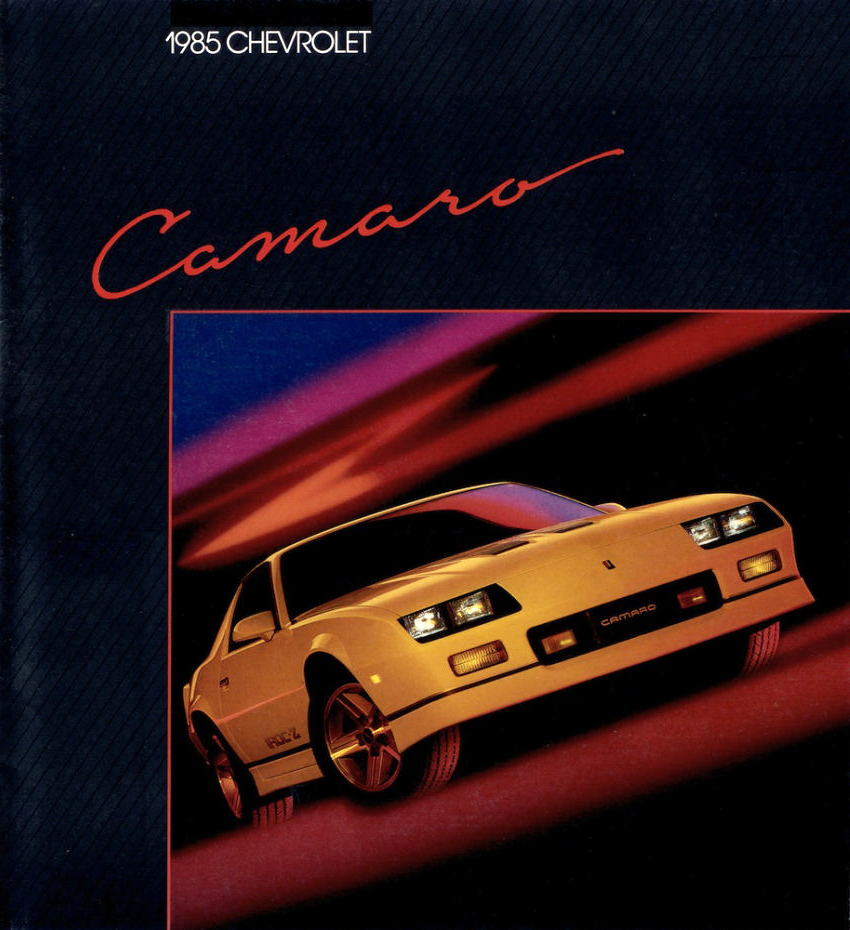
Front cover of the 1985 Chevrolet Camaro brochure

Suspension upgrades specific to the IROC-Z included Delco/Bilstein shock absorbers for the rear wheels and 16-inch wheels all around with Goodyear Eagle GT P245/50VR16 tires—large for the day and a size still readily available.

The IROC-Z also included louvered hood inserts and more aggressive ground effects and spoilers than the Z28. Finally, it was lowered half an inch compared to the Z28.

Three engines were available in 1985 for the IROC-Z, all sized at 5.0 liter/305 ci: standard was the LG4 carburetted motor at 155 bhp. The optional engines available depended on transmission—if you chose the five-speed manual, you could get the High Output carburetted L69 with 190 bhp ($680 and not available on the garden variety Z28) while if you went with the four-speed automatic ($425), you could choose the Tuned Port Injection LB9 at 215 bhp ($695).

Performance with the LB9 was impressive—Motor Trend recorded a 0-60 time of 6.9 seconds. If you cared (and I think most of the target market did not), mileage wasn’t great: the EPA ratings of the day were 16 city/22 highway for the LG4, 15/24 for the L69, and 16/22 for the LB9. With a 16.1-gallon gas tank, the proud new owner of an IROC-Z could expect a range of 250 to 275 miles with a 10% fuel reserve.

Standard equipment on all versions of the Z28 included Sport mirrors, rack and pinion steering, power front disk/rear drum brakes, reclining front bucket seats, a folding rear seat, and an AM radio with dual front speakers.

Options & Production Numbers

Options included four-wheel disk brakes ($179), Custom cloth front bucket seats ($359), a six-way power driver’s seat ($225), air conditioning ($750), Comfortilt steering wheel ($115), power door lock system ($130), power windows ($195), electronic speed control with resume speed ($175), and a rear window wiper and washer ($125). A range of stereos was offered up to an electronically tuned AM/FM stereo radio with seek and scan, a cassette tape player, a clock, and a graphic equalizer ($469).

Chevrolet sold 21,177 IROC-Z versions out of 68,199 Z28s in the 1985 model year, marking an impressive debut. One year later, the IROC-Z would account for 56% of Z28 sales, and in 1988, Chevrolet would phase out the Z28 in favor of the IROC-Z.

The View From 2025

According to Hagerty’s valuation tools, all the money for a 1985 IROC-Z with the top-of-the-line TPI motor and t-tops in #1/Concours condition is $52,500, with a far more normal #3/Good condition version going for $20,200. IROC-Zs regularly appear in the Hemming’s Motor News classifieds, on eBay Motors, and at online auctions such as Bring a Trailer that cater to the eighties car market. As I update this blog entry in June 2025, there’s a Yellow 1985 IROC-Z with 66,000 miles for sale on Hemmings, asking $29,500.

Please make mine Red, with the optional and expensive when new ($846) t-tops. I know they often leak, but I like the look.

Other third-generation Camaro hatchback coupes I have written about include the 1982 Z28 Indy 500 Commemorative Edition, the 1984 Sport Coupe, and the 1986 Berlinetta. I have yet to write about any of the 1987 through 1989 Camaro convertibles.

Last updated June 2025.