1984 Cadillac Eldorado Biarritz convertible

I originally wrote this post in January 2021. In February 2025, it was substantially updated with much additional amplifying detail—enough to make it a new blog entry.

“… this is one convertible that truly brings luxury out in the open.”

For 1984, Cadillac decided to join the eighties convertible party with a version of the Eldorado Biarritz. With a base price of $31,274 (about $99,900 in today’s dollars), the Eldorado droptop was operating in rarified air. In constant dollars, it was the most costly Eldorado of any type since 1960’s hand-crafted Pininfarina-built Brougham.

The only powertrain available for the 1984 Eldorado convertible was the HT-4100 135 bhp 4.1 liter/249 ci V8 with fuel injection paired with a four-speed automatic. With a curb weight of about 3,900 pounds, 0-60 mph came in around 14 seconds. Fuel economy was rated at 17 city/27 highway by 1984 standards (14/20 by today’s measures). A 20.4-gallon gas tank meant an Eldorado convertible owner could expect a range of between 310 and 360 miles with a 10% fuel reserve.

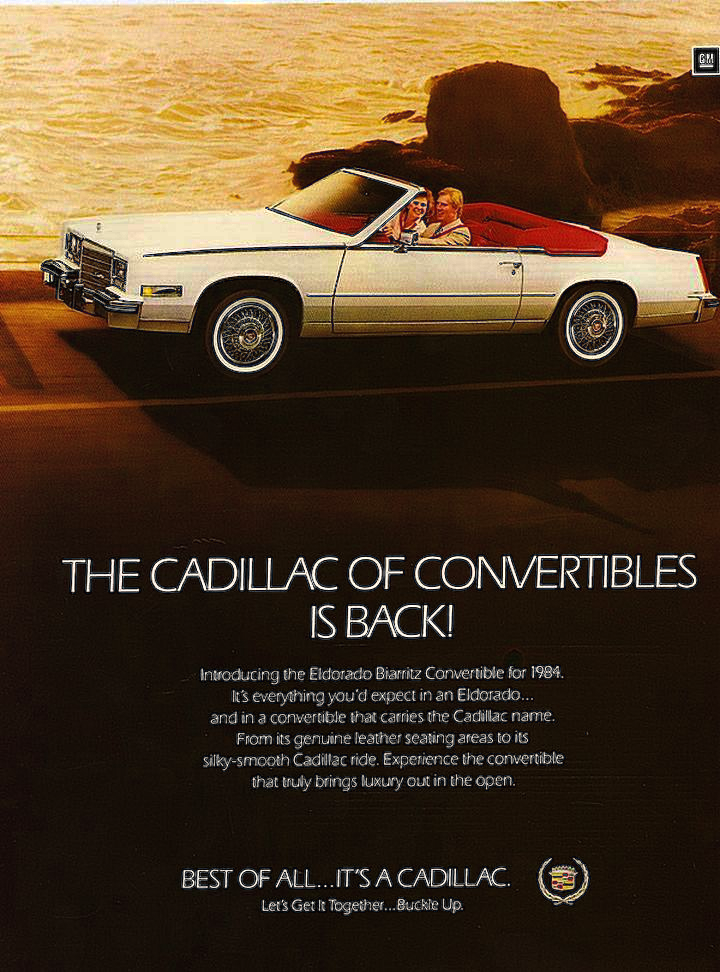
1984 Cadillac Eldorado convertible advertisement
1984 Cadillac Eldorado Biarritz convertible advertisement

Standard exterior and mechanical equipment on the Biarritz convertible included a power convertible top, power rear quarter windows, car color body side moldings, and P225/70R15 steel-belted radial wide white stripe tires (a size still readily available) on 15-inch wheels with wire wheel discs. Inside, a theft-deterrent system, leather seats, and a leather-trimmed steering wheel rim were standard.

Standard exterior and mechanical equipment on every 1984 Eldorado included Soft Ray tinted glass, front-wheel-drive, a four-wheel independent suspension, power steering, remote mirrors, and four-wheel power disk brakes. Inside, electronic climate control, power door locks, and power windows were all included. Standard audio features included a Delco-GM 2000 stereo with four speakers and a power antenna.

Options & Production Numbers

Options available for the Biarritz convertible included a remote locking fuel filler door ($59), electric power outside rearview mirrors ($101), Twilight Sentinel ($79), cruise control ($185), tilt and telescope steering wheel ($184), a six-way power passenger seat ($380), and a Delco 2000 electronically-tuned AM/FM/cassette stereo radio ($299).

Many significant Eldorado coupe options were not available with the convertible. Some unavailable options included the touring suspension, two-tone paint, the memory seat, and the all-conquering Delco-GM/Bose Symphony Sound System.

Cadillac sold 3,300 Eldorado convertibles in 1984—substantial numbers for such a high-end droptop and well more than the platform-mate Buick Riviera managed to sell in any single year. General Motors ended up having to navigate at least one lawsuit from folks who had purchased the 1976 Eldorado, which Cadillac advertised at the time as “the last convertible.”

There would be no more Eldorado convertibles after the end of tenth-generation Eldorado production in 1985. After a year’s break, the Allanté would debut in 1987 and take convertible Cadillacs into the mid-1990s.

The View From 2025

Badge for 2,500 web hits

Despite their sub-optimal motive power, tenth-generation Eldorados attract collector interest, and there is club support. According to Hagerty’s valuation tools, a 1984 Eldorado convertible in #1/Concours condition is $43,100, with a far more normal #3/Good condition version going for $9,800.

These Eldorados are often available in the Hemmings Motor News classifieds, on eBay Motors, on Bring a Trailer, and at in-person auctions. In January 2025, a Cotillion White 1984 Eldorado convertible with red leather “tufted multi-button” seats sold at Barrett-Jackson Scottsdale for a $11,000 hammer price.

Make mine Autumn Maple Firemist, please.

Other Eldorados I have written about include the 1982 Touring Coupe, the 1986 coupe, and the 1988 coupe. Additional E-body/K-body cars with blog entries include the 1980 Buick Riviera S TYPE coupe, the 1980 Cadillac Seville sedan, the 1982 Oldsmobile Toronado Brougham coupe, and the 1984 Buick Riviera T TYPE coupe.

Last updated August 2025.

1980 Cadillac Seville sedan

“Introducing Seville for the 80’s”

For 1980, the Cadillac Seville sedan could justifiably be called all-new. It switched from rear-wheel-drive to front-wheel-drive, used a completely different platform, and made a diesel engine standard.

Of course, the Seville’s exterior look was also completely changed. That styling—by Wayne Cady under Bill Mitchell’s direction—was instantly polarizing; words used in period reviews included striking, astonishing, controversial, and odd. Despite my pre-teen bent toward classically influenced cars, I did not like the new Seville’s design. Perhaps this was because I really liked the styling of the first-generation Seville.

The 1980 Seville’s standard engine was an LF9 105 bhp 5.7 liter/350 ci diesel V8. An L61 145 bhp 6.0 liter/368 ci V8 with fuel injection was a no-cost option. In California, the gasoline engine choice was a 5.7 liter/350 ci V8 with fuel injection.

As might be expected, fuel mileage ratings for the standard diesel were impressive, especially for a car with a 3,911 shipping weight. A Seville owner could expect 21 city/31 highway. With a 23-gallon gas tank, the range was an astounding 540 miles with a 10% fuel reserve—at least in theory. What wasn’t impressive was the Seville’s performance; Road & Track clocked a 0-60 mph time of 21 seconds.

The story was different but not necessarily better with the gas engine. With it, mileage was 14 city/22 highway, so the predicted range dropped to about 375 miles. Performance was notably better, but still not good with the 0-60 time at about 13 seconds.

Standard exterior and mechanical equipment on the $19,662 Seville (about $83,400 in 2025 dollars) included Soft-Ray glass, tungsten-halogen headlamps, a four-wheel independent suspension, electronic level control, four-wheel disc brakes, and P205/75R15 tires (a size still readily available) on 15-inch wheels. Inside, 50/45 Dual Comfort front seats, electronic climate control, and a tilt and telescope steering wheel were included.

Seville Elegante brochure page
Seville Elegante page from the 1980 Cadillac brochure

The $2,934 Elegante package included two-tone paint and 40/40 leather seats. Chrome-plated wire wheel covers were available at no extra cost.

Options included an Astroroof ($1,058), automatic door locks ($129), the Cadillac trip computer ($920), and an AM/FM stereo cassette ($225).

Famously, the Cadillac with the Deadhead sticker that passes Don Henley when he sings about “The Boys of Summer” was a second-generation Seville—likely a 1980 or a 1981.

The View From 2025

According to Hagerty’s valuation tools, all the money for a 1980 Cadillac Seville Elegante with the gas engine (they don’t list values for the diesel) in #1/Concours condition is $23,800, with a more normal #3/Good condition car going for $4,700.

Second-generation Cadillac Sevilles are often available in the Hemmings Motor News classifieds, on eBay Motors, and at online (Bring a Trailer) and in-person auctions. As I write this post, a Woodland Haze 1983 Seville with a Dark Briar Brown interior and 66,000 miles is for sale on Hemmings for $10,000.

Make mine an Elegante in its Sable Black/Sheffield Gray Firemist two-tone, please. Over time, the second-generation styling has grown on me—especially with two-tone paint. Mecum sold a striking Seaspray Green/Neptune Aqua two-tone at their Harrisburg auction in 2019.

Other eighties Cadillacs I have covered include the 1982 Eldorado Touring Coupe, the 1986 Eldorado coupe, the 1986 Fleetwood Brougham sedan, the 1988 Eldorado coupe, the 1989 Allanté convertible, and the 1989 Cadillac Sedan deVille.

Last updated March 2025.

1986 Cadillac Fleetwood Brougham sedan

“Owning a Cadillac is a satisfying experience.”

For 1986, Cadillac transitioned the Fleetwood Brougham from the Cadillac-built HT-4100 130 bhp 4.1 liter/249 ci V8 with fuel injection to the Oldsmobile-built 140 bhp 5.0 liter/307 ci V8 with a Rochester four-barrel carburetor. Production for the model year started late—it didn’t get going until February 1986.

The only powertrain available mated the aforementioned V8 to a four-speed automatic transmission. Mileage was rated at 18 city/25 highway by the day’s standards (16/23 by today’s measures). With a 20.7-gallon fuel tank, a Fleetwood Brougham buyer could expect a range of between 365 and 400 miles with a 10% reserve. The target market didn’t really care about performance, but the 0-60 time was a little under 13 seconds.

Standard exterior equipment on the $21,265 Fleetwood Brougham (about $63,400 in today’s dollars or a little over what a loaded 2025 Cadillac CT5 sedan goes for) included Soft Ray tinted glass and a full padded roof treatment. Mechanical equipment included rear-wheel-drive, power front disc/rear drum brakes, and P215/75R15 steel-belted all-season radial whitewall tires (a size still readily available, including in whitewall) on 15-inch wheels. Inside, an illuminated entry system, power door locks, power windows, electronic climate control, and dual comfort 55/45 heather cloth seats with a six-way power adjuster for the driver were all included in these comfortably equipped cars.

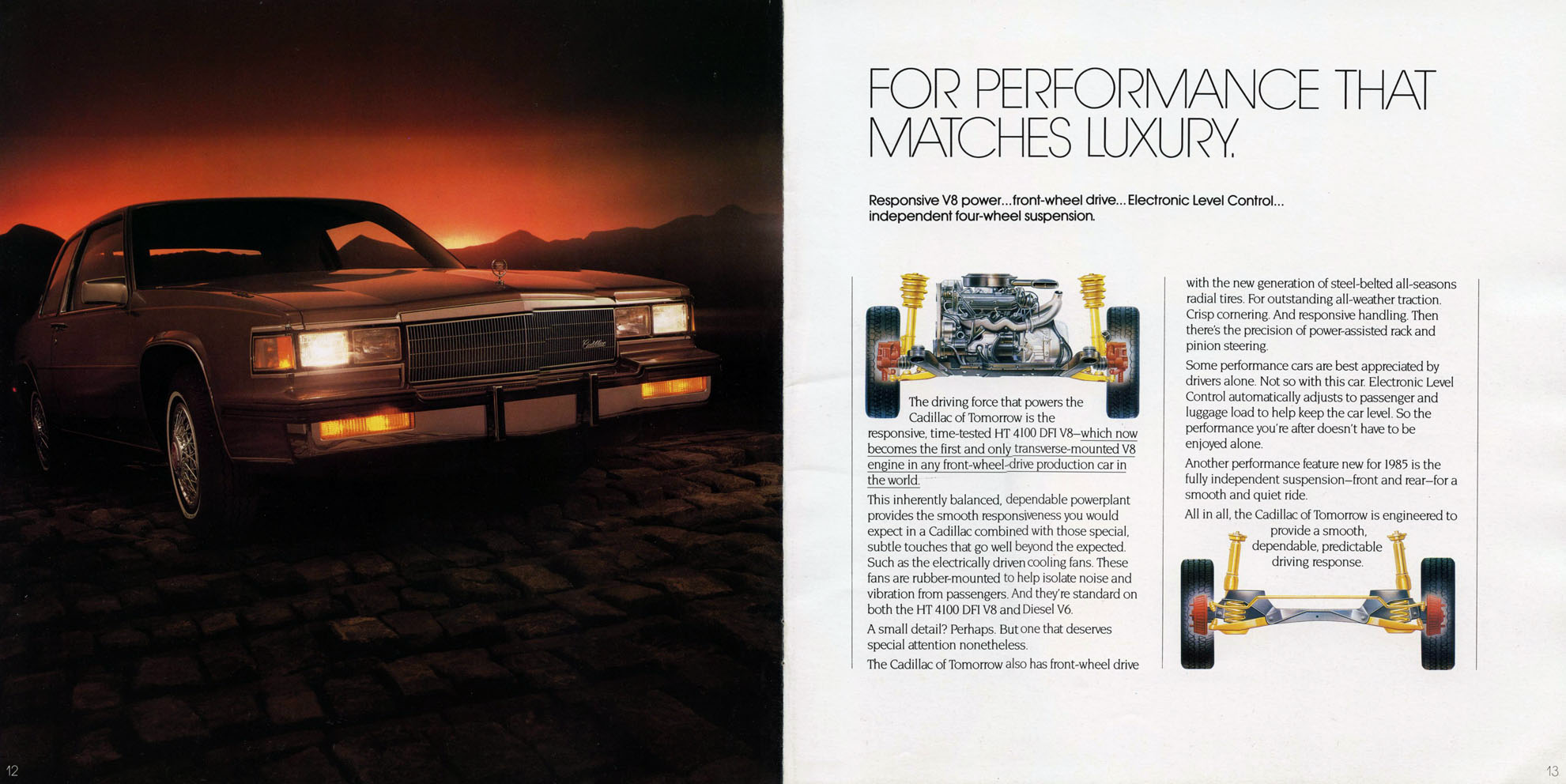
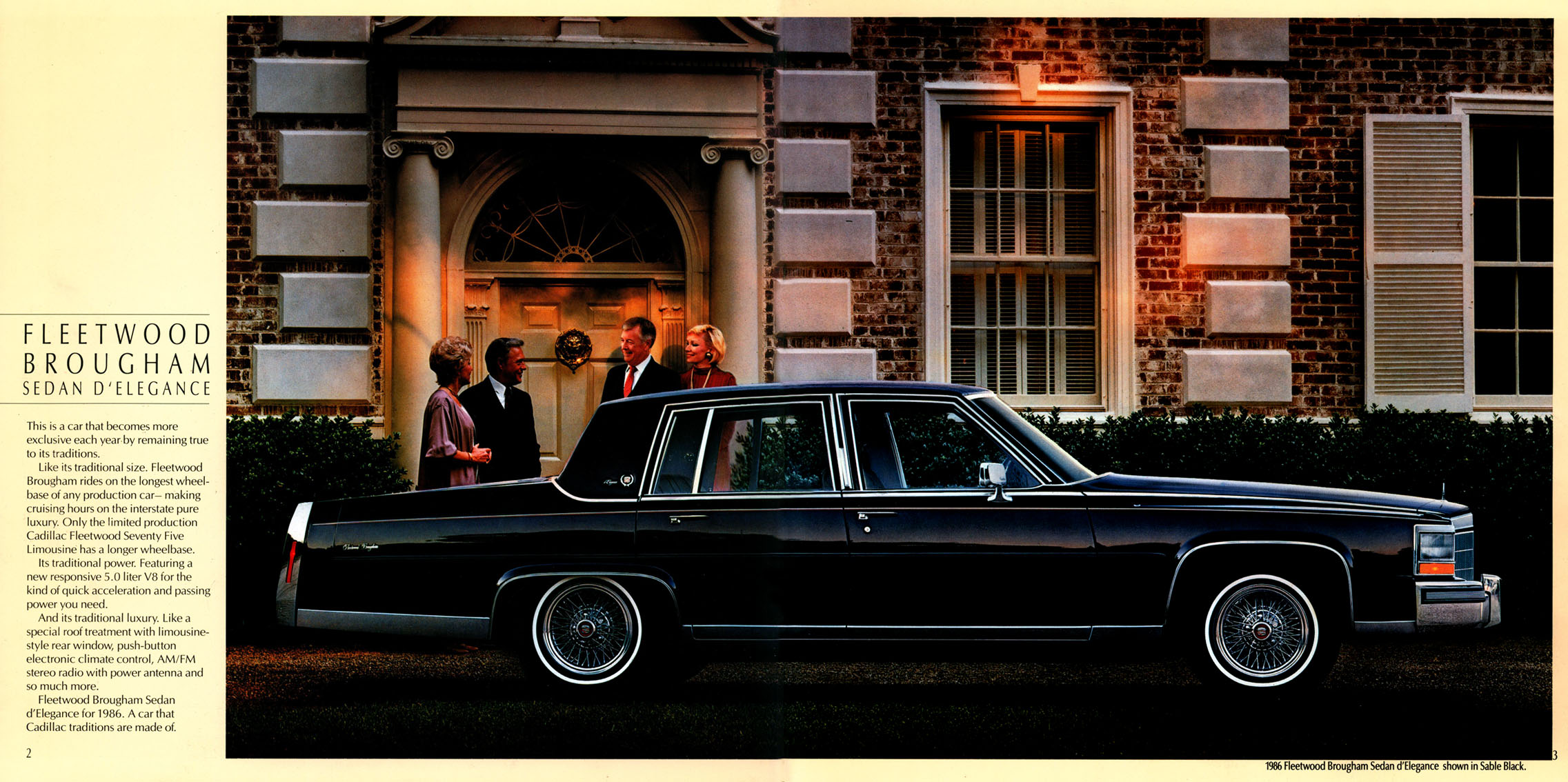
Sedan d'Elegance pages from the 1986 Cadillac Fleetwood Brougham brochure
Sedan d’Elegance pages from the 1986 Cadillac Fleetwood Brougham brochure

Upgrading to the Sedan d’Elegance added adjustable rear seat reading lamps, controlled cycle wipers, tufted pillow-style seating areas, a six-way power seat and manual recliner for the front passenger, and an AM/FM stereo radio with power antenna.

Options & Production Numbers

Among the many exterior and mechanical options were the electrically powered Astroroof ($1,255), electronic level control ($203), and wire wheels ($860 to $940). Inside, Twilight Sentinel ($85), automatic door locks ($170), a power trunk lid release ($40), and a driver’s side memory seat ($215) were available.

The 1986 Fleetwood Brougham sold decently, especially considering the short year—49,115 examples went out the door. By 1986, these cars had evolved into stately evocations of another age. No longer an expression of anything reasonably current in the automotive world, they still received surprising respect in some quarters. In 1987, the name was shortened to just Brougham, but Cadillac would sell the same basic model through the 1992 model year with only one notable update in 1990.

The View From 2025

Folks are collecting these rear-wheel-drive eighties Cadillacs, but values do not approach those of Fleetwoods from previous decades. According to Hagerty’s valuation tools, a 1986 Fleetwood Brougham sedan in #1/Concours condition is $38,500, with a more typical number #3/Good condition car going for $14,300. Eighties Fleetwood Broughams and their ilk are regularly featured in the Hemming’s Motor News classifieds, on eBay Motors, and on Bring a Trailer.

Make mine Autumn Maple Firemist, please.

Other Cadillacs I have written about include the 1980 Seville sedan, the 1982 Cimarron sedan, the 1982 Eldorado Touring Coupe, the 1984 Eldorado Biarritz convertible, the 1986 Eldorado coupe, the 1988 Cimarron sedan, the 1988 Eldorado coupe, the 1989 Allante convertible, and the 1989 Sedan deVille.

Last updated September 2025.

1988 Cadillac Eldorado coupe

“… a bold styling statement.”

For 1988, Cadillac’s Eldorado gained a new 4.5 liter V8, along with a power dome hood, a revised grille, a reshaped rear window treatment, and an extended trunk. Length increased by three inches, and the 1988 Eldorado looked slightly more like the Eldo people had grown to expect. New options for the 1988 Eldorado included an anti-lock brake system and a fully padded roof, which hearkened back to previous generations. All of these changes were developed in a rapid 51 weeks.

The Eldorado’s powertrain was Cadillac’s 155 bhp HT series 4.5 liter/273 ci V8 with throttle body fuel injection paired with a four-speed automatic transmission. Acceleration improved notably—the Eldorado’s 0-60 mph time was now under 10 seconds for the first time since the early 1970s. Fuel economy was 17 city/24 highway by the day’s standards (15/22 by today’s measures). With an 18.8-gallon fuel tank, an Eldorado owner could expect a range of between 315 and 345 miles with a 10% fuel reserve.

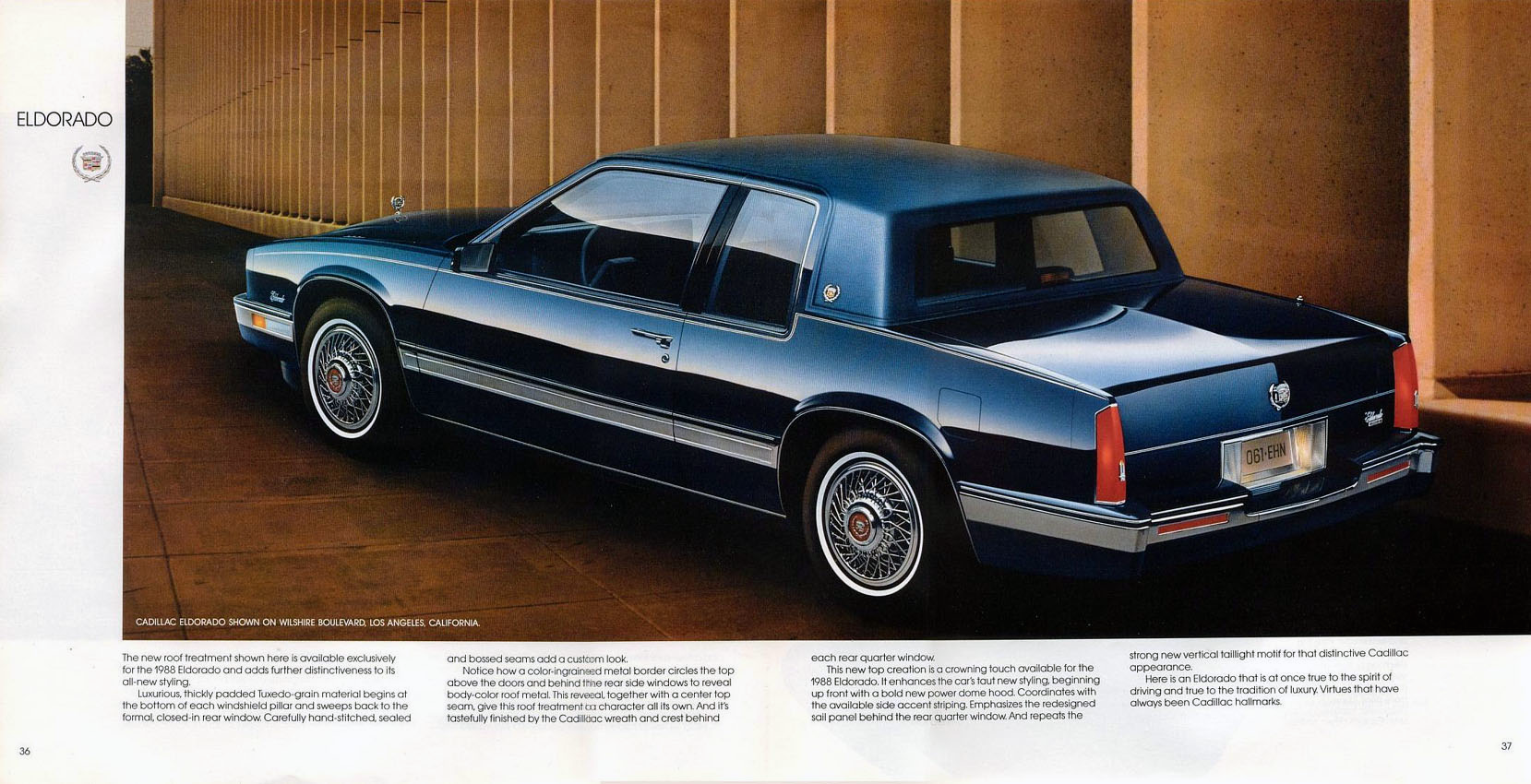
1988 Cadillac Eldorado brochure pages

So, what did those buyers get with their $24,891 (about $70,000 in today’s dollars) 1988 Eldorado? Standard exterior and mechanical equipment included front wheel drive, a four-wheel independent suspension, power-assisted rack and pinion steering, power four-wheel disc brakes, and 205/70R14 tires (a size still readily available) on 14-inch aluminum wheels. Inside, six-way front power seats, a leather-trimmed steering wheel with tilt and telescope adjustment, cruise control, power side mirrors, power windows, power door locks, electronic climate control, Twilight Sentinel, and an AM/FM stereo radio with power antenna were all included—the Eldorado was pretty well equipped.

Packages, Options, & Production Numbers

Moving up to the Biarritz (almost always the top-of-the-line Eldorado since 1956) added wire wheels, two-tone paint, nicer front seats with power lumbar support and power recliners, and real walnut trim on the instrument panel, console, and door trim plates.

Options included anti-lock brakes, touring suspension with 15-inch aluminum alloy wheels, Astroroof, a nicely integrated cellular phone, and the Delco/Bose Symphony Sound System.

The exterior redesign and the new engine definitely assisted sales—they were nearly double what they had been in 1987, though still not close to the salad days of 1985 and prior.

The View From 2025

According to Hagerty’s valuation tools, a 1988 Eldorado in #1/Concours condition is $15,100, with a far more typical #3/Good car going for a mere $5,500. Eldorados of this age come up for sale regularly in the Hemmings Motor News classifieds, on eBay Motors, and Bring a Trailer, so folks are saving them.

Make mine Carmine Red, please.

Other Eldorados I have written about include the 1982 Touring Coupe, the 1984 Biarritz convertible, and the 1986 coupe.

Last updated December 2025.

1982 Cadillac Cimarron sedan

Hemmings Motor News published an extended discussion on the Cadillac Cimarron in their always interesting Hemmings Daily blog, so I figured I’d bring one of my first posts up to a more current location.

“A new kind of Cadillac for a new kind of Cadillac owner.”

Ah—the poor Cadillac Cimarron, rushed to market for CAFE and other reasons without much thought as to who would actually buy it. When released in 1982, it was just a nice as possible, relatively well equipped Chevrolet Cavalier.

Inside page from the 1982 Cadillac Cimarron brochure

The only engine available for 1982 was the 88 bhp L46 1.8 liter/112 ci inline four with Rochester Varajet II two-barrel carburetor. When paired with the standard four-speed manual transmission, mileage was an impressive 26 city/42 highway by the standards of the day (about 21/31 by modern standards), but the car was slow—0-60 mph took about 14 seconds. A three-speed automatic transmission was optional and likely even slower (estimates come to about 16 seconds). The 13.7-gallon fuel tank gave a range of between 330 and 420 miles with a 10% reserve.

The $12,181 base price (about $32,900 in today’s dollars—just a little under what a base 2018 Cadillac ATS sedan costs) included standard exterior and mechanical features such as power brakes, power steering, power mirrors, intermittent windshield wipers, and P195/70R13 tires on 13-inch aluminum wheels. Air conditioning, leather seating areas, a leather steering wheel, a tachometer, and an AM/FM stereo radio with four speakers were all standard in the interior.

Options included a sunroof ($261), cruise control (about $150), power door locks ($12—why bother making them an option?), power windows (yes, the base 1982 Cimarron came with roll-up windows—power windows were an extra $216), six-way power seats ($366), tilt steering wheel ($88), and an AM/FM stereo radio with cassette ($153). It wasn’t hard to load a Cimarron up to almost $13,500—real money in 1982 and about $36,400 in 2018 dollars.

In typical General Motors fashion, the Cimarron improved each year (sometimes significantly). However, the stench of that horribly failed initial release stayed with the car until Cadillac finally stopped selling them at the end of the 1988 model year. By that point, the Cimarron had upgraded from the fairly awful four-cylinder to a decent (and standard) V6 and had exterior styling that was at least somewhat more differentiated from Chevrolet’s.

So, the Cimarron remains a spectacularly easy target—routinely making those “worst ten cars of all time” lists and suchlike. I have yet to see a Cimarron at a serious classic car show, but I’m betting some intrepid soul will save one and bring it back.

Surprisingly, Hagerty does track the Cimarron with their valuation tools—according to them, all the money for a 1982 in #1/Concours condition is $6,100, with a far more typical #3/Good car going for $1,600. I can’t remember ever seeing one for sale in the Hemmings Motor News classifieds—they’re treated by Cadillac folks like Ford folks treat the Mustang II from the 1970s. You do occasionally see them on eBay Motors.

Save

1989 Cadillac Sedan de Ville

For unclear reasons, one, but only one, of the supermarkets in my area often has interesting eighties cars parked outside. In mid-December 2017, despite some snow on the ground, there was a 1989 Cadillac Sedan de Ville on “display” with classic car tags—good enough reason for this blog entry.

“… the definitive full-size luxury car”

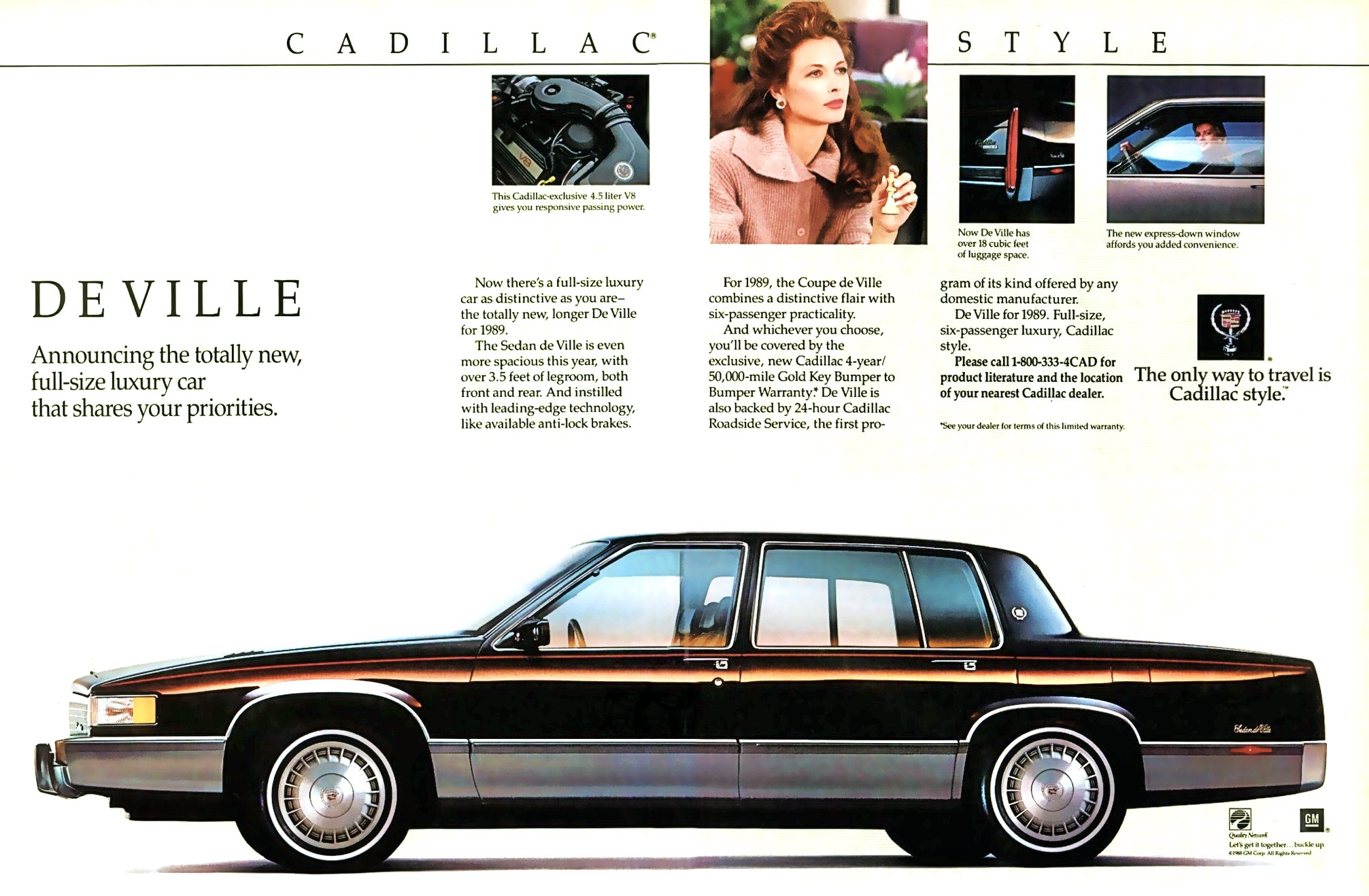
Cadillac’s Sedan de Ville was substantially revised for 1989, marking the first time that it had been “up-sized” for almost two decades. Overall length increased by nearly nine inches, while the wheelbase increased by three inches. The styling of this C-body was more in the traditional Cadillac vein than the 1985-1988 cars, with vertical blades in the rear that somewhat resembled the fins of previous decades. Changes extended to the interior, with more comfortable seats, more room in the rear compartment, and a larger trunk. New options included a heated windshield defogger ($250) and a Delco-Bose Gold Series music system with an AM stereo/FM stereo radio, a compact disc player, and extended-range rear speakers ($872).

Standard power for the front-wheel-drive Sedan de Ville continued to be the transverse-mounted HT 155 bhp 4.5 liter/273 ci V8 with throttle-body fuel injection paired with a Turbo Hydramatic 4T60 four-speed automatic transmission. 0-60 mph took about 10 seconds in the 3,470-pound car. Mileage was 17 city/25 highway by the day’s standards (15/23 by today’s measures)—with an 18-gallon gas tank, a de Ville owner could expect a range of about 310 to 340 miles with a 10% fuel reserve.

1989 Cadillac Sedan de Ville print advertisement

Standard exterior and mechanical equipment on the $25,760 Sedan de Ville (about $69,500 in today’s dollars or about what a loaded 2026 Cadillac CT5 sedan goes for) included tungsten-halogen headlamps, Soft-Ray tinted glass, power rack-and-pinion steering, power brakes, four-wheel independent suspension, and P205/70R15 Michelin steel-belted all seasons whitewall tires (a size still readily available) on 15-inch wheels. Inside, the Sedan de Ville was well equipped: electronic climate control, a six-way power driver’s seat, a tilt-and-telescope steering wheel, cruise control, power side mirrors, power windows (including an express-down driver’s side window), power door locks, and an AM/FM stereo with cassette player were all standard.

Options, Period Reviews, & Production Numbers

Exterior and mechanical options for the 1989 Sedan de Ville included Firemist paint ($240), an Astroroof ($1,355), an anti-lock braking system ($925), and aluminum alloy wheels ($480). Inside, leather seating areas ($560 and including leather-trimmed headrests), a leather-trimmed steering wheel ($115), a theft deterrent system ($225), a digital information cluster ($250), and a rear window defogger ($195) were available.

Reviews of the revised Sedan de Ville were generally positive—Motor Trend referred to the 1989 models as “upgunned”—and it sold well. Cadillac shipped 122,693, making it by far Cadillac’s most successful model for the year—the rear-wheel-drive D-body Brougham was a distant second place with 28,926.

The View From 2025

According to Hagerty’s valuation tools, a 1989 Sedan de Ville in #1/Concours condition is $17,300, with a far more typical #3/Good car going for $7,100 (only the top-of-the-line Allantés do really well among late eighties Cadillacs). This generation of de Villes does maintain a presence in the Hemmings Motor News classifieds, on eBay Motors, and on Bring a Trailer. When I last updated this blog entry in December 2025, there was a Medium Garnet Red Metallic 1989 with 36,000 miles for sale on Hemmings, asking $16,000.

Make mine that same Medium Garnet Red Metallic, please.

Other C-bodies I have covered in this blog are the 1985 Oldsmobile Ninety-Eight Regency sedan and the 1989 Buick Electra Park Avenue Ultra sedan. Other eighties Cadillac sedans I have written about include the 1980 Seville, the 1982 Cimarron, the 1986 Fleetwood Brougham, and the 1988 Cimarron.

Last updated December 2025.

1982 Cadillac Eldorado Touring Coupe

“Created for the person who loves to drive.”

Though Cadillac’s eighth-generation Eldorado had been in production since the 1979 model year, 1982 was the first year for the Touring Coupe edition of the Eldorado. The Touring Coupe marked the first even remotely sporting Eldorado in many years.

Newly standard for the 1982 Eldorado and available on all Cadillacs except the Cimarron was the HT-4100 4.1 liter/249 ci V8 with throttle-body fuel injection. Unfortunately, horsepower for this all-new engine was an unimpressive 125 bhp—somewhat of an issue when considering the Eldorado’s platform mates. Buick’s Riviera T TYPE had a 170 bhp turbocharged V6, and Oldsmobile’s Toronado was available with a 150 bhp V8. Car and Driver clocked a 0-60 time of 15.2 seconds in the approximately 3,800-pound Eldorado, while the Riviera T TYPE was about five seconds faster.

Fuel mileage with the new engine was 17 city/27 highway by the day’s standards. With a 20.4-gallon gas tank, an Eldorado owner could expect a range of 330 to 360 miles with a 10% fuel reserve.

1982 Cadillac Eldorado brochure page
Touring Coupe page from the 1982 Cadillac Eldorado brochure

Standard exterior and mechanical equipment in the $20,666 Eldorado Touring Coupe (about $71,900 in 2025 dollars) included the Touring Suspension and P225/70R15 blackwall tires (a size still readily available) on 15-inch aluminum alloy wheels. Inside, reclining bucket seats, a leather-wrapped steering wheel, and a front seat console were all part of the Touring Coupe experience.

Standard exterior and mechanical equipment on any 1982 Eldorado included front-wheel drive, a four-wheel independent suspension, a four-speed automatic transmission, power steering, tungsten halogen highbeam headlamps, and four-wheel power disc brakes. Inside, Twilight Sentinel, power door locks, power windows, side window defoggers, remote trunk release, electronic climate control with an outside temperature display, a six-way power seat for the driver, and an electronically tuned AM/FM stereo radio with power antenna were all included.

Options, Period Reviews, & Production Numbers

Options included Astroroof ($1,195), electronic cruise control ($175), tilt/telescope steering wheel ($169), and Symphonic Sound System ($290).

The Eldorado Touring Coupe got reasonably even-handed (perhaps a little surprised) reviews from the “buff books,” but didn’t sell very well. First-year sales of 1,700 units (about 3% of overall Eldorado production) declined every year until eighth-generation production ended with the 1985 model year.

The View From 2025

Eighth-generation Eldorados definitely have a following. According to Hagerty’s valuation tools, a 1982 Eldorado in #1/Concours condition is $31,400, with a more normal #3/Good condition car going for $7,800. Eldorado Touring Coupes sometimes show up for sale in the Hemmings Motor News classifieds, on eBay Motors, on Bring a Trailer, and at auction.

There was only one color available for the 1982 Eldorado Touring Coupe (later years had more choices), so make mine Sterling Silver.

Other Eldorados I have written about include the 1984 Biarritz convertible, the 1986 coupe, and the 1988 coupe.

Last updated October 2025.

Save

Save

Save

Save

Save

Save

Save

Save

1988 Cadillac Cimarron sedan

This afternoon I was walking in the University City portion of Philadelphia and I saw a later Cadillac Cimarron driving towards me in surprisingly good shape. As good a reason as any to finally complete this blog entry.

“… built for those who consider driving a sporty pastime.”

It is an article of faith in the automotive world that General Motors often finally gets a car right just before killing it. Examples that spring to mind are the last of the Pontiac Fieros and the last of the Cadillac Allantés. However, in the case of the Cadillac Cimarron, all GM was able to do was make it less awful and embarrassing.

The only engine available for 1988 was the 125 bhp LB6 2.8 liter/173 ci V6 with multi-port fuel injection. When paired with the standard five-speed manual transmission, mileage was 20 city/29 highway by the standards of the day (18/27 by today’s standards). A three-speed automatic transmission was optional and rated at 20 city/27 highway. 0-60 in the 2,800-pound car came in about 9.5 seconds with the manual transmission and about 10.5 seconds with the automatic transmission.

The $16,071 base price (about $33,500 in today’s dollars) included standard exterior and mechanical features such as power brakes, power steering, power mirrors, intermittent windshield wipers, and 13-inch aluminum wheels. Air conditioning, leather seating areas, a leather steering wheel, a tachometer, and an AM/FM stereo radio with four speakers were all standard in the interior.

Options included a sunroof, cruise control, power door locks, power windows, six-way power seat, tilt steering wheel, and the Delco-GM Bose Symphony Sound System.

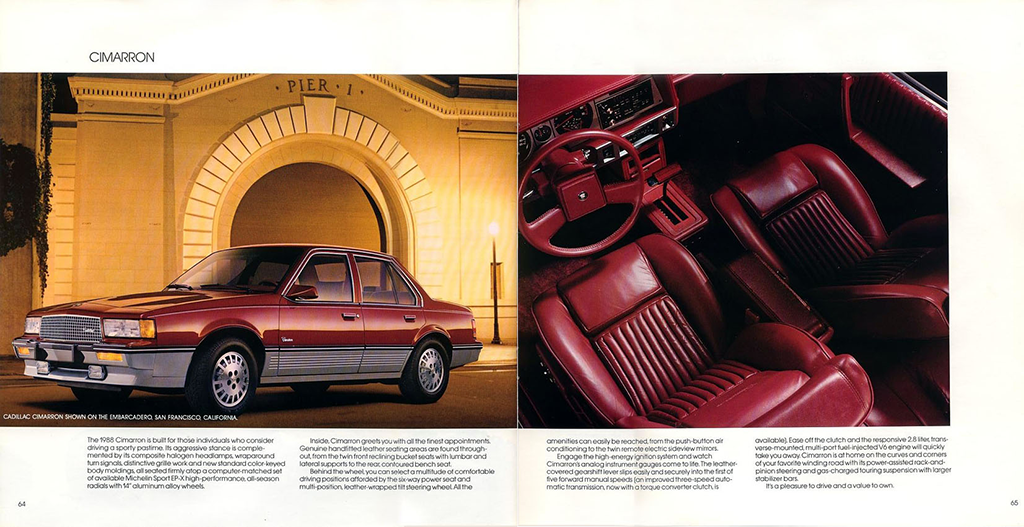
Exterior styling that was at least somewhat more differentiated from the Chevrolet Cavalier sedan than the earliest Cimmarons had been. A more aggressive and distinctive grille had been added in 1984, the front end had been lengthened in 1985, and ribbed lower body cladding had appeared in 1986.

Cimarron pages from the 1988 Cadillac brochure

By 1988, sales of the Cimarron had completely collapsed. After a first year peak of almost 26,000 unit sold in the 1982 model year, sales dropped to a sad 6,454 in the Cimarron’s final model year.

I have yet to see a Cimarron at a serious antique car show—they’re treated by Cadillac folks like Ford folks treat the Mustang II from the 1970s—but I’m betting some intrepid soul will save one and bring it back for judging. You occasionally see them for sale in the Hemming’s Motor News classifieds and on eBay Motors: as I write this in June 2015, there’s a Glacier Blue 1987 Cimarron with a Dark Blue leather interior and 11,300 miles listed on Hemmings for $14,900.

1986 Cadillac Eldorado coupe

“Imaginatively new. Decidedly Cadillac.”

Is it possible to miss the market more than this? For the 1986 model year, Cadillac downsized the front wheel drive Eldorado coupe again. This time, the wheelbase dropped to 108 inches, and overall length was down by over 16 inches to 188 inches—what was supposed to be the top of the non-limousine Cadillac line was now about the size of a 1986 Chevrolet Celebrity (or a 2025 Cadillac CT4 sedan) and a full three feet shorter than the (admittedly massive) 1978 Eldorado.

EightiesEldoradoSales

Predictably, Eldorado buyers didn’t go for it. Sales collapsed from about 74,000 in 1985 to about 21,000 in 1986—definitely not what would be expected from a complete model revision. Six years later, GM had now managed to duplicate the carnage that Ford had experienced with its 1980 luxury vehicle downsizing. Notably, Ford Thunderbird, Lincoln Mark VII (the Continental name departed that year), and Mercury Cougar sales were all up for 1986, along with those of some of GM’s “junior” personal luxury coupes. The December 1987 issue of Special Interest Autos simply called the Eldorado/Riviera/Toronado downsizing “the E-body disaster” and speculated that it was costing GM half a billion dollars a year in lost profits.

1986 Cadillac Eldorado brochure page

So, what did those relatively few buyers get with their $24,251 (about $70,900 in today’s dollars) 1986 Eldorado? Standard exterior and mechanical equipment included power four-wheel disc brakes, power steering, and aluminum alloy wheels. Inside, front bucket seats, power mirrors, power windows, power door locks, a power trunk release, cruise control, electronic climate control, and an AM/FM stereo radio with power antenna were all included, so the Eldorado was at least pretty well equipped.

Packages, Options, & Performance Numbers

Moving up to the Biarritz (almost always the top-of-the-line Eldorado since 1956) cost either $3,095 (with cloth seats) or $3,495 (with leather seats) raising the price to either $27,346 ($79,900 today) or $27,746 ($81,100 today). Standard equipment on the Biarritz included nicer seats with power lumbar support, two-tone paint, and real walnut accents.

Options included a power Astroroof ($1,255), a nicely integrated cellular phone ($2,850), the FE2 touring suspension with 15-inch aluminum alloy wheels and 215/60R15 Goodyear Eagle GT tires ($155), and the Delco-GM/Bose Symphony Sound System ($895).

The Eldorado’s engine was Cadillac’s 130 bhp HT-4100 throttle body fuel injected 4.1 liter/249 ci V8 paired with a four-speed automatic transmission. Fuel economy was 17 city/26 highway by the standards of the day (15/24 by today’s standards). Since the engine and transmission remained the same and the Eldorado was smaller and lighter, performance was better but still not very impressive: 0-60 improved to about 11 seconds.

The View From 2025

According to Hagerty’s valuation tools, all the money for a 1986 Eldorado in #1/Concours condition is $19,100, with a far more typical #3/Good car going for $6,900. Eldorados of this age come up for sale regularly in the Hemmings Motor News classifieds, on eBay Motors, and Bring a Trailer, so folks are saving them.

Make mine Corinthian Blue Firemist, please.

Other Eldorados I have written about include the 1982 Touring Coupe, the 1984 Biarritz convertible, and the 1988 coupe.

Last updated March 2025.

1989 Cadillac Allanté convertible

(talking with a loyal and enthusiastic Allanté owner at the AACA Annual Meeting in 2014 inspired me to write this entry about the last of the 1980s Allantés)

“The only way to travel is Cadillac Style.”

For 1989, the Cadillac Allanté received its first engine upgrade, moving from the 4.1 liter/249 ci HT-4100 V8 to the 4.5 liter/273 ci HT-4500 V8 but remaining connected to the 4T60 4-speed automatic transmission. Power climbed 30 bhp to an even 200 bhp while acceleration improved to about 8.0 seconds to 60 mph with a claimed top speed of 134 mph (probably with the aluminum top on) for Dave Hill’s baby. Mileage declined slightly to 15 city/23 highway by the standards of the day (14/21 by today’s standards. With a 21.9-gallon fuel tank, an Allanté driver could expect a range of 345 to 375 miles with a 10% fuel reserve.

Other changes for 1989 included a new Light Blue Metallic exterior color, new 16 x 7 inch wheels, and a new seat design.

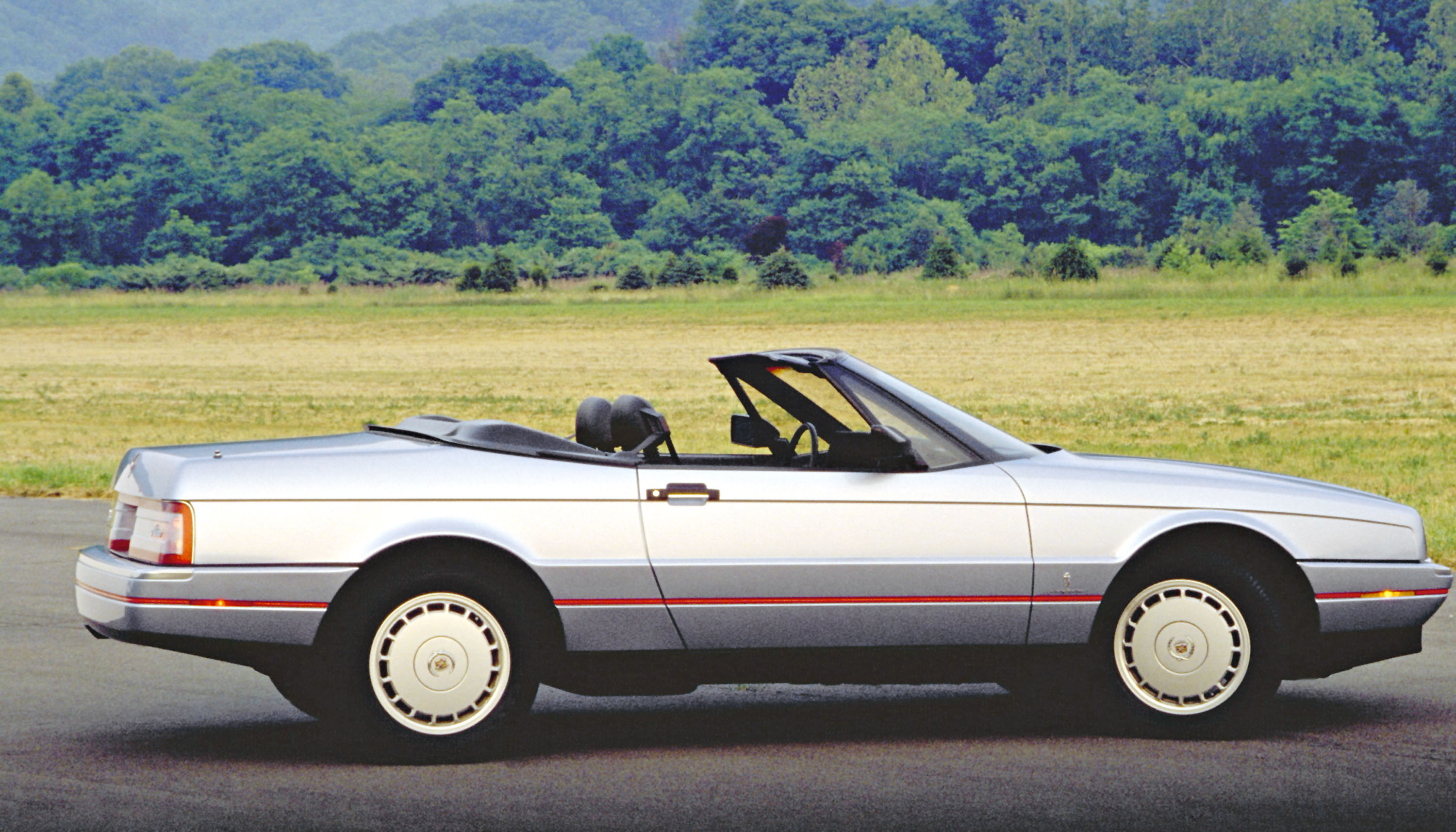
1989 Cadillac Allante
1989 Cadillac Allanté, courtesy of the GM Media Archives

For 1989, the Allanté’s base price remained non-trivial: $57,183 (about $153,400 in 2025 dollars) for the 3,296 buyers. However, just about everything came standard, including ABS, traction control, Goodyear Eagle P225/55VR16 tires (a size still readily available) on 16-inch forged aluminum performance wheels, and the aluminum hard top/cloth convertible top combination. The interior included 10-way leather-covered Recaro bucket seats, electronic climate control, and Symphony Sound System AM/FM stereo with a cassette player. Because it was a Cadillac, you also got air conditioning, power steering, power windows, and power door locks. You could choose either an analog or a digital instrument cluster at no extra charge.

The View From 2025

Allantés have a good club following and consistently appear in the Hemmings Motor News classifieds, on eBay Motors, and on Bring a Trailer. According to Hagerty’s valuation tools, a 1989 Allanté in #1/Concours condition is $23,500, with a far more typical #3/Good car going for $6,700. As I update this blog entry in July 2025, there’s a Pearl White Allanté with a Burgundy interior with 111,000 miles for sale on Hemmings, asking $16,500.

I think the Allanté body style (by Pininfarina, of course) has aged well. It certainly still looks like nothing else on the road—which was definitely one of Cadillac’s goals.

Make mine Pearl White, please.

Last updated July 2025.