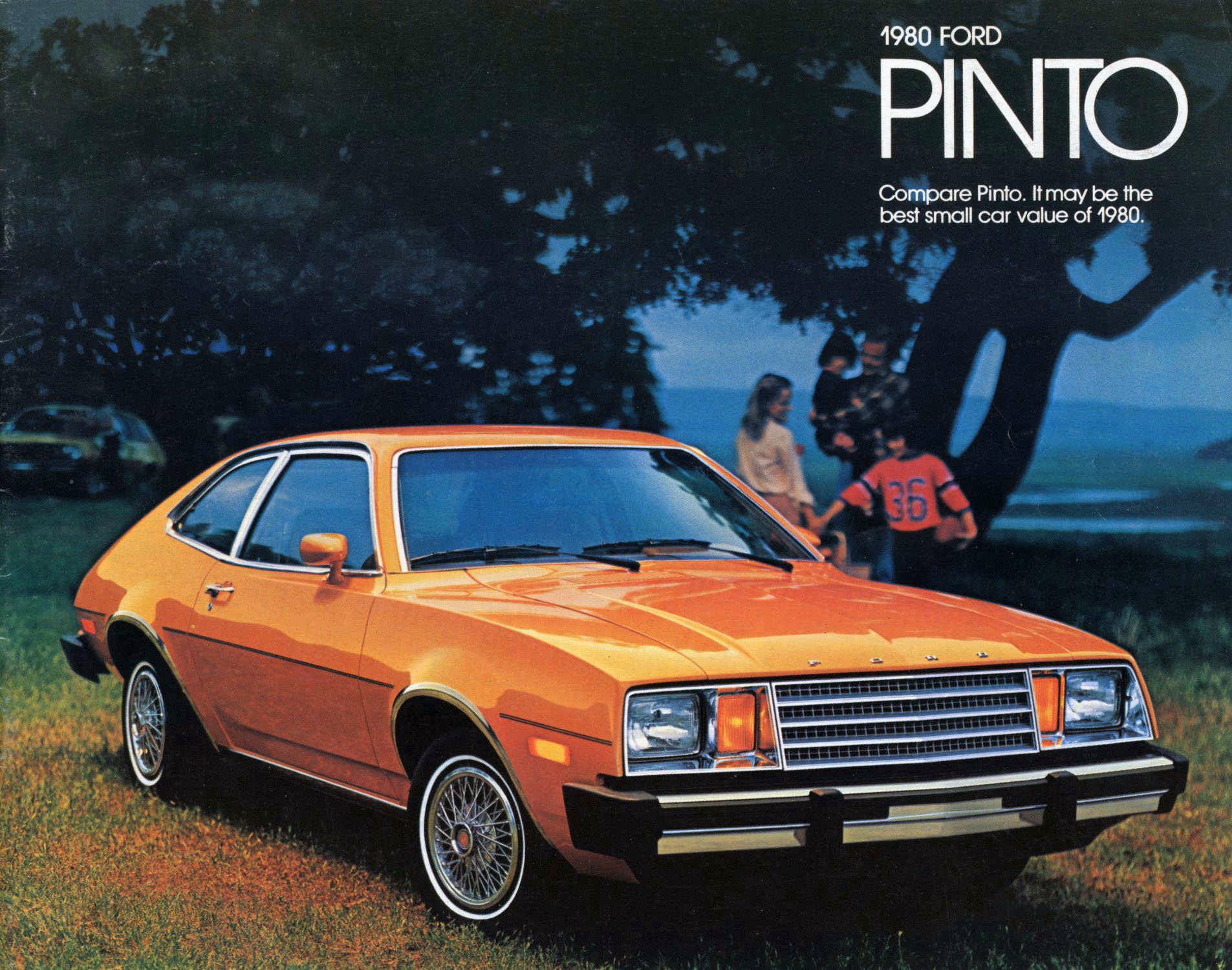
1980 Ford Pinto 2-door sedan

“It may be the best small car value of 1980.”

Ford’s Pinto was little changed in its final year, with minor trim and detail changes and the removal of the V6 engine option.

The only engine remaining was the Lima 88 bhp 2.3 liter/140 ci inline four with a two-barrel carburetor. A four-speed manual was standard, while a SelectShift automatic was optional ($340). 0-60 came in a little over 14 seconds with the manual. Fuel economy was 24 city/38 highway by the day’s standards. With a 13.0-gallon gas tank assembly that now included a longer fuel filler neck and a stronger fuel filler cap than in earlier years, a Pinto owner could expect a range of 295 to 325 miles with a 10% fuel reserve.

1980 Ford Pinto brochure cover

The 1980 Pinto 2-door sedan’s base price was $4,605—about $19,700 in today’s dollars and 30% less expensive than any 2025 Ford product. Standard exterior and mechanical equipment included tinted glass all around, vinyl insert bodyside moldings, rack and pinion steering, front disc/rear drum brakes, and 13-inch black sidewall steel-belted radial ply tires on 13-inch wheels with full wheel covers. Inside, all vinyl or cloth and vinyl high back bucket seats, a mini-console with a storage bin, and an AM pushbutton radio were included.

Packages, Options, & Production Numbers

The wide variety of packages and groups available for the 2-door sedan included:

  • Convenience Group ($118)—pivoting quarter windows, interval windshield wipers, day/night mirror, cigarette lighter
  • ESS Package ($313)—black accents, premium bodyside molding, styled steel wheels with trim rings, ESS nomenclature
  • Exterior Decor Group ($44)—bright grille and headlamp doors, along with bright rocker panel and wheellip moldings, bodyside accent stripes
  • Interior Accent Group ($50)—Deluxe steering wheel, day/night mirror, woodtone appliques, cigarette lighter, rear seat ashtray
  • Interior Decor Group ($238)—cloth/vinyl or all-vinyl low-back bucket seats, Deluxe door trim, Deluxe steering wheel, woodtone appliques, deluxe sound insulation package, courtesy light switch on passenger door
  • Light Group ($41)—map light, lights in glove box, ashtray, engine, and trunk, courtesy light switch on passenger door
  • Sports Package ($118)—3.08 performance rear axle with the manual transmission, Sport steering wheel with black metal spokes, instrumentation (tachometer, ammeter, temperature gauge)

Individual options included a flip-up open air roof ($219), Medium Red Glow metallic glow paint, a Tu-Tone paint/tape treatment, power front disc/rear drum brakes ($78), power steering ($160), the SelectAire conditioner ($538), and series of radios ranging up to an AM/FM stereo with cassette tape player and two door-mounted speakers ($191).

The best-selling Pinto remained the 2-door sedan (Ford’s description), which looked like it should be a hatchback but wasn’t. Ford sold 84,043 of the 2-door sedans (including the decontented Pony edition) compared to 61,542 of the Runabout, which actually was a hatchback but cost 3% more. The all-new Escort would follow in 1981, but that’s another story.

The View From 2025

I haven’t seen a Pinto in the wild for decades, and they have little presence in the Hemmings Motor News classifieds or on eBay Motors. Bring a Trailer has sold four 1980 Pintos in six years.

Make mine Dark Pine Metallic, please.

Other 1980 Fords I have written about include the Fairmont Futura coupe, the Mustang Cobra coupe, and the Thunderbird coupe.

1985 BMW 535i sedan

As I dropped my parents off at church on a Sunday morning a few years ago, I saw a BMW 535i parked on a side street.

“Civilization without isolation”

The 535i version of BMW’s 5-series was introduced in 1985. The 35 in the designation indicated that the sedan newly included BMW’s 182 bhp M30B34 3.4 liter/209 ci inline six with Bosch Motronic fuel injection. A Getrag 265 five-speed manual was standard, and a four-speed automatic was available. 0-60 came in a little under eight seconds in a car with a 3,200-pound curb weight. Fuel economy was rated at a chastening 16 city/22 highway by the day’s standards (14/20 by today’s measures). With a 17.2-gallon gas tank, a 535i owner could expect a range of 265 to 290 miles with a 10% fuel reserve.

1985 BMW 535i print advertisement

The 1985 535i’s base price was $30,760—about $93,900 in today’s dollars and well more than any non M-branded 5 series goes for in 2025. Standard exterior and mechanical equipment on the 535i included a two-position electric sunroof, a fully-independent suspension, power steering, anti-lock power disc brakes, and 200/60-390 tires (a size still readily available thanks to Michelin) on 390 cm wheels. Inside, leather seats, electronic climate control, and an Onboard Computer were included.

Options included a limited slip differential ($390) and electrically adjustable front seats ($415).

The View From 2025

Like most BMWs from the eighties, the 535i attracts collector interest, and there is support from BMW car clubs. According to Hagerty’s valuation tools, all the money for a 1985 BMW 535i in #1/Concours condition is $32,200, with a more normal #3/Good condition car going for $8,400. 535i’s frequently appear for sale in the Hemming’s Motor News classifieds, on eBay Motors, and on Bring A Trailer.

Make mine New Polaris Metallic, please. I know silver is a BMW and other German car cliché, but sometimes a cliché is correct.

Other BMWs I have written about include the 1982 733i sedan, the 1983 633CSi coupe, the 1984 325e coupe, the 1987 L6 coupe, the 1987 M6 coupe, the 1988 M3 coupe, and the 1988 750iL sedan.

1987 Plymouth Turismo hatchback coupe

“Fun is affordable again.”

For 1987, Plymouth’s Turismo hatchback coupe was little changed as it headed into its final model year. The 2.2-liter engine became standard, along with argent Rallye wheels.

The Turismo’s standard powertrain was the K 96 bhp 2.2 liter/135 ci inline four with a two-barrel carburetor paired with a five-speed manual transmission. A three-speed automatic was available as part of the Basic package or the Duster package. 0-60 times are hard to come by for the Turismo, but I’m betting on a little over 10 seconds for the 2,281-pound car—with the five-speed. Fuel economy is better known—25 city/35 highway with the five-speed by the day’s standards (22/32 by today’s measures). With a 13-gallon gas tank, a Turismo driver could expect a range of 320 to 350 miles with a 10% fuel reserve.

Front cover of the 1987 Plymouth Turismo brochure

The $7,199 Turismo (about $21,200 in today’s dollars) had better base equipment for 1987 than it had in previous years. Standard exterior and mechanical equipment included tinted glass, black bodyside moldings, halogen headlights, an electric rear window defroster, a remote liftgate release, power brakes, and P165/80R13 steel belted radial tires (a size now only available from Michelin at considerable expense) on argent 13-inch Rallye steel wheels. Inside, cloth with vinyl trim low-back front bucket seats, a four-spoke color-keyed Sport steering wheel, and an electric rear window defroster were included.

Packages, Options, & Production Numbers

Plymouth offered three packages for the 1987 Turismo:

  • The $776 Basic package included the three-speed automatic and power-assisted steering.
  • The $575 Duster manual package included Duster and Plymouth decals, black dual remote control exterior mirrors, power-assisted steering, cloth with vinyl trim Sport reclining high-back front bucket seats with increased lateral support, Deluxe door trim panels with cloth inserts, a console, and an electronic tuning AM stereo/FM stereo radio with a digital clock and four speakers
  • The $1,009 Duster automatic package included Duster and Plymouth decals, black dual remote control exterior mirrors, the three-speed automatic, power-assisted steering, cloth with vinyl trim Sport reclining high-back front bucket seats with increased lateral support, Deluxe door trim panels with cloth inserts, a console, and an electronic tuning AM stereo/FM stereo radio with a digital clock and four speakers

There were few individual options, but they included California emissions, air conditioning ($701), and an AM/FM stereo cassette with Dynamic Noise Reduction and auto reverse ($246).

Plymouth sold 24,104 Turismos in its final model year—a far cry from the 52,162 sold two years prior. Introduced for 1987, the Sundance coupe would be the putative replacement going forward in Plymouth’s model line.

The View From 2025

I’m going to declare this version of the L-body as vanished. I haven’t seen a Turismo in the wild for decades, and they have little presence in the Hemmings Motor News classifieds or on eBay Motors. Bring a Trailer hasn’t sold any Turismos, though they did sell one of the Scamp pickup truck variants in 2019.

Make mine Garnet Red Pearl Coat, please.

Other Plymouths I have written about include the 1980 Horizon hatchback sedan, the 1980 Volaré station wagon, the 1981 Reliant coupe, and the 1984 Voyager minivan. I’ve also written about the 1983 and 1985 versions of the Dodge Shelby Charger hatchback coupe—the Turismo’s higher-performance sibling.

Last updated October 2025.

1988 Mercury Grand Marquis Colony Park station wagon

“The shape you want to be in.”

For 1988, Mercury’s full-size Colony Park station wagon gained a new and at least somewhat more aerodynamic front end that better integrated the fenders, grille, headlights, and bumper. Inside, the front seats were updated, and the Insta-Clear heated windshield was newly available.

The Colony Park name had a long history within Mercury. The first Colony Park branded wagons appeared in 1957 as the “glamorous style leader” of Mercury’s wagon line. Because there were no Lincoln wagons, the Colony Park was consistently the highest-end wagon available from Ford Motor Company for almost 35 years, and it could be equipped to near-Lincoln levels.

The only powertrain available on the 1988 Colony Park was the Windsor 150 bhp 4.9 liter/302 ci V8 with multi-port fuel injection paired with a four-speed automatic transmission. Acceleration figures are hard to find for this 4,000-pound wagon, but it certainly wasn’t fast. Fuel economy ratings were 17 city/24 highway by the day’s standards (15/22 by today’s measures). With an 18.0-gallon gas tank, Colony Park owners could expect a range of 300 to 330 miles with a 10% fuel reserve.

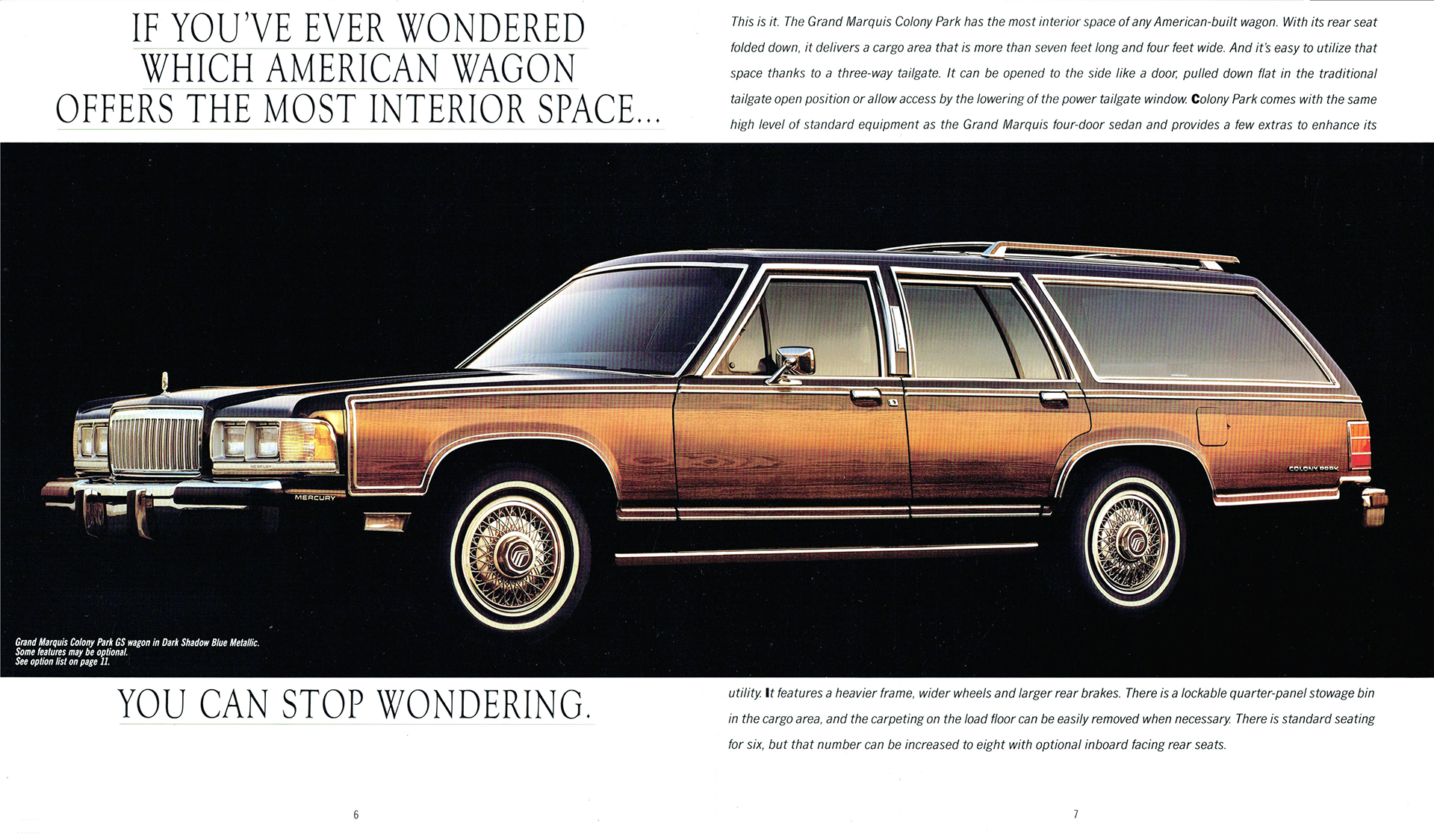
Colony Park pages from the 1988 Mercury Grand Marquis brochure

The 1988 Mercury Grand Marquis Colony Park GS station wagon’s base price was $16,341—about $45,900 in today’s dollars. Standard exterior and mechanical equipment included a bodyside rosewood appliqué, tinted glass, a rear-bumper step pad, power brakes, power steering, and P215/70R15 tires on 15-inch wheels with Deluxe full wheel covers. Inside, vinyl twin comfort seats with dual recliners, Luxury sound insulation, air conditioning, power side windows, a power tailgate window, a quarter-panel stowage bin with lock, a tailgate-activated cargo compartment light, and an electronic AM/FM stereo with four speakers were standard.

For an additional $585, the LS added turbine spoke aluminum wheels, Luxury twin comfort lounge seats with high level cloth, a rear seat center armrest, and the Light Group.

Packages, Options, & Production Numbers

Two packages were available on the Colony Park:

  • Preferred Equipment Package 192A (about $1,700) included front cornering lamps, a Deluxe luggage rack, a 6-way power driver’s seat, dual inboard facing rear seats in vinyl, a tilt steering wheel, fingertip speed control, an electric rear window defroster, and the Power Lock Group.
  • Preferred Equipment Package 193A included everything in 192A and added a power antenna, a leather-wrapped steering wheel, dual illuminated vanity mirrors, and the Premium Sound System (power amplifier, upgraded front and rear speakers, plus two additional speakers).

Exterior and mechanical options included a narrow bodyside molding ($66), the Insta-Clear heated windshield ($250), an automatic leveling suspension ($195), a heavy-duty suspension ($26), and an engine block heater ($18). Inside, buyers could add Automatic Climate Control ($211), a Tripminder computer ($215), and a high-level AM/FM stereo cassette audio system ($472). LS purchasers could also add leather seating surfaces ($415). A loaded LS could near $20,500—not that far from Lincoln Town Car money.

Mercury sold 9,456 Colony Park wagons in the 1988 model year—down about 12% from the previous year despite the freshened styling. Mercury’s offering continued to be outsold by both Buick’s Estate wagons (Electra and LeSabre) and Oldsmobile’s Custom Cruiser wagons—likely its natural competitors.

The View From 2026

Sixth-generation Colony Park wagons sometimes show up for sale in the Hemmings Motor News classifieds, on eBay Motors, and on Bring a Trailer. As I update this blog entry in January 2026, there’s a White 1989 Colony Park GS with 78,000 miles for sale on Hemmings, asking $21,500.

Make mine Medium Cabernet Metallic, I think.

Other Mercurys I have written about include the 1980 Cougar XR-7 coupe, the 1983 Grand Marquis sedan, the 1984 Grand Marquis Colony Park LS station wagon, the 1986 Capri hatchback coupe, the 1987 Lynx XR3 hatchback coupe, and the 1988 Cougar XR-7 coupe.

Last updated January 2026.

0-60 Times in the Eighties

One of the canards of eighties cars is how performance returned over the decade. I’ve accepted this for many years, but recently, I got interested enough to put some time into it.

I ended up plotting about 175 individual 0-60 times of cars I have blogged about, and this chart was the result. The curving green trendline is a polynomial best fit, which drops from 12.5 seconds in 1980 to 7.9 seconds in 1989.

Chart of 0-60 mph times by year in the 1980s

The quickest car I’ve written about is the 1989 Turbo Trans Am, which Car and Driver got to 60 mph in 4.6 seconds—still very respectable even in 2025. The slowest car was a 1980 Cadillac Seville with its standard diesel engine, at 19.7 seconds. Outliers on the lower performance side include the 1986 Hyundai Excel (16.1 seconds), while the 1983 Ferrari Berlinetta Boxer stands out with its 5.0 second 0-60.

The chart definitely supports the premise that performance improved in the 1980s, but there are challenges with the data:

  1. The only data points are from my blog entries. I like to think that I write about a wide variety of cars, but I tend to choose the more interesting ones—which are often the faster versions. So, this skews the data, but likely by about the same for every year.
  2. Some 0-60 times are hard to find, especially of less glamorous or little-changed cars. About 15% of my blog entries did not have a reliable enough 0-60 time for me to usefully plot.
  3. I find that the 0-60 estimation tools are often well off compared to “real” 0-60 times. Thus, I do not trust these tools to create reliable placeholders when I do not have actual data.
  4. There are also the classic differences in 0-60 times between various automobile magazines. Car and Driver was almost always faster—sometimes significantly. An example that comes easily to mind is the 1983 Volkswagen Rabbit GTI, where Car and Driver recorded a 9.7 second 0-60 time, and Road & Track managed a 10.6 second 0-60. Which one to trust?

What do you think?

1982 Buick Riviera convertible

On my birthday, here’s a big, comfortable eighties convertible.

“A classic in its own time.”

After being considered by Buick since the early 1960s, the 1982 model year’s most significant news for the Riviera was the advent of the first production convertibles—though the division didn’t deliver the first examples until July 1982. Every Riviera convertible began life as a “normal” Riviera coupe built at GM’s Linden, NJ assembly plant. Cars destined to become convertibles were assembled with neither a rear seat nor a headliner and were finished in either White or Red Firemist paint with maple leather interiors.

Buick then shipped these coupes about 675 miles to American Sunroof Corporation (ASC) in Lansing, MI, where the involved process of changing them to convertibles began. This procedure required cutting the top off, strengthening the body, adding a different rear seat (narrower than the one fitted to the coupe), and installing the white diamond-grain vinyl convertible top and the associated electronics for the power top’s operation. This process took more than 300 parts and required a quoted 10 hours of labor per car—both notable additions.
Once completed, new Riviera convertibles underwent two separate leak tests to ensure the top’s integrity before being shipped to Buick dealers. Buick general manager Lloyd Reuss was quoted as saying, “it’s not a hacksaw job,” perhaps comparing it to contemporary efforts from Chrysler and Ford.

Advertisement for the 1982 Buick Riviera convertible

Additional standard equipment packaged with the Riviera convertible included contrasting body-side stripes, four-wheel disc brakes, Custom locking wire wheel covers, deluxe trunk trim, 45/45 leather seats, and the aforementioned Firemist paint (if one went with red). Convertible-specific components included a power-operated convertible top, a cloth headliner, power-operated rear quarter windows, and a “special” radio speaker system. It was a good thing that Riviera convertibles came well-equipped because they were really expensive—with a base price of $24,064, 1982’s droptop Riv was about 66% more expensive than its coupe relation’s barrier to entry. In constant dollars, the sixth-generation convertibles are easily the most costly production Rivieras ever built.

Options & Production Numbers

Exterior and mechanical options for the convertible included door edge guards ($15), an 85-amp Delcotron generator ($35), tungsten-halogen high beam headlamps ($10), and Twilight Sentinel headlamp control ($97). Inside, electric seat back recliners for the driver and front passenger ($139 each), Electronic Touch Climate Control air conditioning ($150), and a tilt and telescoping steering column ($150) were available. Buick offered five optional radios for the Riviera, ranging up to a Delco ETR AM-FM stereo radio with a cassette tape player, CB, and Triband power antenna.

For all its expense—a Riviera convertible started at about $80,200 in today’s dollars—the convertible made and continues to make a distinct impression. A friend of mine who has owned his Riviera convertible since new remembers viewing one at a Buick dealership and thinking it was one of the most beautiful cars he had ever seen.

Buick sold 1,248 Riviera convertibles in the 1982 model year, making the droptop 2.8% of overall production. Approximately sixty were part of Buick’s Select 60 program for top dealers.

The View From 2025

There’s robust discussion and support for the sixth-generation Riviera on the AACA’s Buick Riviera page. According to Hagerty’s valuation tools, a 1982 Riviera convertible in #1/Concours condition is $40,600, with a far more normal #3/Good condition going for $12,900. Riviera convertibles often come up for sale in the Hemmings Motor News classifieds, on eBay Motors, on Bring a Trailer, and at in-person auctions.

Make mine Red Firemist, please.

Other sixth-generation Rivieras I have written about include the 1980 S TYPE and the 1984 T TYPE. I should write about a “civilian” coupe at some point.

Most material in this blog entry was sourced from the unfinished Riviera Project.

Last updated December 2025.

1985 Oldsmobile Cutlass Ciera sedan

One of my regular readers and commenters mentioned that he once owned a 1985 Oldsmobile Cutlass Ciera sedan. Longtime followers of this blog know that’s a great way to inspire an article—especially with the knowledge that I had already written about the Buick, Chevrolet, and Pontiac versions of the A-car.

“You always win with a mid-size leader in high style.”

For 1985, Oldsmobile’s Cutlass Ciera received its first facelift, with updates to the front fascia that included a new grille and sleeker headlights. The taillamps were revised, and a high-center mount stop lamp was optional one year before it would be required.

The Ciera’s standard powertrain remained the Iron Duke 92 bhp 2.5-liter/151 ci inline four with fuel injection paired with a three-speed automatic transmission. The LK9 110 bhp 3.0 liter/181 ci V6 with a two-barrel carburetor added $260, while the LG3 125 bhp 3.8 liter/231 V6 with multi-port fuel injection cost $520. The LT7 85 bhp 4.3 liter/263 ci diesel V6 was $260. A four-speed automatic was $175.

The best case 0-60 time was about 11 seconds with the 3.8 liter V6 and the four-speed automatic. Fuel economy ratings for the same combination were 18 city/25 highway by the day’s standards (16/23 by today’s measures). With a 15.6-gallon gas tank, the owner of the quickest Ciera could expect a range of 275 to 300 miles.

The owner of a Ciera with the base Iron Duke/three-speed automatic powertrain might as well have been driving a different car. Their 0-60 time was more like 16 seconds. Fuel economy ratings were an impressive 23 city/32 highway by 1985 standards (21/29 by 2025 measures). With the same 15.6-gallon gas tank, the owner of that Ciera could expect a range of 355 to 385 miles.

Ciera LS page from the 1985 Oldsmobile Cutlass brochure

The 1985 Cutlass Ciera LS sedan was $9,497—about $28,900 in today’s dollars. Standard exterior and mechanical equipment included a front-end panel stand-up ornament, power rack and pinion steering, low drag power front disc brakes, P185/75R14 steel-belted radial-ply all season blackwall tires, and Deluxe wheel discs. Inside, a Custom bench seat with a center armrest in either cloth or vinyl and an AM push-button radio with dual front speakers and a fixed mast fender antenna were included.

Moving up to the $9,998 Brougham added bright rocker panel and wheel opening moldings, a Convenience Group (lamps, visor vanity mirror, and chime tones), knit velour trims, and a divided front seat with individual controls and a center armrest.

One Package, Options, & Production Numbers

Oldsmobile continued to offer a sporty ES package for the Ciera. Built on the LS sedan and adding $895, the ES included a firm ride and handling package, P195/75R14 steel-belted radial-ply blackwall tires on 14-inch wheels with styled wheel discs, reclining bucket seats, and a console with shifter.

Individual options included Soft-Ray tinted glass, a glass panel sunroof ($310), styled aluminum wheels, a four-season air conditioner, and cruise control ($175). Custom leather trim was only available with the Brougham. Three optional radios were offered, with the top-of-the-line being an ETR AM/FM stereo cassette with auto reverse, seek and scan, noise reduction, extended range speakers, and a clock.

August 1983 Fortune magazine cover

Oldsmobile sold 118,575 LS sedans and 112,441 Brougham sedans, making Ciera sedans 21% of total Oldsmobile production. Cieras overall were two out of every seven sales at an average Oldsmobile dealer. Cieras were also relatively reliable and had few, if any, recalls—a significant improvement over the X-cars.

Of course, the Ciera was one of the four poster children for Fortune magazine’s brutal but accurate August 22nd, 1983 cover. Many believe that cover alone changed the future direction of GM styling, but perhaps that course-correction came too late.

The View From 2025

I see these A-body cars as basic and honest, and believe they deserved their sales numbers. Cutlass Cieras sometimes show up for sale in the Hemmings Motor News classifieds or on eBay Motors, though this is increasingly unusual. Bring a Trailer has sold four Cieras.

Make mine Light Chestnut Metallic, please.

Other A-bodies I have written about include the 1983 Pontiac 6000 STE sedan, the 1985 Chevrolet Celebrity Eurosport coupe, the 1986 Buick Century sedan, and the 1989 Chevrolet Celebrity sedan. Blog entries on Oldsmobiles with the Cutlass name include the 1980 Cutlass coupe, the 1981 Cutlass Supreme coupe, and the 1985 Cutlass Supreme coupe.

Interesting Eighties Vehicles at the 2025 Mecum Indy

Mecum’s annual Indy auction finished on May 17th this year. In the middle of 2021, I gave up trying to chronicle every eighties vehicle sold at any particular auction—there’s often an endless sameness to them. So, I now only write about the cars and trucks less seen at auction—and those that sell (a red 1986 Ferrari Testarossa coupe was a no-sale at $135,000). Here are eight out of the 108 that sold that attracted my eye, described in a little more detail than usual.

1982 DeMarco, linked from Mecum’s website

[Lot J147] 1982 DeMarco convertible. Black with a tan vinyl top and Camel leather/vinyl front bucket seats. L81 190 bhp 5.7 liter/350 ci V8 with a four-barrel carburetor, a four-speed manual, and 12,000 miles. $26,000 hammer price for this handsome and relatively rare (they only made 50 or so) convertible conversion, based on a 1981 Chevrolet Corvette but completed (and titled) in 1982.

1987 Chevrolet S-10 Blazer, linked from Mecum’s website

[J186] 1987 Chevrolet S-10 Blazer 4×4 SUV. Apple Red/Frost White two-tone with Carmine vinyl front bucket seats. LL2 125 bhp 2.8 liter/173 ci V6 with fuel injection, a four-speed automatic, and 71,000 miles. $9,500 bought this exceptionally clean and stock S-10 Blazer—how many like this are left?

Photo of 1985 Buick Riviera convertible auctioned at Mecum Indy 2025
1985 Buick Riviera convertible, photo courtesy of Mecum

[K60] 1985 Buick Riviera convertible. Red Firemist with a white convertible top and a red leather/vinyl front 45/45 seat. LM9 200 bhp 3.8 liter/231 ci V6 with sequential fuel injection and a turbocharger, a four-speed automatic, and 67,000 miles. $16,500 for what might be the most interesting example of the Riviera convertibles—rare because it’s a final-year convertible, and even rarer because it is Red Firemist and equipped with a turbo V6 (instead of the far more common V8). I have written about the Riviera convertible many times, but never in this blog—maybe it’s time to fix that.

1981 Checker Marathon, linked from Mecum’s website

[L63] 1981 Checker Marathon taxi. Yellow (natch) with a black vinyl front bench seat. L39 115 bhp 4.4 liter/268 ci V8 with a two-barrel carburetor and a three-speed automatic. Showing 81,000 miles, but who knows how many times that five-digit odometer rolled over. $6,000 is right at Hagerty’s #4/Fair money for a 1981 Checker with a V8.

1987 Chevrolet Chevette exterior
1981 Buick Regal, linked from Mecum’s website

[W24] 1981 Buick Regal Pace Car Edition coupe. Silver/Dark Maple two-tone with maroon cloth front bucket seats. LC3 110 bhp 3.8 liter/231 ci V6 with a two-barrel carburetor, a four-speed automatic, and 72,000 miles. $18,000 for one of 150 built. You could get a Regal with a turbo in 1981, but Buick elected not to do that with these pace car replicas.

1984 Ford Mustang, linked from Mecum’s website

[W175] 1984 Ford Mustang 20th Anniversary convertible. Oxford White with Canyon Red cloth front bucket seats. Lima 145 bhp 2.3 liter/140 ci inline four with fuel injection and a turbocharger, a five-speed manual, and 4,000 miles. You see a reasonable number of 20th Anniversary convertibles for sale, but you sure don’t see many of them with the turbo four and its distinctive hood bulge. $16,500

1988 Ford Thunderbird, linked from Mecum’s website

[W176] 1988 Ford Thunderbird LX coupe. Oxford White with Scarlet Red luxury cloth split front bench seat. 155 bhp Windsor 4.9 liter/302 ci V8 with fuel injection, a four-speed automatic, and 86 miles. At $17,000, this has to be the nicest 1988 LX remaining—right? Also, why am I seeing so many ridiculously nice late eighties ‘Birds?

1984 Oldsmobile Cutlass Ciera, linked from Mecum’s website

[T240] 1985 Oldsmobile Cutlass Ciera convertible. White with a white convertible top and Claret leather front bucket seats. LG3 125 bhp 3.8 liter/231 ci V6 with fuel injection, a four-speed automatic, and 43,000 miles. $8,000 for this Hess and Eisenhardt convertible conversion.

1983 Honda Accord sedan

“Simply beautiful to own and drive.”

November 1, 1982 was an incredibly important date for Honda. That day, a Charcoal Gray Metallic 1983 Honda Accord sedan rolled off the production line at Honda’s Marysville, Ohio plant. That car is currently on exhibition at the marvelous Henry Ford Museum of American Innovation.

The only engine available for any 1983 Accord was the EK1 75 bhp 1.8 liter/107 ci inline four with a three-barrel carburetor. A five-speed manual was standard, while a four-speed automatic transmission was newly available. Consumer Guide clocked a 13.0-second 0-60 time with the manual, which they charitably described as “brisk.” Fuel economy ratings were 32 city/45 highway by the day’s standards (25/32 by today’s measures). With a 15.9-gallon gas tank, an Accord driver could expect a range of between 410 and 495 miles.

Cover of 1983 Honda Accord brochure

The 1983 Honda Accord sedan’s base price was $8,345—about $27,500 in today’s dollars, which is almost exactly what a 2025 Honda Accord LX sedan goes for. Standard exterior and mechanical equipment included dual halogen headlights, tinted glass, variable-assist power rack and pinion steering, power disc/rear drum brakes, and P185/70R13 steel-belted radial ply tires on 13-inch wheels. Inside, cloth reclining front bucket seats with adjustable headrests, cruise control, two speed plus intermittent wipers, a rear window defroster, a remote-control outside rearview mirror, a remote trunk lid release, a tachometer, and a quartz clock with a sweep hand were standard.

One Package, Dealer Options, & Production Numbers

In the middle of the model year, Honda released the Accord Special Edition. The SE added a power sunroof, aluminum alloy wheels, Michelin steel-belted radial tires, leather seats, air conditioning, dual remote-controlled outside mirrors, power windows, power locks, and an AM/FM digital electronic stereo with a stereo cassette player with Dolby noise reduction, a seven-band graphic equalizer, and a power antenna.

There were no factory options—you chose the transmission and the color, and that was it. All options were dealer-installed, including air conditioning for non SE‘s ($500) and eight different radios.

Honda produced 221,137 Accords for the 1983 model year. Comments on the Accord’s build quality from the automotive press continued to range from admiring to stunned—Consumer Guide commented on their test Accord’s “lustrous” paint and “formidable” quality control.

The View From 2025

Second-generation Accords were once prevalent on American roads, but have virtually disappeared by now. You occasionally see these Accords for sale in the Hemmings Motor News classifieds, on eBay Motors, and on Bring a Trailer, but there were no sedans out there as I write this in May 2025.

Make mine Paisley Red Metallic, please.

Other Hondas I have written about include the 1982 Prelude Sport Coupe, the 1983 Civic S hatchback coupe, the 1984 Civic DX hatchback coupe, the 1984 Civic CRX hatchback coupe, the 1985 Civic CRX Si hatchback coupe, the 1986 Accord sedan, the 1986 Prelude Si coupe, and the 1988 Civic sedan.

Last updated September 2025.

1984 Pontiac Fiero coupe

“Dramatically innovative. Exclusively Pontiac.”

The Pontiac Fiero came to market in 1984 with ridiculous expectations, partially driven by Pontiac and partly by how the public sees two-seat mid-engine cars. What had initially been proposed in the late seventies as a “small, sporty commuter car” became a significant part of Pontiac’s mid-eighties We Build Excitement strategy.

Soon, the painful fact that the Fiero’s mechanical parts were from the low end of the General Motors parts bin became stunningly obvious. Citation and Chevette suspension parts abounded, and the only available engine was the distinctly uninspiring 2.5 liter/151 ci Iron Duke inline four with fuel injection, featuring all of 92 bhp.

Predictably, handling and acceleration did not meet expectations, with Road & Track clocking an 11.6-second 0-60 time with the standard four-speed manual. On the other hand, fuel economy numbers were impressive—27 city/47 highway by the day’s standards (21/33 by 2025 measures). Only the tiny 8.7-gallon gas tank kept range with a 10% fuel reserve at a mere 215 to 260 miles.

Fiero pages from the 1984 Pontiac prestige brochure

Standard exterior and mechanical equipment on the $7,999 Fiero (about $25,700 in 2025 dollars) included retractable tungsten halogen headlamps, Sport mirrors, rack and pinion steering, 4-wheel vented power disc brakes, and 185/80R13 tires (a size now only available from Michelin) on 13-inch Rally wheels. Inside, reclining cloth bucket seats, a floor console, and a rear window defroster were included.

Three Optional Models

The $8,499 Fiero Sport added an AM radio. Likely the most important feature of the Sport option was that it added the availability of options such as an automatic transmission, 14-inch tires and wheels, air conditioning, and upgraded seats.

The $9,599 Fiero SE added Soft-Ray tinted glass, the Special Performance Package, 195/70R14 tires (a size still readily available) on 14-inch Hi Tech Turbo wheels, Custom cloth reclining bucket seats, a Formula steering wheel, and an AM radio with a digital readout.

The Indy Pace Car Edition cost an additional $2,895 over an SE and added a specific exterior treatment with ground effects and a rear spoiler, a pop-up sunroof, and white bucket seats with red inserts. All Indy Pace Car Editions had a White over Medium Gray two-tone—Pontiac made 2,000 of them. At a minimum of $12,494 without additional options, they were about $39,200 in today’s dollars, or almost exactly what a 2025 Mazda MX-5 Miata RF Grand Touring goes for.

Individual Options, Production Numbers, & Period Reception

Individual options included a removable glass sunroof ($300), a tilt steering wheel ($110), air conditioning ($730), an electric rear window defogger ($140), power door locks ($125), and power windows ($185).

Fiero sales overall totaled 136,840 in the 1984 model year, with 49% of those being the top-of-the-line SE. First-year sales accounted for 37% of the total number of Fieros produced over five years.

Reviews from the buff books were decent, though there was disappointment at the Iron Duke-only power—especially since Pontiac was already talking about a V6 (and alleging it would be turbocharged). Reading those early reviews, you can sense that the magazines wanted such an undeniably different domestic product to be good.

Then, of course, the recalls came—four in all for the 1984 Fiero. They were primarily related to the fuel system, and the recalls were driven by many fires (perhaps one for every 300 Fieros made in 1984). Pontiac would eventually acknowledge and fix most of the problems, but the damage had been done.

The View From 2025

According to Hagerty’s valuation tools, a 1984 Fiero Indy Pace Car Edition in #1/Concours condition is $25,000, with a more common #3/Good condition car going for $9,800. An SE is about 44% less, while a base car is 46% off. Fieros have a good club and forum following and a fairly strong presence in Hemming’s Motor News classifieds, on eBay Motors, and on Bring a Trailer. As I update this blog entry in December 2025, there’s a White 1984 Fiero Indy Pace Car Edition with 1,676 miles for sale on Hemmings, asking $30,000.

Make mine Fiero Red, please.

SaveTwo other Fieros I have written about are the 1986 GT coupe and the 1988 Formula coupe. Other 1984 Pontiacs I have written about include the Firebird Trans Am 15th Anniversary Edition hatchback coupe and the 2000 Sunbird S/E hatchback coupe.

Last updated December 2025.