
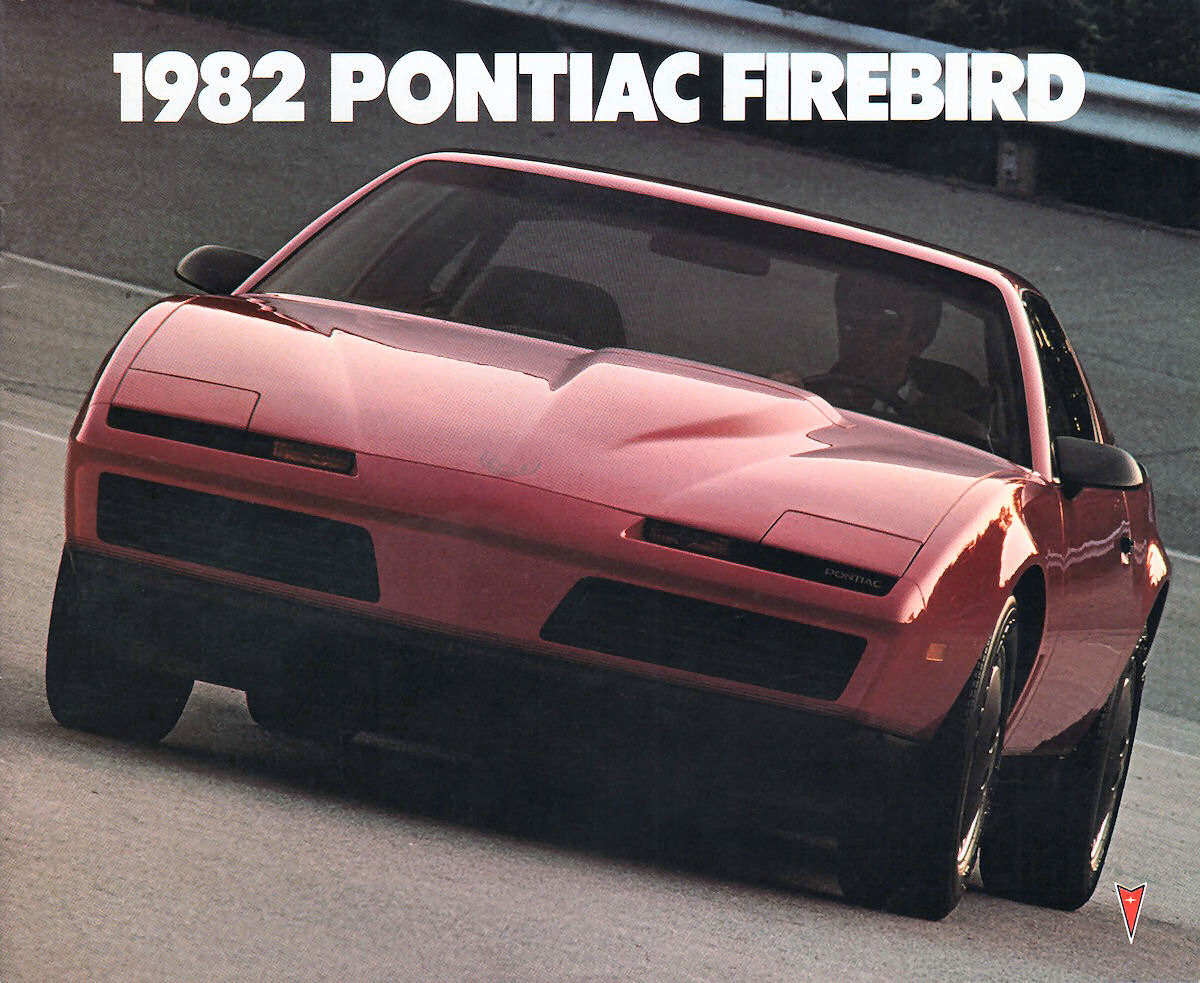
“From saber-like nose to rakish tail, the Trans Am is a brilliant orchestration of aerodynamic function.”
It is hard now to remember how new and wildly aerodynamic the 1982 Pontiac Firebird Trans Am looked when it debuted—Car and Driver wrote that its “exterior sculpturing is an absolute knockout.” The Trans Am suddenly made every other American car (and more than a few European ones) look like they were standing still.
The Trans Am didn’t just look aerodynamic, either: the drag coefficient of .323 is still respectable even in 2025. Pontiac’s choice of pop-up headlights (over the Camaro’s open headlights) and careful airflow tuning yielded an impressive result. According to Autopolis’ excellent article on the 1980-1981 Turbo Trans Am, the third-generation Trans Am’s distinctive hood bulge was intended for a turbocharged V8.
Unfortunately, the mechanicals did not come close to backing up the looks. The top-of-the-line engine for the Trans Am was the LU5 Cross-Fire 165 bhp 5.0 liter/305 ci V8 with throttle-body fuel injection—and that was only available with a three-speed automatic transmission, yielding about a nine-second zero to sixty time (Motor Trend managed to do it in 8.89 seconds). If you wanted the four-speed manual transmission, the best engine choice available on the Trans Am was the base LG4 145 bhp 5.0 liter/305 ci V8 with a four-barrel carburetor—and approximately ten seconds from 0 to 60 mph.
These performance challenges, however, did not prevent Pontiac from implying the world in its commercials for the Trans Am—and having Richard Basehart do the narration.
Standard exterior and mechanical equipment on the $9,658 Trans Am (about $33,500 in today’s dollars) included power brakes (front disc/rear drum), hidden electronically-controlled halogen headlamps, dual sport mirrors, an all-glass rear hatch, a rear decklid spoiler, and 205/70R14 steel-belted radial tires (still a readily available size) on 14-inch turbo cast-aluminum wheels. Inside, reclining front bucket seats, a folding rear seat, a Formula steering wheel, and side window defoggers were included.
Options & Production Numbers
Options included a special performance package ($387 bought you the special handling package, four-wheel disc brakes, and 215/65R15 blackwall tires on 15 x 7 aluminum wheels), tinted glass, a rear hatch washer/wiper, power windows ($165), power door locks ($106), a tilt steering wheel ($95), and air conditioning ($675).
Pontiac sold 52,962 Trans Ams in the 1982 model year, with 2,000 of those having the Recaro package.
The View From 2025
Third-generation Firebirds have a strong following, and 1982 Trans Ams appear regularly in the Hemming’s Motor News classifieds, on eBay Motors, and on Bring a Trailer. According to Hagerty’s valuation tools, a 1982 Trans Am with the Cross-Fire engine, the Recaro package, and T-tops in #1/Concours condition is $34,600, with a more normal #3/Good base Trans Am going for $9,800.
Please make mine Black, but I think I’d hold out for the 1983 version and its five-speed manual transmission/190 bhp L69 HO engine combination.
I evidently can’t help myself with eighties Trans Ams; I’ve written about the 1981, the 1984, the 1985, and the 1989 Turbo. I have also written about the 1986 SE and the 1987 Formula, but I probably should write about the base car at some point.
Last updated November 2025.
 Eighties Cars