Volkswagen’s Jetta sedan was all-new for the North American market for the 1985 model year. The top-of-the-line version (and the one that attracted the most attention from the “buff books”) was the GLI. The Jetta was a small car by modern standards—the 171.7-inch length makes it more than a foot shorter than the 2025 Jetta.
Under the hood was a 100 bhp 1.8 liter/109 ci inline four with Bosch KE-Jetronic fuel injection. A five-speed manual transmission completed the rest of the powertrain—an automatic transmission was optional. Car and Driver recorded a 10.9-second 0-60 time and a 108 mph top speed in a vehicle with a 2,460-pound curb weight. Fuel economy was rated at 26 city/32 highway (23/29 by today’s measures); a 14.5-gallon gas tank gave a 340 to 375-mile range with a 10% fuel reserve.
Front cover of the 1985 Volkswagen Jetta GLI brochure
The Jetta GLI’s base price was $10,315—about $31,600 in 2025 dollars and just a little less than the 2025 Jetta GLI goes for. Standard exterior and mechanical equipment included a front spoiler, aerodynamic halogen headlights, tinted glass, quick ratio power assisted rack and pinion steering, power-assisted four wheel disc brakes with the front brakes ventilated, and 185/60HR14 performance series steel belted radial tires (a size still readily available) on 14-inch styled alloy wheels. Inside, fully reclining front sport bucket seats with adjustable headrests, a 4-spoke leather-wrapped Sport steering wheel, a leather shift knob, a center console, and an electric rear window defroster were included.
Options & Period Reviews
Individual options were relatively few and included a manual sunroof ($335), metallic paint ($150), air conditioning ($725), cruise control, and an AM/FM stereo cassette with four speakers ($575). The $595 power-assist group included power windows, power door locks, and power mirrors.
The 1985 Jetta GLI got good reviews—Car and Driver‘s tagline was “one of the most capable sport sedans.”
The 1989 model year brought the first significant changes to the exterior of the seventh-generation Riviera. The wheelbase and other hard points could not be easily or inexpensively modified, but Buick did extend the rear portion of the body by 11 inches. One version of that year’s brochure (which came with what must have seemed hip floppy discs) claimed that it was “noticeably longer,” while another stated that it was “reminiscent of classic Rivieras.” In the real world, there was no denying that the restyled exterior effectively called back to the suddenly beloved sixth generation. This was a strange symmetry, as Bill Mitchell passed in September 1988.
1989 Buick Riviera press release photo
Various other components also scaled up along with the body; the Riviera moved up to P205/70R15 tires on 15-inch wheels. The roofline had a wider sail panel, and side trim and rocker moldings were modified. New standard equipment included a driver’s side airbag (returning to the Riviera almost a quarter-century later than those first airbags), a leather-wrapped steering wheel, and a leather-wrapped shift handle.
Making all these changes only three years into the sixth generation Riviera’s life cycle marked a significant and unexpected effort, which was led by Anthony Derhake, vehicle chief engineer for the Riviera. What remained of the domestic personal luxury coupe market responded well—Riviera sales increased 146% (!) to 21,189, likely making Buick’s restyling and re-imagining well worth all that effort. Of course, those upgrades didn’t come free; the Riviera’s base price was up over 4% to $22,540 (about $60,300 in today’s dollars).
Amongst all this change, there was also a significant minus for folks who liked choices in their Rivieras: the T Type was no longer available. After eight years (ten if one counts the S Type), Buick essentially gave up on the idea of a specifically branded sporty Riviera for a second time. A $104 Gran Touring package featuring much of the performance-related equipment from the now-retired T-Type remained available.
Many of the changes for 1989 didn’t help Buick in its eternal goal—which continues to this day—of reaching more youthful buyers. Although temporarily successful, the move to more traditional styling was a complete abdication of the hopes for the Riviera that the division had articulated only three years prior.
One thing that didn’t change significantly for the 1989’s exterior was the colors. Eleven of the thirteen available colors remained precisely the same. The only exceptions were Sterling Silver (which changed its formulation but not its name) and a brand new extra-cost Pearlescent Diamond White offering.
Standard exterior equipment for the 1989 Riviera included Soft-Ray tinted glass, tungsten-halogen headlamps, coach lamps, an electric rear window defogger, and a power antenna. Mechanical equipment included four-wheel power disc brakes, power steering, a Dynaride four-wheel independent suspension with automatic level control, and P205/70R15 tires on 15-inch wheels with custom locking wire wheelcovers.
Inside, standard equipment included the Electronic Control Center, Electronic Touch Climate Control air conditioning, a tilt steering column, Electric Speed Control, and electric door locks. Interior trim and upholstery featured manual reclining cloth front bucket seats with an easy-entry passenger feature, a six-way power driver’s seat, and an operating console. An ETR AM/FM stereo radio with seek and scan, clock, and cassette tape player with auto-reverse, search/repeat, and Concert Sound speakers was standard.
The only available powertrain continued to be the LN3“3800” 165 bhp 3.8 liter/231 ci V6 with sequential fuel injection paired with a Turbo Hydramatic 440-T4 automatic transmission with overdrive. Fuel mileage ratings were 19 city/28 highway, with the highway number off one gallon from 1988 as the refreshed Riviera gained about 75 pounds along with its added length. The 1989 Riviera’s 0-60 mph time was once again a “respectable” 10 seconds due to its increased weight.
Options & Period Reviews
Exterior and mechanical options included an electric sliding Astroroof ($1,230), a Landau top ($695), and an anti-lock brake system ($925). Inside, you could get a 16-way adjustable driver’s bucket seat ($1,230) and a cellular telephone installed in the console armrest ($1,975). Buick offered two optional stereos, with the top-of-the-line being the Delco GM/Bose Gold Series Music System ($783), which included an ETR AM stereo-FM stereo radio with seek and scan, a clock, and a cassette tape player with Dolby noise reduction, auto-reverse, and search/repeat.
A new option for 1989 was the Remote Radio Keyless Entry System, which included automatic electric door locks. Pearlescent Diamond White paint ($210) also became available—an extra-cost three-stage paint option that wasn’t a Firemist paint but had the same price.
The $104 Gran Touring package included the Gran Touring suspension, a 2.97 performance axle ratio, fast-ratio power steering, and P215/60R15 Goodyear Eagle (Buick remained with Goodyear for tires for many years, but kept changing the specific fitment) blackwall tires on 15-inch aluminum wheels.
Along with the undeniable interest from potential owners, the 1989 exterior redesign also attracted at least some attention from the automotive press. Popular Mechanics stated that it was a “radical restyling” that counter-intuitively returned the Riviera “to the look of the past.”
The View From 2025
With the excellent support of the Riviera Owners Association, folks are collecting these late seventh-generation Rivieras. According to Hagerty’s valuation tools, a 1989 Buick Riviera in #1/Concours condition is $16,900, with a more normal #3/Good condition car going for $9,100.
Please make mine the extra-cost (but still gorgeous) Sapphire Blue Firemist.
Chrysler’s Cordoba changed little in its final model year. The lower-priced LS version was no more. Some options were also gone—there was no more four-spoke steering wheel.
The spectacular success of the Cordoba in the mid-seventies—and all the hope it brought to Chrysler—was long gone by 1983. The first-generation’s mid-life refresh in 1978 was far from a success, but the results of the 1980 downsizing were even worse.
The Cordoba’s standard powertrain was the Slant Six 90 bhp 3.7 liter/225 ci inline six with a one-barrel carburetor mated to a three-speed TorqueFlite automatic transmission. Fuel economy ratings with the Slant Six were 18 city/24 highway by the day’s standards—not really competitive with GM’s intermediate coupes and showing the strain of a smaller engine in a relatively heavy (3,380 pound) car. With an 18-gallon gas tank, a Cordoba owner could expect a range of 280 to 305 miles with a 10% fuel reserve.
The optional engine was an LA 130 bhp 5.2 liter/318 ci V8 with a two-barrel carburetor. Fuel economy ratings with the V8 were 17 city/26 highway by 1983 standards, making the V8 a good choice if you could afford the extra $225.
1983 Chrysler Cordoba brochure cover
The 1983 Cordoba’s base price was $9,580—about $30,800 in today’s dollars. Standard exterior and mechanical equipment included a Special Edition landau roof, power steering, power front disc/rear drum brakes, and P195/75R15 glass belted radial white sidewall tires (a size now generally only available from specialty companies such as Coker Tire) on 15-inch wheels with Sport wheel covers. Inside, a cloth and vinyl front 60/40 seat with a folding center armrest and a passenger recliner, a two-spoke Luxury steering wheel, and an AM radio were included.
Packages, Options, & Production Numbers
Chrysler offered four packages for the 1983 Cordoba:
The $1,121 Basic Group included semi-automatic air conditioning, Deluxe wipers with intermittent wipe, and Light Group
The $114 Protection Group included color-keyed front and rear accessory floor mats and a litter container
The $143 Light Group included an underhood light, a door-ajar warning light, a map light, a glove box light, and a trunk light
The $587 Convertible Roof Package included a vinyl simulated convertible roof with simulated roof bows and a simulated rear convertible window
Individual exterior and mechanical options included wire wheel covers ($244), forged aluminum wheels ($107), and a power antenna ($60). Inside, leather and vinyl bucket seats ($529), a console ($75), a leather-wrapped steering wheel ($60), a tilt steering wheel ($99), semi-automatic air conditioning ($877), Deluxe wipers with intermittent wipe ($52), power windows ($180), and power door locks ($120). Three optional radios ranging up to an Electronic Search-Tune AM/FM stereo radio with a cassette player with Dolby system were available, with all including four speakers.
Chrysler sold 13,471 1983 Cordobas—less than one-tenth as many as were sold in each of the first three model years. Given those sale numbers—and those of the related Imperial and Mirada—it’s easy to see why all of these mid-size coupes would be gone in the 1984 model year.
The View From 2025
These Cordobas don’t seem to have made it as collectible cars. They’re seldom seen in either the Hemmings Motor News classifieds or on eBay Motors. Bring a Trailer has yet to auction a second-generation Cordoba.
For 1980, the SC version of Porsche’s long-running 911 continued with the Bosch K-Jetronic fuel-injected 172 bhp 3.0 liter/183 ci flat six. With the standard five-speed manual transmission, Car and Driver reached 60 mph in 6.0 seconds, with a top speed of 130 mph in the 2,700-pound 911 SC (the 2025 911 Carrera weighs approximately 3,350 pounds). Fuel mileage was 16 city/28 highway by the day’s standards with premium gas. With a 21.2-gallon gas tank, a 911 SC’s proud new owner could expect a 340 to 375 mile range with a 10% fuel reserve.
The 911 was certainlynot an entry-level Porsche: in 1980, that was left to the 924 (starting at $15,970). The 911 SC’s $27,700 base price is about $119,300 in 2025 dollars and within 10% of what a 2025 911 Carrera coupe costs. Standard exterior and mechanical equipment included a front spoiler, tinted glass, a front oil cooler, rack and pinion steering, and four-wheel vented disc brakes. Inside, reclining front bucket seats, a center console, fold-down rear seats, power windows, an air conditioner, a quartz clock, a driver’s side mirror with electric defrost, and an electric rear window defogger were all standard.
For 1980, American customers were offered a Special Edition 911 SC Weissach for a substantial $32,000 ($137,900 now or about what a 2025 911 Carrera T coupe costs). Porsche built 468 units, with included a flexible lip on the front spoiler, the original 911 Turbo Carerra’s wing on the decklid, Bilstein shocks, Fuchs wheels with Platinum Metallic painted centers, Pirelli CN30 radial tires, and Doric Gray leather front bucket seats with burgundy piping. Half were built in Black Metallic and half in Platinum Metallic.
Individual options for the 911 SC included metallic paint ($625), front rectangular fog lights, an electric sliding sunroof ($850), sport shock absorbers, Pirelli tires, and forged alloy wheels ($1,510). Inside, you could add genuine leather front bucket seats ($895), cruise control, a Porsche CR stereo, and an electric antenna with four speakers.
Period Reviews & Production Numbers
It’s hard to believe at this point, but in 1980 it was thought the 911 was on its way out, and car magazines considered this when they reviewed it. Car and Driver‘s tagline for their appreciative review was The Golden Oldie Hangs in There. Road & Track‘s equivalent was The more things change, the more they remain the same.
Porsche sold 4,242 911 SC coupes in the United States in the 1980 model year.
The View From 2025
911 SCs from the 1980s have held their values very well. According to Hagerty’s valuation tools, all the money for a 1980 Porsche 911 SC coupe in #1/Concours condition is $128,000, with a more normal #3/Good condition car going for $59,000. A targa version can sell for up to $123,000, while a Weissach Edition tops out at $133,000.
Porsche 911 SCs have (of course) excellent club support from many sources and are often available in the Hemmings Motor News classifieds, on eBay Motors, and on Bring a Trailer. As I updated this blog entry in October 2025, a Zinc Metallic 1982 coupe with a tan interior and 142,000 miles is for sale on Hemmings, asking $60,000.
Chrysler’s E Class sedan was all-new for 1983, along with the closely related Chrysler New Yorker sedan and Dodge 600 sedan. Heavily based on the K-car, the E-body featured a wheelbase that was three inches longer than that of the LeBaron, Aries, and Reliant.
The standard powertrain consisted of the 94 bhp K 2.2-liter/134 ci inline four with a two-barrel carburetor paired with a TorqueFlite three-speed automatic transmission. A Mitsubishi 4G54 93 bhp 2.6 liter inline four with a two-barrel carburetor and more torque was a $259 option.
Making a larger and heavier car while retaining the same engine was not a recipe for performance—Consumer Guide recorded a 0-60 time of 17 seconds with the 2.2 liter engine. EPA fuel economy was rated at 24 city/32 highway by the day’s standards. With a smallish 13-gallon gas tank, an E Class owner could expect a range of 270 to 290 miles with a 10% fuel reserve.
Cover of the 1983 Chrysler E Class brochure
Standard exterior and mechanical equipment on the $9,341 Chrysler E Class (about $30,600 in today’s dollars) included halogen high and low beam headlamps, power rack-and-pinion steering, power front disc/rear drum brakes, and P185/70R14 steel belted radial ply tires on 14-inch wheels with Luxury wheel covers. Inside, the headlining Electronic Voice Alert System, a cloth front bench seat with a center armrest, a corporate Luxury steering wheel, a digital electronic clock, and a manually-tuned AM radio were included.
Options, Market Positioning, & Production Numbers
Exterior and mechanical options included two-tone paint ($170), tinted glass ($104), and cast aluminum wheels ($363). Inside, buyers could choose a cloth 50/50 bench seat with dual armrests and dual recliners ($267), tilt steering wheel ($105), air conditioning with bi-level ventilation ($732), Automatic Speed Control ($174), power windows ($255), power door locks ($170), the Electronic Travel Computer Cluster ($206), and three radios ranging up to an electronically tuned AM/FM stereo radio with a cassette player.
I recall Chrysler marketing these cars as a more contemporary alternative to the New Yorker, which shared the same platform but had a more traditional bent—a Chrysler press release stated that the E Class had “smart Euro styling.” Chrysler does this a lot—they did it again about 15 years later with the 300M and LHS.
Chrysler produced 39,258 E Classes for the 1983 model year, making it the second most popular Chrysler sedan—in 1983, the rear-wheel drive New Yorker Fifth Avenue remained the sales leader. Chrysler would sell another 32,237 in 1984, and then the E Class would leave the Chrysler marque and become the Plymouth Caravelle for 1985 (as it had been in the Canadian market from 1983 forward).
The View From 2025
The E Class was a common sight for about ten years, but they’re gone from the streets now—I haven’t seen one for decades. They’re almost never seen in either the Hemmings Motor News classifieds or on eBay Motors. As I write this blog entry in July 2025, Bring a Trailer is auctioning its first E Class—a 1984.
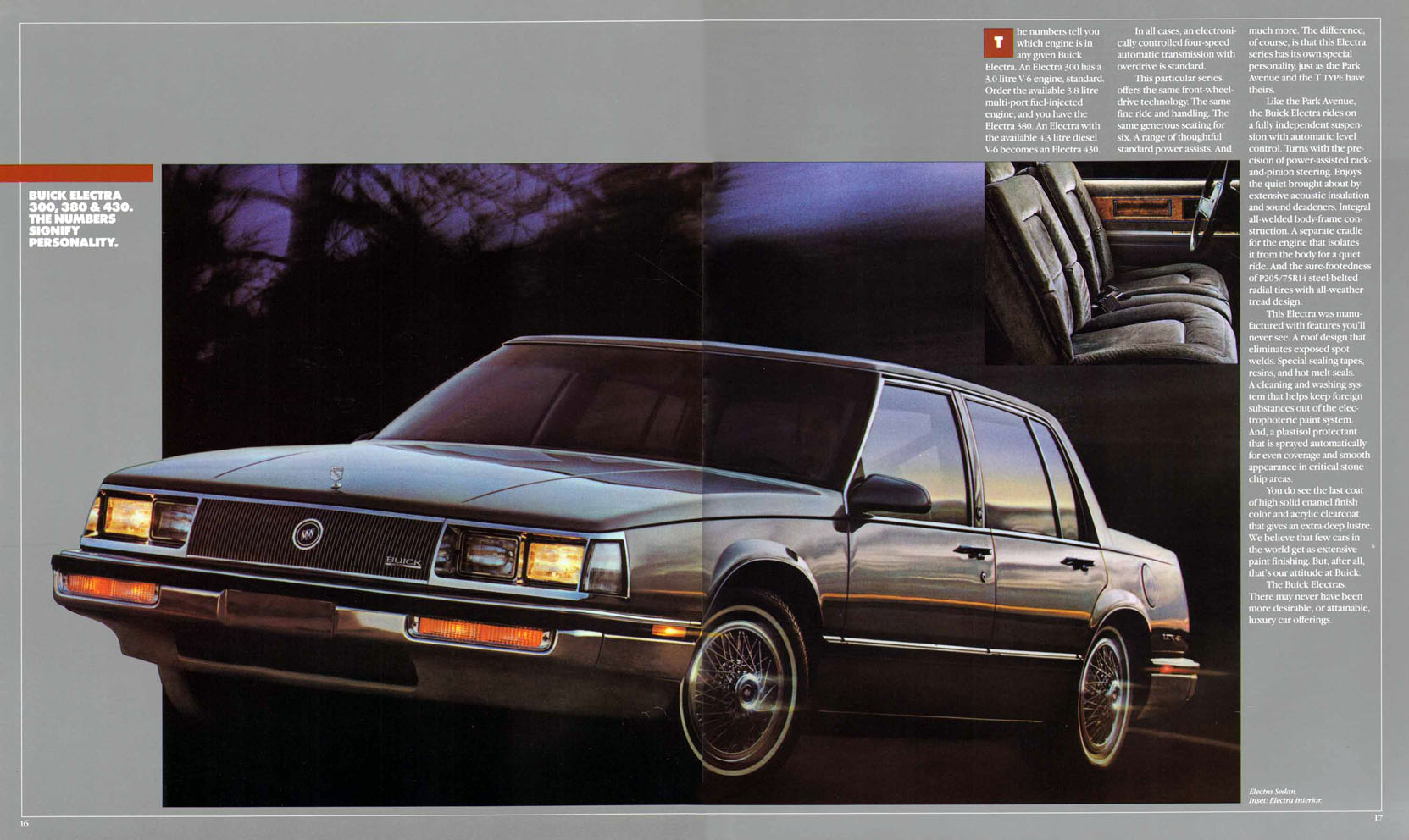
The 1985 Buick Electra sedan was substantially downsized from the previous year and switched to front wheel drive. The big sedan’s overall length decreased by over two feet from 221.3 inches to 197 inches, while shipping weight dropped by about 14%. Design details of the all-new Electra included a front-hinged hood, a flush-mounted windshield, and a flush-mounted back window.
Standard power came from the LK9 110 bhp 3.0 liter/181 ci V6 with a two-barrel carburetor. Optional engines were the 125 bhp LG3 3.8 liter/231 ci multi-port fuel-injected V6 ($260) and the 85 bhp LS2 4.3 liter/261 ci V6 diesel ($390). All engines were teamed with a four-speed automatic transmission with overdrive. For 1985 only, Buick named base model Electras by their engine size—Electra 300, Electra 380, and Electra 430. The 3.0 liter V6 was discontinued in the middle of the 1985 model year, and the diesel V6 would be gone by the time the 1986 model year rolled around.
MotorWeek clocked a 0-60 time of 12 seconds flat in a 1985 Electra with the 3.8 liter V6. Mileage for the short-lived standard engine was 18 city/25 highway by the 1985 measures (16/23 by today’s standards). Hilariously, the upmarket 3.8 liter engine was rated at 19 city/26 highway, the precision of the multi-port fuel injection more than making up for the increased displacement. Buyers of the diesel could expect 22 city/32 highway. With an 18-gallon gas tank, an Electra 380 owner could expect a range of 335 to 360 miles with a 10% fuel reserve.
Pages from the 1985 Buick Electra brochure
The Electra 300‘s base price was $14,331—approximately $43,800 in 2025 dollars and about what a 2025 Buick Enclave full-size crossover goes for. Standard exterior and mechanical equipment included Soft-Ray tinted glass, rack-and-pinion steering with power assist, an independent four-wheel suspension, automatic level control, low drag power front disc/rear drum brakes, and P205/75R14 steel-belted radial-ply blackwall tires (a size still available thanks to Hankook and Kumho) on 14-inch wheels. Inside, cloth 45/55 notchback front seats, a six-way power driver’s seat, manual seatback recliners, air conditioning, power windows, and an electronically-tuned AM/FM stereo radio with clock were standard.
An Electra purchaser could go in two directions if the base model wasn’t enough—more luxury or a sporting touch. Most buyers opted for luxury, which continued to be represented by the Park Avenue. The $16,240 Park Avenue added whitewall tires, a tilt steering column, Electronic Cruise Control, electric door locks, an electric trunk release, and an electronically-tuned AM/FM stereo radio with seek and scan and clock. The Park Avenue included the 3.8 liter V6, but allowed buyers to choose the diesel.
Choosing the $15,568 T TYPE added black accents, a Gran Touring suspension (higher-rate springs, larger shock absorbers, and bigger front and rear stabilizer bars), styled aluminum alloy wheels, cloth 45/55 front sport seats with a storage console, and a leather wrapped Sport steering wheel. The T TYPE included and required the 3.8 liter V6.
Options & Production Numbers
Individual options included an electric sliding glass Astroroof ($1,195), a six-way power passenger’s seat ($215), Electronic Touch Climate Control air conditioning ($165), Twilight Sentinel headlamp control ($60), an electric rear window defogger ($140), and the all-conquering Delco GM/Bose Music System ($895).
55/45 leather front seats ($425) were only available with the Park Avenue. Options only available for the T TYPE included 45/45 leather front Sport seats ($175) and Goodyear Eagle GT P215/65R15 performance tires paired with 15 x 6 inch aluminum wheels.
These C-bodies (there were also Cadillac and Oldsmobile versions) had a stately appearance. Big and (I think) handsome, they had a lot of interior room despite the downsizing—at 111 cubic feet, they had only one cubic foot less than the 1984.
Sales of the 1985 Electra sedan and its variants were good—at 131,011 sedans, more than double the 52,551 that had been sold in 1984. It’s unclear what percentage of buyers went with the Park Avenue or the T TYPE, but I’m betting that the Park Avenue was quite popular.
The View From 2025
C-body Electra sedans sometimes come up for sale in the Hemming’s Motor News classifieds and on eBay Motors. Bring a Trailer has sold four from this generation, including two 1985s.
Make mine the extra-cost ($200) Blue Firemist, please.
Ford’s Pinto was little changed in its final year, with minor trim and detail changes and the removal of the V6 engine option.
The only engine remaining was the Lima 88 bhp 2.3 liter/140 ci inline four with a two-barrel carburetor. A four-speed manual was standard, while a SelectShift automatic was optional ($340). 0-60 came in a little over 14 seconds with the manual. Fuel economy was 24 city/38 highway by the day’s standards. With a 13.0-gallon gas tank assembly that now included a longer fuel filler neck and a stronger fuel filler cap than in earlier years, a Pinto owner could expect a range of 295 to 325 miles with a 10% fuel reserve.
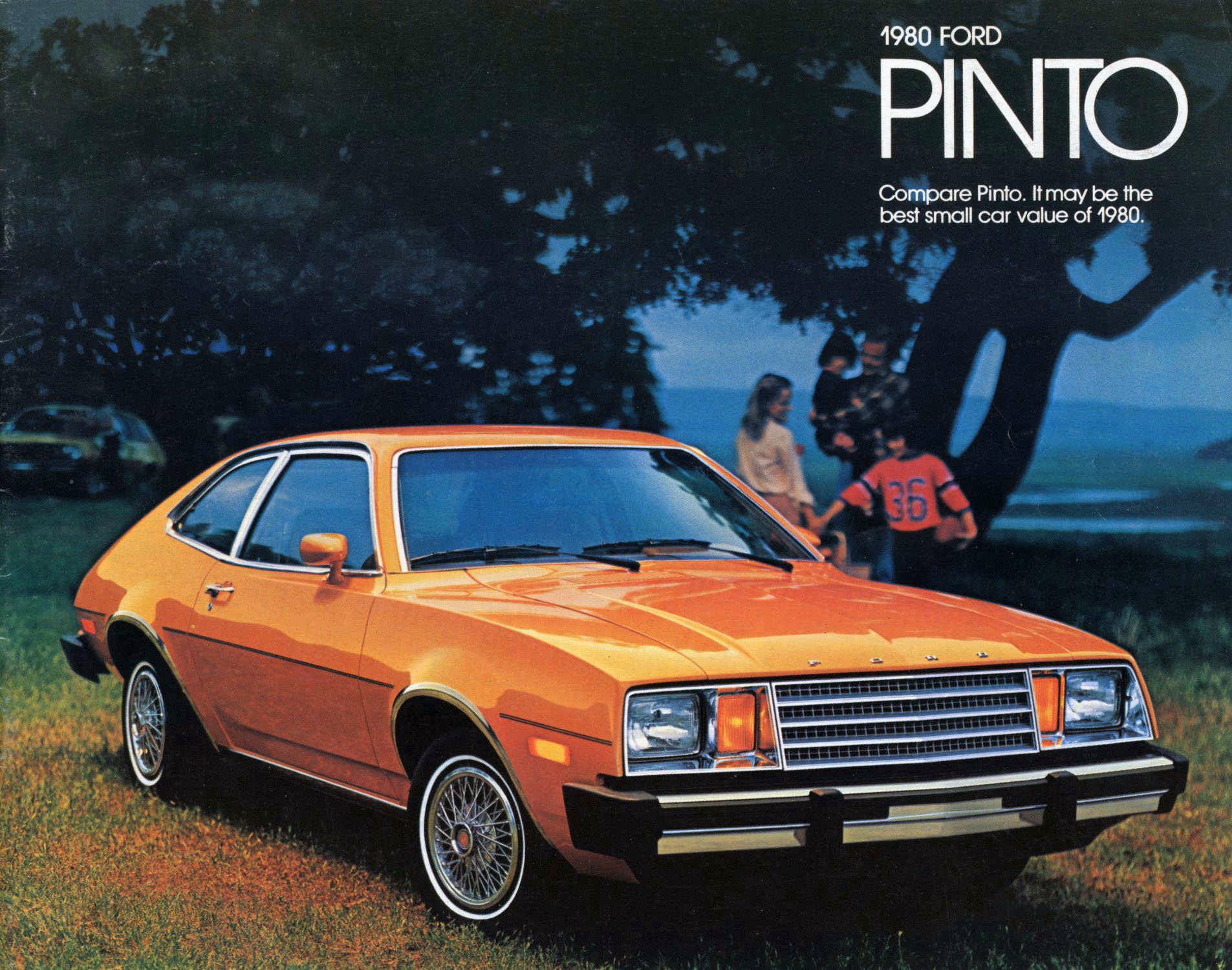
1980 Ford Pinto brochure cover
The 1980 Pinto 2-door sedan’s base price was $4,605—about $19,700 in today’s dollars and 30% less expensive than any 2025 Ford product. Standard exterior and mechanical equipment included tinted glass all around, vinyl insert bodyside moldings, rack and pinion steering, front disc/rear drum brakes, and 13-inch black sidewall steel-belted radial ply tires on 13-inch wheels with full wheel covers. Inside, all vinyl or cloth and vinyl high back bucket seats, a mini-console with a storage bin, and an AM pushbutton radio were included.
Packages, Options, & Production Numbers
The wide variety of packages and groups available for the 2-door sedan included:
Interior Decor Group ($238)—cloth/vinyl or all-vinyl low-back bucket seats, Deluxe door trim, Deluxe steering wheel, woodtone appliques, deluxe sound insulation package, courtesy light switch on passenger door
Light Group ($41)—map light, lights in glove box, ashtray, engine, and trunk, courtesy light switch on passenger door
Sports Package ($118)—3.08 performance rear axle with the manual transmission, Sport steering wheel with black metal spokes, instrumentation (tachometer, ammeter, temperature gauge)
Individual options included a flip-up open air roof ($219), Medium Red Glow metallic glow paint, a Tu-Tone paint/tape treatment, power front disc/rear drum brakes ($78), power steering ($160), the SelectAire conditioner ($538), and series of radios ranging up to an AM/FM stereo with cassette tape player and two door-mounted speakers ($191).
The best-selling Pinto remained the 2-door sedan (Ford’s description), which looked like it should be a hatchback but wasn’t. Ford sold 84,043 of the 2-door sedans (including the decontented Pony edition) compared to 61,542 of the Runabout, which actually was a hatchback but cost 3% more. The all-new Escort would follow in 1981, but that’s another story.
As I dropped my parents off at church on a Sunday morning a few years ago, I saw a BMW 535i parked on a side street.
“Civilization without isolation”
The 535i version of BMW’s 5-series was introduced in 1985. The 35 in the designation indicated that the sedan newly included BMW’s 182 bhp M30B34 3.4 liter/209 ci inline six with Bosch Motronic fuel injection. A Getrag 265 five-speed manual was standard, and a four-speed automatic was available. 0-60 came in a little under eight seconds in a car with a 3,200-pound curb weight. Fuel economy was rated at a chastening 16 city/22 highway by the day’s standards (14/20 by today’s measures). With a 17.2-gallon gas tank, a 535i owner could expect a range of 265 to 290 miles with a 10% fuel reserve.
1985 BMW 535i print advertisement
The 1985 535i’s base price was $30,760—about $93,900 in today’s dollars and well more than any non M-branded 5 series goes for in 2025. Standard exterior and mechanical equipment on the 535i included a two-position electric sunroof, a fully-independent suspension, power steering, anti-lock power disc brakes, and 200/60-390 tires (a size still readily available thanks to Michelin) on 390 cm wheels. Inside, leather seats, electronic climate control, and an OnboardComputer were included.
Options included a limited slip differential ($390) and electrically adjustable front seats ($415).
The View From 2025
Like most BMWs from the eighties, the 535i attracts collector interest, and there is support from BMW car clubs. According to Hagerty’s valuation tools, all the money for a 1985 BMW 535i in #1/Concours condition is $32,200, with a more normal #3/Good condition car going for $8,400. 535i’s frequently appear for sale in the Hemming’s Motor News classifieds, on eBay Motors, and on Bring A Trailer.
Make mine New Polaris Metallic, please. I know silver is a BMW and other German car cliché, but sometimes a cliché is correct.
For 1987, Plymouth’s Turismo hatchback coupe was little changed as it headed into its final model year. The 2.2-liter engine became standard, along with argent Rallye wheels.
The Turismo’s standard powertrain was the K 96 bhp 2.2 liter/135 ci inline four with a two-barrel carburetor paired with a five-speed manual transmission. A three-speed automatic was available as part of the Basic package or the Duster package. 0-60 times are hard to come by for the Turismo, but I’m betting on a little over 10 seconds for the 2,281-pound car—with the five-speed. Fuel economy is better known—25 city/35 highway with the five-speed by the day’s standards (22/32 by today’s measures). With a 13-gallon gas tank, a Turismo driver could expect a range of 320 to 350 miles with a 10% fuel reserve.
Front cover of the 1987 Plymouth Turismo brochure
The $7,199 Turismo (about $21,200 in today’s dollars) had better base equipment for 1987 than it had in previous years. Standard exterior and mechanical equipment included tinted glass, black bodyside moldings, halogen headlights, an electric rear window defroster, a remote liftgate release, power brakes, and P165/80R13 steel belted radial tires (a size now only available from Michelin at considerable expense) on argent 13-inch Rallye steel wheels. Inside, cloth with vinyl trim low-back front bucket seats, a four-spoke color-keyed Sport steering wheel, and an electric rear window defroster were included.
Packages, Options, & Production Numbers
Plymouth offered three packages for the 1987 Turismo:
The $776 Basic package included the three-speed automatic and power-assisted steering.
The $575 Dustermanual package included Duster and Plymouth decals, black dual remote control exterior mirrors, power-assisted steering, cloth with vinyl trim Sport reclining high-back front bucket seats with increased lateral support, Deluxe door trim panels with cloth inserts, a console, and an electronic tuning AM stereo/FM stereo radio with a digital clock and four speakers
The $1,009 Dusterautomatic package included Duster and Plymouth decals, black dual remote control exterior mirrors, the three-speed automatic, power-assisted steering, cloth with vinyl trim Sport reclining high-back front bucket seats with increased lateral support, Deluxe door trim panels with cloth inserts, a console, and an electronic tuning AM stereo/FM stereo radio with a digital clock and four speakers
There were few individual options, but they included California emissions, air conditioning ($701), and an AM/FM stereo cassette with Dynamic Noise Reduction and auto reverse ($246).
Plymouth sold 24,104 Turismos in its final model year—a far cry from the 52,162 sold two years prior. Introduced for 1987, the Sundance coupe would be the putative replacement going forward in Plymouth’s model line.
The View From 2025
I’m going to declare this version of the L-body as vanished. I haven’t seen a Turismo in the wild for decades, and they have little presence in the Hemmings Motor News classifieds or on eBay Motors. Bring a Trailer hasn’t sold any Turismos, though they did sell one of the Scamp pickup truck variants in 2019.
For 1988, Mercury’s full-size Colony Park station wagon gained a new and at least somewhat more aerodynamic front end that better integrated the fenders, grille, headlights, and bumper. Inside, the front seats were updated, and the Insta-Clear heated windshield was newly available.
The Colony Park name had a long history within Mercury. The first Colony Park branded wagons appeared in 1957 as the “glamorous style leader” of Mercury’s wagon line. Because there were no Lincoln wagons, the Colony Park was consistently the highest-end wagon available from Ford Motor Company for almost 35 years, and it could be equipped to near-Lincoln levels.
The only powertrain available on the 1988 Colony Park was the Windsor 150 bhp 4.9 liter/302 ci V8 with multi-port fuel injection paired with a four-speed automatic transmission. Acceleration figures are hard to find for this 4,000-pound wagon, but it certainly wasn’t fast. Fuel economy ratings were 17 city/24 highway by the day’s standards (15/22 by today’s measures). With an 18.0-gallon gas tank, Colony Park owners could expect a range of 300 to 330 miles with a 10% fuel reserve.
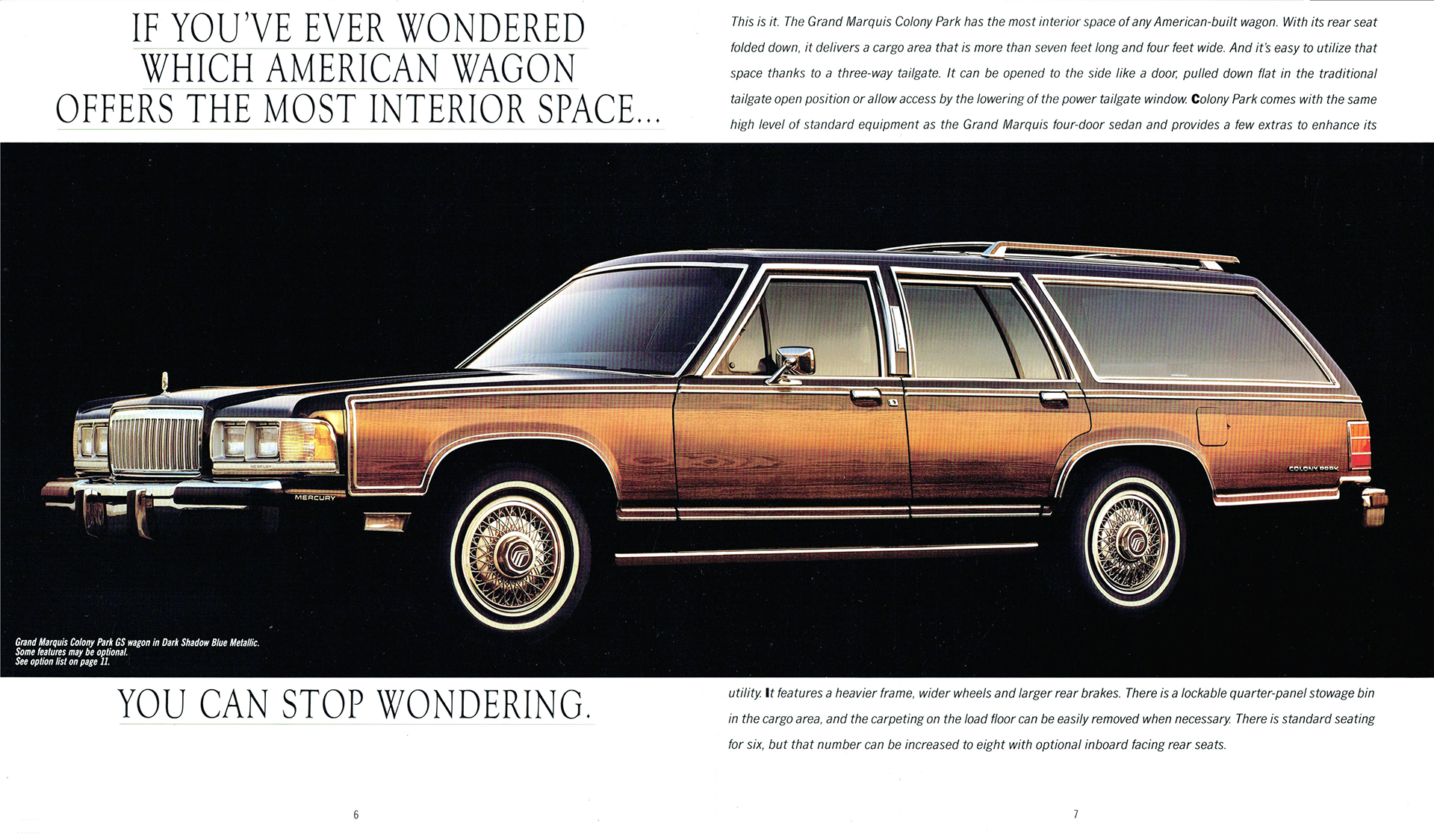
Colony Park pages from the 1988 Mercury Grand Marquis brochure
The 1988 Mercury Grand Marquis Colony Park GS station wagon’s base price was $16,341—about $45,900 in today’s dollars. Standard exterior and mechanical equipment included a bodyside rosewood appliqué, tinted glass, a rear-bumper step pad, power brakes, power steering, and P215/70R15 tires on 15-inch wheels with Deluxe full wheel covers. Inside, vinyl twin comfort seats with dual recliners, Luxury sound insulation, air conditioning, power side windows, a power tailgate window, a quarter-panel stowage bin with lock, a tailgate-activated cargo compartment light, and an electronic AM/FM stereo with four speakers were standard.
For an additional $585, the LS added turbine spoke aluminum wheels, Luxury twin comfort lounge seats with high level cloth, a rear seat center armrest, and the Light Group.
Packages, Options, & Production Numbers
Two packages were available on the Colony Park:
Preferred Equipment Package 192A (about $1,700) included front cornering lamps, a Deluxe luggage rack, a 6-way power driver’s seat, dual inboard facing rear seats in vinyl, a tilt steering wheel, fingertip speed control, an electric rear window defroster, and the Power Lock Group.
Preferred Equipment Package 193A included everything in 192A and added a power antenna, a leather-wrapped steering wheel, dual illuminated vanity mirrors, and the Premium Sound System (power amplifier, upgraded front and rear speakers, plus two additional speakers).
Exterior and mechanical options included a narrow bodyside molding ($66), the Insta-Clear heated windshield ($250), an automatic leveling suspension ($195), a heavy-duty suspension ($26), and an engine block heater ($18). Inside, buyers could add Automatic Climate Control ($211), a Tripminder computer ($215), and a high-level AM/FM stereo cassette audio system ($472). LS purchasers could also add leather seating surfaces ($415). A loaded LS could near $20,500—not that far from Lincoln Town Car money.
Mercury sold 9,456 Colony Park wagons in the 1988 model year—down about 12% from the previous year despite the freshened styling. Mercury’s offering continued to be outsold by both Buick’s Estate wagons (Electra and LeSabre) and Oldsmobile’s Custom Cruiser wagons—likely its natural competitors.
The View From 2026
Sixth-generation Colony Park wagons sometimes show up for sale in the Hemmings Motor News classifieds, on eBay Motors, and on Bring a Trailer. As I update this blog entry in January 2026, there’s a White 1989 Colony Park GS with 78,000 miles for sale on Hemmings, asking $21,500.





 Eighties Cars