
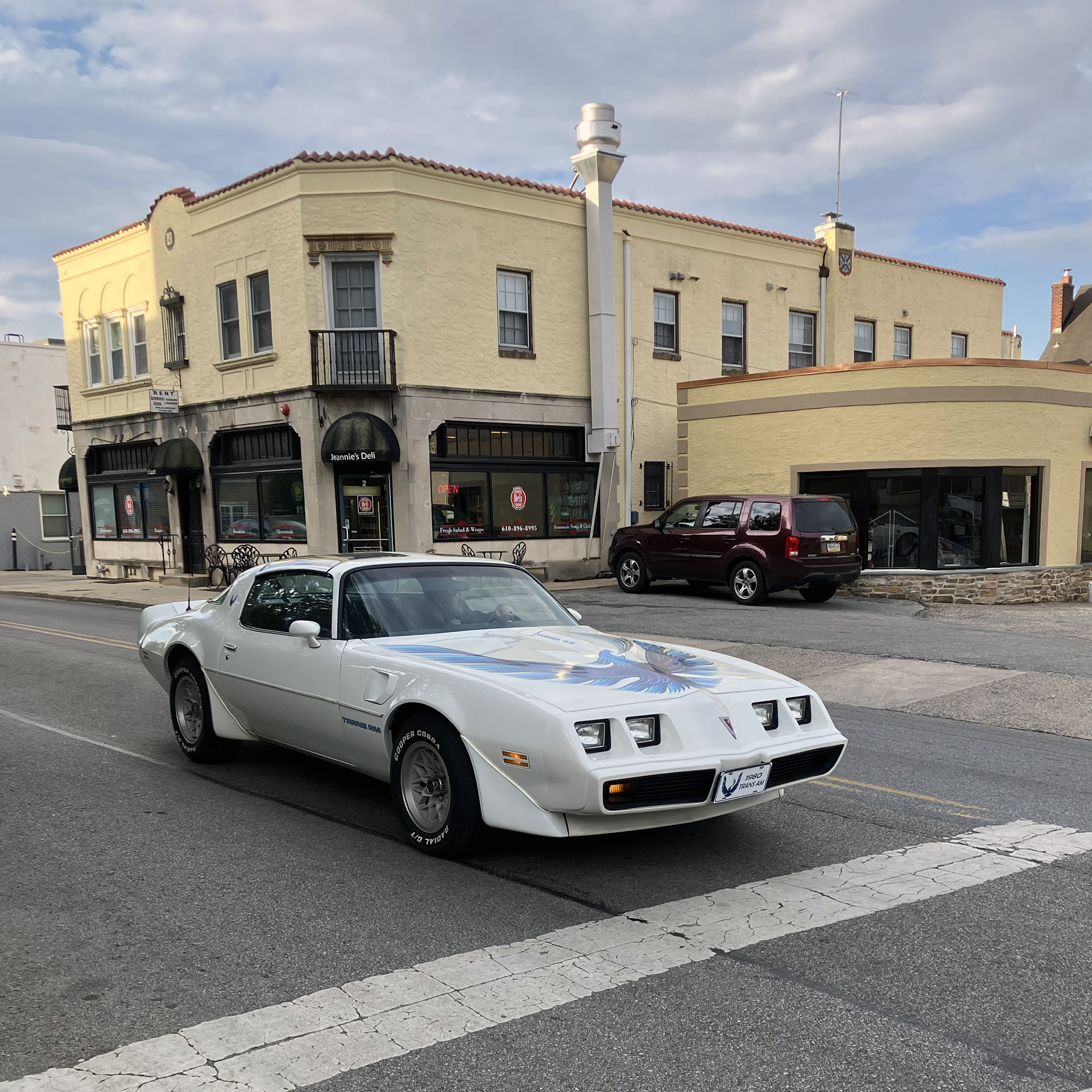
On a lovely spring morning in early 2025, my fiancée was walking from her house toward the temporary train station in Ardmore, PA. On her way to the station, she saw and (more importantly for this blog post) photographed a 1980 Pontiac Firebird Turbo Trans Am in Cameo White smoothly idling at a stop sign. Underneath the image she texted me, she wrote, “You are escorting me to the train.”
“You picked a winner.”
1980 was a transitional year mechanically for the second-generation Firebird and its Trans Am sub-model, though little else of significance changed. Gone was the 6.6 liter/403 ci V8, with the new top-of-the-line engine being a 4.9 liter/301 cu V8 with a turbocharger. Along with the engine changes, there was an asymmetrical hood design and a special hood decal for the Turbo Trans Am.
Pontiac could not do much about the general lack of space efficiency (the EPA rated the Firebird as a subcompact car), the high curb weight (about 3,700 pounds when the Mustang weighed about 2,800), and the relatively primitive technology.
Engines & Transmissions
The standard Trans Am engine was the Pontiac-built L37 155 bhp 4.9 liter/301 ci V8 with a four-barrel carburetor. The only choice for Trans Am purchasers in California was the Chevrolet-built LG4 145 bhp 5.0 liter/305 ci V8 with a four-barrel carburetor, but you did get a $180 credit.
The Trans Am’s most powerful engine was the $350 Pontiac-built LU8 210 bhp 4.9 liter/301 ci V8 with a Rochester Quadrajet four-barrel carburetor and an AiResearch TBO305 turbocharger. The turbo engine was emissions-certified only with the combination of air conditioning and a 3.08:1 rear axle ratio. All Trans Ams in 1980 came with a three-speed automatic—a one-year pause for the four-speed manual as Pontiac struggled to meet emissions regulations.
Combining a turbocharger, a carburetor, and primitive electronic engine controls was not easy, and reviews of one of the world’s first turbo V8s were mixed. The relatively primitive gas of the day meant that Pontiac had to retard the spark advance substantially to minimize detonation, which kept the turbocharger’s power return relatively low. As Car and Driver stated, “by the time the engine reaches 4000 rpm, the show is essentially over.”
Performance & Standard Equipment
A Turbo Trans Am would accelerate from 0-60 in a little over eight seconds (Car and Driver clocked 8.2), which was good for 1980. Fuel mileage was predictably bad—15 city/21 highway mpg by the day’s standards for the combination of the turbo engine and the automatic. With a 20.8-gallon fuel tank, Trans Am owners could expect to travel about 280 to 305 miles before refueling.
Standard exterior and mechanical equipment included in the $7,179 base price of the Trans Am (about $30,900 in today’s dollars) included a front center air dam, dual rectangular headlamps, a black-accented grille, a shaker hood and air cleaner, front and rear wheel opening air deflectors, a rear deck spoiler, a limited slip differential, power steering, power front disc/rear drum brakes, and 225/70-R15 blackwall tires (a size still readily available) on 15-inch Rally II wheels with trim rings. Inside, front bucket seats, a Formula steering wheel, a machined-trimmed instrument panel trim plate, rally gauges with a quartz clock and a tachometer, and a console were included.
Two Special Editions, Options, & Production Numbers
The black-and-gold Trans Am Special Edition package was $748 additional over a base Trans Am—$1,443 bundled with the removable locking hatch roof (otherwise known as T-tops). It included many exterior paint and trim details, including a gold/matte gold hood bird decal, gold headlight grilles, and gold wheels with gold center cap bird emblems. Inside, a gold dash panel, a gold-spoked steering wheel, gold door emblems, and a gold shifter emblem were included. 6,178 buyers took home a Special Edition—about 12% of Trans Am production.
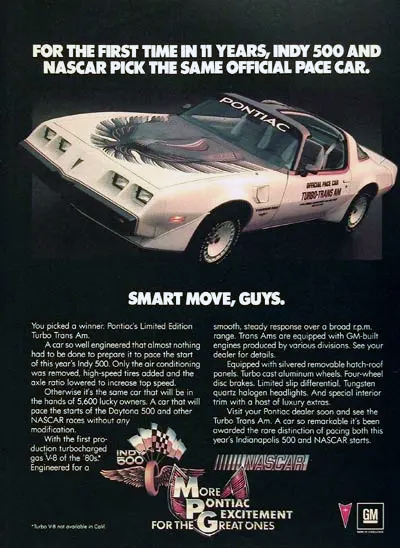
There was also a special edition of the Special Edition in completely different colors—the Indianapolis Pace Car Edition. The Indianapolis Pace Car Edition was Cameo White, with Soft Ray tinted glass on all windows, white Turbo cast aluminum wheels, silver T-tops, and oyster interior trim. Mechanical features included the LU8 turbocharged engine, turbo boost gauges, the WS6 special performance package, and four-wheel power disc brakes. Inside, a leather-wrapped steering wheel, Custom air conditioning, and a Delco-GM ETR AM/FM radio with a cassette player were included. All this extra content was a good thing because the Indianapolis Pace Car Edition listed for $11,020.52 (why not just round to the closest dollar?)—about $47,500 in 2025 dollars. After initially promising 5,600 in advertising, Pontiac ended up building 5,700, about 11% of 1980 Trans Am production.
Exterior and mechanical options available for the Trans Am included the WS6 special performance package ($281), tungsten quartz halogen headlamps ($27), white-lettered tires ($68), Turbo cast aluminum wheels, four-wheel power disc brakes ($162), and an automatic power antenna ($50). Inside, an electric rear window defroster ($107), power door locks ($93), Custom air conditioning ($566), a tilt steering wheel ($81), controlled cycle windshield wipers ($41), and a host of radios (seven!) were all available.
Pontiac built a total of 50,896 Trans Ams in the 1980 model year, with 22,176 (44%) having the turbo engine.
The View From 2025
Initially neglected by the collector car market and with many now used up, late second-generation Trans Ams in good or excellent shape are now getting interesting numbers—almost doubling in the past fifteen years. According to Hagerty’s valuation tools, all the money for a 1980 Turbo Trans Am with T-tops in #1/Concours condition is $69,000, while a more normal Turbo Trans Am in #3/Good condition is valued at $24,900. These Trans Ams are often available in the Hemmings Motor News classifieds, on eBay Motors, and on Bring A Trailer, and they frequently show up at in-person auctions.
Make mine the black-and-gold Special Edition, of course.
I evidently can’t help myself with eighties Trans Ams; I’ve also written about the 1981 coupe, the 1982 hatchback coupe, the 1984 15th Anniversary hatchback coupe, the 1985 hatchback coupe, and the 1989 Turbo hatchback coupe. I have also written about the 1986 SE hatchback coupe and the 1987 Formula hatchback coupe, but I probably should write about the base car at some point.

 Eighties Cars