
“You get the more formal look of the sedan with the high performance of the GT.”
For the 1987 model year, Ford’s Fox-body Mustang received a facelift of both its interior and exterior. Ford restyled the front end, which gave the aging design (work had begun on the Fox-body Mustang in 1976) more of an “aero” look, in keeping with the overall mid-1980s Ford styling direction embodied by the Thunderbird and Taurus. The quarter glass windows were now each a single larger flush piece of glass with “Mustang” lettering at the bottom rear corners, replacing the smaller glass paired with louvers that had been in use since the 1979 model year. Taillights on the LX were revised with clear lenses for the turn signals. The interior received an all-new dash, center console, and revised seat and door trim.
With the SVO gone, the remaining models were the LX and the GT. Ford discontinued the V6 option, leaving only the standard 90 bhp Lima 2.3 liter/140 ci inline four with new-for-1987 fuel injection and the optional 225 bhp Windsor 4.9 liter/302 ci V8 with sequential fuel injection, which was part of an $1,885 5.0L EFI HO V-8 Engine Package. A five-speed manual transmission was standard, while a four-speed automatic was a $515 option.
From a performance and fuel economy perspective, the inline four LX and the V8 LX might as well have been different cars. The Lima-based Mustang with the manual took about 13.3 seconds to get to 60 mph, with the automatic/inline four combination being a few tenths worse. The payoff was fuel economy—25 city/31 highway by the day’s standards for the base powertrain (22/28 by today’s measures). The automatic was about 10% less efficient. With a 15.4-gallon gas tank, an LX owner with the base powertrain could expect an impressive range of 350 to 385 miles with a 10% fuel reserve.
In marked contrast, the Windsor-based Mustang with the manual took about 6.2 seconds to get to 60 mph, with the automatic version taking about 6.7 seconds. Fuel economy was 16 city/24 highway by the day’s standards (15/22 by 2025 measures). Interestingly, the automatic was about 13% more efficient when paired with the V8. An LX owner with the V8 and five-speed manual could expect a range of 260 to 275 miles with a 10% fuel reserve.
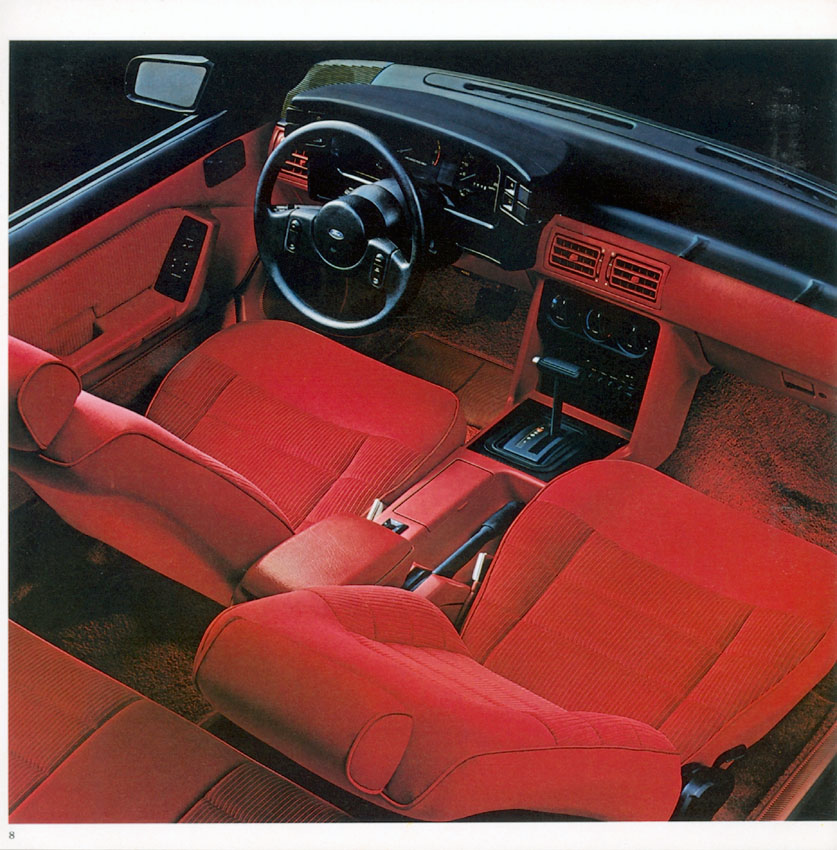
The 1987 Mustang LX 2-door sedan (Ford’s nomenclature) had a base price of $8,043—about $23,500 in today’s dollars, which is approximately 26% less than a base 2025 Mustang costs. Standard exterior and mechanical equipment included power rack and pinion steering, power front disc/rear drum brakes, and P195/75R14 black sidewall steel-belted radial tires on 14-inch wheels with turbine wheel covers. Inside, reclining cloth low back front bucket seats, Light Group, full instrumentation, a console, and an electronic AM/FM stereo search radio with four speakers were included.
Groups, Packages, & Individual Options
Seven groups and packages were available for the Mustang LX 2-door sedan:
- Preferred Equipment Group 240A was the base package
- Light Group was included with the base package and included lights for the engine compartment, the luggage compartment, the ashtray, and the glove box. A dual beam dome/map light and a headlamps on reminder chime were also included
- Special Value Group 240A (no cost for inline four/$735 for V8) included Power Lock Group, an electronic AM/FM stereo radio with cassette tape player, speed control, and styled road wheels
- Power Lock Group ($244) included power door locks, a remote locking fuel door, and a trunk release
- Climate Control Group ($1,005 for inline four/$978 for V8) included tinted glass, a heavy-duty battery, air conditioning, and a rear window defroster
- Custom Equipment Group ($624) included dual electric remote control mirrors, power side windows, dual illuminated visor mirrors, a tilt steering wheel, and a graphic equalizer
- The 5.0L EFI HO V-8 Engine Package ($1,885) included a Traction-Lok axle, GT suspension system components, a 15:1 steering ratio, a heavy-duty battery, P225/60VR15 handling tires, and cast aluminum wheels
Exterior and mechanical options for the Mustang LX 2-door included complete tinted glass ($120) and wire style wheel covers. Inside, a tilt steering wheel ($124), an air conditioner ($788), and power front side windows were available. Stereo options included an electronic AM/FM stereo radio with cassette tape player ($178), a graphic equalizer ($218), and the Premium Sound System ($168 for six upgraded speakers and a 4-channel power amplifier). The Handling Suspension Package and cast aluminum wheels were optional with the inline four but included with the V8.
Period Reviews & Production Numbers
The enthusiast press—including Car and Driver, Hot Rod, and Motor Trend—swiftly realized that the LX 2-door sedan with the V8 was 80 pounds lighter than the GT, which made it slightly quicker. At $9,928, the V8 LX was also 16% cheaper than the GT, making it one of the outstanding performance bargains of the 1980s.
Production data is surprisingly uncertain (wouldn’t the Mustang have been worth paying attention to?), but some of the more likely data states that Ford sold 43,257 Mustang LX 2-door sedans, of which 4,888 (or 11%) were V8s.
The View From 2025
There is strong club support for the 1987 Mustang, as there is for all Mustangs except the mid-seventies Mustang IIs. According to Hagerty’s valuation tools, all the money for a 1987 Mustang notchback coupe in #1/Concours condition is $52,500, with a more typical #3/Good condition car going for $18,600. 1987 Mustangs often show up in the Hemming’s Motor News classifieds, on eBay Motors, and on Bring a Trailer—BaT has sold three 2-door 1987 LXs over the years.
Make mine Medium Shadow Blue Metallic, please. One quarter of the 12 Mustang colors for 1987 were blues.
Other Mustangs I have written about include the 1980 Cobra hatchback coupe, the 1981 coupe, the 1982 GT hatchback coupe, the 1983 GT convertible, and the 1984 SVO hatchback coupe.

 Eighties Cars
Ahh the 5.0 notchback!
Back then I read all the car mags. Of course as young men we all fancied ourselves drag racers, and the Fox sedan/notchback was the hot ticket – way lighter than a GT hatchback. My first live exposure to a real Fox notch was a 1985 5.0 notch an acquaintance had. In spring 1988, my dad almost paid $9k for a 4cyl 4 speed S10 pickup until he saw an ad – ‘go 148mph for $12,999!’ – Don Little Ford in Richmond Hill ON had 45 strippo 5L notches at that price for ‘3 days only’.
Long story short, he bought a new 1988 LX notch. After a few short months with it, he went back to his ‘80 Civic commuter and I was the lucky one to have one of the hottest cars of the new musclecar era.
It was Bright Regatta Blue metallic, blue cloth interior. It really was a low option car, only 3 – the 5.0L engine package (same as in ‘87), the Gatorback tires, and radio delete (which was rectified with a Blaupunkt Denver head unit, 4 speakers and a Panasonic 4 channel x 50W amp under the passenger seat).
Another car we wrung a few years out of, I drove it until about 2000, putting 408k kms (250k miles), with no significant mechanical work other than replacing 2 used up clutches and the usual brakes, failed clutch fan, plugs and wires etc. I wanted to restore it but the tin worm really consumed that car after all those winters.
In January 2024 I was finally able to replace my old hot rod with a 1988 LX 5.0 convertible, in that Medium Shadow Blue metallic but with grey leather interior.
The Mustang LX sedan may not have been the fastest or sexiest car even in its own time. And in the harsh light of the 2020s, it’s a crude instrument whose power pales in comparison to even the mildest of modern vehicles. But it remains very attainable, highly tunable, and ultimately still a blast to boot around in.