“Once again Volkswagen brings a breath of fresh air to the automotive world.”
For the 1985 model year, Volkswagen changed the name of its Rabbit-based convertible in the United States from Rabbit Convertible to Cabriolet. One reason for the Cabriolet rename was likely its base price—at $11,595 (about $35,600 in today’s dollars) around 66% higher than the Golf hatchback coupe’s base price. Another driver was that the Cabriolet retained the Mk1 Rabbit as its basis, rather than joining the Mk2 hatchback coupes and sedans, which were new for 1985 in the United States. All Cabriolets were built by Karmann Coachworks, with most components supplied by Volkswagen, and all had a Karmann badge placed forward of both doors.
The Cabriolet’s standard powertrain was the JH 90 bhp 1.8 liter/109 ci inline four with Bosch K-Jetronic fuel injection paired with a five-speed manual transmission. An automatic transmission was available. Motor Week recorded a 0-60 time of 11.8 seconds with the five-speed in the approximately 2,275-pound Cabriolet.
Volkswagen’s Cabriolet brochure boasted that it was “perhaps the most efficient way to drive from one place to another with the wind in your hair.” This statement was likely correct in 1985; with the five-speed manual, fuel economy ratings by mid-eighties standards were 24 city/29 highway (21/26 by 2025 standards). With a 13.8-gallon gas tank, a Cabriolet owner could expect a range of between 290 and 330 miles with a 10% fuel reserve.
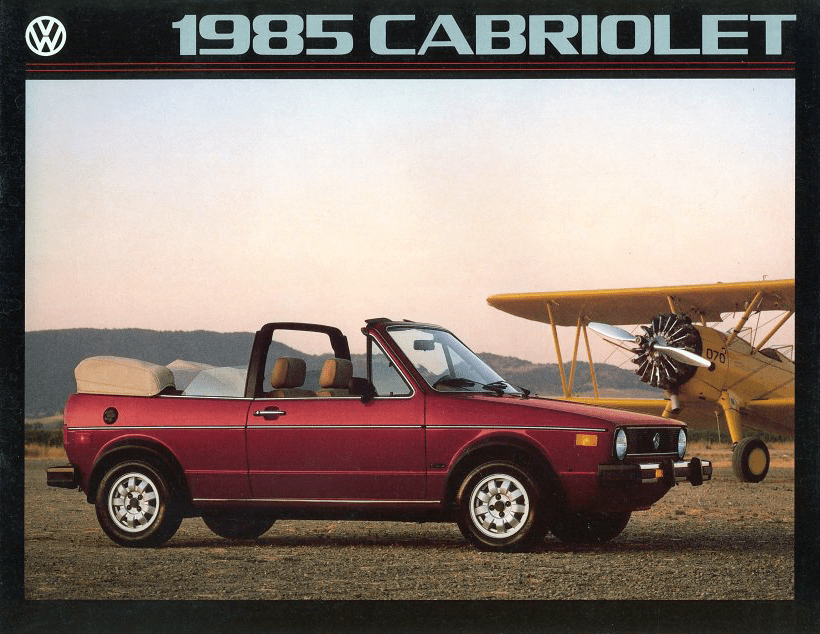
Standard exterior equipment for the Cabriolet included an insulated three-layer convertible top with a heated glass rear window, a boot for the top, tinted glass, and remote-controlled mirrors. Mechanical equipment included front-wheel-drive, a sport suspension, rack-and-pinion steering, power ventilated front disc/rear drum brakes, and 175/70SR13 tires (a size still readily available) on 13-inch wheels. Inside, reclining front bucket seats, full instrumentation, and an electronic AM/FM stereo cassette with four speakers were included.
Options, Competition, & Production Numbers
Options were relatively few: metallic paint, white sidewall tires, 13-inch light-alloy wheels, power steering, cruise control ($200), air conditioning ($725), and cloth sports seats. The Triple White Bestseller package included Alpine White paint, a white convertible top, and white seats. Later in the model year, the usual Wolfsburg Edition promotion was available, with Flash Silver Clearcoat Metallic paint, 185/60HR14 steel-belted radial tires, 14-inch alloy wheels, power steering, a full leather interior, and sports seats.
The mid-priced four-seat convertible market for 1985—all in the $10,500 to $13,500 range—was suddenly rather crowded. In addition to the Volkswagen, potential convertible buyers could choose from the AMC Renault Alliance, the Chevrolet Cavalier/Pontiac Sunbird J-cars, the Chrysler LeBaron/Dodge 600 K-cars, the Ford Mustang/Mercury Capri Fox-bodies, and the Toyota Celica. Despite this various and varied competition, Volkswagen sold an impressive 12,637 Cabriolets in 1985.
The View From 2025
There is definite collector interest in the Cabriolets, and there’s also a lot of information on Cabby Info. Cabriolets are regularly featured in the Hemming’s Motor News classifieds, eBay Motors, and Bring a Trailer.
Make mine Flash Silver Metallic, please.
Other Volkswagens I have written about include the 1981 Dasher station wagon, the 1981 Scirocco S hatchback coupe, the 1983 Rabbit GTI hatchback coupe, and the 1985 Jetta GLI sedan. I’ll have to get to the Quantum and the Vanagon at some point.
Last updated August 2025.

 Eighties Cars