
This post was one of my first entries in this blog. I’ve updated it to reflect both changes in my posting style and substantial improvements in available data.
“The ultimate performance Toyota.”
Remember when Toyota produced a reasonable amount of cool sporty cars?
I do—I believe they nailed it with the Mark II Celica Supra. First, the styling: although based on the Celica, the longer hood (to accommodate the Supra’s inline six) along with the retractable headlights (you’ll have to believe me that they were very cool in the 1980s) substantially changed the car’s look. It wasn’t just the styling—Supras also included a notably higher level of interior equipment.
The engine was Toyota’s 145 bhp 5M-GE 2.8 liter/168 ci dual overhead cam fuel injected inline six, giving a 0-60 time of slightly under 9 seconds (spritely for 1982) and a top speed of approximately 125 mph. Over the next few years, engine power would climb to 161 bhp.
Mileage with the standard five-speed manual transmission was 21 city/34 highway by the day’s standards (19/31 by today’s measures). Choosing the optional four-speed automatic transmission—available only for the L-Type submodel—reduced highway mileage to 32. With a 16.1-gallon gas tank, Supra drivers could expect to travel approximately 355 miles before seeking more fuel.
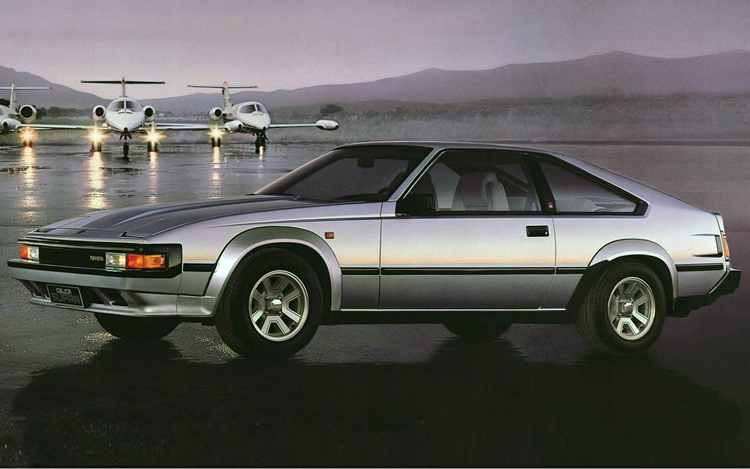
photo courtesy of Motor Trend from their Import Car Of The Year photo shoot.
All Celica Supras included tungsten halogen headlights, a four-wheel independent suspension, rack-and-pinion steering with variable power assist, and ventilated and power-assisted 4-wheel disc brakes. Inside, automatic temperature control air conditioning, power windows, power door locks, cruise control, and a tilt steering wheel were included.
Two models were available: the L– (for “Luxury”) Type and the P– (for “Performance”) Type. The $13,598 L-Type (about $46,800 in 2025 dollars) included standard power mirrors and P195/70R-14 steel-belted radial tires (a size still readily available) on 14 x 5.5-inch aluminum alloy wheels. Inside, striped velour cloth bucket seats were standard.
The $14,598 P-Type (about $50,200 in today’s dollars) included fender flares, a limited-slip differential, Sport Seats with driver’s side 8-way adjustment and pneumatic lumbar support adjustment, and P225/60HR-14 steel-belted radial tires (a size currently available only from BFGoodrich) on 14 x 7 inch aluminum alloy wheels.
Options, Publicity, Period Reception, & Sales Numbers
Options include two-tone exterior paint ($120), black high gloss paint ($70), and an electric sunroof ($440). Options only available for the L-Type included a four-speed automatic transmission, a digital display instrument panel and trip computer ($450), and leather seat trim. Options only for P-Type buyers included a spoiler-type sunshade ($120).
At right is a classic commercial, with legendary (and very tall) race car driver Dan Gurney shilling for the then brand-new Mark II Celica Supra. The second-generation Supra was well-received—Car and Driver included it in their first 10Best list in 1983. Toyota sold 34,048 Celica Supras in 1982.
The View From 2025
According to Hagerty’s valuation tools, a 1982 Toyota Celica Supra in #1/Concours condition is $40,300. The value for a more “normal” #3/Good condition example is $12,400. This generation of Supras maintains a presence in the Hemming’s Motor News classifieds, on eBay Motors, and on Bring a Trailer. When I last updated the contents of this post in July 2025, a Red Metallic 1985 Supra with Gray cloth seats and 114,000 miles was for sale in Hemmings, asking $29,000.
Make mine Silver Gray Metallic, please.
Other Toyotas I’ve written about include the 1980 Corolla Tercel Liftback, the 1981 Celica Sport Coupe, the 1983 Camry sedan, the 1984 Corolla SR5 Sport Coupe, the 1985 MR2 coupe, and the 1988 Supra hatchback coupe.
Last updated July 2025.

 Eighties Cars
The third generation Celica, especially the black and silver Celica Supra remain one of my my favorite cars of the 80s.
Thanks for the comment. Black and silver was a sharp looking color combination on many 1980s cars.
Why? Black and silver shot well for B&W print… still the norm back then.
The only weakness these cars had was with camshafts. 99% have been fixed, but they were eating lobes off them super fast!!! Most were replaced as TSBs during timing belt/chain services or other major service intervals.