1989 Dodge Diplomat sedan

“Negotiate the road in a classic.”

For 1989, Dodge’s M-body Diplomat sedan was little changed. The base model was dropped, leaving only the mid-range Salon and the higher-end SE.

The powertrain remained the same—an LA 140 bhp 5.2 liter/318 ci V8 with a Carter two-barrel carburetor paired with a TorqueFlite three-speed automatic. With a 3,582-pound shipping weight, 0-60 came in about 12 seconds. Compared to other large rear-wheel-drive sedans, fuel economy was a somewhat uncompetitive 16 city/22 highway by the day’s standards (15/20 by today’s measures). With an 18-gallon gas tank, a Diplomat driver could expect a range of 285 to 305 miles with a 10% fuel reserve.

Standard exterior and mechanical equipment on the $11,995 Diplomat Salon sedan included quad halogen headlights, tinted glass, power-assisted steering, power-assisted front vented disk/rear drum brakes, and P205/75R15 steel-belted radial all-season white sidewall tires (a size still readily available, even as a whitewall) on 15-inch wheels with Deluxe wheel covers. Inside, a cloth/vinyl split-back bench seat with a folding center armrest and adjustable head restraints, tilt steering, a driver’s airbag, intermittent wipers, and an electronically tuned AM stereo/FM stereo with an integral digital clock and four speakers were included.

Diplomat SE photo from the 1989 Dodge brochure

The $14,795 SE added a full non-padded vinyl roof, Premium wheel covers, all-cloth individually adjustable front seats with dual seatback recliners, a lighted passenger mirror, chrome exterior dual power mirrors, automatic temperature control air conditioning, cruise control, an electrically heated rear window defroster, and the Protection Package. All of this extra equipment made for a 3,782-pound shipping weight—200 pounds more than the Salon.

Packages, Individual Options, & Production Numbers

By 1989, buying a Dodge Diplomat was all about the packages:

  • The Popular Equipment Discount Package ($1,141) included Premium wheel covers, automatic temperature control air conditioning, an electrically heated rear window defroster, chrome exterior dual power mirrors, and automatic speed control.
  • The SE Luxury Equipment Discount Package ($1,202) included wire wheel covers with locks, a driver’s side power seat, a Luxury leather-wrapped steering wheel, illuminated left and right vanity mirrors, power door locks, power windows, and a power deck lid release. It also included most but not all of the Light Package, including a headlight switch with time delay, a glove box light, a trunk light, and alternator, door ajar, engine oil temperature, and low fuel warning lights.
  • The Light Package ($122) included a headlight switch with time delay, a glove box light, and a trunk light. It also included alternator, door ajar, engine oil temperature, and low fuel warning lights.
  • The Protection Package ($185) included color-keyed vinyl bodyside moldings, black rear bumper guards, undercoating, and front and rear carpeted floor mats.

Individual options for both Diplomat versions included pearl clear coat paint ($41), power door locks ($201), and power windows ($294). Dodge also proudly offered a Premium electronically tuned AM stereo/FM stereo with up-and-down seek-and-scan and a cassette tape player ($262). The electronic cassette tape player included Dolby B noise reduction, automatic reverse, true fast forward and rewind, an automatic metal tape sensor, and tape program music search.

A full non-padded vinyl roof ($206), chrome exterior dual power mirrors ($164), and automatic temperature control air conditioning ($855) were available for the Salon. A power glass sunroof ($1,108) and a power antenna ($72) were SE-only options. A loaded SE could run to about $17,500—real money in 1989 and about $47,300 in today’s dollars.

Dodge sold a mere 5,709 Diplomats in the 1989 model year, sharply fewer than the 19,173 in 1988, when the base Diplomat was also available.

The View From 2025

The Diplomat was one of the last of Chrysler Corporation’s traditional rear-wheel-drive cars—the final year in a line that extended directly back to the original Diplomat in 1977, and had roots in the mid-1960s with the third-generation Dart. Earlier this year, I blogged about Chrysler Corporation’s Transition To Front-Wheel-Drive.

I’m going to declare these Diplomats as vanished, though I would not have said that a decade ago. They’re gone from the Hemmings Motor News classifieds and eBay Motors. Bring a Trailer has sold three Diplomats in the last five years, two of them sedans.

Make mine the extra-cost Twilight Blue Pearl Coat, please.

Four years ago, I wrote a post about the 1987 Chrysler Fifth Avenue sedan—an M-body sister to the Diplomat. Other rear-wheel-drive Chrysler products I have written about include the 1980 Chrysler Cordoba coupe, the 1980 Plymouth Volaré station wagon, the 1981 Chrysler New Yorker sedan, the 1983 Chrysler Cordoba coupe, and the 1983 Imperial coupe.

1983 Dodge Shelby Charger hatchback coupe

“It ain’t just paint.”

Dodge released the Shelby Charger hatchback coupe in February 1983. Based on the Dodge Charger 2.2, the Shelby Charger marked the reunion of Lee Iacocca and Carroll Shelby, years after their legendary success with the 1965 to 1970 Ford Mustang. It was the first vehicle to emerge from the Chrysler-Shelby technical center in Santa Fe Springs, CA.

Motive power was provided by a 107 bhp 2.2 liter/135 ci inline four with a two-barrel carburetor, which was mated to a five-speed manual transmission. With the aid of a 2,400-pound curb weight, Car and Driver recorded a 0-60 mph time of 9.0 seconds—sprightly for a reasonably priced sports coupe in 1983 and faster than the class-leading Volkswagen GTI. As usual, most other testers were notably slower—Road & Track listed a 10.0 second 0-60 time.

Fuel economy ratings were an impressive 25 city/40 highway by the day’s standards. With a 13-gallon gas tank, the owner of a Shelby Charger could expect a range of 310 to 340 miles with a 10% fuel reserve.

1983 Dodge Shelby Charger print advertisement

The Dodge Shelby Charger’s base price was $8,290—about $27,400 in today’s dollars, or about 9% less than a 2025 Dodge Hornet GT crossover goes for. Standard exterior and mechanical equipment included a front air dam, halogen headlamps, tinted glass on all windows, a rear spoiler, a special handling sport suspension, quick ratio power rack and pinion steering, heavy duty power front disc/rear drum brakes, and 195/50VR15 Goodyear Eagle GT tires (a size still readily available) on 15-inch cast aluminum wheels. Inside, front cloth bucket seats featured a CS logo, a Sport steering wheel, a console, a Rallye instrument panel cluster with a tachometer, clock, and trip odometer, and a power liftgate release were included.

Options, Period Reviews, & Production Numbers

Options included air conditioning ($632), automatic speed control ($176), and a series of four radios ranging up to an electronically tuned AM/FM stereo with a cassette player ($485).

Period reviews were generally positive, with many magazines pleased to see Carroll Shelby back in the automotive modification business. Car and Driver stated that the Shelby Charger was “built to slay giants.” Road & Track‘s tag line was “Carroll helps Chrysler bring back the Sixties,” which seems like just a bit of overreach. R&T also compared the Shelby Charger with the Nissan 200SX and the Toyota Celica GT-S. All was not perfect, and just about everyone complained about the seats and the steering wheel.

Dodge produced 8,251 Shelby Chargers for the 1983 model year, making the shortened first year of production the highest of the five years the model was available. 63% of 1983 Shelby Chargers were Santa Fe Blue Crystal Coat, with the rest being Silver Metallic. After 1987, the front-wheel-drive Charger would be gone, replaced by the Shadow, which would have its own Shelby version.

The View From 2025

Though Hagerty doesn’t track their values, Shelby Chargers do have their own following as part of Dodge’s storied high-performance history. They are often available in the Hemmings Motor News classifieds, on eBay Motors, and on Bring a Trailer. As I update this blog post in October 2025, there’s a Ruby Red Pearl Coat 1985 Shelby Charger with a grey and tan interior and 134,000 miles for sale on Hemmings, asking $19,000.

Make mine Santa Fe Blue Crystal Coat, please. That also gets me the silver stripe.

Other sporty Dodges I have written about include the 1984 Daytona Turbo Z hatchback coupe, the 1985 Shelby Charger hatchback coupe, and the 1985 Omni GLH hatchback sedan. I should write about the Shadow, and maybe the Mirada.

Last updated October 2025.

Chrysler Corporation’s Transition To Front-Wheel-Drive

I was working on a blog post on the 1981 Chrysler New Yorker, and I got to thinking about the nuts and bolts of Chrysler’s transition to front-wheel-drive in the United States. For this study, I looked at only non-imported cars (no Arrows, Colts, or Sapporos), and only at offerings from the Chrysler, Dodge, and Plymouth brands.

1977: the year before the Omni/Horizon hatchback sedan debuted, Chrysler Corporation had four platforms, all of them rear-wheel-drive. The F-body Aspen/Volaré compact was by far the sales leader—approximately 48% of Chrysler’s 1.2 million sales. The other offerings were the M-body premium mid-size (new for 1977, with the Dodge Diplomat sedan fated to make it all the way to 1989), the B-body mid-size, and the C-body full-size.

1978: the L-body Omni/Horizon hatchback sold well in its first year, with almost 167,000 exiting Dodge and Plymouth dealerships. These numbers comprised 15% of overall domestic production, with the Aspen/Volaré still being the sales leader. Chrysler Corporation sales declined by about 13%.

1979: a coupe version of the L-body made it to market, branded as Omni 024 and Horizon TC3. Overall Omni/Horizon sales were now 27% of total production, partly because Chrysler’s sales continued to collapse (off another 11%). Chrysler did bring the downsized rear-wheel-drive R-body full-size platform to market, replacing the C-body. 1979 was the last year that the Aspen/Volaré led Chrysler sales.

1980: Omni/Horizon sales increased by 2% to 264,000. They were now 41% of overall domestic production and by far the sales leader in another down year. The rear-wheel-drive J-body coupes (Cordoba and Mirada) replaced the B-body, but didn’t sell any better. 1980 was the final year for the Aspen/Volaré.

1981: a lot changed at your local Dodge or Plymouth showroom in 1981. The Aspen/Volaré was retired, putatively replaced by the heavily publicized Aries/Reliant K-body. Sales of the two front-wheel-drive platforms combined for 81% of overall production, and domestic Chrysler automobile production was up for the first time in many years.

1982: Chrysler added Super K models to the mix—really just slightly nicer versions of the Aries and Reliant. The Chrysler brand got its first front-wheel-drive offering with the LeBaron coupe, sedan, station wagon, and (late in the model year) convertible. The rear-wheel-drive C-body full-size was retired after only three years, with the New Yorker and Gran Fury marques transitioning to the rear-wheel-drive M-body mid-size platform. Despite the increased front-wheel-drive choices, their percentage of production increased only half a percent.

1983: Chrysler introduced the E-body—an extended version of the K-body with three more inches of wheelbase. Dodge got the 600 sedan, while Chrysler got two models—the E Class and the New Yorker (switching platforms yet again). Chrysler’s M-body offering was renamed to New Yorker Fifth Avenue, but I’m betting many potential buyers were still confused. 1983 was also the last year for the J-body coupes, with the Cordoba, Imperial, and Mirada going away.

1984: the sporty G-body Daytona and Laser hatchbacks were announced. Chrysler rebranded the rear-wheel-drive New Yorker Fifth Avenue as simply Fifth Avenue—probably a good idea. With only the M-body as a rear-wheel drive offering, the percentage of front-wheel-drive vehicles reached 88%.

1985: the Chrysler E Class vanished, but magically reappeared as the Plymouth Caravelle. The H-class mid-size sedan debuted in Lancer and LeBaron GTS forms. Dodge kept interest going in the aging L-body with increasingly quicker variants: 1985 had the Omni GLH and the Shelby Charger.

Chart of Chrysler's transition from rear-wheel-drive to front-wheel-drive

1986: unlike the previous five years, things were relatively quiet in 1986, with no model introductions or phase-outs. The K-body convertible was in its final year—there would be no Chrysler LeBarons (Mark Cross or Town & Country) or Dodge 600s after 1986.

1987: the Super K platform disappeared, and the P-body and front-wheel-drive J-body platforms debuted. The K-body offerings no longer included a LeBaron coupe or convertible, but the LeBaron sedan and station wagon and the Aries/Reliant twins were still good for a quarter of overall production. The percentage of front-wheel drive cars hit 90%, but Chrysler still sold over 100,000 of the M-body sedans, with the Chrysler Fifth Avenue being the leader.

1988: the front-wheel-drive C-body debuted, at that point the largest Chrysler front-wheel-drive offering—by an inch of wheelbase. It was seen in the Dodge Dynasty, and yet another version of the New Yorker—the end-of-the-line E-body based New Yorker was branded as New Yorker Turbo. Front-wheel-drive sales hit 93%.

1989: the E-body went away, with the A-body Dodge Spirit and Plymouth Acclaim sedans replacing it. For the first time since 1980, the K-body was not the best-selling platform—the C-body took over the sales crown in its second year, with 207,000 sold. Front-wheel-drive was now 97% of production.

1990: Chrysler Corporation discontinued three platforms in 1990. The K-body and H-body went away, but most important for this narrative is that the rear-wheel-drive M-body was gone. The transition was complete, but Chrysler would return to rear-wheel-drive in 1992 with the Dodge Viper.

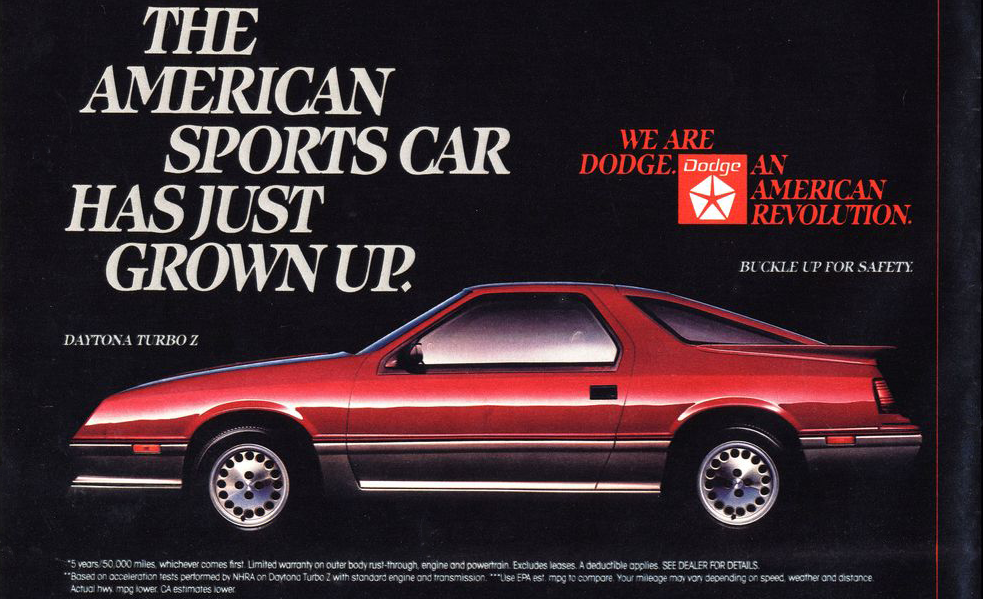
1984 Dodge Daytona Turbo Z hatchback coupe

“The American sports car has just grown up.”

1984 was the first year for Dodge’s Daytona. Built on the K-car platform but with a shorter wheelbase, the Daytona was now Dodge’s sportiest car, upending the Shelby Charger. The Turbo Z was the top-of-the-line of three available Daytona versions.

The Daytona Turbo and Turbo Z‘s standard powertrain was the Turbo I 142 bhp 2.2 liter/135 ci inline four with fuel injection and a turbocharger paired with a five-speed manual transmission. A three-speed automatic transmission was optional ($439). Mileage with the hot setup (turbo and manual) was 20 city/27 highway by the day’s standards (18/25 by 2025 measures), while the 0-60 time was about 8.5 seconds. Moving to the three-speed automatic killed highway mileage, making the ratings 20 and 23. With a 14-gallon gas tank, a five-speed Daytona’s owner could expect a range of 270 to 295 miles with a 10% fuel reserve.

1984 Daytona Turbo Z advertisement

Standard exterior and mechanical equipment on the Daytona Turbo (priced at $10,227 or about $32,400 in today’s dollars) included dual horns, a performance handling package, quick ratio power steering, power brakes, and 195/60R15 Goodyear Eagle GT tires (a size still readily available) on 15-inch cast aluminum wheels. Inside, performance front bucket seats, dual remote power mirrors, a leather-wrapped Sport steering wheel, a center console, and an AM radio with a digital clock were included.

Moving up to Turbo Z ($11,454 or about $36,300 in 2025 dollars) added two-tone paint, a deeper front air dam, extended ground effects, and a specific three-piece rear spoiler.

Options & Production Numbers

Optional equipment included air conditioning ($737), cruise control ($179), tilt steering column ($110), power windows ($185), power door locks ($125), a range of stereos, and a Premium Speaker System ($132). With all the trimmings, a Turbo Z could fairly easily get to $13,200 or so or about $41,800 in today’s dollars—almost exactly what a 2023 Dodge Challenger R/T costs.

Dodge moved almost 50,000 Daytonas in the 1984 model year. The closely related Chrysler Laser actually sold more units in its first two years.

However, Chrysler Corporation must have been disappointed—this was an era where the Chevrolet Camaro, Ford Mustang, and Pontiac Firebird were routinely selling in the hundreds of thousands (the three models combined for 530,000 sold in 1984). By 1987, the Laser would be gone, with the Daytona hanging on through the 1993 model year after a few pretty good years in the late 1980s.

DaytonaLaserSales

Initial reception to the Daytona was good—Car and Driver called it “America’s first legitimate front-wheel-drive muscle car.”

The View From 2025

Daytonas sometimes appear in the Hemmings Motor News classifieds, on eBay Motors, or on Bring a Trailer (BaT has auctioned eleven in the last four years).

Make mine the Red/Silver two-tone, please.

Other sporty Chrysler corporation products I have written about include the 1984 Chrysler Laser hatchback coupe, the 1985 Dodge Shelby Charger hatchback coupe, and the 1985 Dodge Omni GLH hatchback sedan.

Last updated April 2025.

1985 Dodge Shelby Charger hatchback coupe

At Mecum Kissimmee 2022, a Dodge Shelby Charger sold for $12,000.

“32% nastier.”

For 1985, the Dodge Shelby Charger gained an upgraded engine. Gone was the 107 bhp naturally aspirated inline four, replaced with a Turbo I 146 bhp 2.2 liter/135 ci inline four with fuel injection and (natch) a turbocharger. Dodge added a power bulge to the hood to clear the turbocharger, and, of course, there were new Turbo badges. Inside, the high back front bucket seats were notably improved. This combination of changes yielded a substantially improved Shelby Charger over what was initially released in the middle of the 1983 model year.

Shelby Charger pages from the 1985 Dodge Performance brochure

With the aid of a 2,456-pound curb weight, 0-60 mph came in a little under 8 seconds—sprightly for a reasonably priced sport coupe in 1985. Fuel economy ratings were 19 city/29 highway by the day’s standards (17/26 by today’s measures). With a 13-gallon gas tank, the owner of a Shelby Charger could expect a range of 250 to 280 miles with a 10% fuel reserve.

Standard exterior and mechanical equipment on the $9,553 Shelby Charger included tinted glass, halogen headlamps, a rear spoiler, rack and pinion steering, power front disc/rear drum brakes, and P205/50VR15 Goodyear Eagle tires (a size still readily available) with 15-inch cast aluminum wheels. Inside, a Rallye cluster with a tachometer and trip odometer, a front console, a power liftgate release, a Sport steering wheel, and the aforementioned high back front bucket seats were included.

Options & Production Numbers

Options included a removable glass sunroof ($315), a rear window defroster ($132), a rear cargo area tonneau cover ($69), air conditioning ($643), and two upmarket stereos. A $779 Sun/Sound/Shade Discount Package included the sunroof, an AM/FM Premium stereo with cassette, and black rear deck window louvers.

Dodge produced 7,709 Shelby Chargers for the 1985 model year, making that year the second-highest production of the five years the model was available. After 1987, the front-wheel-drive Charger would be gone, replaced by the Shadow.

The View From 2025

Shelby Chargers have their followers as a part of Dodge’s storied high-performance history. They are sometimes available in the Hemmings Motor News classifieds, on eBay Motors, and at online auctions such as Bring a Trailer that cater to the eighties car market. As I update this blog post in April 2025, there’s a Burgundy/Silver 1987 Shelby Charger with a gray interior and 51,000 miles for sale on Hemmings, asking $12,400.

Make mine Santa Fe Blue Metallic, please. That also gets me the silver stripe.

I have also written about the 1985 Omni GLH hatchback sedan.

Last updated April 2025.

1987 Dodge Aries LE sedan

We had a lot of road work going on in our area in September 2020. I had to take a short detour, which sent me down a route that included a few blocks I’d never traveled. I saw a white Dodge Aries sedan parked on the side of the road. A day later, I went back and took a couple of pictures. The Aries was in pretty good shape and sported a Pennsylvania classic car plate.

“More car for the money than you thought possible.”

For 1987, changes to the Dodge Aries sedan were minor. A stainless steel exhaust system was new, as were standard front bucket seats.

The Aries’ standard powertrain was an E86 97 bhp 2.2 liter/135 ci inline four with central fuel injection paired with a five-speed manual transmission. A 100 bhp 2.5 liter/152 ci inline four was a $287 option for the LE only and required the $534 TorqueFlite automatic transmission.

Fuel economy with the standard powertrain was rated at 25 city/32 highway by the day’s standards (22/29 by 2025 measures), while ratings for the 2.5 liter/automatic combination dropped to 22/27. With a 14-gallon gas tank, the owner of a base Aries sedan could expect a range of 320 to 360 miles with a 10% fuel reserve. The driver of a 2.5 liter Aries could expect about 50 miles less. Best case 0-60 times were about 10.5 seconds in a car with a shipping weight of just under 2,500 pounds.

1985 Dodge Aries LE sedan photo
1987 Dodge Aries LE sedan circa 2020

Standard exterior and mechanical equipment for the $7,655 Dodge Aries sedan included halogen headlights, manual rack-and-pinion steering, power front disc/rear drum brakes, a compact spare tire, and P175/80R13 black sidewall tires (now generally a trailer size) on 13-inch wheels with hubcaps. Inside, a manual left exterior mirror, a Deluxe two-spoke steering wheel, a mini console, and cloth with vinyl trim low-back bucket seats with reclining seatbacks were included.

Moving up to the $8,134 LE (which 93% of Aries sedan buyers did), added Deluxe wheel covers, a power left exterior mirror, Deluxe windshield wipers with intermittent wipe, a trunk light, cloth door trim panels, and an AM electronic tuning radio with a digital clock. The LE could get a vinyl bench seat at no extra charge.

Packages, Options, & Production Numbers

Chrysler Corporation had begun to move to more options packages by the mid-eighties. The Aries sedan had four for 1987:

  • Basic Equipment Package ($261) included Deluxe 13-inch wheel covers, a black power left exterior mirror, Deluxe windshield wipers with intermittent wipe, and an AM electronic tuning radio with a digital clock. It was (natch!) only available for the base sedan.
  • Popular Equipment Discount Package included tinted glass, bodyside tape stripes, an automatic transmission, power-assisted steering, and P185/70R14 black sidewall tires (a size still readily available) on 14-inch wheels with Deluxe wheel covers. Inside, the package included black dual remote exterior mirrors, special sound insulation, trunk dress-up, and an AM stereo/FM stereo electronic tuning radio with a cassette player, four speakers, and a digital clock. This package was LE-only and went for $740.
  • Premium Equipment Discount Package ($1,312 and LE-only) included everything in the Popular Equipment Discount Package and added an electric rear window defroster, electronic speed control, a Luxury two-spoke steering wheel, a tilt steering column, and power door locks.
  • Light Package ($59 and LE-only) included an ash receiver light, a cigar lighter light, a headlights-on warning buzzer, an ignition switch light with time delay, and an underhood light.

Individual options included tinted glass ($121), 14-inch cast aluminum road wheels ($332 with either the Popular or Premium packages/$381 without), a conventional spare tire ($75 for 13-inch wheel/$85 for $14-inch wheel), and air conditioning ($790 and requiring tinted glass). Between the packages and the options, a loaded LE sedan could surpass $11,000 on its window sticker.

The Aries sedan continued to sell respectably in 1987, with 71,216 sold. It remained by far the best-selling Dodge sedan.

The View From 2025

Interestingly, K cars have not entirely disappeared from the road—quite unlike many of their eighties peers. Examples of the Aries rarely show up for sale in the Hemmings Motor News classifieds and on eBay Motors, though they do appear on cars.com and Bring a Trailer.

Make mine the extra cost ($41) Twilight Blue Pearl Coat, please.

Other K and K-based cars I have written about include the 1981 Plymouth Reliant coupe, the 1982 Chrysler LeBaron convertible, the 1984 Chrysler Laser hatchback coupe, the 1984 Dodge Daytona Turbo Z hatchback coupe, the 1984 Plymouth Voyager minivan, the 1985 Dodge 600 Club Coupe, and the 1986 Chrysler Town and Country convertible.

Last updated April 2025.

1986 Dodge Ramcharger SUV

Mecum’s “Summer Special” auction in August 2020 included three examples of the 1980s Ramcharger. The one that did the best was a 1986 Royal S.E.—the top-of-the-line for that year. Its hammer price was $15,500.

“Tough in the Rough.”

For 1986, Dodge’s Ramcharger SUV received a new crosshair grille, which had a strong resemblance to their early 1970s pickup truck design. The side mirror assemblies were simplified but other than that, there was little change besides some new colors.

The Ramcharger’s standard engine was an LA 150 bhp 5.2 liter/318 ci V8 with a two-barrel carburetor. It came with a four-speed manual if four-wheel drive was chosen and a three-speed automatic if two-wheel drive was preferred. An LA 175 bhp 5.9 liter/360 ci V8 with a four-barrel carburetor went for an additional $261. With the base powertrain, fuel economy was rated at an uninspiring (and somewhat uncompetitive) 11 city/14 highway by the standards of the day in an SUV with a curb weight that started at 4,045 pounds. A capacious 35-gallon gas tank did give a respectable 360 to 395-mile range with a 10% fuel reserve.

1986 Dodge Ramcharger brcohure cover
1986 Dodge Ramcharger brochure cover

Standard exterior and mechanical equipment on the $11,534 Ramcharger included tinted glass, chrome front and rear bumpers, two-wheel drive, power front disc/rear drum brakes, power steering, and P235/75R15 tires (a size still readily available) on 15 x 6.5-inch wheels. Inside, Deluxe vinyl low-back front bucket seats and an ETR AM radio with a digital clock was included. The four-wheel-drive version of the Ramcharger went for an additional $1,229.

Among the many individual options available were aluminum road wheels ($350), a heavy-duty alternator ($145), intermittent windshield wipers ($55), air conditioning ($740), and an ETR AM stereo/FM stereo radio with a cassette player and a clock ($360).

A few options packages were available. Prospector Package I ($768) included a bright grille, Deluxe wheel covers, a Ram’s Head hood ornament, Prospector nameplates, and a convenience package. Prospector Package II ($1,251) added the Royal S.E. décor package and power door locks. Finally, the top-of-the-line Prospector Package III ($3,269 2WD/$3,186 4WD) added two-tone paint, air conditioning, power windows, speed control, and a tilt steering column.

The Ramcharger’s sales peaked at 37,055 in the 1985 model year and would never again come close to that total. With little changed for 1986, sales slipped substantially, with only 20,815 Ramchargers produced compared to 37,310 Chevrolet Blazers and 57,488 Ford Broncos.

Along with other eighties SUVS, Ramchargers are attracting significant collector interest. According to Hagerty’s valuation tools, all the money for a loaded 1986 Ramcharger Royal S.E. 4×4 in #1/Concours condition is $29,100, with a far more normal #3/Good condition AD-100 version going for $9,400. Ramchargers are often available in the Hemmings Motor News classifieds and on eBay Motors. As I write this post, a Black 1989 Ramcharger with tan bucket seats and 61,000 miles is for sale on Hemmings for $20,000.

Make mine Charcoal Gray Metallic, please. Other Dodges I have written about are the 1985 600 Club Coupe and the 1985 Omni GLH.

1985 Dodge 600 Club Coupe

The crazed folks at The Truth About Cars posted in 2017 about a 1984 Dodge 600 Landau Coupe as part of their Junkyard Find series.

There’s a strong feeling of fulfillment behind the wheel of this striking coupe.

The Dodge 600 was an extended (E-platform) version of the original K-platform cars, with three more inches of wheelbase added to the sedans (coupes and wagons kept the same wheelbase as the first K cars). It debuted in the 1983 model year, two years after the original K cars reached the market. Other E-platform cars were the Chrysler New Yorker, Chrysler E-Class, and (later) the Plymouth Caravelle.

There were three engines available for the Dodge 600. The base engine was Chrysler’s K 99 bhp 2.2 liter/135 ci inline four with fuel injection. The high-performance option was the Turbo I 146 bhp version of the same engine with a Garrett T3 turbocharger and fuel injection. The other option was Mitsubishi’s Astron series 4G54 101 bhp 2.6 liter/153 ci inline four with a two-barrel carburetor.

Fuel economy for the Turbo I and three-speed automatic transmission combination (the five-speed manual was no longer available) was 19 city/24 highway by the day’s standards (it would be 17/22 today). With a 14-gallon gas tank, the new owner of a club coupe could expect a range of between 245 and 270 miles with a 10% fuel reserve.

Club Coupe page from the 1985 Dodge 600 brochure

Standard exterior and mechanical equipment on the $9,060 Club Coupe (about $27,900 in today’s dollars) included halogen headlamps, a Landau padded vinyl roof, power front disc/rear drum brakes, power rack-and-pinion steering, and P185/70R14 steel-belted radial white sidewall tires (a size still readily available) on 14-inch wheels with Luxury wheel covers. Inside, cloth high-back front bucket seats with integral headrests, a full-length console, a Luxury color-keyed two-spoke steering wheel, and an electronically-tuned AM radio were standard. Features listed in the brochure that wouldn’t be considered worth mentioning now included a tethered fuel filler cap and an inside hood release.

Exterior and mechanical options included tinted glass ($115), a sport/handling suspension ($79), and cast aluminum wheels. Inside, air conditioning ($757), automatic speed control ($179), a leather-wrapped steering wheel ($50), and a tilt steering wheel ($110) were available. Three optional radios were available.

The View From 2025

The original K cars and their many variants were once so common on the roads, but have essentially vanished. I haven’t seen a 600 of any type in years, even though Dodge produced over 300,000 of them between 1983 and 1988. You’ll sometimes see the original Dodge Aries/Plymouth Reliant cars at AACA shows along with the top of the line Chrysler LeBaron convertibles. You do occasionally see Dodge 600s for sale in the Hemming’s Motor News classifieds, on eBay Motors, and on Bring a Trailer, but there are no coupes out there as I update this blog post in October 2025.

Make mine Garnet Red Pearl Coat, please.

Other K cars I have written about include the 1981 Plymouth Reliant coupe, the 1982 Chrysler LeBaron convertible, the 1986 Chrysler Town & Country convertible, and the 1987 Dodge Aries LE sedan.

Last updated October 2025.

Save

Save

Sav

Save

Save

Save

Save

Sa

Save

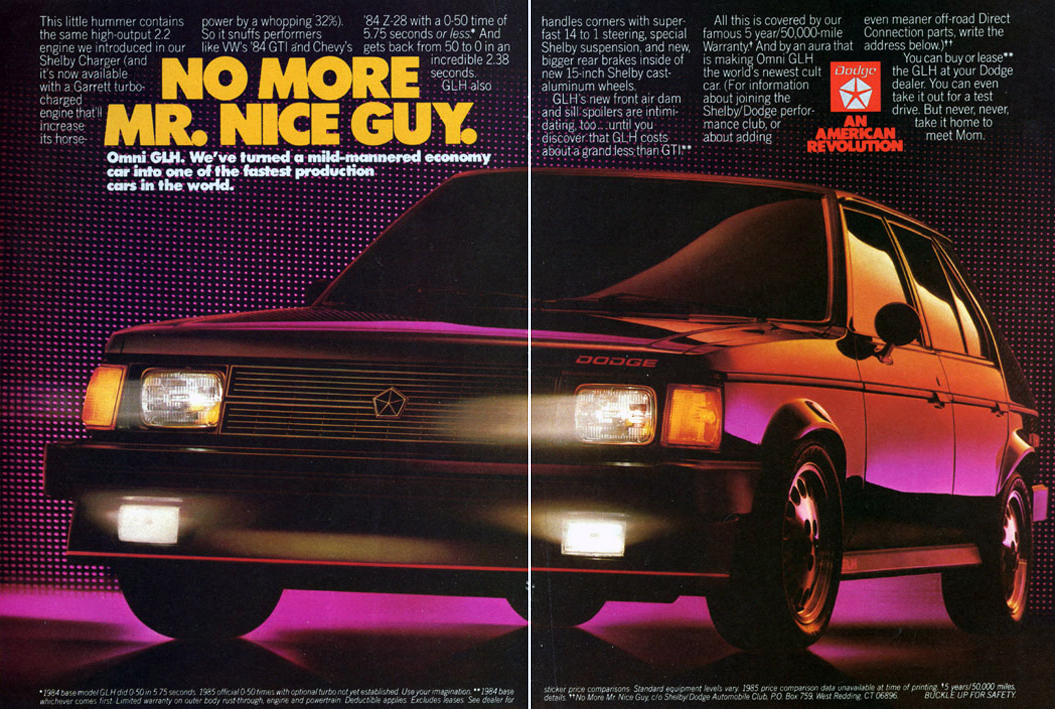
1985 Dodge Omni GLH

“… never, never, take it home to meet Mom.”

Though 1984 was the debut year for the Dodge Omni GLH, 1985 was the first year that Chrysler’s Turbo I 2.2 liter/135 ci turbocharged inline four was available with it (for an additional $872). Packing 146 bhp and 170 lb-ft of torque, the turbo delivered 0-60 times in about 7.5 seconds. Standard power on the GLH was the High Output 110 bhp 2.2 liter/135 ci inline four, and both engines came with a five-speed manual transmission.

Mileage for the turbo was 21 city/30 highway (18/27 by today’s standards) on premium gasoline. Giving up the turbo took you to 25/34 and let you run on regular fuel. Range with the 13-gallon gas tank was almost 300 miles with a 10% reserve.

Omni GLH pages from the 1985 Dodge Performance brochure

The base price for an Omni GLH was $7,620 (about $23,100 in 2025 dollars). For that money, purchasers got a front air dam and side skirts, both finished in black, as was the grille. Distinctive aluminum 16-hole “pizza” wheels rolled on low-profile 195/50R15 tires—now considered a tiny size, but still available. Power steering, power brakes, and a sport suspension were standard and fog lamps completed the “sporty for a 4-door compact” look.

Inside, a GLH was pretty basic. You did get cloth high-backed bucket seats, a Rallye instrument cluster, dual remote mirrors, intermittent windshield wipers, and an AM/FM stereo radio.

Options & Production Numbers

The GLH had few exterior add-ons available. Inside, buyers could add options such as air conditioning ($643), a rear window defroster ($132), automatic speed control ($179), and an AM/FM stereo radio with cassette.

Dodge sold 6,513 Omni GLH models in 1985, including 3,004 normally-aspirated models and 3,509 with the turbo, making the GLH about 9% of total Omni/Horizon production for that model year.

The View From 2025

GLH‘s rarely appear in either the Hemming’s Motor News classifieds or on eBay Motors; I don’t think many of these cars lasted even a decade. You do occasionally see them on Bring a Trailer.

Make mine Black, please—so the ground effects match.

Last updated April 2025.

Some Quiet Love For A K Car

I walked to the local supermarket today to secure some Coca-Cola which we had somehow run short of. We’re located on the southeastern edge of what most weather forecasters seem to think is going to be a full-out blizzard over the next day and a half or so.

It’s only a couple of blocks to the supermarket. On the way is a little tan house which almost always has an original Natural Suede Tan Dodge Aries or Plymouth Reliant station wagon parked next to it. There is no garage for the wagon, so usually it sits out in the weather and rust is definitely showing in parts of that famously squared-off body.

An original K car wagon sits under snow and a car cover this morning
An early Chrysler corporation K car station wagon sits quietly under a little snow and a car cover this morning

This morning, however, there was a fitted blue car cover on the wagon to help protect it from this particular storm, which has just begun.

I may be projecting here, but I choose to see a lot of love and caring for an old and hardworking friend. Is that cover original or new (you can still get them) ? Does it only go on when the predictions are as dire as today’s? How many miles does that wagon have?

Questions, questions, questions. I don’t think I’ve ever seen the owner — if I do, maybe I’ll ask a few.