1983 Ford Mustang GT convertible

I was driving westbound on the Schuylkill Expressway in Philadelphia on a morning in February 2015 when I saw a Fox Mustang convertible (red exterior, black top). A good enough reason to write a blog entry about these attractive cars.

“It’s not just a convertible … it’s a Mustang.”

For 1983, the big news for the Ford Mustang was the return of the convertible for the first time since the 1973 model year. Introduced on November 5th, 1982, the convertible was available only in the luxury GLX trim and the performance GT trim—lower-end L and GL trims remained with the notchback coupe (L and GL) and the hatchback coupe (GL). The GLX was also available only with V6 and V8 engines (no inline-four—turbo or not—would sully the drop-top experience).

The V6 engine choice for the GLX was the Essex 112 bhp 3.8 liter/231 ci with a two-barrel carburetor. Optional on the GLX ($595 additional) and standard on the GT was (of course) the Windsor 175 bhp 4.9 liter/302 ci V8 with a four-barrel carburetor.

Starting at $9,449 (about $30,800 in today’s dollars) and rising significantly during the middle of the model year to a non-trivial $12,467 (about $40,300 in 2025 funds, which is almost exactly what a 2025 Mustang EcoBoost convertible starts at), the GLX did come reasonably well equipped. Standard external and mechanical features included power front disc brakes, tinted glass, and an automatic transmission. Standard interior equipment included a light group and an AM radio.

convertible pages from the 1983 Ford Mustang brochure
Convertible pages from the 1983 Ford Mustang brochure

The GT version of the convertible listed for $13,479 (about $43,600 in 2025 dollars). Standard external and mechanical features included power front disc brakes, power steering, rear spoiler, and a five-speed manual transmission. Standard interior equipment included an AM radio.

All 1983 Mustangs included dual rectangular halogen headlamps, a modified MacPherson strut front suspension, front disc/rear drum brakes, and rack and pinion steering. Inside, full instrumentation (tachometer, trip odometer, fuel/temperature/oil/alternator gauges), full vinyl bucket seats, and a cigarette lighter were included.

Options & Production Numbers

The Mustang option list was long. Inside, air conditioning ($724), speed control ($170), power locks ($160), a tilt steering wheel ($105), and an AM/FM stereo radio with a cassette player ($199) were all available.

All 1983 Mustang convertibles came with a power top, and all windows rolled down—an emphasis Ford frequently made in reference to the Chrysler K car convertibles.
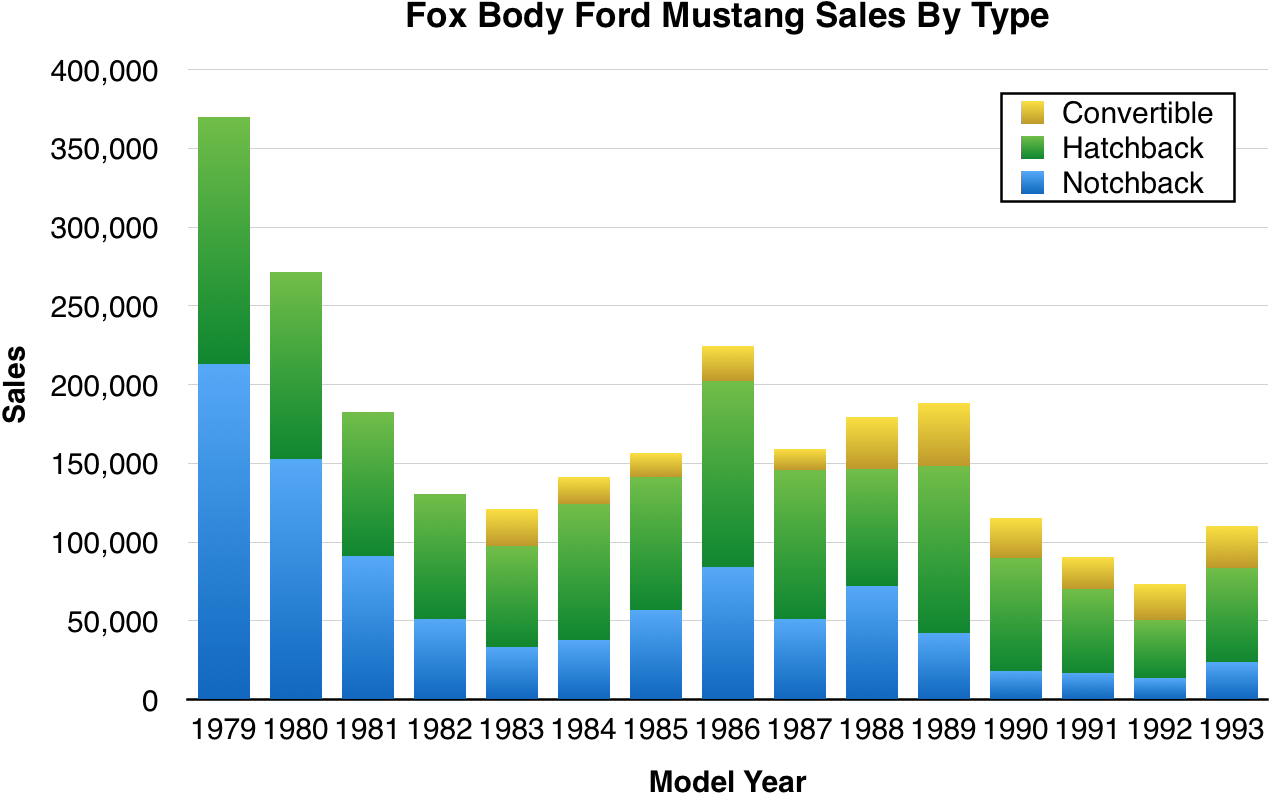
FoxBodyMustangSales

The 1983 Ford Mustang convertible sold reasonably well considering its expense (the GT convertible stickered for 45% more than the GT hatchback). For that year, it probably saved total Mustang sales from dropping below 100,000—helping hold that off until 1991. Between 1983 and 1993, Ford would sell over a quarter of a million of the pony car convertibles.

The View From 2025

There is strong club support for the 1983 Mustang, as there is for all Mustangs except the mid-seventies Mustang IIs. According to Hagerty’s valuation tools, all the money for a 1983 Mustang GT convertible in #1/Concours condition is $58,300, with a more typical #3/Good condition car going for $14,500. 1983 Mustangs often show up in the Hemming’s Motor News classifieds, on eBay Motors, and on Bring a Trailer—as I update this blog entry in March 2025, there’s a Red 1983 Mustang GLX convertible with a white top, a white vinyl interior, an aftermarket V8, and 89,000 miles available on Hemmings for $18,000.

Make mine that same Red, please.

Other Mustangs I have written about include the 1980 Cobra fastback coupe, the 1982 GT fastback coupe, and the 1984 SVO fastback coupe.

Last updated March 2025.

1986 Chrysler Town & Country convertible

“Why sit around waiting for a summer breeze to come up when you can create quite a stir yourself?”

1986 was the last model year for Chrysler’s Town & Country convertible. Basically a special version of the LeBaron convertible, the Town & Country was first available in 1983 and was intended to remind potential buyers of the classic (and valuable) Town & Country convertibles in production from 1946 through 1950. The newer Town & Country was not especially successful, selling only 3,721 units in four years, with only 501 sold in 1986.

Like all LeBarons, the Town & Country‘s front and rear fascias, headlights, grilles, and taillights were all updated with a more rounded and aerodynamic look in 1986. The center-mounted brake light mandated for all 1986 vehicles by U.S. federal law was mounted atop the trunk lid. Inside, the standard digital instrument cluster was redesigned for better legibility.

Also for 1986, a throttle-body fuel injected K 2.5 liter/152 ci inline four producing 100 bhp replaced the carburetted 2.6 inline liter four built by Mitsubishi as the base engine. The optional fuel-injected Turbo I 146 bhp 2.2 liter/135 ci turbocharged inline four remained for an additional $628. Both engines were paired with a TorqueFlite three-speed automatic. Mileage with the base engine was 23 city/25 highway by the day’s standards (20/23 by 2025 measures). The Turbo I was rated at 20 city/24 highway—not a big price to pay for a significant percentage of extra horsepower.

1986 Chrysler Town & Country convertible brochure picture
1986 Chrysler Town & Country convertible pages from the LeBaron brochure

The base price for 1986 Town & Country was a non-trivial $17,595 (about $52,600 in today’s dollars). For that money, you got halogen headlights, dual horns, power brakes, wire wheel covers with locks, and the Town & Country’s distinctive white ash moldings and teak appliques on the body sides. Inside, you got a very attractive Mark Cross leather interior along with air conditioning, power mirrors, a power driver’s seat, and the Ultimate Sound System AM/FM stereo cassette with a graphic equalizer and six speakers.

Packages included the $302 Deluxe Convenience Package (cruise control and tilt wheel) and the Power Convenience Discount Package (power windows and power locks).

The View From 2025

A small set of enthusiasts is collecting these eighties Town & Country convertibles, and I have seen nice examples at several AACA-judged shows. You see them for sale in the Hemmings Motor News classifieds, on eBay Motors, and on Bring a Trailer. As I update this blog entry in October 2025, there’s a White 1986 LeBaron Town & Country with almond seats and 178,000 miles for sale on Hemmings, asking $14,000.

Of course, these Super K convertibles also started Chrysler’s long tradition of making convertibles that might occasionally be sporty but were not sports cars—a market niche they finally exited with the demise of the Chrysler 200 convertible at the end of the 2014 model year.

I still like what Chrysler was trying to do, and I appreciate how these cars look. Make mine White, please, with that killer Almond/Cream leather interior.

I have also written about the debut 1982 Chrysler LeBaron convertible.

Last updated October 2025.

1989 Cadillac Allanté convertible

(talking with a loyal and enthusiastic Allanté owner at the AACA Annual Meeting in 2014 inspired me to write this entry about the last of the 1980s Allantés)

“The only way to travel is Cadillac Style.”

For 1989, the Cadillac Allanté received its first engine upgrade, moving from the 4.1 liter/249 ci HT-4100 V8 to the 4.5 liter/273 ci HT-4500 V8 but remaining connected to the 4T60 4-speed automatic transmission. Power climbed 30 bhp to an even 200 bhp while acceleration improved to about 8.0 seconds to 60 mph with a claimed top speed of 134 mph (probably with the aluminum top on) for Dave Hill’s baby. Mileage declined slightly to 15 city/23 highway by the standards of the day (14/21 by today’s standards. With a 21.9-gallon fuel tank, an Allanté driver could expect a range of 345 to 375 miles with a 10% fuel reserve.

Other changes for 1989 included a new Light Blue Metallic exterior color, new 16 x 7 inch wheels, and a new seat design.

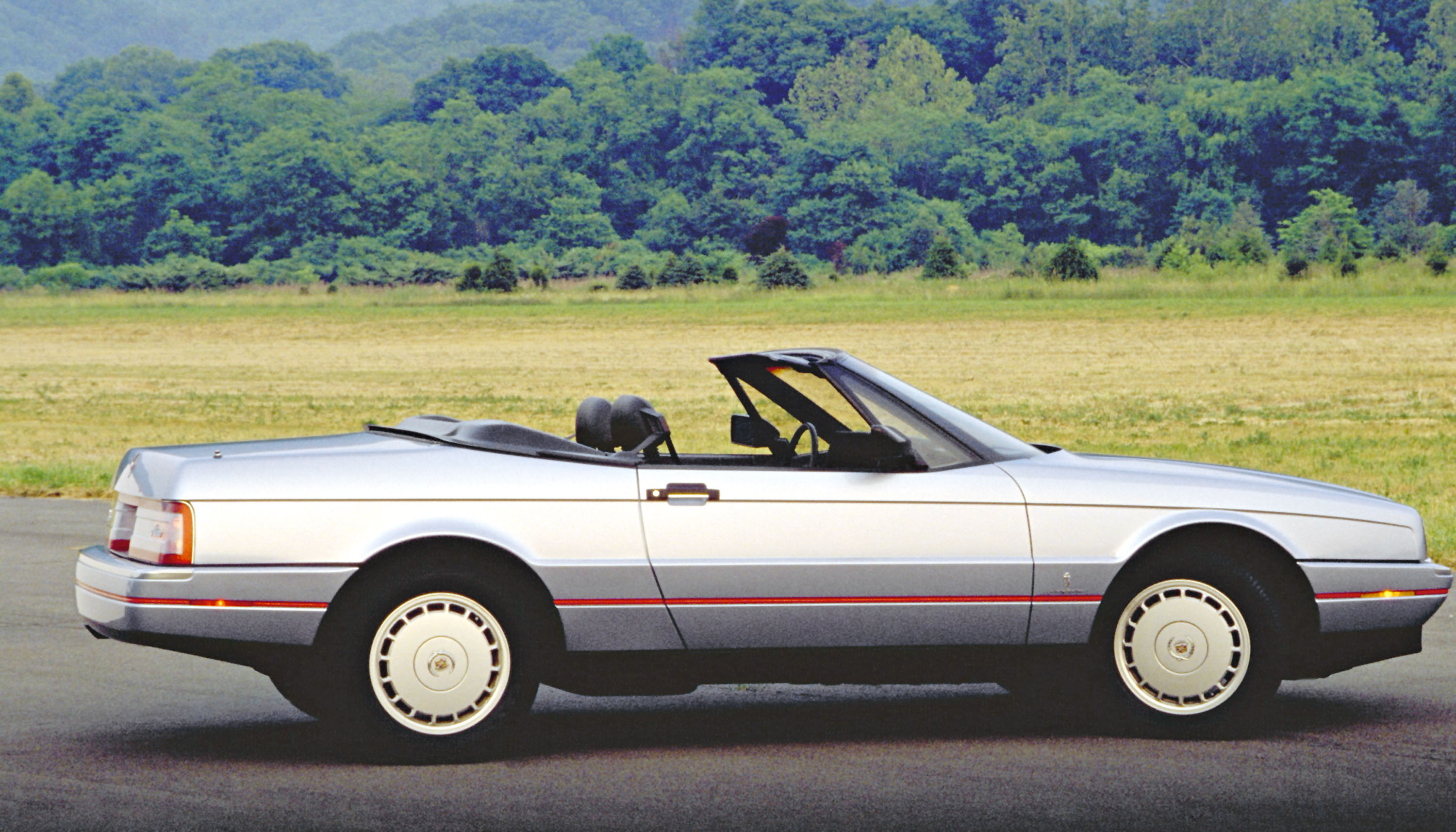
1989 Cadillac Allante
1989 Cadillac Allanté, courtesy of the GM Media Archives

For 1989, the Allanté’s base price remained non-trivial: $57,183 (about $153,400 in 2025 dollars) for the 3,296 buyers. However, just about everything came standard, including ABS, traction control, Goodyear Eagle P225/55VR16 tires (a size still readily available) on 16-inch forged aluminum performance wheels, and the aluminum hard top/cloth convertible top combination. The interior included 10-way leather-covered Recaro bucket seats, electronic climate control, and Symphony Sound System AM/FM stereo with a cassette player. Because it was a Cadillac, you also got air conditioning, power steering, power windows, and power door locks. You could choose either an analog or a digital instrument cluster at no extra charge.

The View From 2025

Allantés have a good club following and consistently appear in the Hemmings Motor News classifieds, on eBay Motors, and on Bring a Trailer. According to Hagerty’s valuation tools, a 1989 Allanté in #1/Concours condition is $23,500, with a far more typical #3/Good car going for $6,700. As I update this blog entry in July 2025, there’s a Pearl White Allanté with a Burgundy interior with 111,000 miles for sale on Hemmings, asking $16,500.

I think the Allanté body style (by Pininfarina, of course) has aged well. It certainly still looks like nothing else on the road—which was definitely one of Cadillac’s goals.

Make mine Pearl White, please.

Last updated July 2025.

1989 Mercedes-Benz 560SL convertible

560SLs were a notable presence in the January 2014 auctions at Scottsdale and Kissimmee, so I decided to finally post this short entry on the last of third-generation SLs.

“Engineered like no other car in the world”

The 1989 Mercedes-Benz 560SL marked the end of the R107 generation that had begun way back in 1972 with the 450SL. There had been a moderate restyling for 1986, but the basic bones were definitely aged.

Motive power was provided by a Bosch fuel injected 227 bhp 5.5 liter/338 ci V8 connected to a four-speed automatic transmission. Mileage wasn’t exactly great for the 3,700-pound car—the ratings of the day were 14 city mpg/17 highway (adding a $1,300 gas guzzler tax to every vehicle), by today’s standards that would be 12 city/16 highway. With the 22.5-gallon gas tank, 560SL owners could expect a range of between 280 and 315 miles with a 10% fuel reserve. 0-60 did come in about 7 seconds, but the 560SL was closer to a muscle car than to a sports car.

Philips light bulb advertisement featuring 1989 Mercedes-Benz 560SL
Philips light bulb advertisement featuring the 1989 Mercedes-Benz 560SL

The base price for 1989 was $64,230 (about $172,400 in today’s dollars). For your money, you got a plethora of standard equipment. Standard exterior and mechanical features included power assisted steering, anti-lock braking system, and power assisted four wheel disc brakes, and light alloy wheels. Inside, leather upholstery, a driver’s side air bag, cruise control, automatic climate control, central locking, electrically operated windows, an electronic AM and FM stereo radio with cassette player, and (of course) a first aid kit were included. About 8,300 buyers took home this last of the line example.

The View From 2025

There is decent club support for the 560SL, as there is for almost all Mercedes-Benz’s. 560SLs maintain a substantial presence in the Hemming’s Motor News classifieds, on eBay Motors, and on Bring a Trailer. As I updated this blog post in August 2025, there were 83 available on Hemmings, including 22 of the 1989 models. According to Hagerty’s valuation tools, all the money for a 1989 560SL in #1/Concours condition is an astounding $153,000, while a more normal #3/Good condition car goes for $24,400.

Make mine Astral Silver Metallic, please.

Other Mercedes-Benz models I have written about included the 1980 450SL convertible, the 1981 380 SEL sedan, the 1985 380SL convertible, the 1985 300SD coupe, and the 1986 560SEC coupe.

Last updated August 2025.