1982 Lamborghini Countach 5000S coupe

“… a technical evolution …”

Midway through the 1982 model year, the Lamborghini Countach received a larger version of its V12. With that, the model designation changed from LP400 S to 5000S. Just because (why not?), this version was also sometimes called the LP500 S.

The engine requires some more detail. The 4.8 liter/291 ci V12 came with six Weber carburetors and made 325 bhp in North American form. With the standard five-speed manual, the 0-60 time was 5.7 seconds. As might be expected, fuel economy by the day’s standards was not impressive—12 city/18 highway (10/13 by 2025 measures). At least the two 15.4-gallon gas tanks allowed a range of 320 to 370 miles before a 5000S driver had to search for more premium fuel.
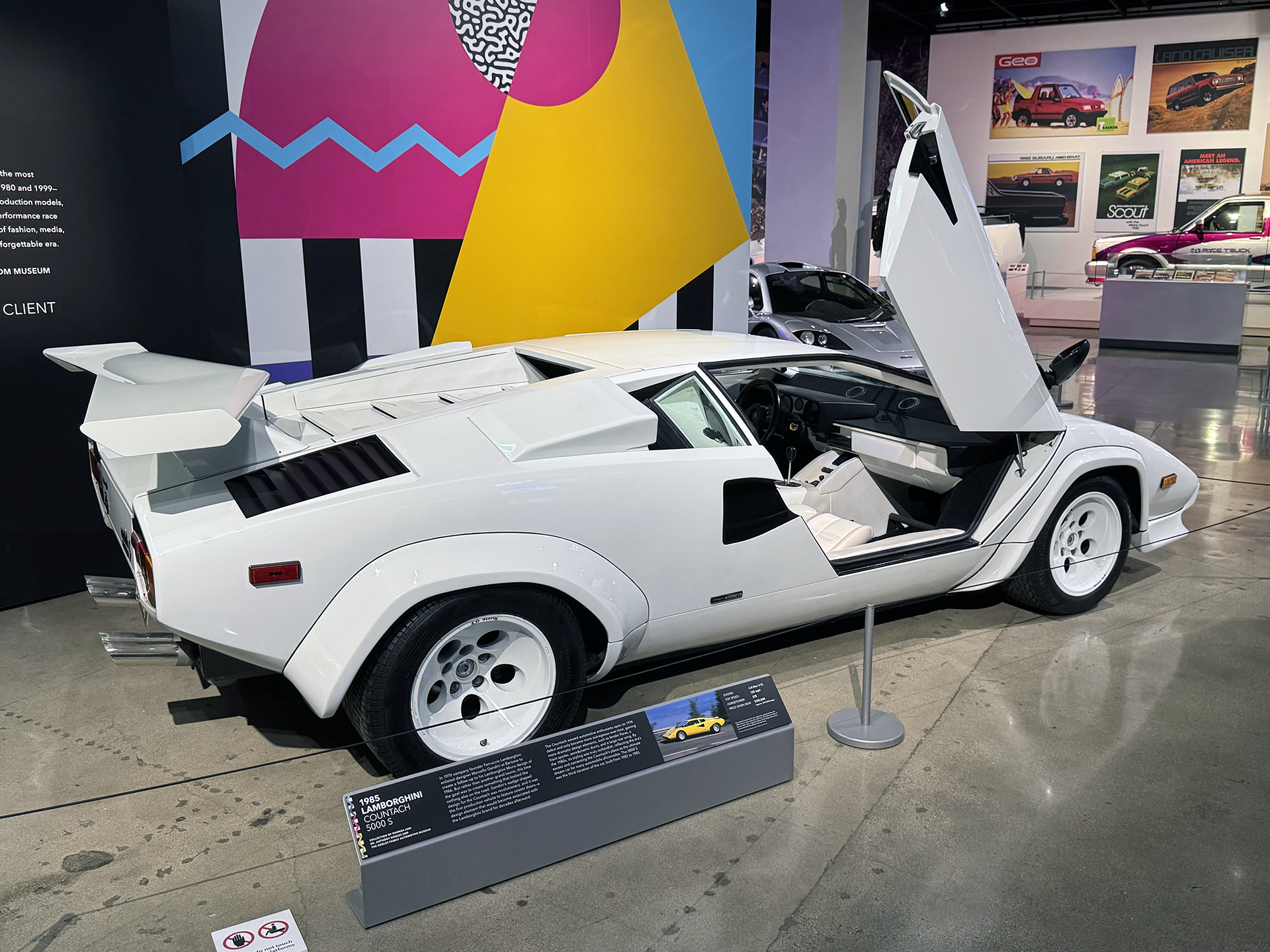
Photo of 1985 Lamborghini Countach 5000S coupe
1985 Lamborghini Countach 5000S coupe at the Peterson Museum

I saw Countachs of various types at the wonderful Petersen Automotive Museum in Los Angeles in late 2025, and it was a great reminder of how vertically short these cars are—the spec for the 5000S was 42.1 inches. When Lamborghini released the Countach LPI 800-4 homage for the 2022 model year, it was actually 2.7 inches taller.

The 1982 Countach 5000S‘s base price was an eye-watering $99,500—about $342,000 in today’s dollars, or about 14% less than what a 2026 Lamborghini Temerario coupe goes for (Lamborghinis have gotten no cheaper in the last forty years) . Standard exterior and mechanical equipment included rack-and-pinion steering, ventilated disc brakes, and 205/50ZR15 front tires and 345/35ZR15 rear tires (both Pirelli P7s) on 15-inch wheels. Inside, leather bucket seats, a tilt-and-telescoping steering wheel, and air conditioning were included.

Options & Production Numbers

Options included a rear wing ($5,500), a sports exhaust, gold wheels, and a series of stereos (including a $3,000 one from Alpine).

Lamborghini built 321 5000S Countachs from March 1982 through March 1985. At that point, the Countach Quattrovalvole took over.

The View From 2025

The view from 2025 is just fine, thank you—according to Hagerty’s valuation tools, all the money for a 1982 Countach 5000S in #1/Concours condition is an astounding $676,000. A more “normal” #3/Good condition example is valued at $407,000. 5000Ss frequently appear for sale in the Hemmings Motor News classifieds, on Bring a Trailer, and at in-person auctions.

Make mine Black, please.

The 5000S is the first Lamborghini I have written about in Eighties Cars. Another 1985 exotic I have written about is the Ferrari Testarossa coupe.

1986 Porsche 911 Turbo coupe

“There is nothing else like it. Nothing.”

After a six-year pause, Porsche brought the 911 Turbo back to the United States market in 1986. The difference compared to other 911s was, of course, the engine, a Bosch fuel-injected 282 bhp 3.3 liter/201 ci flat six with a turbocharger.

With the standard four-speed manual transmission (the Porsche five-speed could not reliably handle the Turbo‘s power), you could expect to hit 60 mph in 6.1 seconds, with a top speed of 157 mph in the 3,000-pound Turbo (the 2025 911 Turbo coupe is about 3,700 pounds). Fuel mileage was an unimpressive 16 city/22 highway by the day’s standards (15/20 by today’s measures) with premium gas, which meant you were paying a $500 gas guzzler tax. A 22.5-gallon gas tank meant a range of 355 to 380 miles with a 10% fuel reserve.

1986 Porsche 930 Turbo print advertisement

The 911 Turbo‘s base price was $53,475—about $157,000 in 2025 dollars. Standard exterior and mechanical equipment included tinted glass all around, a front and rear spoiler, heatable and electrically adjustable outside mirrors, heatable windshield washer nozzles, integrated fog lights, four-wheel vented disc brakes (but no ABS), and an engine oil cooler. Tires were 225/50VR-16 in the front and 245/45VR-16 for the rear, both mounted to 16-inch forged alloy wheels (both tire sizes are still readily available). Inside, a leather interior, a 4-spoke leather-covered steering wheel, an air conditioner, a central locking system, power windows, and Blaupunkt’s Monterey AM/FM stereo cassette with four speakers were all standard.

Production & Period Reviews

Porsche sold 1,424 Turbos in the United States during the 1986 model year, with many of the eager buyers happy to avoid the vicissitudes of gray market imports.

Like many turbocharged Porsches in the 1980s, the 911 Turbo was somewhat of a poster child for turbo lag. The immortal quote from Car and Driver:

“A cheerleader in a clapped-out Mustang II will have no trouble beating you across an intersection while checking her makeup. As a matter of fact, one did exactly that to us.”

All the buff books agreed that the wider rear wheels and tires substantially improved the handling over 1970s Turbos. However, there was a feeling that the mid-eighties Turbo was not as differentiating as the seventies version had been, perhaps because many other performance cars (including others from Porsche) had closed the gap by 1986.

The View From 2025

After all that has been written about them, I don’t feel I have anything startlingly new to say about the 911 Turbo—perhaps the reason it has taken me so long to generate a blog post about it.

Porsche 911 Turbos have (of course) excellent club support from many sources and are often available in the Hemmings Motor News classifieds, on eBay Motors, and on Bring a Trailer. 911 Turbos from the 1980s have held their values very well. According to Hagerty’s valuation tools, all the money for a 1986 Porsche 911 Turbo coupe in #1/Concours condition is $275,000, with a more normal #3/Good condition car going for $175,000. As I write this blog entry in April 2025, there’s a Black 1986 911 Turbo with black leather seats and 16,000 miles for sale on Hemmings, asking $182,500.

Make mine Silver Metallic, please.

Other eighties Porsches I have written about include the 1980 924 hatchback coupe, the 1982 924 Turbo hatchback coupe, the 1982 928 hatchback coupe, the 1985 911 Carrera Cabriolet, the 1986 944 Turbo hatchback coupe, the 1987 911 Carrera coupe, and the 1988 944 hatchback coupe.

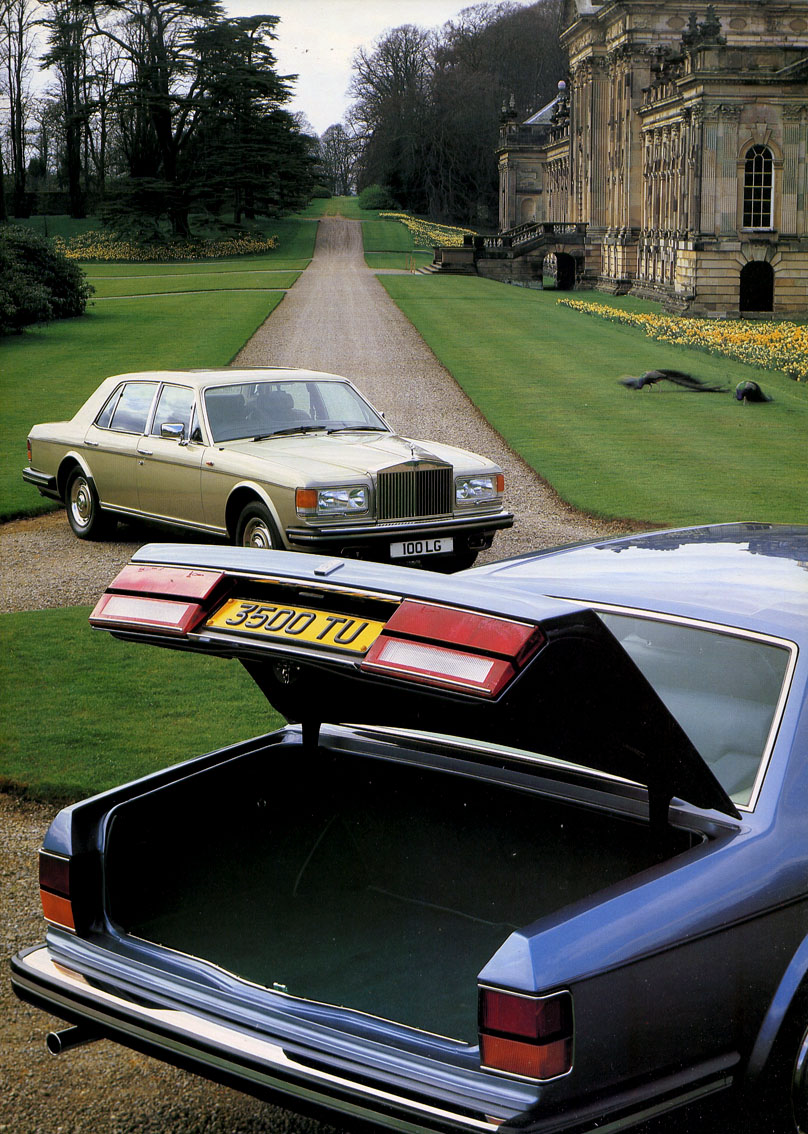
1981 Rolls-Royce Silver Spirit Mk 1 sedan

“Inheriting All The Traditions Of The Best Car In The World”

The introduction of the Silver Spirit in the United States waited one year after the model’s debut in England. The Silver Spirit and the slightly lengthened Silver Spur followed the long-running Silver Shadow and Silver Wraith II models.

The powertrain for Rolls-Royce sedans remained a 6.75 liter/413 ci V8 mated with a three-speed automatic. In 1981 guise with Bosch K-Jetronic fuel injection, the venerable V8 (development had begun in 1952) was rated at 175 bhp. Despite the Silver Spirit’s 4,900-pound curb weight, Car and Driver recorded a respectable 10.8-second 0-60 time. Fuel mileage was distinctly unrespectable—rated at 10 city/13 highway and triggering a $650 gas guzzler tax. With a large 28.6-gallon gas tank, a Silver Spirit owner could expect a range of 265 to 295 miles with a 10% fuel reserve.

The Silver Spirit retailed for an astounding $109,000—about $410,100 in 2025 dollars. This price was at a time when a top-of-the-line Mercedes-Benz 380 SEL went for $44,300, and the comparable BMW 733i was $32,000. Cadillac’s range-topping Seville was a “mere” $23,400.

Page from the 1981 Rolls-Royce Silver Spirit brochure

Standard exterior and mechanical equipment on the Silver Spirit included power-assisted rack and pinion steering, power four-wheel disc brakes, and 235/70HR-15 Michelin XVX tires (a size and type still readily available) on 15-inch wheels. Inside, wood burl trim, leather upholstery, adjustable front bucket seats, automatic speed control, automatic temperature control, and a Blaupunkt Bucharest stereo radio with a cassette player and four speakers were included. There were no formal options, though the factory would satisfy almost any color, upholstery, or trim request for an additional charge.

The View From 2025

Like all Rolls-Royces, the Silver Spirit attracts collector interest, and there is support from the Rolls-Royce forums. Like many late-model Rolls-Royces, Silver Spirits face extreme depreciation because of the costs of deferred maintenance.

According to Hagerty’s valuation tools, a 1981 Rolls-Royce Silver Spirit in #1/Concours condition is $16,300, with a more normal #3/Good condition car going for $8,200. Silver Spirits sometimes appear for sale in the Hemming’s Motor News classifieds, on eBay Motors, and on Bring a Trailer.

Make mine Tudor Red, please.

The Silver Spirit is the first Rolls-Royce I have written about, though I did write about the closely related 1989 Bentley Turbo R sedan. Thus, I have not yet written about the Camargue coupe or the Corniche convertible.

1985 Ferrari 308 GTB Quattrovalvole coupe

“Only those who dare … truly live”

1985 was the final year for the Ferrari 308 (the 328 would follow in 1986). Ferrari’s least expensive two-seater was also overshadowed in the public view by the release of its big brother Testarossa.

The engine was Ferrari’s Tipo F105AB 2.9 liter/179 ci V8 with Bosch K-Jetronic fuel injection and four valves per cylinder (thus Quattrovalvole), making 230 bhp and mated to a five-speed manual transmission. In the 3,200 pound GTB, this was good for period 0-60 times of under 7 seconds. Mileage was pretty awful compared to some of the 308’s fuel-injected competition—10 city/16 highway by the day’s standards (9/15 by today’s standards). With an 18.5-gallon gas tank, 308 owners could expect a chastening 200 to 215 mile range with a 10% fuel reserve.

Ferrari 308 GTB Quattrovalvole, courtesy of Ferrari

Standard exterior and mechanical equipment on the $54,000 GTB (about $134,000 in 2020 dollars) included four-wheel disc brakes, rack and pinion steering, and 16-inch alloy wheels. Inside, leather bucket seats, power windows, tinted glass, and a heated rear window were all included. Available options included metallic paint, a deep front spoiler, a satin black finished aerofoil at the rear of the roof, 16 x 8 inch Speedline wheels with Pirelli P7 tires, air conditioning, and cloth seat centers.

The lovely Pininfarina styling that first appeared in 1975 had aged well with relatively few changes. Debuting for the 1983 model year, the Quattrovalvole could be differentiated from previous 308s by the addition of a slim black louvered panel on the hood to aid radiator exhaust air exit and a redesigned radiator grille with rectangular driving lights on each side. Also new were power-operated side mirrors carrying small enamel Ferrari badges and rectangular side repeaters. The interior also received some minor updates, such as a satin black three-spoke steering wheel with a triangular center.

The View From 2025

Values for the 308 have gone up and down over the last decade. According to Hagerty’s valuation tools, all the money for a 1985 Ferrari 308 GTB Quattrovalvole in #1/Concours condition is currently an astounding $234,000, with the targa-top GTS in the same condition getting $174,000 (the GTB is far rarer, at about 20% of overall Quattrovalvole production). Prices drop significantly for more normal #3/Good condition cars—$128,000 for a GTB and $108,000 for a GTS. Ferrari 308s frequently appear for sale in the Hemmings Motor News classifieds, on Bring a Trailer, and at in-person auctions.

Make mine Rosso Corso, of course. Is there really a question?

Other Ferraris I have written about in this blog include the 1983 Berlinetta Boxer 512i coupe and the aforementioned 1985 Testarossa coupe.

Last updated March 2025.

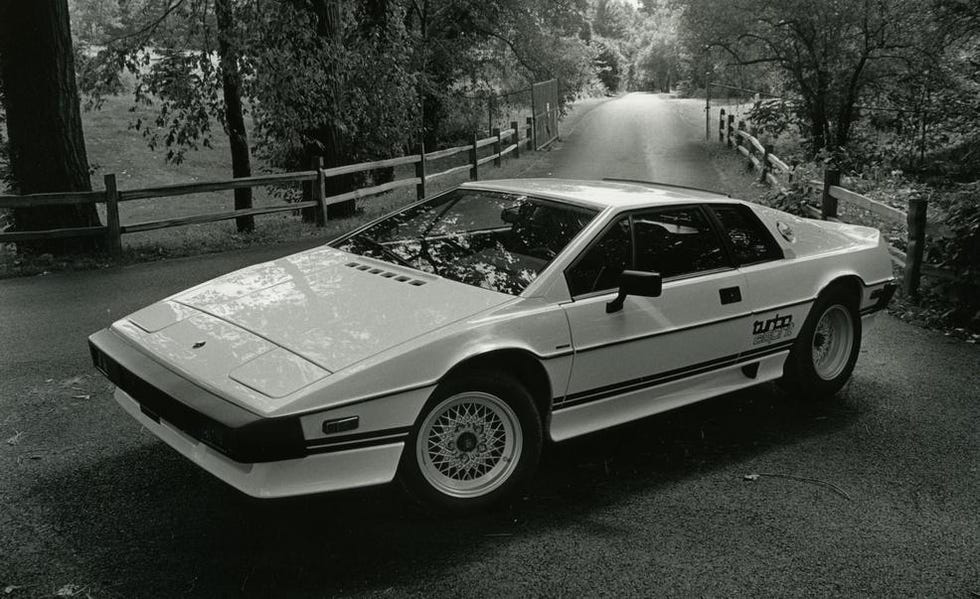
1983 Lotus Turbo Esprit coupe

This early (December 2013) blog entry has been revised and extended enough to consider it a new entry.

“Low, sleek, ultra-competitive.”

The 1983 Lotus Turbo Esprit finally brought the performance that the original Esprit’s supercar looks had promised over half a decade before.

Horsepower was up to 205 bhp from the 140 bhp that had come with the debut of the Esprit in 1977. The engine was still the type-910 2.2 liter/131 ci inline four with a carburetor, but a Garrett AiResearch turbocharger making 8.0 psi of boost was attached along with an intercooler. Other engine technology included an aluminum block, aluminum heads, and four valves per cylinder.

Performance for the almost 3,000-pound exotic substantially improved with the turbo: a 0-60 time of about 6.5 seconds was about 1.5 seconds quicker than the original naturally aspirated car. The Turbo Esprit’s top speed was about 140 mph. From the perspective of 2025, mileage wasn’t so great for a small turbocharged four with a five-speed manual transmission; 14 city/25 highway by the day’s standards and 11/18 by today’s measures. A 22.7-gallon gas tank helped with range, which was likely about 300 to 355 miles with a 10% fuel reserve.

The Esprit’s looks were updated in the same way that many 1970s designs were as they headed into the 1980s. Ground effects were added to the original Giorgetto Giugiaro design, and of course there were huge Turbo Esprit logos on the rear quarters.

1983 Lotus Esprit Turbo photo
1983 Lotus Esprit Turbo photo, courtesy of Car and Driver

Standard exterior and mechanical equipment on the Turbo Esprit included a four-wheel independent suspension, rack and pinion steering, four-wheel disc brakes, and 195/60R15 front tires and 235/60R15 rear tires, all of them Goodyear NCT‘s riding on BBS 15-inch alloy wheels. Inside, air conditioning, power windows, and Connolly leather bucket seats were included.

A few years ago, Car and Driver republished their story on the Turbo Esprit from the November 1983 issue, and it is interesting and instructive to read—though it is notable that they put the Nissan/Datsun 300ZX Turbo on the cover that month instead of the Lotus. They believed that the car would find a hole in the exotic market even at a relatively dear price of $47,984 (about $157,100 in 2025 dollars).

The View From 2025

For reference, according to Hagerty’s valuation tools, all the money for a 1983 Turbo Esprit in #1/Concours condition is currently $65,300, with a more normal #3/Good car going for $30,000. There is good club support for Esprits on LotusTalk, and they regularly show up in the Hemming’s Motor News classifieds, on eBay Motors, and on Bring a Trailer.

Make mine Black, please.

Last updated June 2025.

1983 Ferrari 512 BBi coupe

I used to live about a mile from a Ferrari dealership. As I walked near it back in 2014, I saw a trailer parked around the corner with a low-slung sports car inside. Getting a little closer showed that it was definitely a 512. “Now that’s a Ferrari!”, I said. The man unloading the car chuckled as I walked away.

For 1983, Ferrari’s lovely Pinanfarina-designed 512 BBi received few, if any, changes. The BBi’s engine was Ferrari’s Tipo F110 A 340 bhp 4.9 liter/302 ci flat 12 with Bosch K-Jetronic fuel injection—the 512 had moved to fuel injection (and added the i) for the 1982 model year. When paired with the five-speed manual transmission, 0-60 came in about 5.5 seconds with a top speed of 170 mph or so—fast, fast, fast for 1983.

Photo of a 1983 Ferrari 512 BBi
Photo of a 1983 Ferrari 512 BBi, courtesy of Wikipedia photographer dave_7

Ferraris had gotten more luxurious: standard equipment on the 512 BBi included air conditioning (often said to be inadequate), leather seats, power mirrors, power windows, power door locks driven from the key, a Nardi steering wheel, and a Pioneer AM/FM stereo cassette deck with 7-band graphic equalizer.

Although the 512 BBi was not legal in the U.S., some importers converted them to U.S. specifications by adding catalytic converters, side reflectors, and larger bumpers.

Of course, there’s a fairly famous eighties music video associated with this car.

Sammy Hagar may have his issues, but the 512 BBi he drives in the video made for this song demonstrates exquisite taste. When interviewed by Motor Trend in 2008, he still owned it.

The View From 2025

There’s some really excellent support for 512s (and all Ferraris) from the folks on FerrariChat (who contributed to the original version of this post). According to Hagerty’s valuation tools, all the money for a 1983 512 BBi in #1/Concours condition is $345,000 (though recent auction results may make that seem low). A more “normal” #3/Good condition example is valued at $224,000. Ferrari 512s frequently appear for sale in the Hemmings Motor News classifieds, on Bring a Trailer, and at in-person auctions.

Make mine Rosso Corsa (red), please, though I’m quite tempted by how they look in Grigio (grey).

Other Ferraris I have written about include the 1985 308 GTB Quattrovalvole coupe and the 1985 Testarossa coupe.

Last updated February 2025.

1985 Ferrari Testarossa coupe

When it debuted for the 1985 model, the Ferrari Testarossa had big shoes to fill—it replaced the undeniably beautiful Berlinetta Boxer, which itself had replaced the undeniably beautiful Daytona.

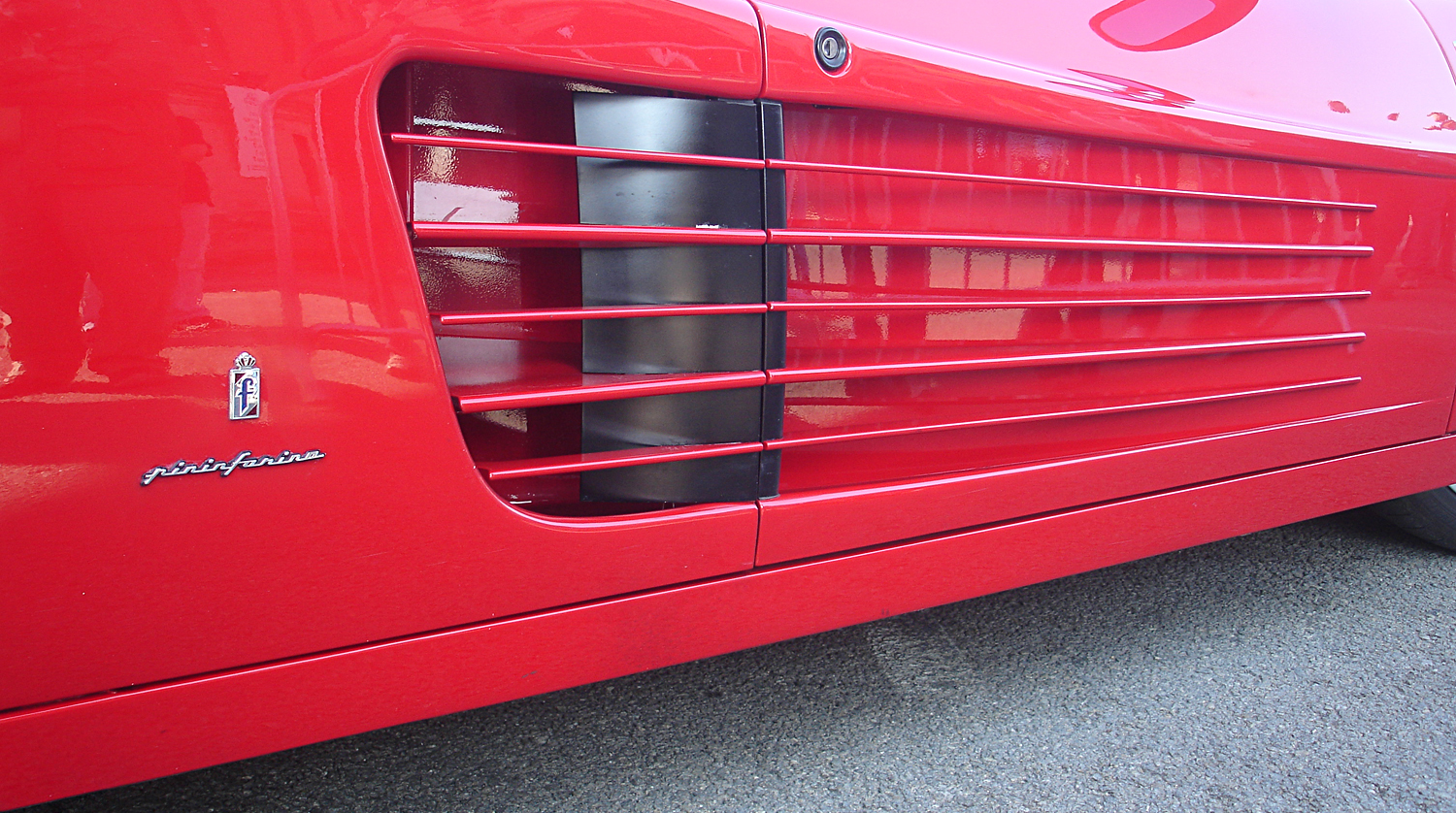
testarossaintake
Close up of the “cheese grater” side strakes on the Ferrari Testarossa.

Sergio Pininfarina’s styling for the Testarossa was not undeniably beautiful, but it definitely was striking. The defining feature was the side strakes covering the radiator intakes, often referred to as “cheese graters.”

The strakes were at least functional, feeding the two side radiators that cooled the Bosch K-Jetronic port fuel-injected 4.9 liter/302 ci 380 bhp flat 12 cylinder engine—crazy power for the mid-1980s. Mileage (not that the target market cared) was flat-out awful10 city/15 highway by the day’s standards (9/14 by today’s standards). At least the 30.4-gallon gas tank meant you could go around 315 to 340 miles before looking for more fuel.

The Testarossa was a Ferrari that reflected the times—it was big (almost six inches wider and 200 pounds heavier than the Berlinetta Boxer it replaced) and flashy. It was also pricey; at $90,000 and up (over $272,000 in 2025 dollars), four times as expensive as a 1985 Corvette (not that too many buyers were cross-shopping the two). You did get at least a little comfort for your money—air conditioning, power seats, and power windows were all standard.

There continues to be disagreement over how good a car—or, more importantly, how good a Ferrari—the Testarossa was. It was undoubtedly fast: 0-60 came in 5.2 seconds, and top speed was about 180 mph.

The View From 2025

There is strong club support for the Testarossa, as there is for all Ferraris. According to Hagerty’s valuation tools, all the money for a 1985 Testarossa in #1/Concours condition is $253,000, with a more “normal” (if any Ferrari can be normal) #3/Good condition car going for $106,000. You see them advertised in the Hemming’s Motor News classifieds, though often it’s a notice of an auction. Bring a Trailer also auctions a reasonable amount of Testarossas.

Make mine that same Rosso Corsa, with the tan interior. My ex-wife prefers the “Miami Vice” white, but I think Testarossas (along with many Ferraris) left our list forever when she found out that you or your very expensive mechanic have to remove the engine from the car to do a “major service” every five years or 30,000 miles.

Other eighties Ferraris I have written about include the 1983 Berlinetta Boxer 512i coupe and the 1985 308 GTB Quattrovalvole coupe.

Updated in March 2025.