1989 Pontiac 20th Anniversary Turbo Firebird Trans Am hatchback coupe

Originally posted on the fourth of July in 2014, here’s some eighties American iron.

“The Only Modification It Needed To Pace The Indy 500 Was A Decal.”

For 1989, the big news in the Pontiac camp was the release of the 20th Anniversary Turbo Firebird Trans Am, which was essentially a Trans Am GTA coupe with an exclusive engine option and some specific trim elements.

Rated at 250 bhp but actually making about 300 bhp, the LC2 3.8 liter/231 ci sequential fuel-injected, turbocharged, and intercooled V6 was teamed with the 200-4R four-speed automatic transmission. Mileage was 16 city/24 highway by the day’s standards (15/22 by today’s standards), and nobody cared. What they did care about was the acceleration—Car and Driver managed to achieve a 4.6 second 0-60 time (Pontiac had claimed 5.5 seconds) and a top speed of 153 mph. At least in power, the third generation Trans Am had come a long way from 1982

1989 Pontiac Firebird brochure cover, courtesy of Flickr user Alden Jewell.
1989 Pontiac Firebird brochure cover, courtesy of Flickr user Alden Jewell

The 20th Anniversary Turbo Firebird Trans Am’s base price was $31,198—about $84,100 in 2025 dollars. Buyers got all the Trans Am GTA exterior and mechanical equipment, which included fog lamps, a power antenna, power steering, four-wheel disc brakes, the special performance package, a limited slip differential, and 245/50-VR16 black sidewall tires (a size still readily available) mounted on gold 16 x 8 diamond-spoke aluminum wheels. Turbo Trans Am-specific additions included larger brake rotors and softer front springs. In addition, there were Turbo Trans Am emblems on the fenders and 20th emblems on the nose and rear pillars.

Inside, standard GTA equipment included air conditioning, power door locks, power windows, power mirrors, tilt steering, cruise control, a rear window defroster, a power deck lid release, and an AM/FM stereo cassette with an equalizer and steering wheel controls. Turbo Trans Am owners also got a turbo-boost gauge inside the tachometer face.

Options & Production Numbers

Pontiac built a total of 1,550 Turbo Trans Ams for sale (there were another 5 test cars), with 85% of them being t-tops with leather bucket seats (buyers could order cloth bucket seats and/or the hardtop, but few did). Period window stickers show the t-top roof and the custom leather interior combined in a value option package.

The View From 2025

Unlike many other eighties cars, 1989 Turbo Trans Ams hold their value just fine. According to Hagerty’s valuation tools, all the money for a 1989 20th Anniversary Turbo Trans Am in #1/Concours condition is $79,000, though some have sold for more. A more “normal” #3/Good condition example is valued at $29,900. Turbo Trans Ams often come up for sale in the Hemmings Motor News classifieds and on eBay Motors, but many are now sold at auction, whether online (Bring a Trailer) or in-person.

Make mine White, please. As with many other General Motors special editions, there’s no color option.

I’ve written about six different eighties Trans Ams; the 1980 Turbo coupe, the 1981 coupe, the 1982 hatchback coupe, the 1984 15th Anniversary hatchback coupe, and the 1985 hatchback coupe. I have also written about the 1986 SE hatchback coupe and the 1987 Formula hatchback coupe, but I probably should write about the base car at some point.

Last updated December 2025.

1989 Nissan Maxima sedan

Familiar and comfortable with things Japanese at least partially from his time serving in the occupation forces following World War II, my grandfather purchased a couple of first Datsun and then Nissan Maximas over the years. When Nissan announced the new and much sportier third-generation version of the Maxima for the 1989 model year, I (firmly convinced of my twenty-year-old hipness) assumed that he would not purchase one. I was wrong: within a year, my grandfather was driving one of those new Maximas with the “4DSC” logo (an abbreviation for “4-Door Sports Car”) on a side window—an at least somewhat instructive lesson for this young man.

“Big enough to hold a meeting. Fast enough to keep it short.”

New for 1989, the third-generation Nissan Maxima was a significant change toward a more sporty image and reality, with attractive new styling and an independent rear suspension. I remember wondering if they had moved too far away from their previous conservative designs for their market. They hadn’t—the 1989 Maxima got good reviews and sold quite well, despite the elimination of the station wagon version.

The Maxima’s engine, a version of Nissan’s VG30E 3.0 liter/181 ci multi-port fuel-injected V6 (closely related to the standard powerplant in the Nissan 300ZX), was slightly upgraded for 1989 to 160 bhp and 182 lb.ft of torque.

As they had in previous years, Nissan sold two differentiated Maxima models for 1989: the luxury-oriented GXE and the significantly more sporty SE.

Standard exterior and mechanical equipment for the $17,499 (about $47,000 in today’s dollars) GXE included rack and pinion steering, keyless entry (a GXE-only feature), and 205/65R15 tires (a size still readily available) on 15-inch alloy wheels. Inside, you got air conditioning, cruise control, power windows, power door locks, and a rear window defogger. Fuel economy with the standard four-speed automatic transmission was decent at 19 mpg city/26 highway by the day’s standards on premium gasoline (17/24 by today’s measures). With an 18.5-gallon fuel tank, a GXE owner could expect a range of between 340 and 375 miles with a 10% fuel reserve.

Cover of the 1989 Nissan Maxima brochure

Moving to the $18,549 SE added a five-speed manual transmission (the four-speed automatic was optional on the SE), four-wheel disc brakes, wider wheels, and a spoiler, along with stiffer springs and sway bars. Inside, a moonroof, a Bose stereo, a leather steering wheel, and white-faced gauges with black markings were all included. With the five-speed, 0-60 mph came in a little under 9 seconds, and fuel economy (also on premium gasoline) was 20 city/26 highway by the day’s standards (18/24 by 2025 measures).

Options available for the Maxima included a sonar suspension system that adjusted damping based on road conditions, a fairly primitive heads-up display, and anti-lock brakes (SE only).

The View From 2025

People seem to remember these cars with affection, and I (and others) think the exterior styling has aged rather well, but I don’t see a lot of collecting, at least not yet. Third-generation Nissan Maximas only occasionally show up in the Hemming’s Motor News classifieds—you do see them a little more often on eBay Motors and Bring a Trailer.

Make mine my grandfather’s Winter Blue Metallic, please.

I have also written about the ur-Maxima—the 1981 Datsun 810 Maxima sedan.

Last updated August 2025.

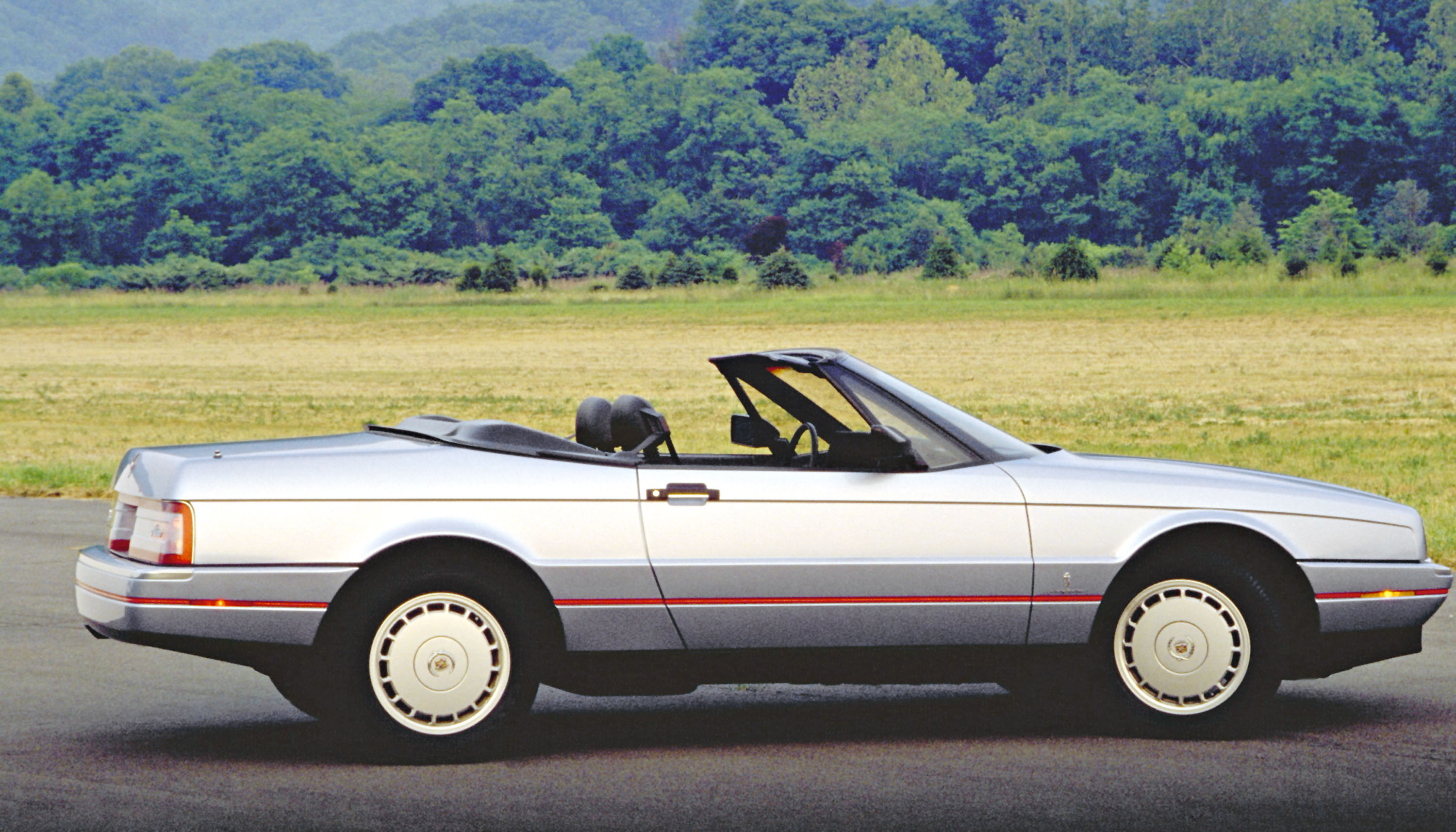
1989 Cadillac Allanté convertible

(talking with a loyal and enthusiastic Allanté owner at the AACA Annual Meeting in 2014 inspired me to write this entry about the last of the 1980s Allantés)

“The only way to travel is Cadillac Style.”

For 1989, the Cadillac Allanté received its first engine upgrade, moving from the 4.1 liter/249 ci HT-4100 V8 to the 4.5 liter/273 ci HT-4500 V8 but remaining connected to the 4T60 4-speed automatic transmission. Power climbed 30 bhp to an even 200 bhp while acceleration improved to about 8.0 seconds to 60 mph with a claimed top speed of 134 mph (probably with the aluminum top on) for Dave Hill’s baby. Mileage declined slightly to 15 city/23 highway by the standards of the day (14/21 by today’s standards. With a 21.9-gallon fuel tank, an Allanté driver could expect a range of 345 to 375 miles with a 10% fuel reserve.

Other changes for 1989 included a new Light Blue Metallic exterior color, new 16 x 7 inch wheels, and a new seat design.

1989 Cadillac Allante
1989 Cadillac Allanté, courtesy of the GM Media Archives

For 1989, the Allanté’s base price remained non-trivial: $57,183 (about $153,400 in 2025 dollars) for the 3,296 buyers. However, just about everything came standard, including ABS, traction control, Goodyear Eagle P225/55VR16 tires (a size still readily available) on 16-inch forged aluminum performance wheels, and the aluminum hard top/cloth convertible top combination. The interior included 10-way leather-covered Recaro bucket seats, electronic climate control, and Symphony Sound System AM/FM stereo with a cassette player. Because it was a Cadillac, you also got air conditioning, power steering, power windows, and power door locks. You could choose either an analog or a digital instrument cluster at no extra charge.

The View From 2025

Allantés have a good club following and consistently appear in the Hemmings Motor News classifieds, on eBay Motors, and on Bring a Trailer. According to Hagerty’s valuation tools, a 1989 Allanté in #1/Concours condition is $23,500, with a far more typical #3/Good car going for $6,700. As I update this blog entry in July 2025, there’s a Pearl White Allanté with a Burgundy interior with 111,000 miles for sale on Hemmings, asking $16,500.

I think the Allanté body style (by Pininfarina, of course) has aged well. It certainly still looks like nothing else on the road—which was definitely one of Cadillac’s goals.

Make mine Pearl White, please.

Last updated July 2025.

1989 Mercedes-Benz 560SL convertible

560SLs were a notable presence in the January 2014 auctions at Scottsdale and Kissimmee, so I decided to finally post this short entry on the last of third-generation SLs.

“Engineered like no other car in the world”

The 1989 Mercedes-Benz 560SL marked the end of the R107 generation that had begun way back in 1972 with the 450SL. There had been a moderate restyling for 1986, but the basic bones were definitely aged.

Motive power was provided by a Bosch fuel injected 227 bhp 5.5 liter/338 ci V8 connected to a four-speed automatic transmission. Mileage wasn’t exactly great for the 3,700-pound car—the ratings of the day were 14 city mpg/17 highway (adding a $1,300 gas guzzler tax to every vehicle), by today’s standards that would be 12 city/16 highway. With the 22.5-gallon gas tank, 560SL owners could expect a range of between 280 and 315 miles with a 10% fuel reserve. 0-60 did come in about 7 seconds, but the 560SL was closer to a muscle car than to a sports car.

Philips light bulb advertisement featuring 1989 Mercedes-Benz 560SL
Philips light bulb advertisement featuring the 1989 Mercedes-Benz 560SL

The base price for 1989 was $64,230 (about $172,400 in today’s dollars). For your money, you got a plethora of standard equipment. Standard exterior and mechanical features included power assisted steering, anti-lock braking system, and power assisted four wheel disc brakes, and light alloy wheels. Inside, leather upholstery, a driver’s side air bag, cruise control, automatic climate control, central locking, electrically operated windows, an electronic AM and FM stereo radio with cassette player, and (of course) a first aid kit were included. About 8,300 buyers took home this last of the line example.

The View From 2025

There is decent club support for the 560SL, as there is for almost all Mercedes-Benz’s. 560SLs maintain a substantial presence in the Hemming’s Motor News classifieds, on eBay Motors, and on Bring a Trailer. As I updated this blog post in August 2025, there were 83 available on Hemmings, including 22 of the 1989 models. According to Hagerty’s valuation tools, all the money for a 1989 560SL in #1/Concours condition is an astounding $153,000, while a more normal #3/Good condition car goes for $24,400.

Make mine Astral Silver Metallic, please.

Other Mercedes-Benz models I have written about included the 1980 450SL convertible, the 1981 380 SEL sedan, the 1985 380SL convertible, the 1985 300SD coupe, and the 1986 560SEC coupe.

Last updated August 2025.