
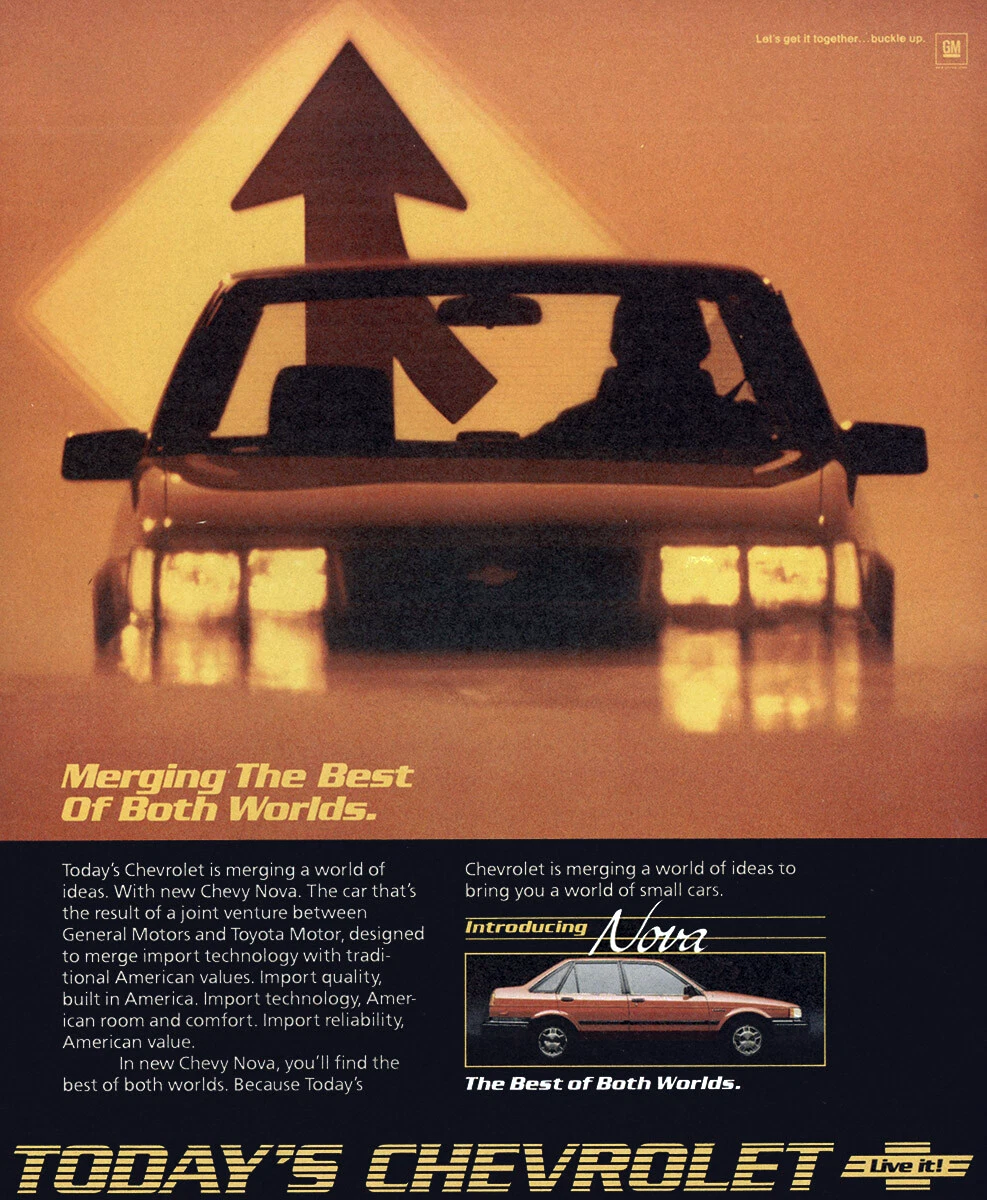
“Merging the best of both worlds.”
After a soft rollout in the Midwest in early 1985, 1986 was the first full model year for the fifth-generation Chevrolet Nova sedan, which was built in the New United Motor Manufacturing Incorporated (NUMMI) plant in Fremont, California—a collaboration between General Motors and Toyota. Of course, these front-wheel-drive Novas had nothing to do with the previous four rear-wheel-drive generations, the last of which had been seen in the 1979 model year.
The new Nova was a rebadged and mildly restyled version of the Japanese market Toyota Sprinter, itself a model sold in Japan as a badge-engineered version of the Toyota Corolla. The pre-existing design was chosen over a clean-sheet approach because it could be brought to market more quickly.
The Nova’s standard powertrain was the 4-AC 70 bhp 1.6 liter/97 ci inline four with a two-barrel carburetor paired with a five-speed manual. A three-speed automatic was optional. Car and Driver recorded a 0-60 time of 12.4 seconds with the manual in a car with a 2,260-pound curb weight—edging toward slow by 1986. Mileage ratings with the manual were 30 city/37 highway by the day’s standards (26/33 by today’s measures). As was normal in the eighties, the automatic gave up some mileage—off two mpg in the city and five mpg on the highway. With a 13.2-gallon gas tank, the owner of a manual Nova could expect a range of 355 to 395 miles with a 10% fuel reserve.
The Nova sedan’s price was $7,435—about $22,700 in 2025 dollars or slightly over what a 2025 Chevrolet Trax LS compact crossover SUV goes for. Standard exterior and mechanical equipment included tinted glass, narrow black body side moldings, front wheel drive, rack-and-pinion steering, power front disk/rear drum brakes, and P155/80R13 all-season steel-belted radial tires (a size still available courtesy of Kumho) on 13-inch wheels with a wheel center cap. Inside, reclining front seats with adjustable head restraints, cloth and vinyl seat trim, cut-pile carpeting, a full length console, side window defoggers, and an AM radio were included.
The Nova CL sedan added a wide body side molding and half-cap wheel covers. Inside, all CLs had a Custom Cloth interior, a driver’s seat with lumbar support and vertical adjustment, a console with a storage box and an armrest, a right-side visor vanity mirror, and an adjustable steering wheel.
Option Packages, Period Reviews, & Production Numbers
The 1986 Nova’s configurability was described mainly by eight separate packages, half of them manual and half automatic:
- Base Package 1 was the base sedan
- Base Package 2 ($610) added the three-speed automatic, left-hand remote and right-hand manual outside mirrors, and power steering
- Base Package 3 ($1,180) added halogen high and low beam headlamps, left-hand remote and right-hand manual outside mirrors, power steering, air conditioning, an electric rear window defogger, and an electronically-tuned AM/FM stereo radio with seek/scan and a digital clock to the base sedan
- Base Package 4 ($1,575) added halogen high and low beam headlamps, air conditioning, an electric rear window defogger, and an electronically-tuned AM/FM stereo radio with seek/scan and a digital clock to Base Package 2
- CL Package 5 ($1,730) added halogen high and low beam headlamps, left-hand remote and right-hand manual outside mirrors, power steering, air conditioning, an electric rear window defogger, and an electronically-tuned AM/FM stereo radio with seek/scan and a digital clock to the CL sedan
- CL Package 6 ($2,125) added the three-speed automatic, halogen high and low beam headlamps, left-hand remote and right-hand manual outside mirrors, power steering, air conditioning, an electric rear window defogger, and an electronically-tuned AM/FM stereo radio with seek/scan and a digital clock to the CL sedan
- CL Package 7 ($2,515) was the sportiest of the Novas and added P175/70R-13 all-season steel belted radial ply blackwall tires, aluminum wheels, electronic speed control with resume speed, an intermittent windshield washer system, and an electronically-tuned AM/FM stereo radio with seek/scan, stereo cassette tape, and a digital clock to CL Package 5
- CL Package 8 ($2,620) was the most luxurious Nova and added a power door lock system, electronic speed control with resume speed, an intermittent windshield washer system, and an electronically-tuned AM/FM stereo radio with seek/scan, stereo cassette tape, and a digital clock to CL Package 6
The Nova’s only individual option was Two-Tone paint ($176), which was only available with the CL. The absolute fanciest CL sedan retailed for $10,231—about $30,500 in today’s dollars, which is about what a well-equipped 2025 Chevrolet Trailblazer LT compact crossover SUV goes for.
Period reviews freely acknowledged that the Nova was basically a rebadged Corolla. Road & Track‘s tagline was “we have met the enemy, and they is us”—another repackaging of Walt Kelly. Motor Trend stated that the Nova was the “latest installment in the ongoing serial of “If you can’t beat ’em, join ’em.”” Popular Mechanics got more personal and asked, “Can a Japanese car built in California find happiness in America?”
Chevrolet sold 124,961 Nova sedans in the 1986 model year, in addition to the 27,943 that had been sold in the 1985 soft rollout. Predictably, the quality of the Nova was considerably higher than that of any other Chevrolet compact car.
The View From 2025
Some call them “Toyolets,” but I’m going to declare this version of the Nova as vanished. I haven’t seen a fifth-generation Nova in the wild for decades, and they have little presence in the Hemmings Motor News classifieds or on eBay Motors. Bring a Trailer has sold a grand total of one—a 1987 sedan.
Make mine Dark Red Metallic, please.
Other 1986 Chevrolets I have written about include the Camaro Berlinetta hatchback coupe, the Cavalier Z24 coupe, and the Corvette convertible.

 Eighties Cars