
For the 1983 model year, the Delco-GM/Bose Music System became available for the Buick Riviera coupe, the Cadillac Eldorado coupe, the Cadillac Seville sedan, and the Oldsmobile Toronado coupe. The industry’s first custom-engineered, factory-installed sound systems, “the Bose” marked the first time that an audiophile (or someone who aspired to be one) wouldn’t automatically remove the factory stereo, call a local car stereo installer, and order something from Crutchfield upon vehicle delivery.
Most higher-end automotive stereo systems of the day combined various high-quality components and hoped to generate good sound from them. Instead, the Delco/Bose alliance developed both the imaging and the equalization via iterative testing specific to each make and model. Interestingly, the equalization between fairly close platform-mates varied considerably—seemingly minor details in the three different coupes’ interiors made a significant difference.
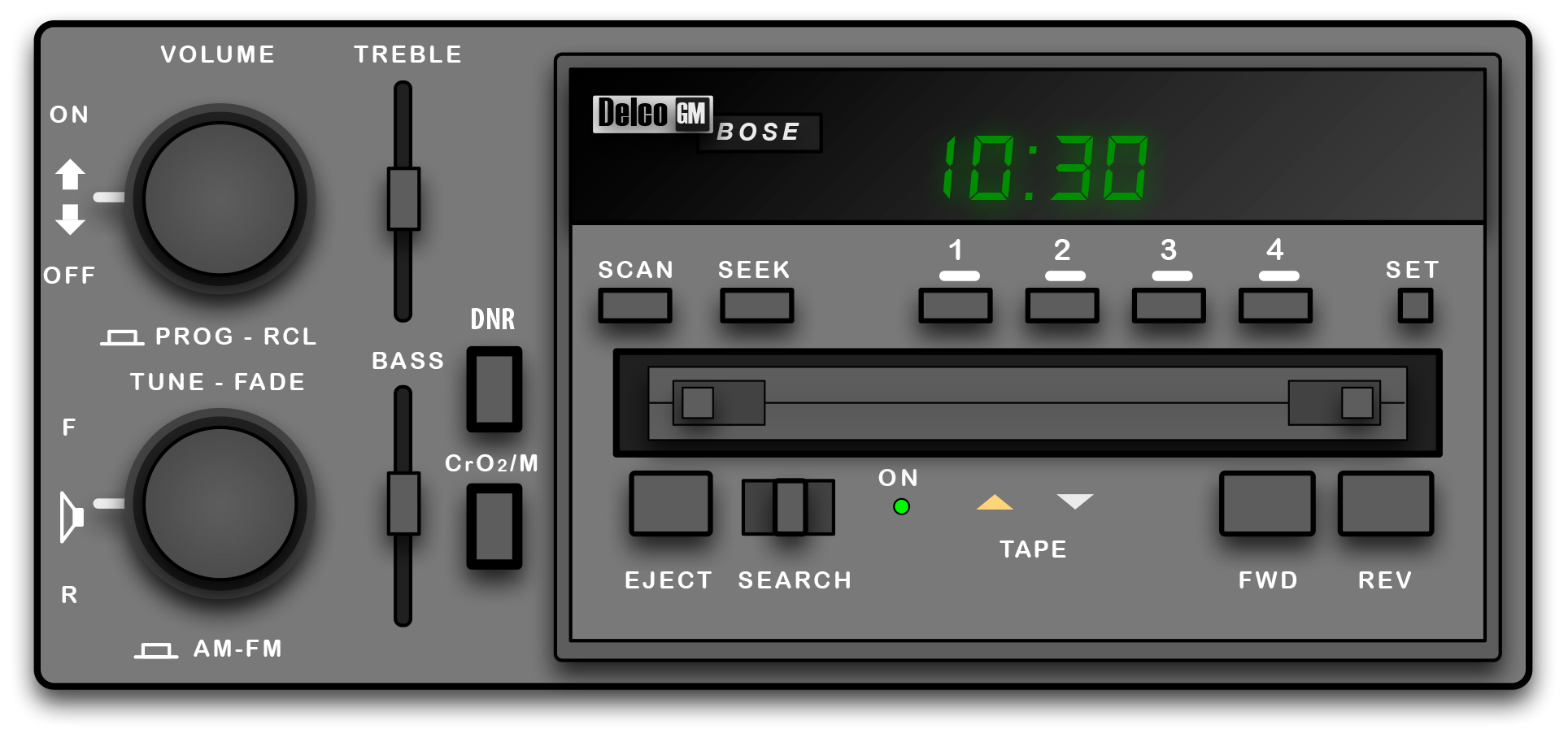
The Bose’s two main differentiators were excellent sound imaging for the two front passengers and individual equalization for each of the four speakers, each with its own 25-watt amplifier. The system’s head unit looked basic, with fewer controls than some lesser Delco systems—something not typical in the 1980s, where higher-end systems (either in the home or auto) usually had more buttons, dials, and sliders. There was no balance control (having one would mess with what Bose saw as the all-important imaging) and no graphic equalizer.
We’re spoiled in the 2020s, where almost every mid-range car stereo leaves little to be desired, but this was not always the case. Reviews of the Delco-GM/Bose Music System from nearly every source were astoundingly good. Some mainstream home audio magazines devoted several pages each to discussing the fantastic new car stereo. The June 1983 issue of Stereo Review even included a sneak peek of the Bose in the 1984 Corvette, with their finishing sentence being, “That’s some car!—and that’s some car stereo!” Depending on the specific model, 15% to 25% of buyers ordered the expensive ($895) new stereo system—a significantly higher take rate than General Motors had expected.
Of course, there were no Corvettes for the 1983 model year. Chevrolet’s incredibly cheesy introduction commercial for the 1984 Corvette—”You’ve Never Seen … Anything … Like This Before”—explicitly referenced the Bose, with a breathless voiceover mentioning “four never-before speakers separately engineered for sound that is out of this world.” In this case, Chevrolet was actually close to the truth: 1984’s Delco-GM/Bose Music System was light years ahead of the 1982 Corvette’s top-of-the-line UN6 Delco ETR AM/FM stereo radio with cassette player and CB—and only a little more expensive.
When the C4 Corvette did appear in early 1983 as a 1984 model, its take rate for the Delco-GM/Bose Music System (RPO UU8) was an astounding 85%. Some Chevrolet dealers found they could not sell a Corvette if it didn’t have the music system, which was the single most expensive option available on the all-new car.
For the rest of the decade, the take rate for the Bose in the Corvette remained very high, ranging from 89% (1988) to 93% (1986). Pricing edged up to $905 in 1987 and then dropped to $773 in 1988. By 1988, the radio delete option was gone from the Corvette’s RPO list.
Among the many GM cars from the eighties I have written about that offered the Bose include the 1984 Buick Riviera T Type coupe, the 1984 Chevrolet Corvette hatchback coupe, the 1985 Buick Electra sedan, the 1985 Buick Somerset Regal coupe, the 1986 Cadillac Eldorado coupe, the 1986 Chevrolet Corvette convertible, the 1988 Chevrolet Corvette 35th Anniversary Edition hatchback coupe, the 1987 Oldsmobile Delta 88 Brougham coupe, the 1988 Cadillac Eldorado coupe, and the 1989 Buick Electra Park Avenue Ultra sedan. By the late eighties, the Bose brand name was also showing up in other cars, such as the 1989 Nissan Maxima sedan.
Most material in this blog entry was sourced from the unfinished Riviera Project. I have also written about Alpine‘s eighties car stereos.

 Eighties Cars