
“Drive your Futura of tomorrow … today.”
1980 model year changes to Ford’s Fairmont Futura coupe included new engine choices and a new Tu-Tone paint treatment. Newly standard were P-metric steel-belted radial ply tires, high-illumination halogen headlamps, and a maintenance-free battery.
The Fairmont was the first of the Fox platforms to make it to market. Initially available for the 1978 model year, it replaced the Maverick as Ford’s compact offering. The Futura coupe’s distinctive wrapover B-pillar design came from a March 1976 Fairmont-based Thunderbird proposal.
Ford had been using the Fairmont name for a while by 1978—Ford of Australia had first used it in 1965. The Futura name was even older, dating back to a Lincoln concept car designed in 1954 and debuting as a higher-trim model of the Falcon in 1961.
Powertrains, Performance, & Standard Equipment
The Fairmont Futura’s standard engine was the Lima 88 bhp 2.3 liter/140 ci inline four with a two-barrel carburetor. The Thriftpower 91 bhp 3.3 liter/200 ci inline six with a one-barrel carburetor ($169) was available, and had 36% more torque than the four. A Windsor 119 bhp 4.2 liter/255 ci V8 with a two-barrel carburetor ($288) was also available—a substantial downgrade from the 139 bhp 4.9 liter/302 ci engine that had been available in 1978 and 1979.
There was once some argument, but it now seems reasonably clear that some Futuras were built with the heavily advertised turbocharged four ($481). This engine was rated at 120 bhp and included a prominent hood bulge with Turbo insignia. Reliability must not have met Ford’s expectations, because the turbocharged four didn’t make it to the 1981 model year.
A four-speed manual was standard with the base 2.3 liter inline four, while a four-speed manual with overdrive was standard with the 3.3 liter inline six. A SelectShift three-speed automatic ($340) was required with the turbocharged four and the V8, and optional for the two other engines.
Performance wasn’t great, but few domestic competitors were much better. Road & Track clocked a 15.8-second 0-60 time with the base powertrain. Best-case times with either the turbo four or the V8 were probably about two seconds better, but a Futura driver wasn’t looking to go racing.
Fuel economy ratings with the base powertrain were impressive: 28 city/38 highway by the day’s standards. The far more common 3.3 liter six/automatic combination was 20/27, with the V8 getting 18/26. The turbo came in at 19/26. With a 14-gallon fuel tank, Fairmont buyers with the 3.3 liter six and the automatic could expect a range of 270 to 295 miles.
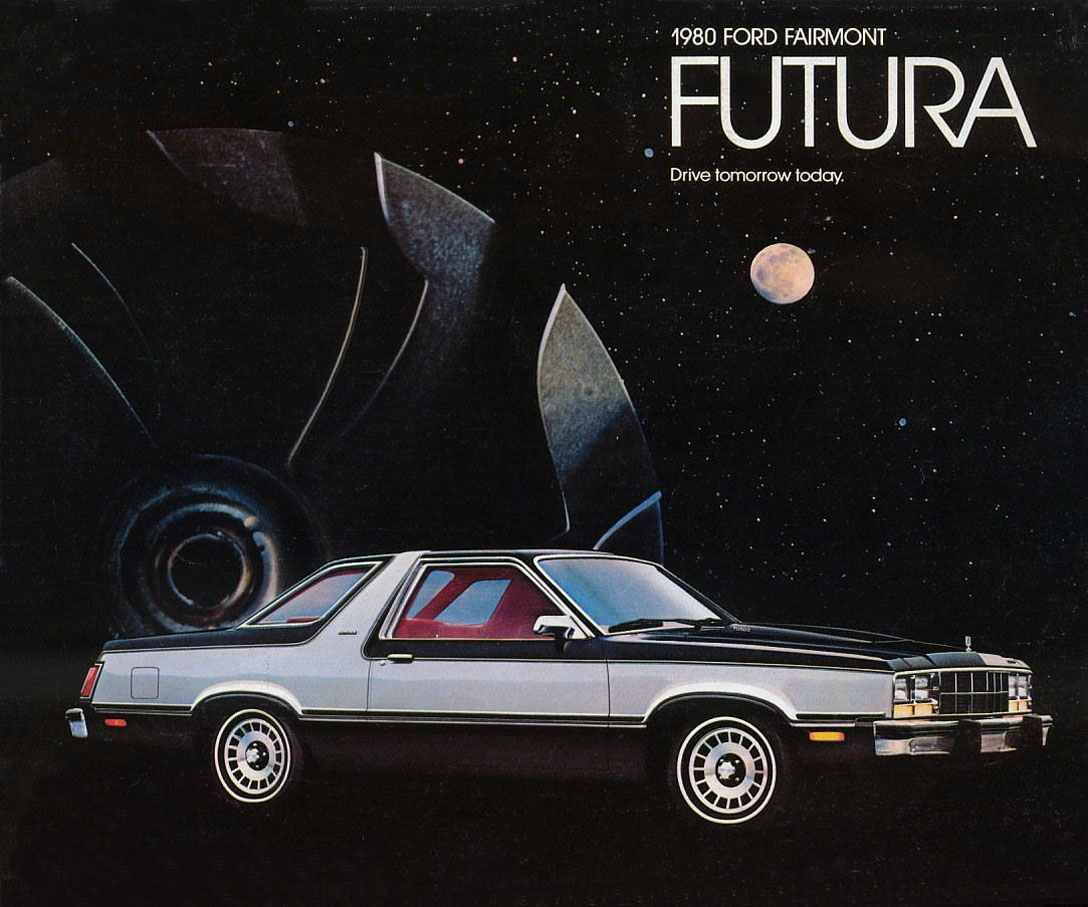
The Fairmont Futura coupe’s base price was $5,531—$23,500 in today’s dollars. Standard exterior and mechanical equipment included dual rectangular halogen headlamps, wraparound taillamps, rack and pinion steering, front disc/rear drum brakes, and P-metric 14-inch black sidewall radial-ply radial tires on 14-inch wheels with Deluxe wheel covers. Inside, accent vinyl low-back front bucket seats and a Deluxe steering wheel hub were included.
Some of the Futura‘s standard interiors depended on the engine and transmission chosen. Buyers of the base 2.3 liter four with the four-speed manual and the turbocharged four with the automatic got low-back front bucket seats in pebble-grain vinyl. Buyers of the 3.3 liter six with the manual and the V8 with the automatic got a bench seat.
Packages, Options, & Production Numbers
The Ghia package ($193) included dual remote-control mirrors, a Ghia badge, plush cut-pile carpeting, a carpeted trunk, a Luxury steering wheel, a glove box lock, sun visors, and a right hand visor vanity mirror. Ghia buyers got a Flight Bench seat in either Luxury velour cloth or pebble-grain vinyl if they chose an automatic transmission, or bucket seats with the four-speed manual.
The Sports group ($114) included an over-the-roof tape stripe, color-keyed turbine wheel covers, and a charcoal/argent grille.
Individual exterior and mechanical options included power front disc brakes ($78) and power steering ($165). Inside, air conditioning ($671), a tilt steering wheel ($78), fingertip speed control ($116), power side windows ($135), and power door locks ($88) were available.
Ford produced 51,878 Futura coupes in 1980, making up 16% of overall Fairmont production in a year where overall Ford sales were down. 1,158 Fairmonts were turbos.
The View From 2025
It is striking both how many Fairmont versions there were and how much effort Ford put into marketing the Futura. Ford presented six versions of the Fairmont:
- a 2-door sedan, which had a normal roofline and looked much plainer than the Futura
- a 4-door sedan
- the Futura coupe
- the Futura sedan, which joined mid-year and had the same grille and many of the same features as the Futura coupe
- a 4-door wagon
- a Squire-branded 4-door wagon with woodgrain vinyl
Though the Futura got two full pages in the Fairmont brochure, Ford also made an eight-page Futura-specific brochure available.
Fairmont Futuras are not often seen for sale in any venue. AutoTrader Classic has an occasional Fairmont, while Bring a Trailer has sold a grand total of one Fairmont overall—a wagon. The word Fairmont appears in the Hemmings Motor News classifieds more as a component (of Model A replicas, for example) than a vehicle. One exception to this lack of sales visibility came in January 2024, when Barrett-Jackson auctioned a 1978 Ford Futura coupe for a $34,000 hammer price—it was the 100,000,000 U.S.-built Ford vehicle.
Make mine Candyapple Red, please.
Other 1980 Fords I have written about include the F-150 pickup truck, the Fiesta hatchback coupe, the Mustang Cobra hatchback coupe, and the Thunderbird coupe. I evidently do not write about a lot of Ford sedans.

 Eighties Cars