
“A car befitting its illustrious heritage”
For 1980, Lincoln completely revised the Continental Mark series, downsizing it for the first time and adding a sedan. The coupe was over 14 inches shorter than the 1979 Mark V and about 750 pounds lighter. However, the Mark VI was still a big car by any standard—more than two feet longer than a 2025 Mercedes-Benz CLE coupe.
Standard power for 1980 was a Windsor 129 bhp 4.9 liter/302 ci V8 with throttle-body fuel injection paired with a four-speed automatic overdrive transmission. Buyers could specify a $160 upgrade, which was the Windsor (not Cleveland) 140 bhp 5.8 liter/351 ci V8 with a Motorcraft 7200 VV two-barrel carburetor. With the standard powertrain, 0-60 took about 14 seconds in the 3,892-pound car. Mileage was 17 city/24 highway by the day’s standards—with the 18-gallon gas tank, Mark VI owners could expect a range of 300 to 330 miles with a 10% fuel reserve.
Standard exterior and mechanical equipment on the $16,291 base Mark VI ($70,200 in today’s dollars or a little over what a 2025 Lincoln Aviator Reserve mid-size SUV costs) included hidden halogen headlamps, luxury wheel covers, and Michelin P205/75R15 white sidewall steel-belted radial tires (a size still readily available) on 15-inch wheels. Inside, cloth Twin Comfort lounge seats, power windows, an electronic instrument panel with message center, a four-spoke color-keyed steering wheel, automatic temperature control air conditioning, and an AM/FM stereo radio with power antenna were all standard.
Packages, Options, & Production Numbers
As had been true for many years, there were multiple Designer Series packages available for the Mark VI:
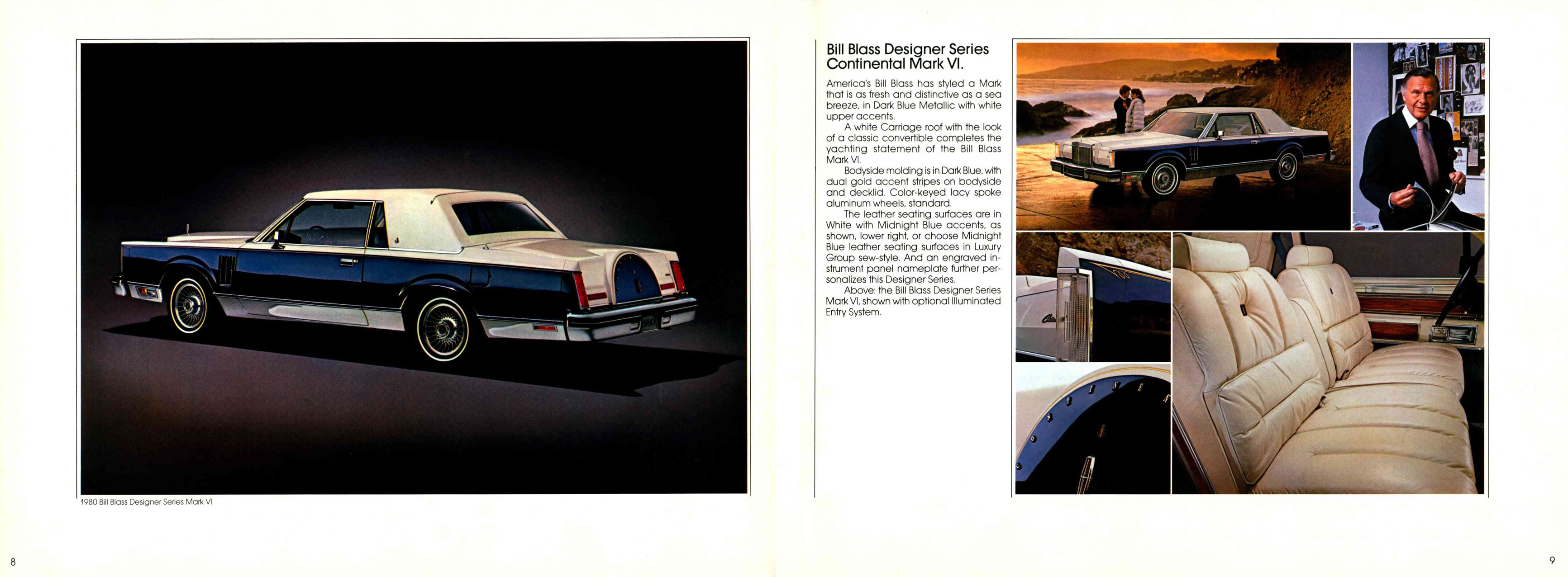
- The Bill Blass Designer Series package ($1,825) included Dark Blue Metallic paint with white upper accents, a white Carriage roof, dark blue bodyside moldings, dual gold accent stripes on bodyside and decklid, and color-keyed lacy spoke aluminum wheels. Inside, leather seating surfaces were a choice of white with blue accents or midnight blue in the Luxury Group sew-style.
- The Cartier Designer Series package ($2,191) included Light Pewter Metallic/Medium Pewter Metallic two-tone paint, a Medium Pewter Landau roof, color-keyed turbine spoke aluminum wheels, light pewter bodyside moldings, single dark red accent stripes on the body and decklid, the Cartier signature in the opera windows, and the Cartier monogram on logo on the front fender louvers and the decklid. Inside, there was a choice of either cloth or leather seating surfaces in the Luxury Group sew-style.
- The Givenchy Designer Series package ($1,739) included Light Fawn Metallic/Bittersweet Metallic two-tone paint, with tri-band pinstriping, a Light Fawn full vinyl roof, wire wheel covers, and the Givenchy monogram on the hood and the rear decklid. Inside, the Givenchy had bittersweet six-way power Twin Comfort seats in the Luxury Group sew-style.
- The Pucci Designer Series package ($2,191) included Light Fawn Metallic/Medium Fawn Metallic two-tone paint, with tri-band pinstriping, a Light Fawn Landau roof, color-keyed lacy spoke aluminum wheels, and the Pucci logo on the front fender louvers and the decklid. Inside, leather seating surfaces had light champagne bolsters with medium champagne inserts in the Luxury Group sew-style.
—all four Designers Series packages included a personalized engraved nameplate on the instrument panel.
There was also the Signature Series ($5,485), which added just about every major option and brought the price to $21,776 (about $93,800 in 2025 dollars). Standard exterior and mechanical features on the Signature Series included a Valino grain vinyl Landau roof and color-keyed turbine spoke cast aluminum wheels. Inside, the Signature Series included Twin Comfort Lounge six-way power seats, the Keyless Entry System, an Automatic Garage Door Opener Control, Speed Control, a tilt steering wheel, the defroster group, illuminated visor vanity mirrors, and a six-speaker Premium Sound System. The Signature Series was available in Silver Metallic or Dark Maroon and could be ordered with Dark Red Signature Body Cloth or leather seating surfaces.
Individual options included touring lamps ($67), a power glass moonroof, wide white sidewall tires, Twin Comfort Lounge six-way power seats ($171), a tilt steering wheel ($83), and Speed Control ($149).
Like the Ford Thunderbird of the same year, the 1980 Continental Mark VI did not sell. Sales of the coupe dropped to 27% of the 1979 number—even if you added the newly available sedan, they were still down 49%; not a good look for a brand-new model. To make the news worse, the virtually unchanged Cadillac Eldorado (which had been downsized in 1979) more than doubled the Mark VI coupe’s sales. The agony would continue for several years, only changing with the release of the aerodynamic and significantly smaller Mark VII in 1984.
The View From 2025
According to Hagerty’s valuation tools, a 1980 Continental Mark VI coupe in #1/Concours condition is $23,000, with a far more typical #3/Good car going for $6,300. Values slide up with the various Designer Series packages and the Signature Series, but only by about 5% to 10%. This generation of Marks maintains some presence in the Hemmings Motor News classifieds, on eBay Motors, and on Bring a Trailer. As I update this blog entry in October 2025, there’s a French Vanilla Metallic 1982 coupe with a black vinyl roof, midnight blue leather seats, and 11,000 miles for sale on Hemmings, asking $11,000.
Make mine Dark Maroon, please.
Other Lincolns I have written about include the 1984 Continental Mark VII LSC coupe, the 1986 Mark VII coupe, the 1987 Continental sedan, and the 1989 Town Car sedan.
Last updated October 2025.

 Eighties Cars