
“Soul Survivor”
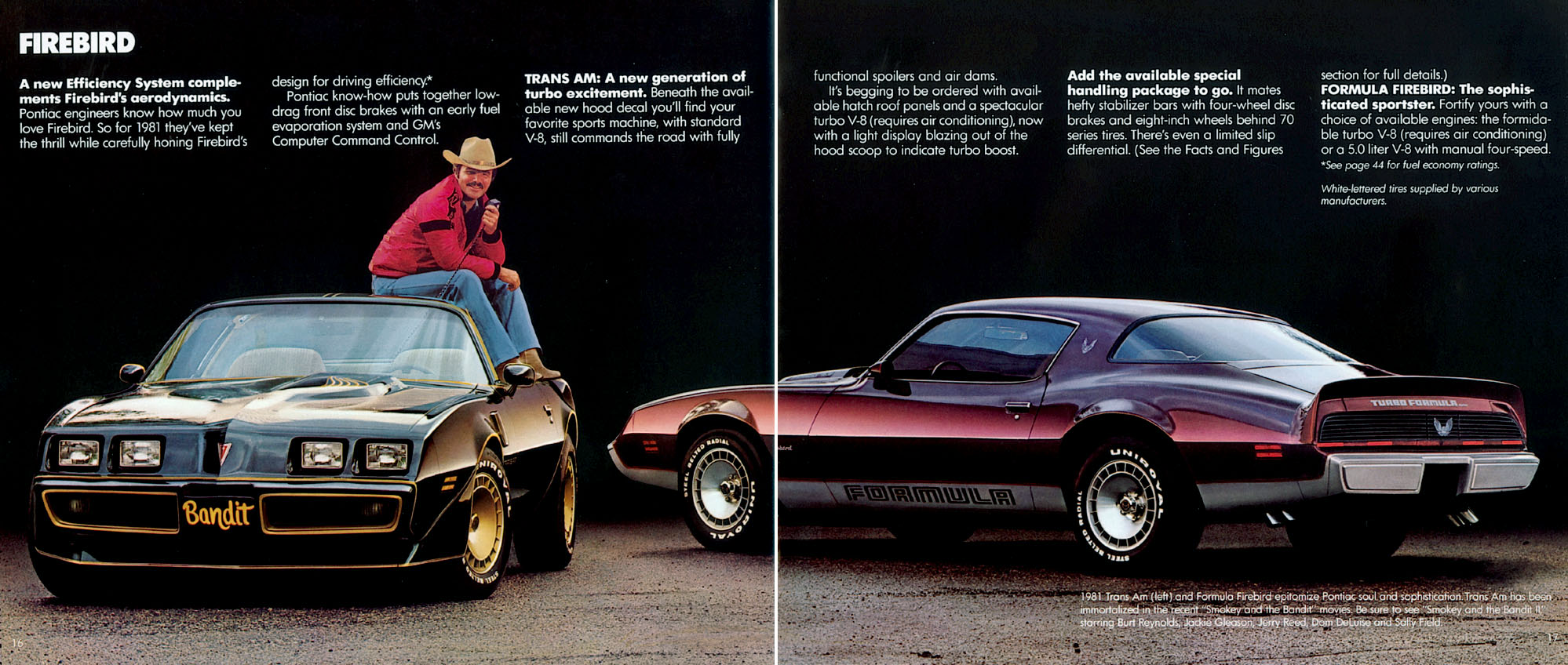
1981 was the last year for the second-generation Firebird and, thus, also the final year for the second-generation Trans Am. With the third-generation cars on the way, Pontiac’s eleven-year-old F-car received only minor changes. The “screaming chicken” decal on the hood was now two colors, compared to the four-color decal from 1979 and 1980. Not much could be done about the general lack of space efficiency (the EPA rated the Firebird as a subcompact car), the high curb weight (about 3,700 pounds when the Mustang weighed about 2,800), and the relatively primitive technology.
Engines & Transmissions
The standard Trans Am powertrain was the Pontiac-built L37 150 bhp 4.9 liter/301 ci V8 with a four-barrel carburetor paired with a three-speed automatic. The only choice for Trans Am purchasers who wanted a manual transmission was the Chevrolet-built LG4 145 bhp 5.0 liter/305 ci V8 with a four-barrel carburetor, but you did get a $147 credit.
The top engine was the $437 Pontiac-built LU8 200 bhp 4.9 liter/301 ci V8 with a four-barrel carburetor and an AiResearch turbocharger, which also added a hood-mounted boost gauge. The turbo engine was emissions-certified only with the combination of air conditioning, an automatic transmission, and a 3.08:1 ratio rear axle. For a period of time during the 1981 model year, Pontiac also required rear disc brakes and a limited-slip differential to get that turbo power.
Combining a turbocharger, carburetors, and primitive electronic engine controls was not easy, and reviews of one of the world’s first turbo V8’s were mixed. The relatively primitive gas of the day meant that Pontiac had to retard spark substantially to minimize detonation, which kept the power returns of the turbocharger relatively low. As Car and Driver stated, “by the time the engine reaches 4000 rpm, the show is essentially over.”
Performance & Standard Equipment
A Turbo Trans Am would accelerate from 0-60 in a little over eight seconds (Car and Driver clocked 8.2), which was good for 1981. Fuel mileage was predictably bad—15 city/21 highway mpg by the day’s standards for the combination of the turbo engine and the automatic. With a 21-gallon fuel tank, Trans Am owners could expect to travel about 280 to 305 miles before refueling.
Standard exterior and mechanical equipment included in the $8,322 base price of the Trans Am (about $31,700 in today’s dollars) included a black accent grille and headlamp bezels, dual rectangular headlamps, front and rear wheel opening air deflectors, chrome side-splitter tailpipe extensions, a shaker hood, power front disc/rear drum brakes, power steering, and P225/70R15 blackwall tires (a size still readily available) on 15-inch Rally II wheels. Inside front bucket seats, a floor console, a bright engine-turned dash plate, and rally gauges with a tachometer were standard.
Packages & Options
The Trans Am Special Edition package was $735 additional over a base Trans Am—$1,430 bundled with the removable locking hatch roof (otherwise known as T-tops). There was also a special edition of the Special Edition—the NASCAR Daytona 500 Pace Car, resplendent in oyster white with a black and red interior. It included the LU8 turbocharged engine, the WS6 special performance package, four-wheel power disc brakes, and a limited-slip differential. Inside, the most notable upgrade from other Turbo Trans Ams was Recaro front seats—among the best available production seats from any manufacturer in 1981. All this extra content was a good thing because the NASCAR Daytona 500 Pace Car listed for $12,257—about $46,700 in 2025 dollars.
Exterior and mechanical options available for the Trans Am included the WS6 special performance package, a limited-slip differential, tungsten quartz halogen headlamps ($29), white-lettered tires, cast aluminum wheels, four-wheel power disc brakes, and an automatic power antenna ($50). Inside, an electric rear window defroster ($115), power door locks ($99), Custom air conditioning ($600), Custom bucket seats, and a host of radios (seven!) were all available.
The View From 2025

Initially neglected by the collector market and with many now used up, late second-generation Trans Ams in good or excellent shape are now getting interesting numbers—almost doubling in the past ten years. According to Hagerty’s valuation tools, all the money for a 1981 Trans Am NASCAR Daytona 500 Pace Car in #1/Concours condition is $69,300, with a more normal non-Turbo Trans Am in #3/Good condition version valued at $14,800. These Trans Ams are often available in the Hemmings Motor News classifieds, on eBay Motors, and on Bring A Trailer, and they frequently show up at in-person auctions.
Make mine the black and gold Special Edition, of course. The NASCAR Daytona 500 Pace Car is tempting, if only for those Recaro seats.
I evidently can’t help myself with eighties Trans Ams; I’ve also written about the 1982 hatchback coupe, the 1984 15th Anniversary hatchback coupe, the 1985 hatchback coupe, and the 1989 Turbo hatchback coupe. I have written about the 1986 SE hatchback coupe and the 1987 Formula hatchback coupe, but I probably should write about the base car at some point.
Last updated September 2025.

 Eighties Cars