
While out driving late in 2014, I saw an early 1980s Chrysler Imperial aggressively carving the back roads in the Philadelphia suburbs near where I live. The body design remains utterly distinctive: the alacrity with which the Imperial was moving makes me assume that it had the carburetor conversion and/or some other engine upgrade.
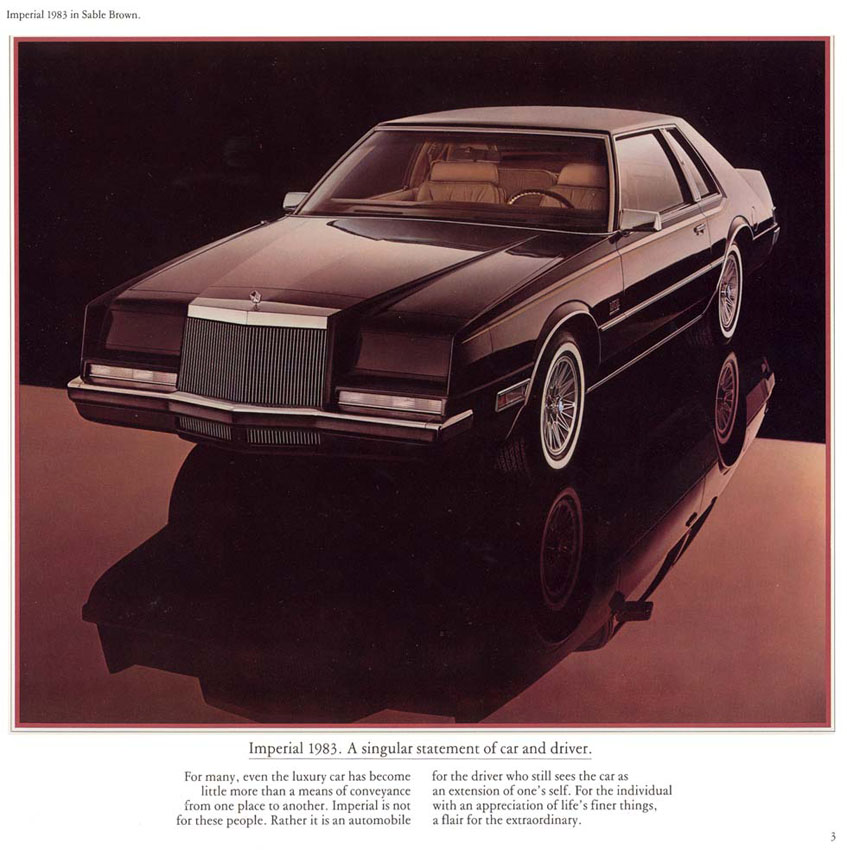
“A singular statement of car and driver.”
Chrysler introduced the “bustle back” Imperial for the 1981 model year, bringing it to market partly to reassure potential buyers that the company would remain in business. By 1983, the Cordoba-based luxury coupe was in its final year, selling a mere 1,427 units as all rear-wheel drive Chrysler products continued their decline.
For 1983, the powertrain continued to be the same: the LA 140 bhp electronic throttle-body fuel-injected 5.2 liter/318 ci V8 paired with a TorqueFlite three-speed automatic transmission. Despite notable attempts at increasing quality (each Imperial went on a five-and-a-half-mile test drive and received numerous other checks before shipping from the factory), the bleeding edge fuel injection continued to be stunningly unreliable—Chrysler frequently ended up replacing it with a carburetted system at the cost of $3,500 plus about 50 hours of labor.
Performance for the 3,900-pound coupe wasn’t impressive: 0-60 came in a little under 14 seconds. To be fair, neither the Cadillac Eldorado nor the Lincoln Continental Mark VI (the Imperial’s intended competitors) were notably faster in 1983. Fuel economy was rated at 16 city/26 highway by the day’s standards, giving a range of 305 to 340 miles with the 18-gallon gas tank and a 10% fuel reserve.
Standard mechanical equipment for the quite well-equipped for 1983 $18,688 Imperial (approximately $61,500 in today’s dollars) included halogen headlights, power brakes, power steering, cruise control, and Goodyear Arriva P205/75R15 steel-belted radial whitewall tires (a size still readily available) on cast aluminum wheels. Exterior equipment included power heated mirrors, power windows, intermittent windshield wipers, and a rear window defroster. Interior equipment included “semi-automatic” air conditioning, a tilt steering wheel, leather and vinyl 60/40 power seats, and a 30-watt AM/FM stereo with cassette and power antenna.
Unusual standard equipment for 1983 in any car included an electronic instrument cluster, a garage door opener, and a two-year/30,000-mile warranty (a lot of warranty in those unreliable days). The only extra cost option was high altitude emissions ($75—why did Chrysler cheap out at this point?); no cost options included cloth and vinyl seats, Michelin tires, and wire wheel covers. Unlike in 1981 and 1982, there was no Frank Sinatra edition for 1983.
The View From 2025
Especially from the rear, the Imperial looks a lot like Cadillac’s 1980 Seville redesign, but seems to have been a separate idea—exterior design had begun in 1977. Not surprisingly, allpar.com has an interesting and detailed article on the 1981-1983 Chrysler Imperial—it is here.
According to Hagerty’s valuation tools, a 1983 Chrysler Imperial in #1/Concours condition is $26,100, with a more normal #3/Good condition car fetching $7,600. Imperials appear in the Hemmings Motor News classifieds and very occasionally on Bring a Trailer. When I updated this entry in April 2025, a Goldenrod Crystal Coat 1982 with 111,000 miles was available on Hemmings, asking $19,800.
Make mine Formal Black, please.
Other real-wheel-drive eighties Chryslers I have written about include the 1980 Cordoba coupe, the 1981 New Yorker sedan, the 1983 Cordoba coupe, and the 1987 Fifth Avenue sedan.
Last updated September 2025.

 Eighties Cars